
History of Ballet The beginning of Dance The
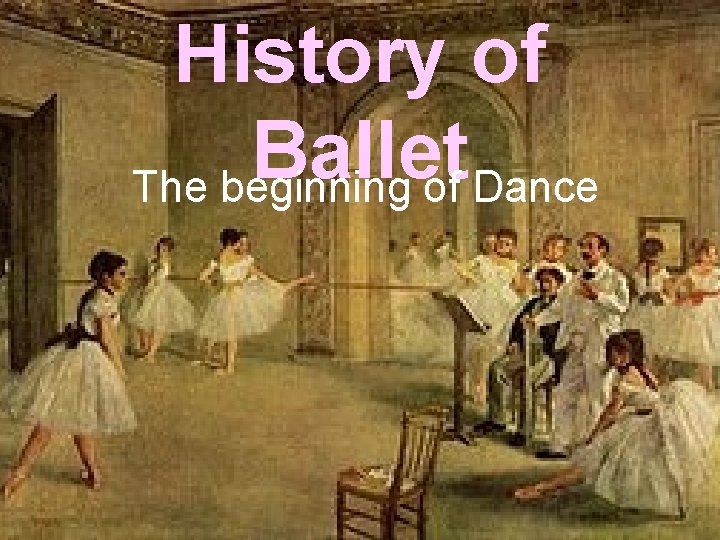
History of Ballet The beginning of Dance
The First Ballets • Lavish entertainments given in the courts of Renaissance Italy. United painting, poetry, music, and dancing A performance given in 1489 was performed between the courses of a banquet; the actions were closely related to the menu and were based on the social dances of the day. These Italian court ballets were further developed in France. Le Ballet Comique de la Reine (The Queen’s Ballet Comedy) was the first ballet with a complete score and was performed in Paris in 1581. Designed for the entertainment of the aristocracy, rich costumes, scenery, and elaborate stage effects were emphasized Professional dancers made their first appearance on the proscenium stage which was first adopted in France in the mid 1600 s.
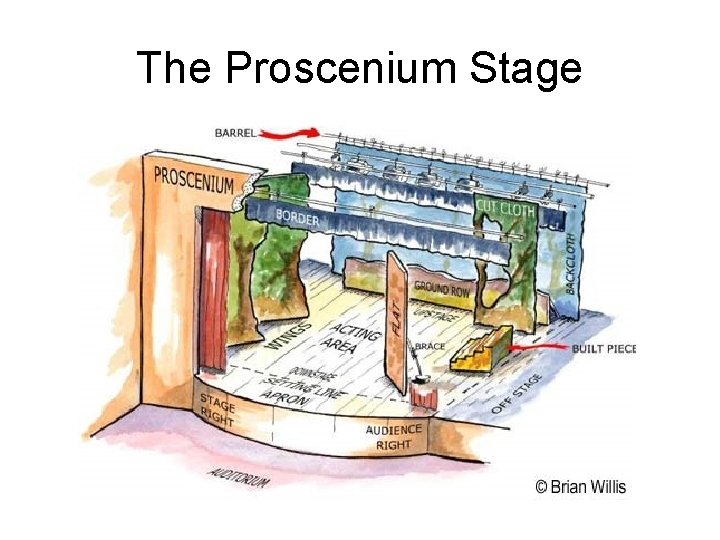
The Proscenium Stage
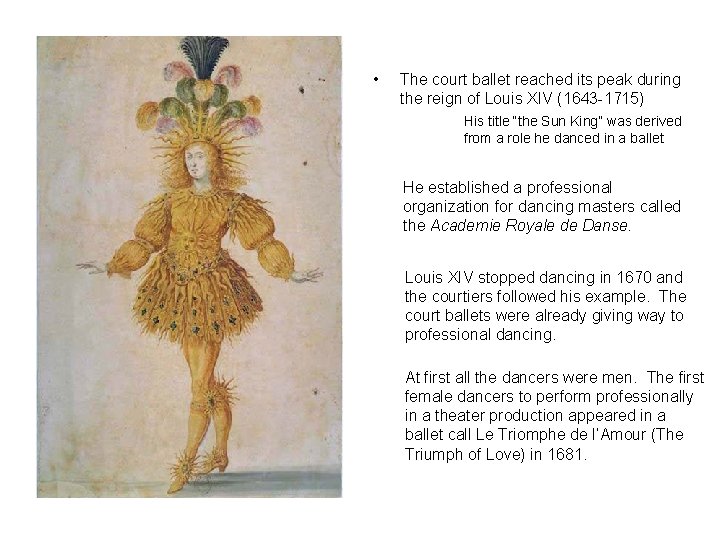
• The court ballet reached its peak during the reign of Louis XIV (1643 -1715) His title “the Sun King” was derived from a role he danced in a ballet He established a professional organization for dancing masters called the Academie Royale de Danse. Louis XIV stopped dancing in 1670 and the courtiers followed his example. The court ballets were already giving way to professional dancing. At first all the dancers were men. The first female dancers to perform professionally in a theater production appeared in a ballet call Le Triomphe de l’Amour (The Triumph of Love) in 1681.
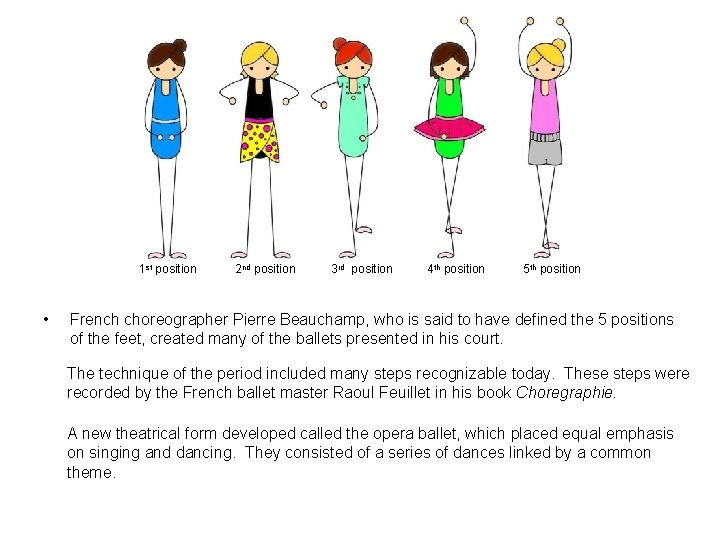
1 st position • 2 nd position 3 rd position 4 th position 5 th position French choreographer Pierre Beauchamp, who is said to have defined the 5 positions of the feet, created many of the ballets presented in his court. The technique of the period included many steps recognizable today. These steps were recorded by the French ballet master Raoul Feuillet in his book Choregraphie. A new theatrical form developed called the opera ballet, which placed equal emphasis on singing and dancing. They consisted of a series of dances linked by a common theme.

Costumes of the 18 th Century Dancers • Dancers were encumbered by masks, wigs or large headdresses and heeled shoes. Women wore panniers, hoopskirts draped at the side for fullness. Men wore the tonnelet, a knee length hoopskirt. Marie Camargo, however, shortened her skirt and adopted heelless slippers to display her sparkling jumps and beats. Her rival, Marie Sall, also broke custom when she discarded her corset and put on Greek robes to dance.
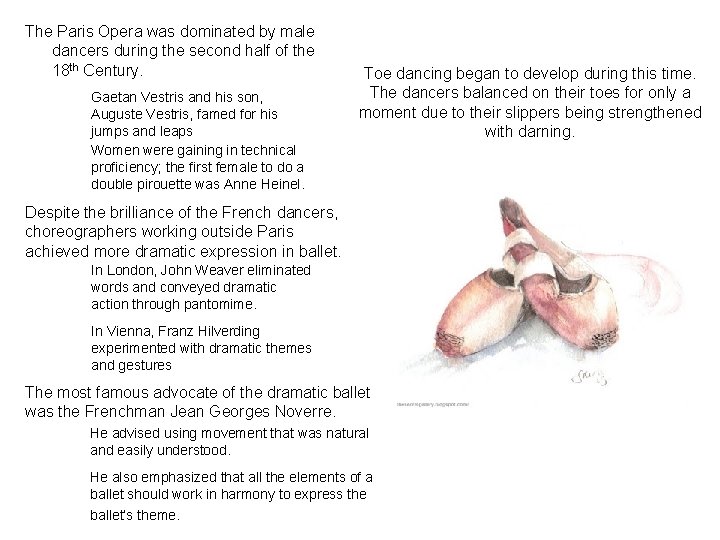
The Paris Opera was dominated by male dancers during the second half of the 18 th Century. Gaetan Vestris and his son, Auguste Vestris, famed for his jumps and leaps Women were gaining in technical proficiency; the first female to do a double pirouette was Anne Heinel. Toe dancing began to develop during this time. The dancers balanced on their toes for only a moment due to their slippers being strengthened with darning. Despite the brilliance of the French dancers, choreographers working outside Paris achieved more dramatic expression in ballet. In London, John Weaver eliminated words and conveyed dramatic action through pantomime. In Vienna, Franz Hilverding experimented with dramatic themes and gestures The most famous advocate of the dramatic ballet was the Frenchman Jean Georges Noverre. He advised using movement that was natural and easily understood. He also emphasized that all the elements of a ballet should work in harmony to express the ballet’s theme.
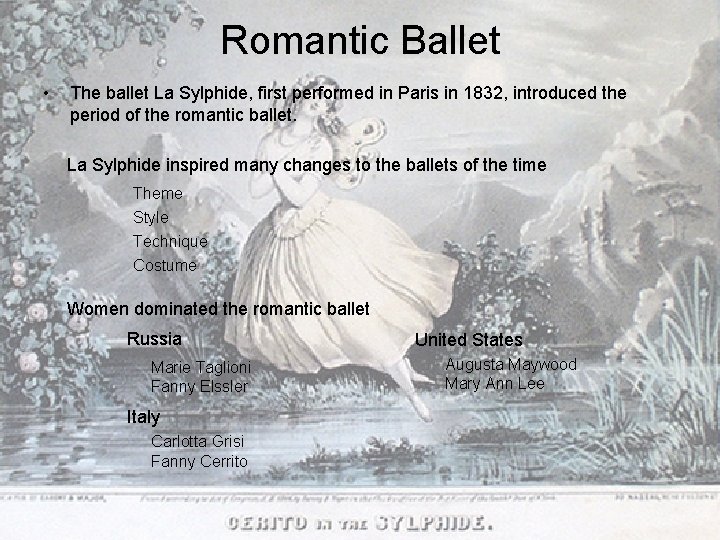
Romantic Ballet • The ballet La Sylphide, first performed in Paris in 1832, introduced the period of the romantic ballet. La Sylphide inspired many changes to the ballets of the time Theme Style Technique Costume Women dominated the romantic ballet Russia Marie Taglioni Fanny Elssler Italy Carlotta Grisi Fanny Cerrito United States Augusta Maywood Mary Ann Lee

• Ballet began to decline in Paris, but Denmark maintained the standards of the romantic ballet. Bournonville, a Danish choreographer established a system of training as well as a large body of works that are still performed by the Royal Danish Ballet. Russia also preserved the integrity of the ballet through a Frenchman, Marius Petipa, who became the chief choreographer of the Imperial Russian Ballet. Petipa perfected the full-length, evening-long story ballet that combined set dances with mimed scenes The Sleeping Beauty Swan Lake
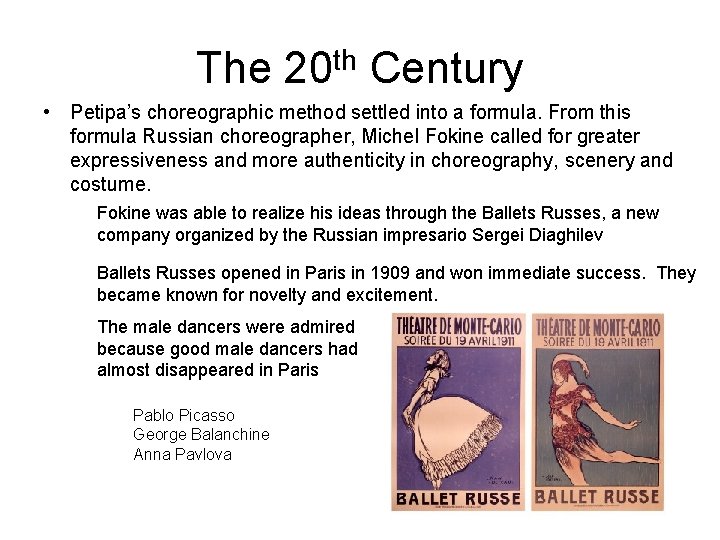
The 20 th Century • Petipa’s choreographic method settled into a formula. From this formula Russian choreographer, Michel Fokine called for greater expressiveness and more authenticity in choreography, scenery and costume. Fokine was able to realize his ideas through the Ballets Russes, a new company organized by the Russian impresario Sergei Diaghilev Ballets Russes opened in Paris in 1909 and won immediate success. They became known for novelty and excitement. The male dancers were admired because good male dancers had almost disappeared in Paris Pablo Picasso George Balanchine Anna Pavlova
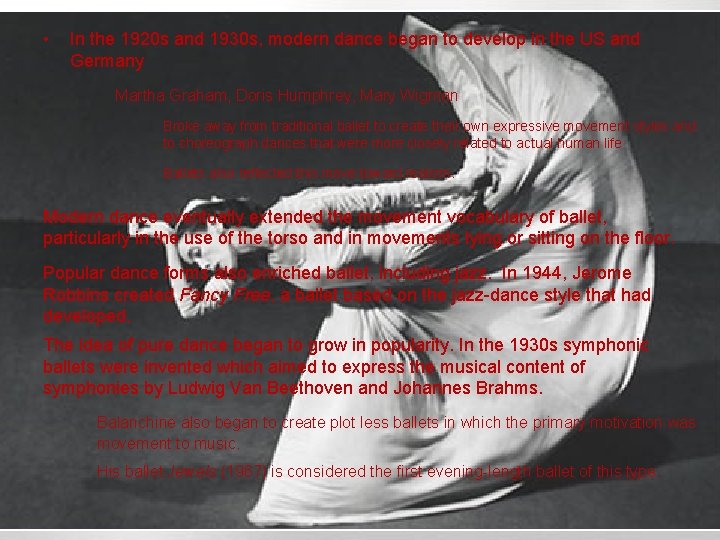
• In the 1920 s and 1930 s, modern dance began to develop in the US and Germany Martha Graham, Doris Humphrey, Mary Wigman Broke away from traditional ballet to create their own expressive movement styles and to choreograph dances that were more closely related to actual human life Ballets also reflected this move toward realism. Modern dance eventually extended the movement vocabulary of ballet, particularly in the use of the torso and in movements lying or sitting on the floor. Popular dance forms also enriched ballet, including jazz. In 1944, Jerome Robbins created Fancy Free, a ballet based on the jazz-dance style that had developed. The idea of pure dance began to grow in popularity. In the 1930 s symphonic ballets were invented which aimed to express the musical content of symphonies by Ludwig Van Beethoven and Johannes Brahms. Balanchine also began to create plot less ballets in which the primary motivation was movement to music. His ballet Jewels (1967) is considered the first evening-length ballet of this type.
Two great American ballet companies were founded in New York City in the 1940 s. American Ballet Theatre New York City Ballet The NYC Ballet drew many of its dancers from the School of American Ballet established by Balanchine in 1934. In 1956, Russian ballet companies performed in the West for the first time. The intense dramatic feeling and technical virtuosity of the Russians made a great impact and their influence on ballet continues today.
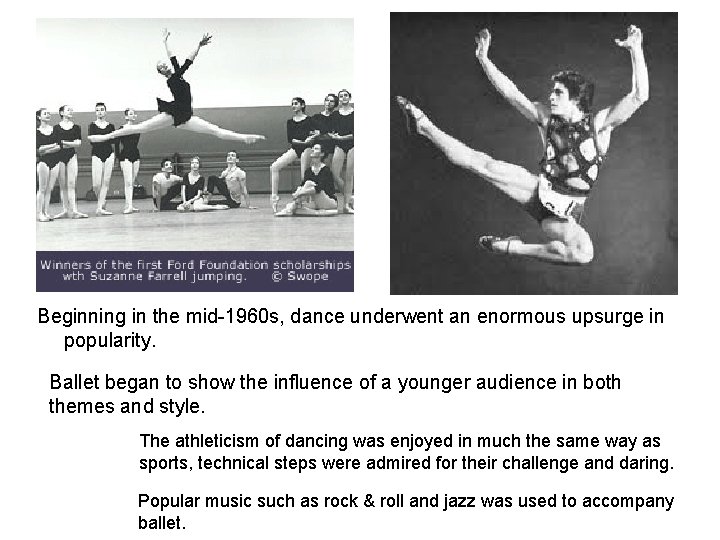
Beginning in the mid-1960 s, dance underwent an enormous upsurge in popularity. Ballet began to show the influence of a younger audience in both themes and style. The athleticism of dancing was enjoyed in much the same way as sports, technical steps were admired for their challenge and daring. Popular music such as rock & roll and jazz was used to accompany ballet.
- Slides: 13