
History of Atomic Physics 3 Quarks and Antiparticles
![The 6 Quarks, when & where… Quark Date Where Mass [Ge. V/c 2] Comment](https://slidetodoc.com/presentation_image_h2/8bf99274b167b4e72877ea4efe067a70/image-11.jpg "The 6 Quarks, when & where… Quark Date Where Mass [Ge. V/c 2] Comment")
- Slides: 26
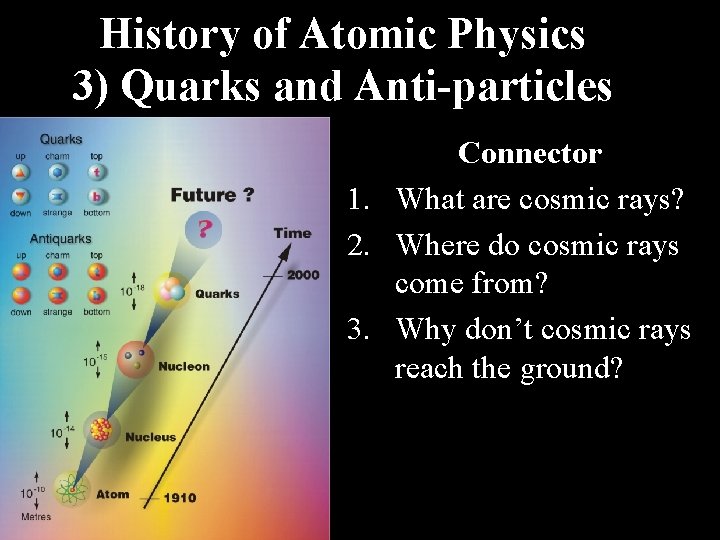
History of Atomic Physics 3) Quarks and Anti-particles Connector 1. What are cosmic rays? 2. Where do cosmic rays come from? 3. Why don’t cosmic rays reach the ground?
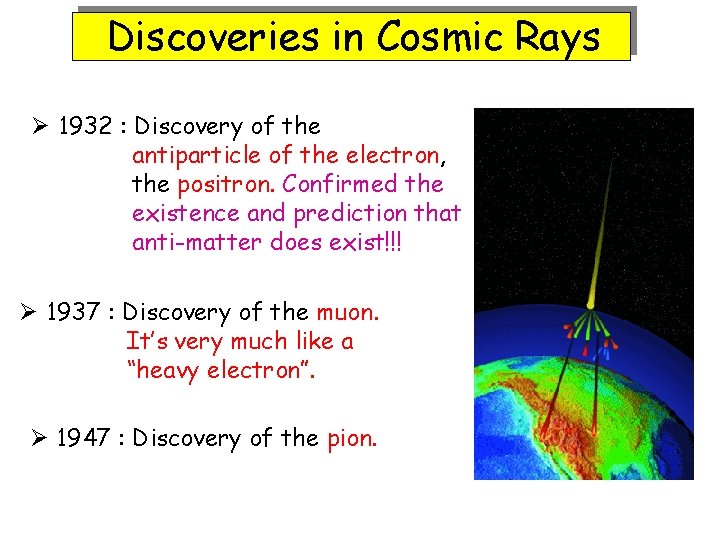
Discoveries in Cosmic Rays Ø 1932 : Discovery of the antiparticle of the electron, the positron. Confirmed the existence and prediction that anti-matter does exist!!! Ø 1937 : Discovery of the muon. It’s very much like a “heavy electron”. Ø 1947 : Discovery of the pion.
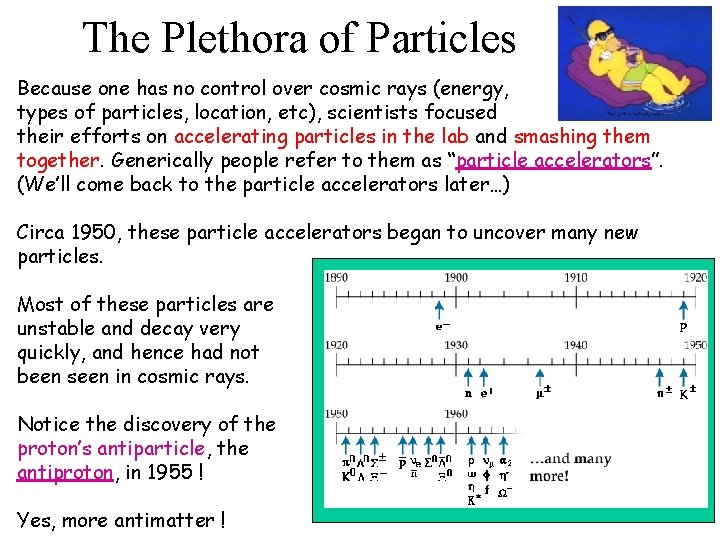
The Plethora of Particles Because one has no control over cosmic rays (energy, types of particles, location, etc), scientists focused their efforts on accelerating particles in the lab and smashing them together. Generically people refer to them as “particle accelerators”. (We’ll come back to the particle accelerators later…) Circa 1950, these particle accelerators began to uncover many new particles. Most of these particles are unstable and decay very quickly, and hence had not been seen in cosmic rays. Notice the discovery of the proton’s antiparticle, the antiproton, in 1955 ! Yes, more antimatter !
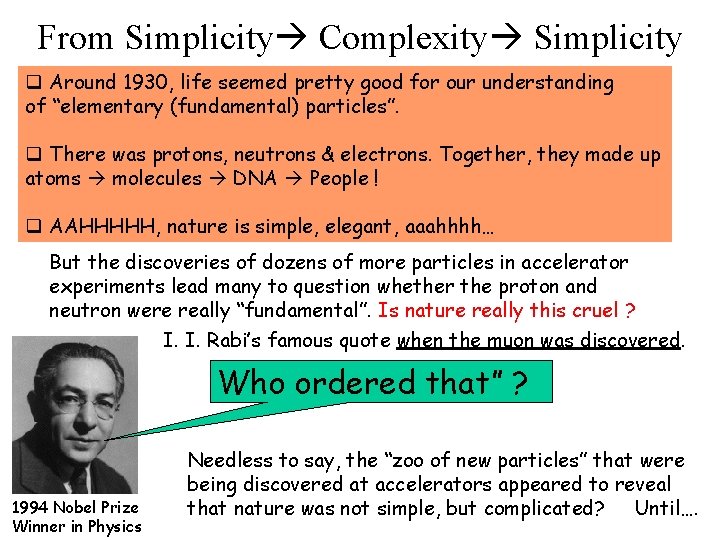
From Simplicity Complexity Simplicity q Around 1930, life seemed pretty good for our understanding of “elementary (fundamental) particles”. q There was protons, neutrons & electrons. Together, they made up atoms molecules DNA People ! q AAHHHHH, nature is simple, elegant, aaahhhh… But the discoveries of dozens of more particles in accelerator experiments lead many to question whether the proton and neutron were really “fundamental”. Is nature really this cruel ? I. I. Rabi’s famous quote when the muon was discovered. Who ordered that” ? 1994 Nobel Prize Winner in Physics Needless to say, the “zoo of new particles” that were being discovered at accelerators appeared to reveal that nature was not simple, but complicated? Until….
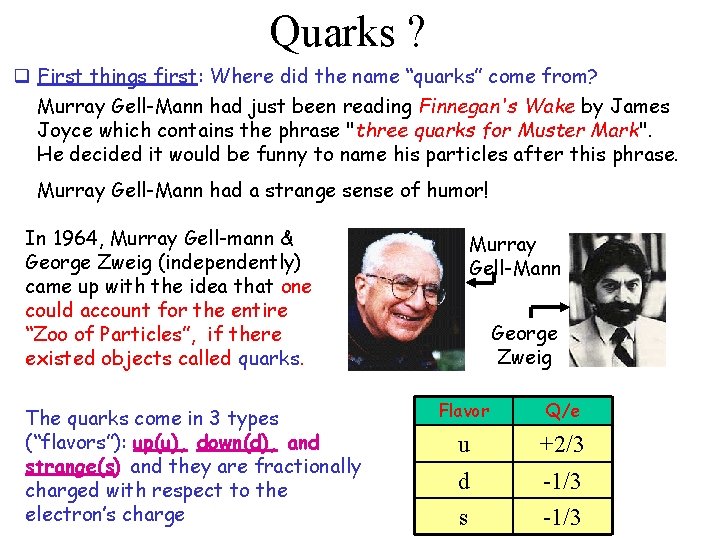
Quarks ? q First things first: Where did the name “quarks” come from? Murray Gell-Mann had just been reading Finnegan's Wake by James Joyce which contains the phrase "three quarks for Muster Mark". He decided it would be funny to name his particles after this phrase. Murray Gell-Mann had a strange sense of humor! In 1964, Murray Gell-mann & George Zweig (independently) came up with the idea that one could account for the entire “Zoo of Particles”, if there existed objects called quarks. The quarks come in 3 types (“flavors”): up(u), down(d), and strange(s) and they are fractionally charged with respect to the electron’s charge Murray Gell-Mann George Zweig Flavor Q/e u +2/3 d -1/3 s -1/3
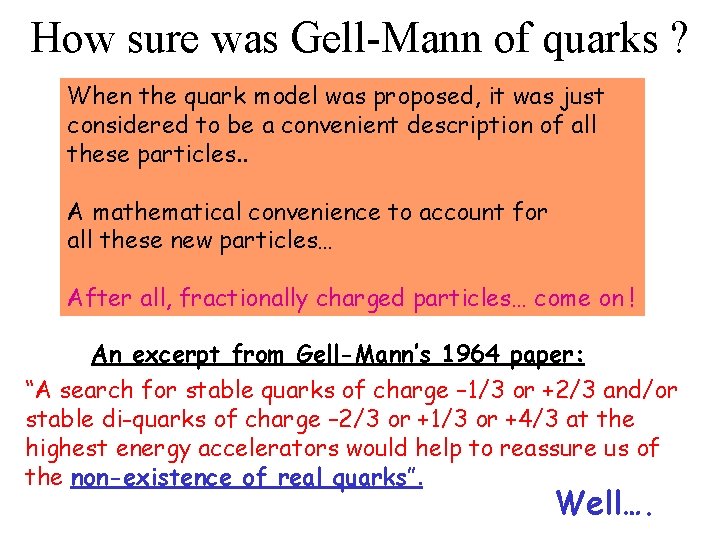
How sure was Gell-Mann of quarks ? When the quark model was proposed, it was just considered to be a convenient description of all these particles. . A mathematical convenience to account for all these new particles… After all, fractionally charged particles… come on ! An excerpt from Gell-Mann’s 1964 paper: “A search for stable quarks of charge – 1/3 or +2/3 and/or stable di-quarks of charge – 2/3 or +1/3 or +4/3 at the highest energy accelerators would help to reassure us of the non-existence of real quarks”. Well….
Probing deeper into matter q If we really want to understand if there is anything “inside” a proton or neutron (aka nucleon), we have to examine it with particles whose wavelengths are smaller than the size of a proton. Since l = h/p, we must produce higher momentum particles. That is, the higher the momentum of the particle, the smaller it’s de. Broglie wavelength can “see”, or “probe” smaller things q Since the proton’s size is very small, about 1 x 10 -15 [m], We need very energetic beams of particles (high momentum) to probe it’s structure. q By the 1960’s, physicists had learned how to produce high energy, well-focused, beams of particles, such as electrons or protons (particle accelerators !) q This has been the driving force behind understanding “What is matter at its most fundamental level ? ”
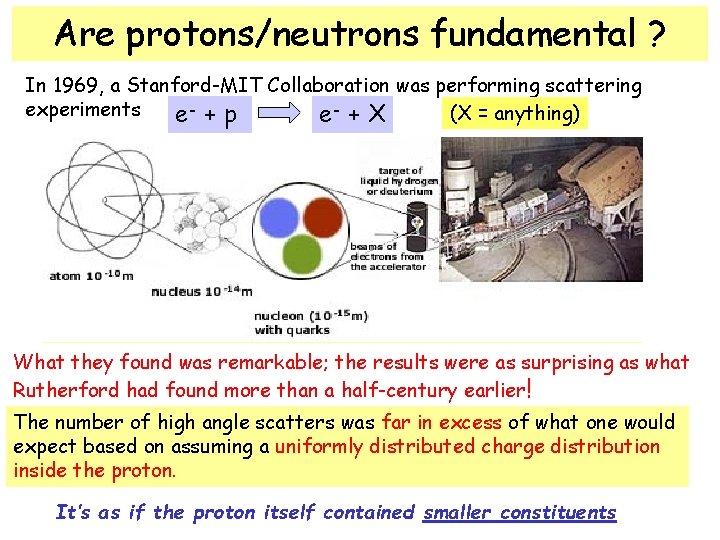
Are protons/neutrons fundamental ? In 1969, a Stanford-MIT Collaboration was performing scattering experiments (X = anything) e- + p e- + X What they found was remarkable; the results were as surprising as what Rutherford had found more than a half-century earlier ! The number of high angle scatters was far in excess of what one would expect based on assuming a uniformly distributed charge distribution inside the proton. It’s as if the proton itself contained smaller constituents
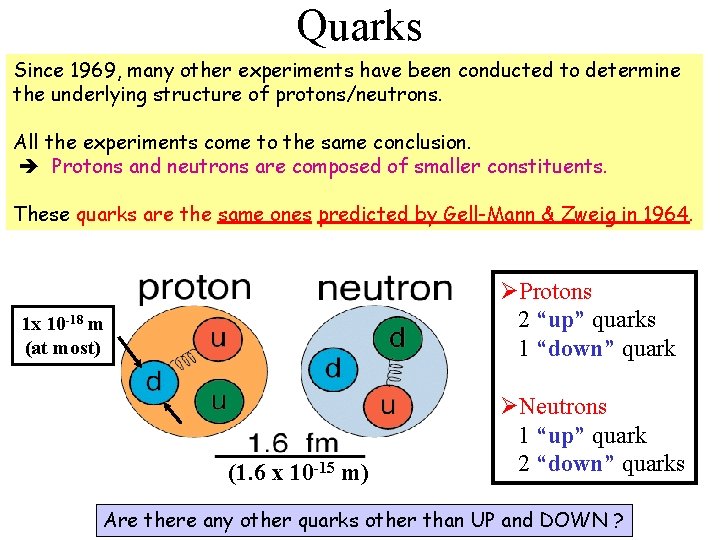
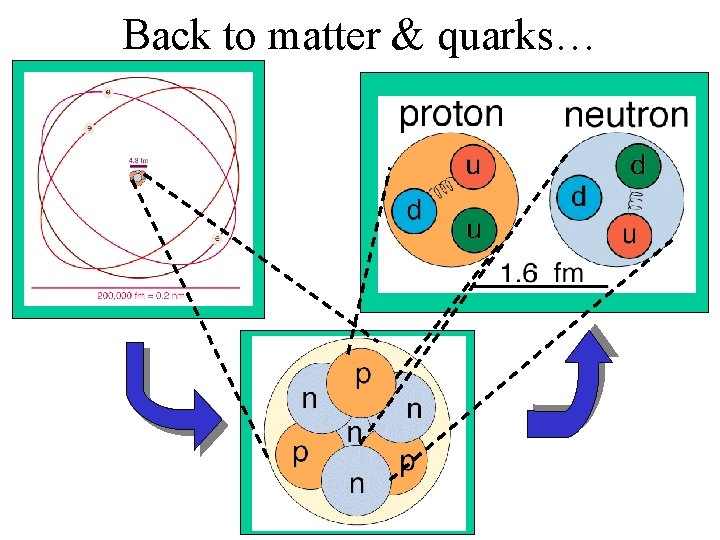
Quarks Since 1969, many other experiments have been conducted to determine the underlying structure of protons/neutrons. All the experiments come to the same conclusion. Protons and neutrons are composed of smaller constituents. These quarks are the same ones predicted by Gell-Mann & Zweig in 1964. ØProtons 2 “up” quarks 1 “down” quark 1 x 10 -18 m (at most) (1. 6 x 10 -15 m) ØNeutrons 1 “up” quark 2 “down” quarks Are there any other quarks other than UP and DOWN ?
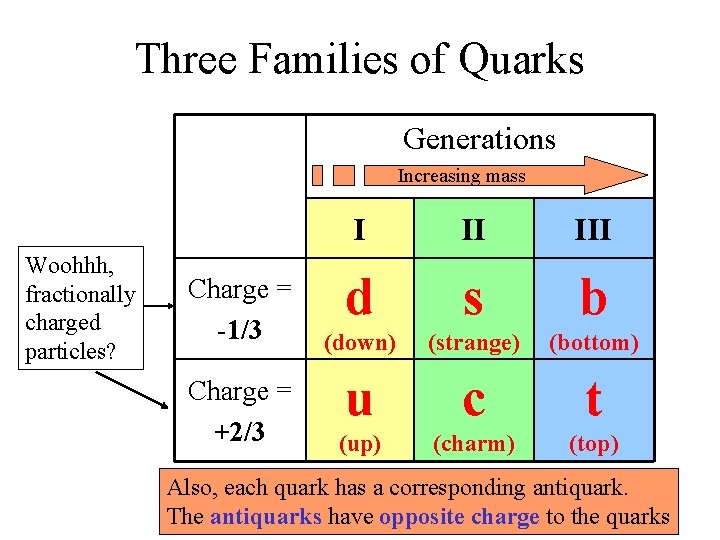
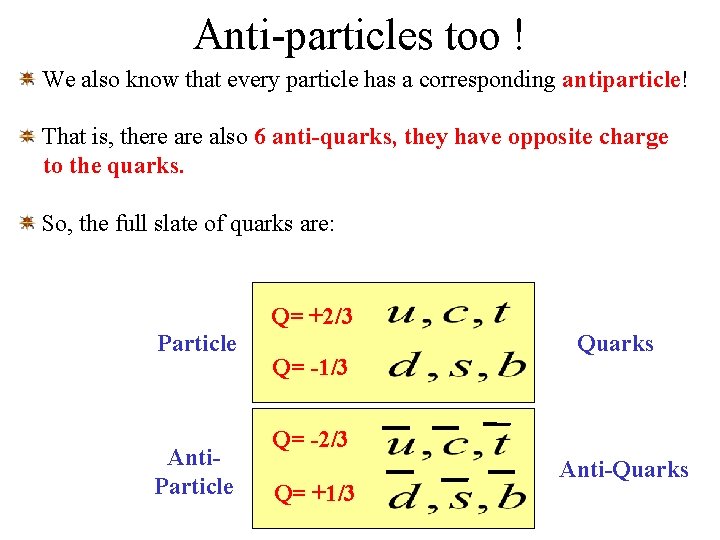
Three Families of Quarks Generations Increasing mass Woohhh, fractionally charged particles? Charge = -1/3 Charge = +2/3 I II III d s b (down) (strange) (bottom) u c t (up) (charm) (top) Also, each quark has a corresponding antiquark. The antiquarks have opposite charge to the quarks
The 6 Quarks, when & where… Quark Date Where Mass [Ge. V/c 2] Comment Constituents of hadrons, most prominently, proton and neutrons. up, down - - ~0. 005, ~0. 010 strange 1947 - ~0. 2 discovered in cosmic rays ~1. 5 Discovered simultaneously in both pp and e+e- collisions. ~4. 5 Discovered in collisions of protons on nuclei ~175 Discovered in pp collisions charm bottom top 1974 1977 1995 SLAC/ BNL Fermilab Notice the units of mass !!! SLAC = Stanford Linear Accelerator BNL = Brookhaven National Lab
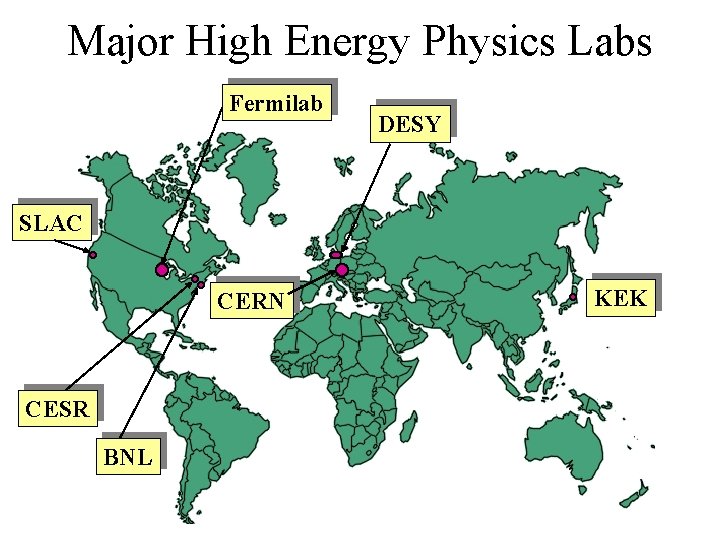
Major High Energy Physics Labs Fermilab DESY SLAC CERN CESR BNL KEK
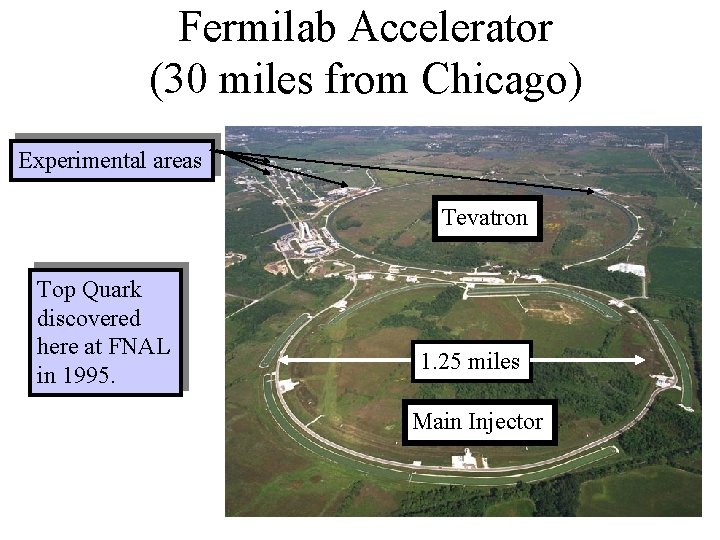
Fermilab Accelerator (30 miles from Chicago) Experimental areas Tevatron Top Quark discovered here at FNAL in 1995. 1. 25 miles Main Injector
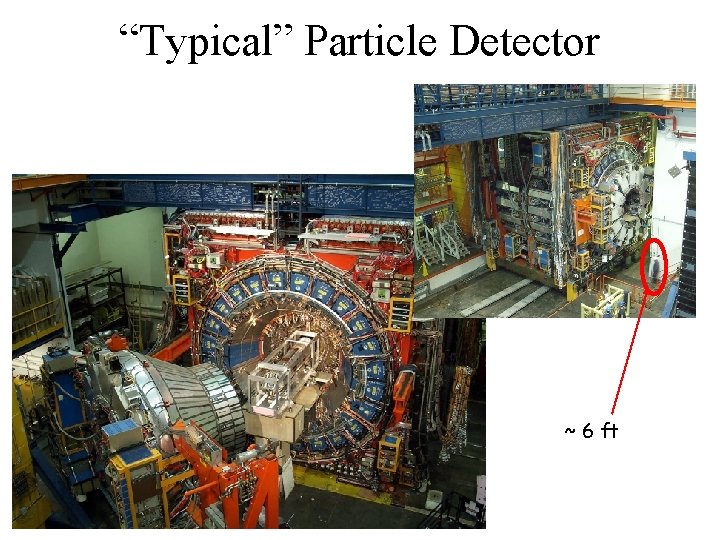
“Typical” Particle Detector ~ 6 ft
Back to matter & quarks…
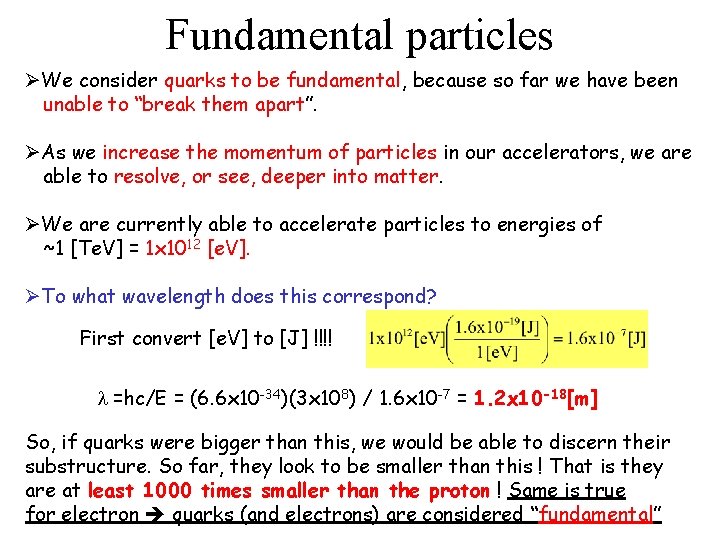
Fundamental particles ØWe consider quarks to be fundamental, because so far we have been unable to “break them apart”. ØAs we increase the momentum of particles in our accelerators, we are able to resolve, or see, deeper into matter. ØWe are currently able to accelerate particles to energies of ~1 [Te. V] = 1 x 10¹² [e. V]. ØTo what wavelength does this correspond? First convert [e. V] to [J] !!!! l =hc/E = (6. 6 x 10 -34)(3 x 10⁸) / 1. 6 x 10 -7 = 1. 2 x 10 -18[m] So, if quarks were bigger than this, we would be able to discern their substructure. So far, they look to be smaller than this ! That is they are at least 1000 times smaller than the proton ! Same is true for electron quarks (and electrons) are considered “fundamental”
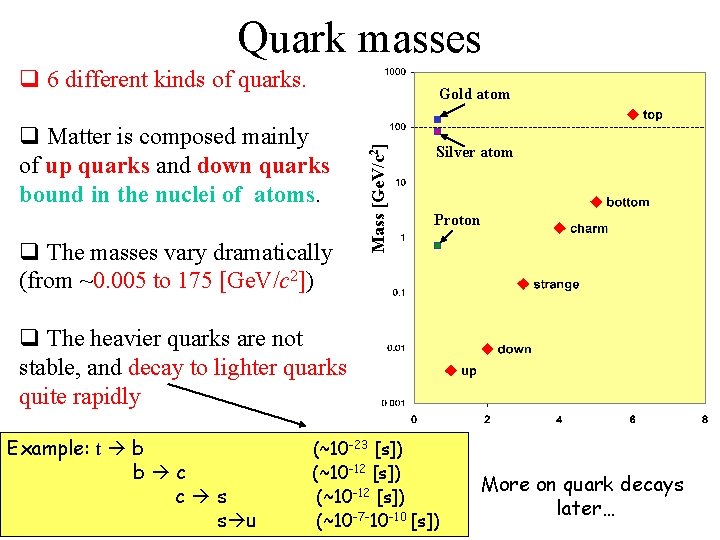
Quark masses q 6 different kinds of quarks. q Matter is composed mainly of up quarks and down quarks bound in the nuclei of atoms. q The masses vary dramatically (from ~0. 005 to 175 [Ge. V/c 2]) Mass [Ge. V/c 2] Gold atom Silver atom Proton q The heavier quarks are not stable, and decay to lighter quarks quite rapidly Example: t b b c c s s u (~10 -23 [s]) (~10 -12 [s]) (~10 -7 -10 -10 [s]) More on quark decays later…
Anti-particles too ! We also know that every particle has a corresponding antiparticle! That is, there also 6 anti-quarks, they have opposite charge to the quarks. So, the full slate of quarks are: Q= +2/3 Particle Anti. Particle Q= -1/3 Quarks Q= -2/3 Q= +1/3 Anti-Quarks
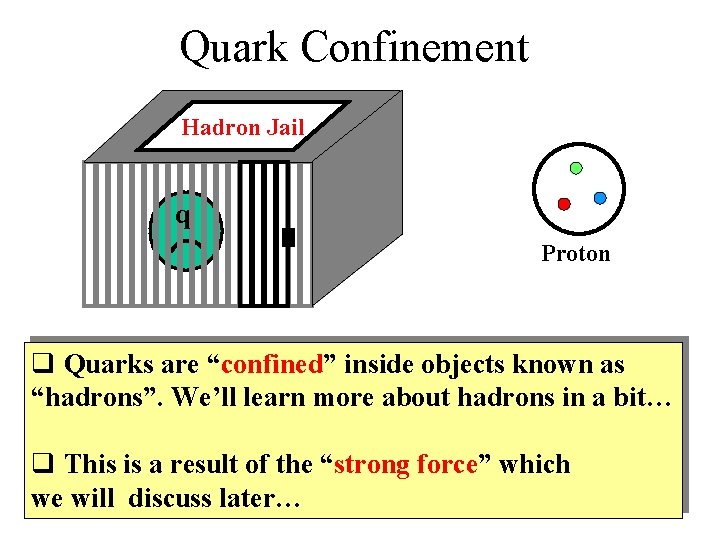
Quark Confinement Hadron Jail q Proton q Quarks are “confined” inside objects known as “hadrons”. We’ll learn more about hadrons in a bit… q This is a result of the “strong force” which we will discuss later…
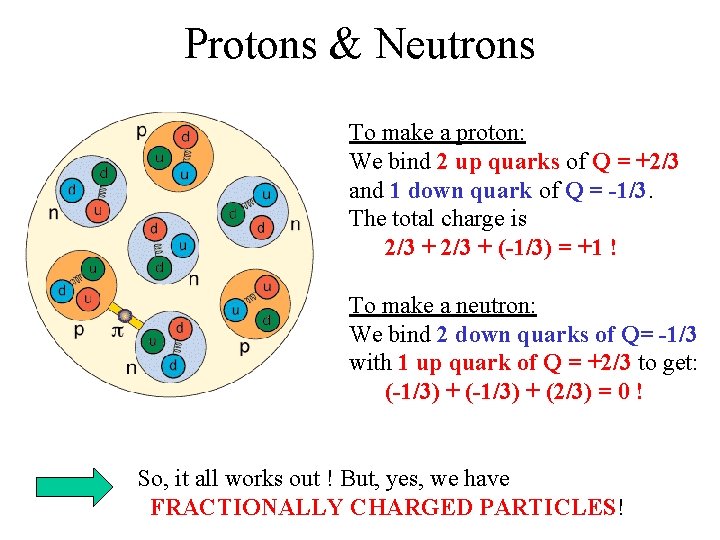
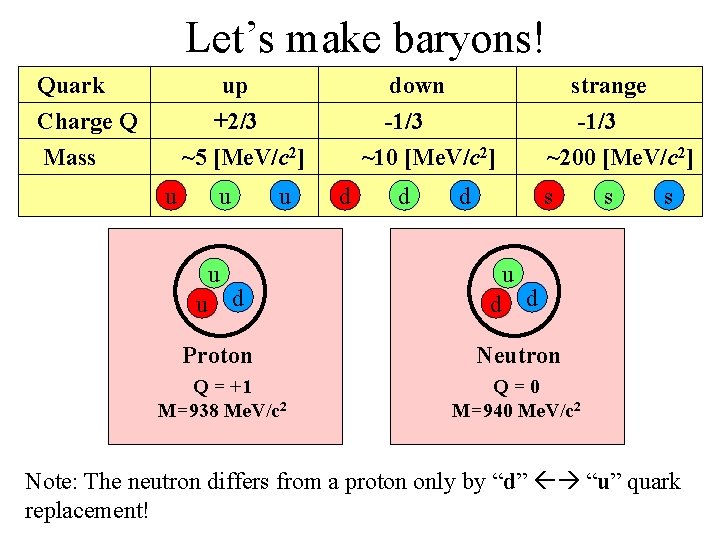
Protons & Neutrons To make a proton: We bind 2 up quarks of Q = +2/3 and 1 down quark of Q = -1/3. The total charge is 2/3 + (-1/3) = +1 ! To make a neutron: We bind 2 down quarks of Q= -1/3 with 1 up quark of Q = +2/3 to get: (-1/3) + (2/3) = 0 ! So, it all works out ! But, yes, we have FRACTIONALLY CHARGED PARTICLES!
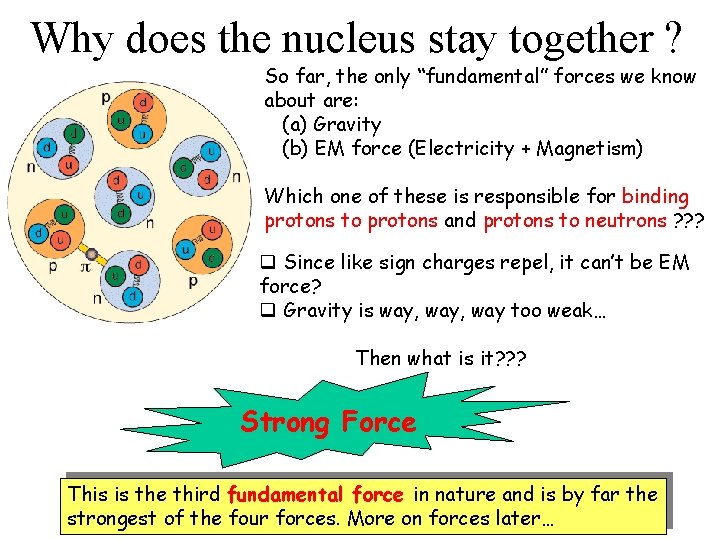
Why does the nucleus stay together ? So far, the only “fundamental” forces we know about are: (a) Gravity (b) EM force (Electricity + Magnetism) Which one of these is responsible for binding protons to protons and protons to neutrons ? ? ? q Since like sign charges repel, it can’t be EM force? q Gravity is way, way too weak… Then what is it? ? ? Strong Force This is the third fundamental force in nature and is by far the strongest of the four forces. More on forces later…
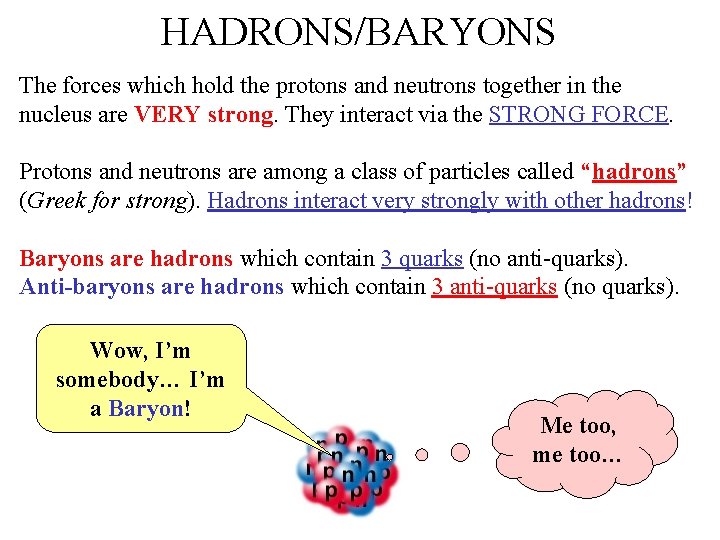
HADRONS/BARYONS The forces which hold the protons and neutrons together in the nucleus are VERY strong. They interact via the STRONG FORCE. Protons and neutrons are among a class of particles called “hadrons” (Greek for strong). Hadrons interact very strongly with other hadrons! Baryons are hadrons which contain 3 quarks (no anti-quarks). Anti-baryons are hadrons which contain 3 anti-quarks (no quarks). Wow, I’m somebody… I’m a Baryon! Me too, me too…
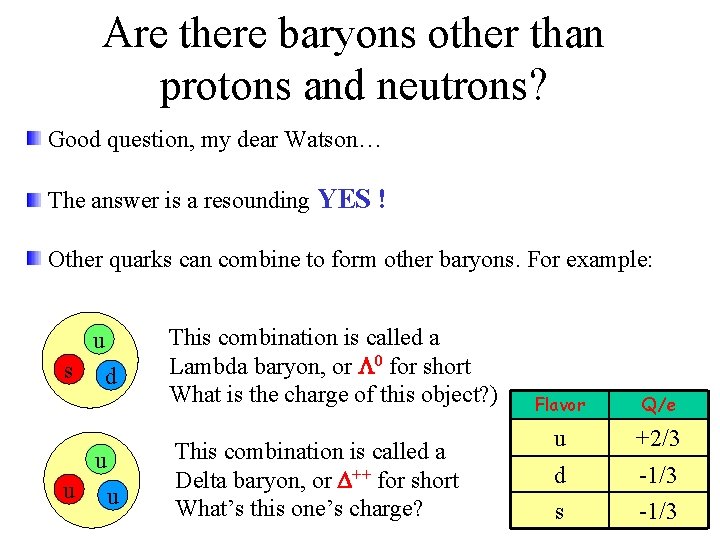
Are there baryons other than protons and neutrons? Good question, my dear Watson… The answer is a resounding YES ! Other quarks can combine to form other baryons. For example: u s d u u u This combination is called a Lambda baryon, or L 0 for short What is the charge of this object? ) This combination is called a Delta baryon, or D++ for short What’s this one’s charge? Flavor Q/e u +2/3 d -1/3 s -1/3
Let’s make baryons! Quark Charge Q up +2/3 Mass down -1/3 ~5 [Me. V/c 2] u u u d strange -1/3 ~10 [Me. V/c 2] d d ~200 [Me. V/c 2] d s u d s s d Proton Neutron Q = +1 M=938 Me. V/c 2 Q=0 M=940 Me. V/c 2 Note: The neutron differs from a proton only by “d” “u” quark replacement!
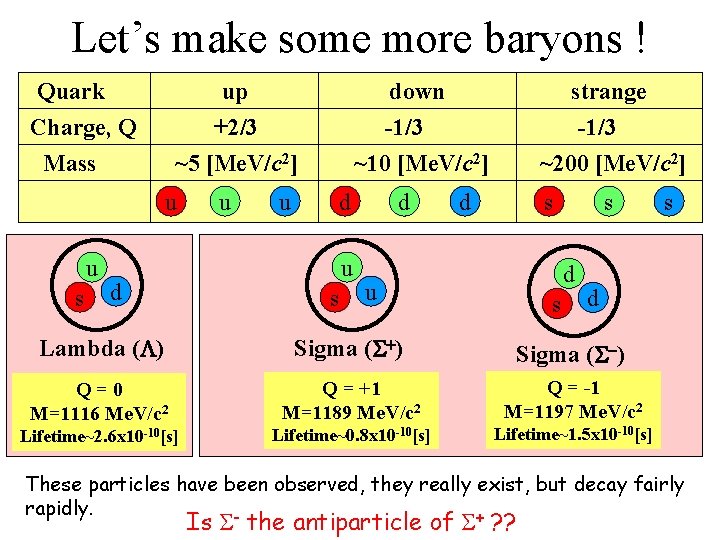
Let’s make some more baryons ! Quark up Charge, Q +2/3 Mass ~5 [Me. V/c 2] u u s d u u down strange -1/3 ~10 [Me. V/c 2] d u s d ~200 [Me. V/c 2] d s s d u s s d Lambda (L) Sigma (S+) Sigma (S-) Q=0 M=1116 Me. V/c 2 Q = +1 M=1189 Me. V/c 2 Q = -1 M=1197 Me. V/c 2 Lifetime~2. 6 x 10 -10[s] Lifetime~0. 8 x 10 -10[s] Lifetime~1. 5 x 10 -10[s] These particles have been observed, they really exist, but decay fairly rapidly. + Is S the antiparticle of S ? ?
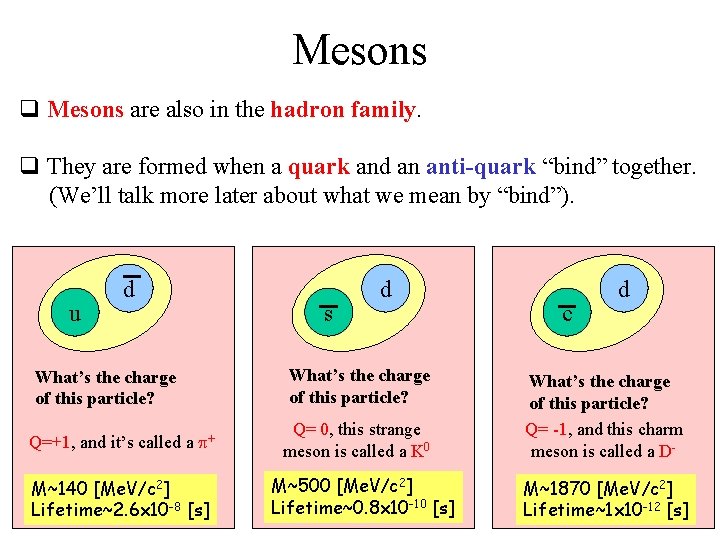
Mesons q Mesons are also in the hadron family. q They are formed when a quark and an anti-quark “bind” together. (We’ll talk more later about what we mean by “bind”). u d s What’s the charge of this particle? Q=+1, and it’s called a d p+ M~140 [Me. V/c 2] Lifetime~2. 6 x 10 -8 [s] Q= 0, this strange meson is called a K 0 M~500 [Me. V/c 2] Lifetime~0. 8 x 10 -10 [s] c d What’s the charge of this particle? Q= -1, and this charm meson is called a DM~1870 [Me. V/c 2] Lifetime~1 x 10 -12 [s]