
HISTORY OF ASTRONOMY How it all began Archaeoastronomy
HISTORY OF ASTRONOMY How it all began.
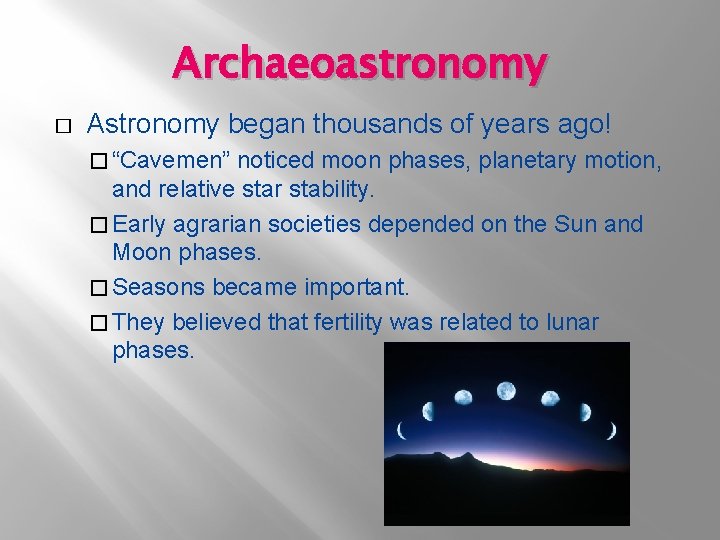
Archaeoastronomy � Astronomy began thousands of years ago! � “Cavemen” noticed moon phases, planetary motion, and relative star stability. � Early agrarian societies depended on the Sun and Moon phases. � Seasons became important. � They believed that fertility was related to lunar phases.
Archaeoastronomy � � The day was divided by the movement of the Sun. The 7 day week… 3 possibilities: � Babylonians - 7 observed celestial objects � Hebrews (Jews) – YHWH, no work on 7 th day � Greeks - Phases of the moon � � The month is based on 12 lunar cycles between one spring and the next. The year was marked by the heliacal (dawn) rising of specific stars.
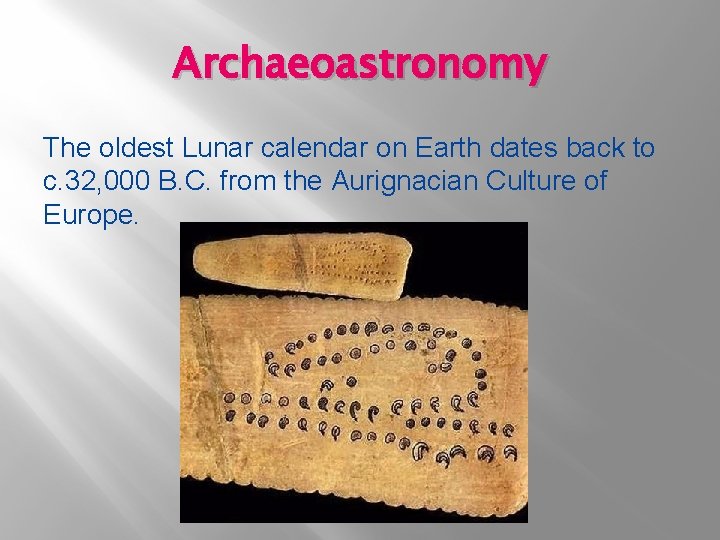
Archaeoastronomy The oldest Lunar calendar on Earth dates back to c. 32, 000 B. C. from the Aurignacian Culture of Europe.
Callippus � � C. 370 – 310 B. C. Greek philosopher who attended astronomy school Supported geocentric model and homocentric model Using days and rotations per orbit of the Sun, he was able to accurately measure seasons and calculated the 365. 25 day year.
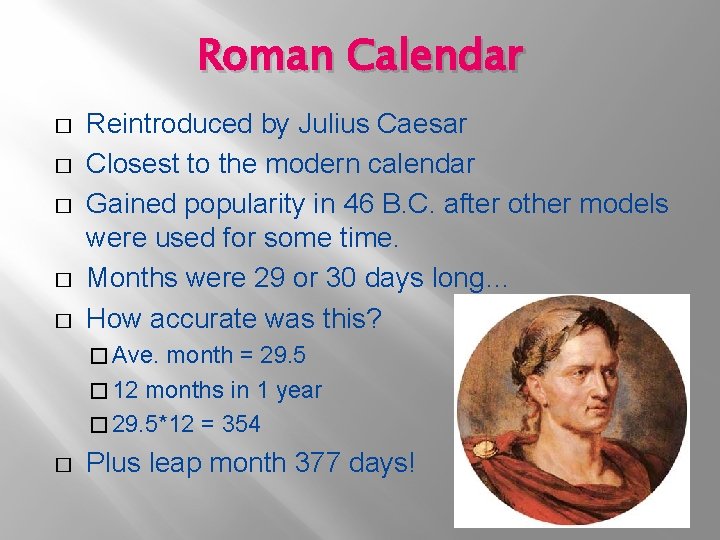
Roman Calendar � � � Reintroduced by Julius Caesar Closest to the modern calendar Gained popularity in 46 B. C. after other models were used for some time. Months were 29 or 30 days long… How accurate was this? � Ave. month = 29. 5 � 12 months in 1 year � 29. 5*12 = 354 � Plus leap month 377 days!
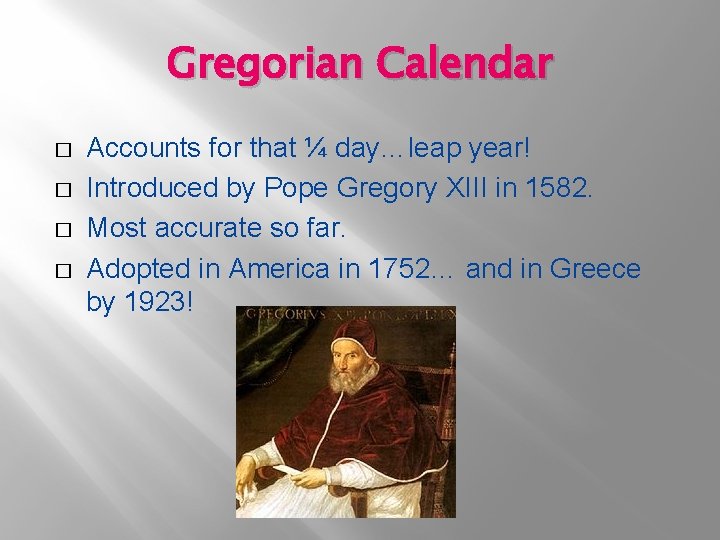
Gregorian Calendar � � Accounts for that ¼ day…leap year! Introduced by Pope Gregory XIII in 1582. Most accurate so far. Adopted in America in 1752… and in Greece by 1923!

What about… � � Some people couldn’t read or write Not everyone had the same education Different localities But…all cultures had driving factors: food, religion, weather…
- Slides: 8