
History of Animation Second Cycle Degree in Theatre

- Slides: 26
History of Animation Second Cycle Degree in Theatre, Film, Television and Media Studies Academic Year 2018 -2019 Lesson 1
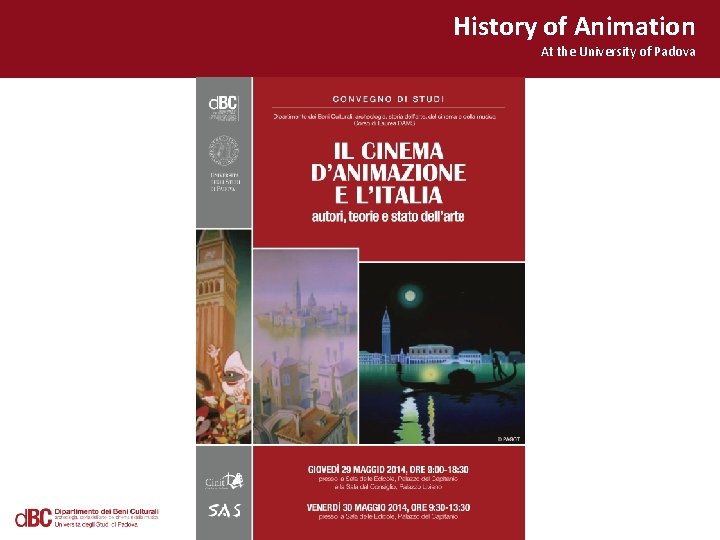
History of Animation At the University of Padova
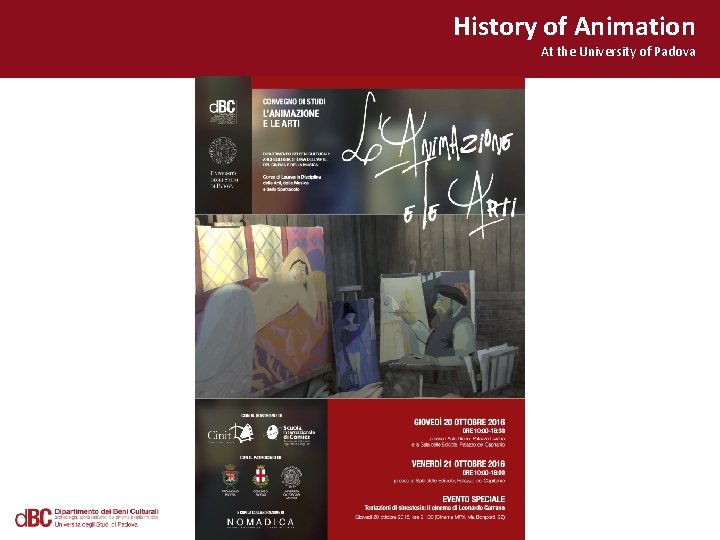
History of Animation At the University of Padova
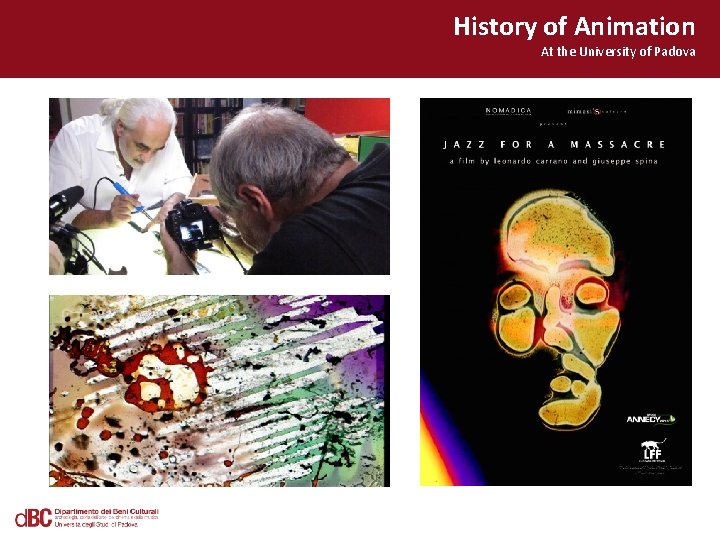
History of Animation At the University of Padova
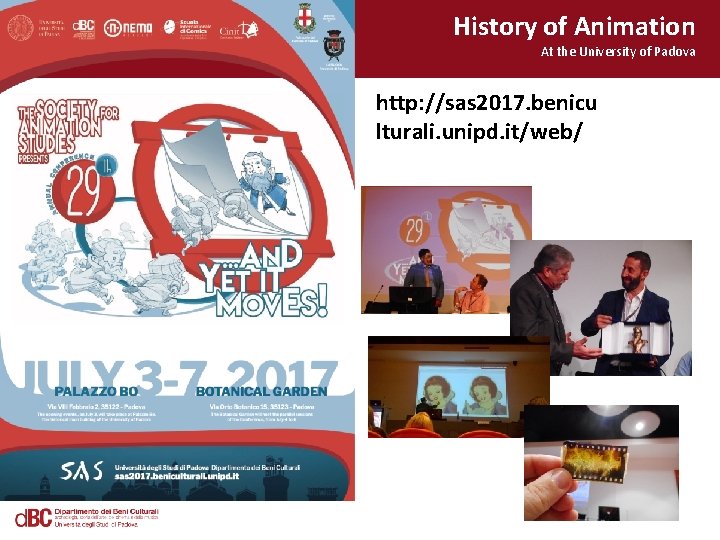
History of Animation At the University of Padova http: //sas 2017. benicu lturali. unipd. it/web/
History of Animation At the University of Padova The Animation Workshop Prof. Raffaele Luponio Two course units: - A workshop for students of the First Cycle Degree in Visual and Performing Arts; - A workshop open to general audiences. http: //immagineperimmagine. wordpress. com
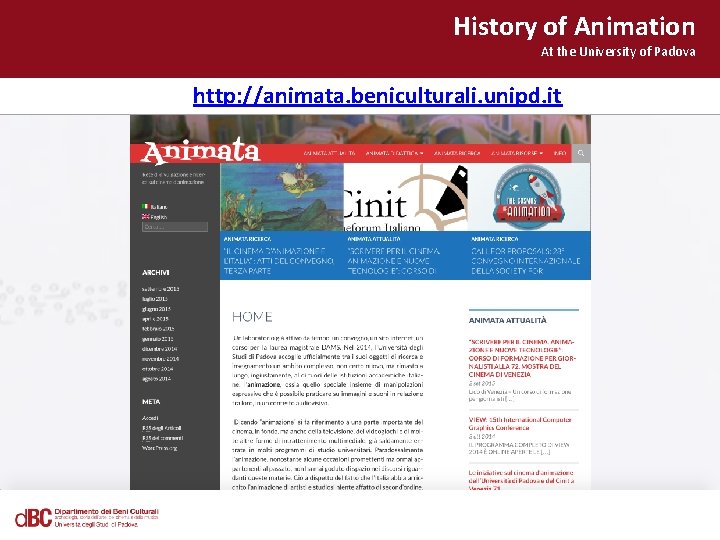
History of Animation At the University of Padova http: //animata. beniculturali. unipd. it
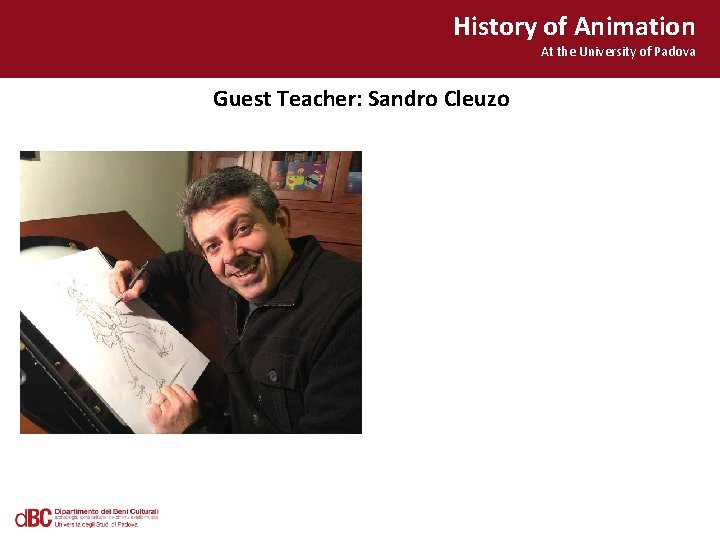
History of Animation At the University of Padova Guest Teacher: Sandro Cleuzo
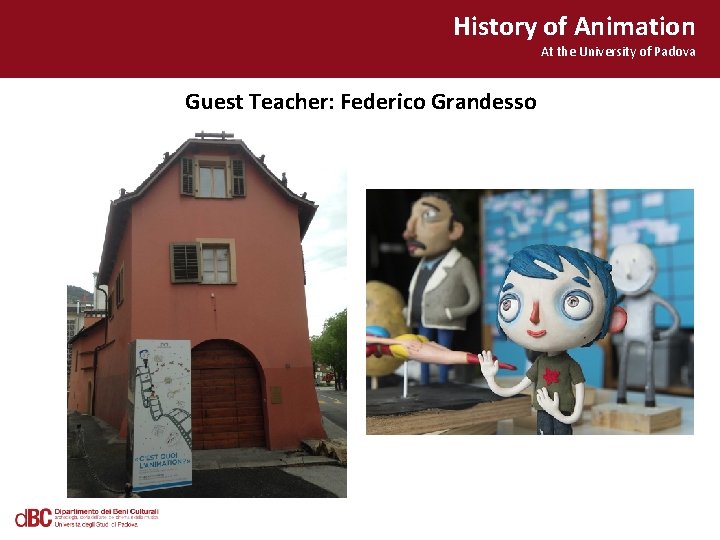
History of Animation At the University of Padova Guest Teacher: Federico Grandesso
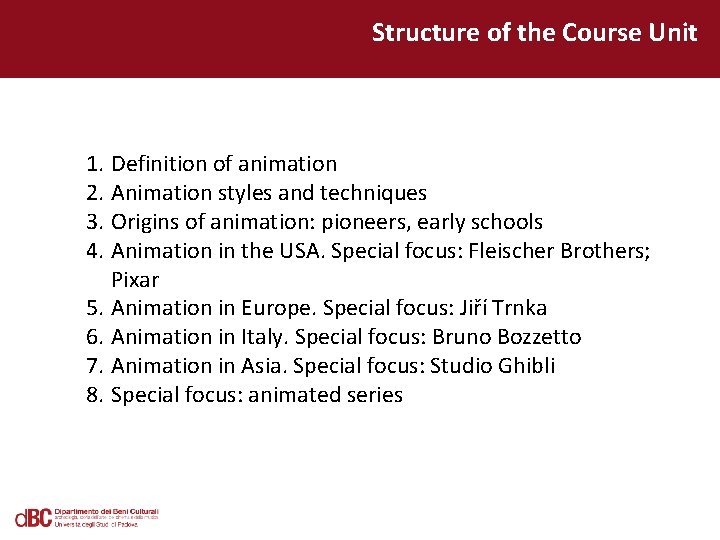
Structure of the Course Unit 1. Definition of animation 2. Animation styles and techniques 3. Origins of animation: pioneers, early schools 4. Animation in the USA. Special focus: Fleischer Brothers; Pixar 5. Animation in Europe. Special focus: Jiří Trnka 6. Animation in Italy. Special focus: Bruno Bozzetto 7. Animation in Asia. Special focus: Studio Ghibli 8. Special focus: animated series
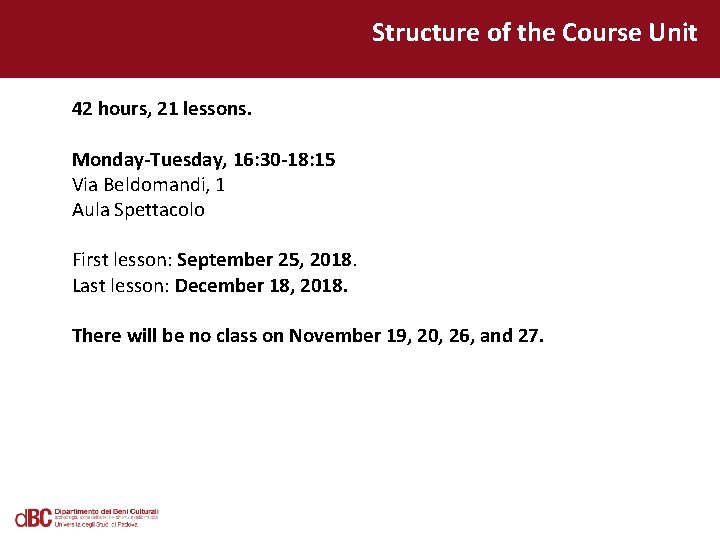
Structure of the Course Unit 42 hours, 21 lessons. Monday-Tuesday, 16: 30 -18: 15 Via Beldomandi, 1 Aula Spettacolo First lesson: September 25, 2018. Last lesson: December 18, 2018. There will be no class on November 19, 20, 26, and 27.
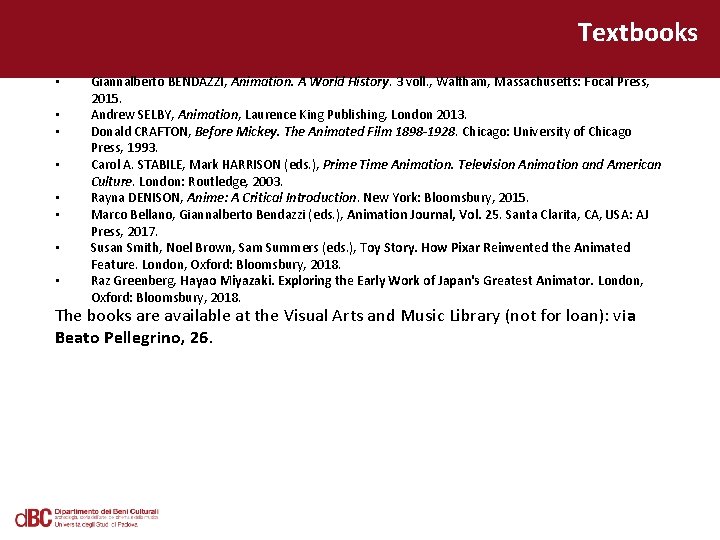
Textbooks • • Giannalberto BENDAZZI, Animation. A World History. 3 voll. , Waltham, Massachusetts: Focal Press, 2015. Andrew SELBY, Animation, Laurence King Publishing, London 2013. Donald CRAFTON, Before Mickey. The Animated Film 1898 -1928. Chicago: University of Chicago Press, 1993. Carol A. STABILE, Mark HARRISON (eds. ), Prime Time Animation. Television Animation and American Culture. London: Routledge, 2003. Rayna DENISON, Anime: A Critical Introduction. New York: Bloomsbury, 2015. Marco Bellano, Giannalberto Bendazzi (eds. ), Animation Journal, Vol. 25. Santa Clarita, CA, USA: AJ Press, 2017. Susan Smith, Noel Brown, Sam Summers (eds. ), Toy Story. How Pixar Reinvented the Animated Feature. London, Oxford: Bloomsbury, 2018. Raz Greenberg, Hayao Miyazaki. Exploring the Early Work of Japan's Greatest Animator. London, Oxford: Bloomsbury, 2018. The books are available at the Visual Arts and Music Library (not for loan): via Beato Pellegrino, 26.
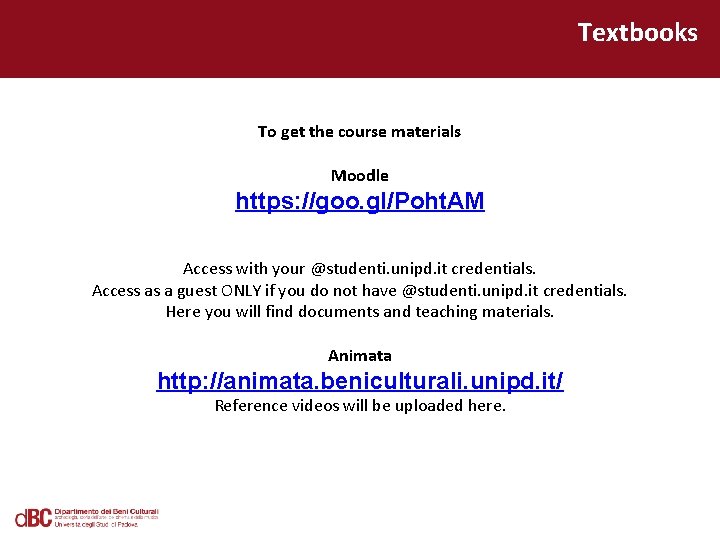
Textbooks To get the course materials Moodle https: //goo. gl/Poht. AM Access with your @studenti. unipd. it credentials. Access as a guest ONLY if you do not have @studenti. unipd. it credentials. Here you will find documents and teaching materials. Animata http: //animata. beniculturali. unipd. it/ Reference videos will be uploaded here.
Final Exam The final exam will be an oral test, both for attending and not attending students. The teacher will ask questions about the exam materials. For attenders, the exam will focus on the contents of the course and on the documents provided by the teacher. Moreover, at the beginning of the course the students will receive a list of films, of which 15 have to be selected and integrally watched. Some of those films could be discussed during the exam.
Final Exam The students can freely choose to talk in Italian or in English during the exam. However, the use of English will be obligatory during one small section of the test: all students (attending and not attending) are required to prepare a five minute talk in English, to be illustrated with a Powerpoint file. The talk and the Powerpoint need to focus on a general topic or a film discussed during the course (or included in the above mentioned list of films). In case of a different topic choice, please contact the teacher in advance. The students can use the Powerpoint files provided by the teacher during the course as a model for their work.
Final Exam To take the exam as attenders, it is advised to be present for at least for 38 hours out of 42. Students have to make up for the missed lessons by getting informed about them from fellow students, through written notes and the like. All attending students are supposed to know 100% of the contents of the course. A missed lesson cannot be used as an excuse for an error during the exam.
Final Exam It is recommendable to attend the course, as not attending students will not receive teaching materials such as videoclips and the like; they will be required to study two complete books written in English (Crafton and Selby). They will have to watch 15 films chosen from the list mentioned above, just like the attending students. As it is expected that each session will see only a few students taking the test, the teacher kindly asks to be informed about eventual absences in a timely manner (at least one day before the test). The exam registration will close three days before the test.
Contacts and Information Teacher’s email: marco. bellano@unipd. it Students are recommended to activate and check their @studenti. unipd. it email address on a regular basis. Student-teacher meetings: send an email and ask for an appointment. Usually, appointments are scheduled just before or after the lessons, Monday and Tuesday. Course page: https: //goo. gl/KHc 9 z. F Teacher’s page: https: //goo. gl/vv. RGco EXAM FILMOGRAPHY: https: //goo. gl/MYM 8 Y 5 WHAT TO STUDY: https: //goo. gl/v. RDGQH
What is Animation? Duck Amuck (Chuck Jones, 1953)
What is Animation? What does Duck Amuck tell us about… … framing and layout?
What is Animation? What does Duck Amuck tell us about… … sound?
What is Animation? What does Duck Amuck tell us about… … sound (again)?
What is Animation? What does Duck Amuck tell us about… … the grammar of cinema?
What is Animation? What does Duck Amuck tell us about… … the nature of cinema?
What is Animation? What does Duck Amuck tell us about… … the “author”?
Suggested readings Richard Thompson, “Duck Amuck”, Film Comment, Vol. 11, No. 1, January-February 1975, pp. 39 -43 (MOODLE).