
History of Animation Second Cycle Degree in Theatre
- Slides: 36
History of Animation Second Cycle Degree in Theatre, Film, Television and Media Studies Academic Year 2018 -2019 Lesson 21
The Masters of Animation Three Masters of Animation: Alexander Alexeïeff Norman Mc. Laren Oskar Fischinger
The Masters of Animation Alexeïeff Alexander Alexeïeff (1901 -1982) He was born in Russia (Kazan), son of a school principal and an officer of the Czarist army. Since he was a child, he had been traveling a lot: his family moved to Constantinople soon after his birth; there, he learnt French even before Russian. Alexander’s father mysteriously disappeared during a mission to Baden Germany. He was probably shot by a Turk. Soon after this event, Alexeïeff’s mother left to Germany without any explanation. She revealed the reason behind her journey only when she returned home.
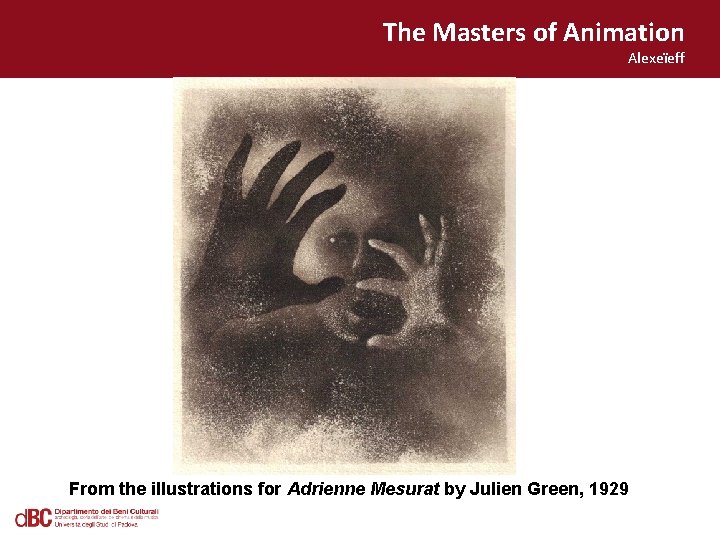
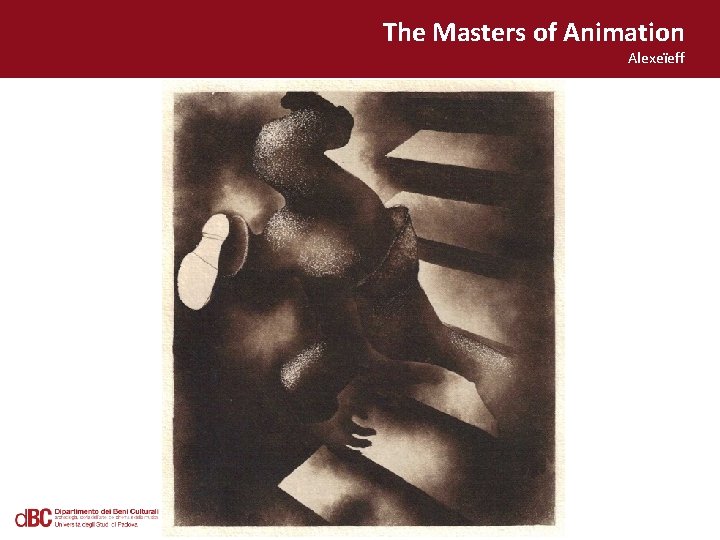
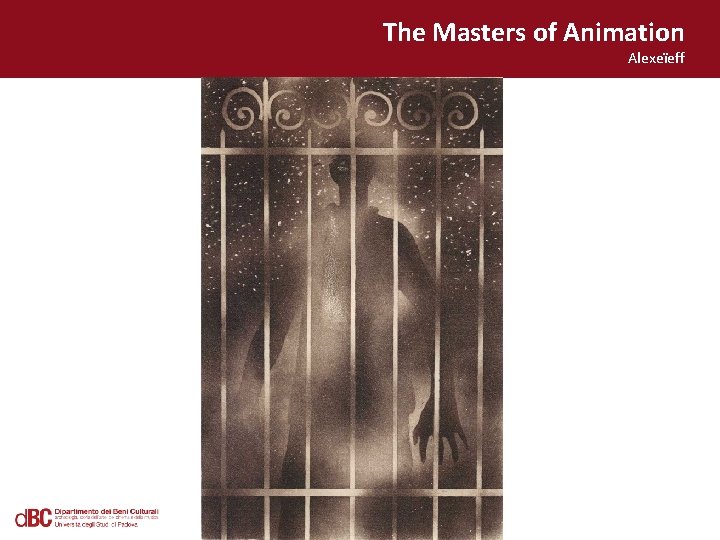
The Masters of Animation Alexeïeff experienced also another mysterious disappearance during his youth: his second oldest brother Nikolai went missing during the Russian Revolution of 1917. Those early, unsettling experiences maybe influenced «Alexeïeff’s lifelong attachment to darkness, mystery and the spirit world» . They «show themselves throughout his work in black figures rising from beneath the sidewalk, in gnomes and monsters, in empty streets and landscapes, in metamorphoses of every kind, and in his poetic use of blacks and whites and greys» . Cecile Starr, “Interview with Alexeïeff, quoted in Robin Allan, “Two Nights on Bald Mountain”, in Giannalberto Bendazzi (ed. ), Alexeïeff – Itinerary of a Master, Dreamland, Annecy, 2001, p. 83.
The Masters of Animation Alexeïeff From the illustrations for Adrienne Mesurat by Julien Green, 1929
The Masters of Animation Alexeïeff
The Masters of Animation Alexeïeff
The Masters of Animation Alexeïeff He studied Fine Arts at the St Petersburg’s Military School. After he finished his courses, he boarded a military ship. Alexeïeff traveled to Japan, China, India and Egypt. In Dubrovnik, Yugoslavia, the crew dispersed. Alexeïeff traveled to Marseille and finally settled in Paris. There, he completed his artistic training at the Académie de la Grande Chaumière in Montparnasse, and started working as a set designer and a book illustrator. At the age of thirty, he started to become interested in cinema.
The Masters of Animation Alexeïeff Inspired by Fernand Léger’s Le ballet mécanique (1924) and Berthold Bartosch’s L’idée (1932), Alexeïeff sought a poetic form of animation, based on chiaroscuro. He envisioned an animated engraving; to achieve this result, he theorized the pinscreen. It would have remained just a theory, however, without the practical aid of his first wife, Alexandra Alexandrovna Grinevskya, and then of Claire Parker (1906 -1981). Parker was a young American student; she joined Alexeïeff’s studio in 1931 and soon after she became the artist’s lover. Alexeïeff divorced Alexandra Grinevsky and married Claire Parker in 1940, after they moved to the USA.
The Masters of Animation Alexeïeff 1933: Une nuit sur le mont chauve. The film was highly appreciated, but it was not profitable. Afterwards, he turned to advertising (La belle au bois dormant, 1935). 1943: En passant, a new pinscreen production for the National Film Board of Canada. Alexeïeff kept working as an engraver; after the War, he returned to Paris. 1951: experimental period; animation of “illusory solids” (Ètudes de solides illusoires). 1962: title illustrations for Le procès (Orson Welles, 1962)
The Masters of Animation Alexeïeff 1963: Le nez, after Gogol 1972: Tableaux d’une exposition, after Mussorgsky. 1977: Trois thèmes, a kind of “sequel” to Tableaux d’une exposition.
The Masters of Animation Alexeïeff Une nuit sur le mont chauve (Alexander Alexeïeff, 1933)
The Masters of Animation Alexeïeff La belle au bois dormant (Alexander Alexeïeff, 1935)
The Masters of Animation Alexeïeff En passant (Alexander Alexeïeff, 1943)
The Masters of Animation Alexeïeff Ètudes de solides illusoires (Alexander Alexeïeff, 1951)
The Masters of Animation Alexeïeff Le nez (Alexander Alexeïeff, 1963)
The Masters of Animation Alexeïeff Tableaux d’une exposition (Alexander Alexeïeff, 1972)
The Masters of Animation Alexeïeff Trois thèmes (Alexander Alexeïeff, 1977)
The Masters of Animation Mc. Laren Norman Mc. Laren (1914 -1987) Opening Speech (Norman Mc. Laren, 1960)
The Masters of Animation Mc. Laren He was born in Scotland. His father, an interior designer, encouraged young Norman’s enrollment at the School of Fine Arts in Glasgow, in 1933. There, he distinguished himself by making films. He found an abandoned 35 mm projector in the school basement. He did not own a camera, so he started painting directly on film stock. 1937: He started working at the General Post Office, London, under the sponsorship of John Grierson. Love on the Wing (1938): his first “official” short film featuring animation painted directly on film.
The Masters of Animation Mc. Laren 1939: New York, Guggenheim Foundation. Dots and Loops, and a few of other experimental short films. John Grierson invited him to work at the new Canadian film office: the National Film Board of Canada. 1943: Mc. Laren is asked to organize an animation department inside the National Film Board. He started working with animators such as George Dunning, Jean-Paul Ladouceur, René Jodoin, Jim Mc. Kay and Grant Munro. 1952: Neighbors is awarded an Oscar.
The Masters of Animation Mc. Laren and animation as a complete form of art - Technique; Free-flowing creation; The social role of the free artist; A cinema without words (“abstract”, just like music).
The Masters of Animation Mc. Laren C’est l’aviron (Norman Mc. Laren, 1944)
The Masters of Animation Mc. Laren La poulette grise (Norman Mc. Laren, 1947)
The Masters of Animation Mc. Laren Begone Dull Care (Norman Mc. Laren, 1949)
The Masters of Animation Mc. Laren Pas de deux (Norman Mc. Laren, 1968)
The Masters of Animation Mc. Laren Synchromy (Norman Mc. Laren, 1971)
The Masters of Animation Fischinger Oskar Fischinger (1900 -1967) He was born in Germany. Early years: he studied violin and practiced as an organ-builder and as a technical artist at an architect’s office. After the War, his family moved to Frankfurt. There, he joined a literary circle and Bernhard Diebold, a local critic. Diebold encouraged his attempts in abstract painting and let him know the works by Walther Ruttmann. 1921: “Wax Experiments”. 1922: he moved to Munich; he founded a studio with Louis Seel, which produced animated shorts (and a second firm, aimed at developing a motor); he licensed the “Wax Machine” to Ruttmann. 1927: after many financial hardships, he left Munich for Berlin. He traveled 564 km on foot, while taking pictures. He later used them in a film, München-Berlin Wanderung (1927).
The Masters of Animation Fischinger 1928: he joined UFA and created special effect for Fritz Lang’s Frau im Mond. 1929 -1933: 12 Studien. Exploration of the sound-moving image relationship; abstract animations based on pieces from the “classical” repertoire. He also experimented with colour (Gasparcolor). The Studien were highly appreciated. 1934: Muratti Greift Ein, a cigarette commercial which was screened in cinemas around Europe. 1935: Komposition in Blau. An agent from Paramount invited Fischinger to work in the USA. He accepted, because of the consolidation of the Nazi power and its threats on avant-garde artistic expressions.
The Masters of Animation Fischinger 1936: the film project The Big Broadcast of 1937, at Paramount. As the studio turned the film in black and white, Fischinger quit. He later completed his abstract sequence as the color short Allegretto. 1938: An Optical Poem, for MGM. 1940: Fantasia and Pinocchio, at Disney. Meanwhile, following advice from his friends, he started to make a living as a traditional painter. 1942: Radio Dynamics 1947: Fischinger’s last finished work, Motion Painting No. 1, based on Johann Sebastian Bach’s Third Brandeburg Concerto. 1950 s: the Lumigraph, a new take on the color organ.
The Masters of Animation Fischinger Wax Experiments (Oskar Fischinger, 1921 -26)
The Masters of Animation Fischinger Studie nr. 7 (Oskar Fischinger, 1931)
The Masters of Animation Fischinger Komposition in Blau (Oskar Fischinger, 1935)
The Masters of Animation Fischinger Radio Dynamics (Oskar Fischinger, 1942)
The Masters of Animation Fischinger Motion Painting No. 1 (Oskar Fischinger, 1947)
Suggested readings Giannalberto Bendazzi, Animation. A World History. 3 voll. , Waltham, Massachusetts: Focal Press, 2015. Vol. I, pp. 140 -147: “Alexandre Alexeïeff”; Vol. I, pp. 153 -157: Oskar Fischinger; Vol. II, pp. 30 -36: “Norman Mc. Laren”.