
History of Animation Paolo B Ramirez BFA 3
History of Animation Paolo B. Ramirez BFA- 3 A
§Animation is the process of making the illusion of motion and the illusion of change by means of the rapid succession of sequential images that minimally differ from each other. The illusion—as in motion pictures in general—is thought to rely on the phi phenomenon and bet movement, but the exact causes are still unclear.
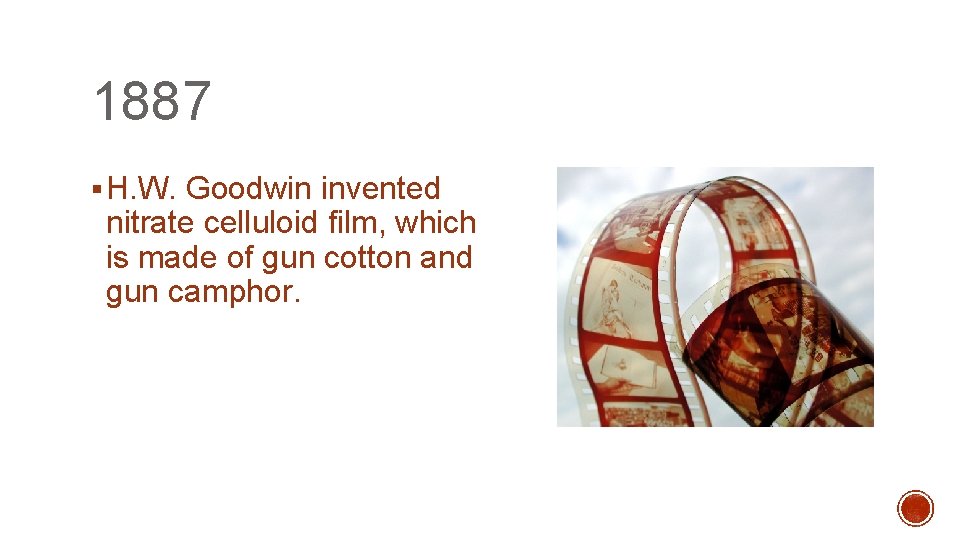
1887 § H. W. Goodwin invented nitrate celluloid film, which is made of gun cotton and gun camphor.

1892 Emil Reynaud opened his Theatre in Paris with a new animation made by his Praxinoscope. The Praxinoscope was a Zoetrope with mirrors placed on an inside column that reflected out the sequential drawings that were on the inside of the drum. He was able to project 80 frames without changing reels and could project 10 to 15 minute "films". But the advent of film drove him out of business and in 1910 he threw all his equipment into a river and died in a sanatorium in 1918.

1894 Lois Lumiere invents the cinematograph, a combination camera/projector/printer, it was the first machine to show movies successfully on a screen. This system used a claw movement and perforated film that was synced to an intermittent shutter movement.

1909 Emil Cohl combines live action and drawn animation together in his film Clair De Lune Espagnol.
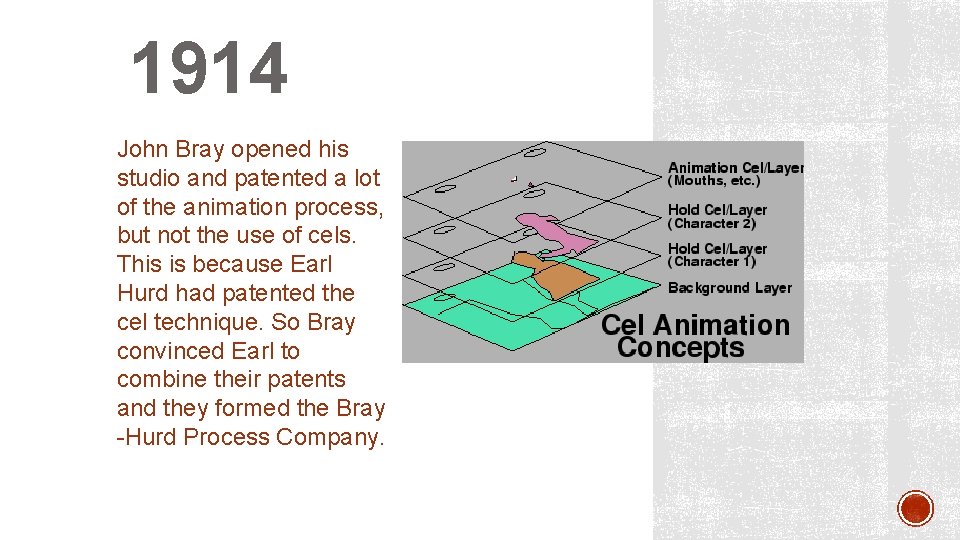
1914 • John Bray opened his studio and patented a lot of the animation process, but not the use of cels. This is because Earl Hurd had patented the cel technique. So Bray convinced Earl to combine their patents and they formed the Bray -Hurd Process Company. • The US animation industry was centered in New York until the late 1920's and early 1930's.

1916 John Bray acquired more patents and establishes a patent monopoly for the animation process. He tried to enforce the patent by requiring all animation studios using his patented animation process to buy a license and pay a fee. Some studios paid it, some ignored it, some of them found a way around it, and some took it to court. This issue caused concern in the animation business until the early 1930's. Bray’s interest shifted from entertainment films to educational films.
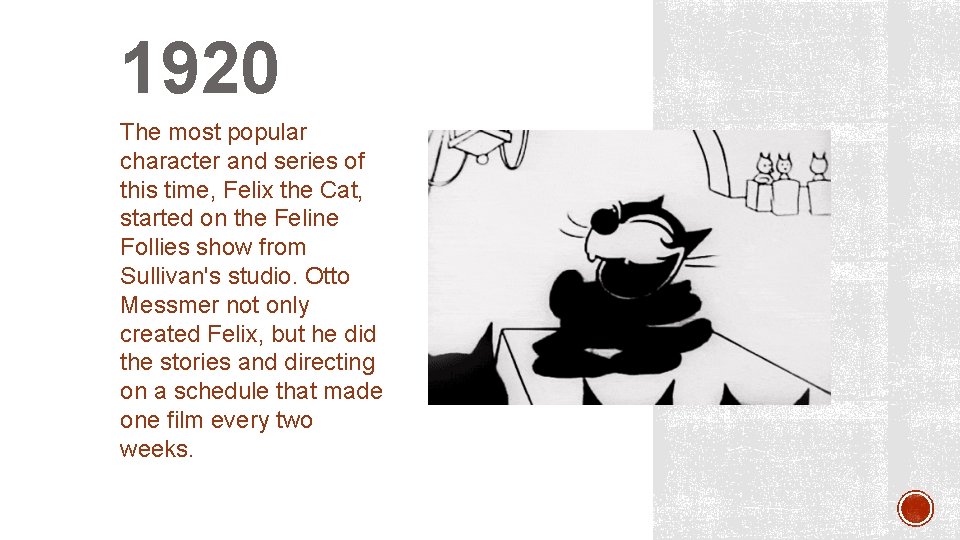
1920 The most popular character and series of this time, Felix the Cat, started on the Feline Follies show from Sullivan's studio. Otto Messmer not only created Felix, but he did the stories and directing on a schedule that made one film every two weeks.

1922 Disney's first animation studio, Laugh-O -Gram Films was built.
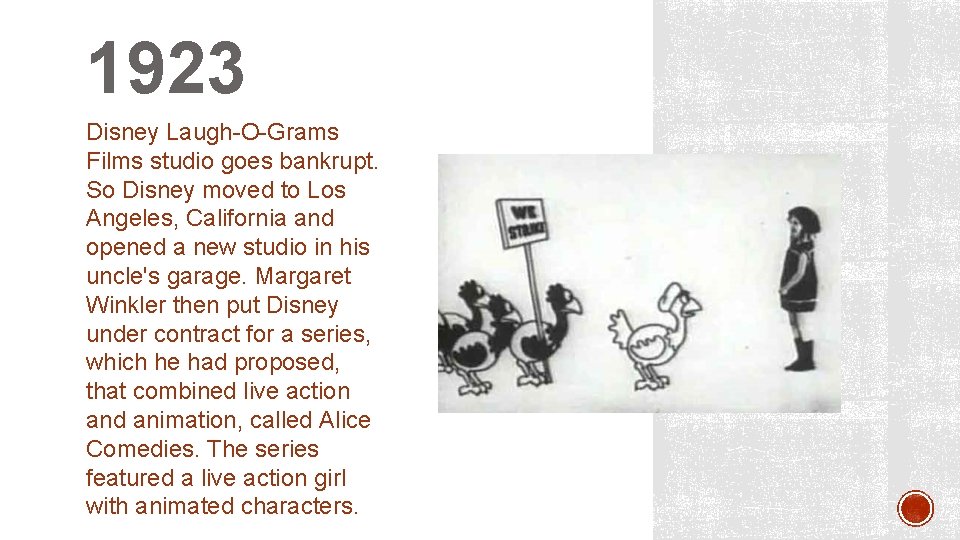
1923 Disney Laugh-O-Grams Films studio goes bankrupt. So Disney moved to Los Angeles, California and opened a new studio in his uncle's garage. Margaret Winkler then put Disney under contract for a series, which he had proposed, that combined live action and animation, called Alice Comedies. The series featured a live action girl with animated characters.
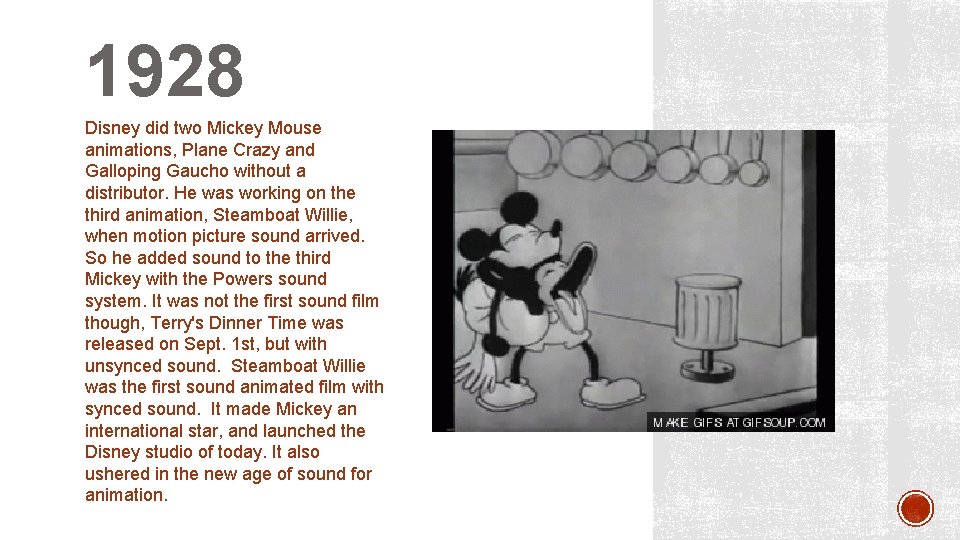
1928 Disney did two Mickey Mouse animations, Plane Crazy and Galloping Gaucho without a distributor. He was working on the third animation, Steamboat Willie, when motion picture sound arrived. So he added sound to the third Mickey with the Powers sound system. It was not the first sound film though, Terry's Dinner Time was released on Sept. 1 st, but with unsynced sound. Steamboat Willie was the first sound animated film with synced sound. It made Mickey an international star, and launched the Disney studio of today. It also ushered in the new age of sound for animation.
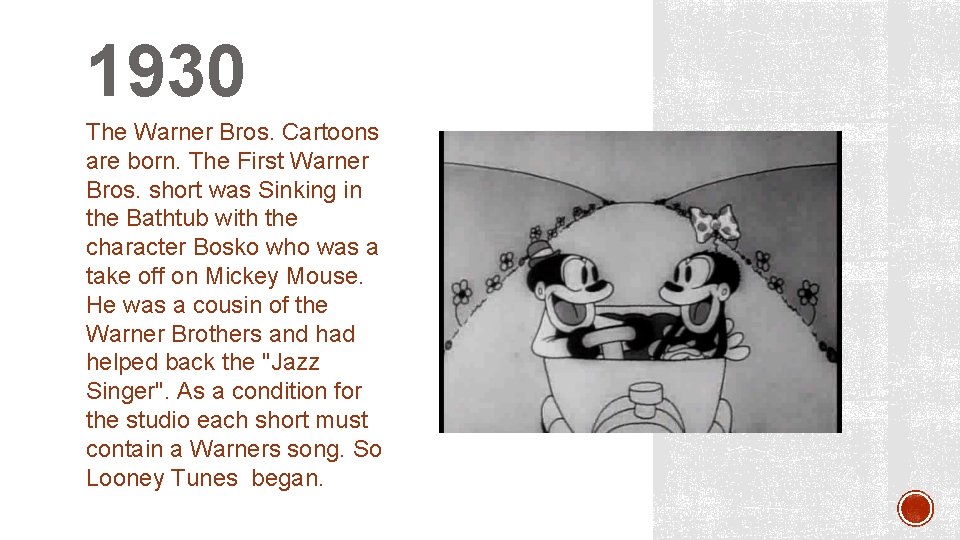
1930 The Warner Bros. Cartoons are born. The First Warner Bros. short was Sinking in the Bathtub with the character Bosko who was a take off on Mickey Mouse. He was a cousin of the Warner Brothers and had helped back the "Jazz Singer". As a condition for the studio each short must contain a Warners song. So Looney Tunes began.

1931 • Warner Bros. makes Merrie Melodies. • Webb Smith, a Disney animator, starts the use of storyboards, but some people would claim that the storyboard was first developed at the Fleischer studios in 1930.
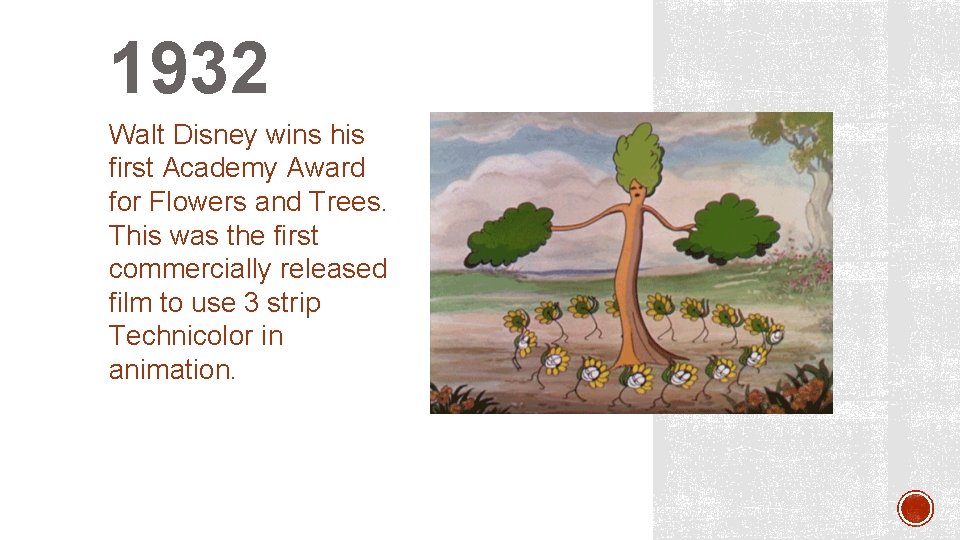
1932 Walt Disney wins his first Academy Award for Flowers and Trees. This was the first commercially released film to use 3 strip Technicolor in animation.

1935 • Hollywood Production Code comes into effect. • Len Lye, creates Color Box, the first
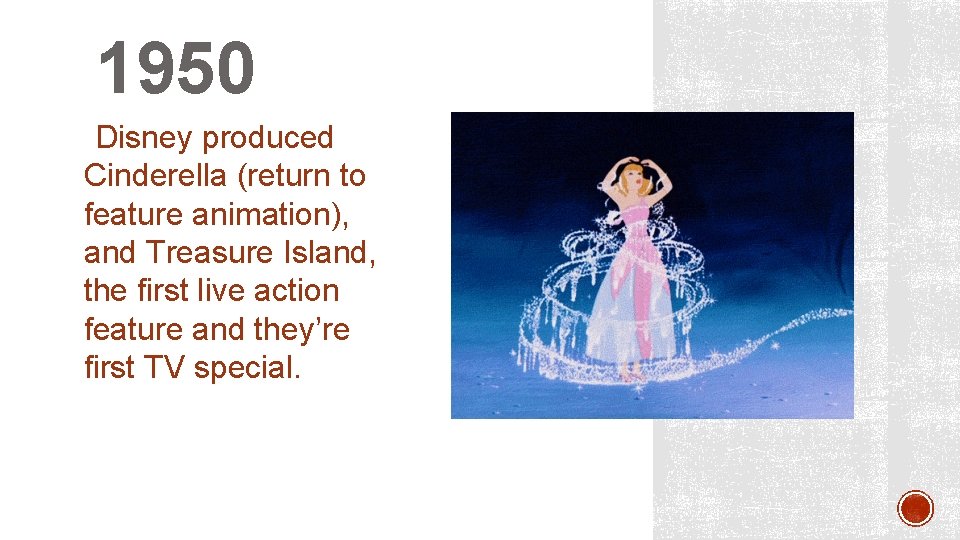
1950 • Disney produced Cinderella (return to feature animation), and Treasure Island, the first live action feature and they’re first TV special. • Animation for TV commercials becomes an important part of the animation industry.
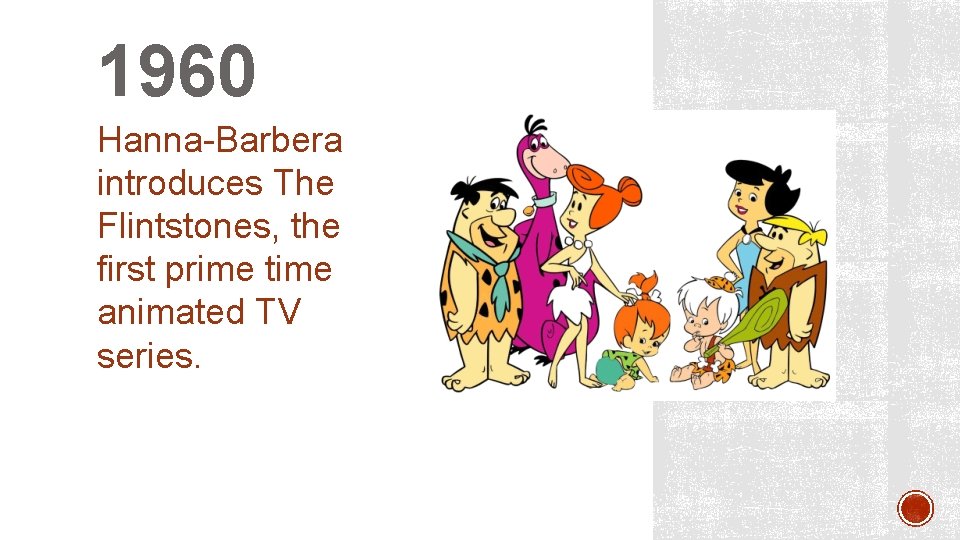
1960 Hanna-Barbera introduces The Flintstones, the first prime time animated TV series.
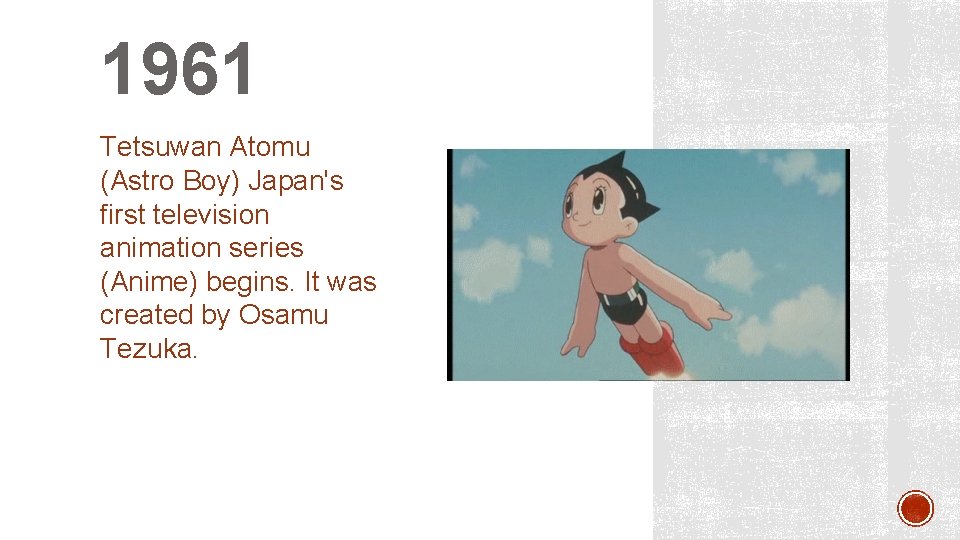
1961 Tetsuwan Atomu (Astro Boy) Japan's first television animation series (Anime) begins. It was created by Osamu Tezuka.
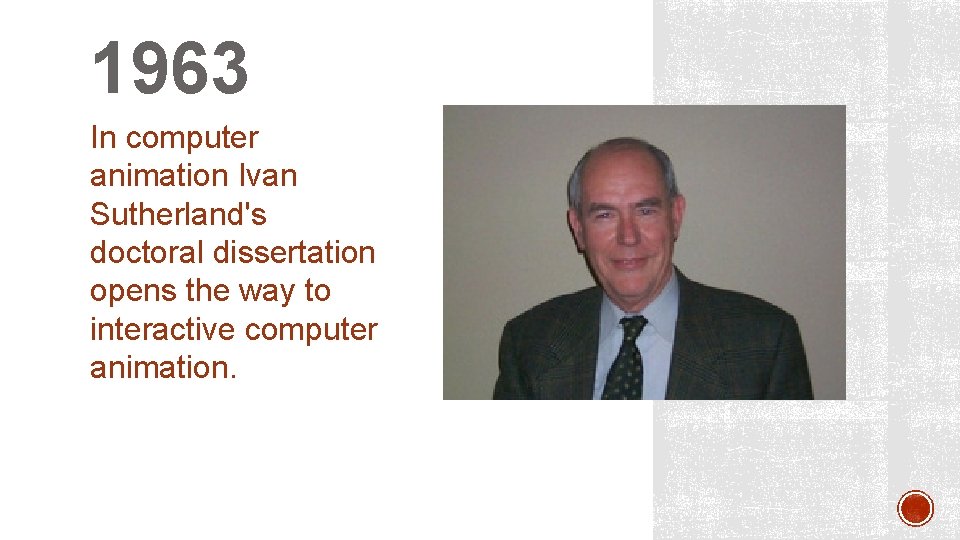
1963 In computer animation Ivan Sutherland's doctoral dissertation opens the way to interactive computer animation.
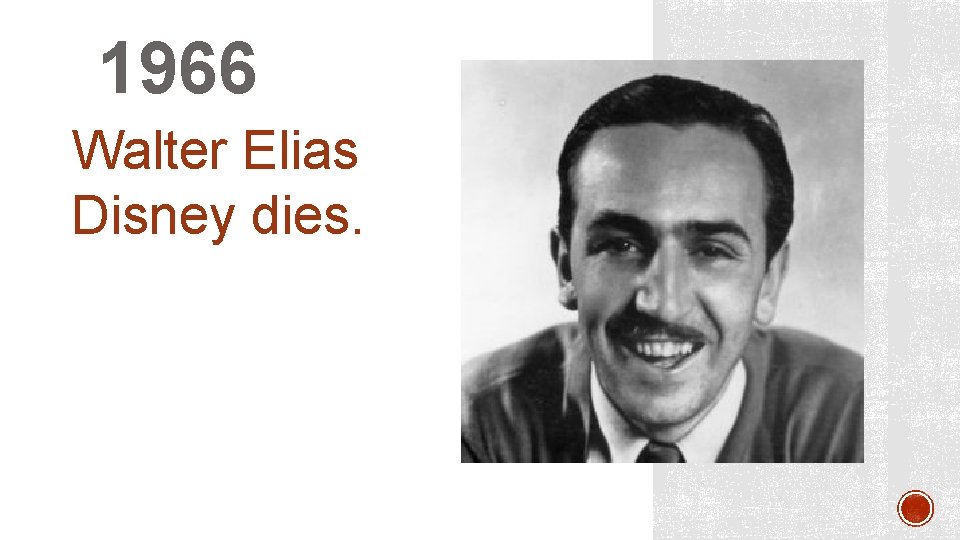
1966 Walter Elias Disney dies.
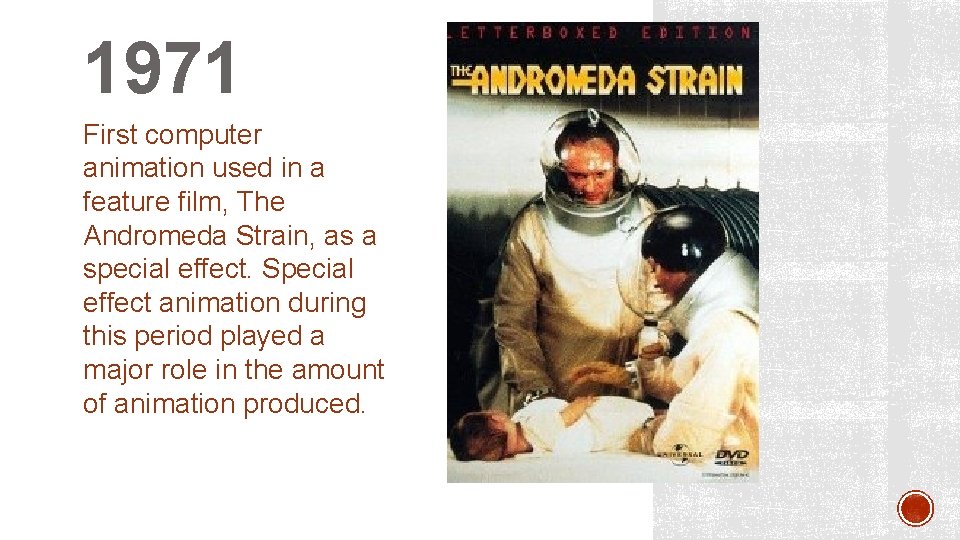
1971 First computer animation used in a feature film, The Andromeda Strain, as a special effect. Special effect animation during this period played a major role in the amount of animation produced.
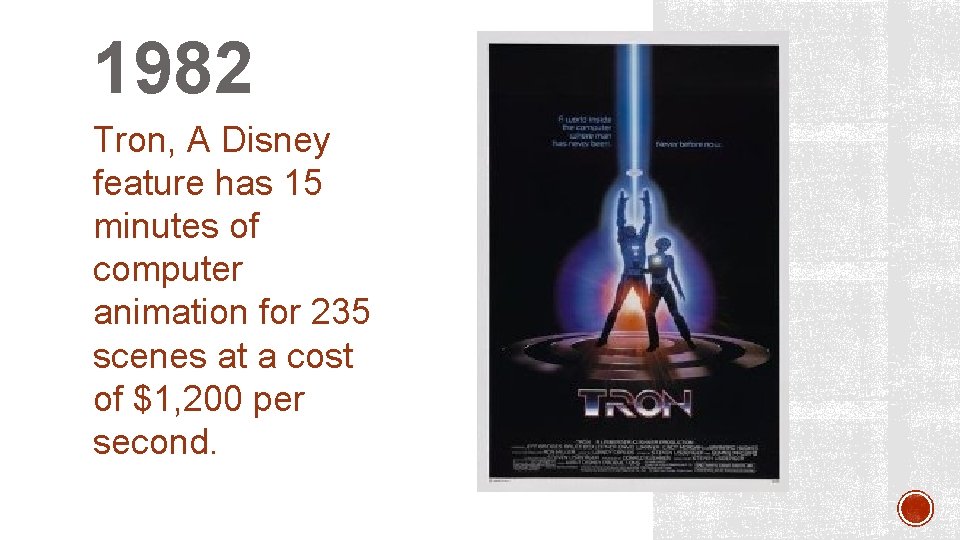
1982 Tron, A Disney feature has 15 minutes of computer animation for 235 scenes at a cost of $1, 200 per second.
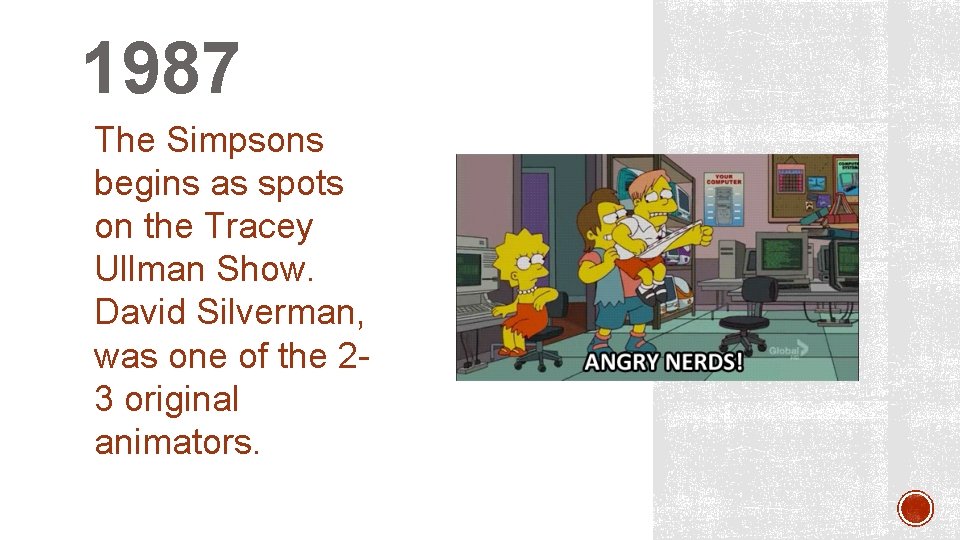
1987 The Simpsons begins as spots on the Tracey Ullman Show. David Silverman, was one of the 23 original animators.
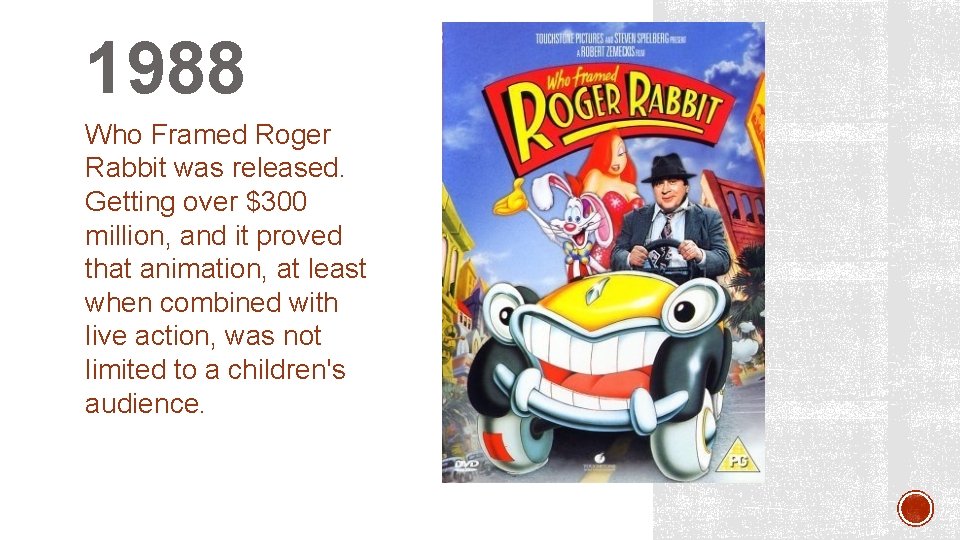
1988 Who Framed Roger Rabbit was released. Getting over $300 million, and it proved that animation, at least when combined with live action, was not limited to a children's audience.
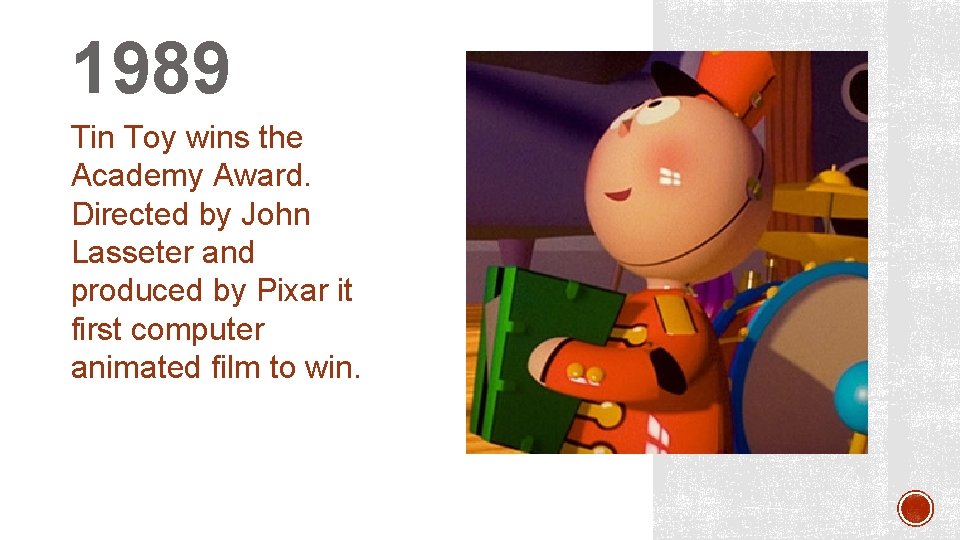
1989 Tin Toy wins the Academy Award. Directed by John Lasseter and produced by Pixar it first computer animated film to win.
1992 Cartoon Network broadcasts in 2 million homes, and by 1995 it's in the 22 millions.
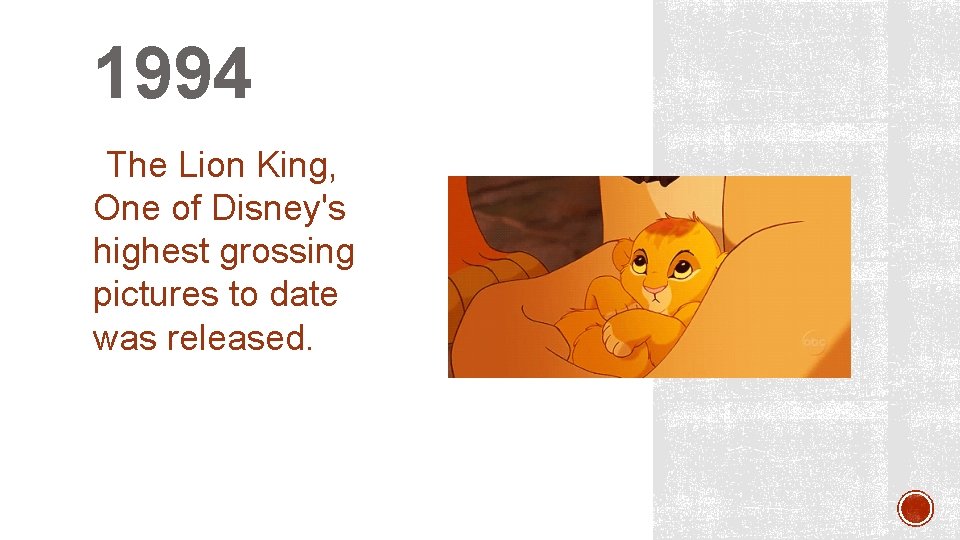
1994 • The Lion King, One of Disney's highest grossing pictures to date was released. • Dream. Works studio formed.
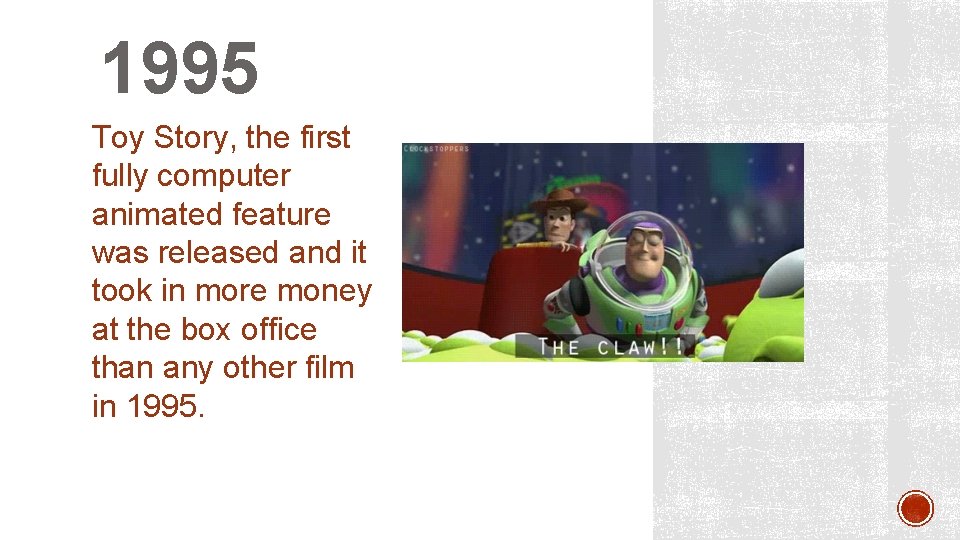
1995 Toy Story, the first fully computer animated feature was released and it took in more money at the box office than any other film in 1995.
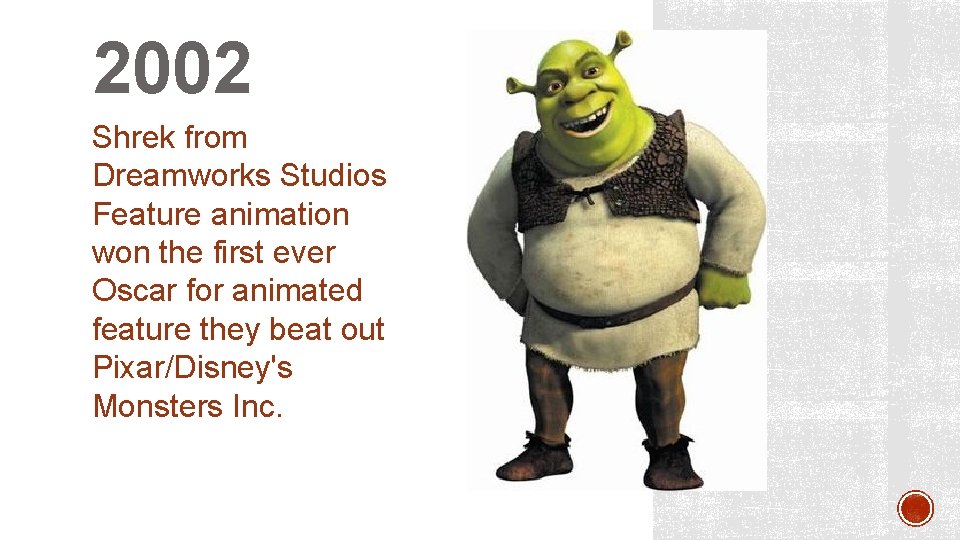
2002 Shrek from Dreamworks Studios Feature animation won the first ever Oscar for animated feature they beat out Pixar/Disney's Monsters Inc.
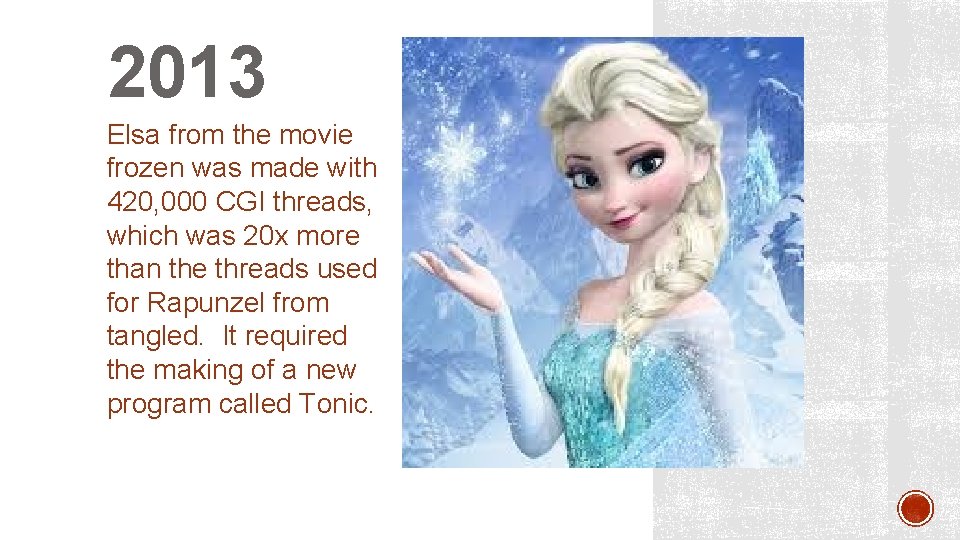
2013 Elsa from the movie frozen was made with 420, 000 CGI threads, which was 20 x more than the threads used for Rapunzel from tangled. It required the making of a new program called Tonic.
§ There are several examples of early sequential images that may seem similar to series of animation drawings. Most of these examples would only allow an extremely low frame rate when they are animated, resulting in short and crude animations that are not very lifelike. However, it's very unlikely that these images were intended to be somehow viewed as an animation. It is possible to imagine technology that could have been used in the periods of their creation, but no conclusive evidence in artifacts or descriptions have been found. It is sometimes argued that these early sequential images are too easily interpreted as "pre-cinema" by minds accustomed to film, comic books and other modern sequential images, while it is uncertain that the creators of these images envisioned anything like it. The notion of instances smaller than a second that are necessary to break down an action into sufficient phases for fluent animation would not really develop before the 19 th century.
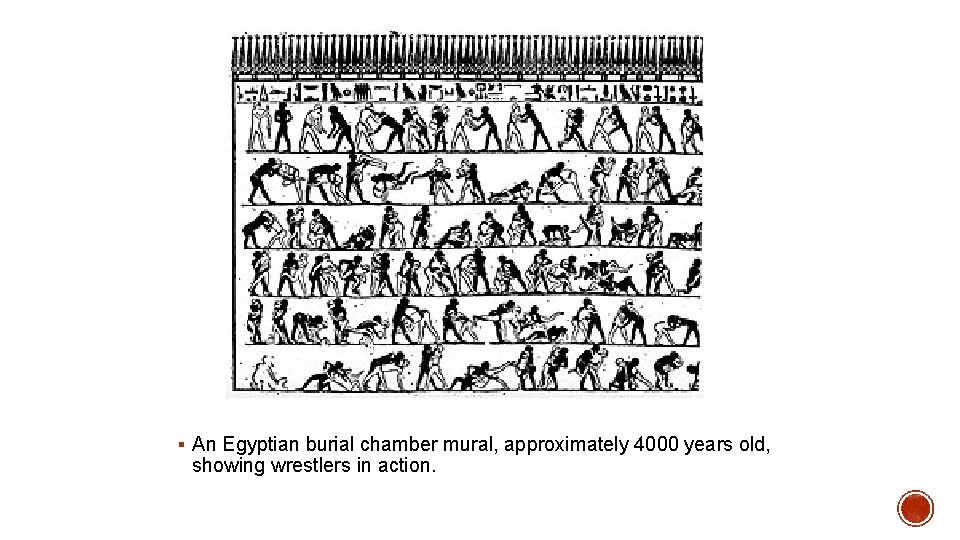
§ An Egyptian burial chamber mural, approximately 4000 years old, showing wrestlers in action.
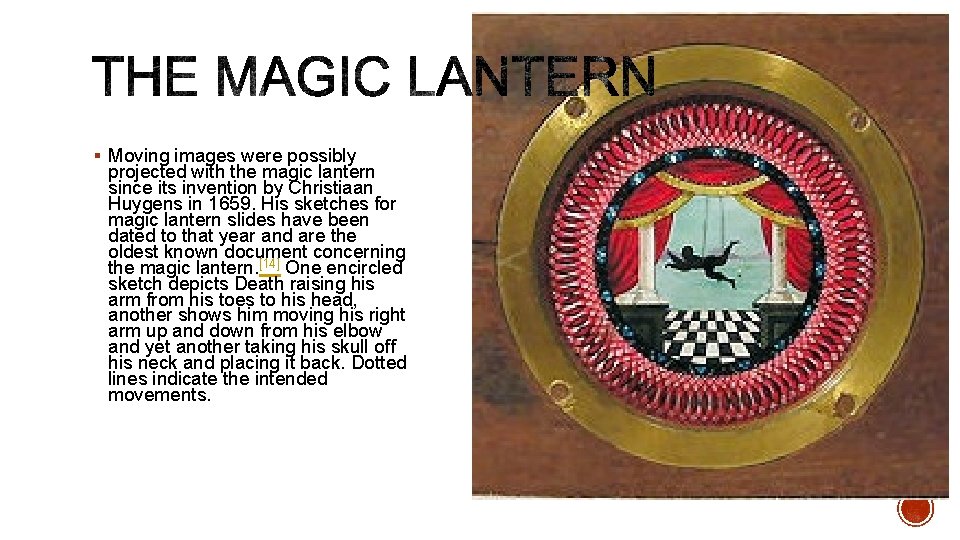
§ Moving images were possibly projected with the magic lantern since its invention by Christiaan Huygens in 1659. His sketches for magic lantern slides have been dated to that year and are the oldest known document concerning the magic lantern. [14] One encircled sketch depicts Death raising his arm from his toes to his head, another shows him moving his right arm up and down from his elbow and yet another taking his skull off his neck and placing it back. Dotted lines indicate the intended movements.
• An article in the Quarterly Journal of Science, Literature, and The Arts (1821) raised some interest in optical illusions of curved spokes in rotating wheels seen through vertical apertures. In 1824 Peter Mark Roget provided mathematical details about the appearing curvatures and added the observation that the spokes appeared motionless. Roget claimed that the illusion is due to the fact “that an impression made by a pencil of rays on the retina, if sufficiently vivid, will remain for a certain time after the cause has ceased. • This was later seen as the basis for theory of "persistence of vision" as the principle of how we see film as motion rather than the successive stream of still images actually presented to the eye. This theory has been discarded as the (sole) principle of the effect since 1912, but remains in many film history explanations. However, Roget's experiments and explanation did inspire some further research by Michael Faraday and also by Joseph Plateau that would eventually bring about the invention of animation.
§ In April 1825 the first Thaumatrope was published by W. Phillips (in anonymous association with John Ayrton Paris) and became a very popular toy. The pictures on either side of a small cardboard disc seem to blend into one combined image when it is twirled quickly by the attached strings. This is often used as an illustration of what has often been called "persistence of vision" (scientifically better known as positive afterimages). Although a thaumatrope can also be used for two-phase animation, no examples are known to have been produced with this effect until long after the phénakisticope had established the principle of animation.
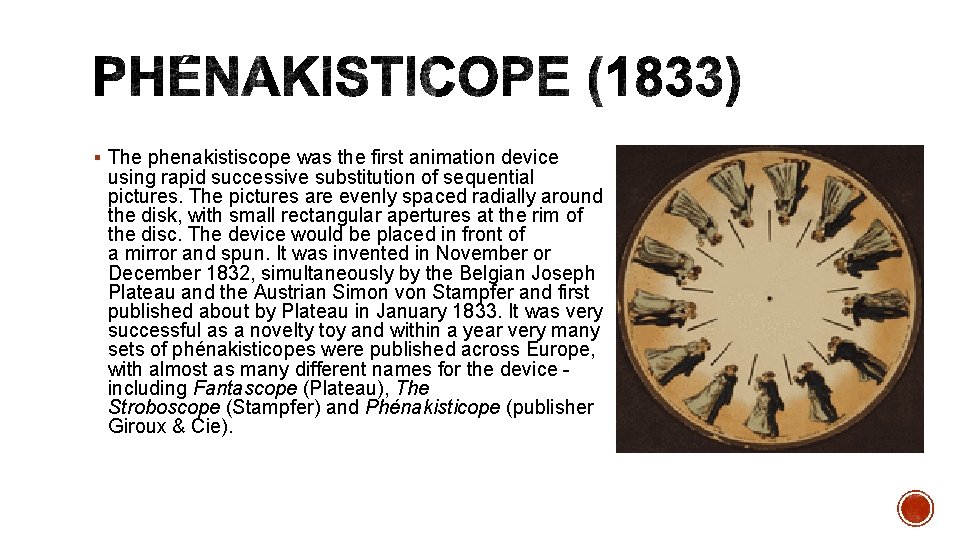
§ The phenakistiscope was the first animation device using rapid successive substitution of sequential pictures. The pictures are evenly spaced radially around the disk, with small rectangular apertures at the rim of the disc. The device would be placed in front of a mirror and spun. It was invented in November or December 1832, simultaneously by the Belgian Joseph Plateau and the Austrian Simon von Stampfer and first published about by Plateau in January 1833. It was very successful as a novelty toy and within a year very many sets of phénakisticopes were published across Europe, with almost as many different names for the device including Fantascope (Plateau), The Stroboscope (Stampfer) and Phénakisticope (publisher Giroux & Cie).
§ In July 1833 Simon Stampfer described the possibility of using the stroboscope principle in a cylinder (as well as on looped strips) in a pamphlet accompanying the second edition of his version of the phénakisticope. British mathematician William George Horner suggested a cylindrical variation of Plateau's phénakisticope in January 1834. Horner planned to publish this Dædaleum with optician King, Jr in Bristol but it "met with some impediment probably in the sketching of the figures"
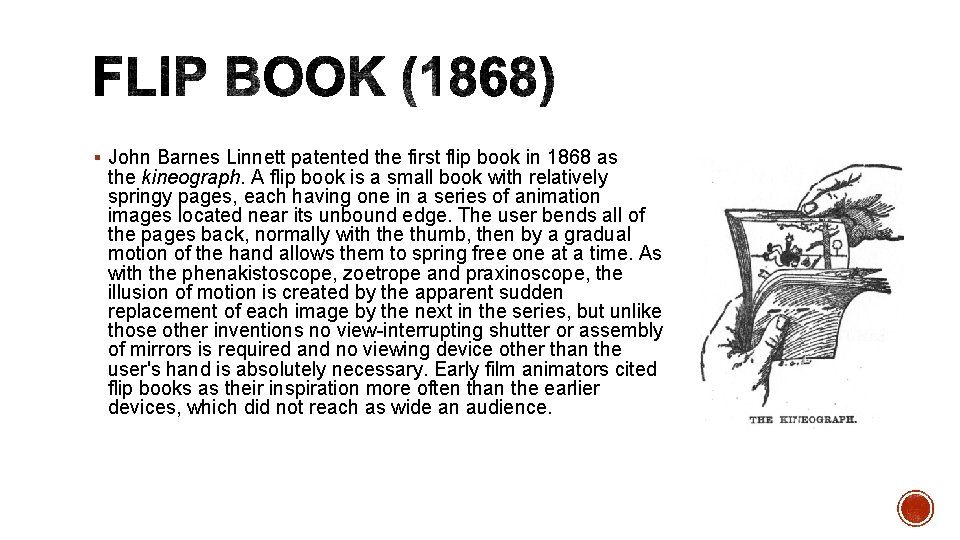
§ John Barnes Linnett patented the first flip book in 1868 as the kineograph. A flip book is a small book with relatively springy pages, each having one in a series of animation images located near its unbound edge. The user bends all of the pages back, normally with the thumb, then by a gradual motion of the hand allows them to spring free one at a time. As with the phenakistoscope, zoetrope and praxinoscope, the illusion of motion is created by the apparent sudden replacement of each image by the next in the series, but unlike those other inventions no view-interrupting shutter or assembly of mirrors is required and no viewing device other than the user's hand is absolutely necessary. Early film animators cited flip books as their inspiration more often than the earlier devices, which did not reach as wide an audience.
§ French inventor Charles-Émile Reynaud developed the Praxinoscope in 1876 and patented it in 1877. ] It is similar to the zoetrope but instead of the slits in the cylinder it has twelve rectangular mirrors placed evenly around the center of the cylinder. Each mirror reflects another image of the picture strip placed opposite on the inner wall of the cylinder. When rotating the praxinoscope shows the sequential images one by one, resulting in a fluent animation. The praxinoscope allowed a much clearer view of the moving image compared to the zoetrope, since the zoetrope's images were actually mostly obscured by the spaces in between its slits. In 1879 Reynaude registered a modification to the praxinoscope patent to include the Praxinoscope Théâtre, which utilized the Pepper's ghost effect to present the animated figures in an exchangeable background. Later improvements included the "Praxinoscope à projection" (marketed since 1882) which used a double magic lantern to project the animated figures over a till projection of a background.
§ Charles-Émile Reynaud further developed his projection praxinoscope into the Théâtre Optique with transparent pictures in a long strip wound between two spools, patented in December 1888. On October 28, 1892 he gave his first public performance of a moving picture show at the Musée Grévin in Paris. The show, billed as Pantomimes Lumineuses, included three cartoons: Pauvre Pierrot, Un bock, and Le Clown et ses chiens. Reynaud acted as the projectionist and the show was accompanied by a piano player. Although the films shown by the Lumière Brothers in 1895 eclipsed it, the show stayed at the Musée Grévin until 1900 and over 500, 000 people had seen it.
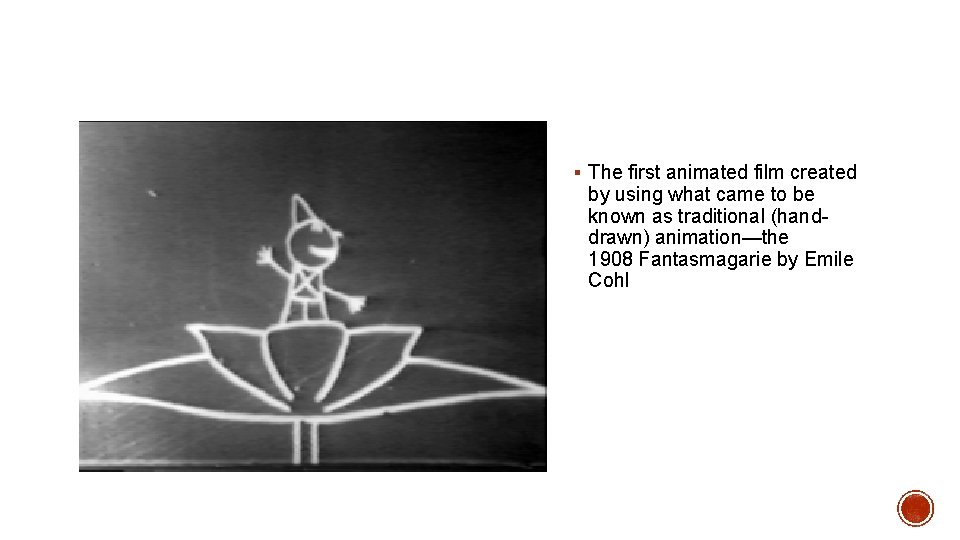
§ The first animated film created by using what came to be known as traditional (handdrawn) animation—the 1908 Fantasmagarie by Emile Cohl
§ Charles-Émile Reynaud's Theathre Optique is the earliest known example of projected animation. It predates even photographic motion picture devices such as Thomas Edison's 1893 invention, the Kinetoscope, and the Lumière brothers' 1894 invention, the cinematograph. Reynaud exhibited three of his animations on October 28, 1892 at Musée Grévin in Paris, France. The only surviving example of these three is Pauvre Pierrot, which was 500 frames long. § After the cinematograph popularized the motion picture, producers began to explore the endless possibilities of animation in greater depth. A short stop-motion animation was produced in 1897 by Albert E. Smith and J. Stuart Blackton called The Humpty Dumpty Circus. Stop motion is a technique in which real objects are moved around in the time between their images being recorded, so that when the images are viewed at a normal frame rate the objects appear to move by some invisible force. It directly descends from various early trick film techniques that created the illusion of impossible actions.
§ A few other films that featured stop motion technique were released afterward, but the first to receive wide scale appreciation was Blackton's The Haunted Hotel, which baffled viewers and inspired much further development. In 1906, Blackton also made the first drawn work of animation on standard film, Humorous Phases of Funny Faces. It features faces that are drawn on a chalkboard and then suddenly move autonomously. § Fantasmagarie , by the French director Emile Cohl(also called Émile Courtet), is also noteworthy. It was screened for the first time on August 17, 1908 at Théâtre du Gymnase in Paris. Cohl later went to Fort Lee, New Jersey near New York City in 1912, where he worked for French studio Éclair and spread its animation technique to the US.
§ In 1914, American cartoonist Winsor Mc. Cay released Gertie the Dinosaur, an early example of character development in drawn animation. The film was made for Mc. Cay's vaudeville act and as it played Mc. Cay would speak to Gertie who would respond with a series of gestures. There was a scene at the end of the film where Mc. Cay walked behind the projection screen and a view of him appears on the screen showing him getting on the cartoon dinosaur's back and riding out of frame. This scene made Gertie the Dinosaurthe first film to combine live action footage with hand drawn animation. Mc. Cay hand-drew almost every one of the 10, 000 drawings he used for the film.
§ In 1923, a studio called Laugh-O-Grams went bankrupt and its owner, Walt Disney, opened a new studio in Los Angeles. Disney's first project was the Alice Comedies series, which featured a live action girl interacting with numerous cartoon characters. Disney's first notable breakthrough was 1928's Steamboat Willie, the third of the Mickey Mouse series. It was the first cartoon that included a fully post-produced soundtrack, featuring voice and sound effects printed on the film itself ("sound-onfilm"). The short film showed an anthropomorphic mouse named Mickey neglecting his work on a steamboat to instead make music using the animals aboard the boat
§ Many consider Walt Disney's 1937 Snow White and the Seven Dwarfs the first animated feature film, though at least seven films were released earlier. However, Disney's film was the first one completely made using hand-drawn animation. The previous seven films, of which only four survive, were made using cutout, silhouette or stop motion, except for one—also made by Disney seven months prior to Snow White's release—Academy Award Review of Walt Disney Cartoons. This was an anthology film to promote the upcoming release of Snow White. However, many do not consider this a genuine feature film because it is a package film. In addition, at approximately 41 minutes, the film does not seem to fulfill today's expectations for a feature film. However, the official BFI, AMPAS and AFI definitions of a feature film require that it be over 40 minutes long, which, in theory, should make it the first animated feature film using traditional animation.
§ Color television was introduced to the US Market in 1951. In 1958, Hanna- Barbera released The Huckleberry Hound Show, the first half-hour television program to feature only animation. Terrytoons released Tom Terrificthe same year. In 1960, Hanna-Barbera released another monumental animated television show, The Flintstones, which was the first animated series on prime television. Television significantly decreased public attention to the animated shorts being shown in theatres.
References • • • • • http: //animation. filmtv. ucla. edu/New. Site/Web. Pages/Histories. htm https: //www. youtube. com/watch? v=Q 3 bbs. DJWl. XQ http: //en. wikipedia. org/wiki/Film_stock http: //www. pinterest. com/pin/529102656193938120/ http: //movie. douban. com/subject/4059057/ http: //automanga. sourceforge. net/Doc/node 3. html http: //my. smithmicro. com/tutorials/2360. html http: //www. business 2 community. com/social-buzz/x-well-known-cats-worldcatday-0970104 http: //en. wikipedia. org/wiki/Laugh-O-Gram_Studio http: //archives. frederatorblogs. com/refrederator/2006/07/20/turning-chicken/ http: //gifsoup. com/view/386773/steamboat-willie-ducky. html http: //archives. frederatorblogs. com/refrederator/category/uncategorized/page/7/ https: //www. tumblr. com/search/merrie+melodies http: //rebloggy. com/post/gif-tree-disney-shorts-dance-flowers-30 s-1932 -silly-symphonies-oscarwinner/43529002709 http: //mycinderelladreams. tumblr. com/page/2 http: //www. pictureshowman. com/articles_genhist_censorship. cfm http: //ficoforums. myfico. com/t 5/media/v 2/gallerypage/user-id/459194/image-id/2045 i 45 CAD 232 D 6243 C 3 A http: //giphy. com/gifs/4 f. WIFukyf 7 vo. Y http: //theworldofcomputingcomp 1220 uwi. weebly. com/ivan-sutherland. html
References Cont. • • • http: //www. biography. com/people/walt-disney-9275533 http: //www. imdb. com/title/tt 0066769/ http: //www. imdb. com/title/tt 0084827/ http: //weheartit. com/entry/37253425 http: //www. imdb. com/title/tt 0096438/ http: //www. rankopedia. com/Best-Disney-Pixar-Production/Candidate. Data/19468/. htm http: //rebloggy. com/post/adventure-time-cartoon-network-not-my-gif/38550362974 http: //www. socialphy. com/posts/images-pics/16740/The-Lion-King-Gifs. html http: //en. wikipedia. org/wiki/Shrek_(character) http: //www. comicvine. com/forums/battles-7/sub-zero-vs-elsa-1541881/ http: //lifeofkj. tumblr. com/post/50709673214/on-popularity-and-the-claw
- Slides: 53