
HISTORY OF ANIMATION John Emmanuel C Marquez BFA3
HISTORY OF ANIMATION John Emmanuel C. Marquez BFA-3 A
ANIMATION is the process of making the illusion of motion and the illusion of change by means of the rapid display of a sequence of images that minimally differ from each other.
EARLY APPROACHES TO MOTION IN ART There are several examples of early sequential images that may seem similar to series of animation drawings. Most of these examples would only allow an extremely low frame rate when they are animated, resulting in short and crude animations that are not very lifelike. However, it's very unlikely that these images were intended to be somehow viewed as an animation. It is possible to imagine technology that could have been used in the periods of their creation, but no conclusive evidence in artifacts or descriptions have been found. It is sometimes argued that these early sequential images are too easily interpreted as "pre-cinema" by minds accustomed to film, comic books and other modern sequential images, while it is uncertain that the creators of these images envisioned anything like it. The notion of instances smaller than a second that are necessary to break down an action into sufficient phases for fluent animation would not really develop before the 19 th century.
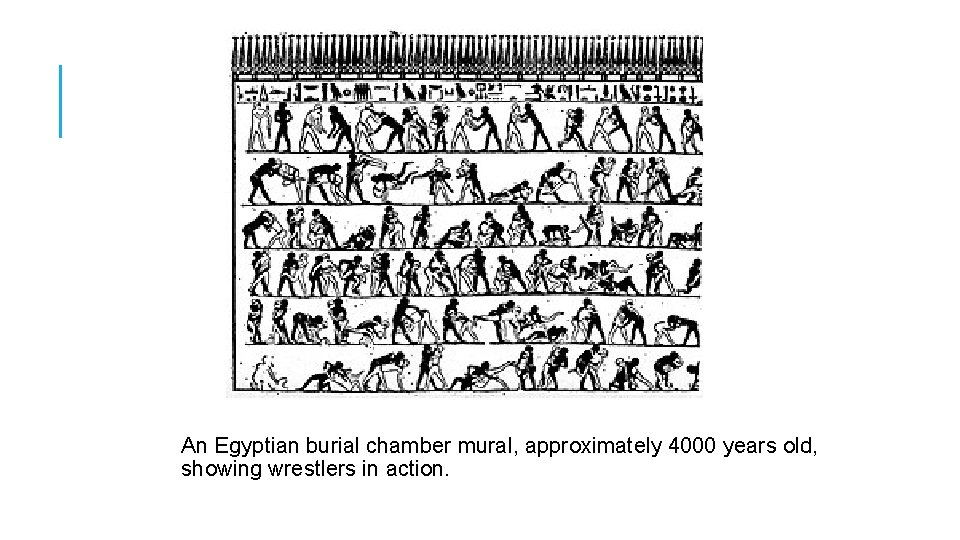
An Egyptian burial chamber mural, approximately 4000 years old, showing wrestlers in action.
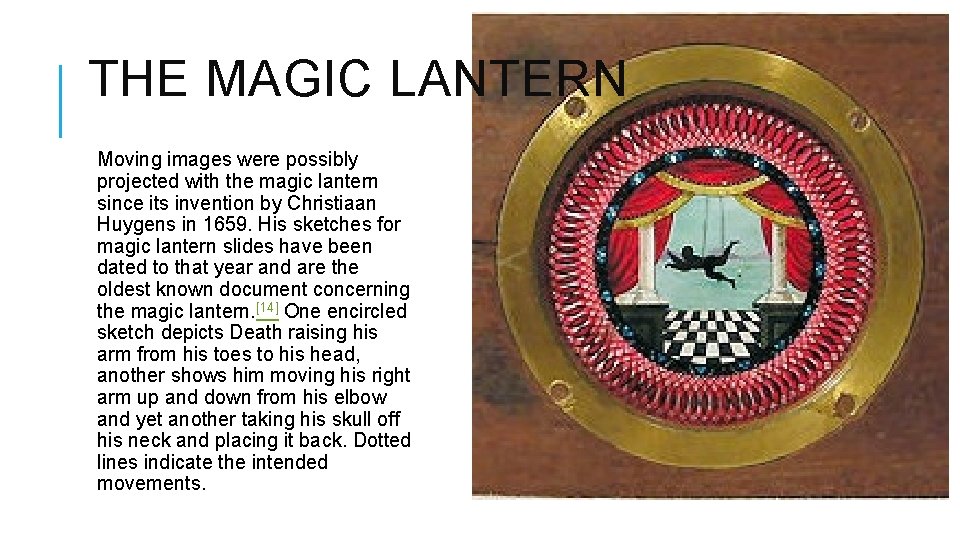
THE MAGIC LANTERN Moving images were possibly projected with the magic lantern since its invention by Christiaan Huygens in 1659. His sketches for magic lantern slides have been dated to that year and are the oldest known document concerning the magic lantern. [14] One encircled sketch depicts Death raising his arm from his toes to his head, another shows him moving his right arm up and down from his elbow and yet another taking his skull off his neck and placing it back. Dotted lines indicate the intended movements.
ANIMATION BEFORE FILM
PRELUDE • An article in the Quarterly Journal of Science, Literature, and The Arts (1821) raised some interest in optical illusions of curved spokes in rotating wheels seen through vertical apertures. In 1824 Peter Mark Roget provided mathematical details about the appearing curvatures and added the observation that the spokes appeared motionless. Roget claimed that the illusion is due to the fact “that an impression made by a pencil of rays on the retina, if sufficiently vivid, will remain for a certain time after the cause has ceased. • This was later seen as the basis for theory of "persistence of vision" as the principle of how we see film as motion rather than the successive stream of still images actually presented to the eye. This theory has been discarded as the (sole) principle of the effect since 1912, but remains in many film history explanations. However, Roget's experiments and explanation did inspire some further research by Michael Faraday and also by Joseph Plateau that would eventually bring about the invention of animation.
THAUMATROPE (1825) In April 1825 the first Thaumatrope was published by W. Phillips (in anonymous association with John Ayrton Paris) and became a very popular toy. The pictures on either side of a small cardboard disc seem to blend into one combined image when it is twirled quickly by the attached strings. This is often used as an illustration of what has often been called "persistence of vision" (scientifically better known as positive afterimages). Although a thaumatrope can also be used for two-phase animation, no examples are known to have been produced with this effect until long after the phénakisticope had established the principle of animation.

PHÉNAKISTICOPE (1833) The phenakistiscope was the first animation device using rapid successive substitution of sequential pictures. The pictures are evenly spaced radially around the disk, with small rectangular apertures at the rim of the disc. The device would be placed in front of a mirror and spun. It was invented in November or December 1832, simultaneously by the Belgian Joseph Plateau and the Austrian Simon von Stampfer and first published about by Plateau in January 1833. It was very successful as a novelty toy and within a year very many sets of phénakisticopes were published across Europe, with almost as many different names for the device including Fantascope (Plateau), The Stroboscope (Stampfer) and Phénakisticope (publisher Giroux & Cie).
ZOETROPE (1866) In July 1833 Simon Stampfer described the possibility of using the stroboscope principle in a cylinder (as well as on looped strips) in a pamphlet accompanying the second edition of his version of the phénakisticope. British mathematician William George Horner suggested a cylindrical variation of Plateau's phénakisticope in January 1834. Horner planned to publish this Dædaleum with optician King, Jr in Bristol but it "met with some impediment probably in the sketching of the figures"
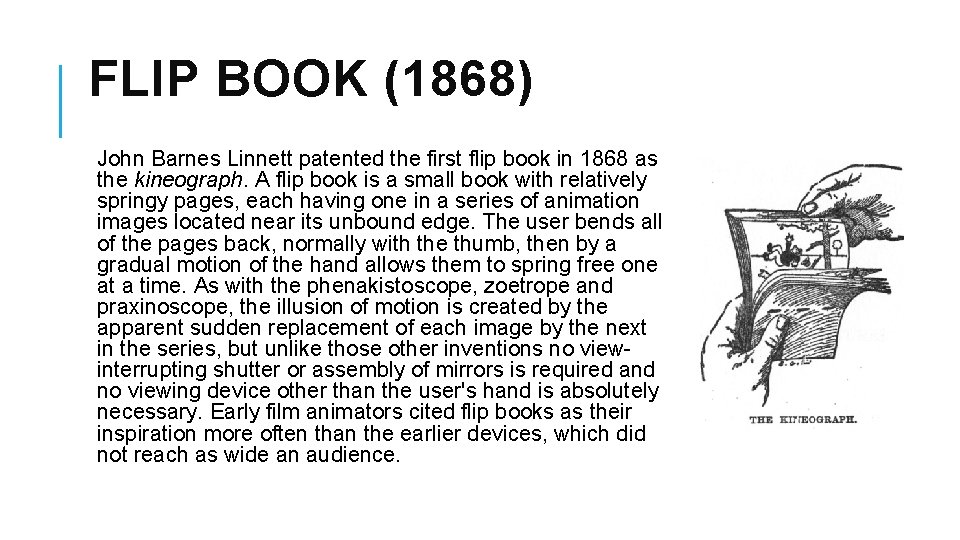
FLIP BOOK (1868) John Barnes Linnett patented the first flip book in 1868 as the kineograph. A flip book is a small book with relatively springy pages, each having one in a series of animation images located near its unbound edge. The user bends all of the pages back, normally with the thumb, then by a gradual motion of the hand allows them to spring free one at a time. As with the phenakistoscope, zoetrope and praxinoscope, the illusion of motion is created by the apparent sudden replacement of each image by the next in the series, but unlike those other inventions no viewinterrupting shutter or assembly of mirrors is required and no viewing device other than the user's hand is absolutely necessary. Early film animators cited flip books as their inspiration more often than the earlier devices, which did not reach as wide an audience.
PRAXINOSCOPE (1877) French inventor Charles-Émile Reynaud developed the Praxinoscope in 1876 and patented it in 1877. ] It is similar to the zoetrope but instead of the slits in the cylinder it has twelve rectangular mirrors placed evenly around the center of the cylinder. Each mirror reflects another image of the picture strip placed opposite on the inner wall of the cylinder. When rotating the praxinoscope shows the sequential images one by one, resulting in a fluent animation. The praxinoscope allowed a much clearer view of the moving image compared to the zoetrope, since the zoetrope's images were actually mostly obscured by the spaces in between its slits. In 1879 Reynaude registered a modification to the praxinoscope patent to include the Praxinoscope Théâtre, which utilized the Pepper's ghost effect to present the animated figures in an exchangeable background. Later improvements included the "Praxinoscope à projection" (marketed since 1882) which used a double magic lantern to project the animated figures over a till projection of a background.

EARLIEST ANIMATIONS ON FILM
THÉ TRE OPTIQUE Charles-Émile Reynaud further developed his projection praxinoscope into the Théâtre Optique with transparent pictures in a long strip wound between two spools, patented in December 1888. On October 28, 1892 he gave his first public performance of a moving picture show at the Musée Grévin in Paris. The show, billed as Pantomimes Lumineuses, included three cartoons: Pauvre Pierrot, Un bock, and Le Clown et ses chiens. Reynaud acted as the projectionist and the show was accompanied by a piano player. Although the films shown by the Lumière Brothers in 1895 eclipsed it, the show stayed at the Musée Grévin until 1900 and over 500, 000 people had seen it.
TRADITIONAL ANIMATION
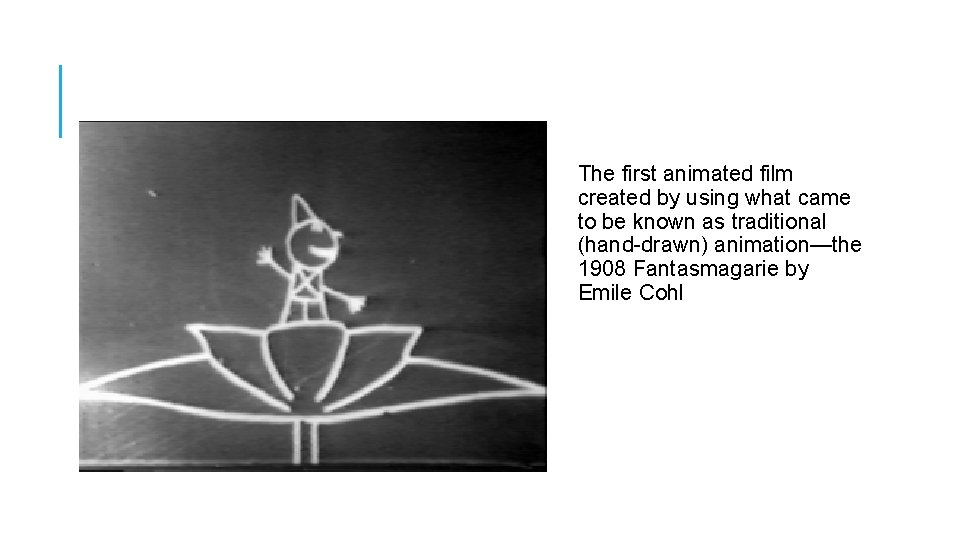
The first animated film created by using what came to be known as traditional (hand-drawn) animation—the 1908 Fantasmagarie by Emile Cohl
THE SILENT ERA §Charles-Émile Reynaud's Theathre Optique is the earliest known example of projected animation. It predates even photographic motion picture devices such as Thomas Edison's 1893 invention, the Kinetoscope, and the Lumière brothers' 1894 invention, the cinematograph. Reynaud exhibited three of his animations on October 28, 1892 at Musée Grévin in Paris, France. The only surviving example of these three is Pauvre Pierrot, which was 500 frames long. §After the cinematograph popularized the motion picture, producers began to explore the endless possibilities of animation in greater depth. A short stop-motion animation was produced in 1897 by Albert E. Smith and J. Stuart Blackton called The Humpty Dumpty Circus. Stop motion is a technique in which real objects are moved around in the time between their images being recorded, so that when the images are viewed at a normal frame rate the objects appear to move by some invisible force. It directly descends from various early trick film techniques that created the illusion of impossible actions.
THE SILENT ERA §A few other films that featured stop motion technique were released afterward, but the first to receive wide scale appreciation was Blackton's The Haunted Hotel, which baffled viewers and inspired much further development. In 1906, Blackton also made the first drawn work of animation on standard film, Humorous Phases of Funny Faces. It features faces that are drawn on a chalkboard and then suddenly move autonomously. §Fantasmagarie , by the French director Emile Cohl(also called Émile Courtet), is also noteworthy. It was screened for the first time on August 17, 1908 at Théâtre du Gymnase in Paris. Cohl later went to Fort Lee, New Jersey near New York City in 1912, where he worked for French studio Éclair and spread its animation technique to the US.
THE SILENT ERA In 1914, American cartoonist Winsor Mc. Cay released Gertie the Dinosaur, an early example of character development in drawn animation. The film was made for Mc. Cay's vaudeville act and as it played Mc. Cay would speak to Gertie who would respond with a series of gestures. There was a scene at the end of the film where Mc. Cay walked behind the projection screen and a view of him appears on the screen showing him getting on the cartoon dinosaur's back and riding out of frame. This scene made Gertie the Dinosaurthe first film to combine live action footage with hand drawn animation. Mc. Cay hand-drew almost every one of the 10, 000 drawings he used for the film.
WALT DISNEY & WARNER BROS In 1923, a studio called Laugh-O-Grams went bankrupt and its owner, Walt Disney, opened a new studio in Los Angeles. Disney's first project was the Alice Comedies series, which featured a live action girl interacting with numerous cartoon characters. Disney's first notable breakthrough was 1928's Steamboat Willie, the third of the Mickey Mouse series. It was the first cartoon that included a fully post-produced soundtrack, featuring voice and sound effects printed on the film itself ("sound-on-film"). The short film showed an anthropomorphic mouse named Mickey neglecting his work on a steamboat to instead make music using the animals aboard the boat
SNOW WHITE AND THE SEVEN DWARFS Many consider Walt Disney's 1937 Snow White and the Seven Dwarfs the first animated feature film, though at least seven films were released earlier. However, Disney's film was the first one completely made using hand -drawn animation. The previous seven films, of which only four survive, were made using cutout, silhouette or stop motion, except for one—also made by Disney seven months prior to Snow White's release—Academy Award Review of Walt Disney Cartoons. This was an anthology film to promote the upcoming release of Snow White. However, many do not consider this a genuine feature film because it is a package film. In addition, at approximately 41 minutes, the film does not seem to fulfill today's expectations for a feature film. However, the official BFI, AMPAS and AFI definitions of a feature film require that it be over 40 minutes long, which, in theory, should make it the first animated feature film using traditional animation.
THE TELEVISION ERA Color television was introduced to the US Market in 1951. In 1958, Hanna. Barbera released The Huckleberry Hound Show, the first half-hour television program to feature only animation. Terrytoons released Tom Terrificthe same year. In 1960, Hanna-Barbera released another monumental animated television show, The Flintstones, which was the first animated series on prime television. Television significantly decreased public attention to the animated shorts being shown in theatres.
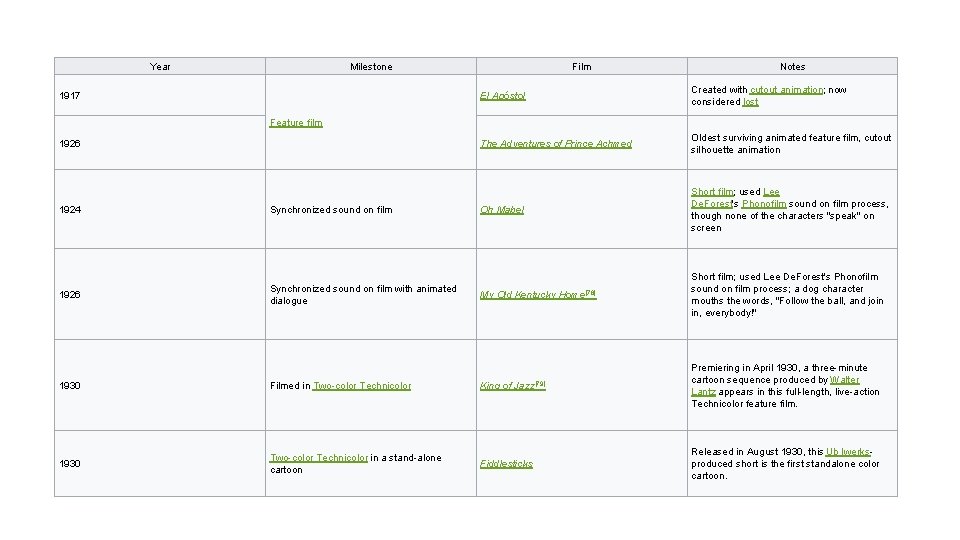
Year Milestone 1917 Film Notes El Apóstol Created with cutout animation; now considered lost The Adventures of Prince Achmed Oldest surviving animated feature film, cutout silhouette animation Oh Mabel Short film; used Lee De. Forest's Phonofilm sound on film process, though none of the characters "speak" on screen My Old Kentucky Home[78] Short film; used Lee De. Forest's Phonofilm sound on film process; a dog character mouths the words, "Follow the ball, and join in, everybody!" Feature film 1926 1924 Synchronized sound on film 1926 Synchronized sound on film with animated dialogue 1930 Filmed in Two-color Technicolor King of Jazz[79] Premiering in April 1930, a three-minute cartoon sequence produced by Walter Lantz appears in this full-length, live-action Technicolor feature film. 1930 Two-color Technicolor in a stand-alone cartoon Fiddlesticks Released in August 1930, this Ub Iwerksproduced short is the first standalone color cartoon.

1930 Feature length puppet animated (stop-motion) film The Tale of the Fox 1931 Feature-length sound film Peludópolis 1932 Filmed in three-strip Technicolor Flowers and Trees 1937 Feature filmed in three-strip Technicolor Snow White and the Seven Dwarfs 1940 Stereophonic sound Fantasia 1949 Television series Crusader Rabbit 1950 Short lived TV show The Adventures of Paddy the Pelican Filmed in stereoscopic 3 D Melody Short film Presented in widescreen Toot, Whistle, Plunk and Boom Short film Feature filmed in widescreen format Lady and the Tramp Animated TV series to aired outside of USA A Rubovian Legend Stop-motion television series The Gumby Show[80] 1956 Primetime television series CBS Cartoon Theatre Compilation television series 1957 Television series to be broadcast in color Colonel Bleep Television series 1958 Half-hour television series The Huckleberry Hound Show 1959 Animated series to have its production outsourced to an overseas company Rocky and His Friends/The Bullwinkle Show Television series Syncro-Vox Clutch Cargo Television series Short film 1953 1955
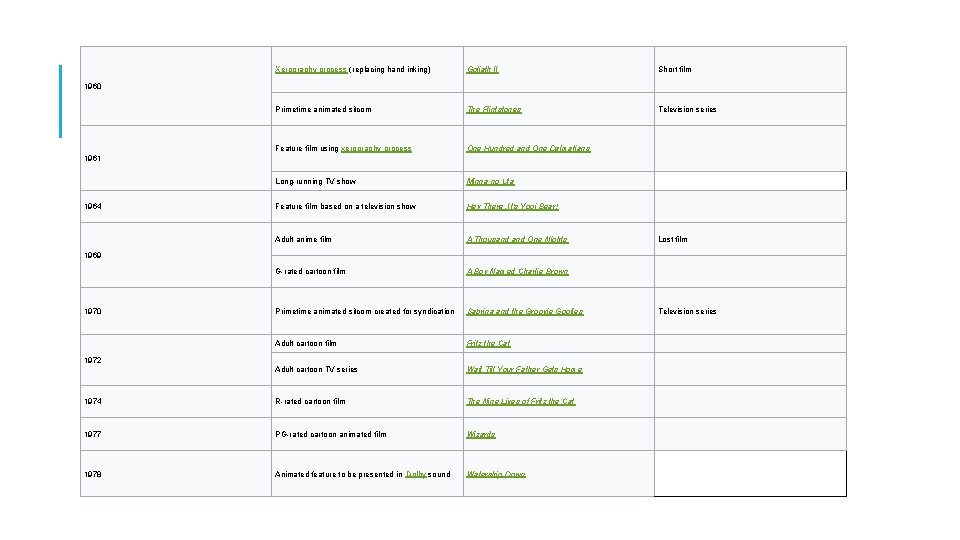
Xerography process (replacing hand inking) Goliath II Short film Primetime animated sitcom The Flintstones Television series Feature film using xerography process One Hundred and One Dalmatians Long-running TV show Minna no Uta Feature film based on a television show Hey There, It's Yogi Bear! Adult anime film A Thousand One Nights G-rated cartoon film A Boy Named Charlie Brown Primetime animated sitcom created for syndication Sabrina and the Groovie Goolies Adult cartoon film Fritz the Cat Adult cartoon TV series Wait Till Your Father Gets Home 1974 R-rated cartoon film The Nine Lives of Fritz the Cat 1977 PG-rated cartoon animated film Wizards 1978 Animated feature to be presented in Dolby sound Watership Down 1960 1961 1964 Lost film 1969 1970 1972 Television series
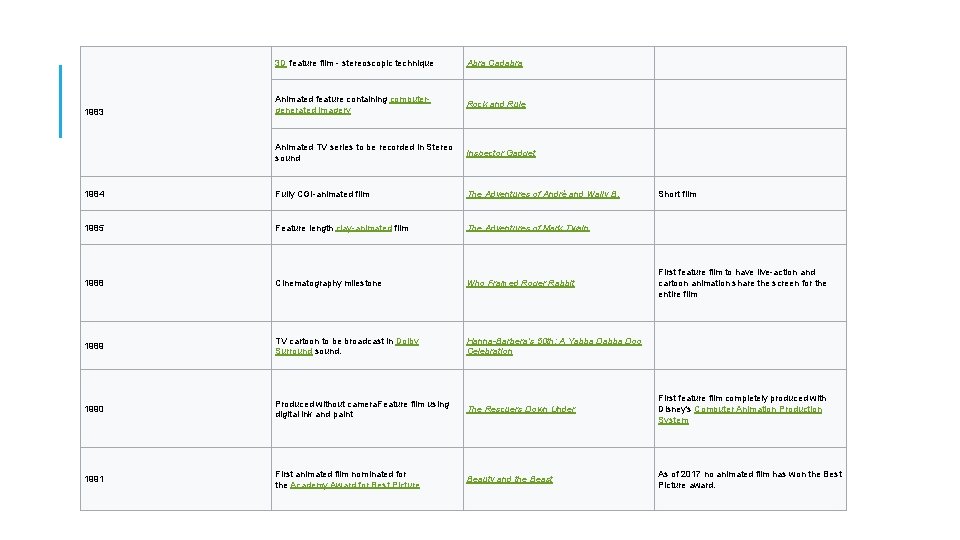
3 D feature film - stereoscopic technique Abra Cadabra Animated feature containing computergenerated imagery Rock and Rule Animated TV series to be recorded in Stereo sound Inspector Gadget 1984 Fully CGI-animated film The Adventures of André and Wally B. 1985 Feature length clay-animated film The Adventures of Mark Twain 1988 Cinematography milestone Who Framed Roger Rabbit 1989 TV cartoon to be broadcast in Dolby Surround sound. Hanna-Barbera's 50 th: A Yabba Doo Celebration 1990 Produced without camera. Feature film using digital ink and paint The Rescuers Down Under First feature film completely produced with Disney's Computer Animation Production System 1991 First animated film nominated for the Academy Award for Best Picture Beauty and the Beast As of 2017 no animated film has won the Best Picture award. 1983 Short film First feature film to have live-action and cartoon animation share the screen for the entire film

Direct-to-video CGI-animated series Veggie. Tales CGI-animated TV series Insektors Half-hour computer-animated TV series Re. Boot Fully computer-animated feature film. G-rated CGI feature film Toy Story Animated television series to be broadcast in Dolby Surround Pinky and the Brain 1997 Animated series produced for the Internet. Flash-animated series The Goddamn George Liquor Program 1998 PG-rated CGI animated film Antz 1999 IMAX Disney animated film Fantasia 2000 First Aardman Rated-G Film Chicken Run Motion-capture animation. PG-13 -rated CGI animated film Final Fantasy: The Spirits Within First Academy Award for Best Animated Feature Won by Shrek 1993 1994 1995 2001
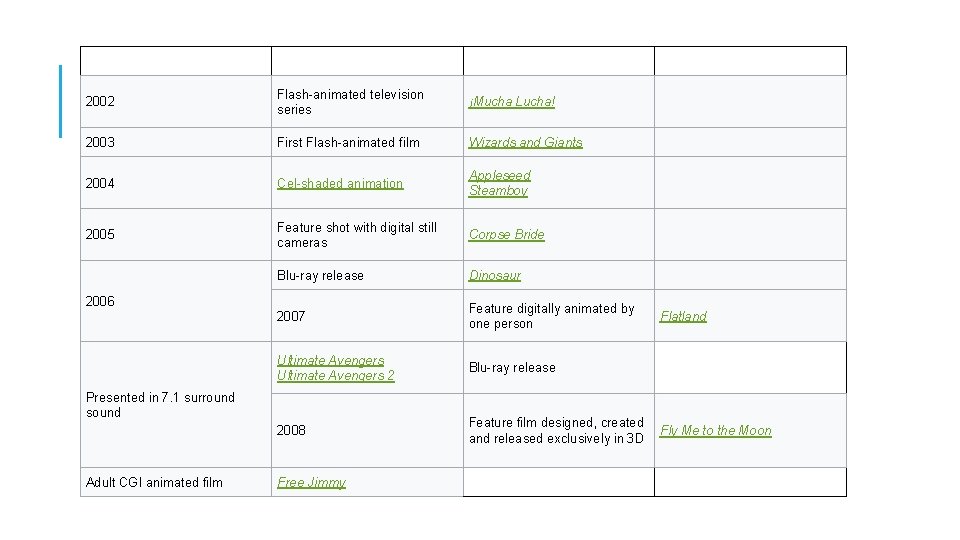
2002 Flash-animated television series ¡Mucha Lucha! 2003 First Flash-animated film Wizards and Giants 2004 Cel-shaded animation Appleseed Steamboy 2005 Feature shot with digital still cameras Corpse Bride Blu-ray release Dinosaur 2007 Feature digitally animated by one person Ultimate Avengers 2 Blu-ray release 2008 Feature film designed, created and released exclusively in 3 D 2006 Presented in 7. 1 surround sound Adult CGI animated film Free Jimmy Flatland Fly Me to the Moon
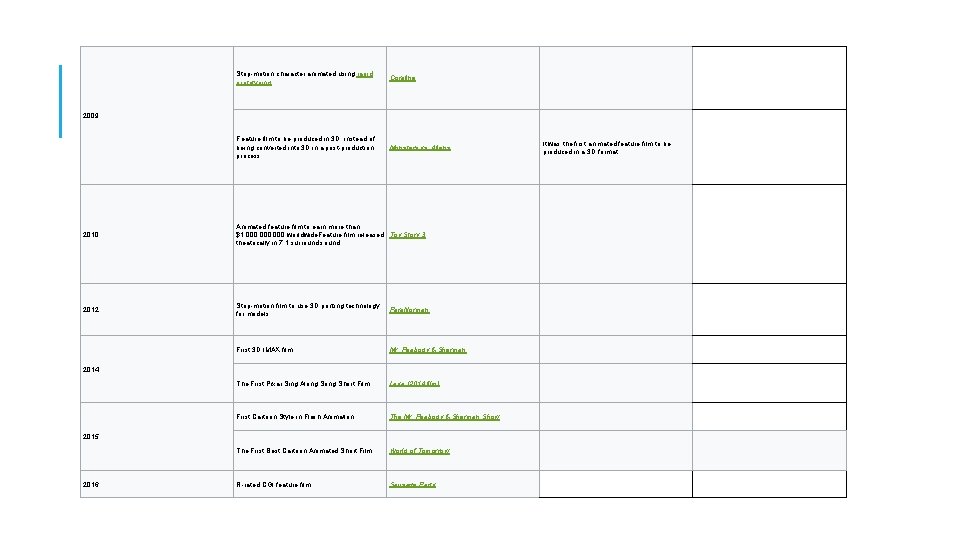
Stop-motion character animated using rapid prototyping Coraline Feature film to be produced in 3 D, instead of being converted into 3 D in a post-production process Monsters vs. Aliens 2009 2010 Animated feature film to earn more than $1, 000, 000 worldwide. Feature film released Toy Story 3 theatrically in 7. 1 surround sound 2012 Stop-motion film to use 3 D printing technology for models Para. Norman First 3 D IMAX film. Mr. Peabody & Sherman The First Pixar Sing Along Short Film Lava (2014 film) First Cartoon Style in Flash Animation The Mr. Peabody & Sherman Show The First Best Cartoon Animated Short Film World of Tomorrow R-rated CGI feature film Sausage Party 2014 2015 2016 It was the first animated feature film to be produced in a 3 D format.
- Slides: 29