
History of Animation By Tony Pisano 1824 Peter
History of Animation By Tony Pisano
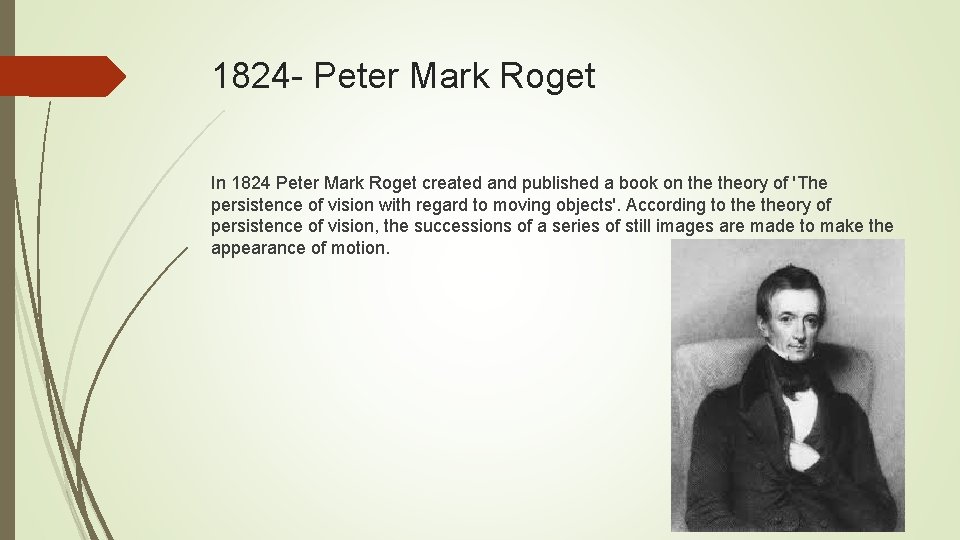
1824 - Peter Mark Roget In 1824 Peter Mark Roget created and published a book on theory of 'The persistence of vision with regard to moving objects'. According to theory of persistence of vision, the successions of a series of still images are made to make the appearance of motion.
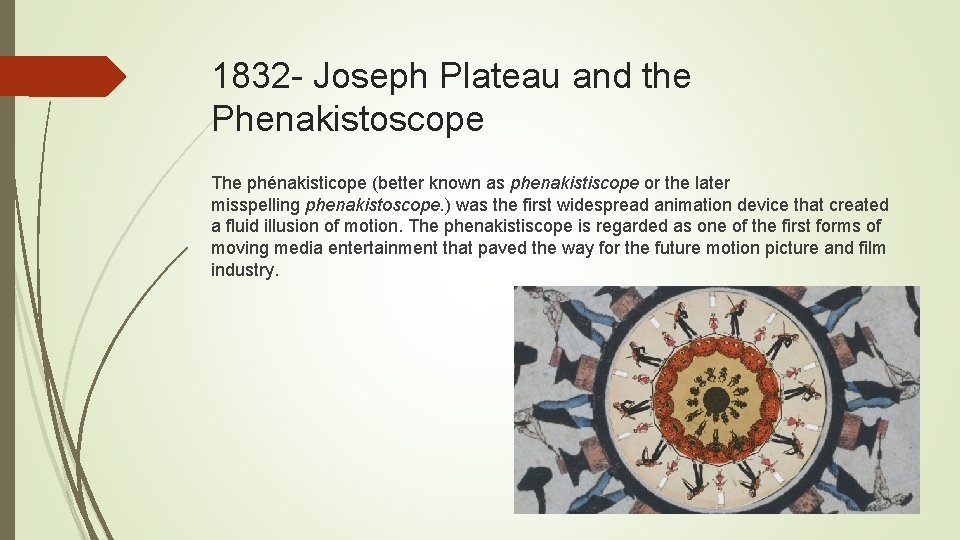
1832 - Joseph Plateau and the Phenakistoscope The phénakisticope (better known as phenakistiscope or the later misspelling phenakistoscope. ) was the first widespread animation device that created a fluid illusion of motion. The phenakistiscope is regarded as one of the first forms of moving media entertainment that paved the way for the future motion picture and film industry.
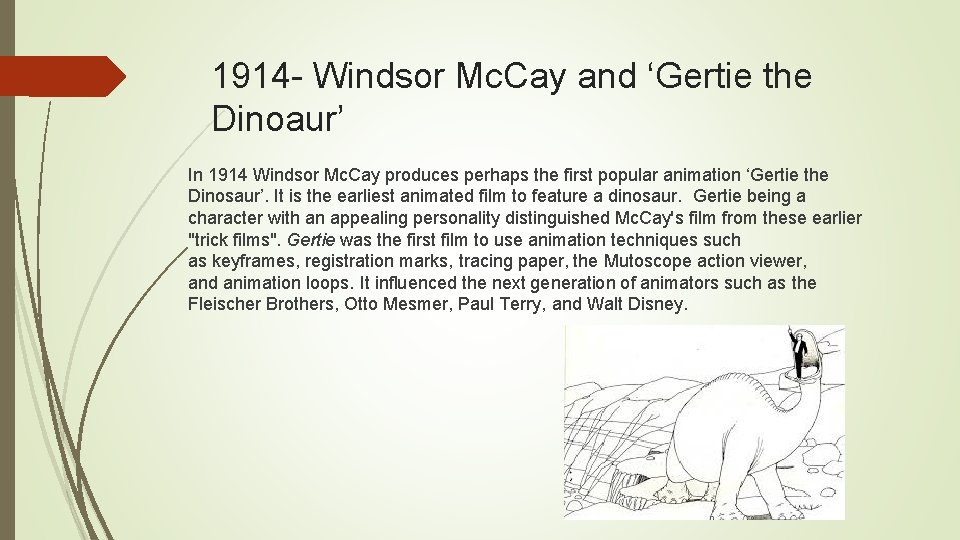
1914 - Windsor Mc. Cay and ‘Gertie the Dinoaur’ In 1914 Windsor Mc. Cay produces perhaps the first popular animation ‘Gertie the Dinosaur’. It is the earliest animated film to feature a dinosaur. Gertie being a character with an appealing personality distinguished Mc. Cay's film from these earlier "trick films". Gertie was the first film to use animation techniques such as keyframes, registration marks, tracing paper, the Mutoscope action viewer, and animation loops. It influenced the next generation of animators such as the Fleischer Brothers, Otto Mesmer, Paul Terry, and Walt Disney.

1917 - John Bray patents rotoscoping To eliminate the time-consuming task of completely redrawing the entire cartoon for each frame, Bray came up with the idea of using a printed background. Using zinc etching, hundreds of identical background scenes with the center left blank were printed on tracing paper. Bray then added the moving components of the cartoon to the blank center, thus drastically reducing the time and the number of skilled artists needed to complete an animated cartoon. The new technique was considered an improvement over fellow cartoon animator Winsor Mc. Cay's method of retracing all the lines in each frame, which often would appear to wiggle and wobble when cast on the film screen. Wishing to protect his new technique, Bray filed for his first U. S. patent, which was granted as No. 1, 107, 193. Bray, with the help of a wife whose intelligence and business sense proved to be a valuable asset, was on his way to revolutionizing the animation industry.
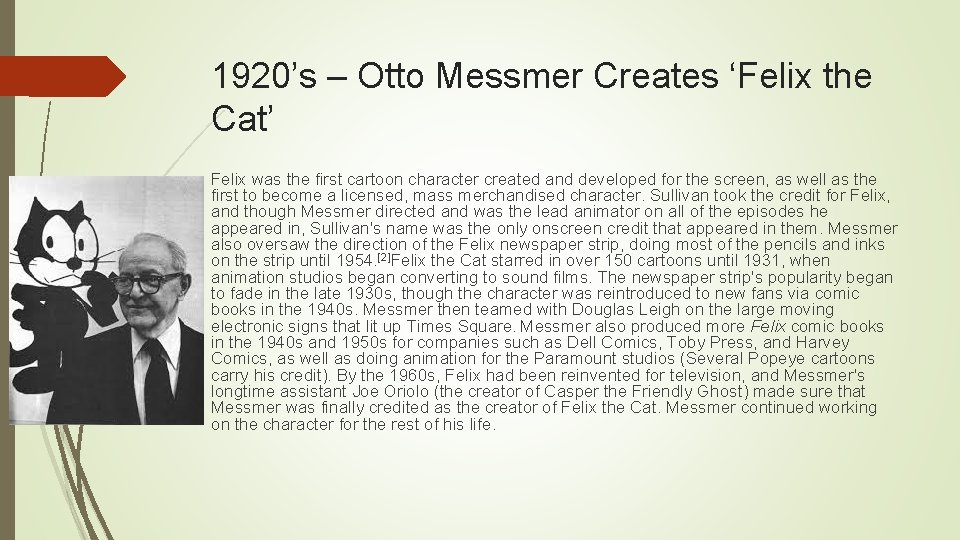
1920’s – Otto Messmer Creates ‘Felix the Cat’ Felix was the first cartoon character created and developed for the screen, as well as the first to become a licensed, mass merchandised character. Sullivan took the credit for Felix, and though Messmer directed and was the lead animator on all of the episodes he appeared in, Sullivan's name was the only onscreen credit that appeared in them. Messmer also oversaw the direction of the Felix newspaper strip, doing most of the pencils and inks on the strip until 1954. [2]Felix the Cat starred in over 150 cartoons until 1931, when animation studios began converting to sound films. The newspaper strip's popularity began to fade in the late 1930 s, though the character was reintroduced to new fans via comic books in the 1940 s. Messmer then teamed with Douglas Leigh on the large moving electronic signs that lit up Times Square. Messmer also produced more Felix comic books in the 1940 s and 1950 s for companies such as Dell Comics, Toby Press, and Harvey Comics, as well as doing animation for the Paramount studios (Several Popeye cartoons carry his credit). By the 1960 s, Felix had been reinvented for television, and Messmer's longtime assistant Joe Oriolo (the creator of Casper the Friendly Ghost) made sure that Messmer was finally credited as the creator of Felix the Cat. Messmer continued working on the character for the rest of his life.
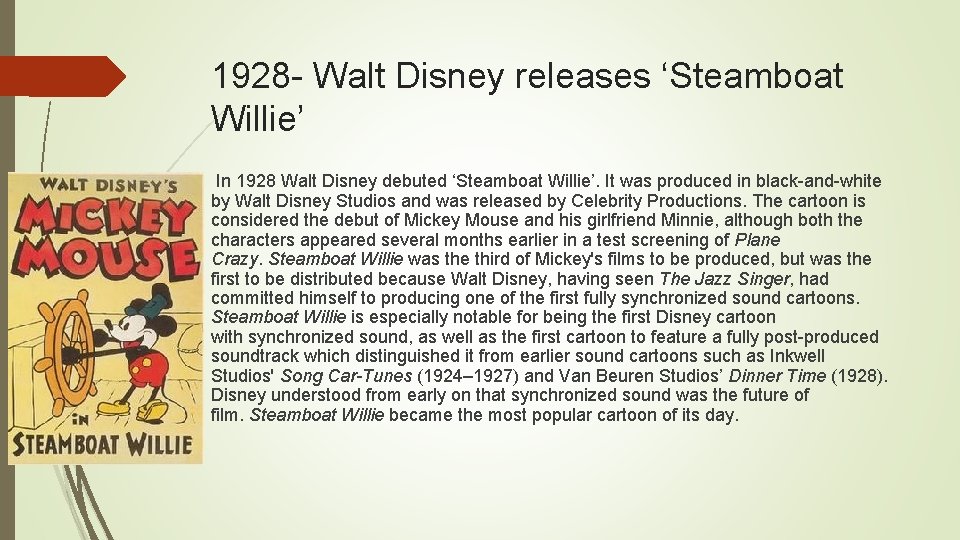
1928 - Walt Disney releases ‘Steamboat Willie’ In 1928 Walt Disney debuted ‘Steamboat Willie’. It was produced in black-and-white by Walt Disney Studios and was released by Celebrity Productions. The cartoon is considered the debut of Mickey Mouse and his girlfriend Minnie, although both the characters appeared several months earlier in a test screening of Plane Crazy. Steamboat Willie was the third of Mickey's films to be produced, but was the first to be distributed because Walt Disney, having seen The Jazz Singer, had committed himself to producing one of the first fully synchronized sound cartoons. Steamboat Willie is especially notable for being the first Disney cartoon with synchronized sound, as well as the first cartoon to feature a fully post-produced soundtrack which distinguished it from earlier sound cartoons such as Inkwell Studios' Song Car-Tunes (1924– 1927) and Van Beuren Studios’ Dinner Time (1928). Disney understood from early on that synchronized sound was the future of film. Steamboat Willie became the most popular cartoon of its day.
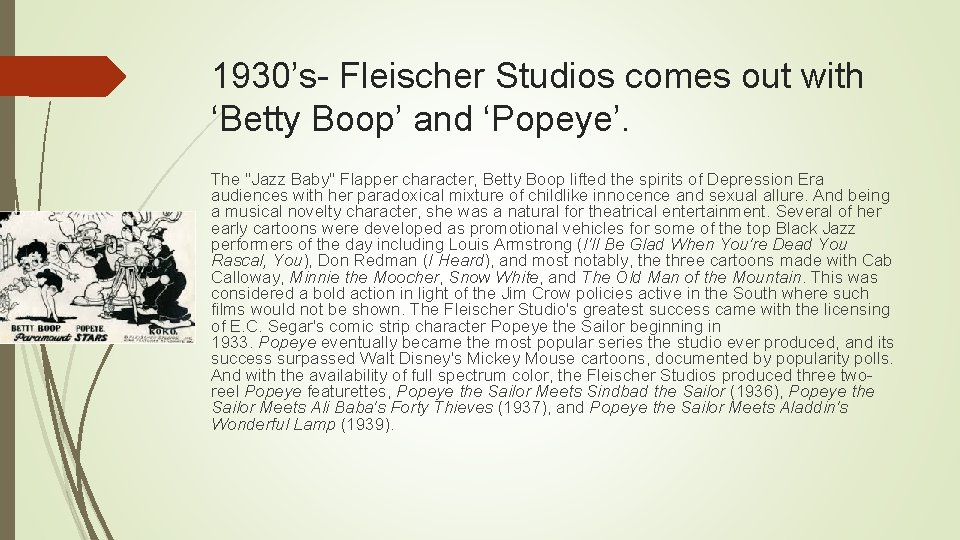
1930’s- Fleischer Studios comes out with ‘Betty Boop’ and ‘Popeye’. The "Jazz Baby" Flapper character, Betty Boop lifted the spirits of Depression Era audiences with her paradoxical mixture of childlike innocence and sexual allure. And being a musical novelty character, she was a natural for theatrical entertainment. Several of her early cartoons were developed as promotional vehicles for some of the top Black Jazz performers of the day including Louis Armstrong (I'll Be Glad When You're Dead You Rascal, You), Don Redman (I Heard), and most notably, the three cartoons made with Cab Calloway, Minnie the Moocher, Snow White, and The Old Man of the Mountain. This was considered a bold action in light of the Jim Crow policies active in the South where such films would not be shown. The Fleischer Studio's greatest success came with the licensing of E. C. Segar's comic strip character Popeye the Sailor beginning in 1933. Popeye eventually became the most popular series the studio ever produced, and its success surpassed Walt Disney's Mickey Mouse cartoons, documented by popularity polls. And with the availability of full spectrum color, the Fleischer Studios produced three tworeel Popeye featurettes, Popeye the Sailor Meets Sindbad the Sailor (1936), Popeye the Sailor Meets Ali Baba's Forty Thieves (1937), and Popeye the Sailor Meets Aladdin's Wonderful Lamp (1939).
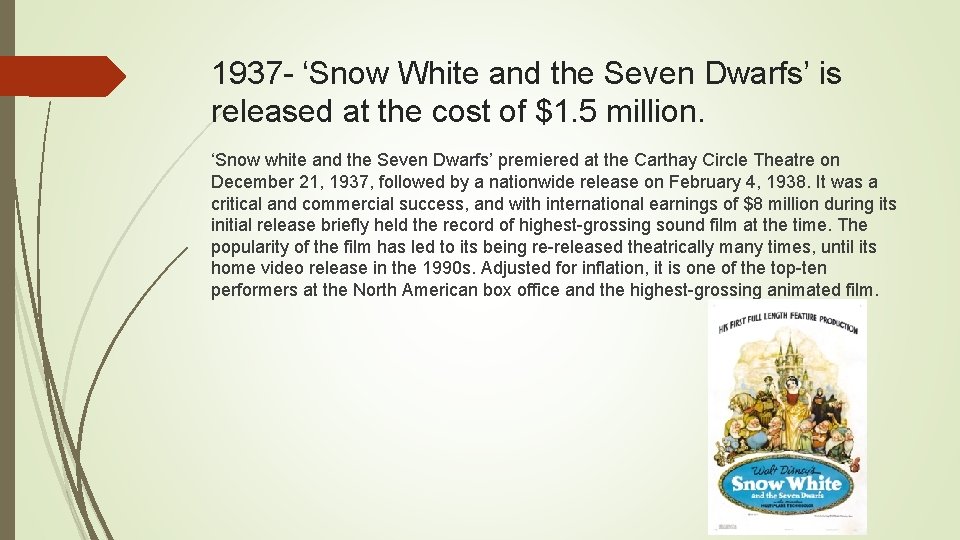
1937 - ‘Snow White and the Seven Dwarfs’ is released at the cost of $1. 5 million. ‘Snow white and the Seven Dwarfs’ premiered at the Carthay Circle Theatre on December 21, 1937, followed by a nationwide release on February 4, 1938. It was a critical and commercial success, and with international earnings of $8 million during its initial release briefly held the record of highest-grossing sound film at the time. The popularity of the film has led to its being re-released theatrically many times, until its home video release in the 1990 s. Adjusted for inflation, it is one of the top-ten performers at the North American box office and the highest-grossing animated film.

1993 - The Use of CGI in ‘Jurassic Park’ ‘Jurrasic Park’ is a 1993 American science fiction adventure film directed by Steven Spielberg and produced by Kathleen Kennedy and Gerald R. Molen. It is the first installment in the Jurassic Park franchise, and is based on the 1990 novel of the same name by Michael Crichton and a screenplay written by Crichton and David Koepp. Before the 1990 s, most visual effects in movies consisted of stop motion and people in suits. While computer animation was used in “Star Wars” and “Tron” and in title sequences like 1978’s “Superman, ” it wasn't until Jurassic Parks Release that a movie used lots of computer-generated imagery, or CGI, and mixed it with live action. There are only 14 minutes of dinosaur visual effects in "Jurassic Park, " about four of which were made with a computer, but its lasting effect on movies has been monumental.
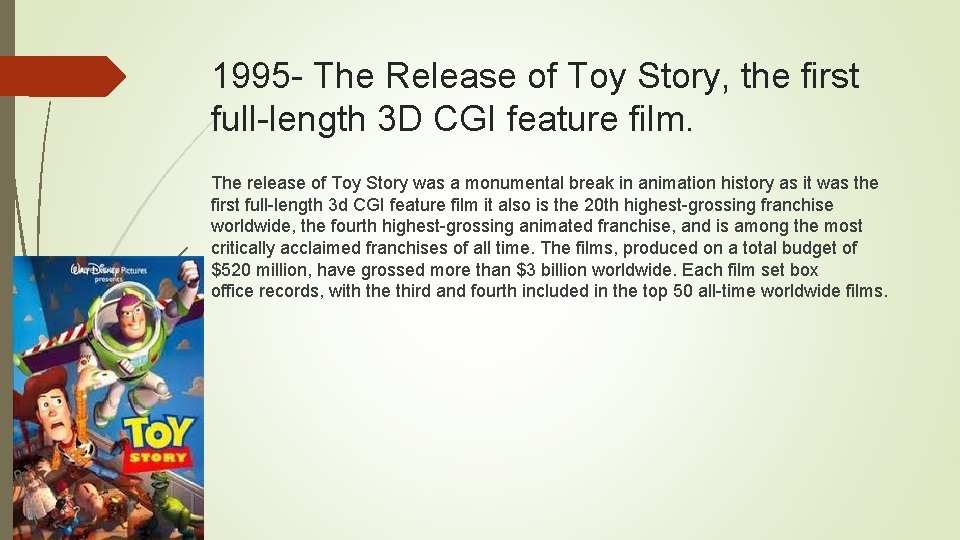
1995 - The Release of Toy Story, the first full-length 3 D CGI feature film. The release of Toy Story was a monumental break in animation history as it was the first full-length 3 d CGI feature film it also is the 20 th highest-grossing franchise worldwide, the fourth highest-grossing animated franchise, and is among the most critically acclaimed franchises of all time. The films, produced on a total budget of $520 million, have grossed more than $3 billion worldwide. Each film set box office records, with the third and fourth included in the top 50 all-time worldwide films.

Im Done now. That’s it Thanks.
- Slides: 12