
History Of Animation 1600s Early 1900s John T





- Slides: 17
History Of Animation 1600’s - Early 1900’s John T, Benjamin S and Richard L
Brief History There are prehistoric cave paintings that captures the motion of the images. For example, there are drawings of animals with multiple legs in different positions - this shows an attempt to convey the perception of motion. There was also five images of an artifact bear in a sequential positions that depicted the bear jumping up to eat the leaves of the trees. All of these examples shows how in the early years, people have tried to depict a motion feature using drawings or images. Overtime, the creation of series of images in a specific order provided a foundation for the development of art in animation.
Influences The magic lantern of 1650 was the first simple animation. It was used to entertain, amaze, and even frighten people. It wasn’t until many years later that people realized the true value of these ‘animations’, and how they captivated an audience. Simple animation in the mid-late 1800’s was often in the form of children’s toys, which often featured a series of drawings, that when interacted with in a certain way, the illusion of motion was achieved. Not long after the invention of some of these simple toys did people begin to become interested in animation. This new concept was very important to the road that led to modern animation. People began experimenting with different animation techniques in the late 1800’s and into the early 1900’s. Some of these simple animations were shorts such as ‘Fantasmagorie’ or ‘Gertie the Dinosaur’. This simple start was the very thing that led people to become fascinated by the process by which drawings are animated, and brought us to modern animation.
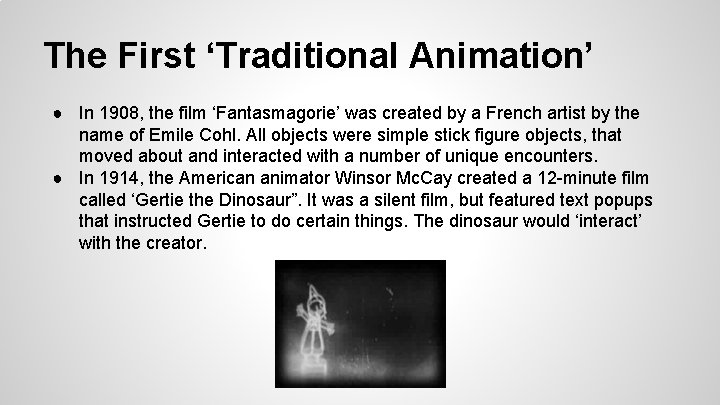
The First ‘Traditional Animation’ ● In 1908, the film ‘Fantasmagorie’ was created by a French artist by the name of Emile Cohl. All objects were simple stick figure objects, that moved about and interacted with a number of unique encounters. ● In 1914, the American animator Winsor Mc. Cay created a 12 -minute film called ‘Gertie the Dinosaur”. It was a silent film, but featured text popups that instructed Gertie to do certain things. The dinosaur would ‘interact’ with the creator.
Magic Lantern Thaumatrope Phenakistoscope Some of the historic devices that influenced the growth of animation Flip Book Praxinoscope Zoetrope
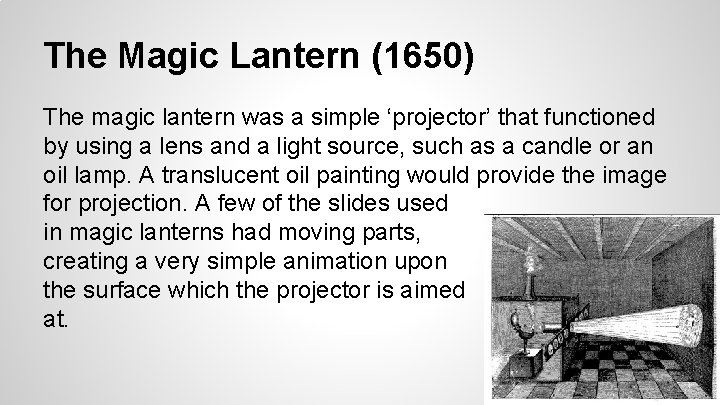
The Magic Lantern (1650) The magic lantern was a simple ‘projector’ that functioned by using a lens and a light source, such as a candle or an oil lamp. A translucent oil painting would provide the image for projection. A few of the slides used in magic lanterns had moving parts, creating a very simple animation upon the surface which the projector is aimed at.
Thaumatrope (1824) Thaumatrope was a small disk with different pictures on each side and has strings attached to it. When you quickly twirl the strings, the two images would appear a single image. This device creates an illusion of animation using two images and a string attached to it. The Thaumatrope was a children’s toy that was quite popular in the 1800’s. It is still used today to teach basic principles of animation. However, the animations are very simple, because they are limited to two frames. This is why devices such as the Zoetrope or Phenakistoscope were more practical for longer animations.
An example of Thaumatrope
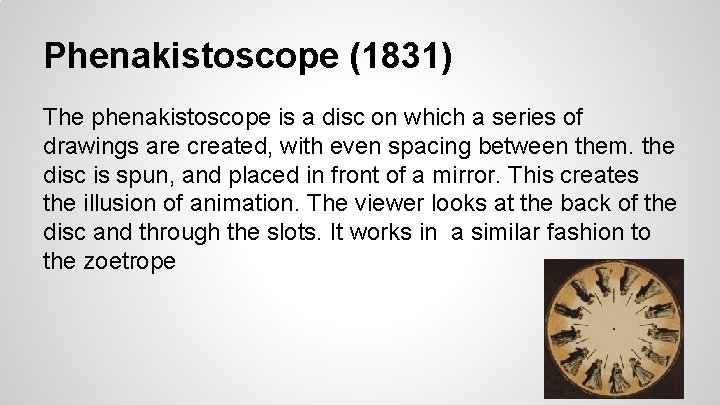
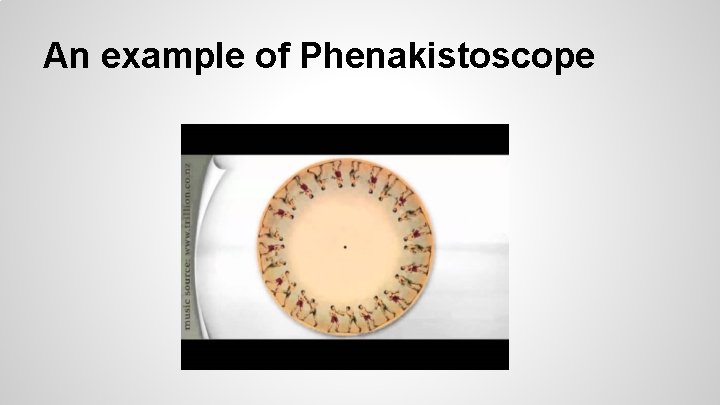
Phenakistoscope (1831) The phenakistoscope is a disc on which a series of drawings are created, with even spacing between them. the disc is spun, and placed in front of a mirror. This creates the illusion of animation. The viewer looks at the back of the disc and through the slots. It works in a similar fashion to the zoetrope
An example of Phenakistoscope
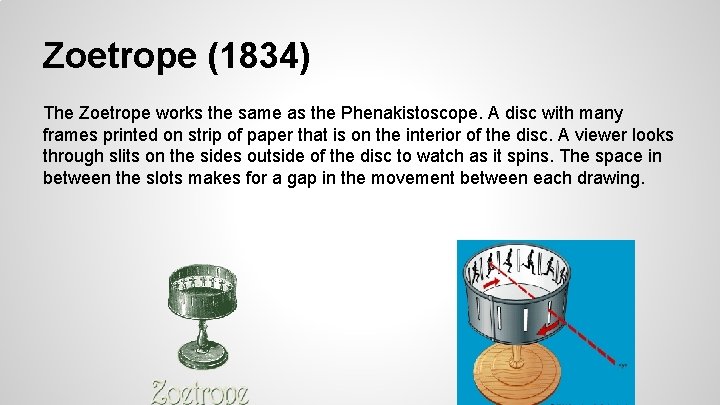
Zoetrope (1834) The Zoetrope works the same as the Phenakistoscope. A disc with many frames printed on strip of paper that is on the interior of the disc. A viewer looks through slits on the sides outside of the disc to watch as it spins. The space in between the slots makes for a gap in the movement between each drawing.
Flip Book (1868) The flip book, or the Kineograph, as it was originally patented, is a book that features a drawing on each page. Each drawing is slightly different from the previous. When the user ‘flips’ the pages in the correct order, the drawings begin to ‘move’. This works in a similar way to the phenakistoscope, in the way that one image is quickly replaced by another. The advantage of the flipbook over some of the other simple methods at the time was that it did not require a complex mirror setup or viewing device.
An example of a Flip Book
Praxinoscope (1877) Charles-Emile Reynaud was the creator of the Praxinoscope a device that made a series of images appear to move. The series of images would be on the inside of a ring that would be spun, along with a mirror structure on the interior of the ring. The mirrors were placed in such a way that when spun, they would reflect the spinning image, and the illusion of motion was created.
An example of Praxinoscope
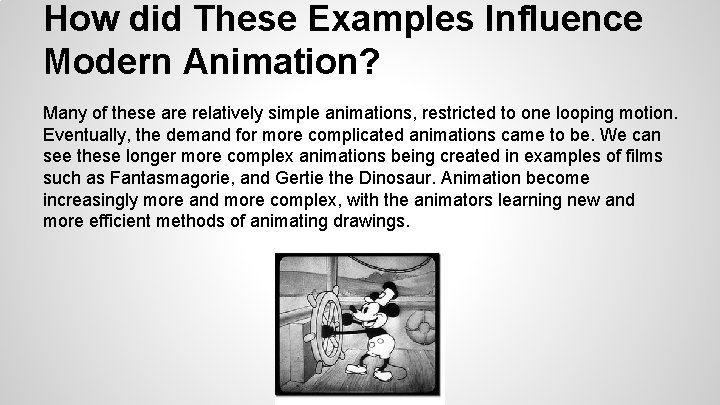
How did These Examples Influence Modern Animation? Many of these are relatively simple animations, restricted to one looping motion. Eventually, the demand for more complicated animations came to be. We can see these longer more complex animations being created in examples of films such as Fantasmagorie, and Gertie the Dinosaur. Animation become increasingly more and more complex, with the animators learning new and more efficient methods of animating drawings.
In your presentation: · Provide a brief history or overview of the time period. This can be done in paragraph, point or timeline format. ( 7/7 possible marks) · List the influences and importance of the style of animation. In other words, how did this style of animation move the industry forward or contribute significantly. ( 0/4 marks) · Provide images or links to You. Tube for important examples of the various types of animations within that period. ( 4/4 marks) Total 11/15 = 73%