
HISTORY OF ANATOMY By Prof A K Srivastava
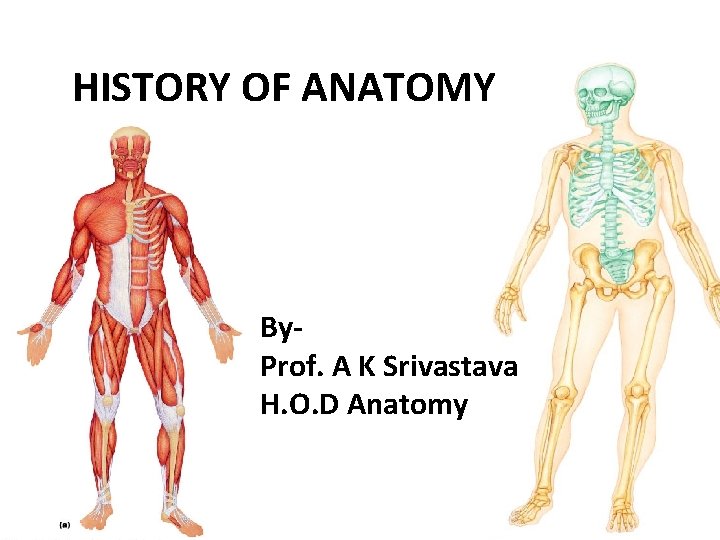
HISTORY OF ANATOMY By. Prof. A K Srivastava H. O. D Anatomy

CLASSIFICATION OF HUMANS • Classification Scheme – Kingdom: Animalia – Phylum: Chordata – Subphylum: Vertebrata – Class: Mammalia – Order: Primate – Family: Hominidae – Genus: Homo – Species: Sapiens • Scientific Binominal: Homo sapiens
KINGDOM • 6 Recognized Kingdoms – Eubacteria – Archaebacteria – Protista – Fungi – Plantae – Animalia
PHYLA of the Animal Kingdom • Range – from Simple (Phylum Protozoa) – to complex (Phylum Chordata) • Phylogeny = the study of Phyla • Ontogeny = the study of individual development • Embryology = the study of prenatal development
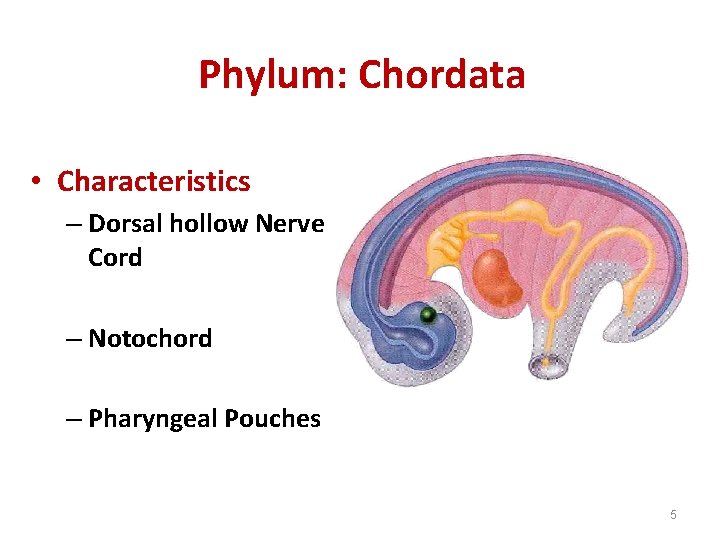
Phylum: Chordata • Characteristics – Dorsal hollow Nerve Cord – Notochord – Pharyngeal Pouches 5
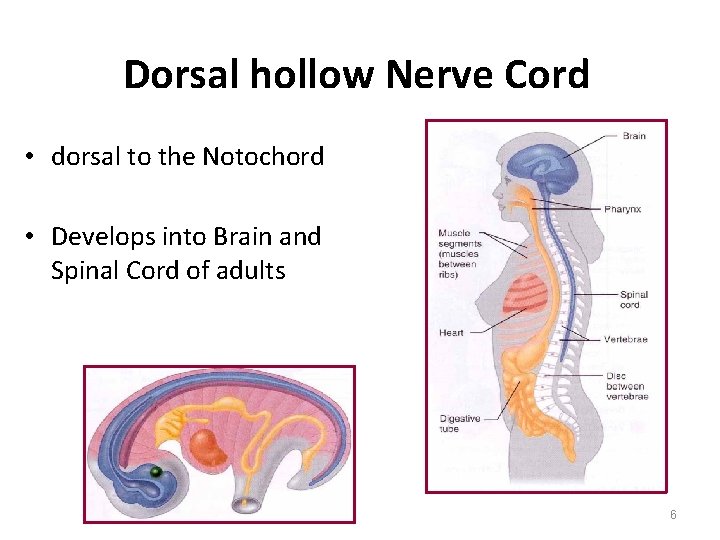
Dorsal hollow Nerve Cord • dorsal to the Notochord • Develops into Brain and Spinal Cord of adults 6
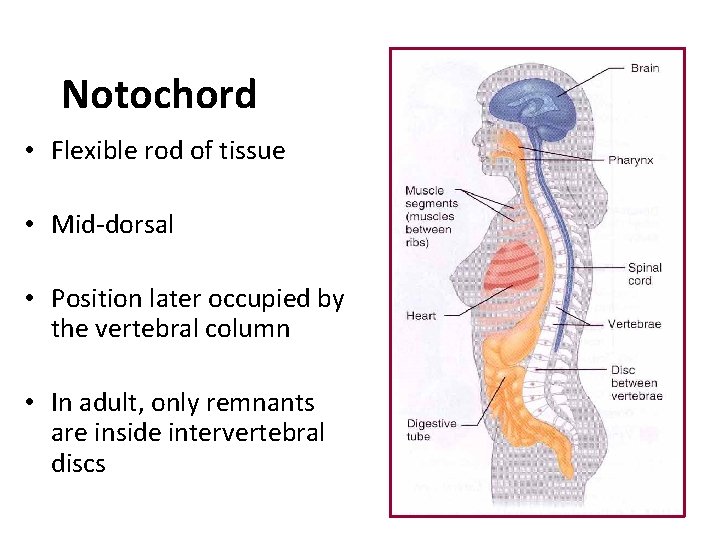
Notochord • Flexible rod of tissue • Mid-dorsal • Position later occupied by the vertebral column • In adult, only remnants are inside intervertebral discs

Pharyngeal Pouches • Envaginations of pharyngeal walls • Gill slits in fish • In human adults, become: – Eustachian tube – Middle ear cavity – Tympanic membrane
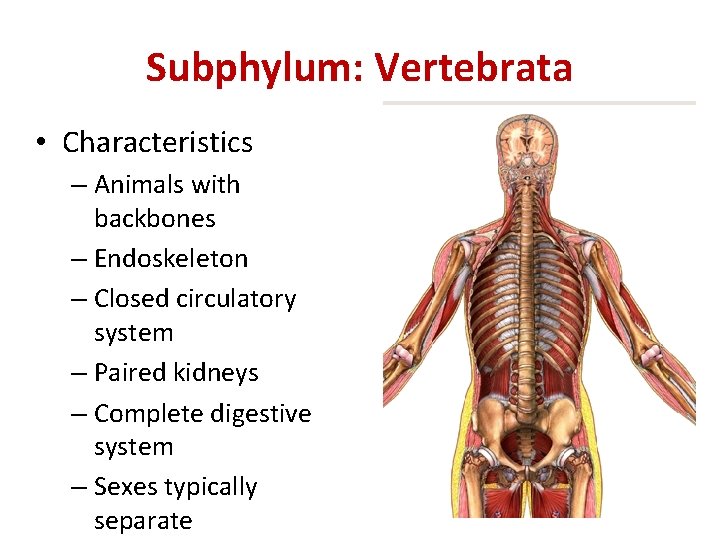
Subphylum: Vertebrata • Characteristics – Animals with backbones – Endoskeleton – Closed circulatory system – Paired kidneys – Complete digestive system – Sexes typically separate
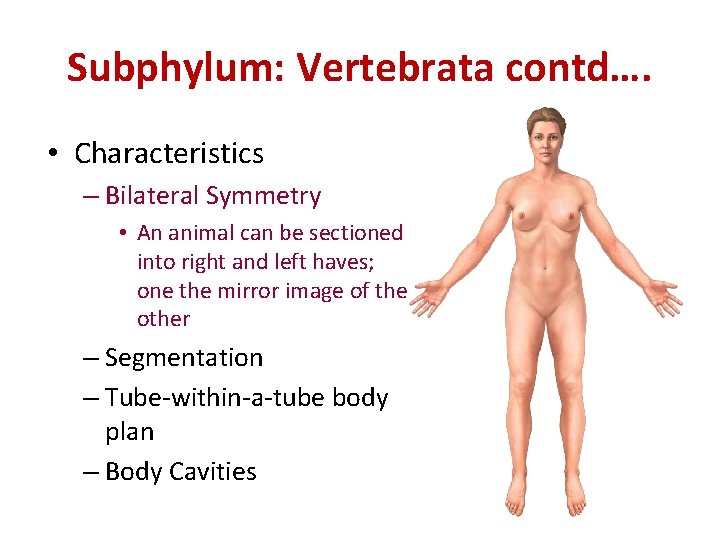
Subphylum: Vertebrata contd…. • Characteristics – Bilateral Symmetry • An animal can be sectioned into right and left haves; one the mirror image of the other – Segmentation – Tube-within-a-tube body plan – Body Cavities
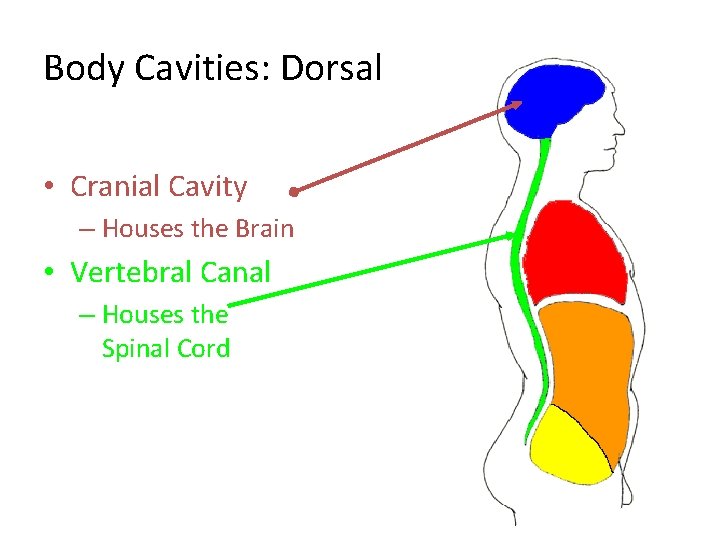
Body Cavities: Dorsal • Cranial Cavity – Houses the Brain • Vertebral Canal – Houses the Spinal Cord
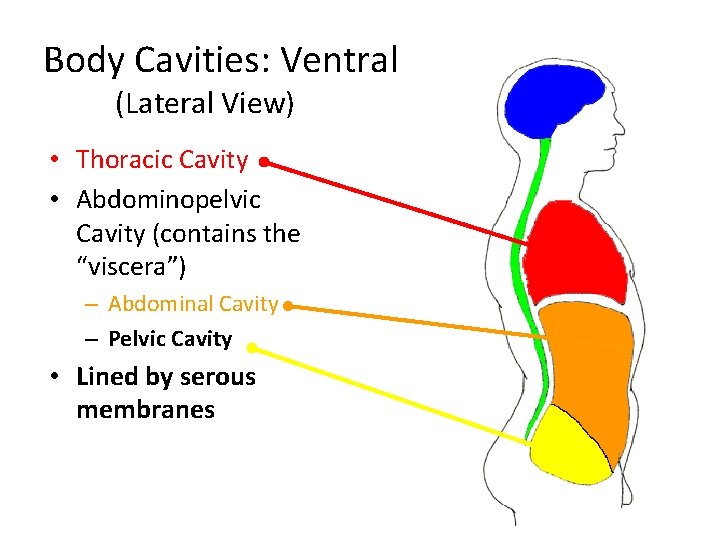
Body Cavities: Ventral (Lateral View) • Thoracic Cavity • Abdominopelvic Cavity (contains the “viscera”) – Abdominal Cavity – Pelvic Cavity • Lined by serous membranes
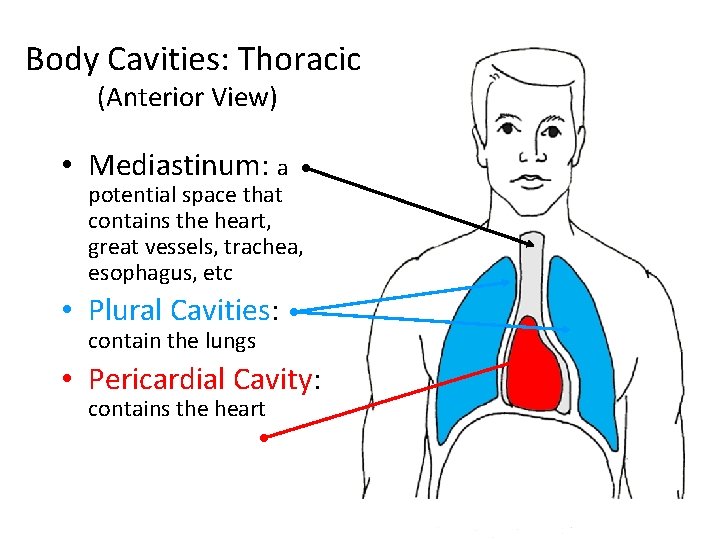
Body Cavities: Thoracic (Anterior View) • Mediastinum: a potential space that contains the heart, great vessels, trachea, esophagus, etc • Plural Cavities: contain the lungs • Pericardial Cavity: contains the heart
Serous Cavities • Ventral Body Cavity • Lined by a serous membrane, or Serosa – Parietal serosa: forms outer wall of cavity – Visceral serosa: covers the visceral organs • Serous fluid – Secreted by the membranes – Is slick; reduces friction

Serous Pericardium • • Around the Heart Parietal Pericardium Visceral Pericardium Pericardial Cavity – Filled with serous fluid

The Pleural Cavities • Around the Lungs • Parietal Pleura: – lines walls of thoracic cavity • Visceral Pleura: – covers each lung

The Peritoneal Cavity • within abdominopelvic cavity • Parietal Peritoneum • Visceral Peritoneum • Some organs are retroperitoneal
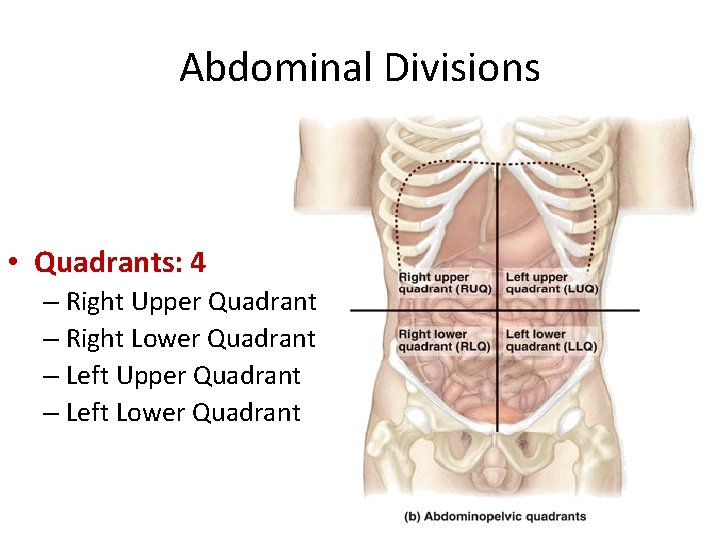
Abdominal Divisions • Quadrants: 4 – Right Upper Quadrant – Right Lower Quadrant – Left Upper Quadrant – Left Lower Quadrant
Other Cavities • • • Oral cavity Nasal cavity Orbital cavities Middle ear cavities Synovial cavities
Classes • • • Osteichthyes Amphibia Reptilia Aves Mammalia
Class Mammalia • Characteristics – Hair – Mammary glands – Differentiation of teeth – Muscular diaphragm – Endotherms – Four-chambered heart with systemic and pulmonary circuits – Red blood cells without nuclei – Complex nervous system – Internal fertilization
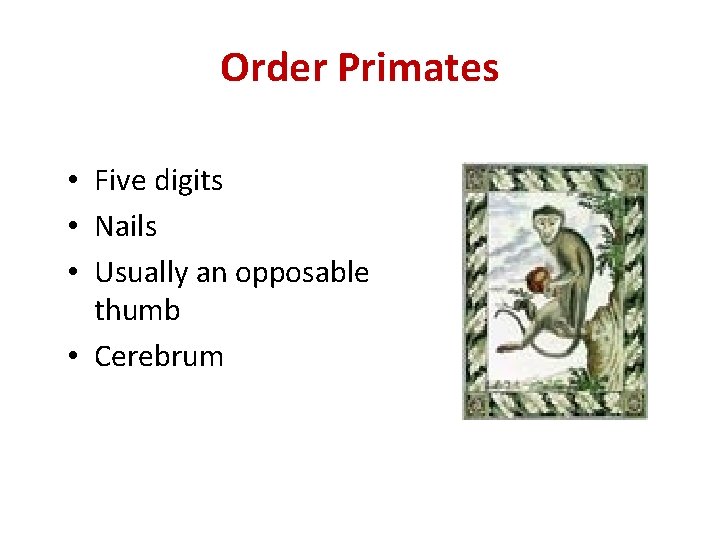
Order Primates • Five digits • Nails • Usually an opposable thumb • Cerebrum
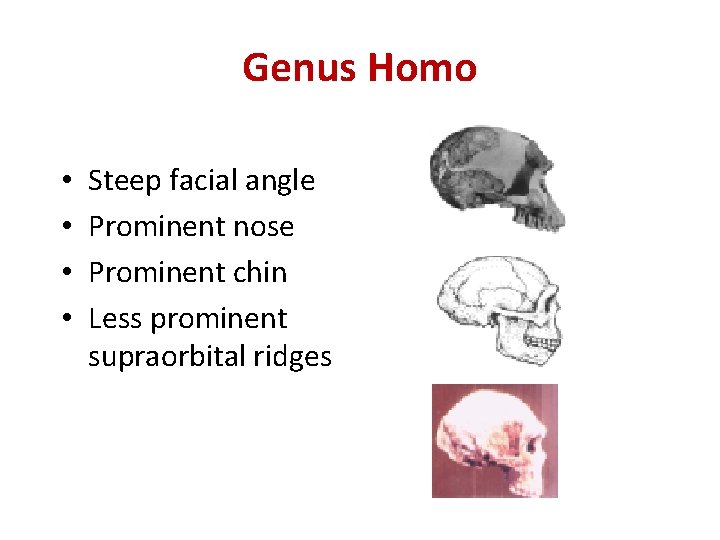
Genus Homo • • Steep facial angle Prominent nose Prominent chin Less prominent supraorbital ridges
Species Sapiens • • • Largest Cerebrum Increasing Brain Size Increasing Skeletal size Increasing tool use Decreasing tooth size Decreasing Skeletal robustness
HISTORY OF ANATOMY “The past is not dead history, it is living material out of which man builds for the future”. Rene Dubos (1901 -1982)
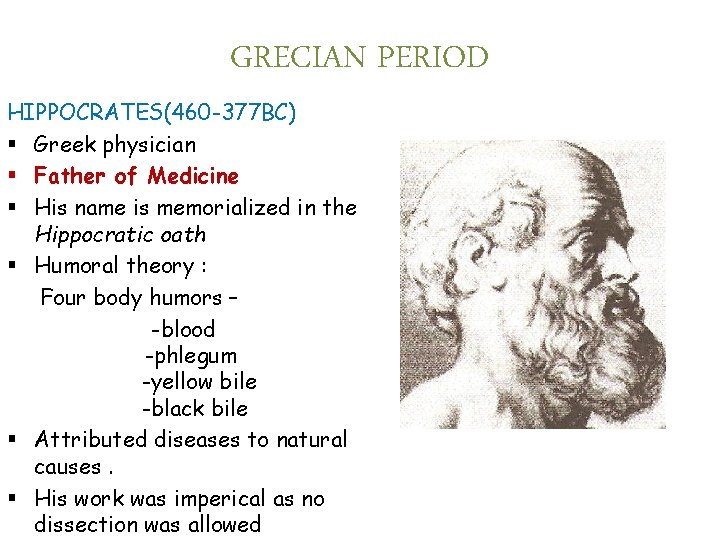
GRECIAN PERIOD HIPPOCRATES(460 -377 BC) § Greek physician § Father of Medicine § His name is memorialized in the Hippocratic oath § Humoral theory : Four body humors – -blood. -phlegum -yellow bile -black bile § Attributed diseases to natural causes. § His work was imperical as no dissection was allowed
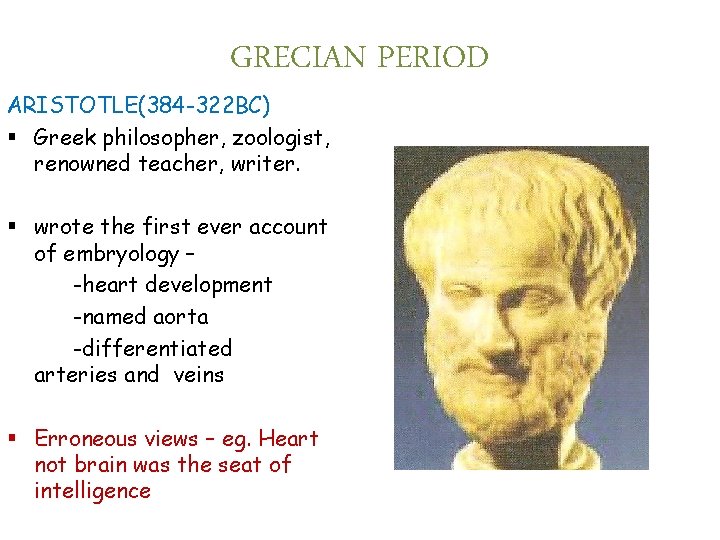
GRECIAN PERIOD ARISTOTLE(384 -322 BC) § Greek philosopher, zoologist, renowned teacher, writer. § wrote the first ever account of embryology – -heart development -named aorta -differentiated. arteries and veins § Erroneous views – eg. Heart not brain was the seat of intelligence

GRECIAN PERIOD HEROPHILUS (about 325 BC) § Great teacher of anatomy in Alexandria § performed -vivi-sections (dissections of living humans) -dissections of human cadavers § regarded brain as seat of intelligence § described cerebrum, cerebellum , fourth ventricle § first to identify nerves as sensory or motor. § He is credited with the discovery of ovum
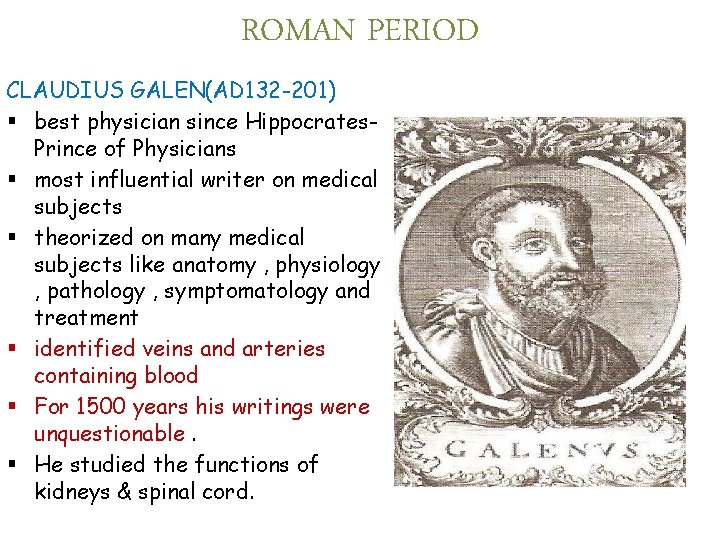
ROMAN PERIOD CLAUDIUS GALEN(AD 132 -201) § best physician since Hippocrates. Prince of Physicians. § most influential writer on medical subjects § theorized on many medical subjects like anatomy , physiology , pathology , symptomatology and treatment § identified veins and arteries containing blood § For 1500 years his writings were unquestionable. § He studied the functions of kidneys & spinal cord.
Middle ages (Medieval Period) • After the fall of Roman empire. • Anatomy became stagnant in Christian Europe. • Flourished in islamic world. • The Arabs had Galen in high regards. • Hunayn ibn Ishaq translated 129 of Galen works into Arebic • The Canon of Medicine was very influential through islamic world and was most authoritative book on Anatomy
RENAISSANCE PERIOD §Period characterised by rebirth of science § lasted from 14 th century through 16 th century §It was a transitional period from the middle. ages (referred to as Dark ages) to the modern ages. of science. §Canon remained the most important text book on Anatomy §Series of authors dissected cadavers
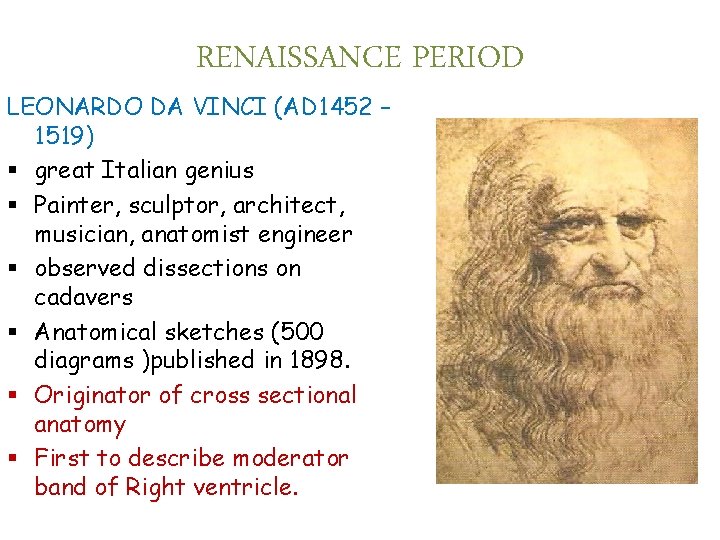
RENAISSANCE PERIOD LEONARDO DA VINCI (AD 1452 – 1519) § great Italian genius § Painter, sculptor, architect, musician, anatomist engineer § observed dissections on cadavers § Anatomical sketches (500 diagrams )published in 1898. § Originator of cross sectional anatomy § First to describe moderator band of Right ventricle.
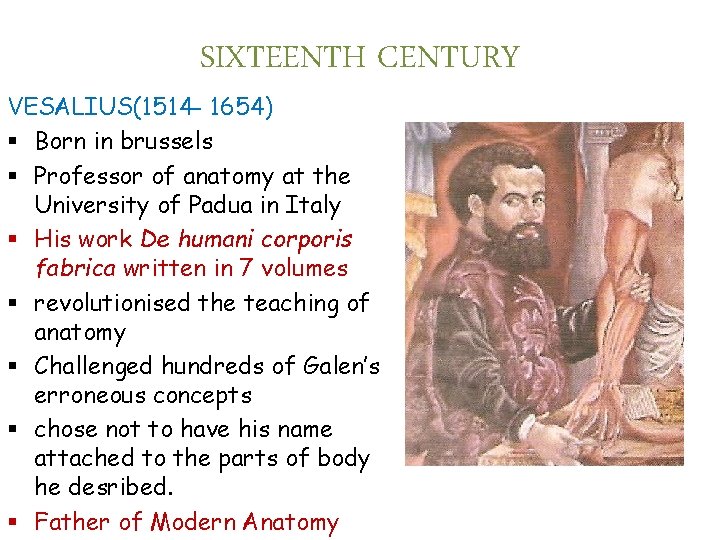
SIXTEENTH CENTURY VESALIUS(1514 - 1654) § Born in brussels § Professor of anatomy at the University of Padua in Italy § His work De humani corporis fabrica written in 7 volumes § revolutionised the teaching of anatomy § Challenged hundreds of Galen’s erroneous concepts § chose not to have his name attached to the parts of body he desribed. § Father of Modern Anatomy
SEVENTEENTH and EIGHTEENTH CENTURY WILLIAM HARVEY(1578 -1657) § English anatomist § Conducted experiments ‘ on the motion of heart and blood in animals ‘ § Suggested continuous circulation of blood with in vessels § Demonstrated that blood circulates and does not flow back and forth through the same vessels § Credited for providing physiological (functional) orientation to anatomy.
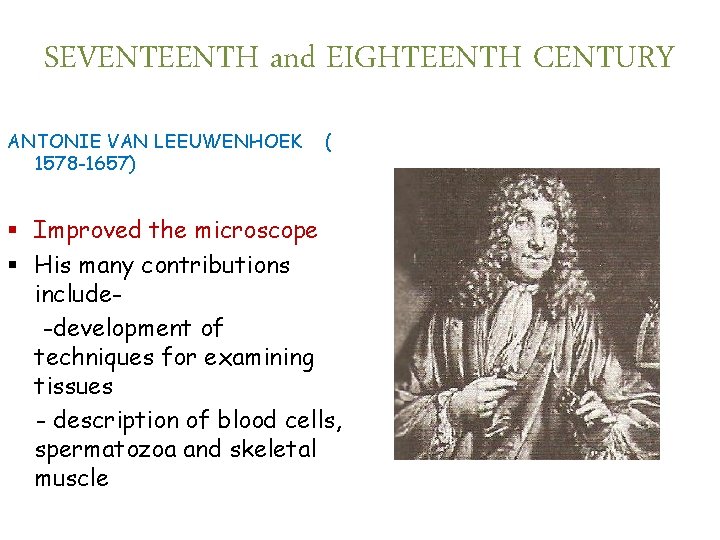
SEVENTEENTH and EIGHTEENTH CENTURY ANTONIE VAN LEEUWENHOEK 1578 -1657) ( § Improved the microscope § His many contributions include-development of techniques for examining tissues - description of blood cells, spermatozoa and skeletal muscle
SEVENTEENTH and EIGHTEENTH CENTURY MALPIGHII(1628 -1634) § Italian anatomist § ‘ Father of Histology’ § His name is associated with malpighian corpuscles of the kidney and malpighian bodies of spleen.
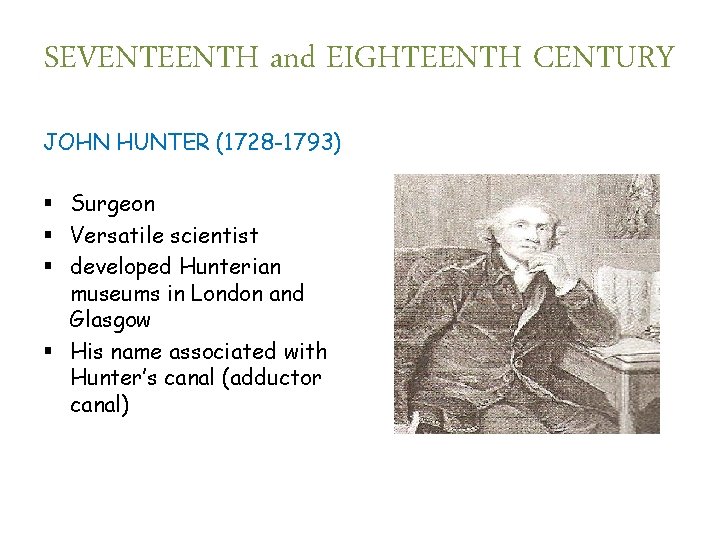
SEVENTEENTH and EIGHTEENTH CENTURY JOHN HUNTER (1728 -1793) § Surgeon § Versatile scientist § developed Hunterian museums in London and Glasgow § His name associated with Hunter’s canal (adductor canal)
SEVENTEENTH and EIGHTEENTH CENTURY WILHELM KONARD VON ROENTGEN (1845 -1923) § First used X-rays to detect bone fractures and assess extent of Tuberculosis GREGORY JOHANN MENDEL (1822 - 1844) § performed experiments on plant’s hybridization § ‘Father of Genetics’ De GRAF : described ovaries SPALLAN ZANI : showed sperm and ovum FRANCIS GLISSON : described liver, gall bladder, stomach, intestine THOMAS WILLIS : published summary of nervous system
NINETEENTH CENTURY § ROBERT HOOKE -Coined the term ‘cell’ § JEAN BAPTISTE LAMARCK – observed gel like substance with in the cell § SCHLEIDEN and SCHWANN - put forth the cell theory § RUDOLF VIRCHOW – worked on a book titled ‘cell pathology’ § JOHANNES MULLER – applied physics , chemistry and psychology to the study of human body § Noted anatomists of this century – - Astley Cooper - Georges cuvier - Meckel - Henry Gray in 1858 published Gray’s. Anatomy; Descriptive
TWENTIETH CENTURY IMAGING ANATOMY - Ultrasound - CT Scan - MRI - PET
History of Anatomy in India • Anatomy in ancient India The post- upanishadic period from 800 B. C to 1000 A. D. may be considered the “ golden age of Indian Medicine”. Ayurveda, the science of life Ayur=longlife; veda=science Two great proponent of this science -Susruta &Charaka. Susrata lived two centuries before Christ &was a Contemporary to Charak’s guru Atreya
- first written evidence of Ayurveda is in the-Sanskirit writing of Charak samhita and Susruta Samhita. q. Charak Samhita can be dated back to 1. A. D. - Both these samhita’s devote a complete section “Sarira sthana”to the subject of Anatomy. - in these sections beside gross Anatomy, embryology and histology are also delt.
SUSRATA OR SUSHRUTHA (6 TH century B. C. ) - renowned surgeon of ancient India - described about 120 surgical instruments. - 300 surgical procedures and classifies human surgery into 8 catagories. - He lived and taught his art on the bank of Ganga in Varanasi. Known as father of surgery. - The anatomical fact described him are - 300 bones, 500 muscles (400 in limbs, 66 in trunk &34 in Head & Neck. - Described blood vessels i. e. , Dhaminis and Siras - Organs like Lung (pupphusa),
Anatomy In Modern India • Medical education in India revived with the arrival of the British (1600 A. D) • Medical schools were estabilished (late 19 thcentury) Madras, calcutta and bombay. • Madras in 1835. Dr Mortimer of that school use to teach the muscles and bones from paste board models. • Mortimer’s mannual precedes Cunningham’ mannual of practical anatomy • Dr Y. G. Nadgir was the first to be appointed as

LETS ANSWER A FEW Questions
Q 1. Which surgeon of ancient India is also called as “Father of Surgery” ? A. Charak B. Sushruta C. Atreya D. Dhanvantri
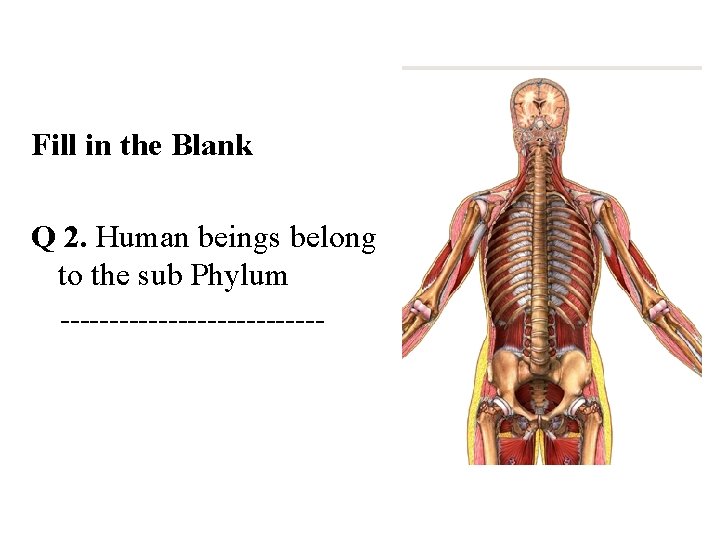
Fill in the Blank Q 2. Human beings belong to the sub Phylum --------------
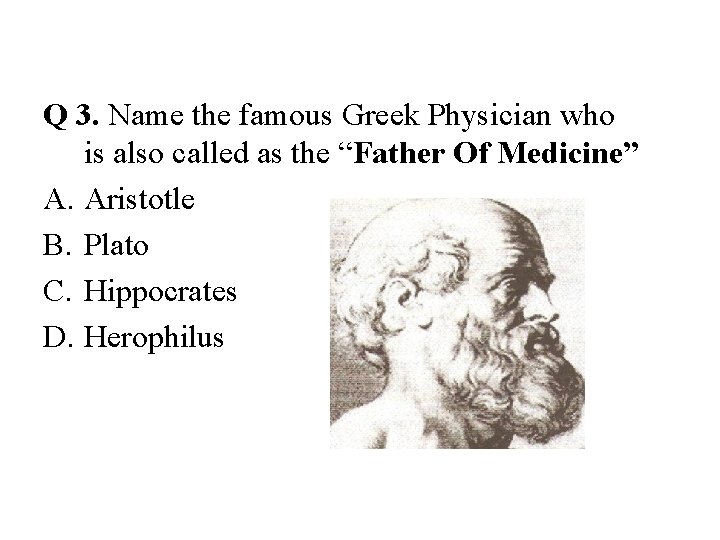
Q 3. Name the famous Greek Physician who is also called as the “Father Of Medicine” A. Aristotle B. Plato C. Hippocrates D. Herophilus
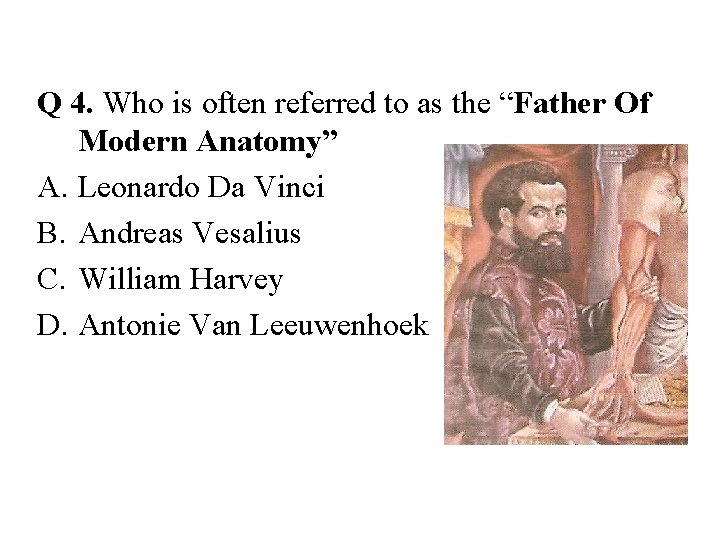
Q 4. Who is often referred to as the “Father Of Modern Anatomy” A. Leonardo Da Vinci B. Andreas Vesalius C. William Harvey D. Antonie Van Leeuwenhoek
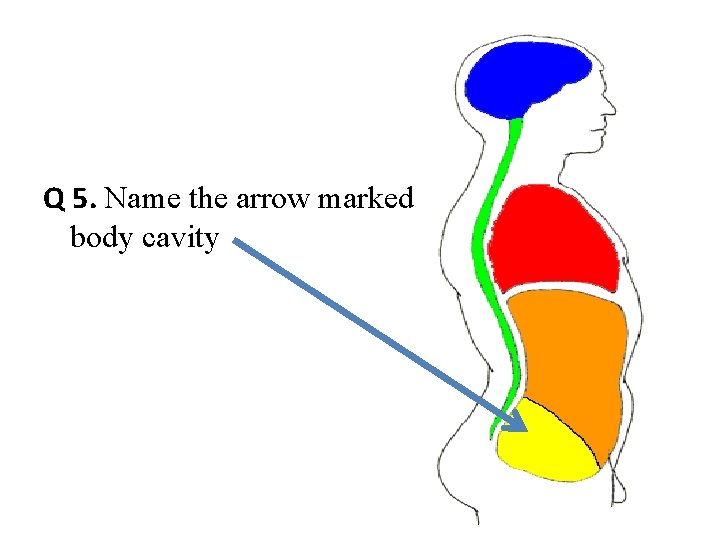
Q 5. Name the arrow marked body cavity
- Slides: 50