
HISTORY OF AGRICULTURE Class I WHY THIS COURSE

- Slides: 68
HISTORY OF AGRICULTURE Class I
WHY THIS COURSE? • • • Agriculture is important for India 62% population depend on agriculture Contribution to GDP going down TFP had been declining but now recovering NSS Survey indicates 44% farmers want to quit farming Investment in ag. R&D declining Youth not attracted to agriculture Situation likely to be alarming after 2025 New generation faces a big challenge IARI students: Good in subject matter, poor in other sub.
Origin of Agriculture • Modern man (Homo sapiens) believed to have evolved from Homo erectus- 135, 000 -200, 000 yrs ago • Most of this period lived in Nomadic existence in forest as hunters & gatherers of food • Process of domestication-10, 000 yrs ago • Sign of plant cultivation-8 th-7 th millennium BC • Archaeological remains-wheat, barley, pea, lentils etcnear East- spread to Europe, West Asia & Nile valley • More sp. –domesticated • What motivated them to adopt: hunting to settled agri. ? • People on diversified diet healthier than farmers
FOOD & AGRICULTURE Food – an essential need Agriculture- prime source for food History of agri. - co-terminus with civilization History of Indian agri. - complicated & controversial • Absence of literary text for early period • Lit. available – post Gupta or early medieval era • •
Agriculture in India • Earliest source- Arthashastra of Kautilya – Agri. is way of life, a philosophy & a culture – Agri. & herding under Revenue Admn. – Characterized by archaelogical evidences 1. Vindhya-Ganga region 2. North-west of Indian subcontinent – Hunting-gathering in late Mesolithic period to – Domestication of animals and cultivation of plants- 7 -6 th millenium BC
Agriculture in India • Indian subcontinent had 2 centres of farming of cereals : – North-west with barley-wheat complex (Mehrgarh) – Vindhya-Ganga region for rice: latter is earlier than former Domestication of rice is found at Atranjikher & Lal Qila (1200 -1500 BC) Rice-wheat-barley-legume agri. Established in Narhan & Imlikhurd by the end of 3 rd millennium Two crop a year started around this period
Agriculture in India • Millets of African origin -Introduced in India in 3 rd millennium BC -Associated with Harappan culture (2, 500 -2, 000 BC) -Came to middle Ganga plains by 1800 BC • Border land of Afghanistan- Domestication of animals and plants – Symbiotic development of sedentary agri. & pastoral nomadism- quite common in hills
Agriculture in India • Indus civilization- Well provided with development of Agri & animal husbandry – – – Higher precipitation Irrigation Cultivation of rice, wheat & barley Use of chem. Fertilizers (Gypsum & Ca. SO 4) Raising two crops a year
Agriculture in India • Sixth century BC to 6 TH century AD-Variety of sources: -Pali, Sangam, Sanskrit -Kautilya’s Arthsastra & Dharmsastra – Classification of land – Irrigation – Export of items-sugar – Taxes & – Medicinal & aromatic plants
Agriculture in India • Early medieval Period (600 AD to 1200 AD) – Agrarian structure – New type of tools & technology – Regional agri. –South India, Bengal & Gujarat British Period : -Initialy concerned with development - Ignored agriculture -Led to Bengal Famine
Origin of Agriculture- Hypothesis • Several hypotheses but debate continues as none of them wholly satisfactory: – Climate change- ice age-11, 000 yrs ago- favourable environment for farming – Population pressure – Resource concentration from desertification – Land ownership – Natural selection Greg Wadley & Angus Martin (1993)- cereals and milk contain ‘Exorphins’- drug like addictive properties
Origin of Agriculture • Origin of agri. Can’t be because of particular invention • Why it took so long to settle and cultivate? • Gifted individuals – hunting can’t go forever, let’s change- is it better way of life? • Change is not easy to humans- discarding old and adopting new, nevertheless • Change is difficult but change is must for progress
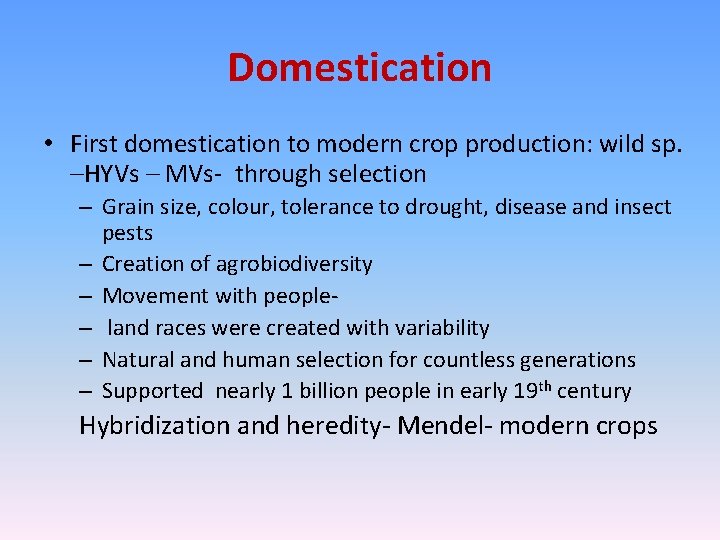
Domestication • First domestication to modern crop production: wild sp. –HYVs – MVs- through selection – Grain size, colour, tolerance to drought, disease and insect pests – Creation of agrobiodiversity – Movement with people– land races were created with variability – Natural and human selection for countless generations – Supported nearly 1 billion people in early 19 th century Hybridization and heredity- Mendel- modern crops
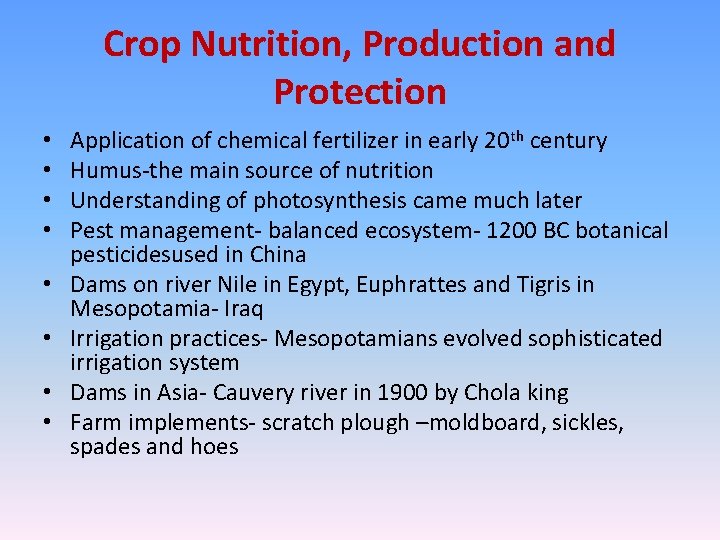
Crop Nutrition, Production and Protection • • Application of chemical fertilizer in early 20 th century Humus-the main source of nutrition Understanding of photosynthesis came much later Pest management- balanced ecosystem- 1200 BC botanical pesticidesused in China Dams on river Nile in Egypt, Euphrattes and Tigris in Mesopotamia- Iraq Irrigation practices- Mesopotamians evolved sophisticated irrigation system Dams in Asia- Cauvery river in 1900 by Chola king Farm implements- scratch plough –moldboard, sickles, spades and hoes
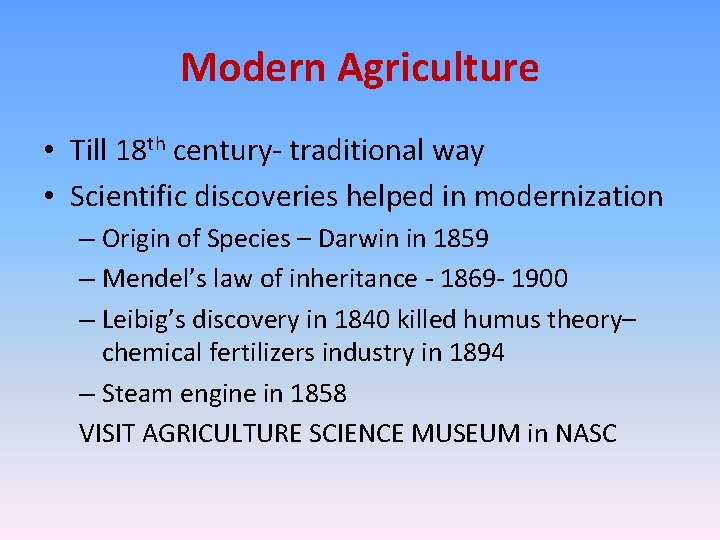
Modern Agriculture • Till 18 th century- traditional way • Scientific discoveries helped in modernization – Origin of Species – Darwin in 1859 – Mendel’s law of inheritance - 1869 - 1900 – Leibig’s discovery in 1840 killed humus theory– chemical fertilizers industry in 1894 – Steam engine in 1858 VISIT AGRICULTURE SCIENCE MUSEUM in NASC
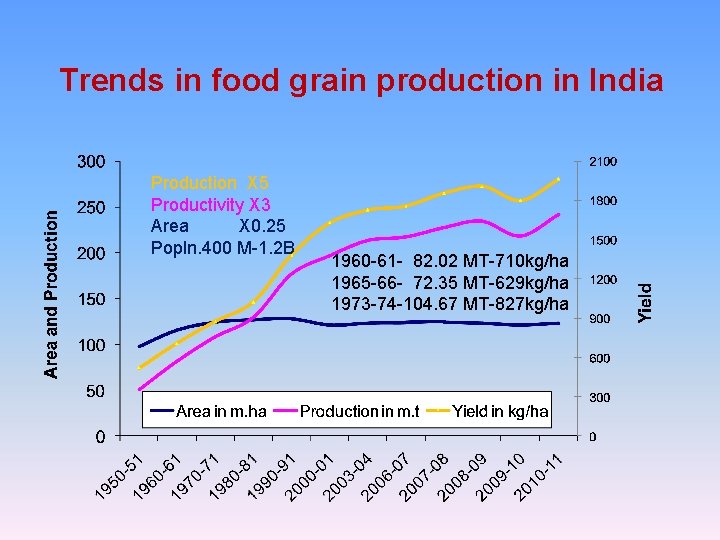
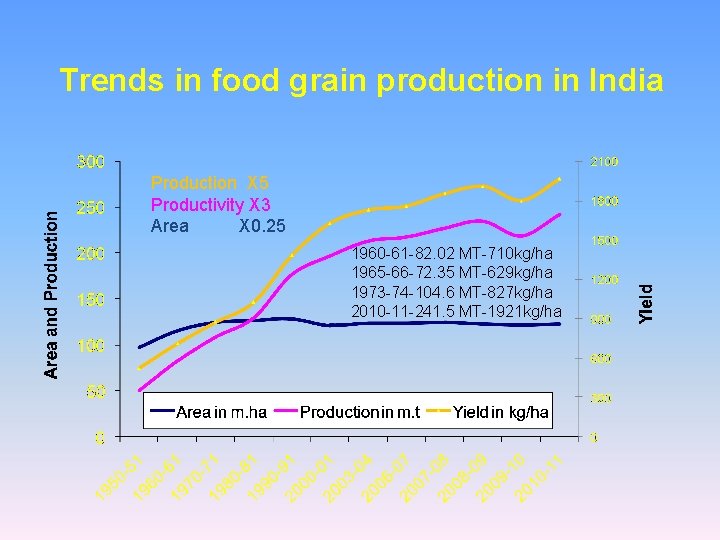
Trends in food grain production in India Production X 5 Productivity X 3 Area X 0. 25 Popln. 400 M-1. 2 B 1960 -61 - 82. 02 MT-710 kg/ha 1965 -66 - 72. 35 MT-629 kg/ha 1973 -74 -104. 67 MT-827 kg/ha
Transformation of Agriculture Traditional to Modern
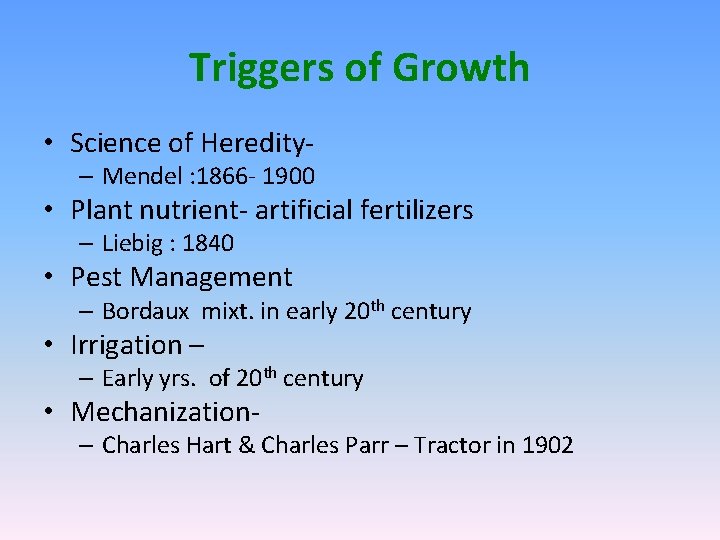
Triggers of Growth • Science of Heredity- – Mendel : 1866 - 1900 • Plant nutrient- artificial fertilizers – Liebig : 1840 • Pest Management – Bordaux mixt. in early 20 th century • Irrigation – – Early yrs. of 20 th century • Mechanization- – Charles Hart & Charles Parr – Tractor in 1902
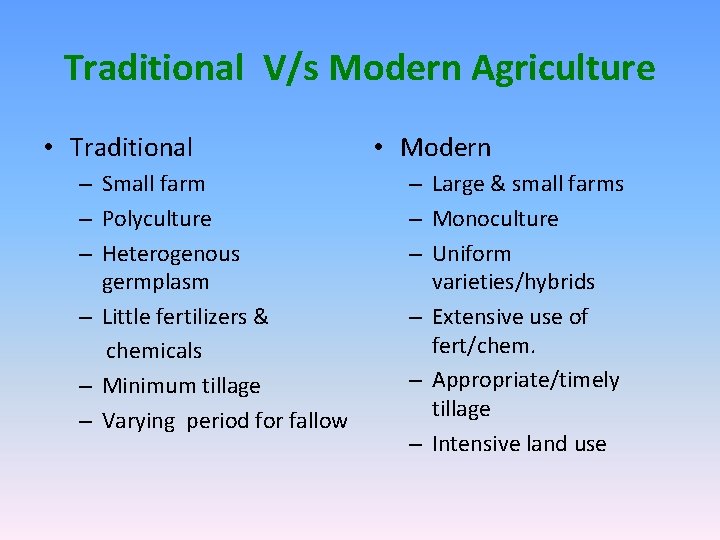
Traditional V/s Modern Agriculture • Traditional – Small farm – Polyculture – Heterogenous germplasm – Little fertilizers & chemicals – Minimum tillage – Varying period for fallow • Modern – Large & small farms – Monoculture – Uniform varieties/hybrids – Extensive use of fert/chem. – Appropriate/timely tillage – Intensive land use
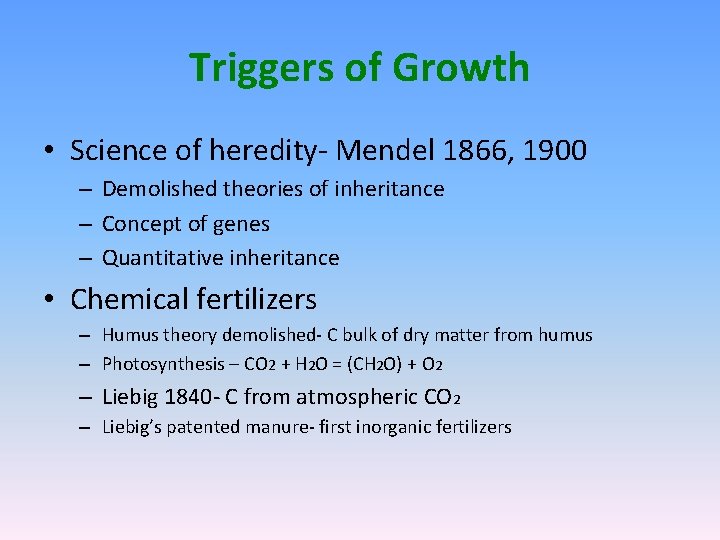
Triggers of Growth • Science of heredity- Mendel 1866, 1900 – Demolished theories of inheritance – Concept of genes – Quantitative inheritance • Chemical fertilizers – Humus theory demolished- C bulk of dry matter from humus – Photosynthesis – CO 2 + H 2 O = (CH 2 O) + O 2 – Liebig 1840 - C from atmospheric CO 2 – Liebig’s patented manure- first inorganic fertilizers
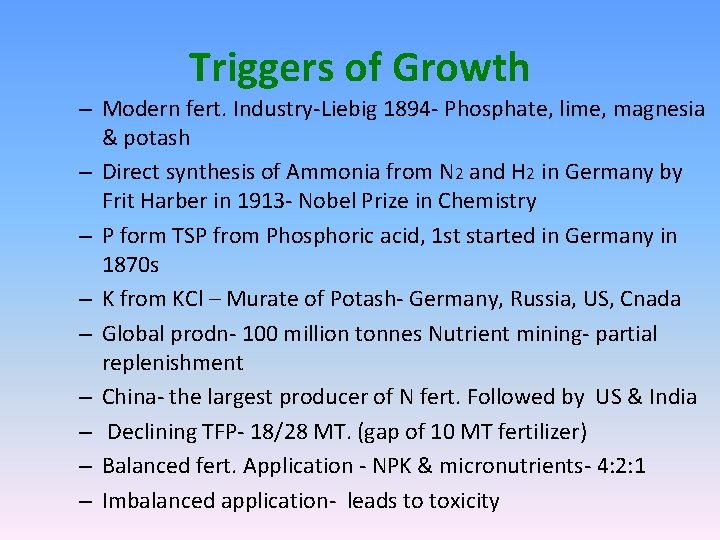
Triggers of Growth – Modern fert. Industry-Liebig 1894 - Phosphate, lime, magnesia & potash – Direct synthesis of Ammonia from N 2 and H 2 in Germany by Frit Harber in 1913 - Nobel Prize in Chemistry – P form TSP from Phosphoric acid, 1 st started in Germany in 1870 s – K from KCl – Murate of Potash- Germany, Russia, US, Cnada – Global prodn- 100 million tonnes Nutrient mining- partial replenishment – China- the largest producer of N fert. Followed by US & India – Declining TFP- 18/28 MT. (gap of 10 MT fertilizer) – Balanced fert. Application - NPK & micronutrients- 4: 2: 1 – Imbalanced application- leads to toxicity
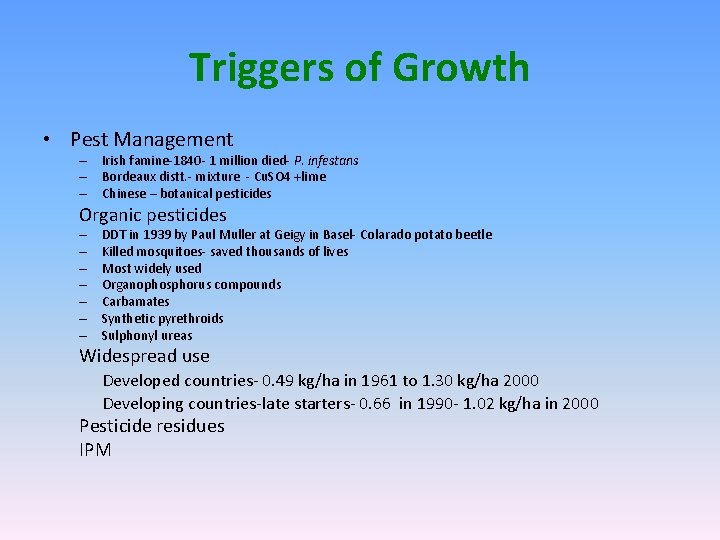
Triggers of Growth • Pest Management – Irish famine-1840 - 1 million died- P. infestans – Bordeaux distt. - mixture - Cu. SO 4 +lime – Chinese – botanical pesticides Organic pesticides – – – – DDT in 1939 by Paul Muller at Geigy in Basel- Colarado potato beetle Killed mosquitoes- saved thousands of lives Most widely used Organophosphorus compounds Carbamates Synthetic pyrethroids Sulphonyl ureas Widespread use Developed countries- 0. 49 kg/ha in 1961 to 1. 30 kg/ha 2000 Developing countries-late starters- 0. 66 in 1990 - 1. 02 kg/ha in 2000 Pesticide residues IPM
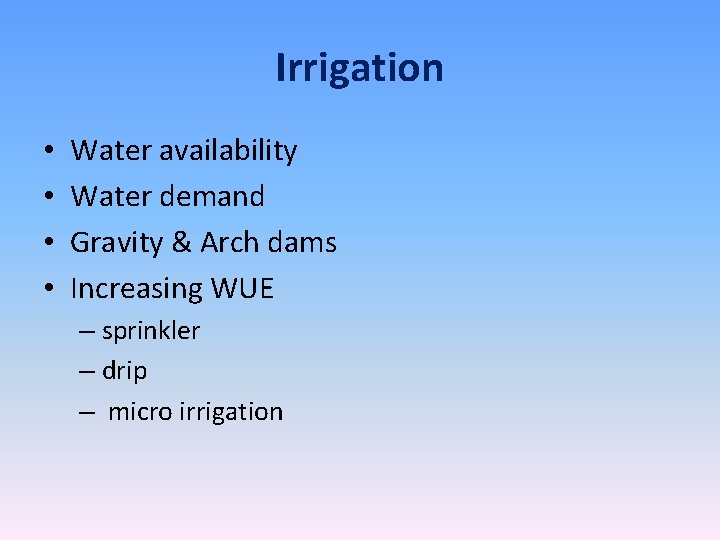
Irrigation • • Water availability Water demand Gravity & Arch dams Increasing WUE – sprinkler – drip – micro irrigation
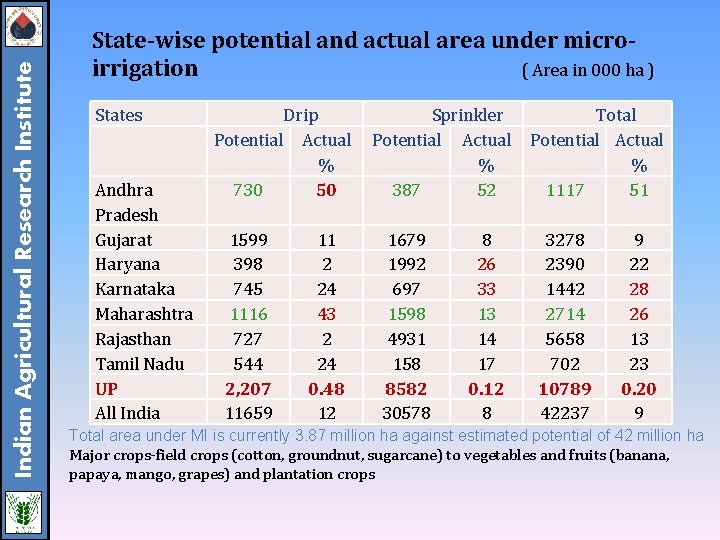
Indian Agricultural Research Institute State-wise potential and actual area under microirrigation ( Area in 000 ha ) States Andhra Pradesh Gujarat Haryana Karnataka Maharashtra Rajasthan Tamil Nadu UP All India Drip Potential Actual % 730 50 1599 398 745 1116 727 544 2, 207 11659 11 2 24 43 2 24 0. 48 12 Sprinkler Potential Actual % 387 52 1679 1992 697 1598 4931 158 8582 30578 8 26 33 13 14 17 0. 12 8 Total Potential Actual % 1117 51 3278 2390 1442 2714 5658 702 10789 42237 9 22 28 26 13 23 0. 20 9 Total area under MI is currently 3. 87 million ha against estimated potential of 42 million ha Major crops-field crops (cotton, groundnut, sugarcane) to vegetables and fruits (banana, papaya, mango, grapes) and plantation crops
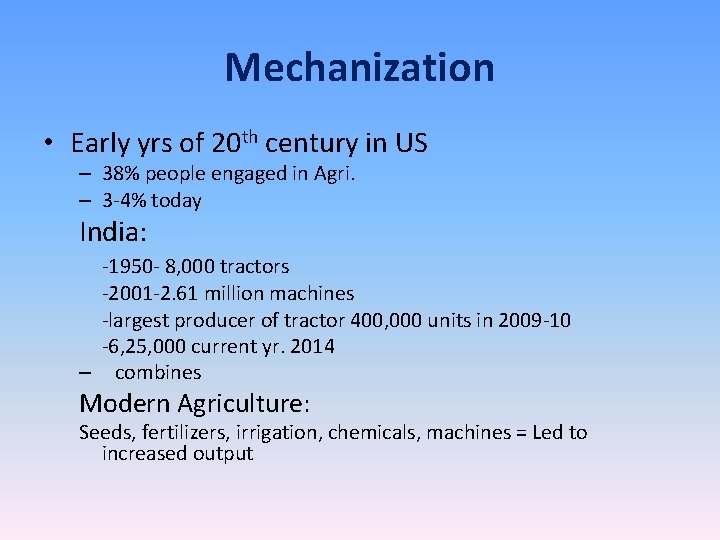
Mechanization • Early yrs of 20 th century in US – 38% people engaged in Agri. – 3 -4% today India: -1950 - 8, 000 tractors -2001 -2. 61 million machines -largest producer of tractor 400, 000 units in 2009 -10 -6, 25, 000 current yr. 2014 – combines Modern Agriculture: Seeds, fertilizers, irrigation, chemicals, machines = Led to increased output
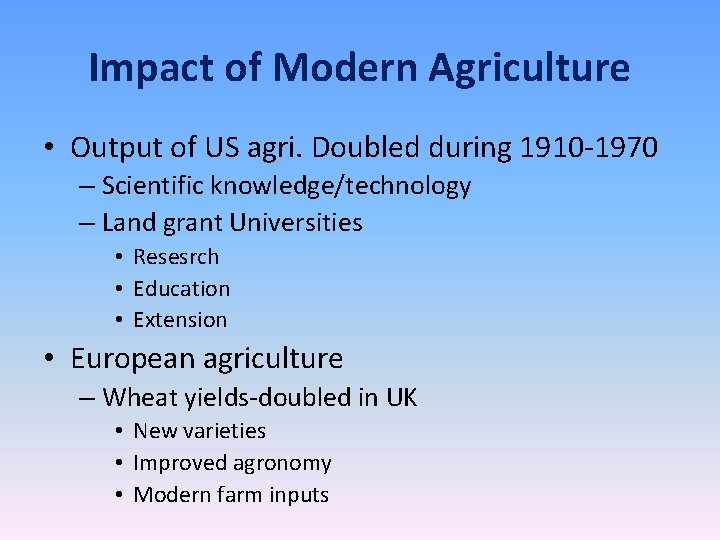
Impact of Modern Agriculture • Output of US agri. Doubled during 1910 -1970 – Scientific knowledge/technology – Land grant Universities • Resesrch • Education • Extension • European agriculture – Wheat yields-doubled in UK • New varieties • Improved agronomy • Modern farm inputs
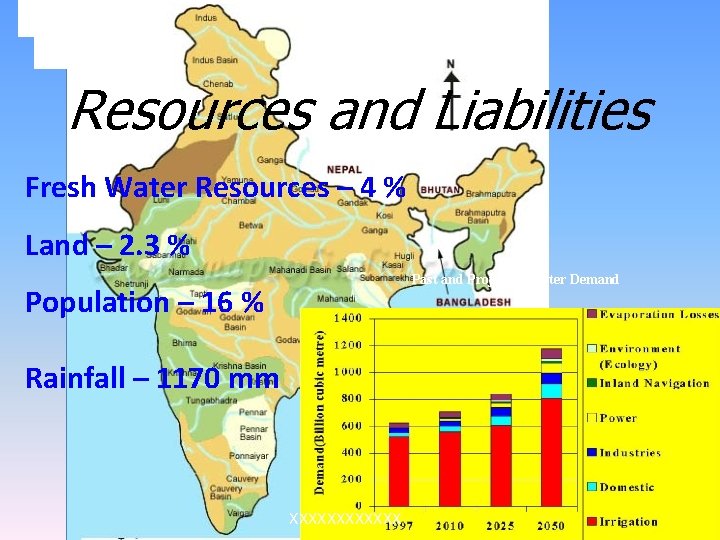
Resources and Liabilities Fresh Water Resources – 4 % Land – 2. 3 % Population – 16 % Past and Projected Water Demand Rainfall – 1170 mm Dr. S. Raman, New Delhi Winter School, XXXXXX 20/3/09
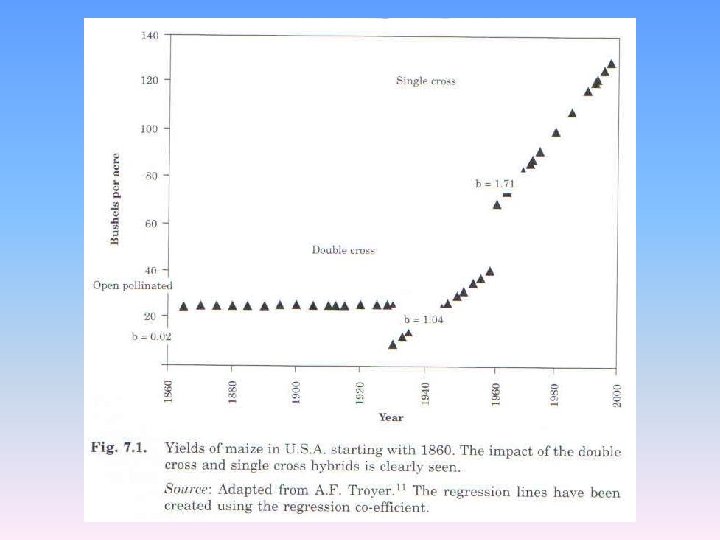
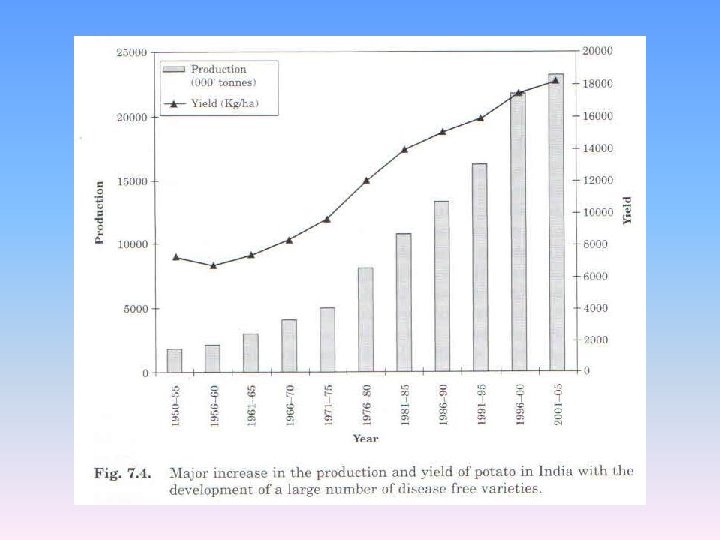
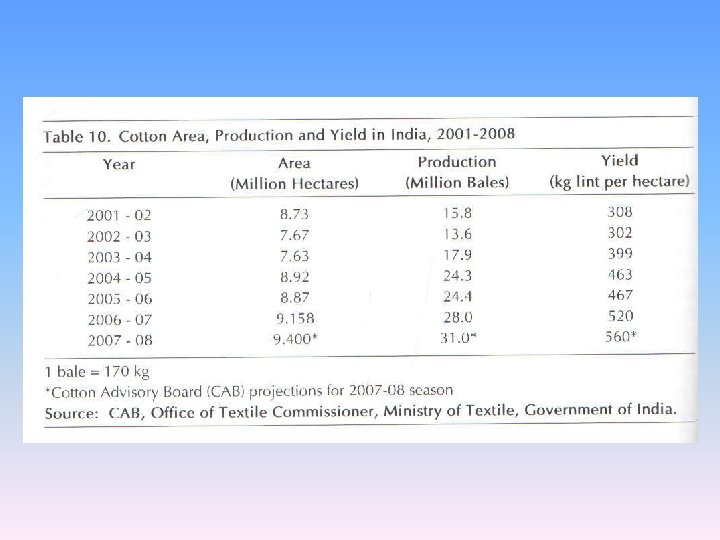
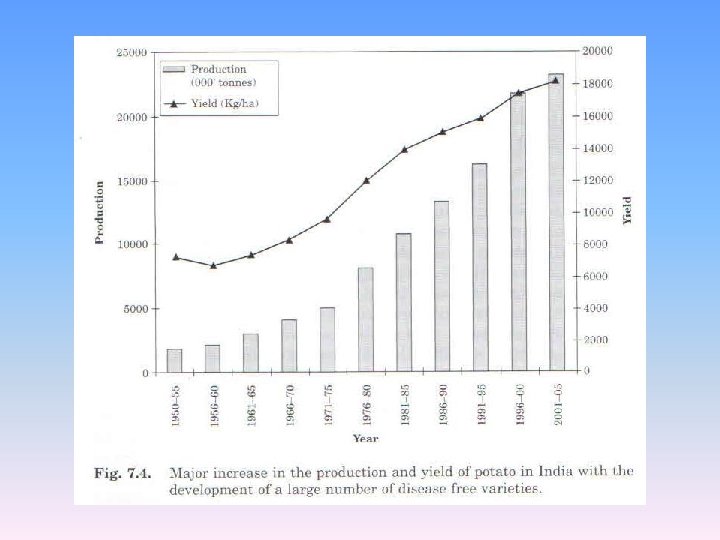
Some Success Stories • • Maize Potato Cotton Soybean
Trends in food grain production in India Production X 5 Productivity X 3 Area X 0. 25 1960 -61 -82. 02 MT-710 kg/ha 1965 -66 -72. 35 MT-629 kg/ha 1973 -74 -104. 6 MT-827 kg/ha 2010 -11 -241. 5 MT-1921 kg/ha
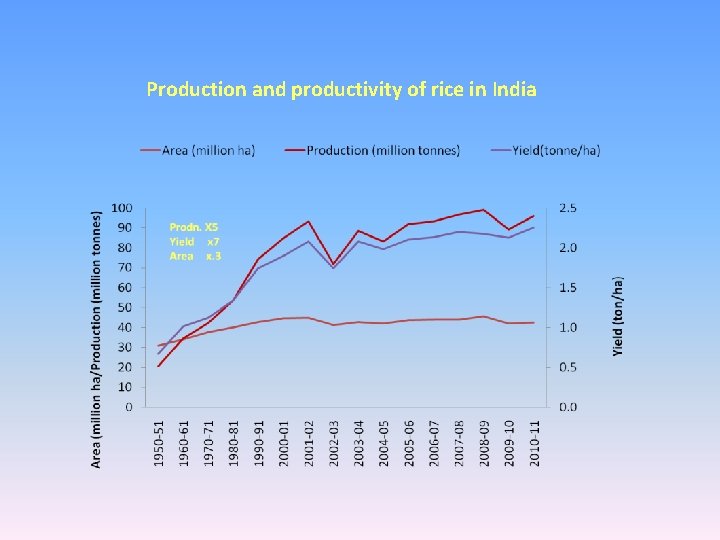
Production and productivity of rice in India
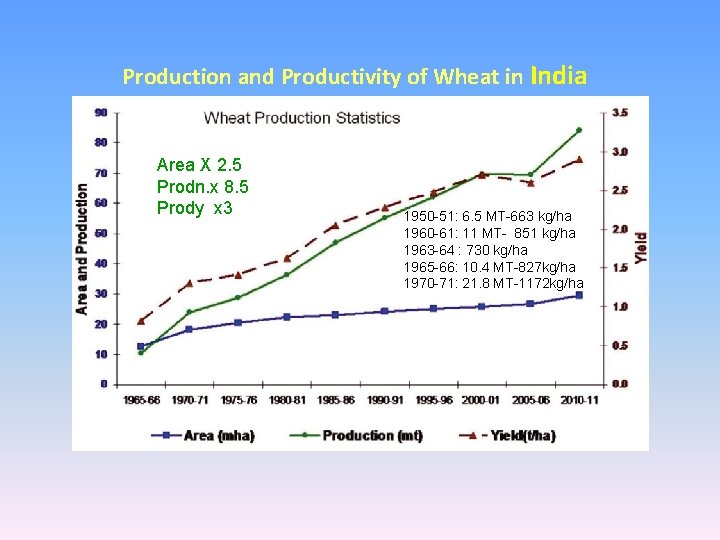
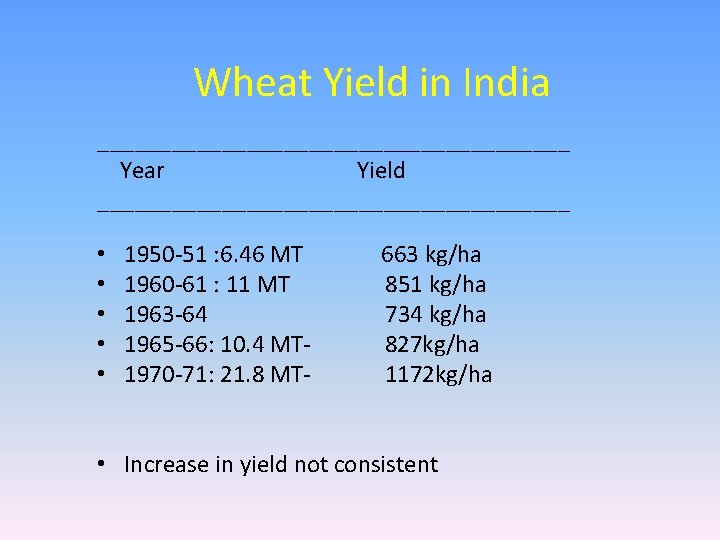
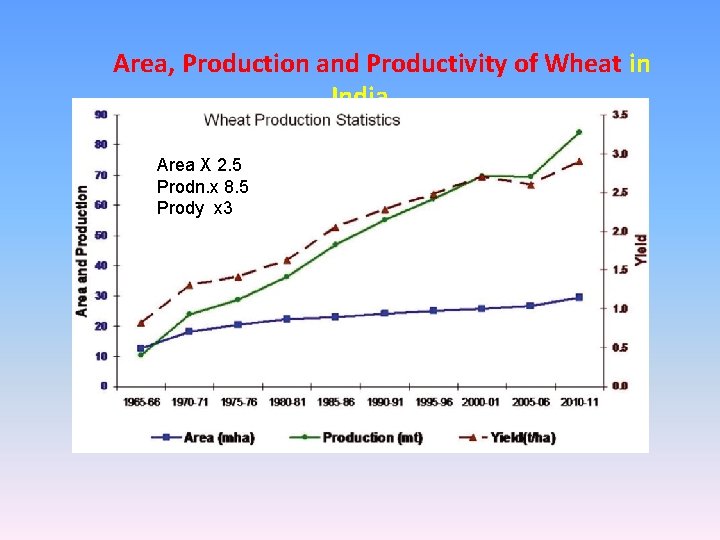
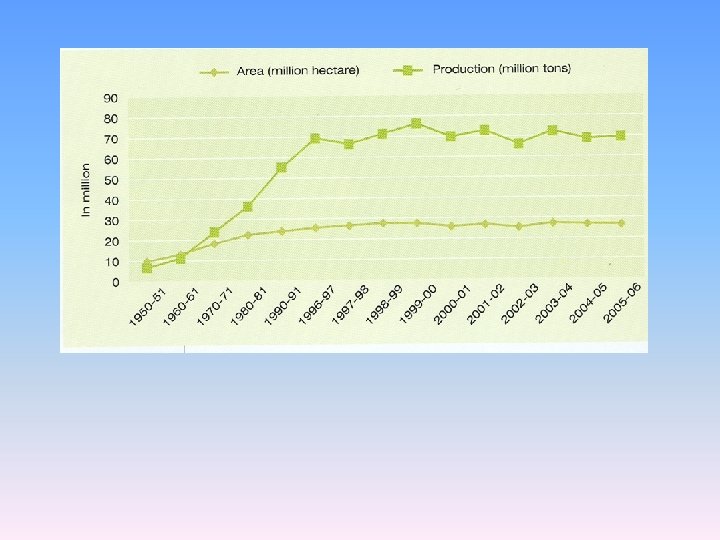
Production and Productivity of Wheat in India Area X 2. 5 Prodn. x 8. 5 Prody x 3 1950 -51: 6. 5 MT-663 kg/ha 1960 -61: 11 MT- 851 kg/ha 1963 -64 : 730 kg/ha 1965 -66: 10. 4 MT-827 kg/ha 1970 -71: 21. 8 MT-1172 kg/ha
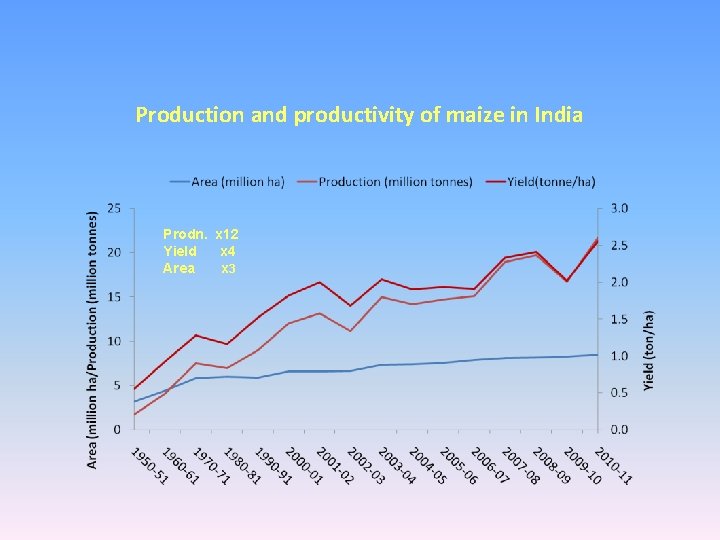
Production and productivity of maize in India Prodn. x 12 Yield x 4 Area x 3
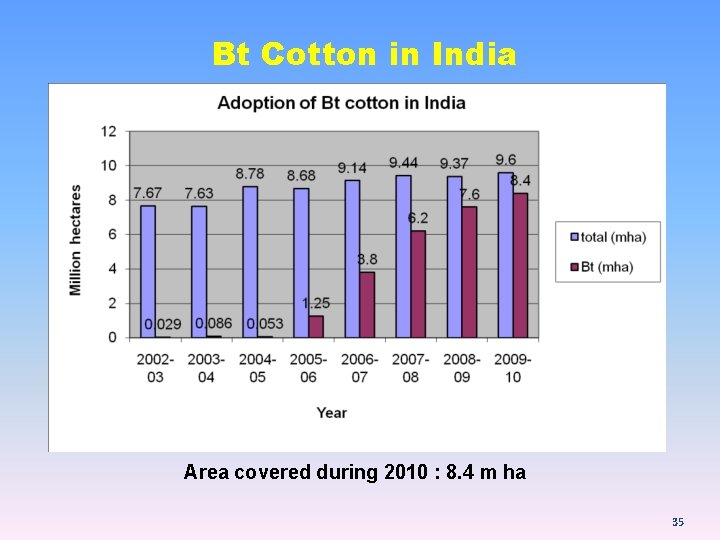
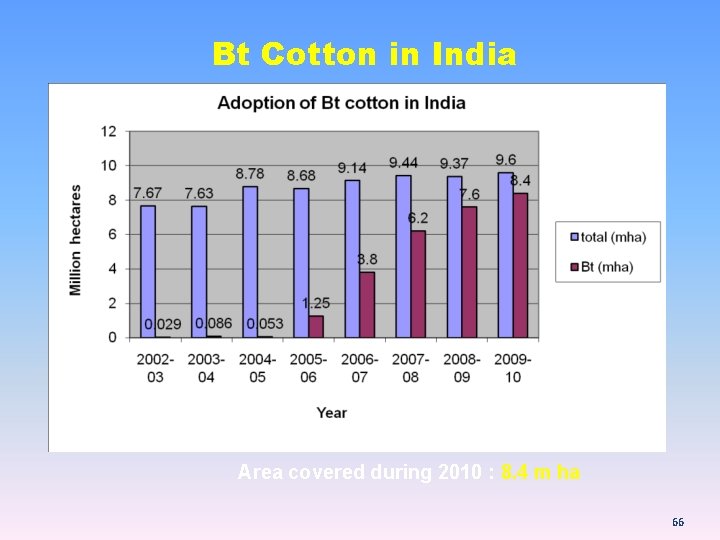
Bt Cotton in India Area covered during 2010 : 8. 4 m ha 35
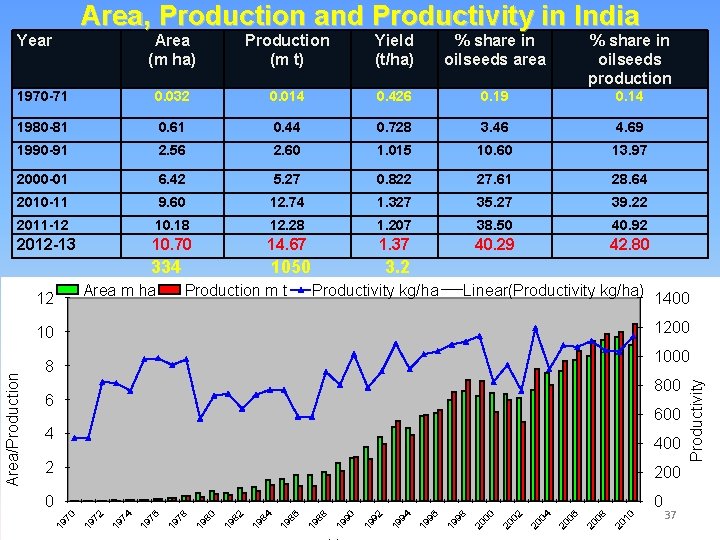
Area, Production and Productivity in India Year Area (m ha) Production (m t) Yield (t/ha) % share in oilseeds area % share in oilseeds production 1970 -71 0. 032 0. 014 0. 426 0. 19 0. 14 1980 -81 0. 61 0. 44 0. 728 3. 46 4. 69 1990 -91 2. 56 2. 60 1. 015 10. 60 13. 97 2000 -01 6. 42 5. 27 0. 822 27. 61 28. 64 2010 -11 9. 60 12. 74 1. 327 35. 27 39. 22 2011 -12 10. 18 12. 28 1. 207 38. 50 40. 92 2012 -13 10. 70 14. 67 1. 37 40. 29 42. 80 334 1050 3. 2 Area m ha 12 Production m t Productivity kg/ha Linear(Productivity kg/ha) 1200 10 800 6 600 4 400 10 20 08 20 06 20 04 20 02 20 00 20 98 19 96 19 94 19 92 19 90 19 88 19 86 19 84 19 82 19 80 19 78 19 19 76 0 74 0 72 200 70 2 37 Productivity 1000 8 19 Area/Production 1400
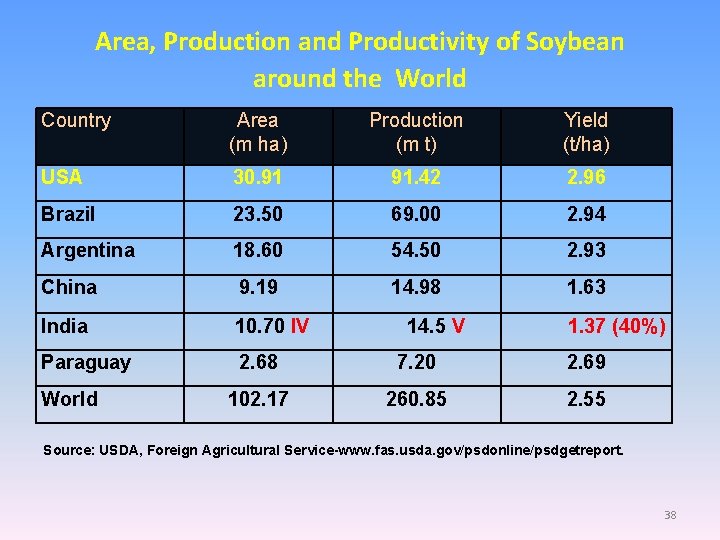
Area, Production and Productivity of Soybean around the World Country Area (m ha) Production (m t) Yield (t/ha) USA 30. 91 91. 42 2. 96 Brazil 23. 50 69. 00 2. 94 Argentina 18. 60 54. 50 2. 93 China 9. 19 14. 98 1. 63 India 10. 70 IV Paraguay 2. 68 7. 20 2. 69 102. 17 260. 85 2. 55 World 14. 5 V 1. 37 (40%) Source: USDA, Foreign Agricultural Service-www. fas. usda. gov/psdonline/psdgetreport. 38
GREEN REVOLUTION BREAKTHROUGH IN WHEAT IMPROVEMENT WHY MODERNIZATION OF AGRICULTURE? Class III
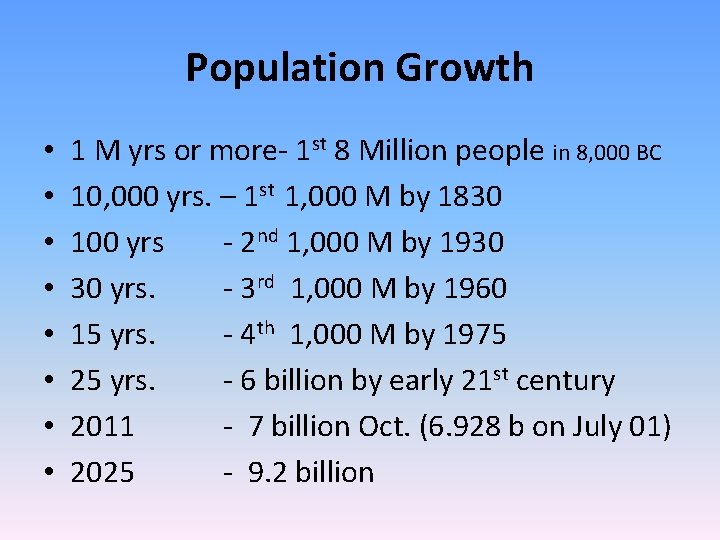
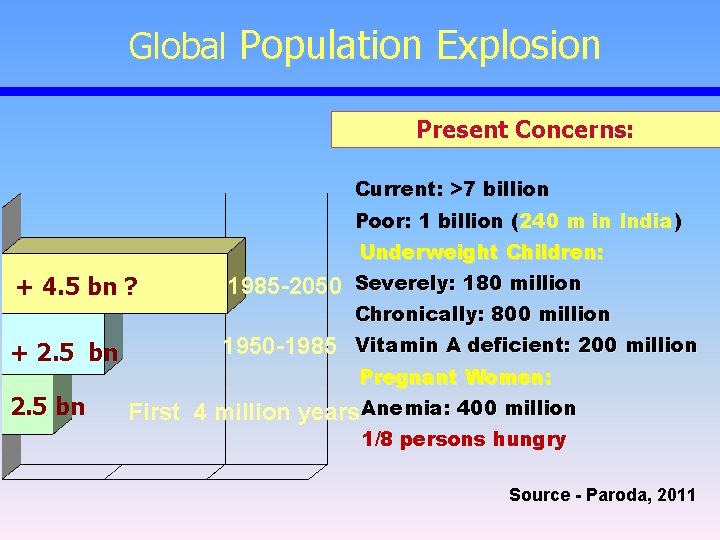
Population Growth • • 1 M yrs or more- 1 st 8 Million people in 8, 000 BC 10, 000 yrs. – 1 st 1, 000 M by 1830 100 yrs - 2 nd 1, 000 M by 1930 30 yrs. - 3 rd 1, 000 M by 1960 15 yrs. - 4 th 1, 000 M by 1975 25 yrs. - 6 billion by early 21 st century 2011 - 7 billion Oct. (6. 928 b on July 01) 2025 - 9. 2 billion
Global Population Explosion Present Concerns: Current: >7 billion Poor: 1 billion (240 m in India) Underweight Children: + 4. 5 bn ? 1985 -2050 Severely: 180 million + 2. 5 bn 1950 -1985 Vitamin A deficient: 200 million 2. 5 bn Chronically: 800 million Pregnant Women: First 4 million years Anemia: 400 million 1/8 persons hungry Source - Paroda, 2011
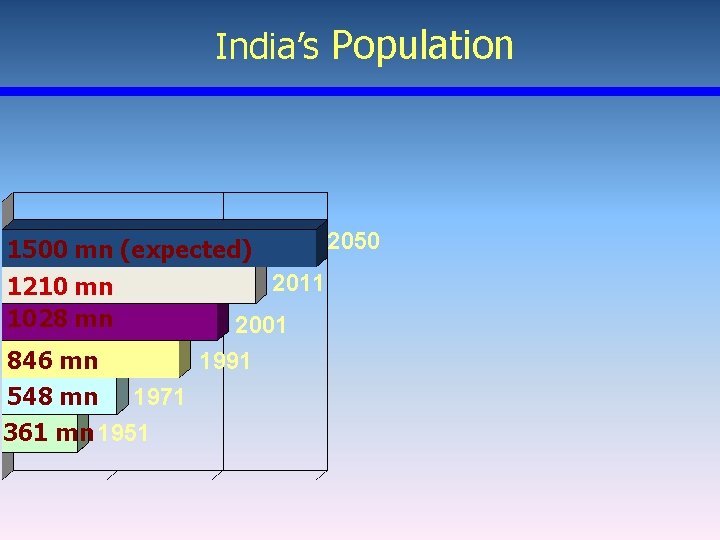
India’s Population 2050 1500 mn (expected) 1210 mn 1028 mn 846 mn 548 mn 1971 361 mn 1951 2011 2001 1991
Decennial Growth in Human Population • Graph • Ship-to-mouth • Life boat • Paddock Brothers’ Famine 1975
Other Factors Developed Vs developing • Increased longevity Antibiotics in 1950 s: Penicillin Chloromycetin • • Industrial Revolution- strong production & distribution base for Fert, pesticides, farm machinery Knowledge & technology Policy & investment Developing countries followed the suit
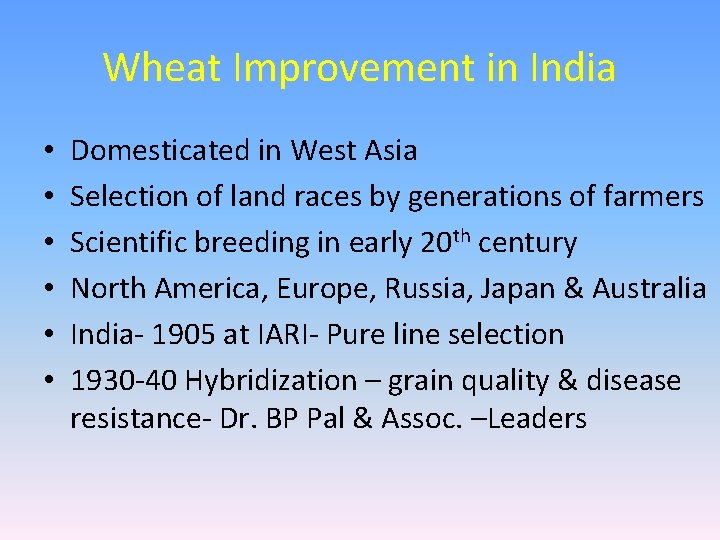
Wheat Improvement in India • • • Domesticated in West Asia Selection of land races by generations of farmers Scientific breeding in early 20 th century North America, Europe, Russia, Japan & Australia India- 1905 at IARI- Pure line selection 1930 -40 Hybridization – grain quality & disease resistance- Dr. BP Pal & Assoc. –Leaders
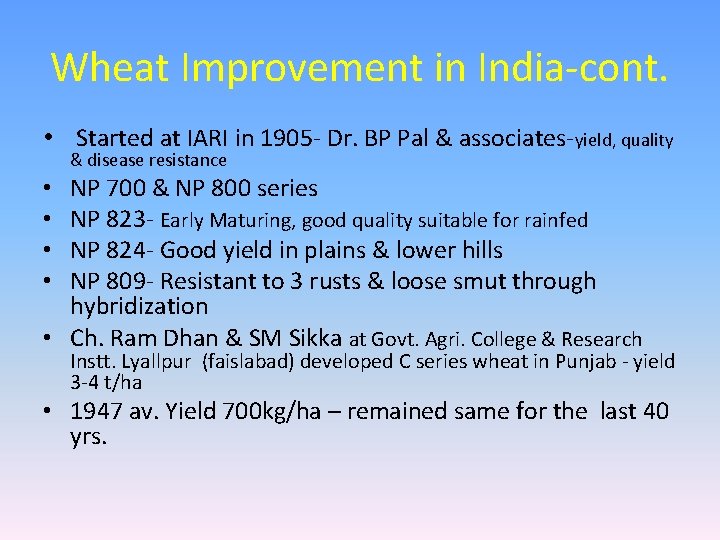
Wheat Improvement in India-cont. • Started at IARI in 1905 - Dr. BP Pal & associates-yield, quality & disease resistance NP 700 & NP 800 series NP 823 - Early Maturing, good quality suitable for rainfed NP 824 - Good yield in plains & lower hills NP 809 - Resistant to 3 rusts & loose smut through hybridization • Ch. Ram Dhan & SM Sikka at Govt. Agri. College & Research • • Instt. Lyallpur (faislabad) developed C series wheat in Punjab - yield 3 -4 t/ha • 1947 av. Yield 700 kg/ha – remained same for the last 40 yrs.
Low Productivity of Indian Wheat Remedy of the Malady
Wheat Yield in India ___________________ Year Yield ___________________ • • • 1950 -51 : 6. 46 MT 1960 -61 : 11 MT 1963 -64 1965 -66: 10. 4 MT 1970 -71: 21. 8 MT- 663 kg/ha 851 kg/ha 734 kg/ha 827 kg/ha 1172 kg/ha • Increase in yield not consistent
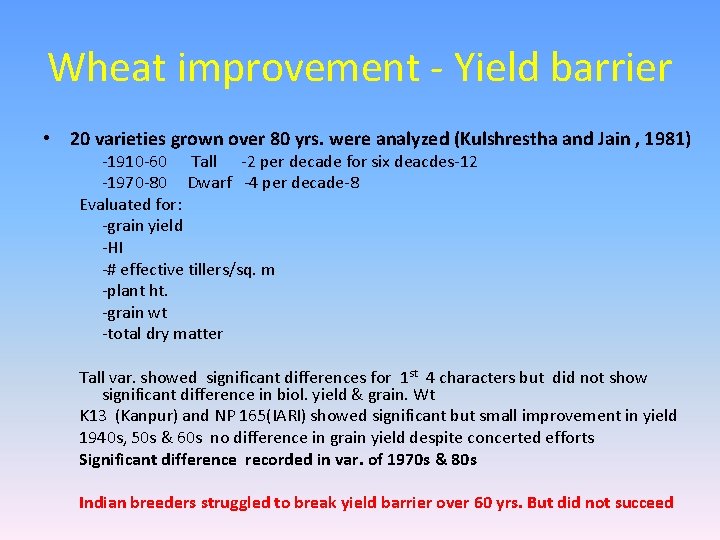
Wheat improvement - Yield barrier • 20 varieties grown over 80 yrs. were analyzed (Kulshrestha and Jain , 1981) -1910 -60 Tall -2 per decade for six deacdes-12 -1970 -80 Dwarf -4 per decade-8 Evaluated for: -grain yield -HI -# effective tillers/sq. m -plant ht. -grain wt -total dry matter Tall var. showed significant differences for 1 st 4 characters but did not show significant difference in biol. yield & grain. Wt K 13 (Kanpur) and NP 165(IARI) showed significant but small improvement in yield 1940 s, 50 s & 60 s no difference in grain yield despite concerted efforts Significant difference recorded in var. of 1970 s & 80 s Indian breeders struggled to break yield barrier over 60 yrs. But did not succeed
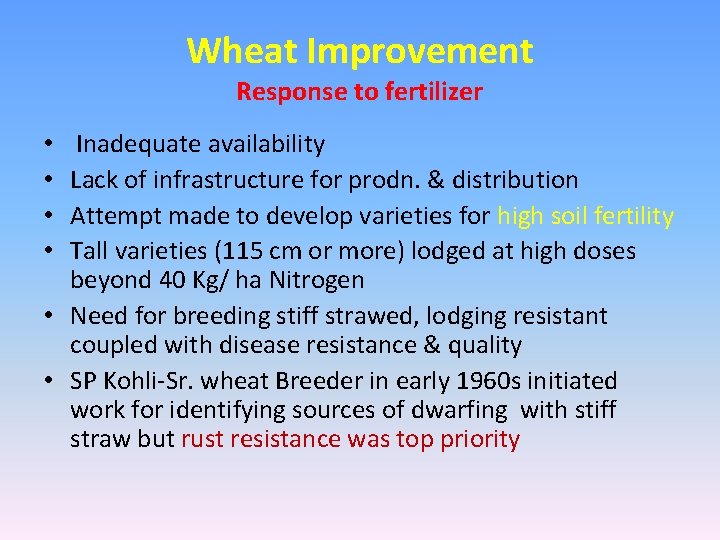
Wheat Improvement Response to fertilizer Inadequate availability Lack of infrastructure for prodn. & distribution Attempt made to develop varieties for high soil fertility Tall varieties (115 cm or more) lodged at high doses beyond 40 Kg/ ha Nitrogen • Need for breeding stiff strawed, lodging resistant coupled with disease resistance & quality • SP Kohli-Sr. wheat Breeder in early 1960 s initiated work for identifying sources of dwarfing with stiff straw but rust resistance was top priority • •
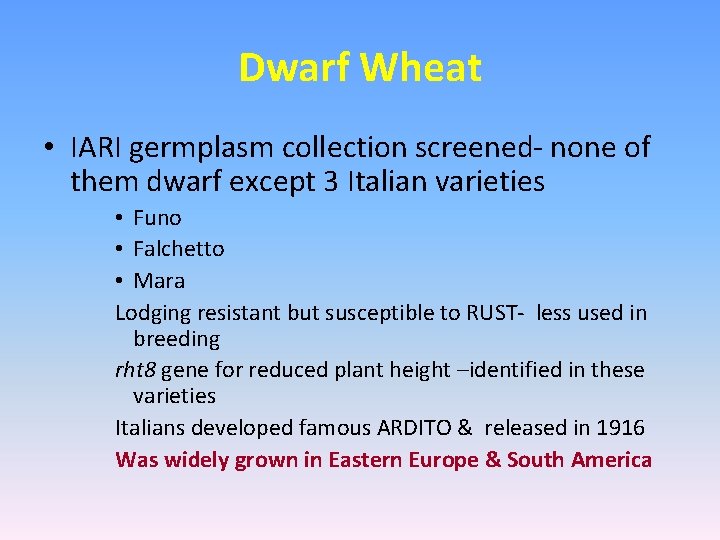
Dwarf Wheat • IARI germplasm collection screened- none of them dwarf except 3 Italian varieties • Funo • Falchetto • Mara Lodging resistant but susceptible to RUST- less used in breeding rht 8 gene for reduced plant height –identified in these varieties Italians developed famous ARDITO & released in 1916 Was widely grown in Eastern Europe & South America
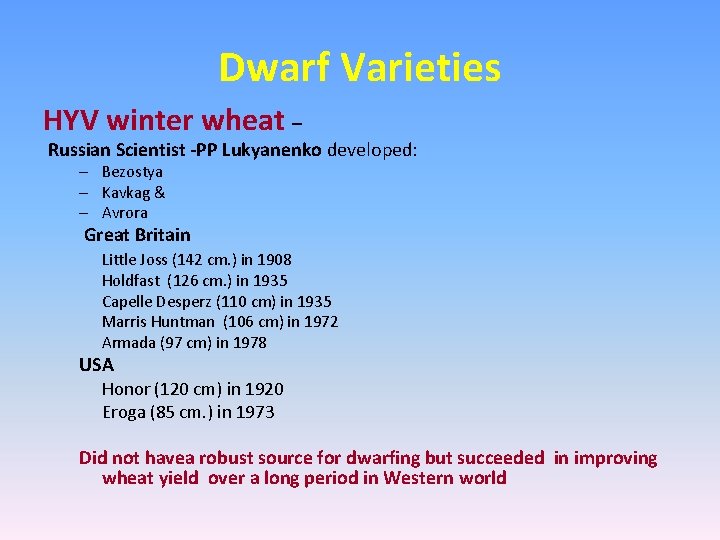
Dwarf Varieties HYV winter wheat – Russian Scientist -PP Lukyanenko developed: – Bezostya – Kavkag & – Avrora Great Britain Little Joss (142 cm. ) in 1908 Holdfast (126 cm. ) in 1935 Capelle Desperz (110 cm) in 1935 Marris Huntman (106 cm) in 1972 Armada (97 cm) in 1978 USA Honor (120 cm) in 1920 Eroga (85 cm. ) in 1973 Did not havea robust source for dwarfing but succeeded in improving wheat yield over a long period in Western world
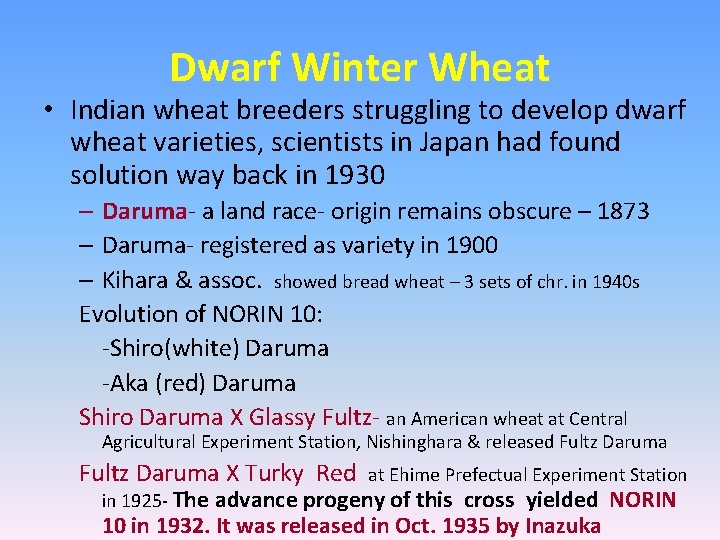
Dwarf Winter Wheat • Indian wheat breeders struggling to develop dwarf wheat varieties, scientists in Japan had found solution way back in 1930 – Daruma- a land race- origin remains obscure – 1873 – Daruma- registered as variety in 1900 – Kihara & assoc. showed bread wheat – 3 sets of chr. in 1940 s Evolution of NORIN 10: -Shiro(white) Daruma -Aka (red) Daruma Shiro Daruma X Glassy Fultz- an American wheat at Central Agricultural Experiment Station, Nishinghara & released Fultz Daruma X Turky Red at Ehime Prefectual Experiment Station in 1925 - The advance progeny of this cross yielded NORIN 10 in 1932. It was released in Oct. 1935 by Inazuka
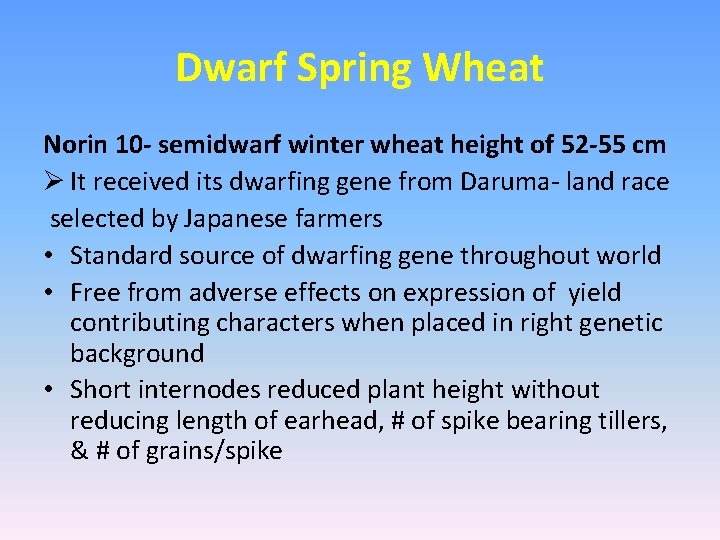
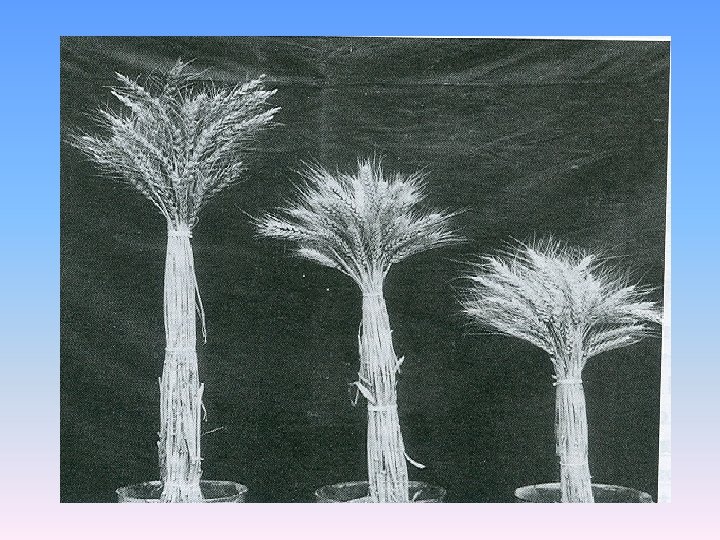
Dwarf Spring Wheat Norin 10 - semidwarf winter wheat height of 52 -55 cm Ø It received its dwarfing gene from Daruma- land race selected by Japanese farmers • Standard source of dwarfing gene throughout world • Free from adverse effects on expression of yield contributing characters when placed in right genetic background • Short internodes reduced plant height without reducing length of earhead, # of spike bearing tillers, & # of grains/spike
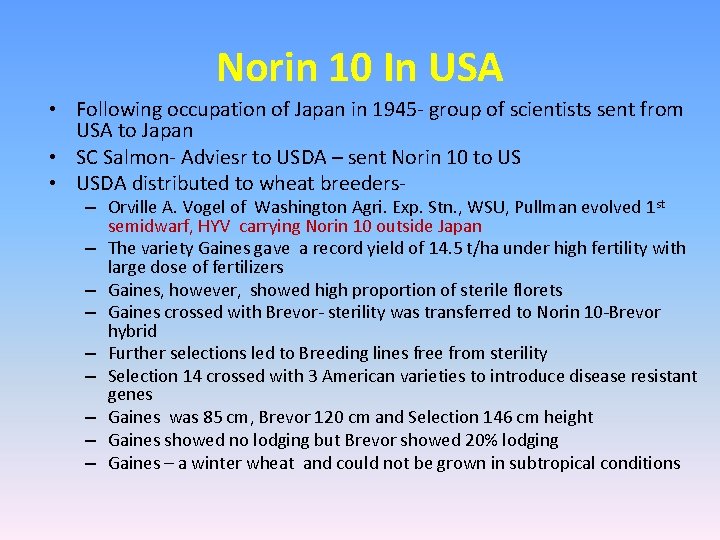
Norin 10 In USA • Following occupation of Japan in 1945 - group of scientists sent from USA to Japan • SC Salmon- Adviesr to USDA – sent Norin 10 to US • USDA distributed to wheat breeders- – Orville A. Vogel of Washington Agri. Exp. Stn. , WSU, Pullman evolved 1 st semidwarf, HYV carrying Norin 10 outside Japan – The variety Gaines gave a record yield of 14. 5 t/ha under high fertility with large dose of fertilizers – Gaines, however, showed high proportion of sterile florets – Gaines crossed with Brevor- sterility was transferred to Norin 10 -Brevor hybrid – Further selections led to Breeding lines free from sterility – Selection 14 crossed with 3 American varieties to introduce disease resistant genes – Gaines was 85 cm, Brevor 120 cm and Selection 146 cm height – Gaines showed no lodging but Brevor showed 20% lodging – Gaines – a winter wheat and could not be grown in subtropical conditions
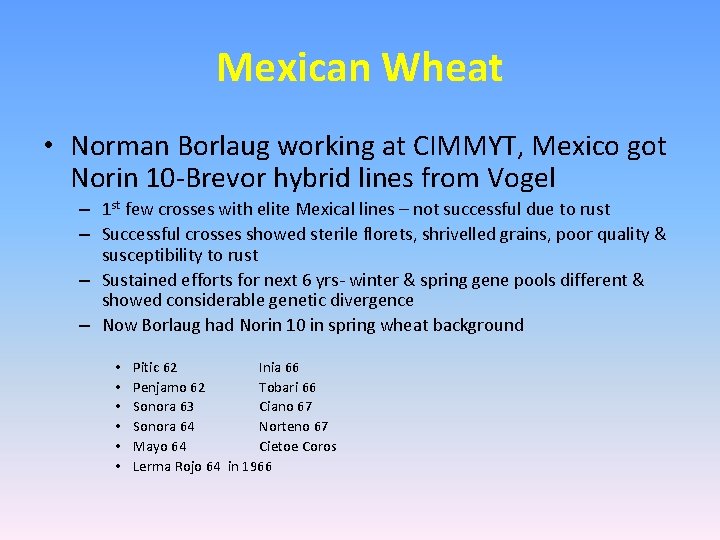
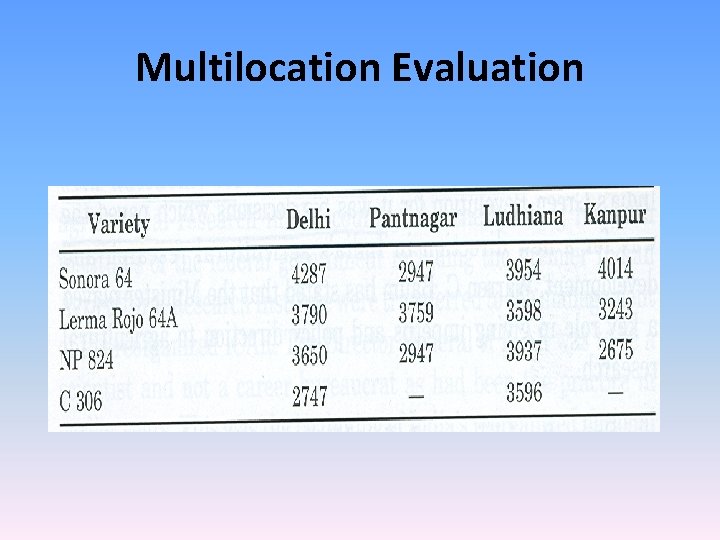
Mexican Wheat • Norman Borlaug working at CIMMYT, Mexico got Norin 10 -Brevor hybrid lines from Vogel – 1 st few crosses with elite Mexical lines – not successful due to rust – Successful crosses showed sterile florets, shrivelled grains, poor quality & susceptibility to rust – Sustained efforts for next 6 yrs- winter & spring gene pools different & showed considerable genetic divergence – Now Borlaug had Norin 10 in spring wheat background • • • Pitic 62 Inia 66 Penjamo 62 Tobari 66 Sonora 63 Ciano 67 Sonora 64 Norteno 67 Mayo 64 Cietoe Coros Lerma Rojo 64 in 1966
Multilocation Evaluation
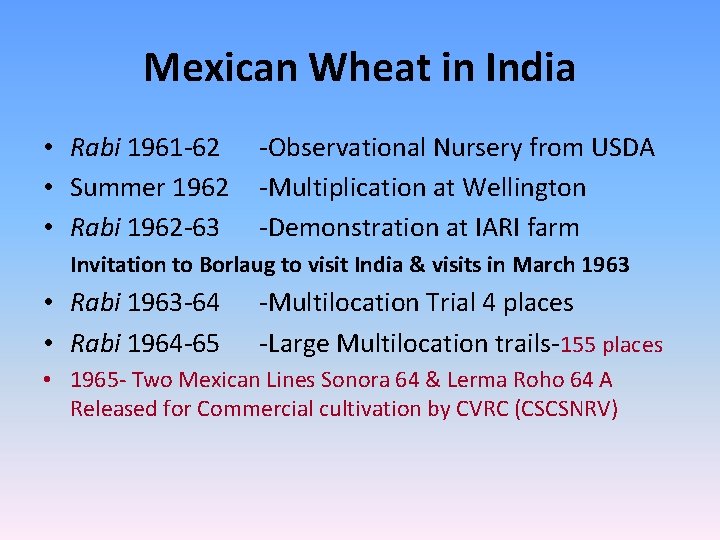
Mexican Wheat in India • Rabi 1961 -62 • Summer 1962 • Rabi 1962 -63 -Observational Nursery from USDA -Multiplication at Wellington -Demonstration at IARI farm Invitation to Borlaug to visit India & visits in March 1963 • Rabi 1963 -64 • Rabi 1964 -65 -Multilocation Trial 4 places -Large Multilocation trails-155 places • 1965 - Two Mexican Lines Sonora 64 & Lerma Roho 64 A Released for Commercial cultivation by CVRC (CSCSNRV)
Area, Production and Productivity of Wheat in India Area X 2. 5 Prodn. x 8. 5 Prody x 3
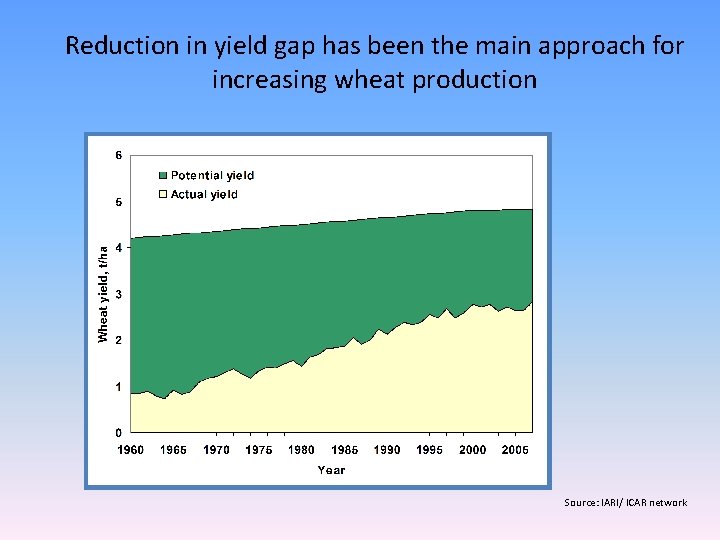
Reduction in yield gap has been the main approach for increasing wheat production Source: IARI/ ICAR network
Bt Cotton in India Area covered during 2010 : 8. 4 m ha 66
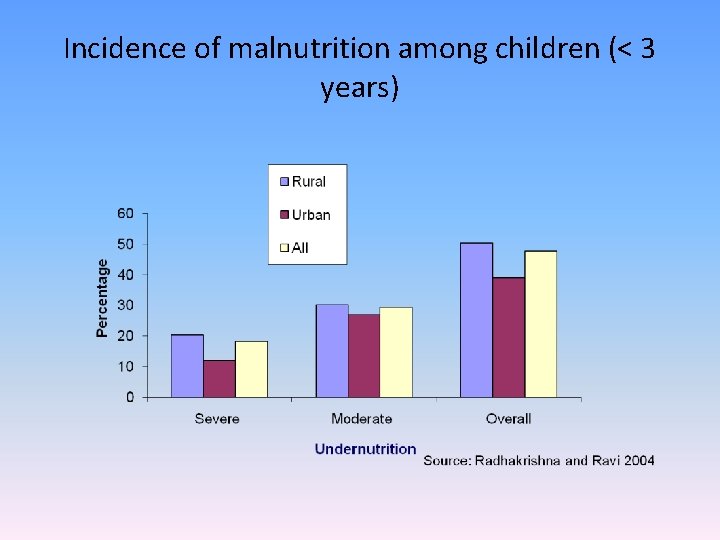
Incidence of malnutrition among children (< 3 years)
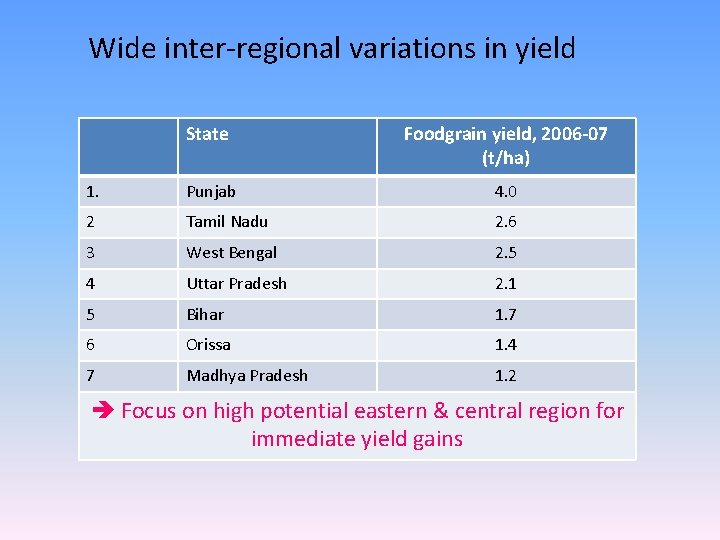
Wide inter-regional variations in yield State Foodgrain yield, 2006 -07 (t/ha) 1. Punjab 4. 0 2 Tamil Nadu 2. 6 3 West Bengal 2. 5 4 Uttar Pradesh 2. 1 5 Bihar 1. 7 6 Orissa 1. 4 7 Madhya Pradesh 1. 2 Focus on high potential eastern & central region for immediate yield gains
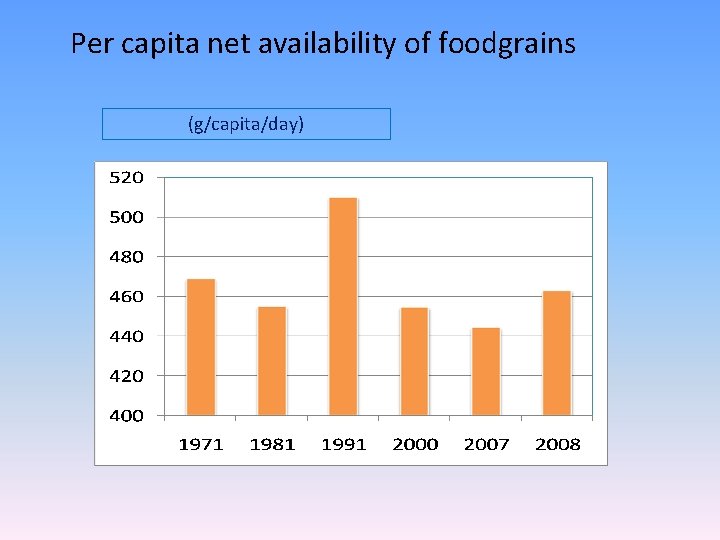
Per capita net availability of foodgrains (g/capita/day)