
HISTORY OF ADDICTION THEORY AND PRACTICE Topic Counseling

- Slides: 31
HISTORY OF ADDICTION THEORY AND PRACTICE Topic: Counseling Procedures 1. 5 Credit Hours Hannah Lowe, M. Ed. , LPC, NCC
Tid-bits to start Introduction to Hannah Lowe hlowe@shinc. org Dynamics of Zoom Mute Chat Questions Credit for course 1. 5 hours Counseling Procedures
Objectives Explore the history of addiction within a cultural context and a treatment context Demonstrate the interaction between cultural approach to addiction and theory Practice conceptualizing clinical cases from a theoretical perspective. Practice framing treatment goals within the context of theoretical approach.
Outline • Truth or Fiction Quiz • History • Significant Milestones • Moral Model • Psychological Models • Medical Models • Biopsychosocial Model
TRUTH OR FICTION (CHAT) Alcoholic’s Anonymous was the first and the fastest-growing alcoholics mutual aid in the world.
Truth or Fiction (Chat) • America’s “discovery of addiction” in the early twentieth century led to the “noble experiment” of alcohol prohibition.
Truth or Fiction (Chat) • Men, women, and children consumed alcohol every day in Colonial America.
Truth or Fiction (Chat) • Most people addiction to narcotics during the nineteenth century were provided narcotics by physicians or ingested narcotics to selftreat medical conditions.
Truth or Fiction (Chat) • Opiate addiction in American during the nineteenth century was primary a problem experienced by the Chinese.
Truth or Fiction (Chat) • The disease concept of alcoholism was first introduced by E. M. Jellinek.
Truth or Fiction (Chat) • Maintaining opiate users on medically monitored, daily doses of narcotics was first introduced as a treatment for addiction in the 1960’s.
Truth or Fiction (Chat) • Methadone maintenance was pioneered by Drs. Dole, Nyswader, and Kreek.
Truth or Fiction (Chat) • The only federally-funded treatment resource for narcotic addiction treatment in the 1930’s and 1940’s were the public hospitals (“narcotic farms”) in Lexington, Kentucky and Fort Worth, Texas.
Truth or Fiction (Chat) • A major milestone in the history of addiction treatment was the birth of therapeutic community in the late 1950’s.
Truth or Fiction (Chat) • The anti-medication bias in the field of addiction treatment is historically rooted in the number of such medication that have later been founded to have a high potential for misuse.
Truth or Fiction (Chat) • The president most associated with pushing prevention and treatment as a national drug control policy was Richard Nixon.
Truth or Fiction (Chat) • The American Association for the Study and Cure of Inebriety was founded upon the belief that inebriety was a bad habit rather than a disease.
Truth or Fiction (Chat) • A major factor in the explosive growth of addiction treatment between 1975 and 1985 was the expansion of insurance benefits to treat alcoholism and other addictions.
Truth or Fiction (Chat) • The most influential document in the rise of the modern alcoholism treatment system was the 1967 report of the Cooperative Commission on the Study of Alcoholism.
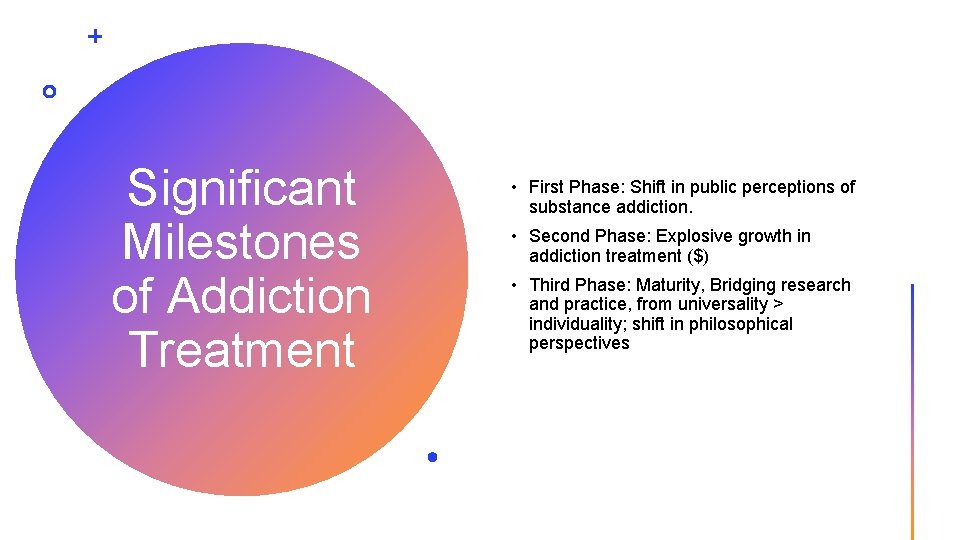
Significant Milestones of Addiction Treatment • First Phase: Shift in public perceptions of substance addiction. • Second Phase: Explosive growth in addiction treatment ($) • Third Phase: Maturity, Bridging research and practice, from universality > individuality; shift in philosophical perspectives
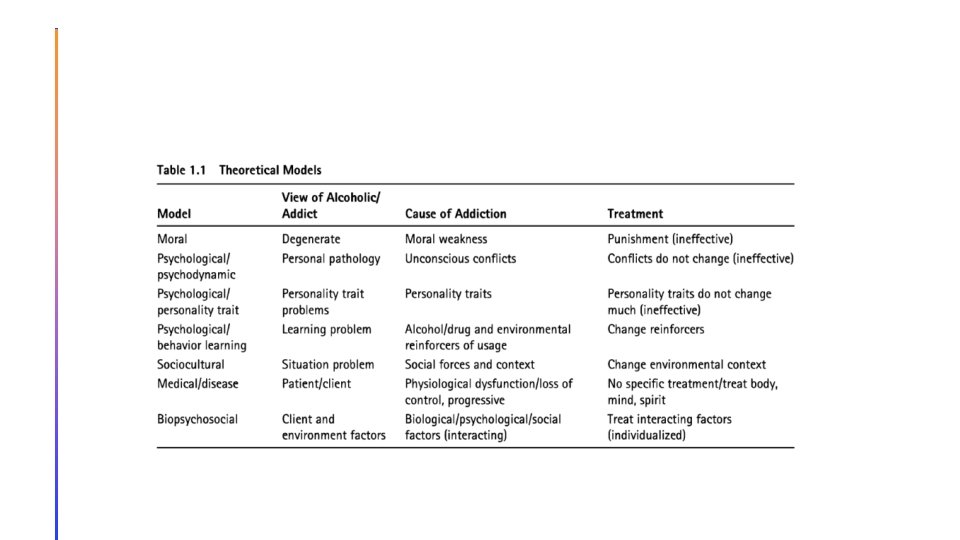
Moral Model of Substance Use • Views the person addicted to (insert substance) as a degenerate and sees addiction as a moral weakness (Heyman, 2013; Keller, 1976) • Punishment is preferred over treatment because a cure is not envisioned (Mc. Hugh et al. , 1979)
Medical Model of Substance Use • Views addiction as a progressive disease with physiological symptoms. • Loss of control over substance use • Progression of the disease- ending in death (Goodman & Levy, 2003) • Person with Addiction viewed as Patient • Cause of Addiction: Physiological dysfunction/ loss of controlprogressive • Treatment: No specific treatment (Ersche et al. , 2012; Koob & Le Moal, 2008; Volkow et al. , 2012)
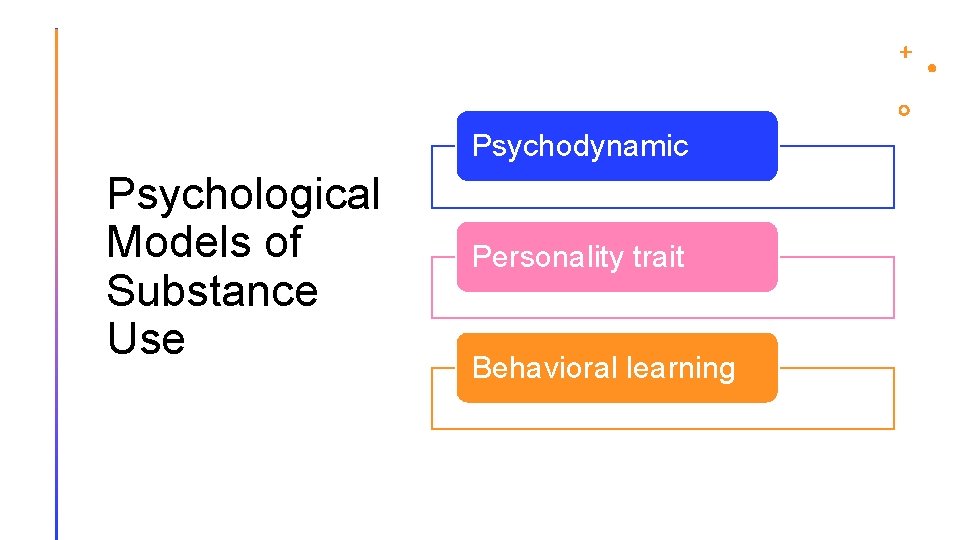
Psychodynamic Psychological Models of Substance Use Personality trait Behavioral learning
Psychological Models of Substance Use: Psychodynamic Theory • View of Person with addiction: Personal Pathology • Goal of treatment: Uncover unconscious conflicts • Treatment: Work with Conflict (can be ineffective) (Goodman, n. d. ; Johnson, 2013; Zimberg, 1985)
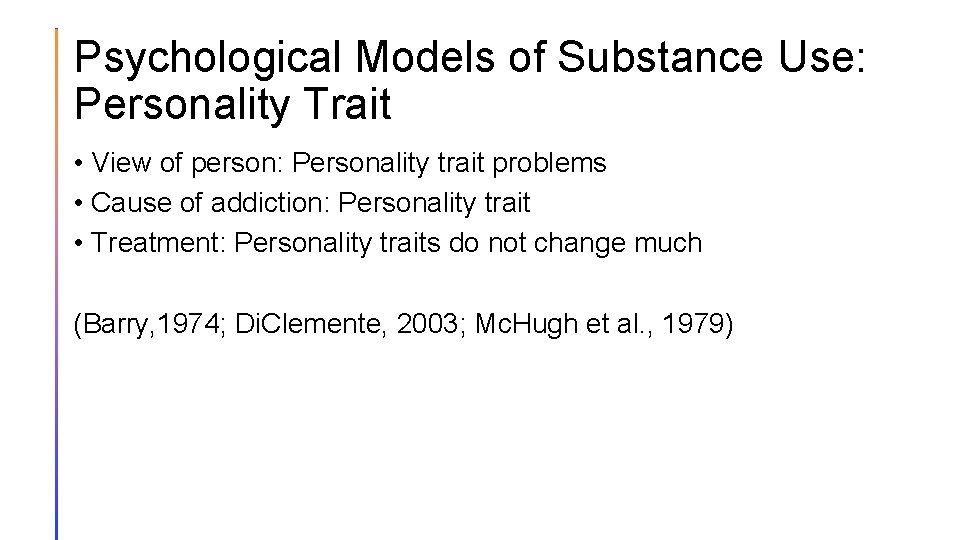
Psychological Models of Substance Use: Personality Trait • View of person: Personality trait problems • Cause of addiction: Personality trait • Treatment: Personality traits do not change much (Barry, 1974; Di. Clemente, 2003; Mc. Hugh et al. , 1979)
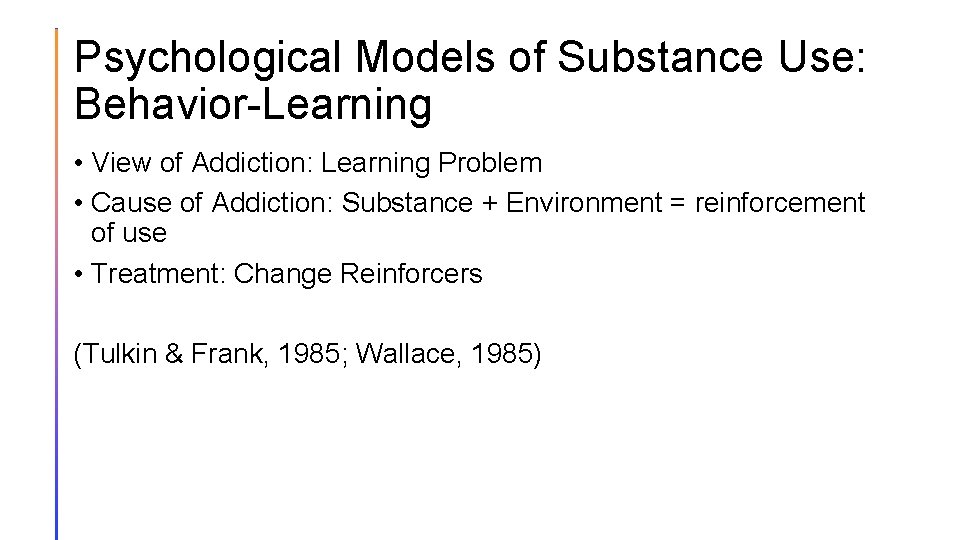
Psychological Models of Substance Use: Behavior-Learning • View of Addiction: Learning Problem • Cause of Addiction: Substance + Environment = reinforcement of use • Treatment: Change Reinforcers (Tulkin & Frank, 1985; Wallace, 1985)
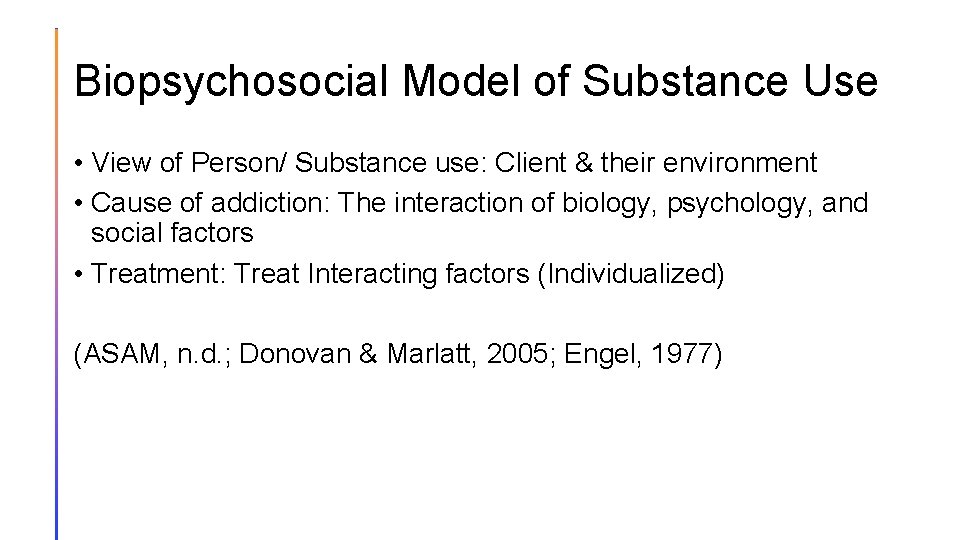
Biopsychosocial Model of Substance Use • View of Person/ Substance use: Client & their environment • Cause of addiction: The interaction of biology, psychology, and social factors • Treatment: Treat Interacting factors (Individualized) (ASAM, n. d. ; Donovan & Marlatt, 2005; Engel, 1977)
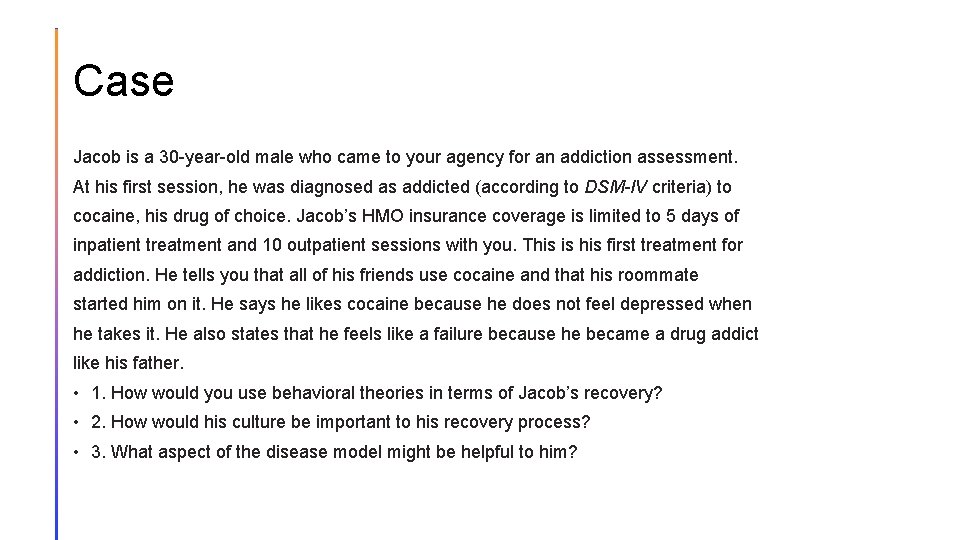
Case Jacob is a 30 -year-old male who came to your agency for an addiction assessment. At his first session, he was diagnosed as addicted (according to DSM-IV criteria) to cocaine, his drug of choice. Jacob’s HMO insurance coverage is limited to 5 days of inpatient treatment and 10 outpatient sessions with you. This is his first treatment for addiction. He tells you that all of his friends use cocaine and that his roommate started him on it. He says he likes cocaine because he does not feel depressed when he takes it. He also states that he feels like a failure because he became a drug addict like his father. • 1. How would you use behavioral theories in terms of Jacob’s recovery? • 2. How would his culture be important to his recovery process? • 3. What aspect of the disease model might be helpful to him?
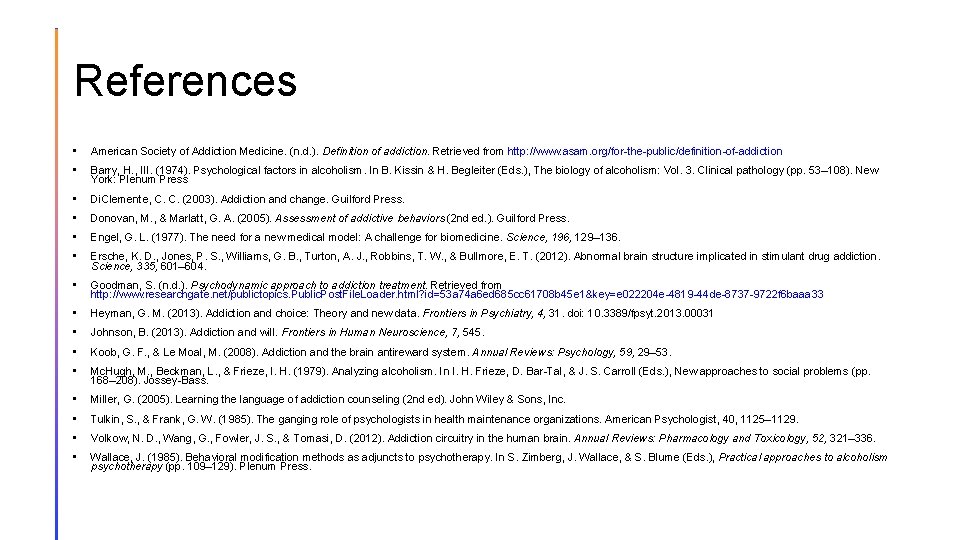
References • American Society of Addiction Medicine. (n. d. ). Definition of addiction. Retrieved from http: //www. asam. org/for-the-public/definition-of-addiction • Barry, H. , III. (1974). Psychological factors in alcoholism. In B. Kissin & H. Begleiter (Eds. ), The biology of alcoholism: Vol. 3. Clinical pathology (pp. 53– 108). New York: Plenum Press • Di. Clemente, C. C. (2003). Addiction and change. Guilford Press. • Donovan, M. , & Marlatt, G. A. (2005). Assessment of addictive behaviors (2 nd ed. ). Guilford Press. • Engel, G. L. (1977). The need for a new medical model: A challenge for biomedicine. Science, 196, 129– 136. • Ersche, K. D. , Jones, P. S. , Williams, G. B. , Turton, A. J. , Robbins, T. W. , & Bullmore, E. T. (2012). Abnormal brain structure implicated in stimulant drug addiction. Science, 335, 601– 604. • Goodman, S. (n. d. ). Psychodynamic approach to addiction treatment. Retrieved from http: //www. researchgate. net/publictopics. Public. Post. File. Loader. html? id=53 a 74 a 6 ed 685 cc 61708 b 45 e 1&key=e 022204 e-4819 -44 de-8737 -9722 f 6 baaa 33 • Heyman, G. M. (2013). Addiction and choice: Theory and new data. Frontiers in Psychiatry, 4, 31. doi: 10. 3389/fpsyt. 2013. 00031 • Johnson, B. (2013). Addiction and will. Frontiers in Human Neuroscience, 7, 545. • Koob, G. F. , & Le Moal, M. (2008). Addiction and the brain antireward system. Annual Reviews: Psychology, 59, 29– 53. • Mc. Hugh, M. , Beckman, L. , & Frieze, I. H. (1979). Analyzing alcoholism. In I. H. Frieze, D. Bar-Tal, & J. S. Carroll (Eds. ), New approaches to social problems (pp. 168– 208). Jossey-Bass. • Miller, G. (2005). Learning the language of addiction counseling (2 nd ed). John Wiley & Sons, Inc. • Tulkin, S. , & Frank, G. W. (1985). The ganging role of psychologists in health maintenance organizations. American Psychologist, 40, 1125– 1129. • Volkow, N. D. , Wang, G. , Fowler, J. S. , & Tomasi, D. (2012). Addiction circuitry in the human brain. Annual Reviews: Pharmacology and Toxicology, 52, 321– 336. • Wallace, J. (1985). Behavioral modification methods as adjuncts to psychotherapy. In S. Zimberg, J. Wallace, & S. Blume (Eds. ), Practical approaches to alcoholism psychotherapy (pp. 109– 129). Plenum Press.