
HISTORY HISTORICALLY POLICE DEPARTMENTS OPERATED WITHOUT CLEARLY DEFINED




- Slides: 49
HISTORY • HISTORICALLY POLICE DEPARTMENTS OPERATED WITHOUT CLEARLY DEFINED AND AGREED UPON MISSIONS • POLICE OFFICERS WERE NEVER INTENDED TO HAVE MUCH POWER • AT FIRST CITIZENS POLICED THEMSELVES. PEOPLE ESCAPING FROM POLITICAL, RELIGIOUS, OR ECONOMIC OPPRESSION FOUNDED AMERICA. • PRIVATE JUSTICE PREVAILED. WHEN WRONGED THEY MADE IT RIGHT.
ENGLAND IN THE EARLY 1200’S The primary enforcer was the shire-reeve, who was appointed by the king. The shire-reeve not only enforced the king’s laws, but also collected taxes. He was the overseer of all the hundreds in his shire. As England became more urban the tithing system became less effective because the members were unpaid. They had no incentive to control crime.
A constable , appointed by a local nobleman, had the job of making sure citizens in his hundred reported problems and tracked down offenders.
Edward I formally gave constables an official police force to help protect property in large towns; the force was funded by pledges and manned by unpaid volunteers.
In 1326, Edward II, established a new office of justice of the peace, filled by a nobleman appointed by the king. The justice of the peace, with the constable as his assistant eventually refined his role to that of a judge. This is the first separation of judicial and law enforcement function.
England continued to grow and become more urbanized. Jobs became fewer and fewer due to the industrial revolution and social conditions became worse.
With the military being called in to quell riots the people turned against this practice in 1818 when 11 people were killed during a disturbance at a lecture in Manchester. This set the stage for a dramatic reform. Sir Robert Peel became Home Secretary in 1822.
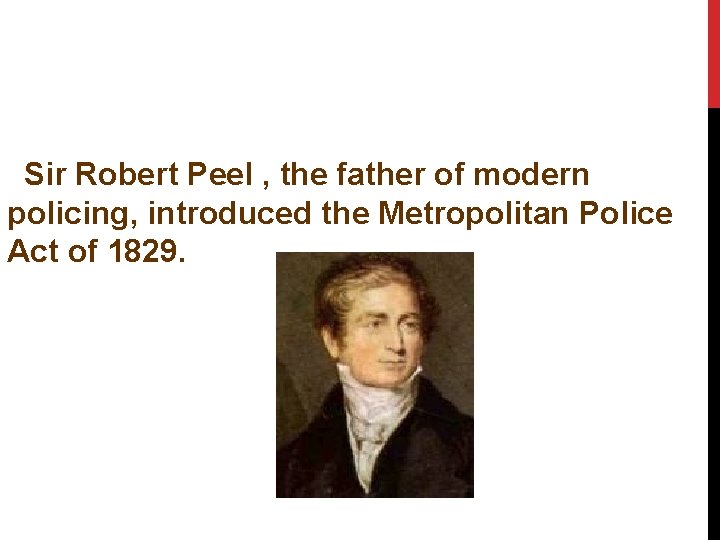
Sir Robert Peel , the father of modern policing, introduced the Metropolitan Police Act of 1829.
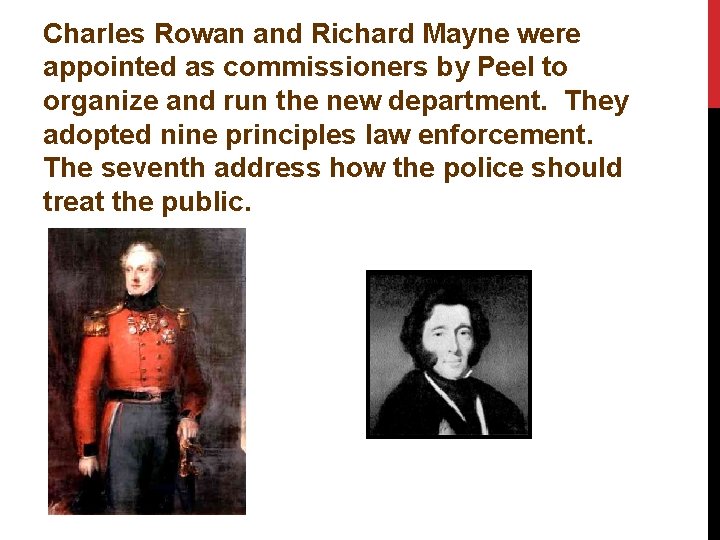
Charles Rowan and Richard Mayne were appointed as commissioners by Peel to organize and run the new department. They adopted nine principles law enforcement. The seventh address how the police should treat the public.
The police at all times should maintain a relationship with the public that gives reality to the historic tradition that the police are the public and that the public are the police; the police are the only members of the public who are paid to give full-time attention to duties which are incumbent on every citizen in the interest of the community welfare. (1829)
American law enforcement can trace its beginnings back to Britain. Law enforcement started here with volunteer night watches and eventually developed into paid police forces.
These early police departments were governed by the spoils system. The departments were influenced by partisan politics. With jobs being given to those that supported winning political candidates.
In 1871 leading police officials met in Philadelphia where they started the first Uniform Crime-Reporting System. This moved police toward limiting themselves to crime-fighting.
This in effect created a measure of police performance based on reported crime rather than citizen input and concern.
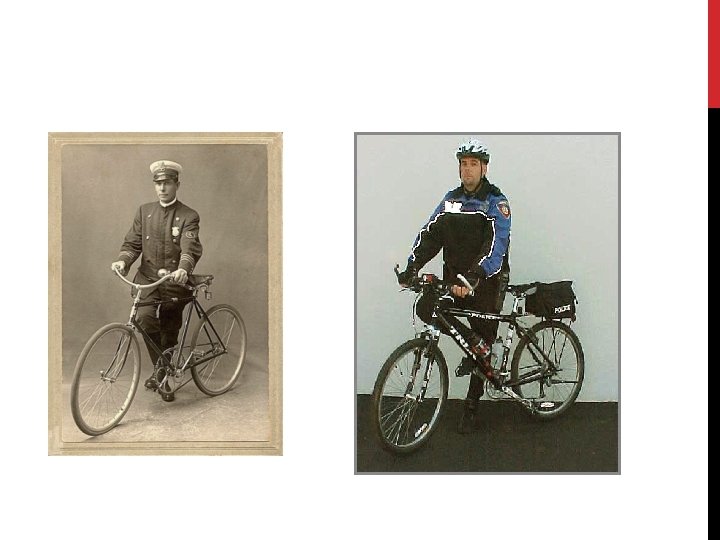
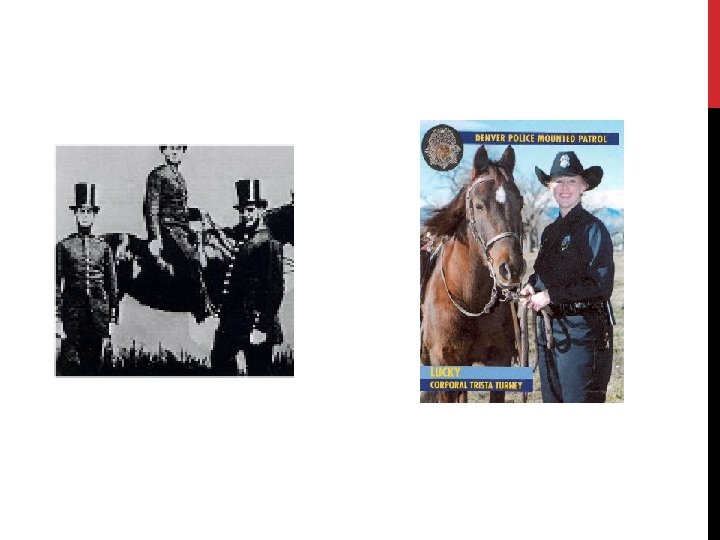
Police in the urban areas patrolled their areas on foot. This changed in the 1890 when police began using bicycles to cover greater areas and to have a quicker response.
On the western frontier horses were the transportation norm. Sheriff’s relied on community volunteer in the form of posses to help locate offenders.
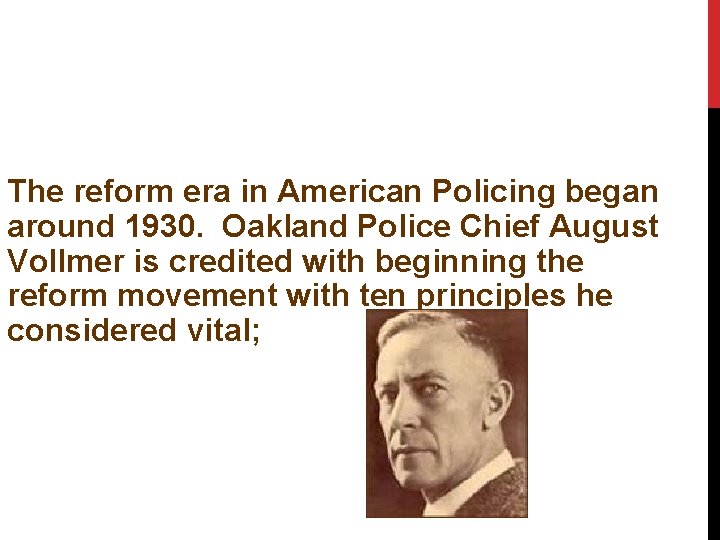
The reform era in American Policing began around 1930. Oakland Police Chief August Vollmer is credited with beginning the reform movement with ten principles he considered vital;
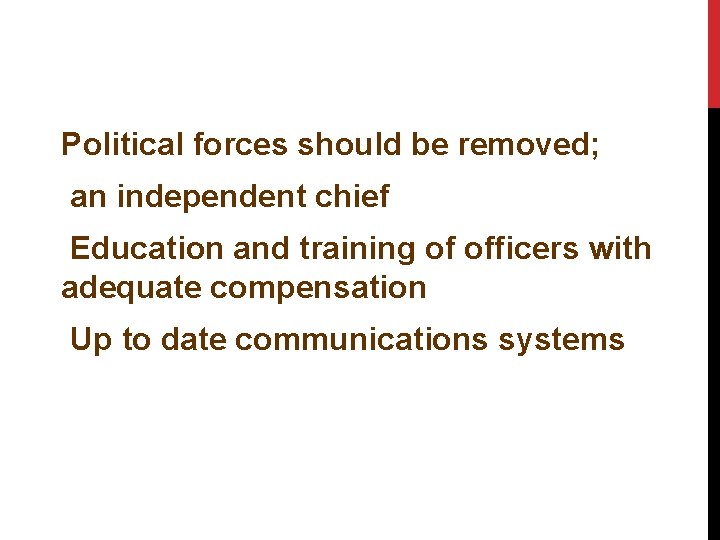
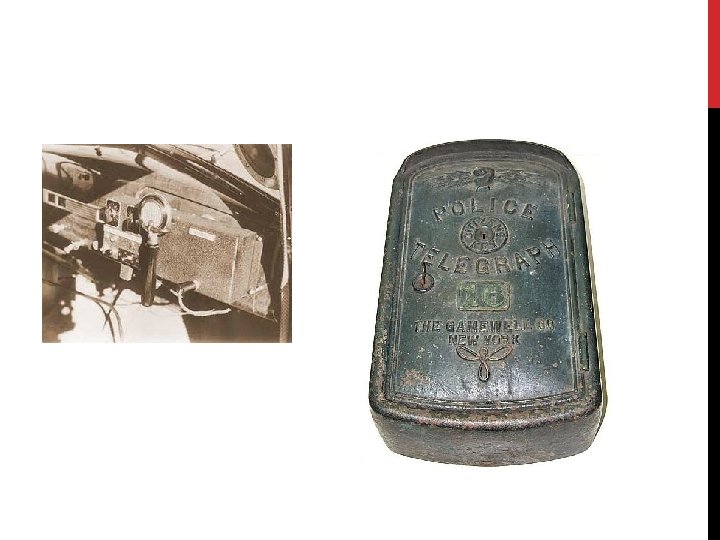
Political forces should be removed; an independent chief Education and training of officers with adequate compensation Up to date communications systems
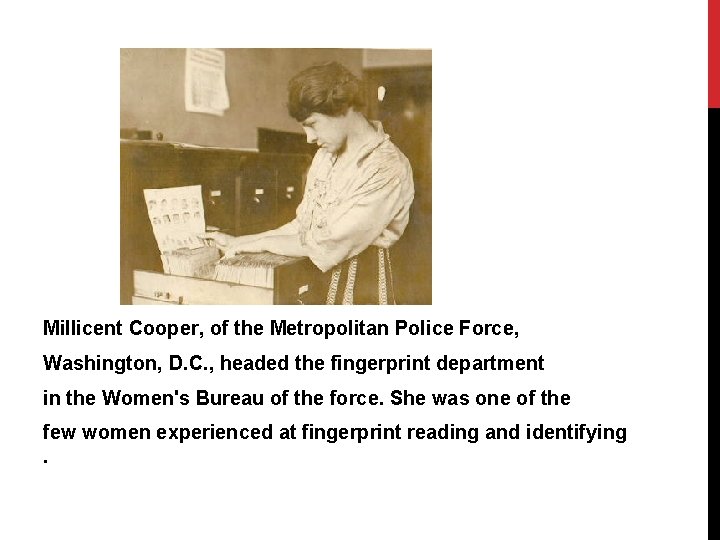
Millicent Cooper, of the Metropolitan Police Force, Washington, D. C. , headed the fingerprint department in the Women's Bureau of the force. She was one of the few women experienced at fingerprint reading and identifying.
Complete and adequate records for efficient use of resources Benefit of crime prevention Expanded use of women in police work The need for different police approaches The importance of the service role in policing.
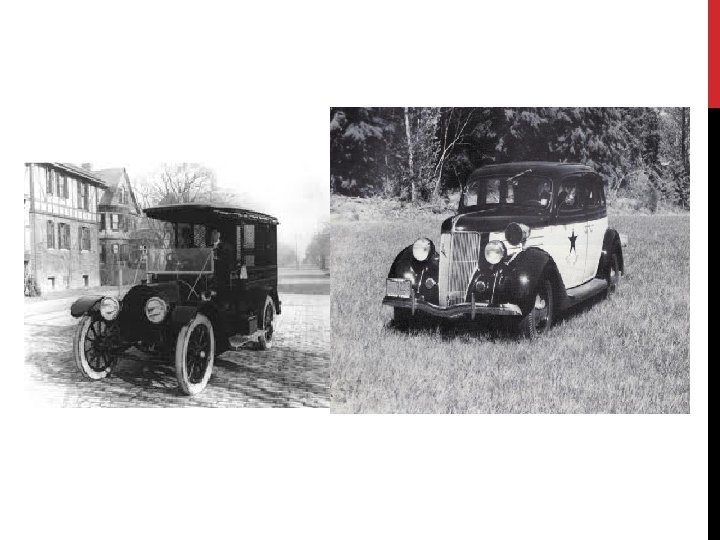
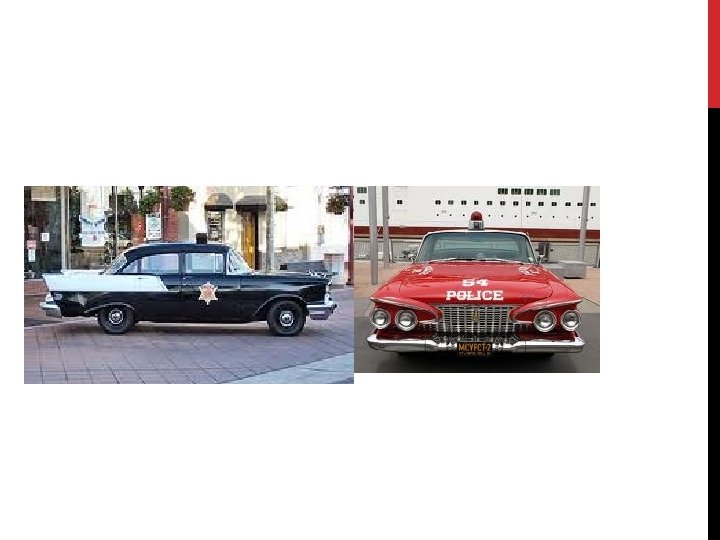
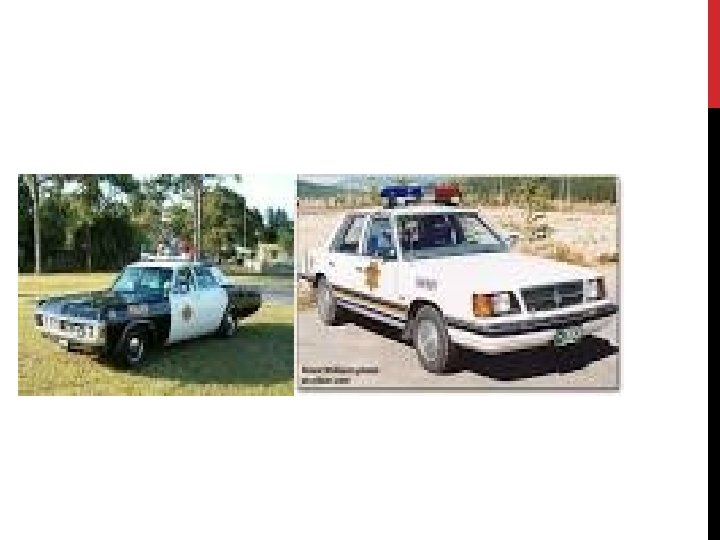
Technological Changes that began in the 20’s and 30’s Automobiles Two-way radios A new science called forensics
PREVENTATIVE PATROL Officers were expected to randomly cruise neighborhoods to seek out and deter crime. This gave the illusion of significant presence, but resulting research determined that it was not effective.
RAPID RESPONSE This was the expected outcome of random patrol. Common wisdom suggests that the quicker the response the better the chance of catching the offender and aiding victims. Research suggests that the chances of catching an offender at the scene are not that great because of citizen reporting delays. 90% of reported crimes are at least 5 to 10 minutes old prior to the police being called.
1960 S In the 60’s things had become so bad in many cities police and citizens began adopting a new attitude, us versus them.
1960 S The police were totally relying on the patrol car and their radios. Officers were caught between powerful social forces trying to maintain social order while upholding unpopular and often ill-considered policies of the politicians and legislators.
1980 S Attention shifted from who should be a police officer and how police organizations should be administered to what police should be expected to accomplish.
The environment for policing has changed. Now the perception of crime or the increase of crime has citizens concerned. Resources are being overwhelmed Everything around us is in flux • Technology, education, economy, demographics, politics
BROKEN WINDOWS THEORY In 1982 George Kelling & James O. Wilson wrote a paper that introduced the broken windows theory, with 3 points.
Neighborhood disorder creates fear – Urban areas with street people, youth gangs, prostitutes, and the mentally disturbed are the ones most likely to maintain a high degree of crime.
Neighborhoods give out crimepromoting “signals”. A neighborhood where housing has deteriorated, broken windows left unrepaired, and disorderly behavior is ignored emits crime-promoting signals. Honest citizens live in fear while predatory criminals are attracted.
Community Policing- is essential. If police are to reduce fear and successfully combat crime in these urban areas, they must rely on the cooperation of citizens for support and assistance.
PUBLIC PERCEPTION IS REALITY The public doesn’t care about arrest statistics; they care about feeling safe and quality of life issues.
The public and the police must work together! Community relations and effective crime control can not be left to a few specialized units within a traditionally organized police department. All officers must assume a different way of thinking and doing.
We must build partnerships. This is the core component of community policing and problem solving and having a supportive organization.
Community partnerships and problem solving will give officers new responsibility, a flexible style of management, and assist them in being creative and innovative.
Partnerships need cooperation, respect, and trust in order to perform problem solving.
Problem solving has enjoyed success in many communities around the country. Problem solving is a process of continuously looking at crime and disorder problems to analytically understand those problems. Analysis must be done to tailor the solution to the problem
Community Oriented Policing and Problem Oriented Policing involve moving toward an effectiveness model of policing. We need to use crime reduction, not criminal arrests as an assessment tool.
WHO ARE OUR COMMUNITY PARTNERS? Service providers Businesses Service clubs Other governmental agencies
There are many benefits of community policing. It increases the potential for impacting crime, fear of crime, and quality of life. It coordinates and leverages resources from all sectors for more effective strategies. Community policing increases the trust and understanding of community members and strengthens organizational support.
Community policing creates a network of assistance, guidance, and technical support in problem solving. It also is a more strategic approach to creating a long-term impact.