
History Enquiry How dark were the Dark Ages
- Slides: 7
History Enquiry: How “dark” were the Dark Ages? The Anglo-Saxon Kingdoms Mr Cooper 1
Bede’s history In about 731 AD, a monk called Bede wrote the first history of England. Bede described how the Angles, Saxons and Jutes — tribes from northern Germany — invaded the country and set up seven kingdoms. He named these kingdoms Wessex, Sussex, Essex, Kent, Mercia, East Anglia and Northumbria. Bede was right when he said that many people migrated to Britain from northern Germany. However it seems that Bede was wrong when he said they immediately set up kingdoms. Instead, the evidence from graves suggest that Anglo-Saxons became rich and powerful slowly. Once some individual Anglo-Saxons were wealthy, they started to take control of the villages and communities around them, and then gradually became more powerful. 2
The European connection One of the most advanced kingdoms was called Kent was located on the south coast of England so it was closely connected to Francia, the region now known as France. When the Romans left Britain, civilised society collapsed. However, in Francia, when the Romans left the people there managed to keep a lot of the things that made it civilised. So in Francia there were still towns, reading and writing in Latin and laws to govern how people lived. This meant that Francia remained connected to the wider world and people in Francia could get hold of luxury goods like wine. In Kent, archaeologists have found evidence, like Frankish money, to show that there was trade with Francia. There is also written evidence that says Kentish kings were married to Frankish women. 3
Powerful kings By the seventh century, some Anglo Saxon kings had become rich and powerful. These kings wore symbolic clothes, weapons and jewelry to show their relationship to the past. It was during this time that important people started to be buried in made hills called barrows. One of the most famous barrows was at Sutton Hoo. Here a whole ship was discovered by archaeologists. In the ship was buried the body of a powerful man, who was covered in decorated armour. The designs show that he wanted to show that he was related to his Anglo-Saxon ancestors in northern Germany. The value of what he was buried with tells us that he was rich enough to afford expensive products from abroad. 4
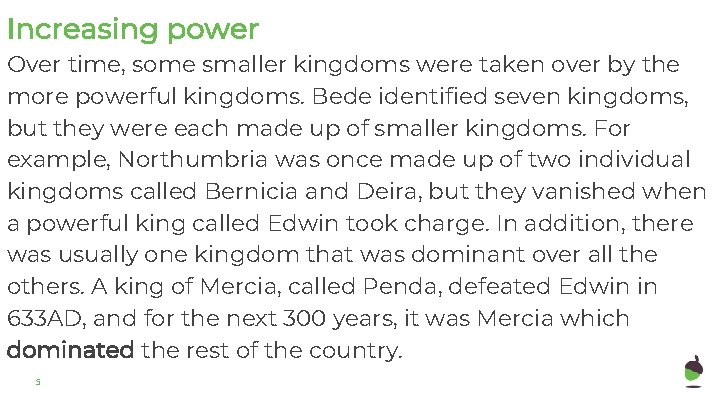
Increasing power Over time, some smaller kingdoms were taken over by the more powerful kingdoms. Bede identified seven kingdoms, but they were each made up of smaller kingdoms. For example, Northumbria was once made up of two individual kingdoms called Bernicia and Deira, but they vanished when a powerful king called Edwin took charge. In addition, there was usually one kingdom that was dominant over all the others. A king of Mercia, called Penda, defeated Edwin in 633 AD, and for the next 300 years, it was Mercia which dominated the rest of the country. 5
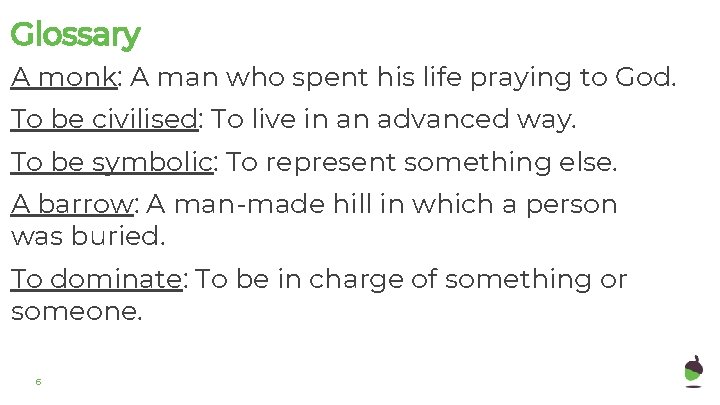
Glossary A monk: A man who spent his life praying to God. To be civilised: To live in an advanced way. To be symbolic: To represent something else. A barrow: A man-made hill in which a person was buried. To dominate: To be in charge of something or someone. 6
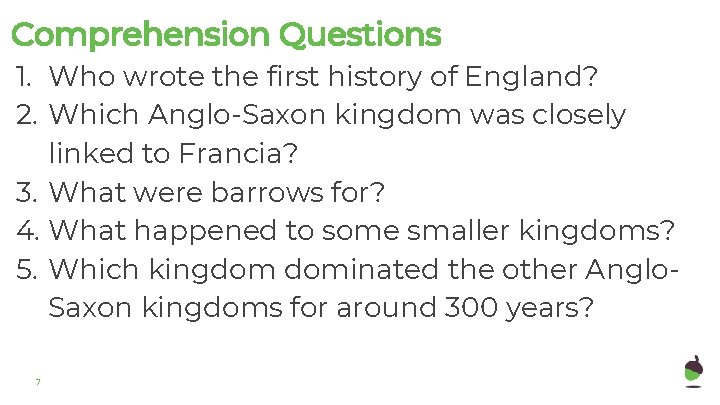
Comprehension Questions 1. Who wrote the first history of England? 2. Which Anglo-Saxon kingdom was closely linked to Francia? 3. What were barrows for? 4. What happened to some smaller kingdoms? 5. Which kingdom dominated the other Anglo. Saxon kingdoms for around 300 years? 7