
HISTORY CURRICULUM Content strands Relationship between the strands
HISTORY CURRICULUM

Content strands Relationship between the strands Inquiry Questions Depth Studies Relationships between overviews and depth studies Concepts for developing historical understanding Year level descriptions Content elaborations Glossary A glossary is provided to support the common understanding of key terms in the content descriptions.

HISTORICAL JEOPARDY
TOPIC HEADING EXAMPLE POSSIBLE POINTS 10 LET THE GAME BEGIN! ANSWER 1 MINUTE TIMER QUESTION
EXAMPLE = 10 A disciplined process of inquiry into the past that develops students' curiosity and imagination. WHAT IS HISTORY?

HISTORICAL JEOPARDY
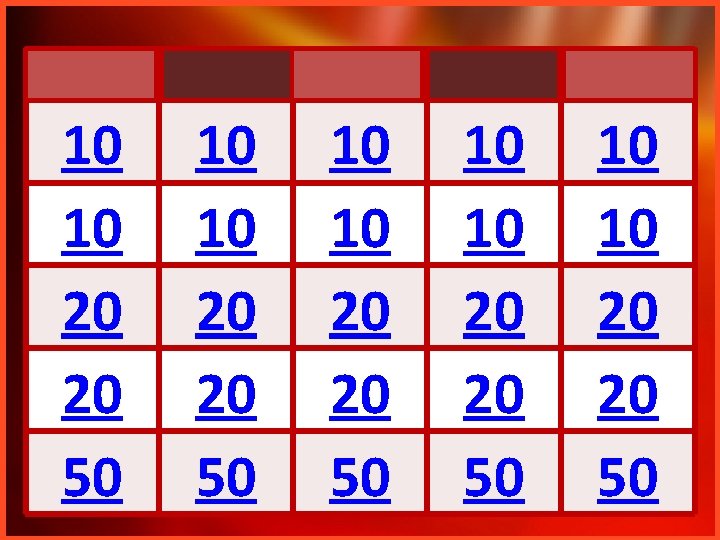
ISMS CONCEPTS PERIODS SKILLS INQUIRY 10 10 20 20 50 10 10 20 20 50
ISM = 10 The process whereby rule or control is established and maintained over other peoples and nations. WHAT IS IMPERIALISM?
ISM = 10 The feeling of belonging to a people, a place and a common culture. WHAT IS NATIONALISM?

ISM = 20 The introduction of machinery to produce large quantities of goods using fuel-based technology. WHAT IS INDUSTRIALISM?
ISM = 20 The practice of one country acquiring full or partial political control over another country. WHAT IS COLONIALISM?
ISM = 50 A combination of economic practices involving the formation and trade in ownership of companies for buying and selling goods, in a relatively free market. WHAT IS CAPITALISM?
CONCEPTS = 10 Information obtained from sources that are valuable for a particular inquiry. WHAT IS EVIDENCE?
CONCEPTS = 10 An understanding of the past from the point of view of a particular individual or group including an appreciation of the circumstances they faced. WHAT IS EMPATHY?
CONCEPTS = 20 Supports the needs of the present without compromising the ability of future generations to meet their own needs. WHAT IS SUSTAINABILITY?
CONCEPTS = 20 The importance that is assigned to particular aspects of the past. WHAT IS SIGNIFICANCE?
CONCEPTS = 50 Used by historians to identify chains of events and developments over time. WHAT IS CAUSE AND EFFECT?
PERIODS = 10 This period covers history from the development of early human communities to the end of the last antiquity. WHAT IS ANCIENT?
PERIODS = 10 The period of history between the end of the Roman Empire to the end of the Renaissance. WHAT IS MEDIEVAL?
PERIODS = 20 This period covers history from the beginning of the Industrial Revolution to the present. WHAT IS MODERN?
PERIODS = 20 Historical dates before the birth of Christ are classified as this. WHAT IS BEFORE COMMON ERA?
PERIODS = 50 Historical dates after the birth of Christ are classified as this. WHAT IS COMMON ERA?
SKILLS = 10 A word or phrase used to describe abstract aspects of features of the past and more specific features. WHAT ARE TERMS?
SKILLS = 10 The study of time. It involves the arrangement of events in order, as in a timeline. WHAT IS CHRONOLOGY?
SKILLS = 20 A person’s point of view, the position from which they see and understand events going on around them. WHAT IS PERSPECTIVE?
SKILLS = 20 An explanation of the past, for example about a specific person, event of development. WHAT IS INTERPRETATION?
SKILLS = 50 This occurs when particular interpretations about the past are open to debate. WHAT IS CONTESTABILITY?
INQUIRY = 10 The process of investigation undertaken in order to understand the past. WHAT IS HISTORICAL INQUIRY?
INQUIRY = 10 Objects and documents created or written during the time being investigated. WHAT ARE PRIMARY SOURCES?
INQUIRY = 20 Accounts about the past that were created after the time being investigated and which often present a particular interpretation. WHAT ARE SECONDARY SOURCES?
INQUIRY = 20 People’s spoken recollections of the past, recorded through an audio or video interview. WHAT IS ORAL HISTORY?
INQUIRY = 50 The study of the characteristics of human populations, such as size, age profile and life expectancy. WHAT IS DEMOGRAPHY?
- Slides: 35