
History and structures of Australian law making Australia

- Slides: 11
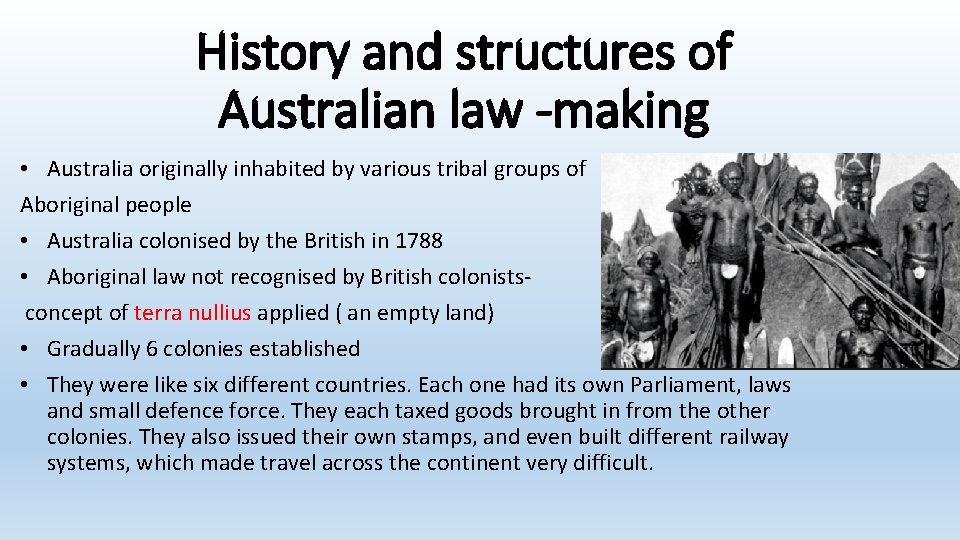
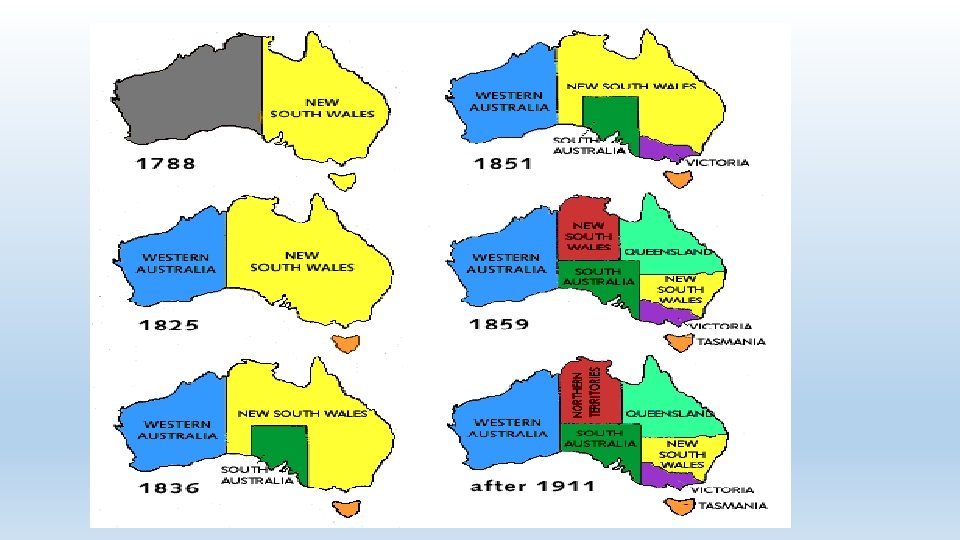
History and structures of Australian law -making • Australia originally inhabited by various tribal groups of Aboriginal people • Australia colonised by the British in 1788 • Aboriginal law not recognised by British colonistsconcept of terra nullius applied ( an empty land) • Gradually 6 colonies established • They were like six different countries. Each one had its own Parliament, laws and small defence force. They each taxed goods brought in from the other colonies. They also issued their own stamps, and even built different railway systems, which made travel across the continent very difficult.
• Each colony applied British laws • 1851+ - colonies given power to make their own laws. • Late 1890’s- Colonies discuss the idea of forming a federation (a nation with one central law-making body and a number of regional law-making bodies) to improve efficiency in relation to defence, currency, immigration and trade. • Colonies decide there is a need for one central authority to take responsibility for these matters. • Colonies write up a Constitution Bill which outlined how this central authority would be structured, what its role would be and what law-making powers it would have. • Constitution Bill sent to Britain for British parliament to consider. • 1900 Commonwealth of Australia Constitution Act passed- 6 colonies became states, law-making powers distributed between colonies and new central authority. • January 1, 1901 Constitution Act came into effect • 1901 to today Australia’s federal and state parliaments began writing laws
We will look at an historical video Federation ( 2. 39 mins) http: //www. peo. gov. au/multimedia/videos. html
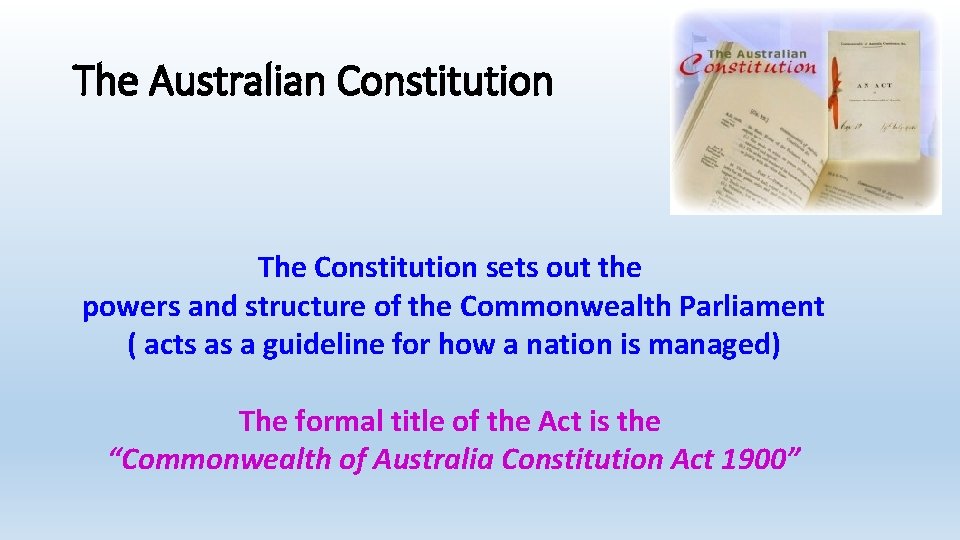
The Australian Constitution The Constitution sets out the powers and structure of the Commonwealth Parliament ( acts as a guideline for how a nation is managed) The formal title of the Act is the “Commonwealth of Australia Constitution Act 1900”
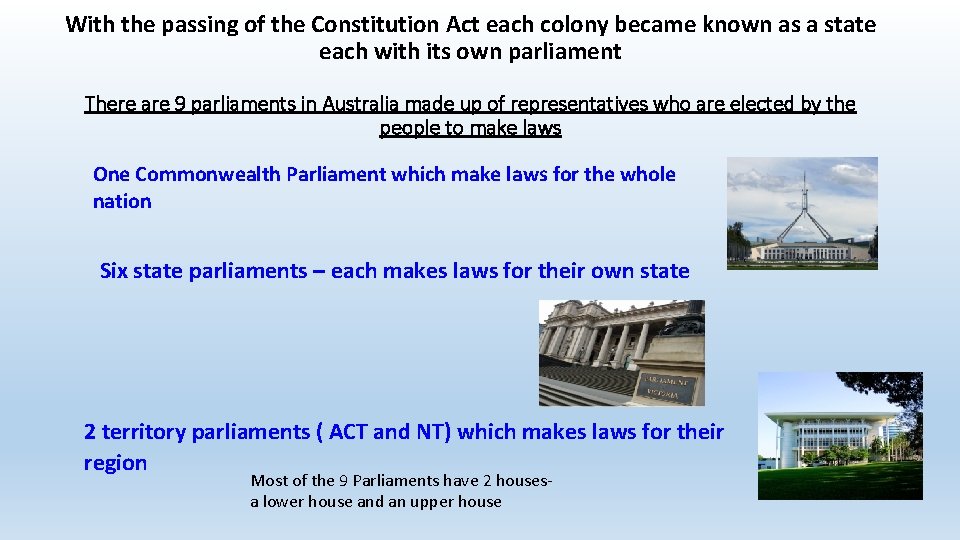
With the passing of the Constitution Act each colony became known as a state each with its own parliament There are 9 parliaments in Australia made up of representatives who are elected by the people to make laws One Commonwealth Parliament which make laws for the whole nation Six state parliaments – each makes laws for their own state 2 territory parliaments ( ACT and NT) which makes laws for their region Most of the 9 Parliaments have 2 housesa lower house and an upper house
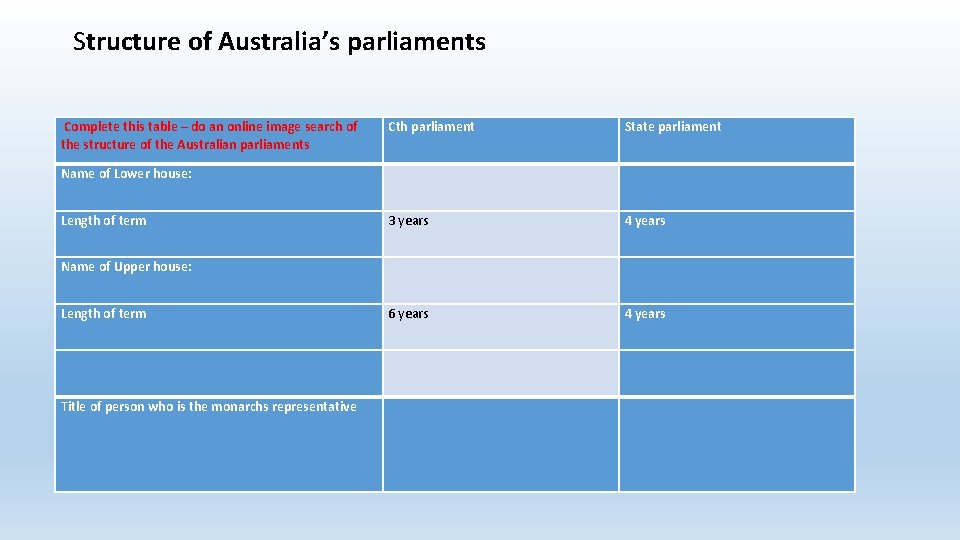
Structure of Australia’s parliaments Complete this table – do an online image search of the structure of the Australian parliaments Cth parliament State parliament 3 years 4 years 6 years 4 years Name of Lower house: Length of term Name of Upper house: Length of term Title of person who is the monarchs representative
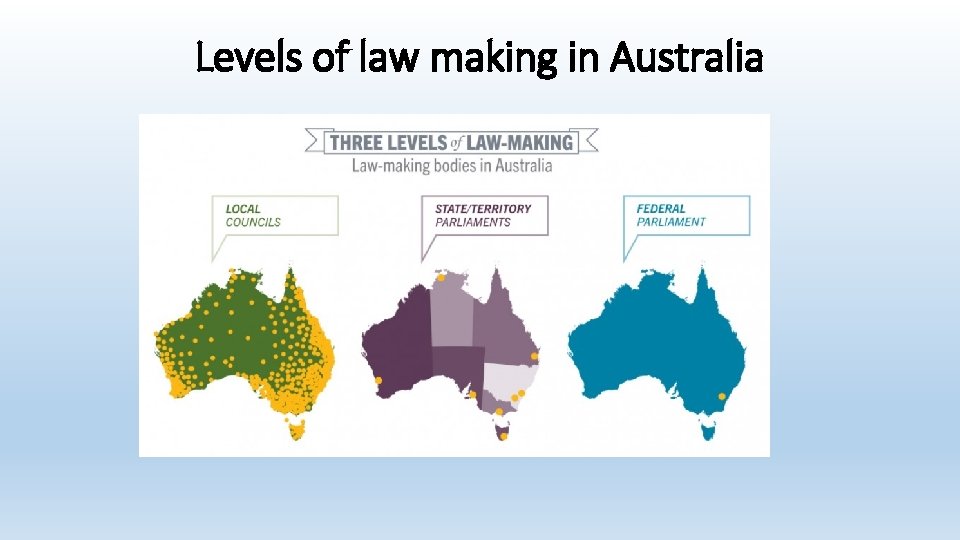
Levels of law making in Australia
A Commonwealth Parliament to make laws that apply to the ‘whole of Australia’ (e. g tax laws, terrorism laws) State parliaments to make laws that only apply in a specific state ( e. g criminal laws and road laws) Subordinate authorities other bodies ( e. g. local councils, VCAA, Work Safe Victoria, Vic. Roads) that are given the power to make laws by and on behalf of the parliament through an ‘enabling act’.
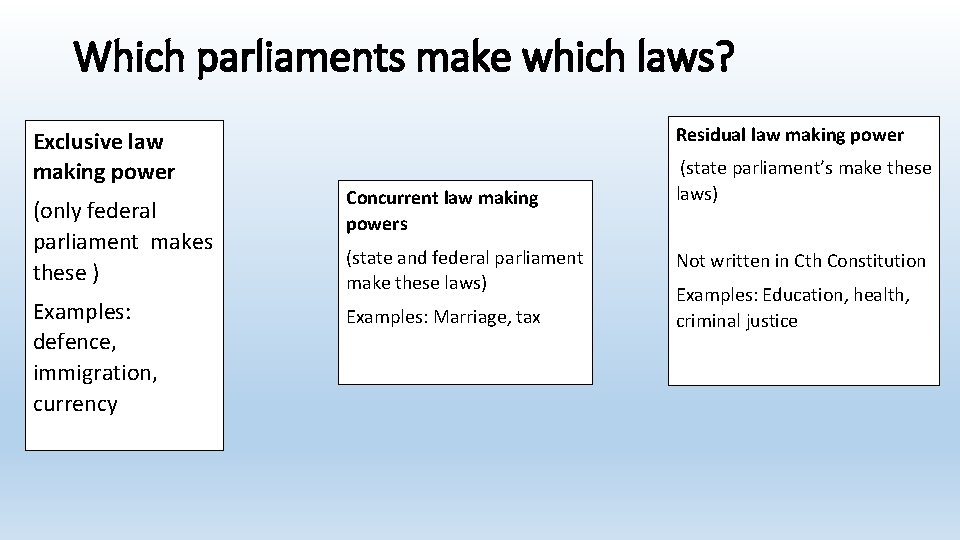
Which parliaments make which laws? Exclusive law making power Residual law making power (only federal parliament makes these ) Concurrent law making powers Examples: defence, immigration, currency Examples: Marriage, tax (state and federal parliament make these laws) (state parliament’s make these laws) Not written in Cth Constitution Examples: Education, health, criminal justice
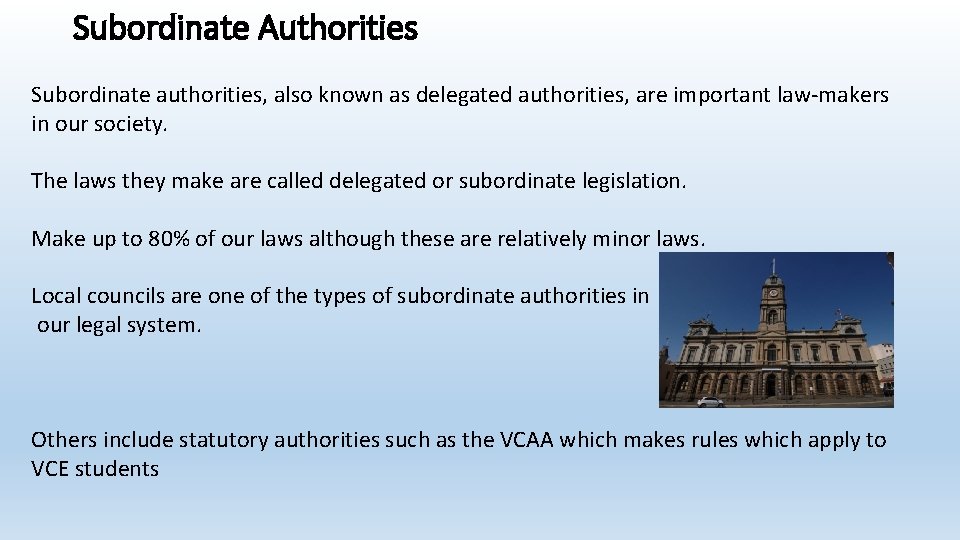
Subordinate Authorities Subordinate authorities, also known as delegated authorities, are important law-makers in our society. The laws they make are called delegated or subordinate legislation. Make up to 80% of our laws although these are relatively minor laws. Local councils are one of the types of subordinate authorities in our legal system. Others include statutory authorities such as the VCAA which makes rules which apply to VCE students