
HISTORY AND POLITICS ITALIAN MIGRATION In the 1900





- Slides: 26
HISTORY AND POLITICS
ITALIAN MIGRATION
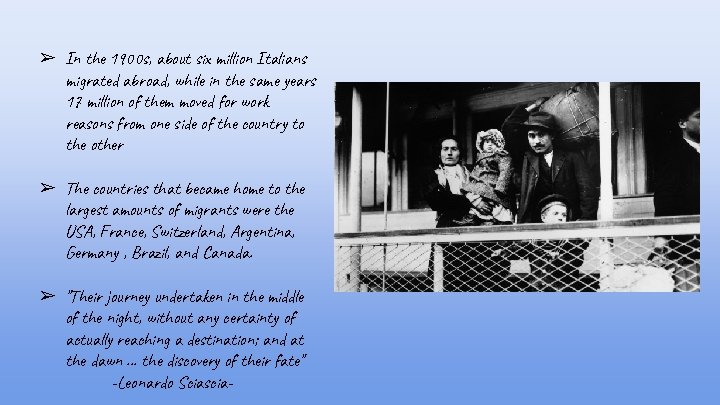
➢ In the 1900 s, about six million Italians migrated abroad, while in the same years 17 million of them moved for work reasons from one side of the country to the other ➢ The countries that became home to the largest amounts of migrants were the USA, France, Switzerland, Argentina, Germany , Brazil, and Canada. ➢ "Their journey undertaken in the middle of the night, without any certainty of actually reaching a destination; and at the dawn. . . the discovery of their fate" -Leonardo Sciascia-
Internal migration causes ➢ Around 1950, Italian industry is engaged in reconstruction. ➢ Southern agriculture knows a certain development, but at the same time, the development of Northern agriculture is much faster. ➢ The imbalance between the two parts of the country worsens over time, the South does not improve, while the North moves rapidly. ➢ A highly mechanized agriculture, based on specialized crops and able to produce at competitive prices for European markets, is financed. However, millions of South peasants are abandoned on their own.
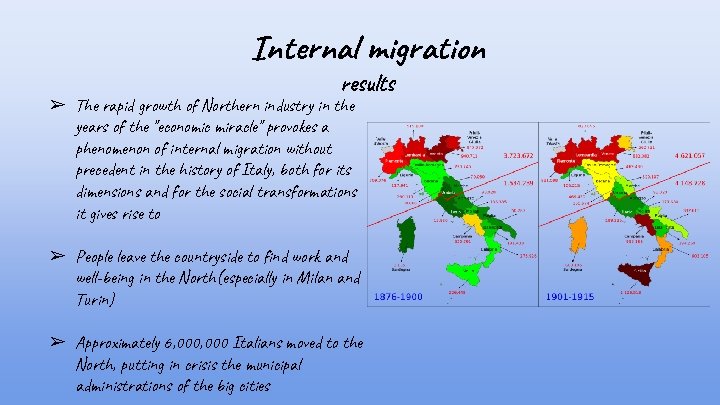
Internal migration results ➢ The rapid growth of Northern industry in the years of the "economic miracle" provokes a phenomenon of internal migration without precedent in the history of Italy, both for its dimensions and for the social transformations it gives rise to ➢ People leave the countryside to find work and well-being in the North(especially in Milan and Turin) ➢ Approximately 6, 000 Italians moved to the North, putting in crisis the municipal administrations of the big cities
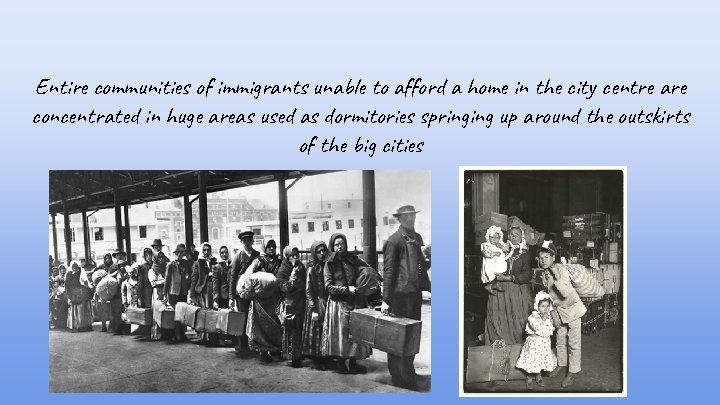
Entire communities of immigrants unable to afford a home in the city centre are concentrated in huge areas used as dormitories springing up around the outskirts of the big cities
In the wake of a propeller… The Great Arrival causes Decades of internal strife had left a legacy of violence, social chaos, and widespread poverty Diseases and natural disasters transatlantic transportation became more affordable
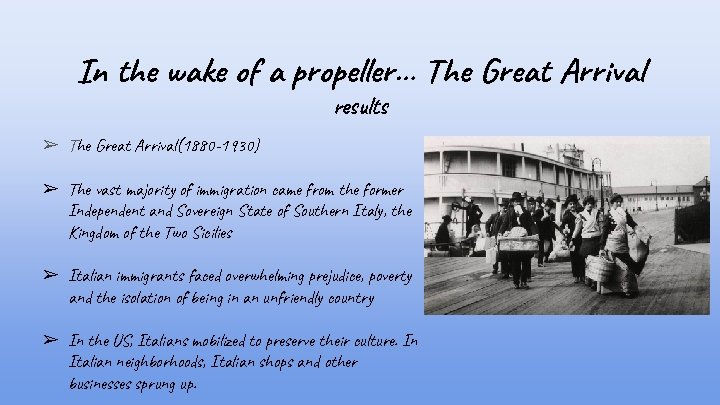
In the wake of a propeller… The Great Arrival results ➢ The Great Arrival(1880 -1930) ➢ The vast majority of immigration came from the former Independent and Sovereign State of Southern Italy, the Kingdom of the Two Sicilies ➢ Italian immigrants faced overwhelming prejudice, poverty and the isolation of being in an unfriendly country ➢ In the US, Italians mobilized to preserve their culture. In Italian neighborhoods, Italian shops and other businesses sprung up.
LEGGE MARTELLI, 1990 - it gave precise provisions on immigration - redefines refugee status LEGGE TURCO NAPOLITANO, 1996 - - - introduces planning of immigrants inflow - clarifies the procedure both on entering the State and on leaving it - clarifies residence arrangements In Italy - planning revision of immigrants inflow; opposition to illegal immigration integration of foreigners definition of the procedures for the acquisition of citizenship establishment of temporary detention centres for immigrants provisions for health and social assistance LEGGE BOSSI FINI, 2002 - - enables expulsion of illegal immigrants from the Italian territory escorted to the borders stiffer penalties for human traffickers residence permit (provided they have a job contract) regularisation of foreign workers (housekeepers, carers) employment of the navy to fight human traffick
Greek immigration
The genocide of the Greeks of Pontus refers to massacres and displacements against Greek populations in the Pontus region that were carried out by the Young Turks during the period 1914 -1923. It is estimated that it cost the lives of about 326, 000 -382, 000 Greeks. Survivors fled to Upper Pontus (in the USSR) and after the Asia Minor Disaster in 1922, in Greece.
On February 24, 1994 The Greek Parliament unanimously voted the proclamation of May 19 th as "Memorial Day for the Genocide of Greeks in the Asia Minor". The genocide of the Pontians is officially recognized by four states, Greece by a law of 1994 (N 2193/1994), Sweden with a vote in the Swedish parliament on 11 March 2010, Armenia in March 2015, together with the genocide of the Assyrians and the Netherlands, together with the genocide of the Armenians and Assyrians on 9 April 2015.
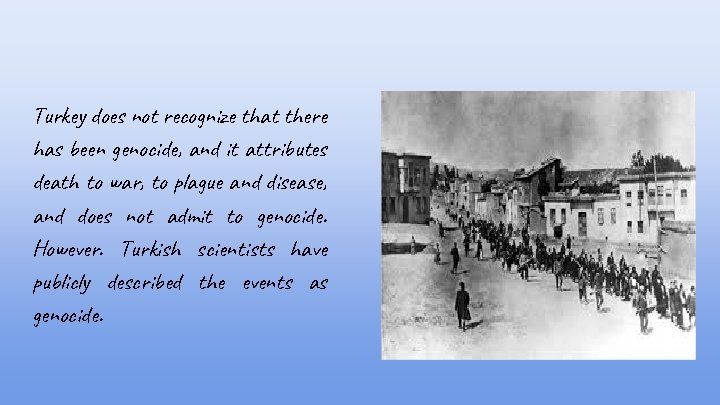
Turkey does not recognize that there has been genocide, and it attributes death to war, to plague and disease, and does not admit to genocide. However. Turkish scientists have publicly described the events as genocide.
Until before the petty catastrophe of 1922, Smyrna numbered 370, 000, of whom 165, 000 were Greeks, 80, 000 Ottoman Turks, 55, 000 Jews, 40, 000 Armenians, 6, 000 Lebanese, and 30, 000 other foreigners. According to George Horton, Smyrna at that time exceeded 500, 000 inhabitants. The language was Greek, so that it was called by the Turks as, from the Europeans to the Paris of Levante. This presence was marked by the various works assigned to them, mainly by wealthy Greek merchants who had contacts with Europe. So, the customs office of Smyrna was constructed by Gustav Eifel, architect of the same name in Paris, while the Clock at the Governor's Square (Conak) was the gift of William II. The European architecture combined with the local architecture gave the term "Smyrnaikos House" as something special in its kind.
The 1923 Greek-Turkish Exchange of Persons Was based on the religious identity, including the Greek Orthodox Christian citizens of Turkey and the Muslim citizens of Greece. It was mandatory to exchange large-scale populations, or else, agreed mutual displacement. The only one in world history that was dictated by a transnational convention. Nansen designed and oversaw the exchange, taking into account the interests of Greece, Turkey and other western European countries, as a talented diplomat with experience in the movement of Russian Armenians and Assyrian refugees after the First World War. The agreement promised that the property of migrants would be safeguarded and that they could freely transport any movable property with them.
All the property that would be left in Greece would belong to the Greek state, and all the property that would remain in Turkey would belong to the Turkish state. Due to the different nature of the populations, the property left behind by the Greek economic elites of Anatolia was greater than that was left by Muslim farmers in Greece. The Greek-Turkish exchange was a result of the Turkish Independence War. After Mustafa Kemal Ataturk's entry to Smyrna followed by the dissolution of the Ottoman Empire on 1 November 1922, an official treaty of peace with Greece was signed, after months of negotiations in Lausanne on July 24, 1923. Two months after the treaty, the Allies delivered Constantinople to the Nationalists, marking the definitive departure of the occupying allied forces from Anatolia.
German immigration
Development of migration to Germany during the 50 s and 60 s Circumstances in Germany after WWII: - West-Germany experienced an “economic miracle” (Wirtschaftswunder) the economy grew by approx. 12. 1% the unemployment rate shrank from 11% in 1950 to less than 1% in 1961 the country was in great need of laborers
"Guest Workers" as "Human Capital": the first contract was negotiated in 1955 with Italy further contracts soon followed: with Greece and Spain (1960), Turkey (1961), Morocco (1963), Portugal (1964), Tunisia (1965) and Yugoslavia (1968) the guest workers were allowed to work in Germany for a temporary period of time thus socio-political or infrastructural concepts for longer term residence weren´t developed
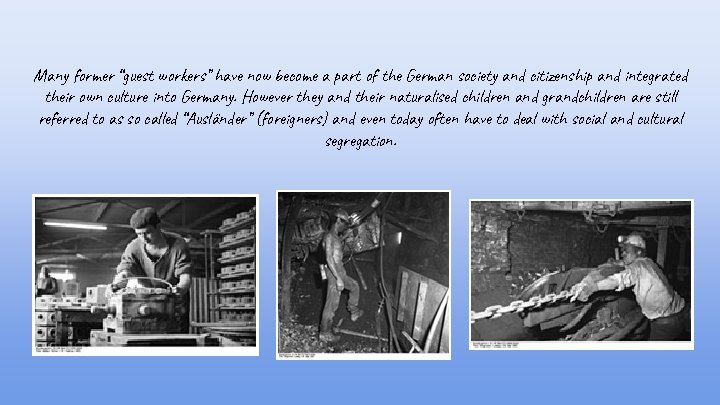
Employment of “guest workers”: foreign laborers often worked in the mining industry or in large factories they took on jo bs that German laborers considered unattractive due to the lack of training, non-recognition of foreign certificates and language deficits “guest workers” were limited to the lowest wage categories many lived under inhuman circumstances (e. g. they lived in small barracks or dorm
The 1973 Recruitment Ban: the recruitment ban in 1973 completely stopped the entry of guest workers it was assumed that the workers would return to their countries voluntarily sia vast majority stayed in Germany and arranged the immigration of their families to the country the government noticed unemployed foreigners and launched a campaign to pay jobless people from foreign countries money to return back to their homes
Many former “guest workers” have now become a part of the German society and citizenship and integrated their own culture into Germany. However they and their naturalised children and grandchildren are still referred to as so called “Ausländer” (foreigners) and even today often have to deal with social and cultural segregation.
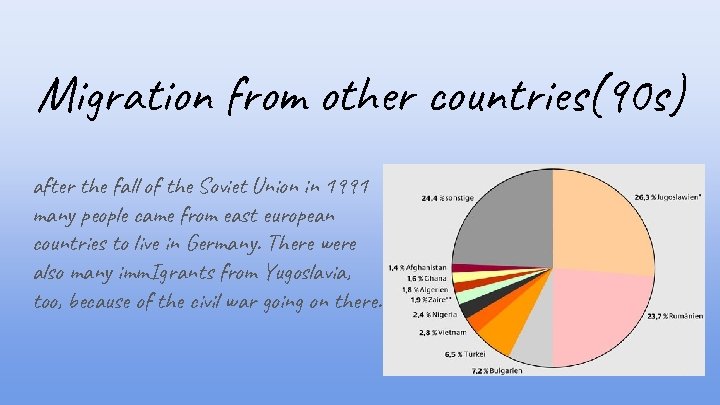
Migration from other countries(90 s) after the fall of the Soviet Union in 1991 many people came from east european countries to live in Germany. There were also many imm. Igrants from Yugoslavia, too, because of the civil war going on there.
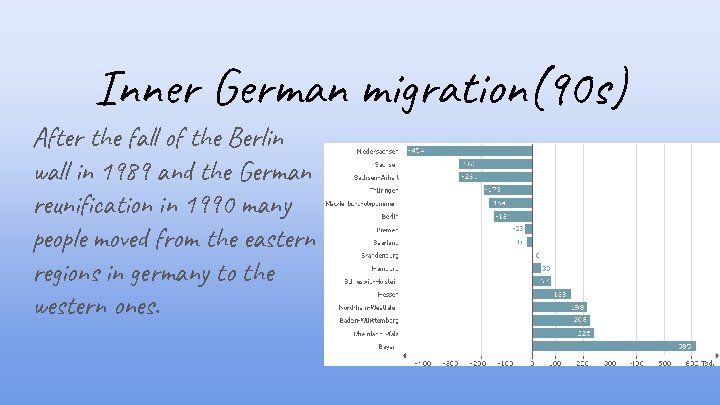
Inner German migration(90 s) After the fall of the Berlin wall in 1989 and the German reunification in 1990 many people moved from the eastern regions in germany to the western ones.
Consequences ● laws which are regulate the immigration ● culture from foreign countries in Germany ● more people are living in Germany
Thank you!