
History and Evolution of Life Deep time evolutionary








- Slides: 35
History and Evolution of Life • • • Deep time evolutionary history Origin of Life Natural selection Major Events and Extinctions Human Evolution Domestication of Species Larry M. Frolich, Ph. D. Biology Department, Yavapai College
What is deep time? • To understand evolution, we must appreciate deep time (like deep space)—time stretching beyond what is easy to intuitively grasp • Outstretched arms all of Earth’s four billion year history—one swipe of a finger-nail file and human history is gone) • Toilet paper analogy—if a roll of toilet paper is Earth history, humans reside in the shreds at the end of the very last sheet. • See weblinks for more views of Earth history and deep time Larry M. Frolich, Ph. D. Biology Department, Yavapai College
• Let a roll of toilet paper represent the four billion (4. 0 B) year history of life on Earth • If the roll has 1000 sheets (Scott brand), then each sheet represents four million (4. 0 M) years • If the roll has about 200 sheets (more typical smaller rolls), then each sheet represents 20 million (20. 0 M) years • Here are some key events: EVENT TIME BEFORE PRESENT (BYA--billions of years ago (MYA--millions of years ago) SHEET NUMBER ON THE TYPICAL ROLL Formation and Solidification of Earth 4. 6 -4. 0 BYA 1 Oldest Rocks Known 3. 8 BYA 10 Earliest evidence of life--carbon forms in rock 3. 8 BYA 10 Earliest fossil prokaryotic cells 3. 5 BYA 25 Oxygen levels rise steeply due to increase in photosynthetic activity 2. 5 BYA 75 Complex eukaryotic cells appear in fossil record 1. 5 BYA 125 First multicellular organisms in fossil record 600 MYA 170 Burgess Shale--exposion of multicellular diversity--most multicellular animal groups represented in primitive form 515 MYA 176 First land vertebrates 350 MYA 183 Archaeopteryx--precursor to birds (and other dinosaurs) 150 MYA 192 End Cretaceous Extinction--goodbye dinos, hello mammalian, bird, flowering plant diversity 65 MYA 196 Lucy--Australopithecus 4 MYA 1 (last 1/4 of sheet) Homo erectus, fire 1 MYA 1 (last 1/20 of sheet) Start of agriculture, settlements 10, 000 -20, 000 years ago Larry M. Frolich, Ph. D. Biology Department, Yavapai College 1 (last fibers)
Early Earth • How do we know chemical make-up? From existing ancient rocks • Notice presence of molecules of life Larry M. Frolich, Ph. D. Biology Department, Yavapai College
Stanley Miller experiments • Early Earth atmosphere • Energy applied • Organic molecules including all molecules of life and “micelles” formed • Today—fully engineered life—how far off? Larry M. Frolich, Ph. D. Biology Department, Yavapai College
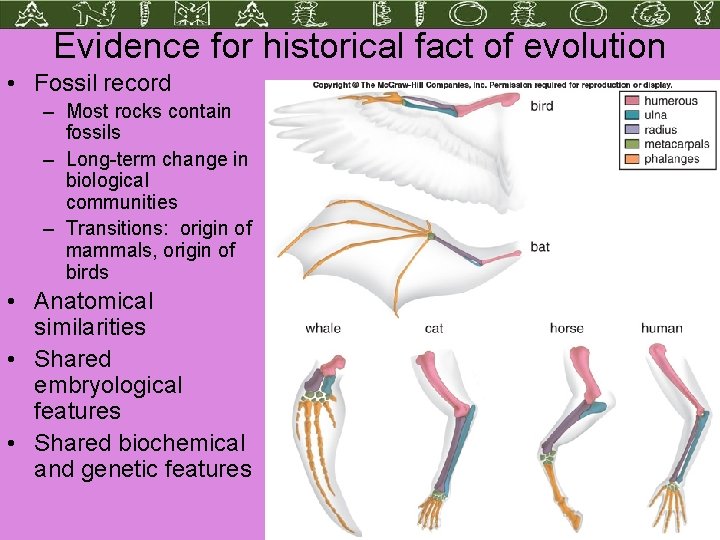
Evidence for historical fact of evolution • Fossil record – Most rocks contain fossils – Long-term change in biological communities – Transitions: origin of mammals, origin of birds • Anatomical similarities • Shared embryological features • Shared biochemical and genetic features Larry M. Frolich, Ph. D. Biology Department, Yavapai College
How does evolution happen? • Darwin’s great idea—natural selection • Just like “artificial selection” for agricultural breeds (in fact, is there any difference—what is “artificial” about human involvement? ) Larry M. Frolich, Ph. D. Biology Department, Yavapai College
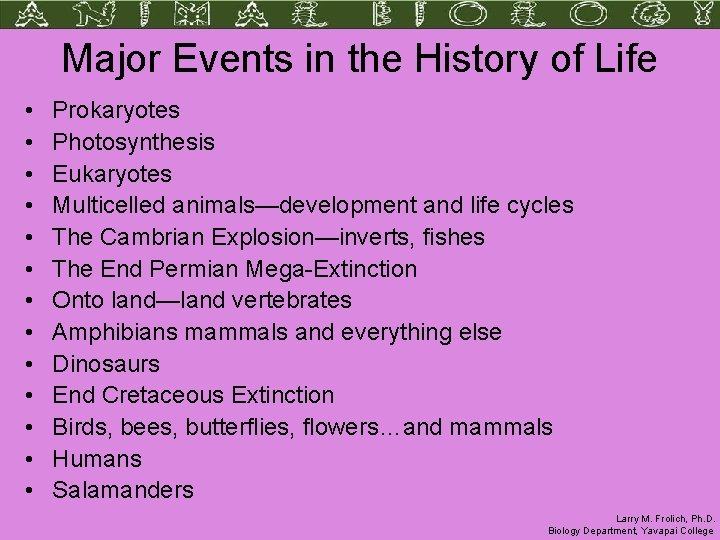
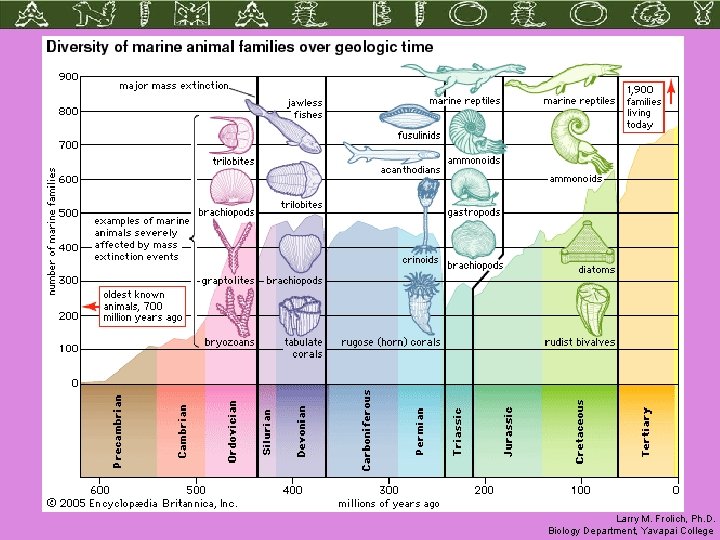
Major Events in the History of Life • • • • Prokaryotes Photosynthesis Eukaryotes Multicelled animals—development and life cycles The Cambrian Explosion—inverts, fishes The End Permian Mega-Extinction Onto land—land vertebrates Amphibians mammals and everything else Dinosaurs End Cretaceous Extinction Birds, bees, butterflies, flowers…and mammals Humans Salamanders Larry M. Frolich, Ph. D. Biology Department, Yavapai College
http: //www. physicalgeography. net/fundamentals/9 a. html Larry M. Frolich, Ph. D. Biology Department, Yavapai College
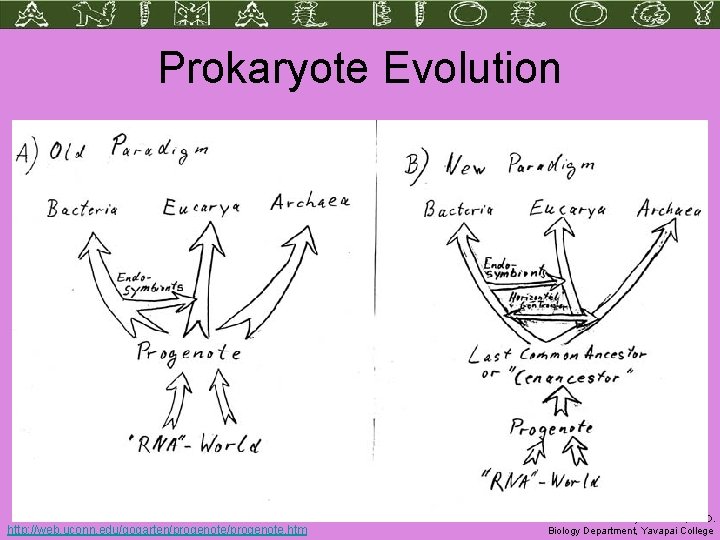
Prokaryote Evolution http: //web. uconn. edu/gogarten/progenote. htm Larry M. Frolich, Ph. D. Biology Department, Yavapai College
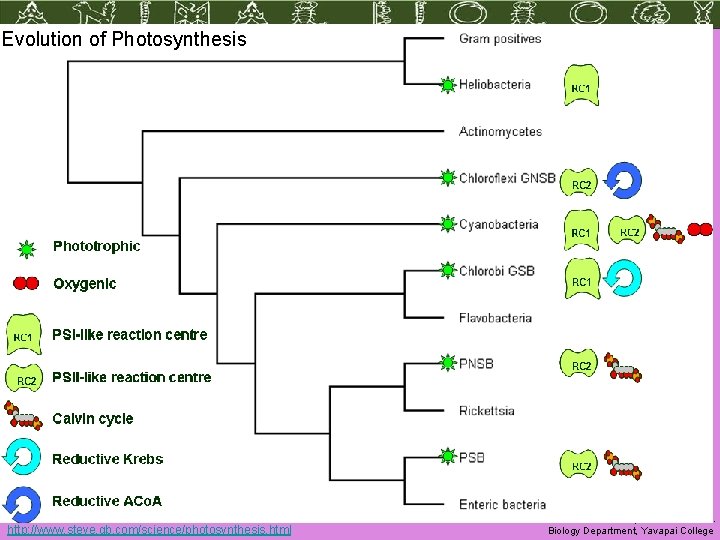
Evolution of Photosynthesis http: //www. steve. gb. com/science/photosynthesis. html Larry M. Frolich, Ph. D. Biology Department, Yavapai College
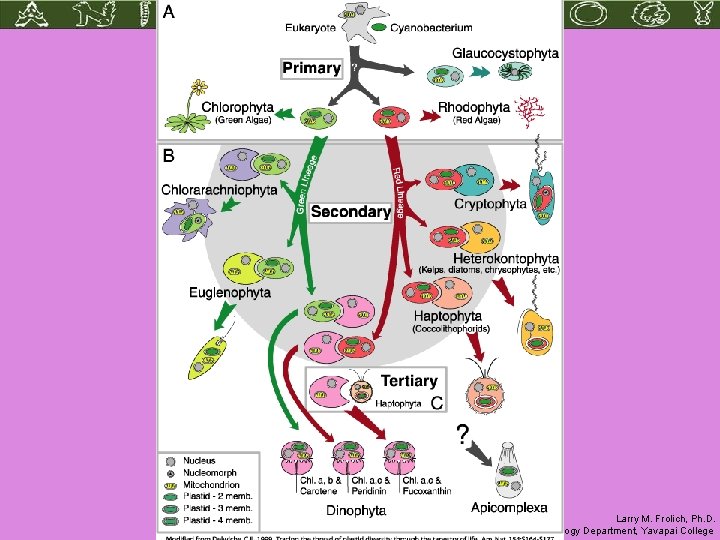
Larry M. Frolich, Ph. D. Biology Department, Yavapai College
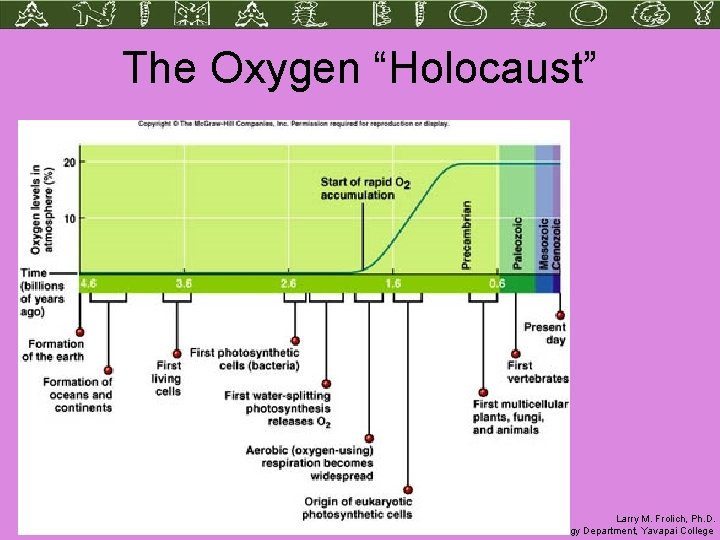
The Oxygen “Holocaust” Larry M. Frolich, Ph. D. Biology Department, Yavapai College
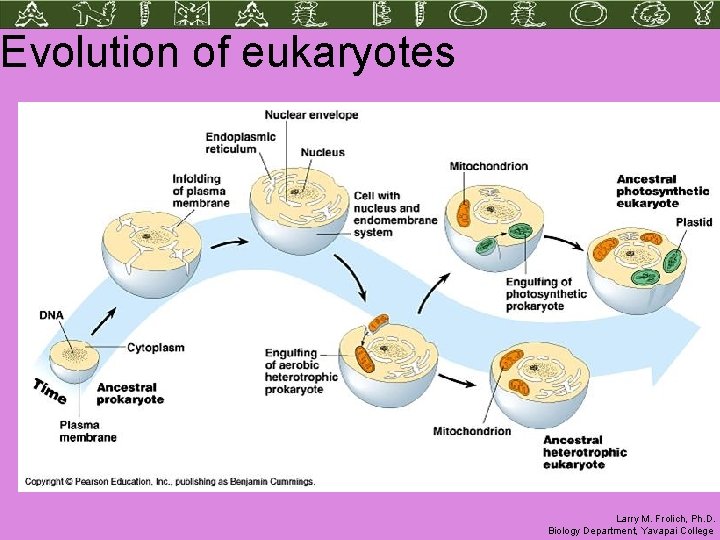
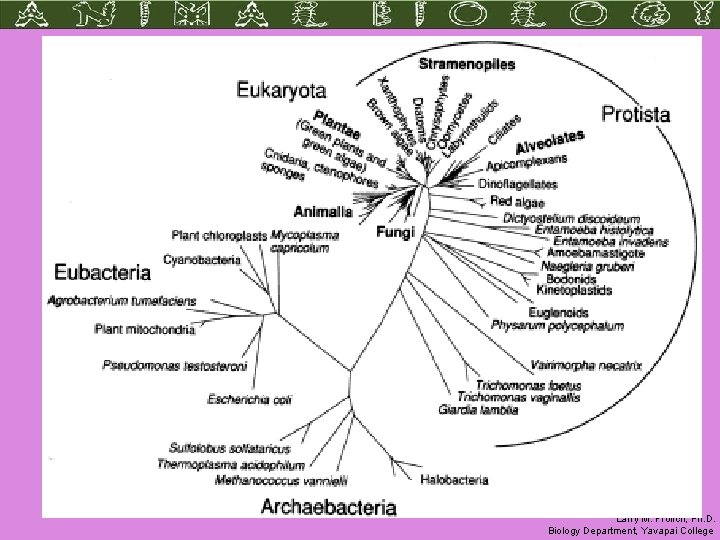
Evolution of eukaryotes Larry M. Frolich, Ph. D. Biology Department, Yavapai College
Larry M. Frolich, Ph. D. Biology Department, Yavapai College
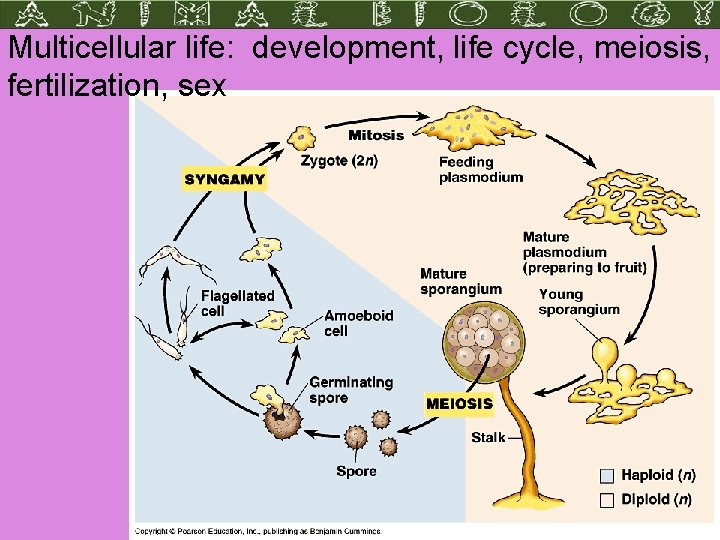
Multicellular life: development, life cycle, meiosis, fertilization, sex Larry M. Frolich, Ph. D. Biology Department, Yavapai College
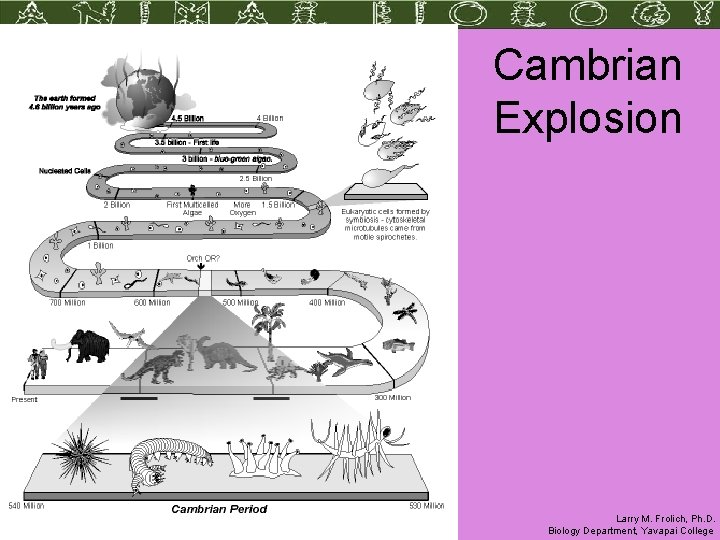
Cambrian Explosion Larry M. Frolich, Ph. D. Biology Department, Yavapai College
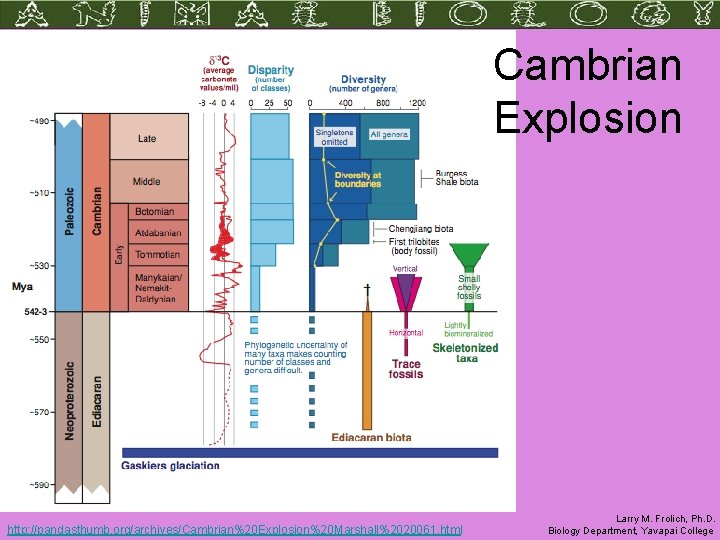
Cambrian Explosion http: //pandasthumb. org/archives/Cambrian%20 Explosion%20 Marshall%2020061. html Larry M. Frolich, Ph. D. Biology Department, Yavapai College
Larry M. Frolich, Ph. D. Biology Department, Yavapai College
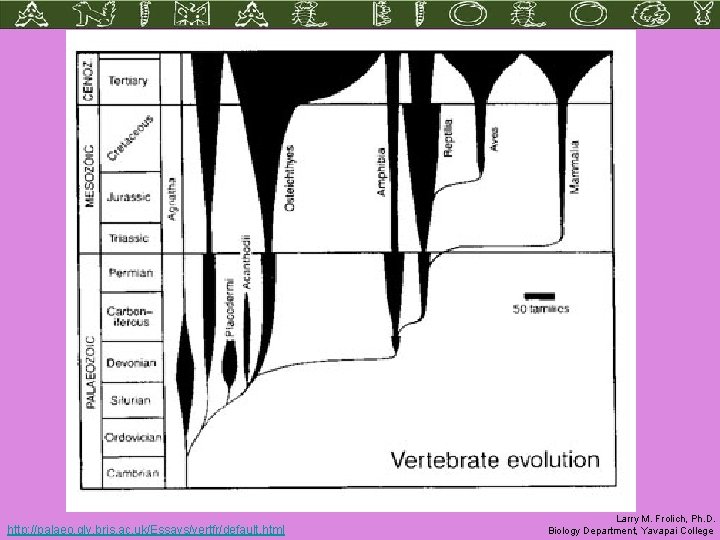
http: //palaeo. gly. bris. ac. uk/Essays/vertfr/default. html Larry M. Frolich, Ph. D. Biology Department, Yavapai College
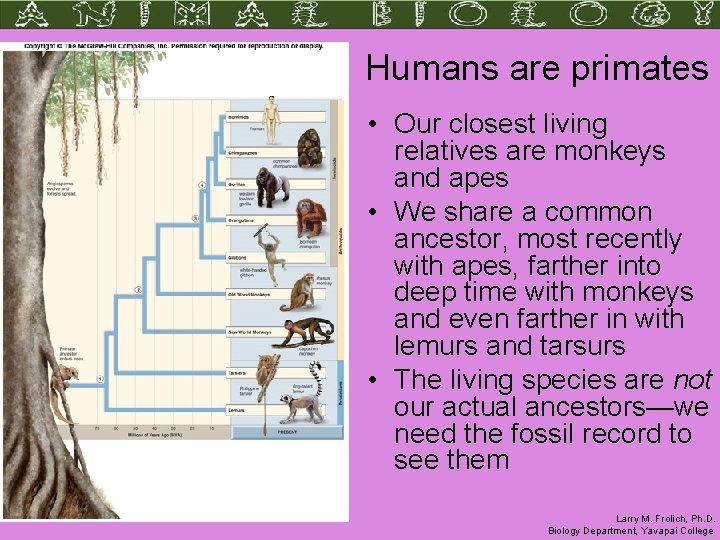
Humans are primates • Our closest living relatives are monkeys and apes • We share a common ancestor, most recently with apes, farther into deep time with monkeys and even farther in with lemurs and tarsurs • The living species are not our actual ancestors—we need the fossil record to see them Larry M. Frolich, Ph. D. Biology Department, Yavapai College
Fossil record of primates evolutionarily close to humans • • • Mediocre human fossil record Not all fossils on direct ancestral line to humans Larry M. Frolich, Ph. D. Past shows many different human and human-like species living at one time Biology Department, Yavapai College
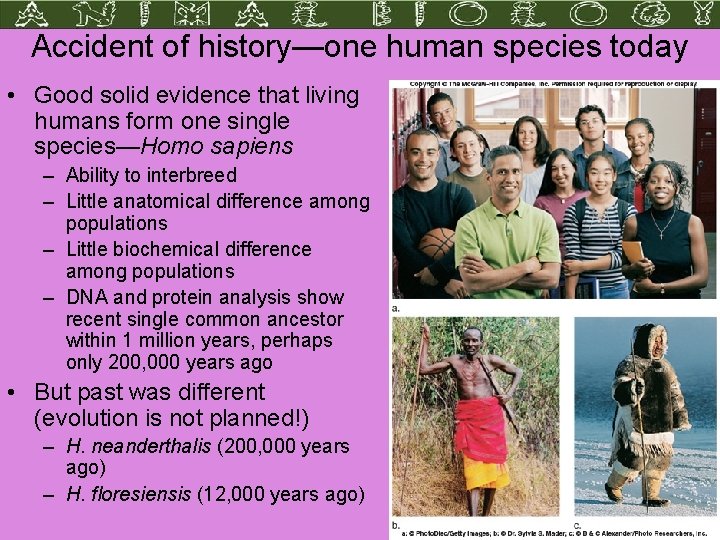
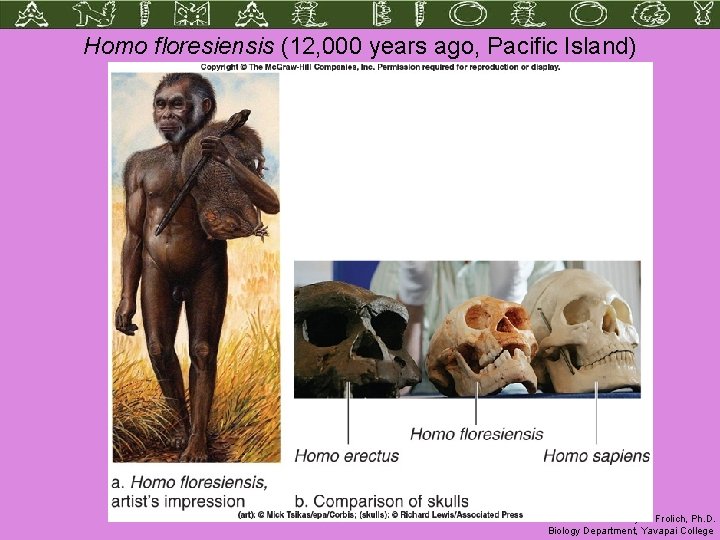
Accident of history—one human species today • Good solid evidence that living humans form one single species—Homo sapiens – Ability to interbreed – Little anatomical difference among populations – Little biochemical difference among populations – DNA and protein analysis show recent single common ancestor within 1 million years, perhaps only 200, 000 years ago • But past was different (evolution is not planned!) – H. neanderthalis (200, 000 years ago) – H. floresiensis (12, 000 years ago) Larry M. Frolich, Ph. D. Biology Department, Yavapai College
Homo floresiensis (12, 000 years ago, Pacific Island) Larry M. Frolich, Ph. D. Biology Department, Yavapai College
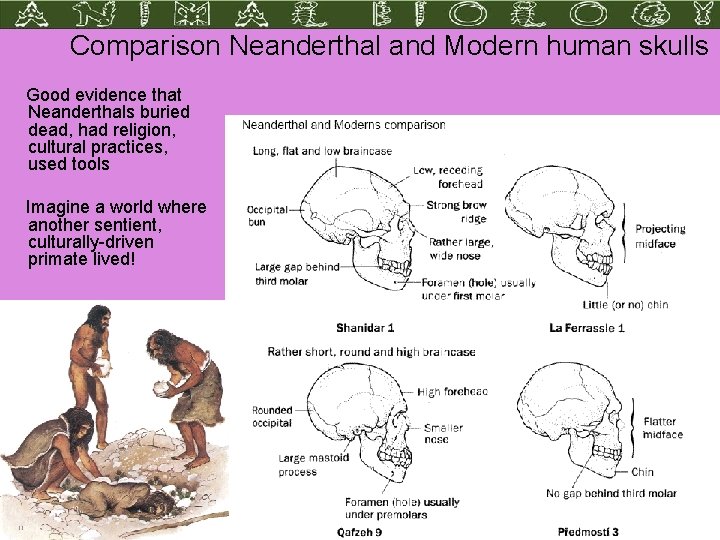
Comparison Neanderthal and Modern human skulls Good evidence that Neanderthals buried dead, had religion, cultural practices, used tools Imagine a world where another sentient, culturally-driven primate lived! Larry M. Frolich, Ph. D. Biology Department, Yavapai College
Humans today • Dominate planet • Ecologists have often focused on “wild” ecosystems • But most landscapes now have some human elements, usually very strong effects • Is this good or bad? And for whom? Larry M. Frolich, Ph. D. Biology Department, Yavapai College
Relationships among species • In a community, relationships among species can be beneficial, damaging or neutral: – Symbiotic: mutually beneficial, both species benefit – Parasitic: one species benefits (“parasite”) and the other is harmed (“host”) – Commensal: One species benefits, the other is unharmed – Mutualism: both species benefit, like symbiosis, but it may appear one species has the advantage, but evolutionarily, over the long-term, both benefit – Predation: Usually considered parasitic, where the predator is the parasite, but can also be seen as mutualistic • We think of species in a community as “co-evolving” to establish these types of relationships • For some reason, we don’t tend to analyze human relationships with other species this way. But domestication of other species, originally for agriculture, is most often mutualistic. Larry M. Frolich, Ph. D. Biology Department, Yavapai College
Development of agricultural systems were evolutionary events Larry M. Frolich, Ph. D. Biology Department, Yavapai College
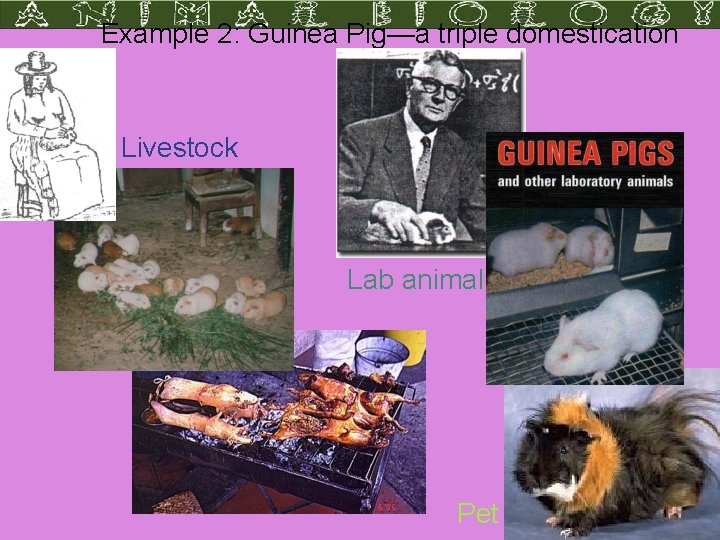
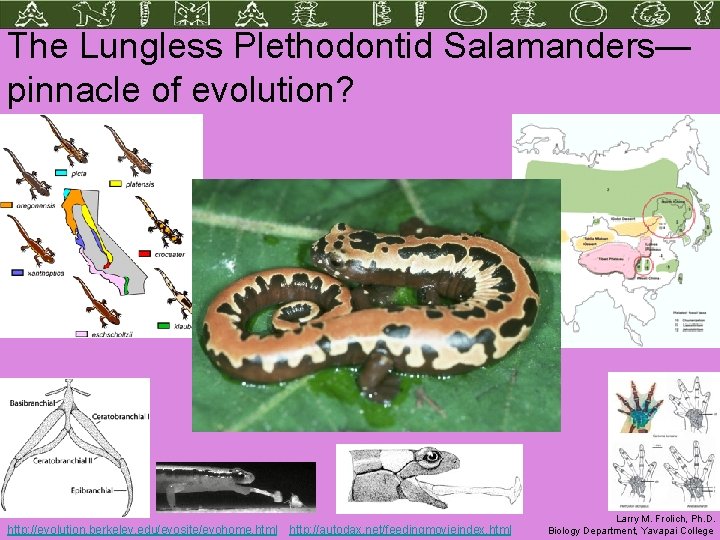
What is domestication? What is food? How did it all come about? • We tend to assume that we are “consuming” resources— physical or biotic. This is the view your text mostly provides • But another way of thinking is that those species who coevolved with us into domestication have also been “winning” the evolutionary game, or multiplying their numbers with us (more dogs or wolves? ; more horses or zebras? ; more corn or teosinthe? ). Who “domesticates” whom? Who started the relationship? Was it the plant who made its seed obvious and easy to cultivate, or the humans who “discovered” that seed? Was it the animal breed that was naturally social and docile, or the humans who tamed the animal? • We can even understand laboratory domestications (salamanders for developmental studies; E. coli for recombinant DNA studies and production; white mice as human analogs) as the most recent way in which other Larry M. Frolich, Ph. D. species have convinced us to take care of them. Biology Department, Yavapai College
Our relationship with domesticated species • We do still have ecological relationships with “wild” species. Examples: – – – Hunt mushrooms Create game reserves Create national parks household and urban/rural “pests” (e. g. molds, sewer rats) Symbiotic micro-organisms (skin and mouth bacteria) Disease-causing micro-organisms • But mostly we have tight relationships with domesticated species. Basis for ecological relationship: – – – Food and agriculture (by far most common—food crops and animals) Transportation (“beasts of burden”) Care and protection (pets) "It makes just as much sense to think Laboratory study and production of agriculture as something the grasses did to people as a way to conquer the Other? trees. " --Michael Pollan, 2001, The Botany of Desire Larry M. Frolich, Ph. D. Biology Department, Yavapai College
Resource use, or evolution of the domesticate relationship? • Our quality of life depends on how these domesticate relationships continue to evolve. • For the Earth, or the eco-systems, this evolution will just be something “natural. ” • For us, it will determine how much suffering versus how much plenitude people will experience • Over deep time history, large animals, and especially large mammals like ourselves, have been prone to raid extinction • Will our sentient nature overcome this trend? Larry M. Frolich, Ph. D. Biology Department, Yavapai College
Domestication (or Human co-Evolution) Today • Early agricultural domestication was with species that – Behave well with humans – Make their reproductive processes obvious to humans • But what are domestications of last 100 years – Laboratory domestications – Species that can survive indoors – Species that make some aspect of their biology— usually at cellular/developmental/molecular level— easily accessible to humans FLT Larry M. Frolich, Ph. D. Biology Department, Yavapai College
Example 1: E. coli WHY HUMANS “LIKE” E. coli • Adaptable and reproduces under wide variety of lab conditions • Easy visualization • Genes and proteins easily WHY E. coli “LIKES” HUMANS accessible • Provide new and safe • Endonucleases and other environments for reproduction DNA manipulation • Make new genetic material genes/proteins known and accessible isolated Virulent strains with easy human “Unintended” consequence of • E. access coli domestication—virulent, anti-biotic resistant strains Larry M. Frolich, Ph. D. Biology Department, Yavapai College
Example 2: Guinea Pig—a triple domestication Livestock Lab animal Pet Larry M. Frolich, Ph. D. Biology Department, Yavapai College
The Lungless Plethodontid Salamanders— pinnacle of evolution? http: //evolution. berkeley. edu/evosite/evohome. html http: //autodax. net/feedingmovieindex. html Larry M. Frolich, Ph. D. Biology Department, Yavapai College