
History and Application of the Alaska Tribal Health
History and Application of the Alaska Tribal Health Compact with the Indian Health Service Rose Tepp, Tribal Lead Negotiator, Kenaitze Indian Tribe Carolyn Crowder, Crown Consulting & Management Christopher Mandregan, Jr. , Alaska Area Director, Indian Health Service
WHAT WE WILL COVER Ø Introduction & History of Alaska Tribal Health System Ø How the One Alaska Compact Evolved Ø Inter-Tribal Relationships & Cooperation Ø Impact on the Federal System

ALASKA NATIVE HEALTH DELIVERY HISTORY Ø 1900 -1970: Health care for Alaska Natives was provided by the U. S. government Ø 1970 -1998: Alaska Native tribes organized health care organizations under Self-Governance legislation and gradually assumed ownership of health services at regional and tribal levels Ø 1998 -2015: All Alaska Native health care is provided by Alaska Native organizations Ø Ø Ø Represents 229 Tribes Serves 147, 000 Alaska Natives/American Indians 586, 412 square miles of predominantly road-less land
HISTORY OF ALASKA TRIBAL HEALTH SYSTEM Ø Alaska Native Health Board established (1968) Representing 26 member Tribal Health Orgs & Independent Tribal P. L. 93 -638 Compactors/Contractors Ø Alaska Tribal Health Directors Ø Technical Advisors Forum to address all Statewide Health Issues Created & Co-managed Statewide Services i. e. Community Health Aide Program, Sanitation & Safe Water Services Recognized Federal & State Health Advocacy Voice for Alaska Natives

ALASKA TRIBAL HEALTH SYSTEM MILESTONES Ø 1968 Formation of the Alaska Native Health Board Ø 1970 First regional health organizations (YKHC and NSHC) Ø 1975 AFN’s Alaska Native Health Care Policy Statement Ø 1994 Alaska Tribal Health Compact agreement Ø 1997 New Alaska Native Medical Center Ø 1998 Formation of ANTHC Ø 1999 ANMC ownership transferred to ANTHC/SCF Ø 2002 ANHB Statewide Native Health Plan Ø 2004 ATHS Memo of Understanding
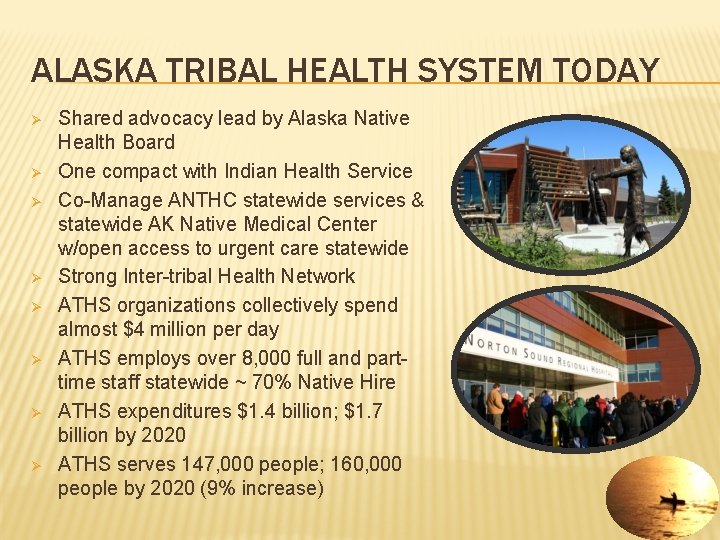
ALASKA TRIBAL HEALTH SYSTEM TODAY Ø Ø Ø Ø Shared advocacy lead by Alaska Native Health Board One compact with Indian Health Service Co-Manage ANTHC statewide services & statewide AK Native Medical Center w/open access to urgent care statewide Strong Inter-tribal Health Network ATHS organizations collectively spend almost $4 million per day ATHS employs over 8, 000 full and parttime staff statewide ~ 70% Native Hire ATHS expenditures $1. 4 billion; $1. 7 billion by 2020 ATHS serves 147, 000 people; 160, 000 people by 2020 (9% increase)
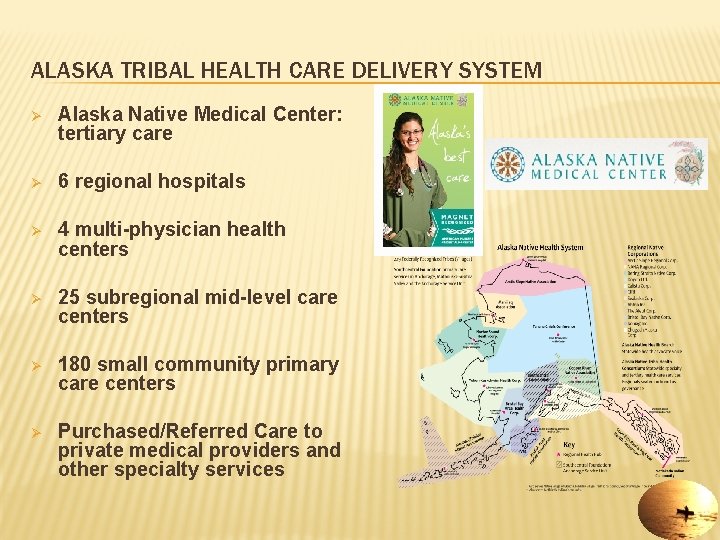
ALASKA TRIBAL HEALTH CARE DELIVERY SYSTEM Ø Alaska Native Medical Center: tertiary care Ø 6 regional hospitals Ø 4 multi-physician health centers Ø 25 subregional mid-level care centers Ø 180 small community primary care centers Ø Purchased/Referred Care to private medical providers and other specialty services
EVOLUTION OF THE ALL-ALASKA COMPACT Ø Alaska Tribal Health System proposed Single State-wide Agreement under the Title III of the ISDEAA Tribal Self Governance Demonstration Project (1988 -early 1990 s) Ø Congress Authorized statewide organization: 3 THOs + 2 Unaffiliated Reps designated to manage ANTHC statewide services and co-manage ANMC, through ANTHC Consortium Board of Directors (1998) Ø Made Permanent by Title V Legislation: 22 Co-signers to the Alaska Tribal Health Compact; Tribal authority delegated through Authorizing Resolutions (2000) Ø Funding Agreements are entered into by a Tribe or Co-Signer on behalf of member Tribes Ø Foundation is Respect for Strong Government-to-Government Relationship
EVOLUTION OF THE ALL-ALASKA COMPACT Ø Alaska Tribal Caucus Structure: Ø Ø All co-signers are members Election of Co-lead negotiators : one Tribal Governance Leader, one Administrative Leader ANHB serves as facilitator Sets Agenda for Compact Negotiations Ø Ø Ø Caucuses (Tribal & Federal) Review of Common Open Items Issues & Updates Pre-negotiations – new issues & new co-signers Common Negotiations – Preserves Tribal Right to Opt out of commonly negotiated items Individual Tribal Funding Agreement Negotiations (drawing to determine order) Ø Ø Opportunity to share local concerns and issues Negotiation of Tribal-specific terms, language & issues
ALASKA TRIBAL CAUCUS COOPERATIVE RELATIONSHIP: Ø Co-signer Common Negotiations Cooperative Process Ø Ø Ø Tribal Shares Committee (Open to All Co-signers) Legal Language Committee (Open to All Co-signers & Legal Counsel) Open Tribal Discussion of National Issues of Importance to Co-signers Open Items List Recorder: All Co-signers Agree on Documentation of Tribal Shares, Legal language, Issues among Co-signers Agreement on Ground Rules Decision making Process Ø Ø Ø Ø Closed Caucus before Pre- & Final-negotiations & as needed Co-signer discussion of Agency Lead Negotiator positions/decisions in other negotiations General Agreement of Common Issues among Co-signers Documentation & Agreement on Caucus position on Open Items List of Issues Principles: Ø Shared Vision for the Greater Good Ø Do No Harm Ø Do Not Made Concessions which has potential to erode Tribal rights to Self Govern Consensus Decision-making & Process for Conflict Resolution Tribes retain right to opt out of commonly negotiated language during individual negotiations
ALASKA TRIBAL COMPACT IMPACT ON ALASKA AREA OFFICE: Ø Alaska paved the way for Tribes to assume Area Office Assume non-residual programs, functions, services and activities Ø Transfer of Area pfsa’s to ANTHC radically changed relationship with Alaska Area Office Ø Role of Alaska Area Office shifted from providing health services to performing inherently federal functions, i. e. , functions that cannot be contracted to Tribes under the ISDEAA.
ALASKA AREA’S JOURNEY FROM COMPREHENSIVE HEALTH CARE SYSTEM TO INHERENTLY FEDERAL FUNCTIONS: � 1994 – 274 Area FTEs/1, 200 S/U FTEs � Comprehensive state-wide programs including: � � 2016 – 34 Area Alaska Native Medical Center Office of Community Health Services Office of Environmental Health & Engineering Community Health Aide Training Title III Self-Governance Demonstration Project prompted downsizing to pay Area Tribal Shares (RIF Avoidance & Budget) � 1999 - ANMC & Area state-wide PSFAs Transferred to Tribal Management �
AREA OFFICE MISSION STATEMENT The Mission of the Alaska Area Native Health Service, IHS is To Make Tribal Self. Determination Work for All.
CONSIDERATIONS FOR A “RESIDUAL” AREA OFFICE: � Assumptions created at the national level drove Area decisions (e. g. , IT & centralization) � Tribal decisions also drive decisions about Area staffing and functions (e. g. , T 1 v T 5, HR, procurement, & finance) � What functions are (really) inherently federal? � Budget constraints are more acute in the absence of 3 rd party revenues (Pay Act) � Statutory changes since 1994 affect ability to perform with existing model
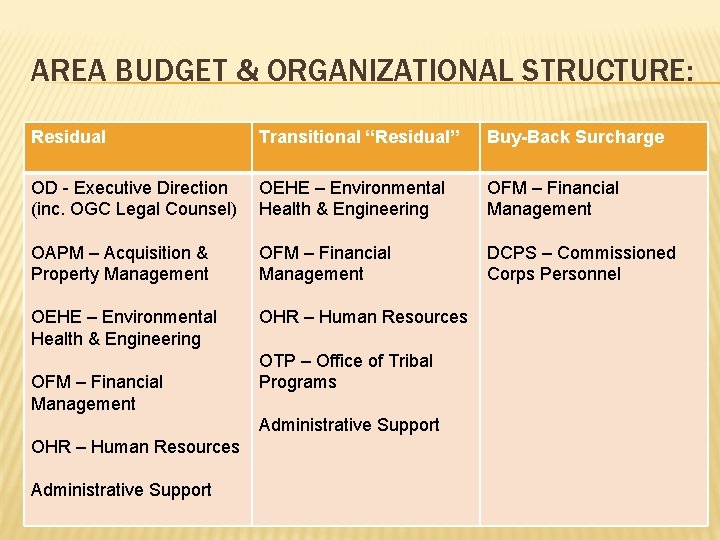
AREA BUDGET & ORGANIZATIONAL STRUCTURE: Residual Transitional “Residual” Buy-Back Surcharge OD - Executive Direction (inc. OGC Legal Counsel) OEHE – Environmental Health & Engineering OFM – Financial Management OAPM – Acquisition & Property Management OFM – Financial Management DCPS – Commissioned Corps Personnel OEHE – Environmental Health & Engineering OHR – Human Resources OFM – Financial Management OTP – Office of Tribal Programs Administrative Support OHR – Human Resources Administrative Support
Way Dankoo Taikuu! Tsimshian Inupiaq Tsin'aen Ahtna Athabascan Qagaasakung Aleut Háw'aa ‘Awa'ahdah Haida Eyak THANK YOU! Gunalchéesh Igamsiqanaghhalek Благодарите Вас Siberian Yupik Dena’ina Athabascan Quyana! Yup’ik Tlingit
- Slides: 16