
History Alive Chapter 10 The Bill of Rights
History Alive Chapter 10 The Bill of Rights
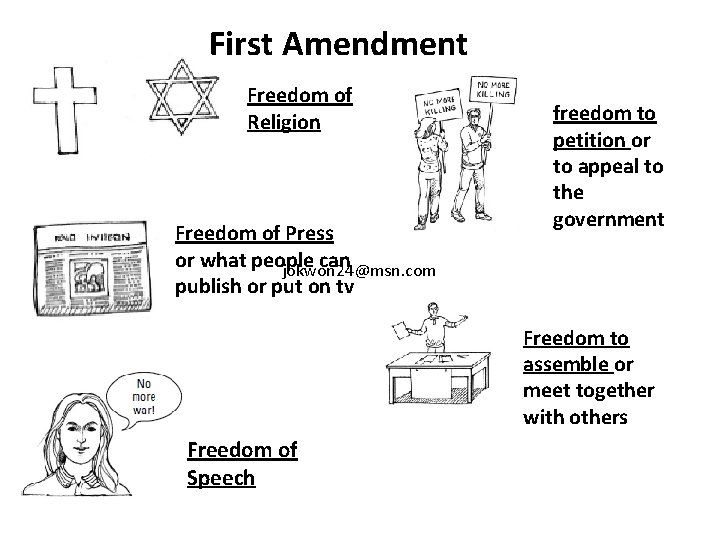
First Amendment Freedom of Religion Freedom of Press or what people can jokwon 24@msn. com publish or put on tv freedom to petition or to appeal to the government Freedom to assemble or meet together with others Freedom of Speech
Supreme Court Precedents That Helped Define These Rights • In 1962, in the landmark case of Engel v. Vitale, the Court changed course. This case challenged the recitation of a standard prayer each day in New York’s public schools. In its decision, the Court struck down the practice. Writing for the majority, Justice Hugo Black said that state-sponsored prayer in schools was “a practice wholly inconsistent with the Establishment Clause. ” • In West Virginia State Board of Education v. Barnette, the Court said that Jehovah’s Witnesses could refuse to salute the flag. • In Texas v. Johnson, the Court concluded that flag burning as an expression of opinion was protected symbolic speech. • In NAACP v. Button (1963), however, the Court concluded that the civil rights group was not seeking financial gain. It was, instead, helping people petition the government for their lawful rights. On that basis, the NAACP’s efforts were protected under the First Amendment.
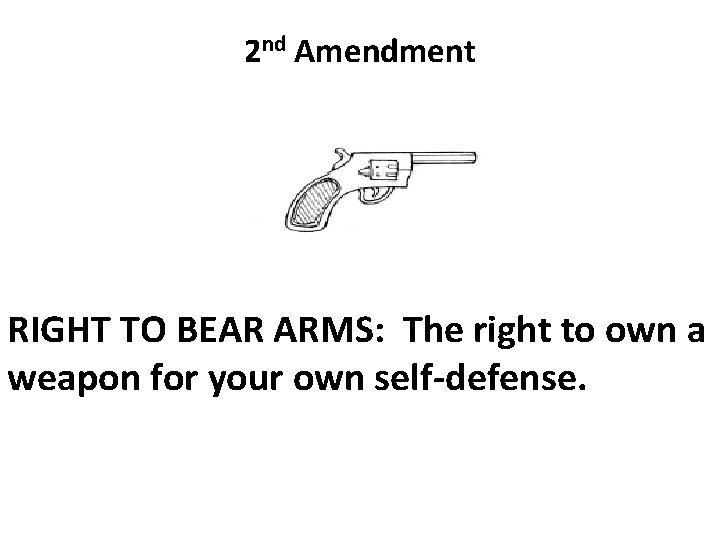
2 nd Amendment RIGHT TO BEAR ARMS: The right to own a weapon for your own self-defense.
Supreme Court Precedents That Helped Define These Rights • n 1934, however, an increase in violent, gang-related shootings and an attempt on President Franklin Roosevelt’s life led to the passage of the first federal gun control law. This law placed a tax on certain powerful firearms and required background checks on buyers in order to limit the sale of such guns. In some cases, gun owners also had to register their weapons. • The Supreme Court upheld this law in United States v. Miller (1939). In that case, the Court supported the conviction of two men who had failed to register a sawedoff shotgun, a particularly deadly weapon. The Court’s decision directly tied gun ownership to militias. Because militias never used sawed-off shotguns for common defense, the Court determined that government had the right to regulate such weapons. Justice James Clark Mc. Reynolds declared, “We cannot say that the Second Amendment guarantees the right to keep and bear such an instrument. ” • The Miller case is the only Supreme Court decision that directly addresses Second Amendment rights
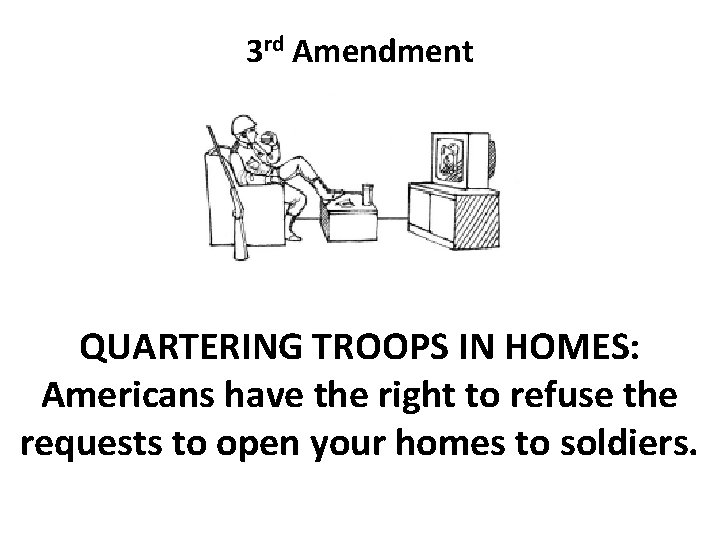
3 rd Amendment QUARTERING TROOPS IN HOMES: Americans have the right to refuse the requests to open your homes to soldiers.
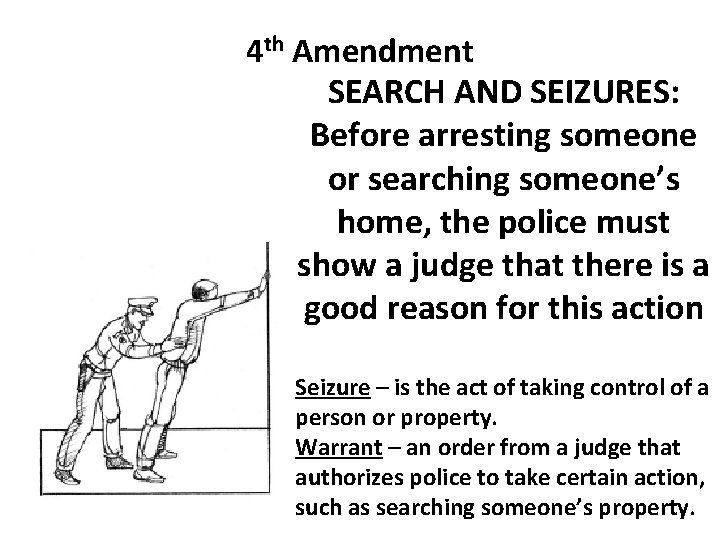
4 th Amendment SEARCH AND SEIZURES: Before arresting someone or searching someone’s home, the police must show a judge that there is a good reason for this action Seizure – is the act of taking control of a person or property. Warrant – an order from a judge that authorizes police to take certain action, such as searching someone’s property.
Supreme Court Precedents That Helped Define These Rights • One case, Katz v. United States (1967), hinged on recordings of a suspect’s conversation made from a public phone booth. Because the recording device was placed outside the booth and recorded only the suspect’s voice, the police believed they did not need a warrant. But the Court disagreed. It concluded that a warrant was required, because the suspect had a “reasonable expectation of privacy” in a phone booth.
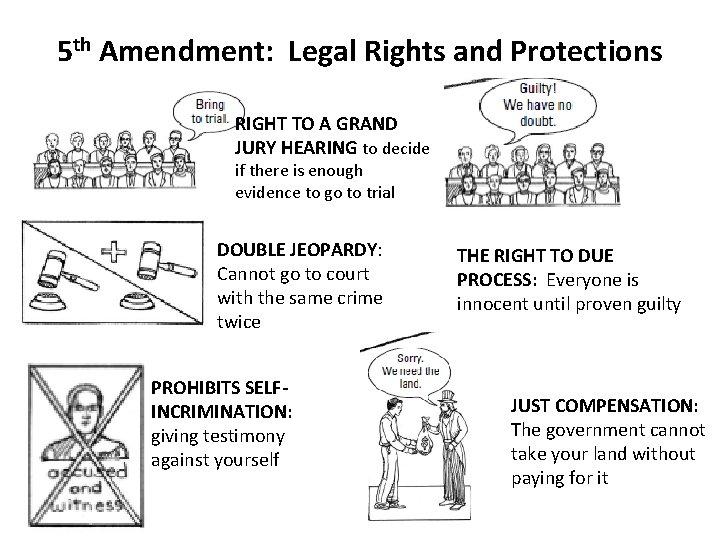
5 th Amendment: Legal Rights and Protections RIGHT TO A GRAND JURY HEARING to decide if there is enough evidence to go to trial DOUBLE JEOPARDY: Cannot go to court with the same crime twice PROHIBITS SELFINCRIMINATION: giving testimony against yourself THE RIGHT TO DUE PROCESS: Everyone is innocent until proven guilty JUST COMPENSATION: The government cannot take your land without paying for it
Supreme Court Precedents That Helped Define These Rights • In Miranda v. Arizona (1966), the Court set forth a procedure for ensuring that suspects know their rights. Chief Justice Earl Warren described this procedure in his written opinion: – Prior to any questioning, the person must be warned that he has a right to remain silent, that any statement he does make may be used as evidence against him, and that he has a right to the presence of an attorney. • These rights of the accused became known as Miranda rights.
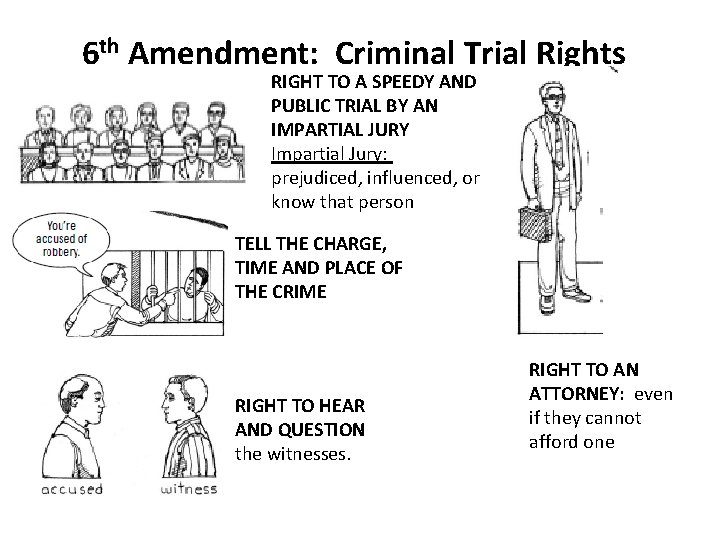
6 th Amendment: Criminal Trial Rights RIGHT TO A SPEEDY AND PUBLIC TRIAL BY AN IMPARTIAL JURY Impartial Jury: prejudiced, influenced, or know that person TELL THE CHARGE, TIME AND PLACE OF THE CRIME RIGHT TO HEAR AND QUESTION the witnesses. RIGHT TO AN ATTORNEY: even if they cannot afford one
Supreme Court Precedents That Helped Define These Rights • The right to legal counsel was the focus of the 1963 Court case of Gideon v. Wainwright. Clarence Earl Gideon was a poor, uneducated ex-convict who was arrested for theft in Florida. Unable to afford an attorney, he asked the court to provide him free legal counsel. Because Florida courts provided such services only in death penalty cases, the judge turned him down. Gideon was found guilty and sentenced to five years in prison.
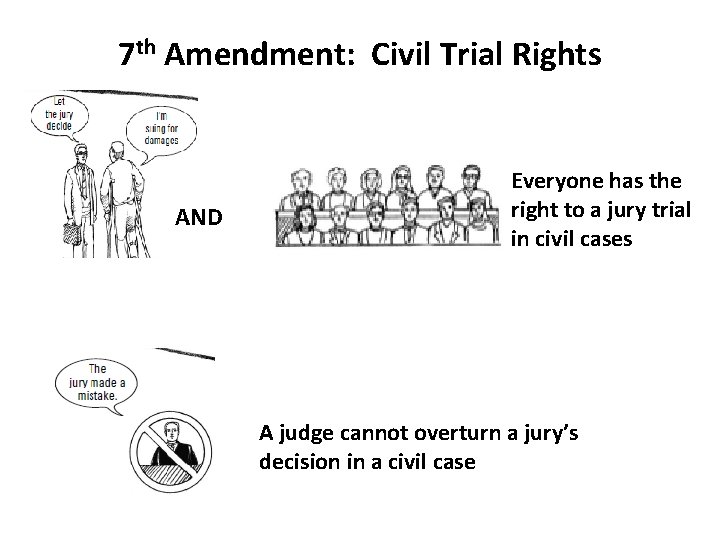
7 th Amendment: Civil Trial Rights AND Everyone has the right to a jury trial in civil cases A judge cannot overturn a jury’s decision in a civil case
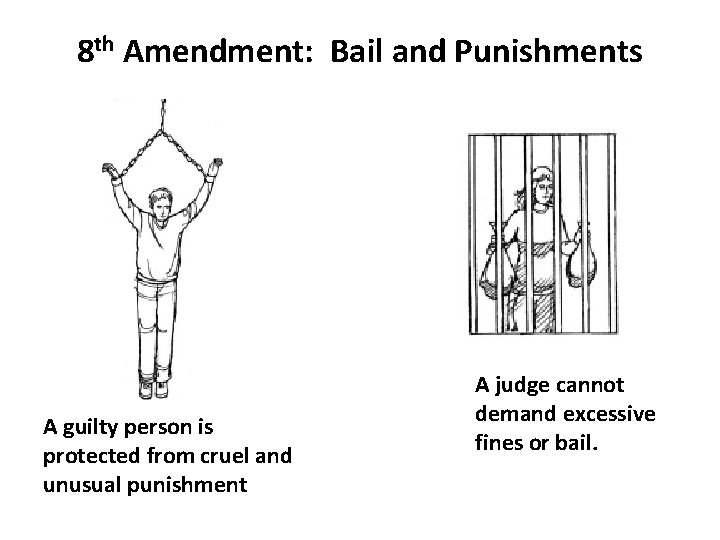
8 th Amendment: Bail and Punishments A guilty person is protected from cruel and unusual punishment A judge cannot demand excessive fines or bail.
Supreme Court Precedents That Helped Define These Rights • In the 1972 case of Furman v. Georgia, however, the Court focused on the death penalty itself. It concluded that capital punishment was cruel and unusual when it was inconsistently and unequally applied from one case to another. The Court observed that all too often, two people convicted of a capital crime received very different penalties. One might be sentenced to life in prison while the other was condemned to death.
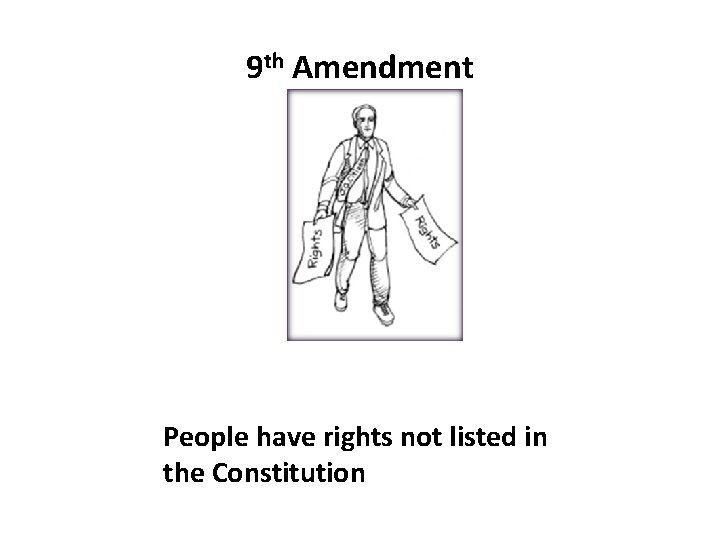
9 th Amendment People have rights not listed in the Constitution
Supreme Court Precedents That Helped Define These Rights • In 1965, in the case of Griswold v. Connecticut, some justices on the Court declared that the Ninth Amendment includes the right to privacy. Estelle Griswold, an official with the Planned Parenthood League of Connecticut, had been arrested for providing medical advice to married couples on how to prevent pregnancy. Her actions violated a Connecticut law that prohibited the use of contraceptives. In its decision, the Court declared that the law violated marital privacy rights.
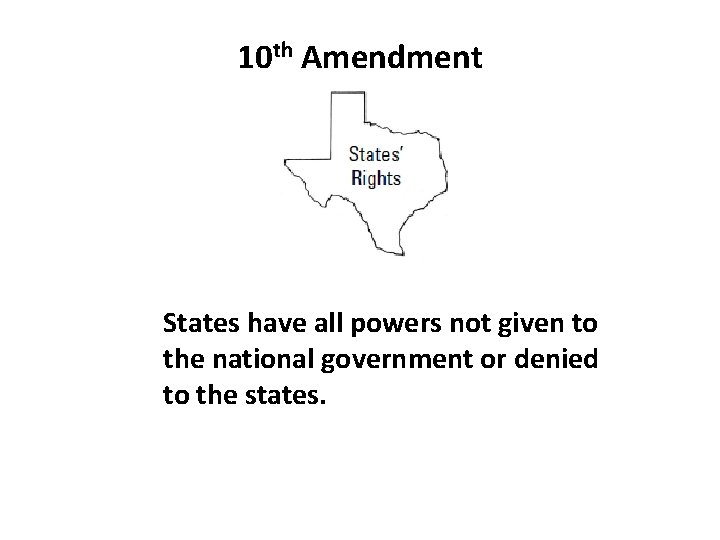
10 th Amendment States have all powers not given to the national government or denied to the states.
Supreme Court Precedents That Helped Define These Rights • In the case of United States v. Morrison (2000). This case focused on a law, the Violence Against Women Act, that allowed victims of domestic violence to sue their attackers in federal court. The Court struck down this law, saying that violent crime between individuals was an issue for the states, not the federal government.
- Slides: 19