
Historical Timeline of Genetics 10 th Grade Biology
Historical Timeline of Genetics 10 th Grade Biology Mr. Walker
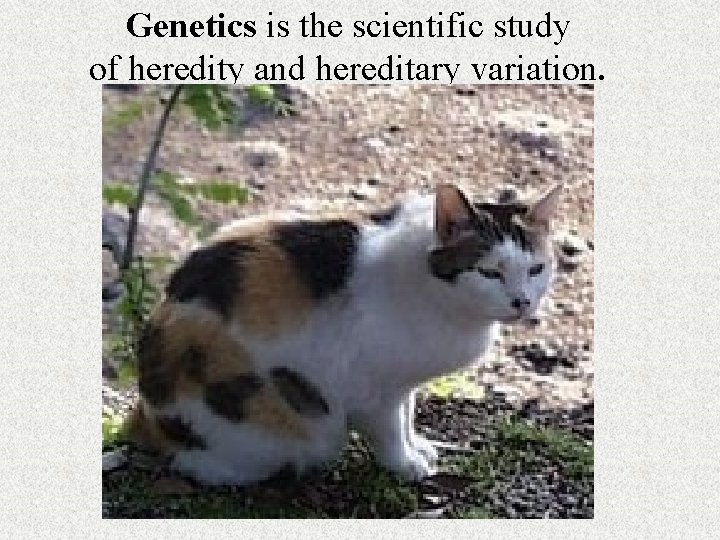
Genetics is the scientific study of heredity and hereditary variation.

Gregor Johann Mendel • 1865, began breeding garden peas at an Austrian monastery. • He introduced the idea of genetic traits, alleles, hybridization, and the law of segregation.

• 1842 -1910, Karl Wilhelm von Nageli and Walther Flemming discovered the nature of chromosomes.
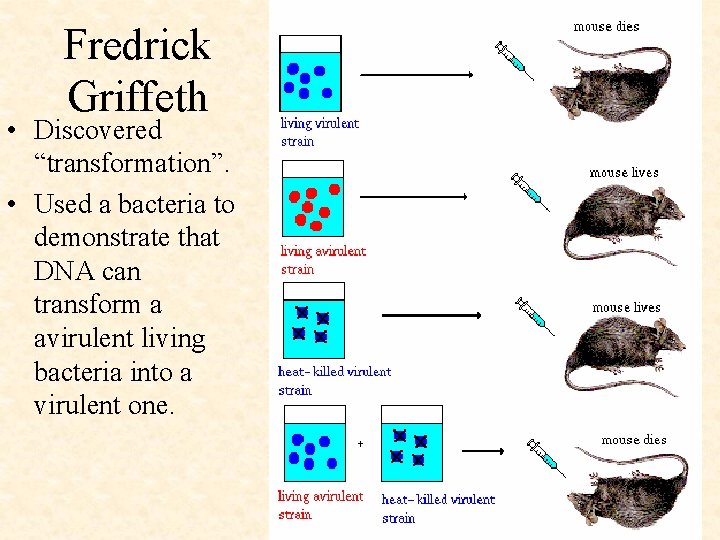
Fredrick Griffeth • Discovered “transformation”. • Used a bacteria to demonstrate that DNA can transform a avirulent living bacteria into a virulent one.
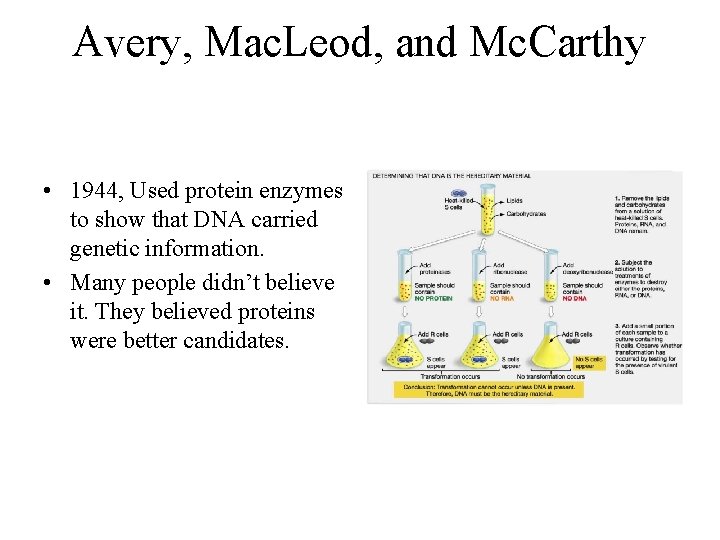
Avery, Mac. Leod, and Mc. Carthy • 1944, Used protein enzymes to show that DNA carried genetic information. • Many people didn’t believe it. They believed proteins were better candidates.
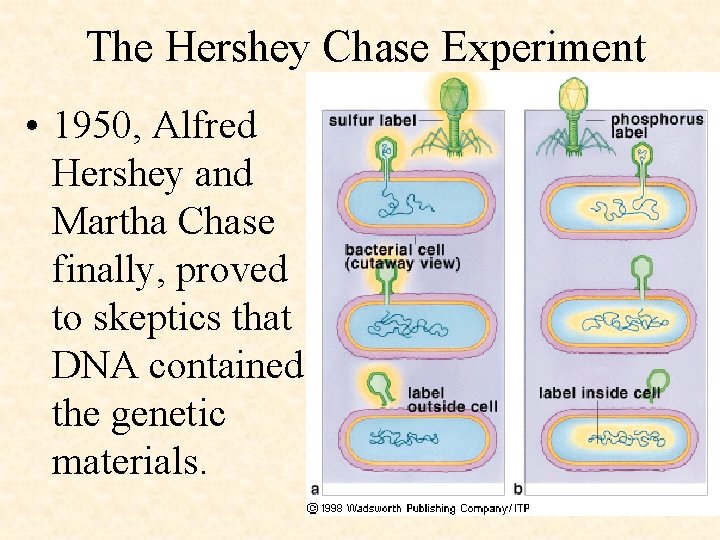
The Hershey Chase Experiment • 1950, Alfred Hershey and Martha Chase finally, proved to skeptics that DNA contained the genetic materials.
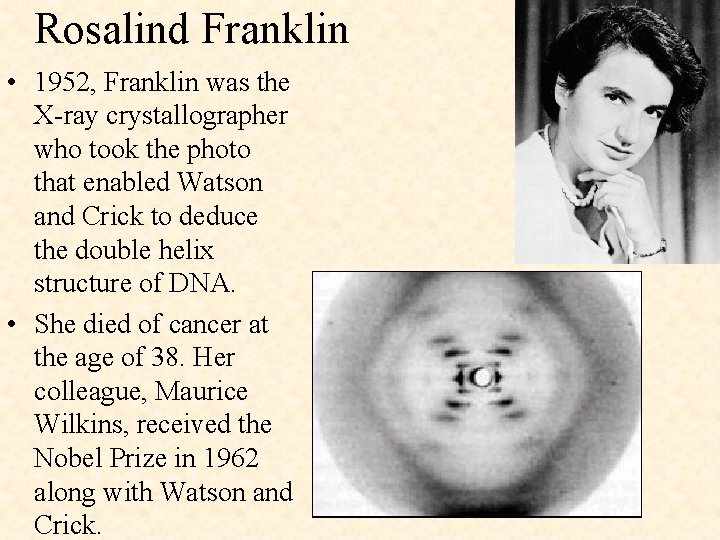
Rosalind Franklin • 1952, Franklin was the X-ray crystallographer who took the photo that enabled Watson and Crick to deduce the double helix structure of DNA. • She died of cancer at the age of 38. Her colleague, Maurice Wilkins, received the Nobel Prize in 1962 along with Watson and Crick.
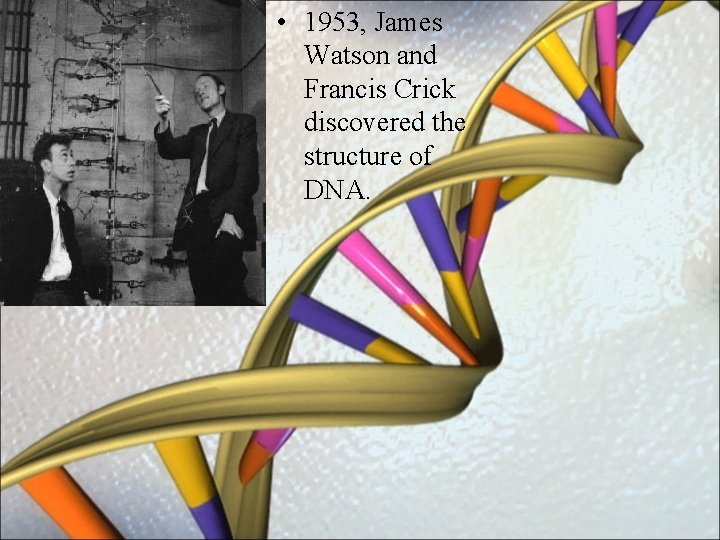
• 1953, James Watson and Francis Crick discovered the structure of DNA.

Heredity Notes: • Humans have 23 pairs of chromosomes totaling 46. • Heredity is the passing of traits from parents to offspring • Alleles are different forms of a trait that a gene may have • Genetics is the study of how the traits are inherited • A hybrid is an organism that is produced from two different species. E. g. Liger

Hybrid Example
Important Terms • Dominant= a trait that covers up another trait. Capitalized letters are used to represent dominant traits. • Recessive=a trait that is being covered up by another trait. Lower case letters are used to represent recessive traits. • Punnett Squares are tools that predict the probability of traits in organisms • Genotype: the genetic makeup of an organism. E. g. Aa • Phenotype: the outward appearance of an organism. E. g. brown hair. • Homozygous: an organism with two alleles that are the same for a trait. • Heterozygous: an organism with two different alleles for a trait.
How to do a Punnett Square • -Use easily recognizable letters Rr. Aa. Not Cc • B- means BB or Bb • Other terms: – Hybrid-Heterozyous – Pure-homozygous • Example of Punnett Square and using two letters.
- Slides: 13