
Historical Time Periods Periodization a period of historical
- Slides: 30
Historical Time Periods • Periodization: "a period of historical time defined by shared characteristics. "
Historical Time Periods • 3 Million BCE – 250, 000 BCE • Australopithecus to Homo Sapiens
Historical Time Periods • Paleolithic: 250, 000 BCE – 15, 000 BCE
Historical Time Periods • Neolithic: 15, 000 BCE – 5000 BCE Symbolization Agriculturalization Estrus to Menses
Historical Time Periods • Ancient Civilizations: 5000 BCE – 500 BCE • Writing, Iron, Wheels
Historical Time Periods • Classical Civilizations: 500 BCE - 500 CE • Empires: Extended Trans-Regional Contact • Spread of Universalizing Traditions
Historical Time Periods • Post-Classical Age: 500 CE - 1450 • Collapse of Classical Civilizations • Spread of Civilization Across Afro-Eurasia
Historical Time Periods • Early Modern Period: 1450 • Europeans Enter World Stage
Historical Time Periods • Modern Period: 1750 • Political and Industrial Revolutions • Second Age of Global Imperialism
Historical Time Periods • 1750 – 1911: Iranian, Turkish, Mexican and Chinese Revolutions
Historical Time Periods • 1914 – 1918: First World War • 1929: The Great Depression • 1939 -1945: World War II
Historical Time Periods • 1945: The Nuclear Age • 1945 – 1991: Cold Wars • 1945 – Present: Decolonization, Globalization, Environmental Concerns
World History Movement • William Mc. Neill • L. S. Stavrianos • Jeremy Bentley • Marshall G. S. Hodgson • Andre Gunder Frank These historians began to question the Euro-centric nature of historical discussion
World History Movement • Despite the modern constancy of change in daily life and thought, many historians and educators seem reluctant to reexamine their tenets of periodization.
World History Movement • The AP World Modern course has led to periodization discussion about the importance of previously accepted time periods and civilizations: • Greeks, Romans, Achaemenid Persians, Umayyad and Abbasid Muslims, Zhou, Han and Tang China, Mauryan India, Olmecs and Ghana (500 bce - 1200 ce)
World History Movement • Three events characterize the start of the new course: • The fall of Constantinople to the Ottoman Turks (1453) • The development of the movable type printing press in Europe (c. 1450 • The Portuguese exploration of the Atlantic and Africa (1415 -1434) • However, all of these events were preceded by other events: The Ottoman Empire founded by Osman I circa 1299 -1302; Chinese block printing circa 800 ce; Islamic Empires of the Umayyad Caliphate 661750 ce, Abbasid Caliphate 750 -1258 ce, which create pressure for alternate trade routes sought by the Portuguese
World History Movement • The original start date of the course, 1450 CE begins the era of European ascendency onto the world stage as first Portugal and later other European nations explored and conquered lands on four continents. But the College Board Test Development Committee did listen to suggestions to move the start date back to 1200 CE.
World History Movement • One truism in any discussion about of periodization, whichever formulation historians choose to use, is that it is often predicated on culturally specific if not arbitrary beginning and ending dates.
World History Movement • Jews order time since God created the world. • Christians date their calendars from the birth of Christ. • Muslims date their calendar based on Muhammad's flight—hegira— from Mecca to Medina. • The Big History Project: History begins with the Big Bang
World History Movement • Japanese organize calendars by the reign names of their emperors— the new emperor of Japan, Naruhito's reign began May 1, 2019 or 1 Reiwa • the Aztecs believed the world is in the Fifth Sun • Romans dated their calendars from the founding of Rome and divided its history into periods based on the kingdom, the republic and the Principate or empire
World History Movement • Within each period, each civilization organized smaller units of time often by dynasties—Egypt had arguably thirty-one or thirty-three in three kingdoms divided by intermediary times of illnesses when catastrophes befell the Egyptians. • China uses both dynasties and the Dynastic Cycle to organize chronology • Americans often delineate time by presidencies or shared characteristics of an age (the Age of Jackson) • And there has been recent debate to reorganize time around the detonation of the atomic bombs in 1945 with the new date becoming Year 1 of the Atomic Era (AE).
Why 1200 as the Starting Point? • 1200 CE does represent an end of one period and the beginning of another period • the Silk Roads, missionaries and pilgrims spreading world religions as well as the nomadic empires, all of which saw important happenings around after 1200 CE • the Middle East specifically Cairo's Mamluk Sultanate, the late Baghdad of the Abbasids, and the Mongols, all which affected rising European trade • the Indian Ocean trade network of India, the Malacca Straits and China
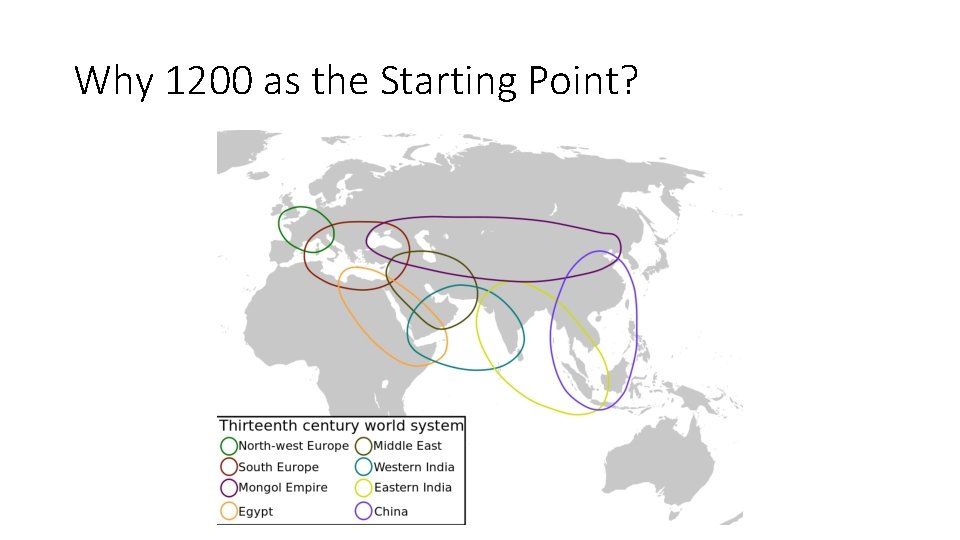
Why 1200 as the Starting Point? • earlier economic transformations reached their apogee in the 1200 s when all parts of Afro-Eurasia knew of each other and were in some form of regular contact (see map in Chapter 11: Ways of the World and succeeding slide) • 1200 is a time of extensive cultural, artistic and intellectual achievements • the Old World was in the process of developing its first world economic system (of the 21 st century) in the 1200 s
Why 1200 as the Starting Point?
Why 1200 as the Starting Point? Collapses and Disruptions • Many of the vital Post-Classical civilizations and states suffered severe collapses and disruptions around the year 1200 CE • The Byzantine Empire, sack of Constantinople 1204 and the Partition of the Byzantine Empire by the Latin Church (4 th Crusades) • Keivan Rus • The Abbasid Dynasty • The Turkish and Seljuk sultanates
Why 1200 as the Starting Point? Collapses and Disruptions • the Almohad Caliphate in Iberia • Srivijaya on Sumatra • Tibet • Heian Japan • Song China • the Toltec Empire • Chichen Itza
Why 1200 as the Starting Point? Collapses and Disruptions • Other states saw significant changes to existing structures whether political, social, economic or cultural to warrant the discussion of a change in a period: • The creation of the Delhi Sultanate • the rise of Mali • the first shogunate in Japan • the increased power of the Khmer Empire • the birth of new empires in the Valley of Mexico and the Andes • the birth and expansion of the Mongol Empire clearly represent a changed period.
Why 1200 as the Starting Point? Collapses and Disruptions • There were significant changes both culturally and intellectually across Eurasia to denote a changed period—the Europeans experienced a Twelfth Century Renaissance while Muslims moved increasingly away from Aristotelian explanations in Islam to a Sunni resurgence around Sufi mysticism-Confucianism took a strong hold in China and Japan while Islam began to spread in Southeast Asia. • Moreover trade made a major resurgence and became a defining characteristic of this period. The Mongols favored and supported increased trade across the steppe while trade across the Sahara and in the Indian Ocean expanded dramatically.
Why 1200 as the Starting Point? Afro-Eurasia After 1200, two cultural, intellectual and economic centers of the world remained: The Muslim ecumene stretching from the Atlantic to South Asia including Central Asia as well as parts of Sub-Saharan Africa and the Neo-Confucian Song Dynasty in China In Egypt, Turkish “slaves” or Mamluks created the Mamluk Sultanate after ousting the Ayyubid sultans; the Mamluk Sultanate lasts until overthrown by the Ottoman Empire in 1517 and dominated the slave trade and markets out of Saharan Africa
Why 1200 as the Starting Point? Afro-Eurasia In 1206 Turkish soldiers created the Sultanate of Delhi and dominated North India until overthrown by another Central Asian dynast, Babur who founded the Mughal Dynasty in 1526. The Muslim world was in the twilight of its Golden Age, represented by the House of Wisdom in Baghdad. Muslim scholars translated countless older Mesopotamian, Greek, Persian and Hindu works