
Historical perspective and definition of nursing Roles and

- Slides: 42
Historical perspective and definition of nursing Roles and functions of the professional nurse. Dr. Abdul-Monim batiha 1
Learning Objectives After completing this chapter, the students will be able to: o Discuss contemporary factors influencing the development of nursing. o Identify the essential aspects of nursing. 2
• Identify four major areas within the scope of nursing practice. • Describe the roles of nurses. • Discuss the criteria of a profession and professionalization of nursing. 3
Introduction Nursing has had a significant effect on people's lives. As rapid change continues to transform the profession of nursing and health care system. Today, nurses bring knowledge, leadership, spirit, and vital expertise to expanding roles that afford increased participation, responsibility, and rewards. 4
Contemporary nursing practice An understanding of contemporary ﻣﻌﺎﺻﺮ nursing practice includes a look at definitions of nursing, recipients of nursing, scope of nursing, settings of nursing practice, nurse practice acts, and current standards of clinical nursing practice. 5
Definitions of Nursing Florence Nightingale “The act of utilizing the environment of the patient to assist him in his recovery" (Nightingale, 1860). Nightingale considered a clean, well-ventilated, and quite environment essential for recovery. 6
Verginia Henderson "The unique function of the nurse is to assist the individual, sick or well, in the performance of those activities contributing to health or its recovery (or to peaceful death)". 7
Canadian Nurses Association (CNA) Described nursing practice as a dynamic, caring, helping relationship in which the nurse assists the client to achieve and obtain optimal health. 8
Certain themes are common to many of these definitions • Nursing is caring. • Nursing is an art. • Nursing is a science. • Nursing is client centered. 9
• Nursing is holistic. • Nursing is adaptive. • Nursing is concerned with health promotion, health maintenance, and health restoration. • Nursing is a helping profession. 10
American Nurses Association (ANA) "direct, goal oriented, and adaptable to the needs of the individual, the family, and the community during health and illness" (ANA, 1973). 11
• In 1980, the (ANA) changed this definition of nursing to this "Nursing is the diagnosis and treatment of human responses to actual or potential health problems". 12
Recipients of Nursing o. The Recipients of Nursing are sometimes called consumers, sometimes patients, and sometimes clients. 13
• A consumer is an individual, a group of people, or a community that uses a service or community. People who use health care products or services are consumers of health care. 14
• A patient is a person who is waiting for or undergoing medical treatment and care. The word patient comes from a Latin word meaning "to suffer" or "to bear". Traditionally, the person receiving health care has been called a patient. 15
• A client is a person who engages the advice or services of another who is qualified to provide this service. The term client presents the receivers of health care as collaborators in the care, that is, as people who are also responsible for their own health. 16
Scope of Nursing o. Nurses provide care for three types of clients: individuals, families, and communities. o. Nursing practice involves four areas: promoting health and wellness, preventing illness, restoring health, and care of the dying. 17
Promoting Health and Wellness • Wellness is a state of well-being. It means engaging in attitudes and behavior that enhance the quality of life and maximize personal potential. 18
• Nurses promote wellness in clients who are both healthy and ill. This may involve individual and community activities to enhance healthy lifestyles such as improving nutrition and physical fitness, preventing drug and alcohol misuse, restricting smoking, and preventing accidents and injury in the home and workplace. 19
Preventing Illness The goal of illness preventing programs is to maintain optimal health by preventing disease. Nursing activities that prevent illness include immunizations, prenatal and infant care, and prevention of sexually transmitted disease. 20
Restoring Health • focuses on the ill client and it extends from early detection of disease through helping the client during the recovery period. 21
Nursing Activities Include the following: • Providing direct care to the ill person, such as administering medications, baths, and specific procedures and treatments. • Performing diagnostic and assessment procedures, such as measuring blood pressure and examining feces for occult blood. 22
• Consulting with other health care professionals about client problems. • Teaching clients about recovery activities, such as exercises that will accelerate recovery after a stroke. • Rehabilitating clients to their optimal functional level following physical or mental illness, injury, or chemical addiction. 23
• Care of the Dying This area of nursing practice involves comforting and caring for people of all ages who are dying. it includes helping clients live as comfortably as possible until death and helping support person cope with death. 24
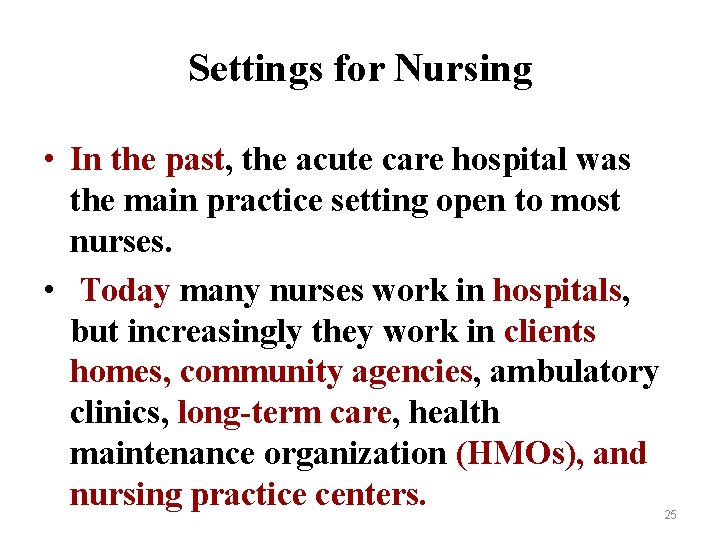
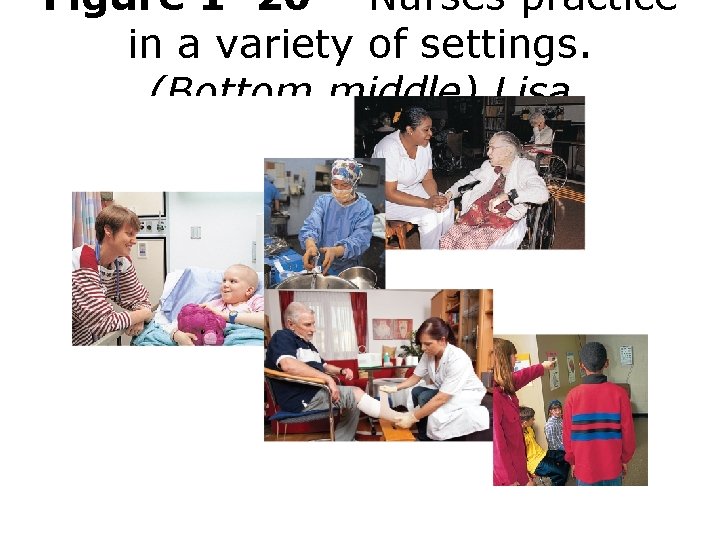
Settings for Nursing • In the past, the acute care hospital was the main practice setting open to most nurses. • Today many nurses work in hospitals, but increasingly they work in clients homes, community agencies, ambulatory clinics, long-term care, health maintenance organization (HMOs), and nursing practice centers. 25
Settings for Nursing Acute care hospitals Clients' homes Community agencies Ambulatory clinics Long-term care facilities Health maintenance organizations (HMOs) • Nursing practice centers • • •
Figure 1– 20 Nurses practice in a variety of settings. (Bottom middle) Lisa S. /Shutterstock.
• Nurses have different degree of nursing autonomy and nursing responsibility in the various settings. • They may provide direct care, teach clients and support persons, serve as nursing advocates and agents of change, and help determine health policies affecting consumers in the community and in hospitals. 28
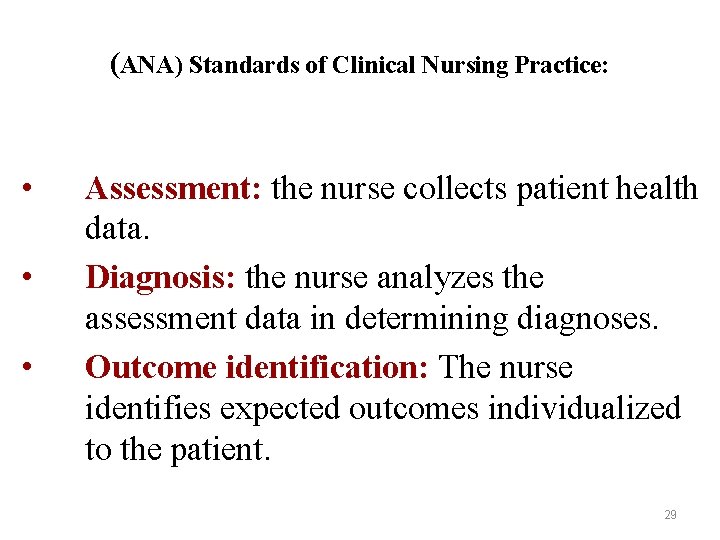
(ANA) Standards of Clinical Nursing Practice: • • • Assessment: the nurse collects patient health data. Diagnosis: the nurse analyzes the assessment data in determining diagnoses. Outcome identification: The nurse identifies expected outcomes individualized to the patient. 29
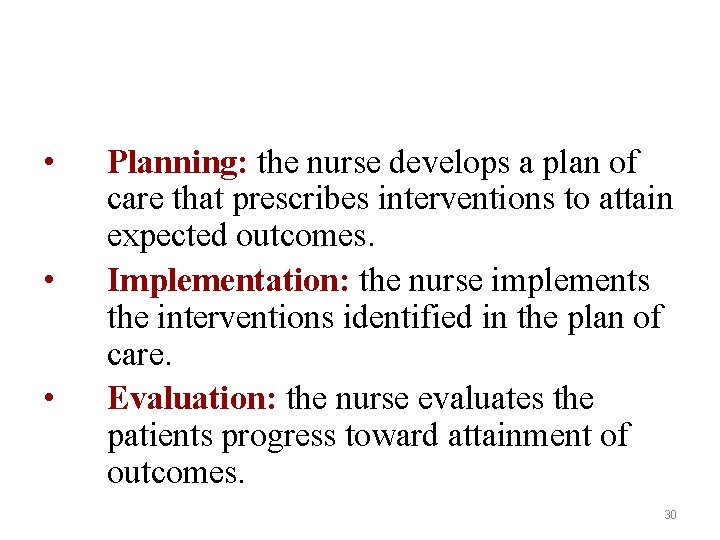
• • • Planning: the nurse develops a plan of care that prescribes interventions to attain expected outcomes. Implementation: the nurse implements the interventions identified in the plan of care. Evaluation: the nurse evaluates the patients progress toward attainment of outcomes. 30
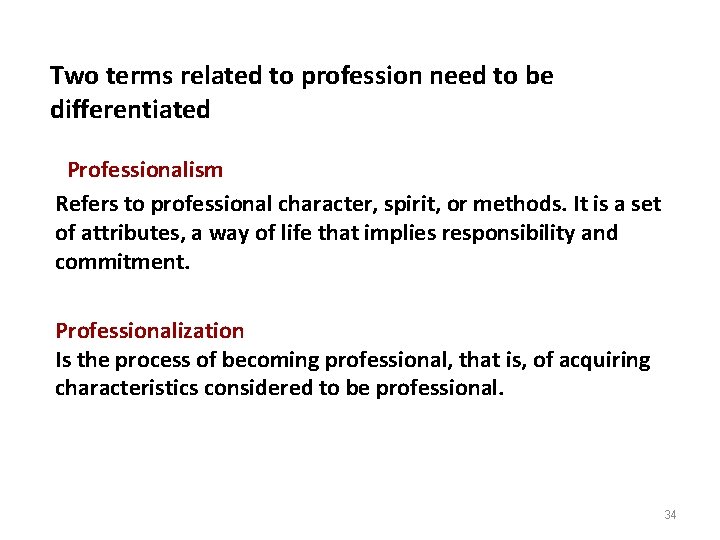
Two terms related to profession need to be differentiated Professionalism Refers to professional character, spirit, or methods. It is a set of attributes, a way of life that implies responsibility and commitment. Professionalization Is the process of becoming professional, that is, of acquiring characteristics considered to be professional. 34
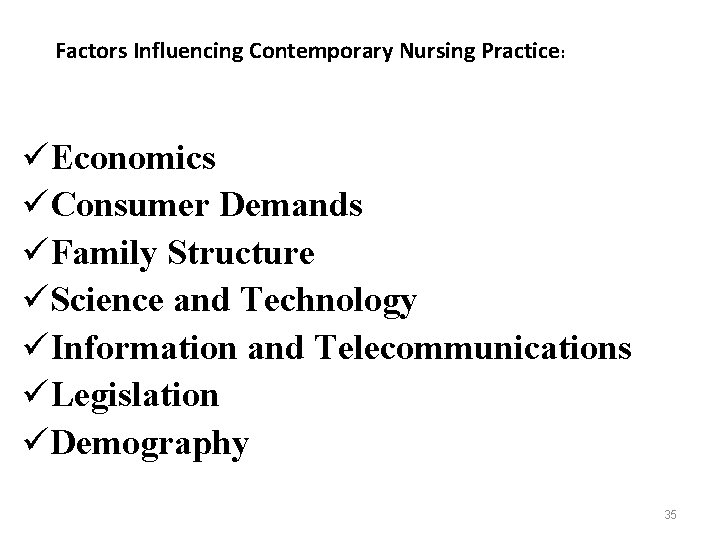
Factors Influencing Contemporary Nursing Practice: üEconomics üConsumer Demands üFamily Structure üScience and Technology üInformation and Telecommunications üLegislation üDemography 35
Roles and Functions of Nurses • Caregiver – Assist client physically and psychologically while preserving client's dignity • Communicator – Identify client problems and communicate them to other members of the health care team
Roles and Functions of Nurses • Teacher – Help clients learn about health and health care procedures to restore or maintain health • Client advocate – Represent, protect the client's needs and wishes
Roles and Functions of Nurses • Counselor – Help client to recognize and cope with stressful psychological or social problems, develop improved relationships, and promote personal growth • Change agent – Assist clients to make modifications in behavior
Roles and Functions of Nurses • Leader – Influence others to work together to accomplish specific goal(s) • Manager – Manage care of individuals, families, and communities – Delegate nursing activities
Roles and Functions of Nurses • Case manager – Work with or act as primary nurse to oversee care of specific caseload • Research consumer – Use research to improve client care
Thank you 42