
Historical Period 2 1607 1754 The Thirteen Colonies
- Slides: 94
Historical Period 2 1607 -1754 The Thirteen Colonies and the British Empire
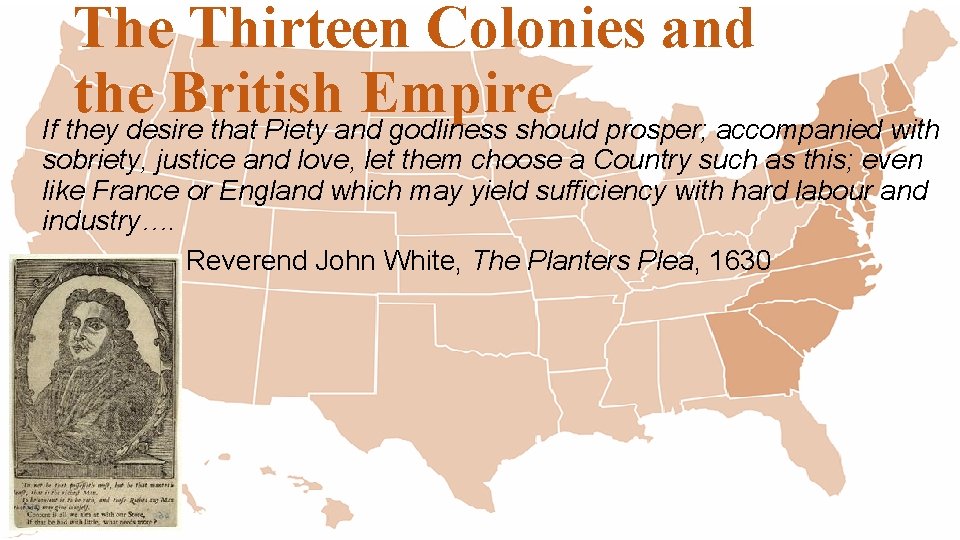
The Thirteen Colonies and the British Empire If they desire that Piety and godliness should prosper; accompanied with sobriety, justice and love, let them choose a Country such as this; even like France or England which may yield sufficiency with hard labour and industry…. Reverend John White, The Planters Plea, 1630
Introduction • Total of 13 colonies developed along Atlantic Coast of North America • Each received its identity and its authority by means of a charter from English monarch • Charter described relationship between colony and crown • Three types of colonies 1. Corporate: operated by joint-stock companies (ex Jamestown) 2. Royal: under direct authority and rule of king’s gov’t (ex VA after 1624) 3. Proprietary: under authority of individuals granted charters of ownership by king (ex PA, MD) • English brought tradition of representative gov’t • Accustomed to holding elections for reps who would speak for property owners on such things as taxes • Feelings for independence grew as did tensions between king and colonial subjects
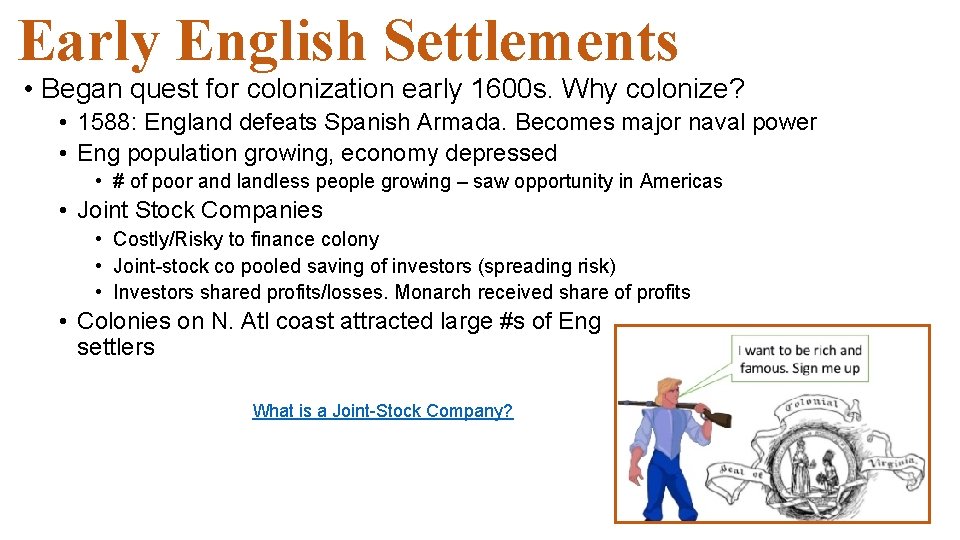
Early English Settlements • Began quest for colonization early 1600 s. Why colonize? • 1588: England defeats Spanish Armada. Becomes major naval power • Eng population growing, economy depressed • # of poor and landless people growing – saw opportunity in Americas • Joint Stock Companies • Costly/Risky to finance colony • Joint-stock co pooled saving of investors (spreading risk) • Investors shared profits/losses. Monarch received share of profits • Colonies on N. Atl coast attracted large #s of Eng settlers What is a Joint-Stock Company?
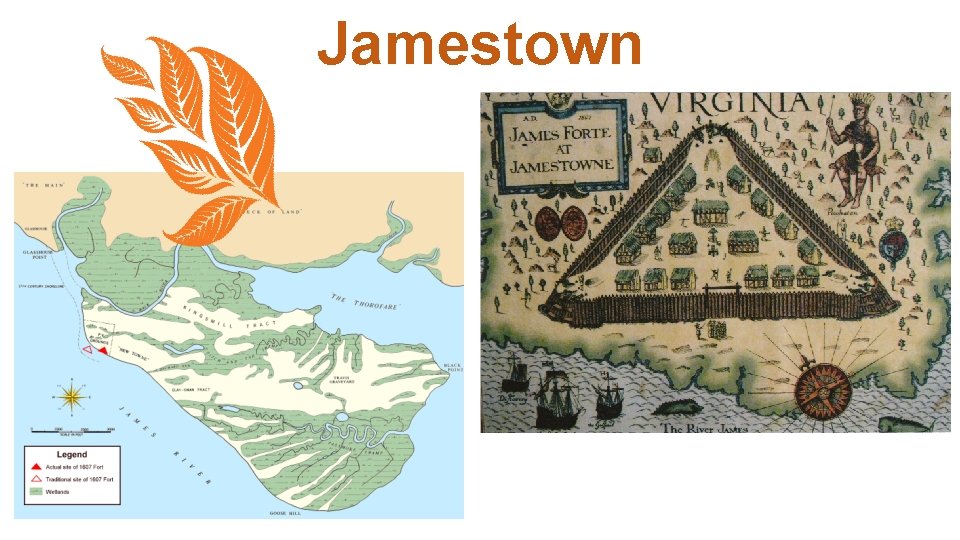
Early English Settlements Jamestown Nightmare at Jamestown 45 mins • King James I chartered Virginia Company, a joint-stock co • 1 st permanent Eng colony in America at Jamestown 1607 • Early Problems – 1 st settlers suffered. why? • • Location in swampy area along James R = fatal outbreaks dysentery/malaria Many Gentlemen who were unaccustomed to physical work Others gold-seekers – refused to hunt/farm Key source of trade? Indians. But conflicts arose, trade ceased, settlers faced starvation – “the starving time” • Solutions • Leadership of Capt John Smith • John Rolfe (married Pocohantas) – developed profitable variety of tobacco that became popular in Europe Tobacco
Jamestown
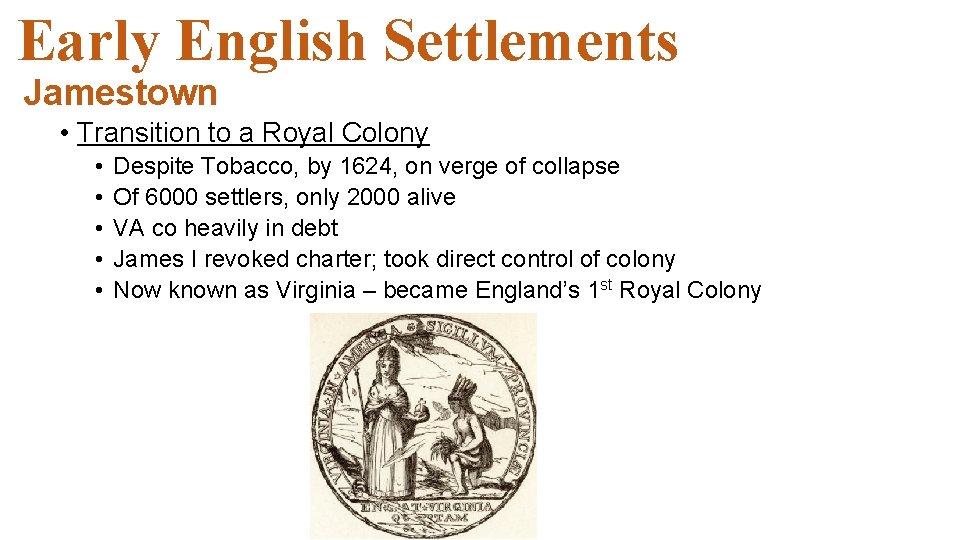
Early English Settlements Jamestown • Transition to a Royal Colony • • • Despite Tobacco, by 1624, on verge of collapse Of 6000 settlers, only 2000 alive VA co heavily in debt James I revoked charter; took direct control of colony Now known as Virginia – became England’s 1 st Royal Colony
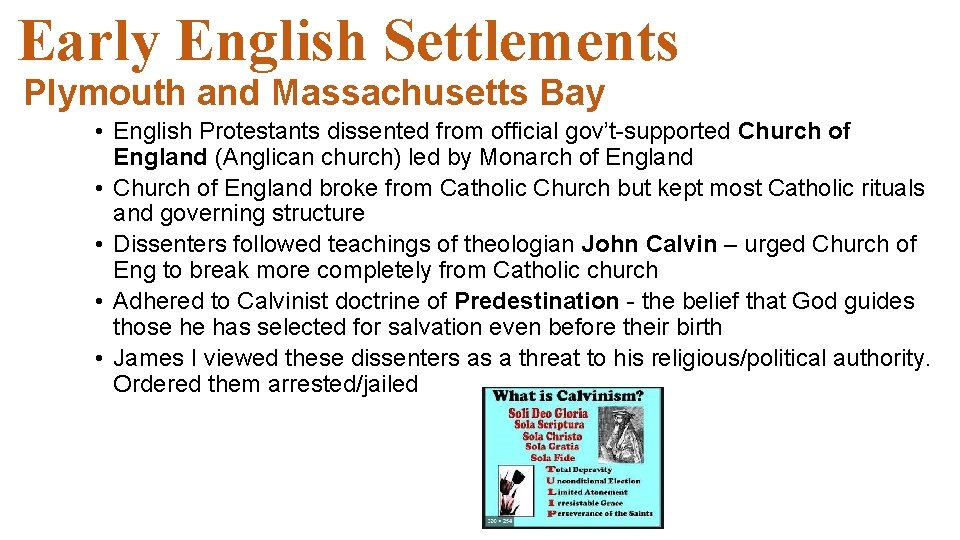
Early English Settlements Plymouth and Massachusetts Bay • English Protestants dissented from official gov’t-supported Church of England (Anglican church) led by Monarch of England • Church of England broke from Catholic Church but kept most Catholic rituals and governing structure • Dissenters followed teachings of theologian John Calvin – urged Church of Eng to break more completely from Catholic church • Adhered to Calvinist doctrine of Predestination - the belief that God guides those he has selected for salvation even before their birth • James I viewed these dissenters as a threat to his religious/political authority. Ordered them arrested/jailed
Early English Settlements The Plymouth Colony • Radical dissenters known as Separatists bc they wanted separate church independent of royal control • Few hundred Separatists left England for Holland for religious freedom – became known as Pilgrims bc of travel • Economic hardship + cultural diffs with Dutch led them to seek another haven, America! • 1620, Pilgrims sailed to VA aboard Mayflower. <half were Separatists. Rest were seeking economic opportunity • 65 day voyage. Mayflower off course. In MA, not VA. Decided to establish a new colony at Plymouth rather than proceed to Jamestown as planned.
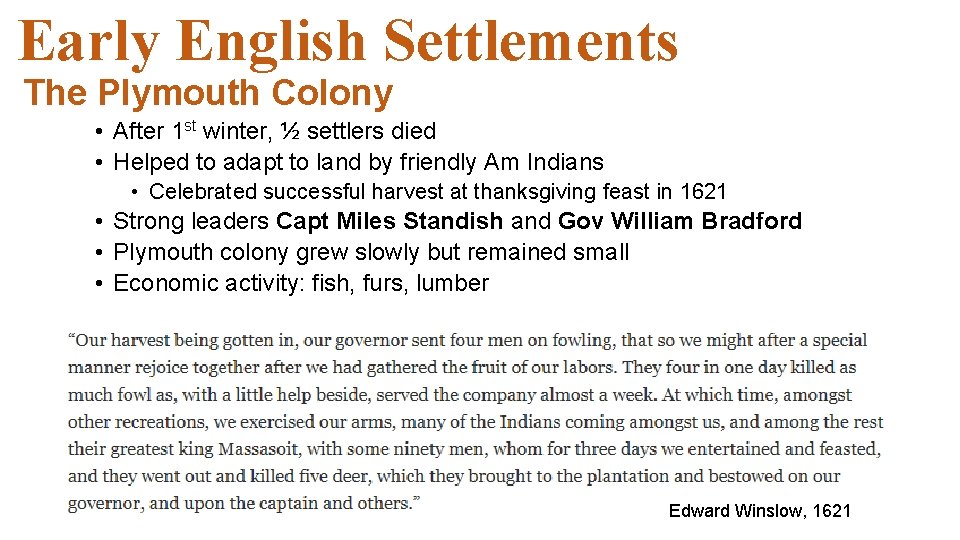
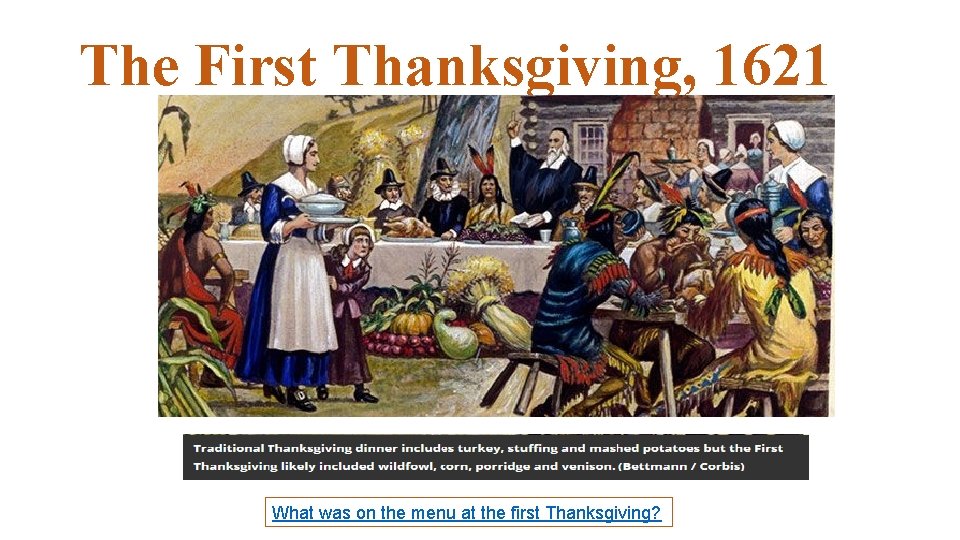
Early English Settlements The Plymouth Colony • After 1 st winter, ½ settlers died • Helped to adapt to land by friendly Am Indians • Celebrated successful harvest at thanksgiving feast in 1621 • Strong leaders Capt Miles Standish and Gov William Bradford • Plymouth colony grew slowly but remained small • Economic activity: fish, furs, lumber Edward Winslow, 1621
The First Thanksgiving, 1621 What was on the menu at the first Thanksgiving?
Early English Settlements Massachusetts Bay Colony • Moderate dissenters who wanted to purify/reform (not separate from) the Church of England. Known as Puritans. • Charles I king in 1625. Persecution of Puritans increased • Seeking religious freedom, Puritans granted royal charter for MA Bay Co (1629) • 1630. ~1000 led by John Winthrop sailed for MA. • Founded Boston + • Civil War in England 1630 s drove ~15, 000 more settlers to the colony – a movement known as the Great Migration (the first of many)
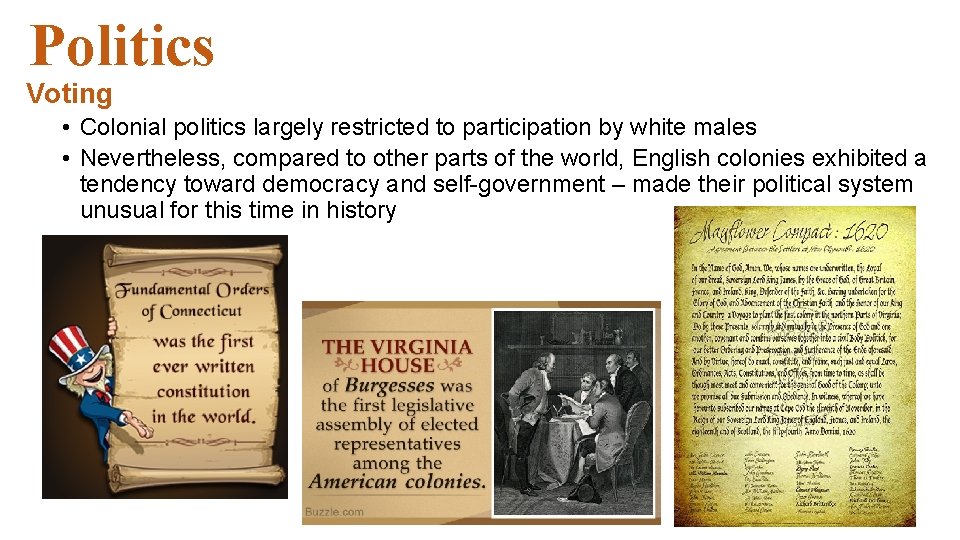
Early Political Institutions Representative Assembly in VA • VA co recruited settlers by guaranteeing colonists same rights as Englishmen including representation in lawmaking process • VA House of Burgesses 1619. 1 st representative assembly established in America Representative Gov’t in New England • Mayflower Compact – 1620. Prior to landing at Plymouth, MA. Pilgrims drew up/signed. Pledged to make decisions by will of the majority. • early form of colonial self-gov’t and basic constitution • MA Bay Colony. All freemen (male members of Puritan church) had right to vote in yearly elections of gov, his assistants, and a rep assembly
Early Political Institutions Limits to Colonial Democracy • • Only male property owners could vote for reps Female and landless: few rights Slaves and indentured servants: no rights Colonial governors had unlimited powers – answered to king or whoever provided financial colonies’ financial support • Thus, democratic ideas coexisted with antidemocratic practices – slavery, treatment of Indians
The Chesapeake Colonies – VA & VA MD • 1632, divided. George Calvert - Lord Baltimore (a Catholic) given the new colony of Maryland (MD). 1 st proprietary colony Religious issues in MD • King expected proprietors to faithfully carry out his wishes, thus, king had control • MD became haven for Catholics • Act of Toleration • Push Migration: religious persecution in England • Several wealthy Catholics to MD – set up large plantations, but outnumbered by Protestant farmers • Protestants held majority in MD assembly • 1649, Calverts persuade assembly to adopt Act of Toleration – 1 st colonial statute granting religious freedom to all Christians (death to anyone who denied divinity of Jesus)
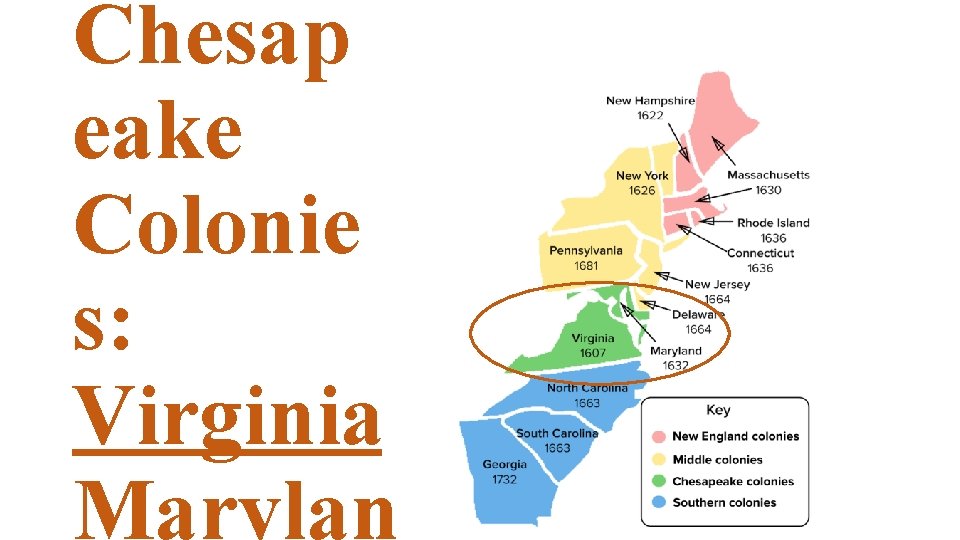
Chesap eake Colonie s: Virginia Marylan
The Chesapeake Colonies Religious issues in MD • Protestant Revolt • • Late 1600 s, brief civil war in MD Protestants win, Act of Toleration repealed Catholics lost right to vote in elections for MD assembly By late 1700 s, MD economy and society similar to VA, except still greater tolerance for religious diversity among diff Protestant sects in MD.
The Chesapeake Colonies Labor Shortages • MD and VA – Economic opportunities: land-owning; growing demand for Tobacco • Slow population growth (due to disease, food shortages, Indian battles) = labor shortage = new ways to find workers • Indentured Servants: under contract w/ master or landowner who paid their Atlantic passage • Young people agreed to work for specified period (4 -7 yrs) in return for room/board • Under absolute rule of masters under end of contract • End of contract – freedom. Then worked for wages or obtained own land to farm • For landowners – this system provided only temporary labor
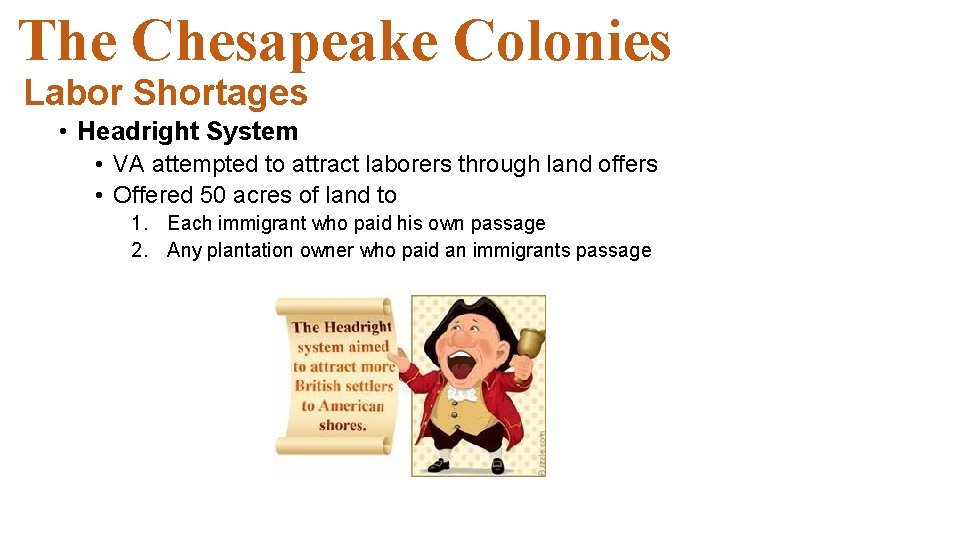
The Chesapeake Colonies Labor Shortages • Headright System • VA attempted to attract laborers through land offers • Offered 50 acres of land to 1. Each immigrant who paid his own passage 2. Any plantation owner who paid an immigrants passage
The Chesapeake Colonies Labor Shortages • Slavery • 1619 – Dutch ship brought black Africans to VA. In VA, technically indentured servants. • Not in lifelong bondage, children were free • Early colonists still struggling, and were too poor to purchase Africans as slaves • 1650 - ~ 400 Af laborers in VA • 1660 s: VA House of Burgesses passed laws that discriminated between blacks and whites – Africans and their offspring were to be kept in permanent bondage – slaves for life. Children’s status based on that of the mother
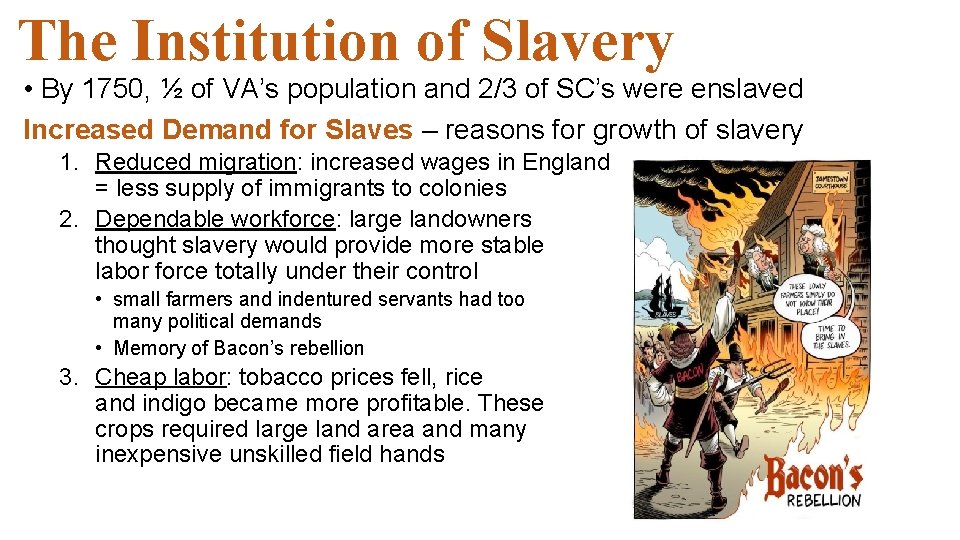
The Chesapeake Colonies Conflict in VA • Sir William Berkeley, British Royal governor of VA (1641 -52; 1660 -1677) – dictatorial powers to govern on behalf of large planters • Antagonized small farmers on VA western frontier bc he failed to protect them from Indian attacks • Bacon’s Rebellion 1676 • Nathanial Bacon, impoverished gentleman farmer, led rebellion against Berkeley’s gov’t • Bacon and western farmers resented economic/political control exercised by few large planters in Chesapeake area • Indian conflict ignited flame of social rebellion • Army of volunteers conducted series of raids and massacres against Indians on VA frontier • Berkeley accused Bacon of rebelling against royal authority • Bacon’s army defeated govt forces and burned Jamestown settlement • Bacon died of dysentery, rebel army collapsed • Berkelely had 23 rebels executed
The Chesapeake Colonies Conflict in VA • Lasting Problems • Bacons’s Rebellion – highlighted 2 lasting disputes in colonial VA 1. Sharp class diffs btwn wealthy planters and landless or poor farmers 2. Colonial resistance to royal control • Long-term significance • VA leaders more attentive to issues of poor and/or landless (class tensions eased) • Marked a switch from indentured servant labor to slavery (committed future generations to a labor system based on racial exploitation) Click here Bacon’s Rebellion Explained
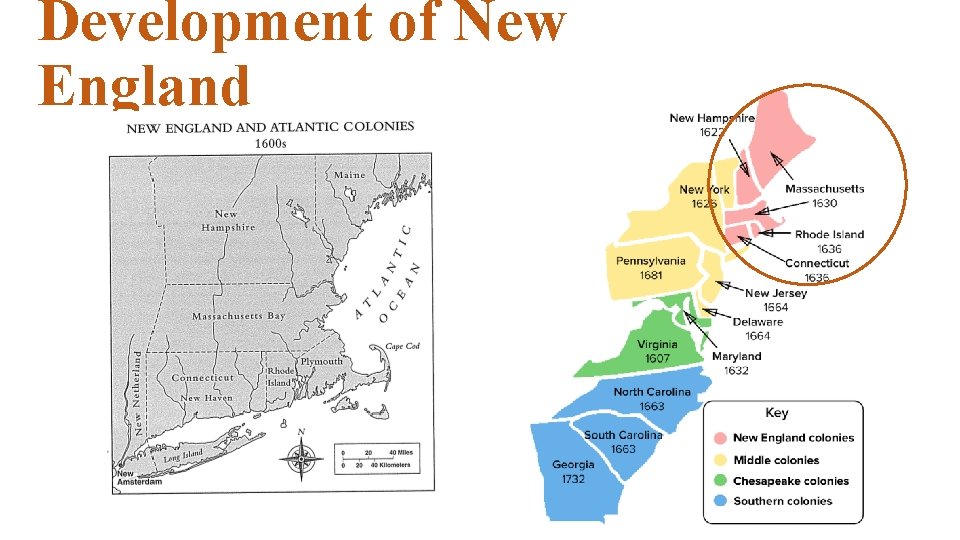
Development of New England • Strong religious convictions helped sustain settlers in Plymouth & MA Bay – Protestant Work Ethic • Intolerance for alternate religious views • Banished dissidents who formed settlements – RI & CT Rhode Island • Roger Williams – believed individual’s conscience was beyond control of civil or church authority • Banished from MA Bay • Founded settlement of Providence 1636 • What’s new in Providence? 1. Recognized rights of Indians – paid them for use of land 2. Allowed Catholics, Quakers, Jews religious freedom • Williams also founded one of first Baptist churches in America
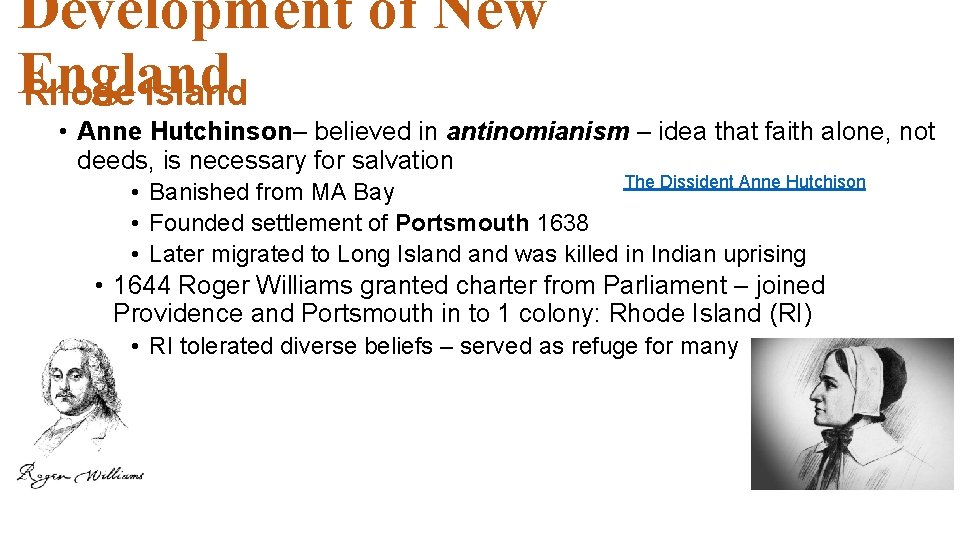
Development of New England Rhode Island • Anne Hutchinson– believed in antinomianism – idea that faith alone, not deeds, is necessary for salvation The Dissident Anne Hutchison • Banished from MA Bay • Founded settlement of Portsmouth 1638 • Later migrated to Long Island was killed in Indian uprising • 1644 Roger Williams granted charter from Parliament – joined Providence and Portsmouth in to 1 colony: Rhode Island (RI) • RI tolerated diverse beliefs – served as refuge for many
Development of New England Connecticut (CT) • 1636 Rev Thomas Hooker led lrg grp of Boston Puritans to CT River valley – founded colony of Hartford • The Fundamental Orders of CT, first written constitution in American history drawn up by settlers • Established rep govt with legislature elected by popular vote + governor chosen by that legislature • 2 nd settlement in CT valley started by John Davenport in 1637 – New Haven • 1665 Hartford and New Haven combined to form colony of CT • Royal charter gave CT a degree of self-govt, including election of governor
Development of New England New Hampshire (NH) • Last New England colony • Originally part of MA Bay, north of Boston • 1769 King Charles II hoped to increase more royal control over colonies so separated NH from Bay colony • Made NH a royal colony, subject to authority of appointed governor
Development of New England Halfway Covenant • 1660 s – generation into 1 st Puritan colonies in New England • To be a full member of Puritan congregation, needed to have profound religious experience – a conversion • few native born generation were having one • To maintain church influence and membership, Halfway Covenant was offered • Could become partial church member w/o conversion • As yrs passed, strict Puritan practices weakened in most New England communities in order to maintain church membership
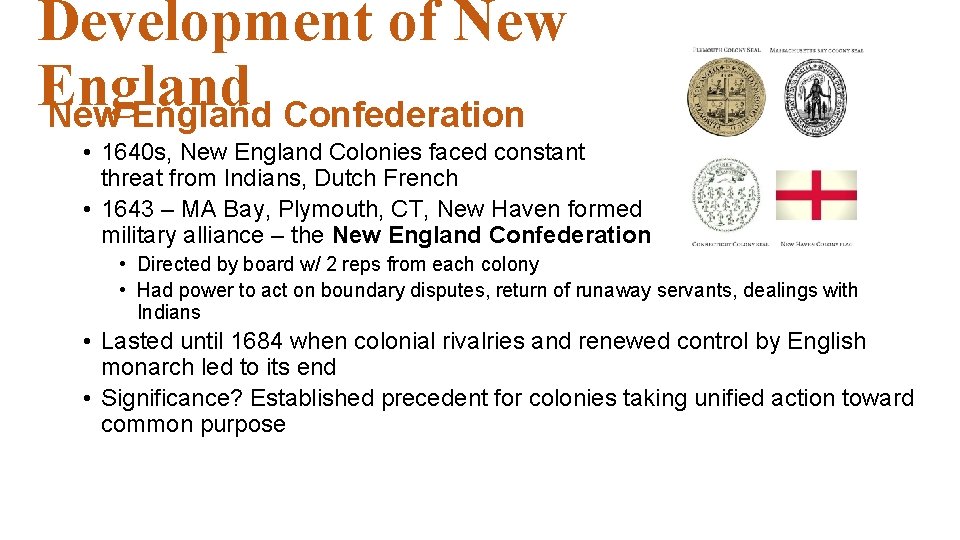
Development of New England Confederation • 1640 s, New England Colonies faced constant threat from Indians, Dutch French • 1643 – MA Bay, Plymouth, CT, New Haven formed military alliance – the New England Confederation • Directed by board w/ 2 reps from each colony • Had power to act on boundary disputes, return of runaway servants, dealings with Indians • Lasted until 1684 when colonial rivalries and renewed control by English monarch led to its end • Significance? Established precedent for colonies taking unified action toward common purpose
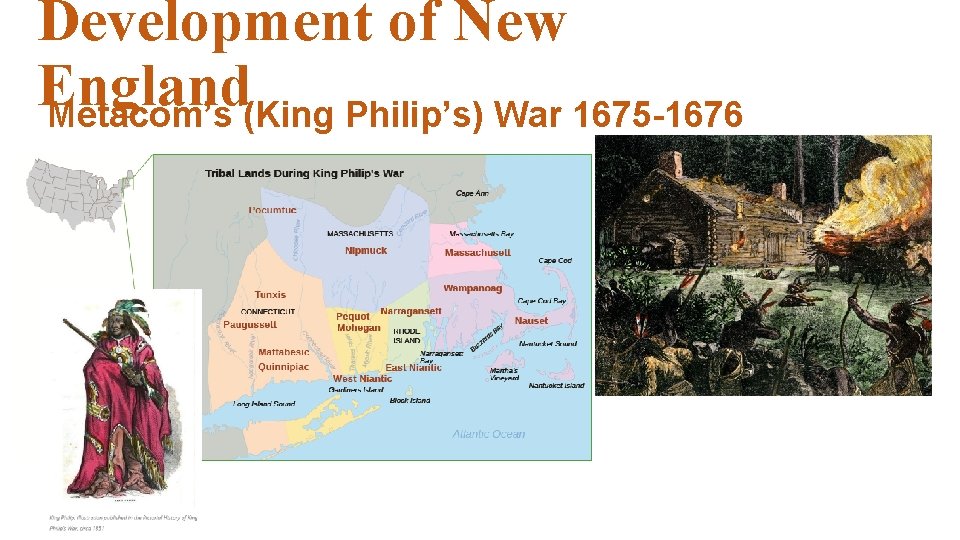
Development of New England Metacom’s (King Philip’s) War 1675 -1676 • New England Confederation helped New England colonists put down an Indian threat • Chief of Wampanoags, Metacom (colonists called him King Philip) united tribes in southern New England against English settlers who were encroaching on Indians’ land • Vicious War – 1000 s on both sides killed, towns and villages burned • Colonial forces win eventually, killing King Philip and ending most Indian resistance in New England
Development of New England Metacom’s (King Philip’s) War 1675 -1676
Development of New England
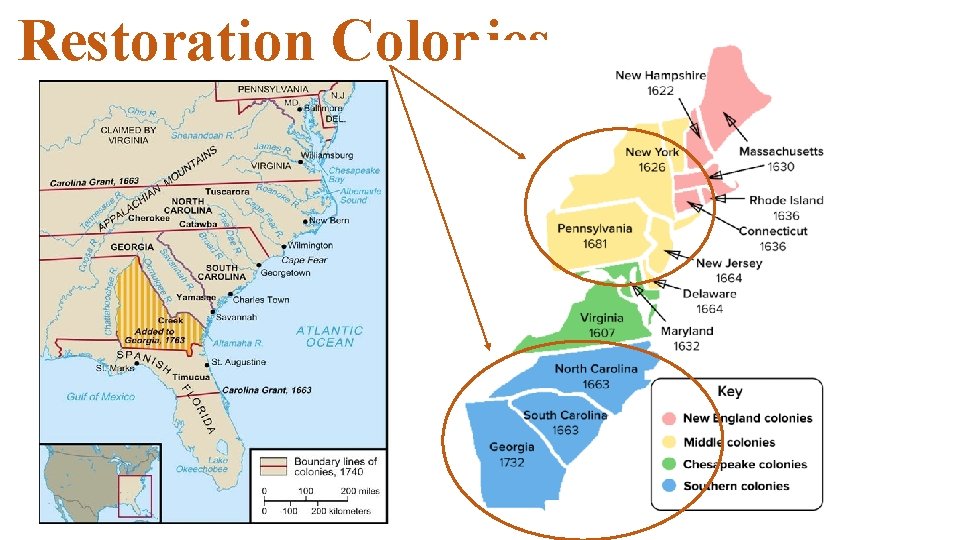
Restoration Colonies • New colonies formed in late 17 th century during England’s Restoration period (restoration of Charles II, in 1660 after Puritan rule under Oliver Cromwell) The Carolinas – South (SC) & North (NC) South Carolina • 1670. Founded by a few colonists from England + some planters form Barbados • Initially, economy based on trading furs, and providing food to West Indies • Mid 18 th century, SC economy and culture similar to West Indies – large rice-growing plantations worked by African slaves
Restoration Colonies The Carolinas – South (SC) & North (NC) North Carolina • Farmers from VA and New England established small, self-sufficient tobacco farms • Fewer large plantations, less reliance on slavery • due to few good harbors, poor transportation • Developed reputation for democratic views and autonomy from Brit control
Restoration Colonies New Jersey (NJ) • 1664. NY split • Area btwn Hudson R and Delaware Bay to proprietors Lord John Berkeley and Sir George Cateret • 1674. One proprietor given West NJ, other give East NJ • To attract settlers, both made generous land offers and allowed religious freedom and an assembly • Later sold their lands to various grps. Land titles in NJs changed hands repeatedly – led to inaccurate property lines, general confusion • 1702. Eng crown combined the two NJs into a royal colony: New Jersey
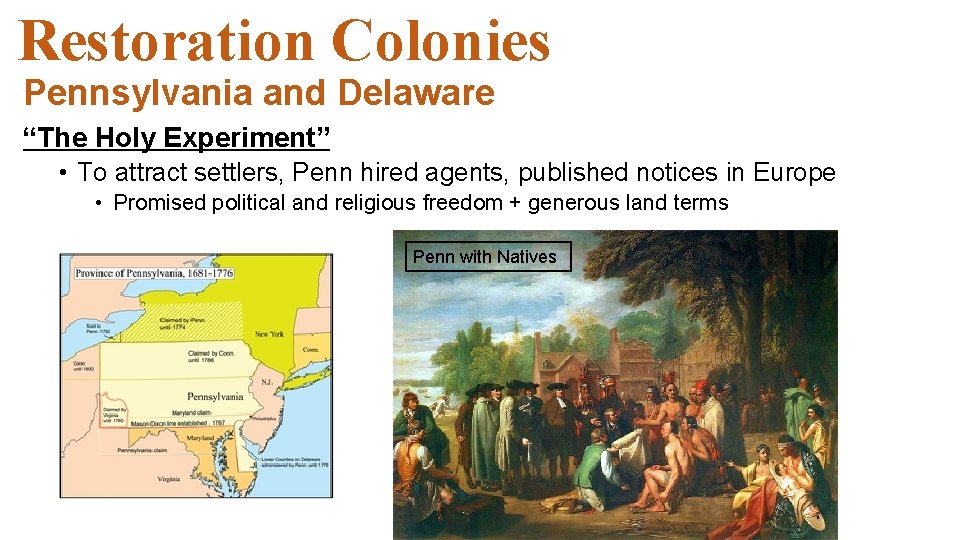
Restoration Colonies Pennsylvania (PA) and Delaware (DE) West of NJ – broad expanse of forest land originally settled by peace-loving Quakers • Religious Society of Friends – the Quakers • Believed in equality of all men and women, nonviolence, and resistance to military service • Believed religious authority found in each person’s soul – not in Bible or any outside source • Believed people were inherently good (unlike attitude of Puritans) • Their views a radical challenge to established authority, thus persecuted and jailed for their beliefs William Penn • Penn’s father was owed large debt from royal family. In 1681 they paid William in a grant of American land for a colony. He called it Pennsylvania (Penn’s woods)
Restoration Colonies Pennsylvania and Delaware “The Holy Experiment” • Penn’s goals for his colony • serve as refuge for Quakers and other persecuted peoples • Liberal ideas in govt • Generate income and profits • 1682. Frame of govt guaranteed rep assembly elected by landowners + written constitution • 1701 Charter of Liberties guaranteed religious freedom and unrestricted immigration • Penn supervised founding of town on Delaware R, Philadelphia • Brought plant for grid pattern of streets (later imitated by other cities) • Attempted to treat Indians fairly, not cheat them when purchasing land
Restoration Colonies Pennsylvania and Delaware “The Holy Experiment” • To attract settlers, Penn hired agents, published notices in Europe • Promised political and religious freedom + generous land terms Penn with Natives
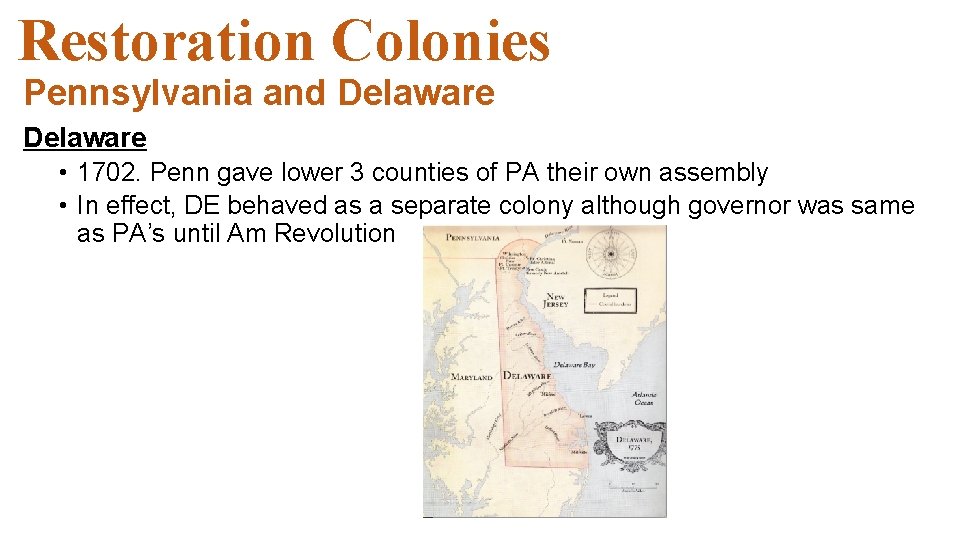
Restoration Colonies Pennsylvania and Delaware • 1702. Penn gave lower 3 counties of PA their own assembly • In effect, DE behaved as a separate colony although governor was same as PA’s until Am Revolution
Restoration Colonies Georgia (GA): The Last Colony • 1732. Only colony to receive direct financial support from English govt. Why? • Brits wanted defensive buffer to protect prosperous SC plantations from threat of Spanish Florida • Thousands in debtor prisons in England. Wealthy philanthropists thought sending debtors to America to start life over would relieve overcrowded jails Special Regulations • James Oglethorpe and other philanthropists given royal charter for a proprietary colony • 1 st settlement – Savannah • Oglethorpe 1 st governor – developed plan for success of colony • Banned drinking rum and slavery • Colony did not prosper – partly bc of Spanish threat Royal Colony • 1752. Oglethorpe + gave up. GA became royal colony. • Restrictions on rum and slavery dropped • Adopted plantation system of SC • At time of Am Rev, GA was smallest and poorest of 13 colonies
Restoration Colonies
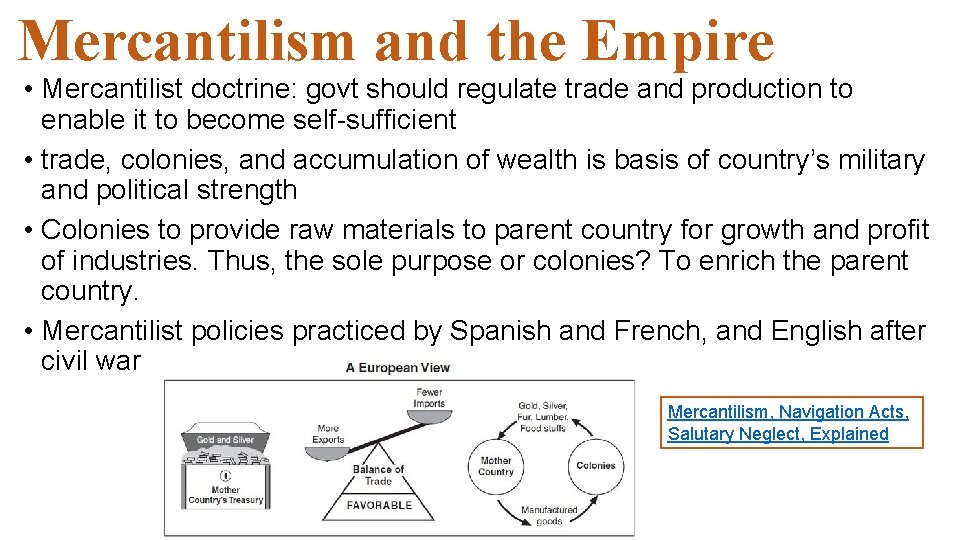
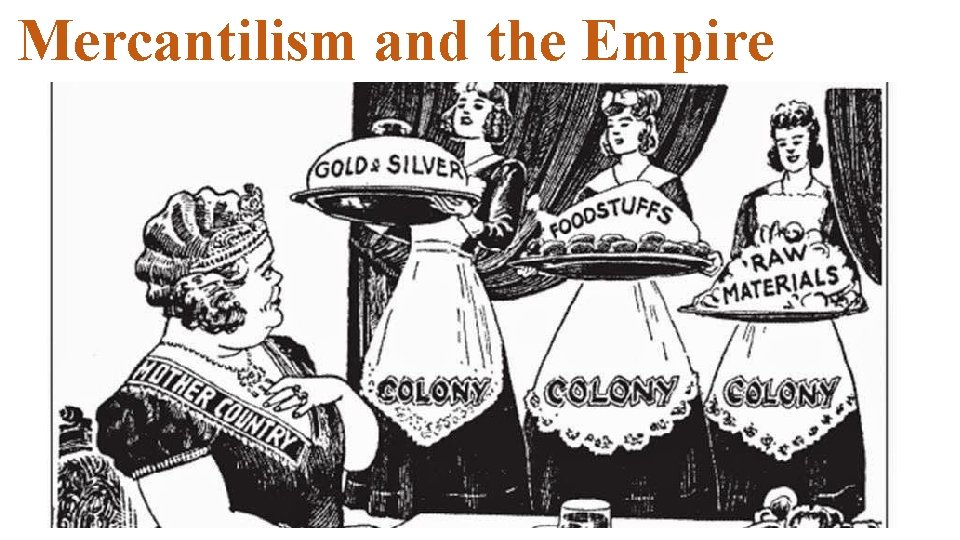
Mercantilism and the Empire • Mercantilist doctrine: govt should regulate trade and production to enable it to become self-sufficient • trade, colonies, and accumulation of wealth is basis of country’s military and political strength • Colonies to provide raw materials to parent country for growth and profit of industries. Thus, the sole purpose or colonies? To enrich the parent country. • Mercantilist policies practiced by Spanish and French, and English after civil war Mercantilism, Navigation Acts, Salutary Neglect, Explained
Mercantilism and the Empire
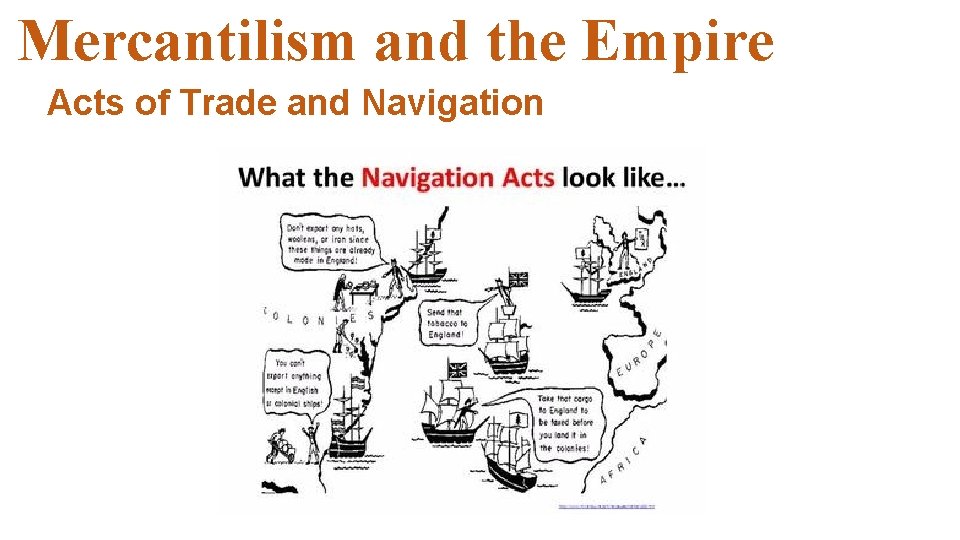
Mercantilism and the Empire Acts of Trade and Navigation • 1650 -1673 Eng govt implemented mercantilist policy w/ series of Navigation Acts which established rules for colonial trade: 1. Trade to and from colonies only by English or colonial-built ships – only operated by English or colonial crews 2. All goods imported into colonies, except for some perishables, had to pass through English ports 3. Specified, “enumerated” goods from colonies exported only to England. • Originally tobacco, but later list greatly expanded • Impact on Colonies • The Good? • New England shipbuilding prospered • Chesapeake tobacco had monopoly in England • American colonies protected from French and Spanish by English military
Mercantilism and the Empire Acts of Trade and Navigation • Impact on Colonies • The Bad? • Limited development of colonial manufacturing • Chesapeake farmers had to accept low prices for crops • Colonists paid high prices for English manufactured goods • Effects of the Navigation Acts • Economic advantages offset by negative political effects on British-colonial relations • Colonists resented regulatory laws imposed by distant govt in London – and learn to defy it Especially in New England, colonists defied acts by smuggling in French, Dutch and other goods • Enforcement of the Acts • Lax in enforcement – agents corrupt • Occasionally crown would attempt to overcome colonial resistance – 1684 it revoked MA Bay charter bc of smuggling activity
Mercantilism and the Empire Acts of Trade and Navigation
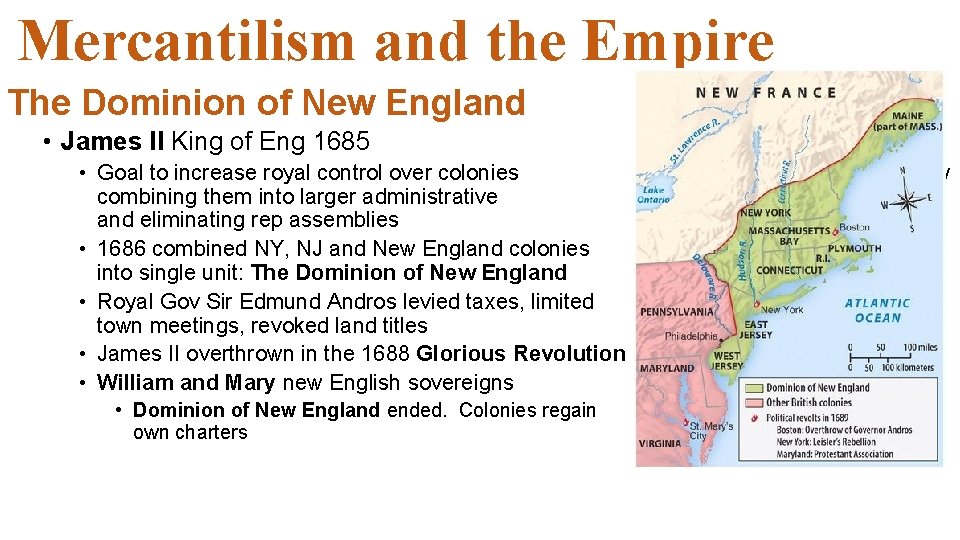
Mercantilism and the Empire The Dominion of New England • James II King of Eng 1685 • Goal to increase royal control over colonies combining them into larger administrative and eliminating rep assemblies • 1686 combined NY, NJ and New England colonies into single unit: The Dominion of New England • Royal Gov Sir Edmund Andros levied taxes, limited town meetings, revoked land titles • James II overthrown in the 1688 Glorious Revolution • William and Mary new English sovereigns • Dominion of New England ended. Colonies regain own charters by units
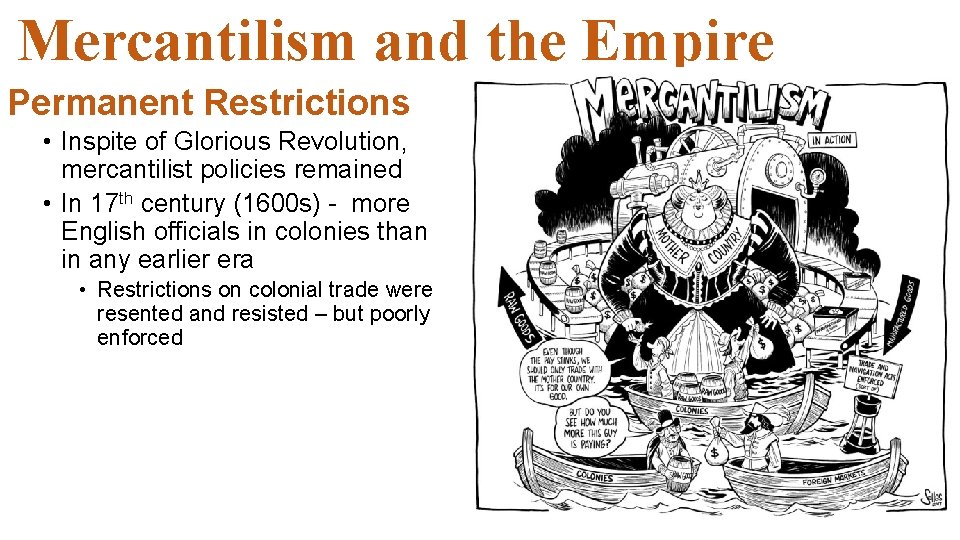
Mercantilism and the Empire Permanent Restrictions • Inspite of Glorious Revolution, mercantilist policies remained • In 17 th century (1600 s) - more English officials in colonies than in any earlier era • Restrictions on colonial trade were resented and resisted – but poorly enforced
The Institution of Slavery • By 1750, ½ of VA’s population and 2/3 of SC’s were enslaved Increased Demand for Slaves – reasons for growth of slavery 1. Reduced migration: increased wages in England = less supply of immigrants to colonies 2. Dependable workforce: large landowners thought slavery would provide more stable labor force totally under their control • small farmers and indentured servants had too many political demands • Memory of Bacon’s rebellion 3. Cheap labor: tobacco prices fell, rice and indigo became more profitable. These crops required large land area and many inexpensive unskilled field hands
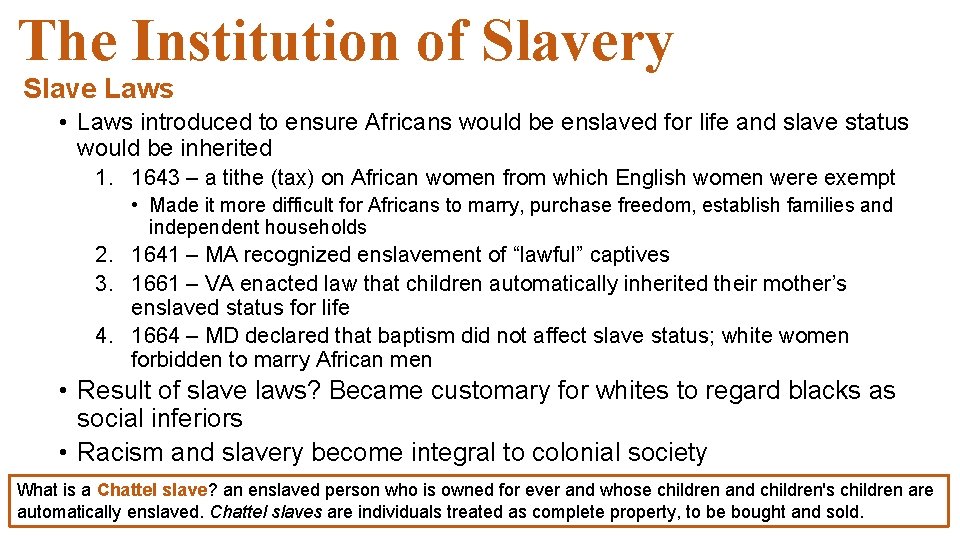
The Institution of Slavery Slave Laws • Laws introduced to ensure Africans would be enslaved for life and slave status would be inherited 1. 1643 – a tithe (tax) on African women from which English women were exempt • Made it more difficult for Africans to marry, purchase freedom, establish families and independent households 2. 1641 – MA recognized enslavement of “lawful” captives 3. 1661 – VA enacted law that children automatically inherited their mother’s enslaved status for life 4. 1664 – MD declared that baptism did not affect slave status; white women forbidden to marry African men • Result of slave laws? Became customary for whites to regard blacks as social inferiors • Racism and slavery become integral to colonial society What is a Chattel slave? an enslaved person who is owned for ever and whose children and children's children are automatically enslaved. Chattel slaves are individuals treated as complete property, to be bought and sold.
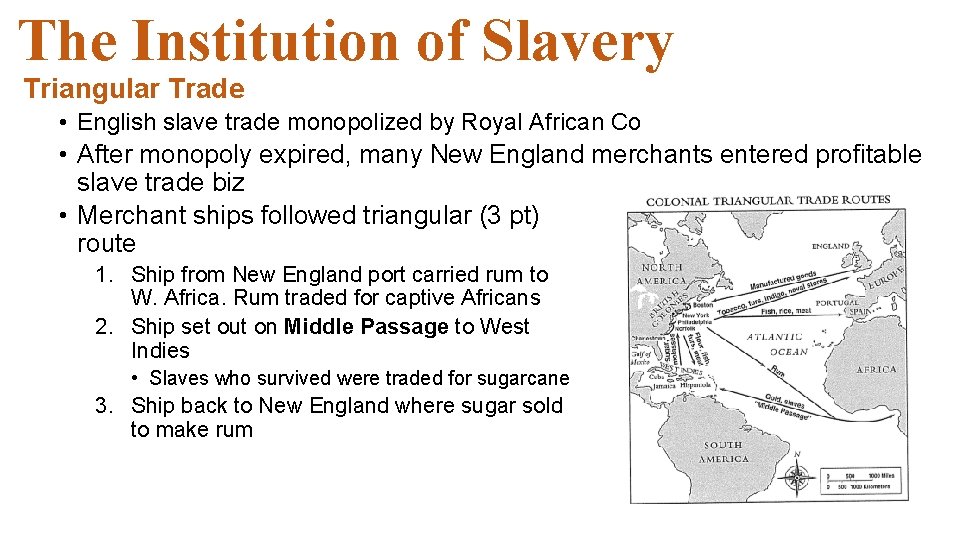
The Institution of Slavery Triangular Trade • English slave trade monopolized by Royal African Co • After monopoly expired, many New England merchants entered profitable slave trade biz • Merchant ships followed triangular (3 pt) trade route 1. Ship from New England port carried rum to W. Africa. Rum traded for captive Africans 2. Ship set out on Middle Passage to West Indies • Slaves who survived were traded for sugarcane 3. Ship back to New England where sugar sold to make rum
Historical Period 2 1607 -1754 Colonial Society in the th 18 Century
Colonial Society in the 18 Century The American is a new man, who acts upon new principles; he must th therefore entertain new ideas, and form new opinions. From involuntary idleness, servile dependence, and useless labor, he has passed to toils of a very different nature, rewarded by ample subsistence. This is an American. J. Hector St. John Crevecoeur, from an American Farmer, 1782
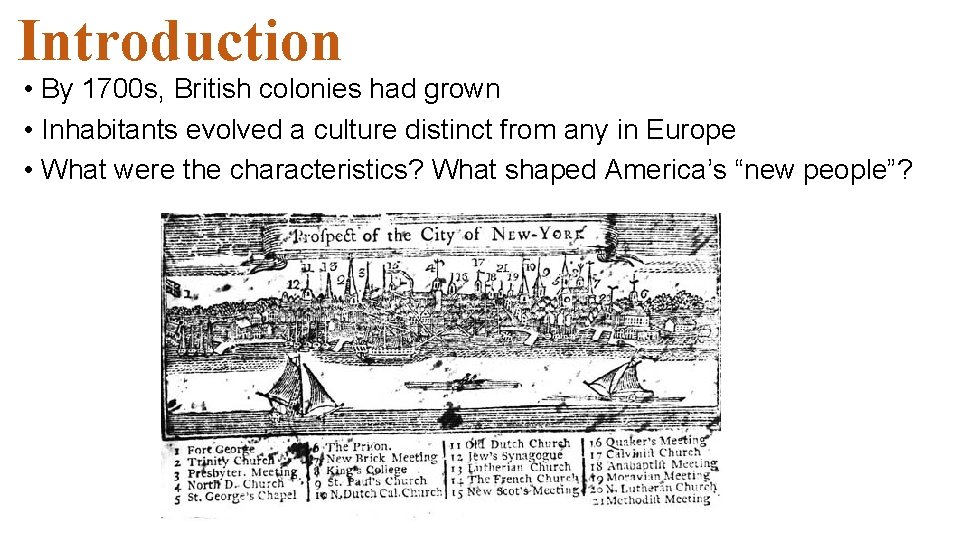
Introduction • By 1700 s, British colonies had grown • Inhabitants evolved a culture distinct from any in Europe • What were the characteristics? What shaped America’s “new people”?
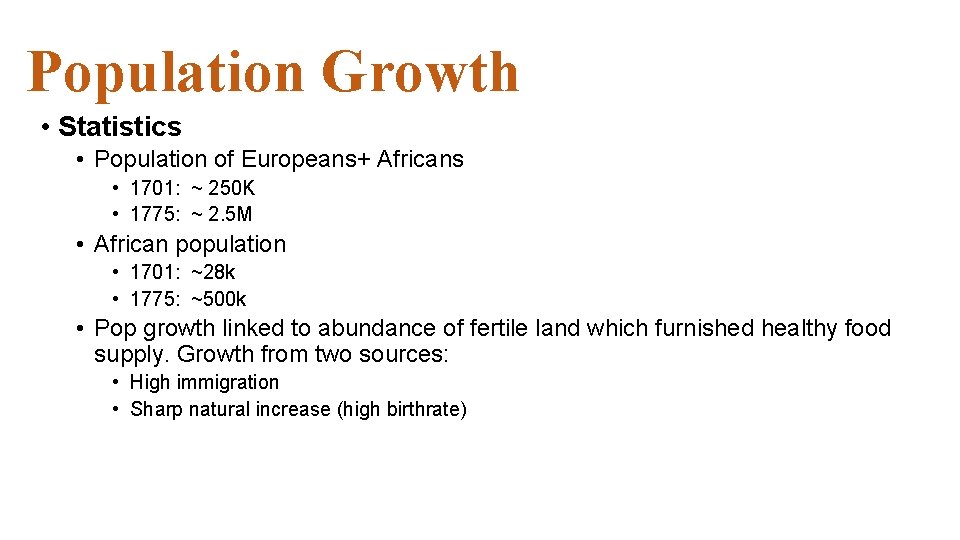
Population Growth • Statistics • Population of Europeans+ Africans • 1701: ~ 250 K • 1775: ~ 2. 5 M • African population • 1701: ~28 k • 1775: ~500 k • Pop growth linked to abundance of fertile land which furnished healthy food supply. Growth from two sources: • High immigration • Sharp natural increase (high birthrate)
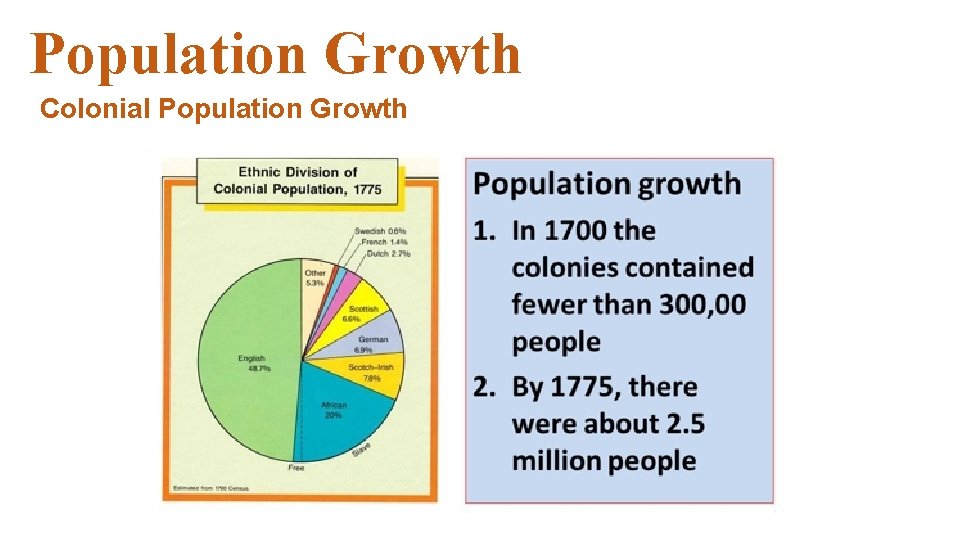
Population Growth Colonial Population Growth
Population Growth European Immigration • Mostly Protestants, but also smaller numbers of Catholics, Jews • Mostly from Brit Isles and other parts of Europe • Push/Pull Migration Factors • Push: religious persecution, wars, lack of economic opportunity • Pull: more religious tolerance, economic opportunities in farming sector and colonial towns • Settlement • Most to Middle Colonies • Western frontier of Chesapeake/Southern Colonies • Limited immigration to New England. Why? Land scarce, Puritan control
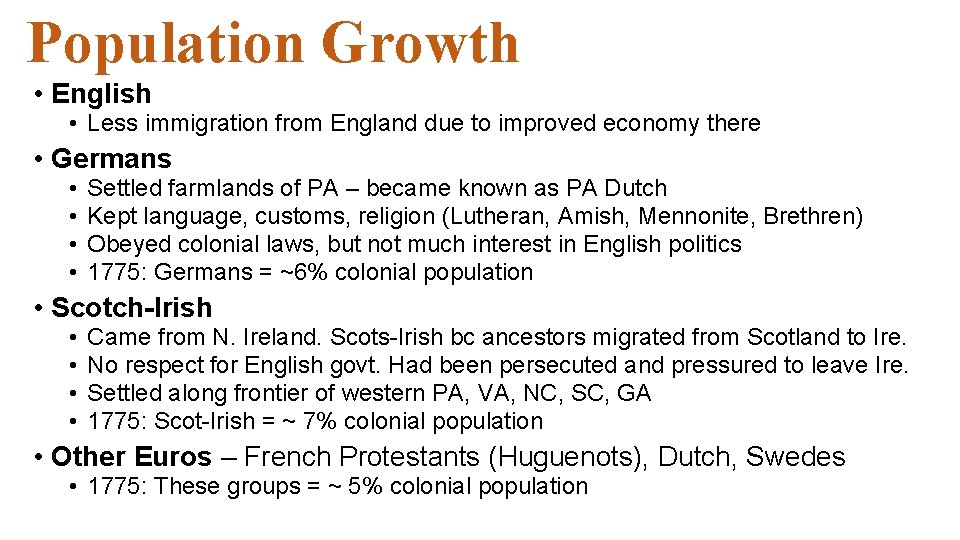
Population Growth • English • Less immigration from England due to improved economy there • Germans • • Settled farmlands of PA – became known as PA Dutch Kept language, customs, religion (Lutheran, Amish, Mennonite, Brethren) Obeyed colonial laws, but not much interest in English politics 1775: Germans = ~6% colonial population • Scotch-Irish • • Came from N. Ireland. Scots-Irish bc ancestors migrated from Scotland to Ire. No respect for English govt. Had been persecuted and pressured to leave Ire. Settled along frontier of western PA, VA, NC, SC, GA 1775: Scot-Irish = ~ 7% colonial population • Other Euros – French Protestants (Huguenots), Dutch, Swedes • 1775: These groups = ~ 5% colonial population
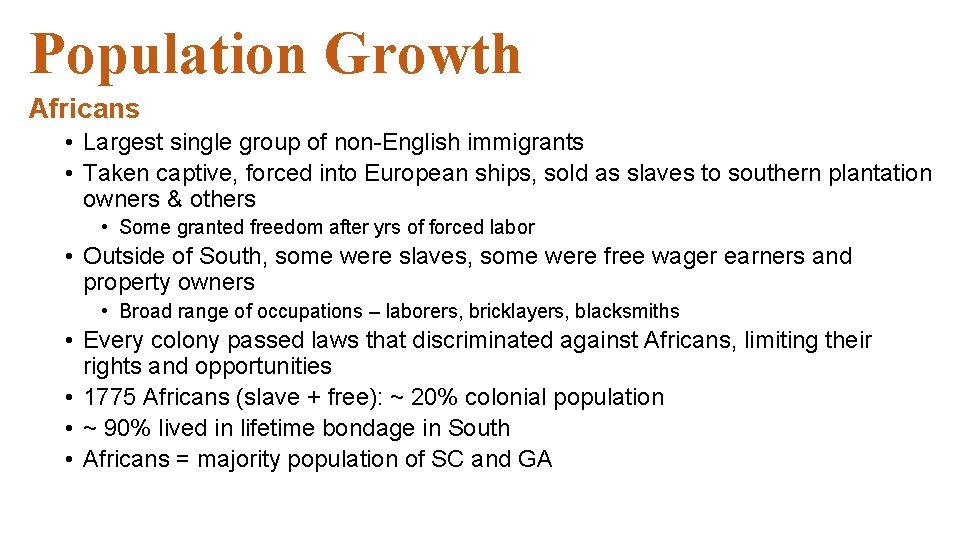
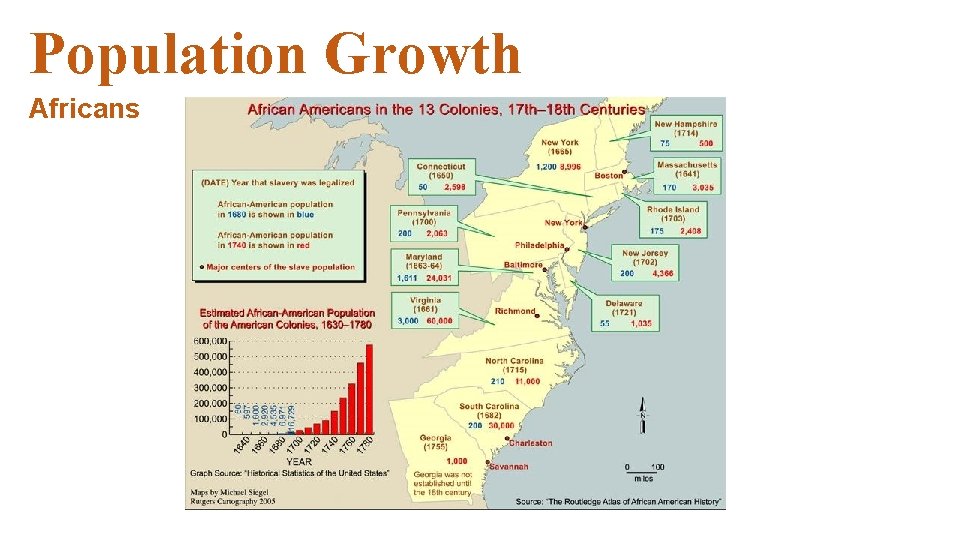
Population Growth Africans • Largest single group of non-English immigrants • Taken captive, forced into European ships, sold as slaves to southern plantation owners & others • Some granted freedom after yrs of forced labor • Outside of South, some were slaves, some were free wager earners and property owners • Broad range of occupations – laborers, bricklayers, blacksmiths • Every colony passed laws that discriminated against Africans, limiting their rights and opportunities • 1775 Africans (slave + free): ~ 20% colonial population • ~ 90% lived in lifetime bondage in South • Africans = majority population of SC and GA
Population Growth Africans
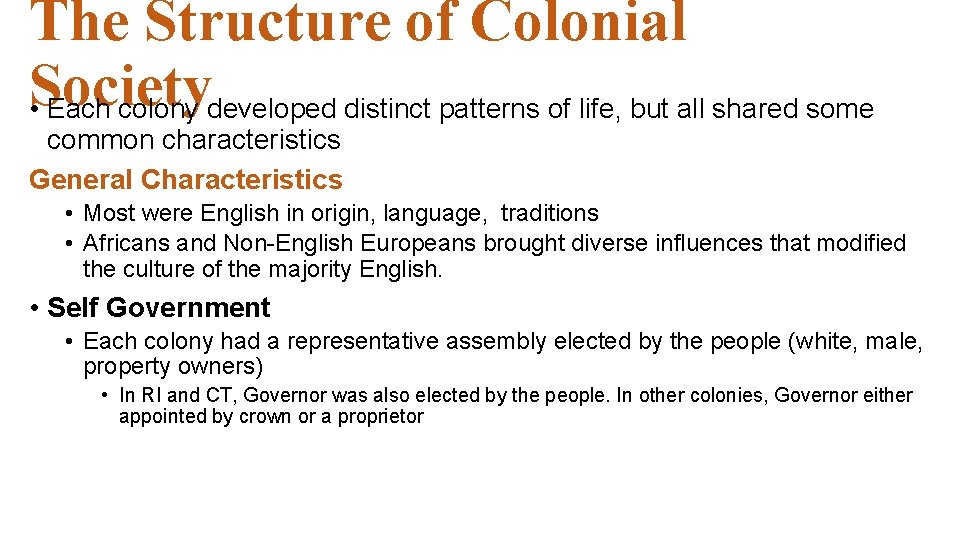
The Structure of Colonial Society • Each colony developed distinct patterns of life, but all shared some common characteristics General Characteristics • Most were English in origin, language, traditions • Africans and Non-English Europeans brought diverse influences that modified the culture of the majority English. • Self Government • Each colony had a representative assembly elected by the people (white, male, property owners) • In RI and CT, Governor was also elected by the people. In other colonies, Governor either appointed by crown or a proprietor
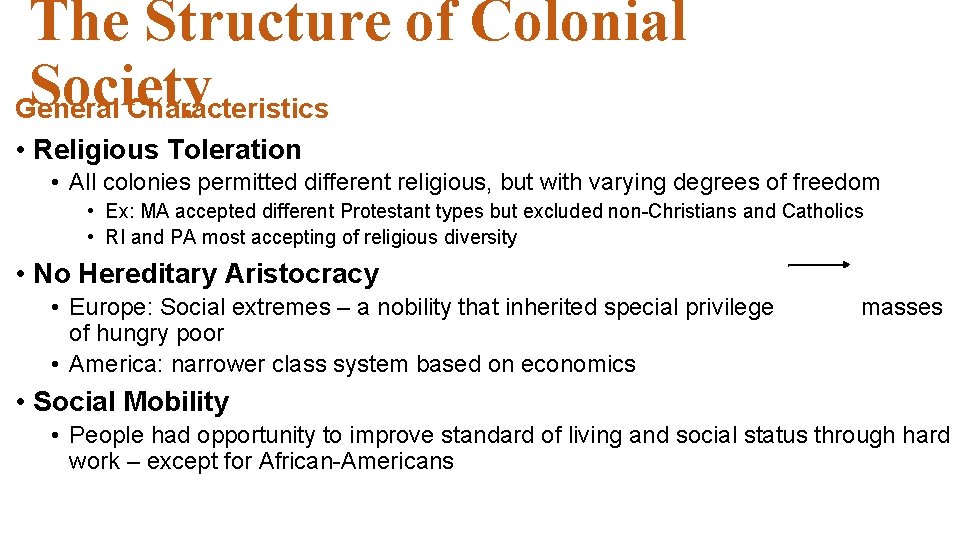
The Structure of Colonial Society General Characteristics • Religious Toleration • All colonies permitted different religious, but with varying degrees of freedom • Ex: MA accepted different Protestant types but excluded non-Christians and Catholics • RI and PA most accepting of religious diversity • No Hereditary Aristocracy • Europe: Social extremes – a nobility that inherited special privilege of hungry poor • America: narrower class system based on economics masses • Social Mobility • People had opportunity to improve standard of living and social status through hard work – except for African-Americans
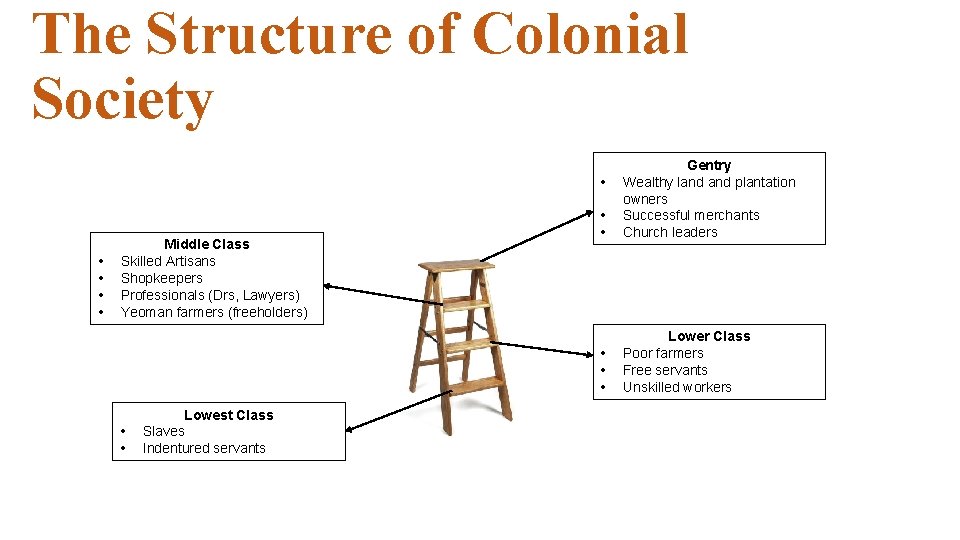
The Structure of Colonial Society • • Gentry Wealthy land plantation owners Successful merchants Church leaders • • • Lower Class Poor farmers Free servants Unskilled workers • • • Middle Class Skilled Artisans Shopkeepers Professionals (Drs, Lawyers) Yeoman farmers (freeholders) • • Lowest Class Slaves Indentured servants
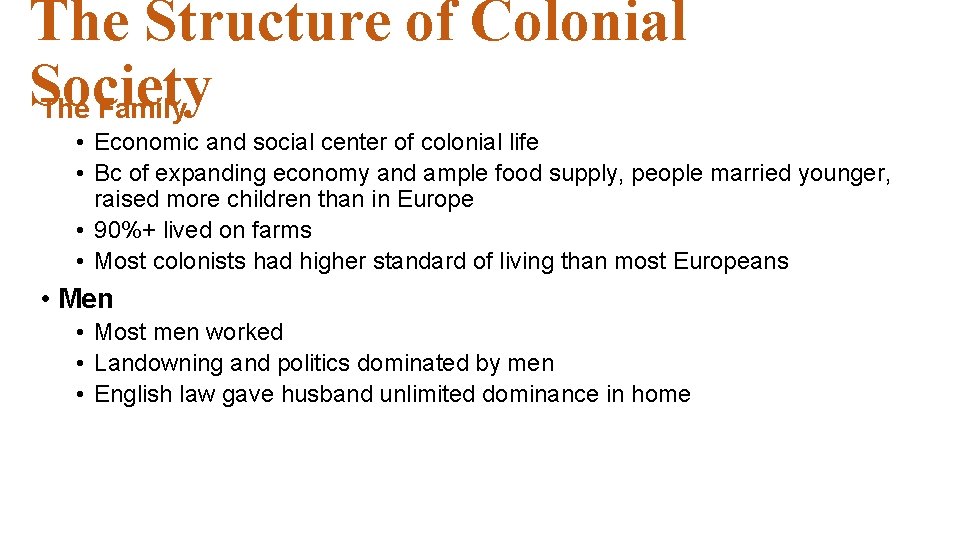
The Structure of Colonial Society The Family • Economic and social center of colonial life • Bc of expanding economy and ample food supply, people married younger, raised more children than in Europe • 90%+ lived on farms • Most colonists had higher standard of living than most Europeans • Men • Most men worked • Landowning and politics dominated by men • English law gave husband unlimited dominance in home
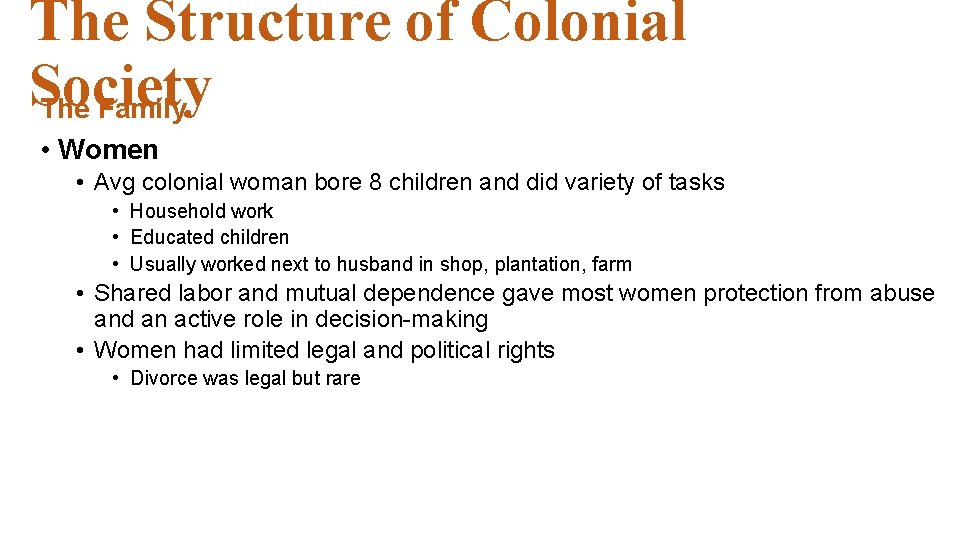
The Structure of Colonial Society The Family • Women • Avg colonial woman bore 8 children and did variety of tasks • Household work • Educated children • Usually worked next to husband in shop, plantation, farm • Shared labor and mutual dependence gave most women protection from abuse and an active role in decision-making • Women had limited legal and political rights • Divorce was legal but rare
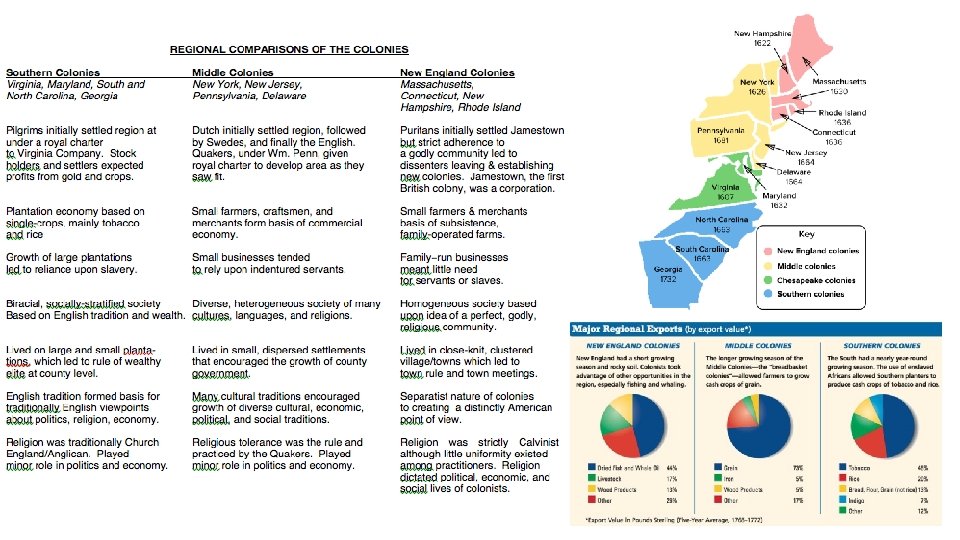
The Economy • Rich farmland British mercantilist policies kept colonies engaged primarily in agriculture • By 1760 s, ½ British world trade was with its American colonies • Brits permitted limited colonial manufacturing (flour, rum) • Brits restricted industry that competed w/ England ex. Textiles • Growth of colonies increased economic opportunities ministers • Quickest route to wealth? Land-owning Drs. , lawyers, teachers, • New England • Logging, shipbuilding, trading, rum-distilling • Ag? Bc of rocky soil, long winters, farming was limited to yeoman, family subsistence farms • Most < 100 acres with family labor
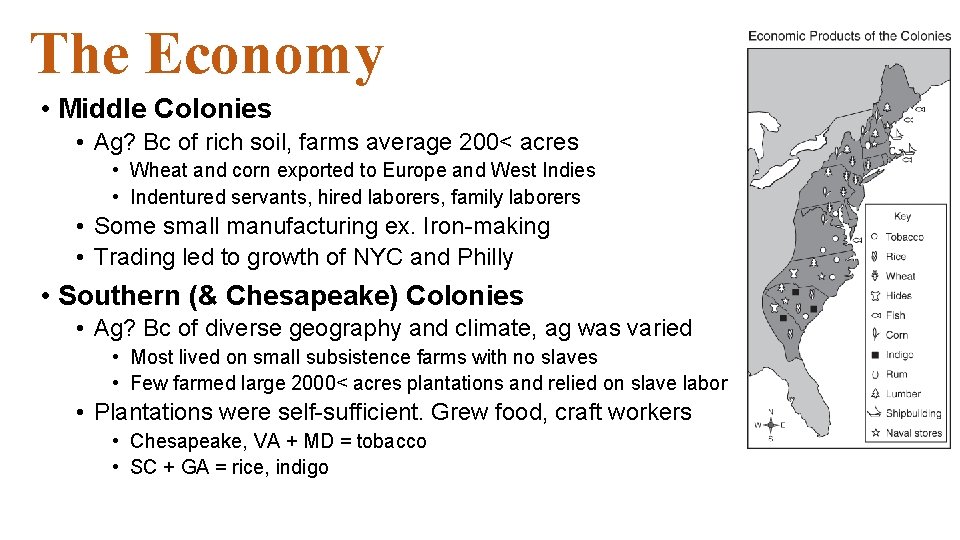
The Economy • Middle Colonies • Ag? Bc of rich soil, farms average 200< acres • Wheat and corn exported to Europe and West Indies • Indentured servants, hired laborers, family laborers • Some small manufacturing ex. Iron-making • Trading led to growth of NYC and Philly • Southern (& Chesapeake) Colonies • Ag? Bc of diverse geography and climate, ag was varied • Most lived on small subsistence farms with no slaves • Few farmed large 2000< acres plantations and relied on slave labor • Plantations were self-sufficient. Grew food, craft workers • Chesapeake, VA + MD = tobacco • SC + GA = rice, indigo
The Economy • Monetary System • • Brits controlled colonial economy party by limited the use of money Colonies forced to use hard currency (gold & silver) to pay for imports from Brits For domestic trade, colonies issued paper currency Brits vetoed colonial laws that harmed Brit merchants Transportation • Major trade centers where good harbors navigable rivers were (NYC, Philly, Charleston) • By 18 th century, overland trail by horse state more common • The role of taverns • Food & lodging for traders • Social centers where news was exchanged and politics discussed • Postal system – horses overland, small ships on water routes – operated both within and between colonies by 18 th century
Religion • Overwhelming majority = Protestant denominations • New England: Congregationalists (Puritans) and Presbyterians • New York: Dutch colonists = Dutch Reformed. Merchants = Anglican (later Episcopalian) • PA: Lutherans, Mennonites, Quakers • VA and Southern colonies: Anglican • Challenges • Jews, Catholics, Quakers suffered most discrimination – sometimes persecution • Congregationalists criticized by other Protestants as domineering and overly complex doctrine • With colonial growth and diversity, less govt (tax) support of churches
Religion The Great Awakening Read This! History Channel Great Awakening • Early 18 th century, sermons in Protestant churches were long, intellectual discourses portraying God as a benign creator of a perfectly ordered universe • Less emphasis than earlier times on human sinfulness and perils of hell • 1730 s-40 s a spiritual revival, a Great Awakening – a movement characterized by fervent expression of religious feeling among masses of people • Jonathan Edwards • 1741. Expressed Great Awakening ideas in a series of sermons, especially in “Sinners in the Hands of an Angry God” • Invoked Old Testament scriptures to argue that God was rightfully angry with human sinfulness • Everyone who expressed deep penitence could be saved by God’s grace, but souls who paid no heed to commandments who suffer eternal damnation • Edward mostly influenced New England More on “Sinners in the Hands of an Angry God”
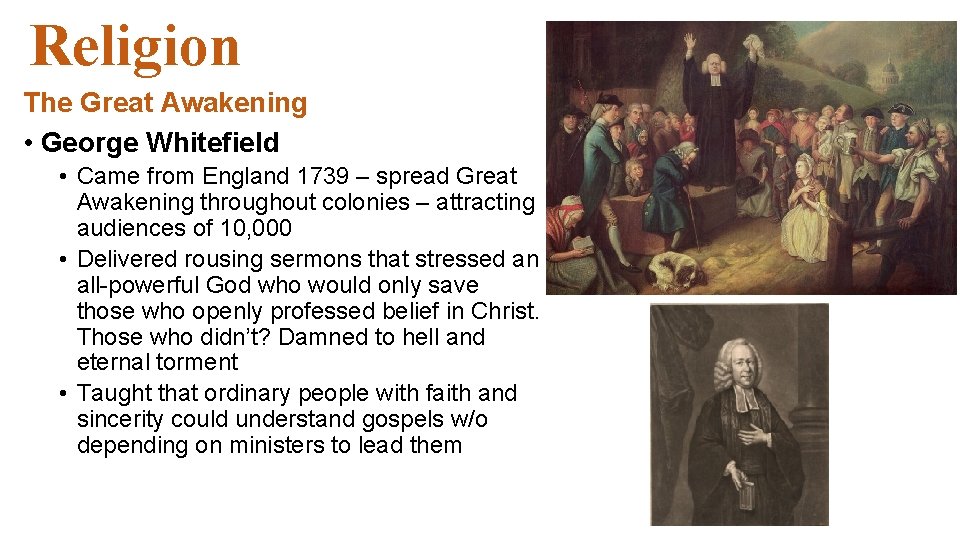
Religion The Great Awakening • George Whitefield • Came from England 1739 – spread Great Awakening throughout colonies – attracting audiences of 10, 000 • Delivered rousing sermons that stressed an all-powerful God who would only save those who openly professed belief in Christ. Those who didn’t? Damned to hell and eternal torment • Taught that ordinary people with faith and sincerity could understand gospels w/o depending on ministers to lead them
Religion The Great Awakening • Religious Impact • Profound effect. As result of sinners tearfully confessing their guilt and then joyously exulting in being saved – emotionalism became common part of Protestant services • Ministers lost some of their authority as some now studied the Bible in their own houses • Caused division w/in churches. Congregationalist, Presbyterians • Old Lights: condemned Great Awakening ideas • New Lights: supported Great Awakening ideas • More evangelical denominations grew: Baptists, Methodists • Denominations competed for followers • Greater support for separation of church and state
Religion The Great Awakening • Political Impact • Had a democratizing effect by changing the way people viewed authority • If common people could make their own religious decisions w/o relying on “higher” authority (such as a minister), then they felt they could make their own political decisions w/o deferring to the authority of great landowners and merchants • This contributes to the colonial challenge to the authority of the king and his royal governors in the later part of 18 th century
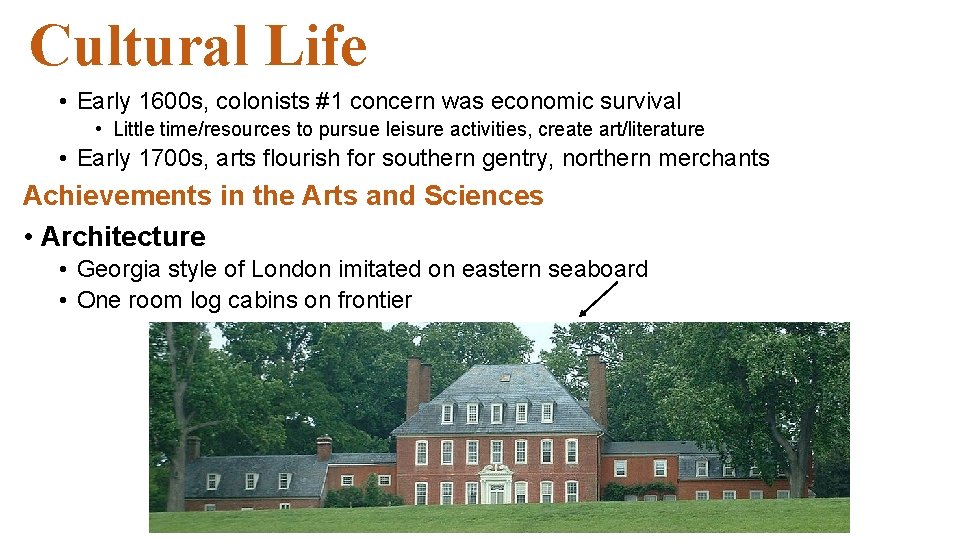
Cultural Life • Early 1600 s, colonists #1 concern was economic survival • Little time/resources to pursue leisure activities, create art/literature • Early 1700 s, arts flourish for southern gentry, northern merchants Achievements in the Arts and Sciences • Architecture • Georgia style of London imitated on eastern seaboard • One room log cabins on frontier
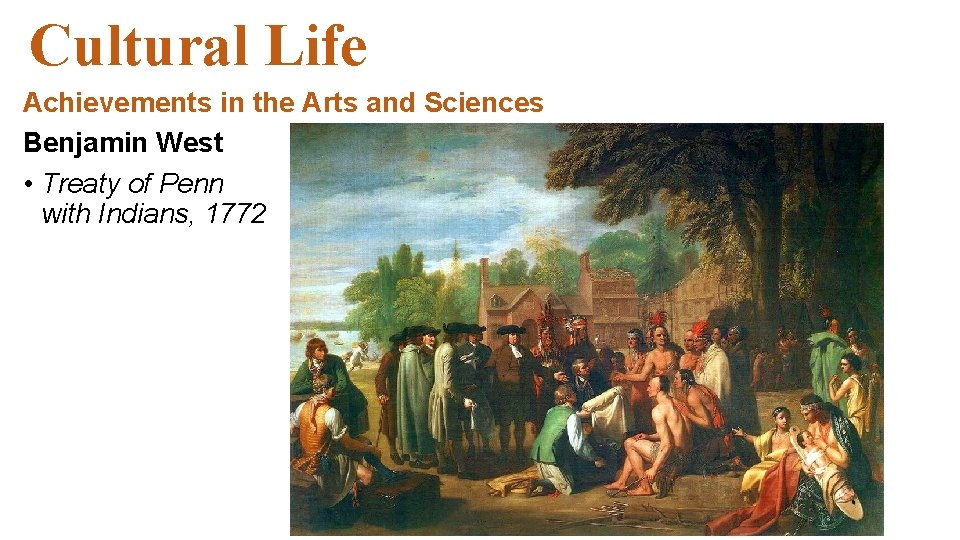
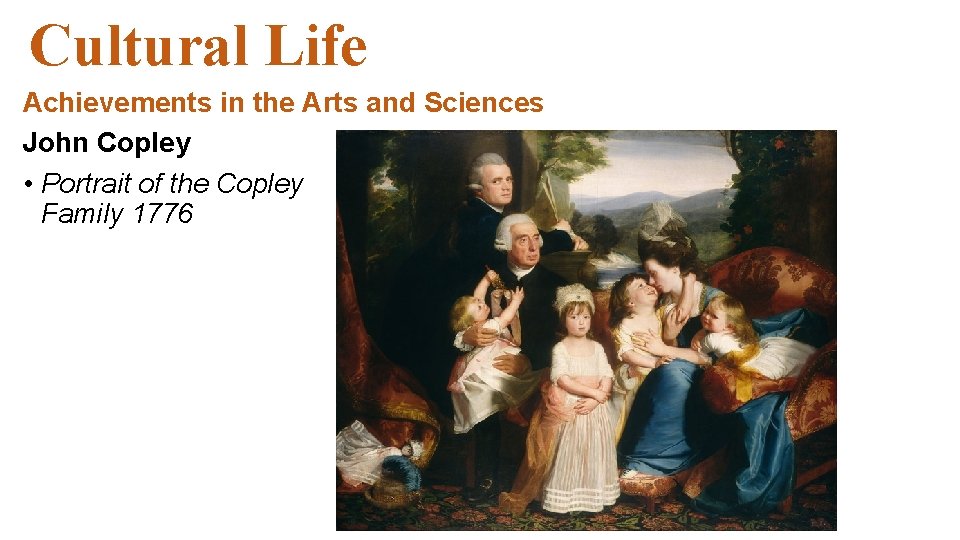
Cultural Life Achievements in the Arts and Sciences • Painting • Many colonial painters were itinerant artists who wanted countryside looking for families who wanted portraits • Two prominent pre-Revolution American painters: Benjamin West, John Copley
Cultural Life Achievements in the Arts and Sciences Benjamin West • Treaty of Penn with Indians, 1772
Cultural Life Achievements in the Arts and Sciences John Copley • Portrait of the Copley Family 1776
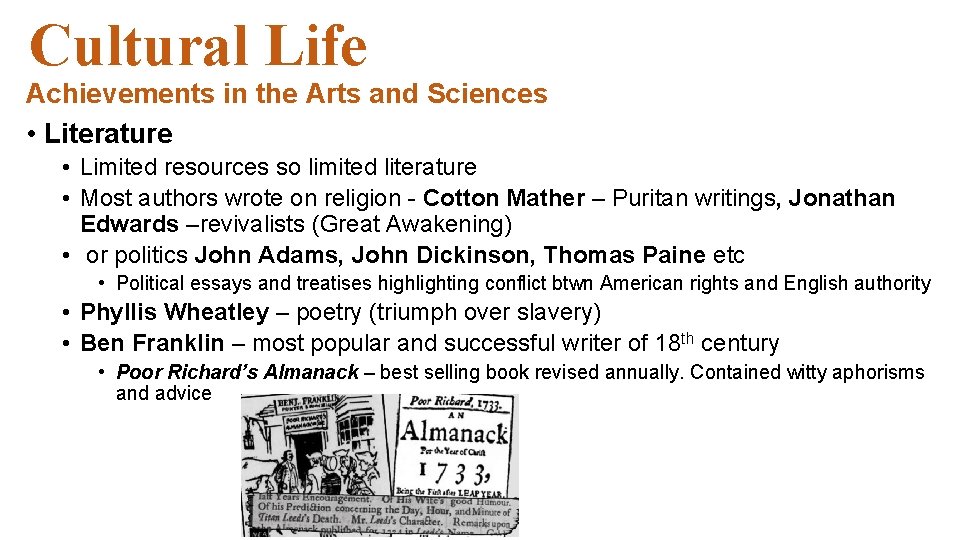
Cultural Life Achievements in the Arts and Sciences • Literature • Limited resources so limited literature • Most authors wrote on religion - Cotton Mather – Puritan writings, Jonathan Edwards –revivalists (Great Awakening) • or politics John Adams, John Dickinson, Thomas Paine etc • Political essays and treatises highlighting conflict btwn American rights and English authority • Phyllis Wheatley – poetry (triumph over slavery) • Ben Franklin – most popular and successful writer of 18 th century • Poor Richard’s Almanack – best selling book revised annually. Contained witty aphorisms and advice
Cultural Life Achievements in the Arts and Sciences • Science • Most self-taught • John Bartram – botany • Ben Franklin – work with electricity, development of bi-focal eyeglasses, Franklin stove Ben Franklin inventions
Cultural Life Education • Elementary Education • New England • emphasis on learning Bible led Puritans to create 1 st tax-supported schools • MA 1647 law: towns 50< families required to establish grammar schools to prepare boys for college • Middle Colonies • Schools were church-sponsored or private • Teachers often lived with families of students • Southern colonies • Parents gave children whatever education they could • On plantations, tutors provided instruction for owners’ children
Cultural Life Education • Higher Education • 1 st colonial colleges were sectarian - promoted doctrine of particular religious group • • Puritans – Harvard in 1636 for theological and scholarly education Anglicans – William and Mary 1694 Congregationalists – Yale 1701 Great Awakening prompted creation of 5 new colleges 1746 -1769 • • • Presbyterians – Princeton 1746 Anglican – Columbia 1754 Baptist – Brown 1764 Reformed – Rutgers 1766 Congregationalist – Dartmouth 1769 • Only 1 nonsectarian college founded during this period – College of Philadelphia (Univ of PA) 1765. Founded by Ben Franklin and other civic-minded men
Cultural Life Education • Ministry • Christian ministry held widespread respect among the common people • Often the only well-educated person in a small community • Physicians • Occasional epidemics of smallpox and diphtheria in colonies. Treatment by ”cures” often made patients worse • Common practice was to “bleed” the sick with use of leeches/bloodsuckers • Beginning Dr. had little formal medical training • Other than occasional apprenticeship to experience physician • 1 st medical college 1765. College of Philadelphia (Univ of PA) • Ben Franklin’s plan
Cultural Life Education • Lawyers • Uncommon in 1600 s – people argued their own case before a colonial magistrate (judge) • 1700 s trade expanded, legal problems more complex – led to need for more expert assistance in court • Most able lawyers formed a bar (committee/board) to set rules for aspiring lawyers • Gained respect in 1760 -70 s when they argued for colonial rights • John Adams, James Otis, Patrick Henry – 3 such lawyer whose legal arguments provided intellectual argument for Am Revolution
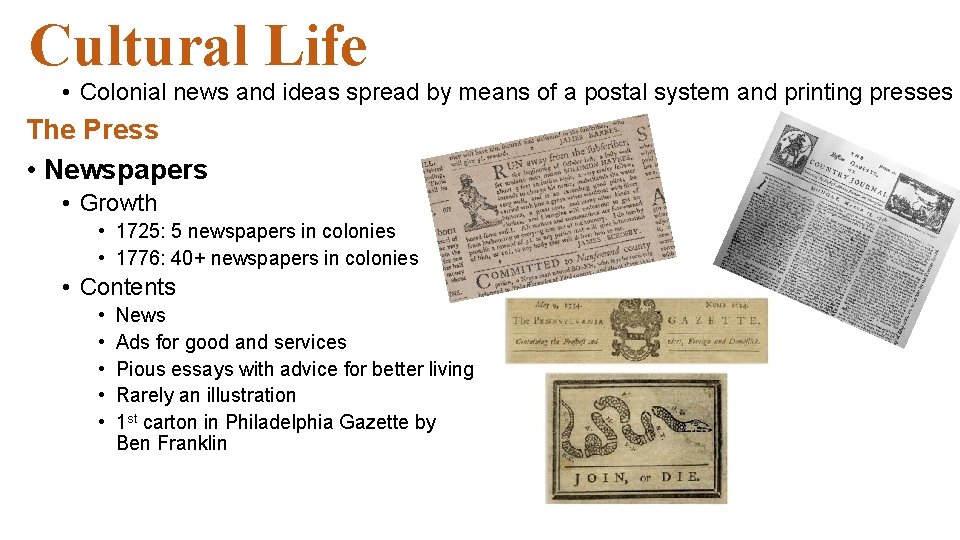
Cultural Life • Colonial news and ideas spread by means of a postal system and printing presses The Press • Newspapers • Growth • 1725: 5 newspapers in colonies • 1776: 40+ newspapers in colonies • Contents • • • News Ads for good and services Pious essays with advice for better living Rarely an illustration 1 st carton in Philadelphia Gazette by Ben Franklin
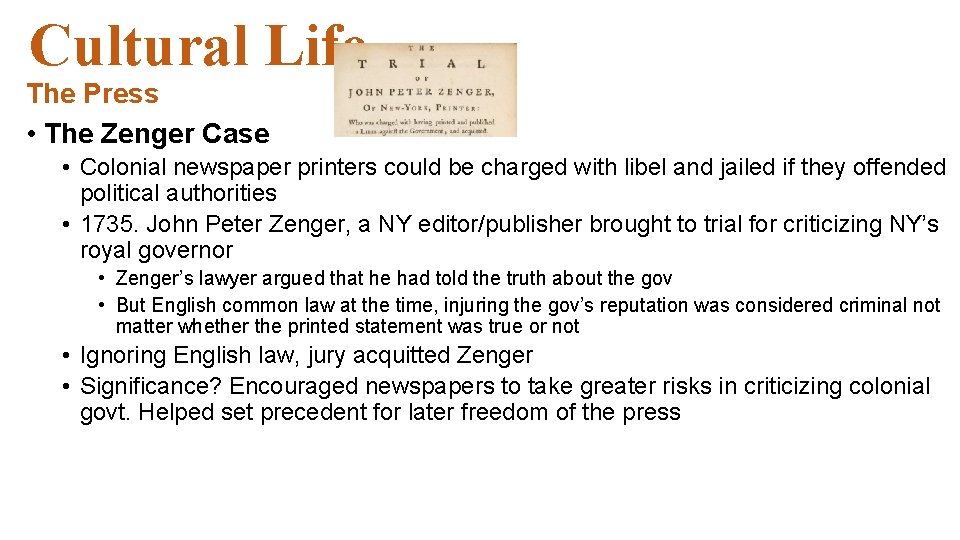
Cultural Life The Press • The Zenger Case • Colonial newspaper printers could be charged with libel and jailed if they offended political authorities • 1735. John Peter Zenger, a NY editor/publisher brought to trial for criticizing NY’s royal governor • Zenger’s lawyer argued that he had told the truth about the gov • But English common law at the time, injuring the gov’s reputation was considered criminal not matter whether the printed statement was true or not • Ignoring English law, jury acquitted Zenger • Significance? Encouraged newspapers to take greater risks in criticizing colonial govt. Helped set precedent for later freedom of the press
Cultural Life Rural Folkways • Most colonists rarely saw a newspaper or read a book other than the Bible • Farmers worked from sun-up to sun-down. • Farmers year divided into 4 seasons: spring-planting, summer growing, fall harvesting, winter prep for next cycle • Food plentiful, light and heat limited • Entertainment? Card-playing, horse-racing (southern colonies), theater-going (middle colonies), religious lectures (Puritan New England)
Cultural Life The Enlightenment • Enlightenment: 18 th century philosophical movement that emphasized use of reason to reevaluate previously accepted doctrines and traditions and the power of reason to understand shape the world • Adherents believed that the “darkness” of past ages could be corrected through reason – could solve most of humanity’s problems • John Locke, 17 th century English philosopher, was major influence on the Enlightenment and American thinking • Two Treatises of Government: Locke argued that while gov’t is supreme, it is bound to follow “natural laws” based on rights people have because they are human • Argued that sovereignty relies with the people, not the gov’t • Citizens had a right and obligation to revolt against any govt that fails to protect their rights • Locke’s stress on natural rights provide rationale for Am Rev and for basic principles of US Constitution
Cultural Life Emergence of a National Character • A distinctly American viewpoint and way of life emerged as a result of • Motivation for leaving Europe • Political heritage of English majority • Influence of American natural environment • Some characteristics • • Exercised rights of free speech and press Accustomed to electing representatives to colonial assemblies Tolerated variety of religions Foreign travelers to America noted that Americans were restless, enterprising, practical, and forever seeking to improve their circumstances
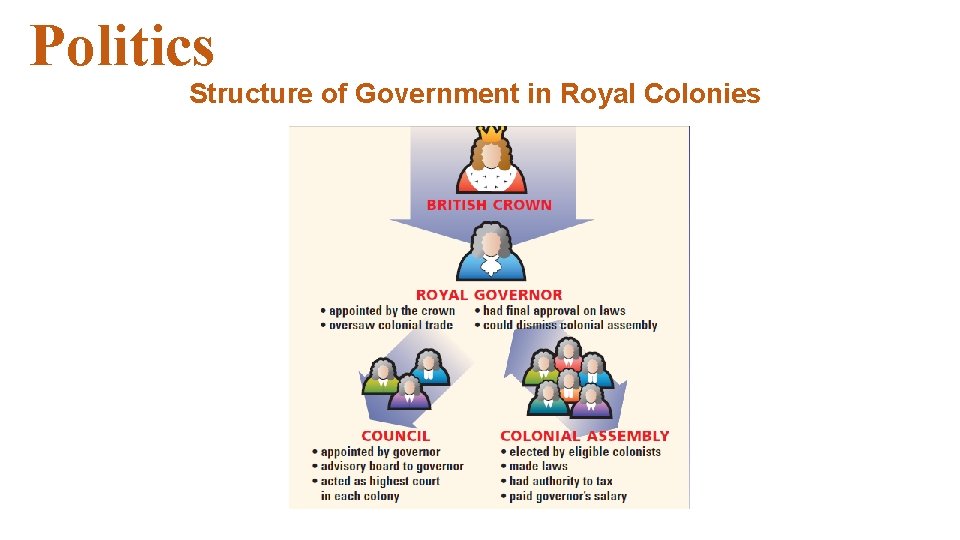
Politics • In 1750, the 13 colonies had similar systems of govt • Governor = chief executive. A separate legislature voting either to adopt or reject governors laws Structure of Government • Colonial Governors • 8/13 were royal colonies with governor appointed by king (NY, NH, MA, NJ, VA, NC, SC, GA) • 3/13 were proprietary colonies with governor appointed by proprietors (MD, PA, DE) • 2/13 were elected by popular vote (CT, RI) • Colonial Legislatures - Each colony had bicameral legislature • Lower house/assembly – elected by eligible voters • Voted for/against new taxes…thus, became accustomed to paying taxes only if their chosen representatives approved • Upper house (council) – in royal and proprietary, members appointed by king or governor • In CT and RI, both eligible voters elected both lower and upper house members
Politics Structure of Government in Royal Colonies
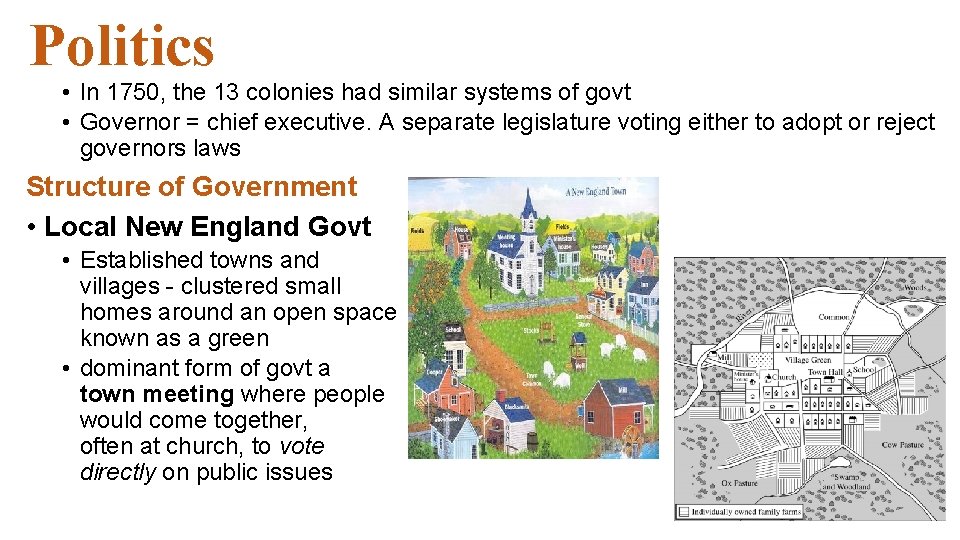
Politics • In 1750, the 13 colonies had similar systems of govt • Governor = chief executive. A separate legislature voting either to adopt or reject governors laws Structure of Government • Local New England Govt • Established towns and villages - clustered small homes around an open space known as a green • dominant form of govt a town meeting where people would come together, often at church, to vote directly on public issues
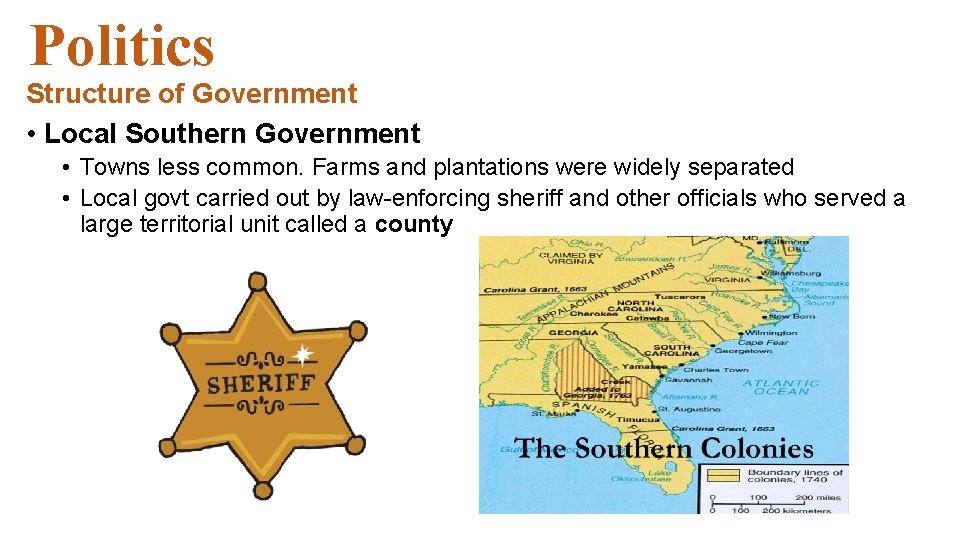
Politics Structure of Government • Local Southern Government • Towns less common. Farms and plantations were widely separated • Local govt carried out by law-enforcing sheriff and other officials who served a large territorial unit called a county
Politics Voting • Initially, democracy limited and partial in the colonies bc a sizable majority of colonial population barred from voting • • Women Poor white men Slaves Most free blacks The rationale behind property ownership? Considered the temptations of bribery too great for the poor • By 18 th century less barriers to voting • Religious restrictions removed in all colonies • Still required at least a small amount of property in all colonies in order to vote • Who served in the colonial assemblies and councils? • VA House of Burgesses – restricted to certain families of wealthy landowners • MA – legislature open to small farmers, but educated, propertied elite held most power for generations • Common people everywhere tended to defer to their “betters”, depended on them to make decisions or them
Politics Voting • Colonial politics largely restricted to participation by white males • Nevertheless, compared to other parts of the world, English colonies exhibited a tendency toward democracy and self-government – made their political system unusual for this time in history