
Historical Overview of Theatre in Australia The Australian




- Slides: 18
Historical Overview of Theatre in Australia
The Australian Continent • modern, industrialized nation on largely unpopulated continent • seven states, territories • only island continent • only continent to be occupied by single nation • population hugs seaboard; interior is mostly desert (80% of country in arid or semiarid zones)
Australia and New Zealand
Aboriginal Australia • ancestors of the Aborigines arrived on the continent at least 65, 00070, 000 years ago • from South Indonesia during the last ice age • over time, separated into distinct tribal groups with their own languages and traditions • subsistence husbandry
Kinship, Religion, and the Land • over this long period, tribal lands were integrated into a complex set of religious beliefs and practices that governed all aspects of Aboriginal life • believed that physical structure of tribal territory embodied ancient spiritual entities that preserved and protected the land its people • since the land was a physical expression of spirit ancestors, and the spirits were progenitors of the Aborigines, land people were connected in mutually dependent relationship • land central to sense of personal identity; myths of “Dreamtime”
Uluru (Ayers Rock)
European Exploration • Terra Australis Incognita • 17 C Dutch exploration: in 1642 Abel Tasman named Australia “New Holland” • initial reports unfavorable • 1770 James Cook annexed east coast territory on behalf of King George III of England, named it “New South Wales”
Convict Transportation 1788 -1868 • 1776 Britain’s North American colonies declared independence • Britain could no longer send convicts to America • overflowing prisons • in the 1780 s it was suggested that Britain could use New South Wales as a prison • transportation for seven years, 10 years, or life
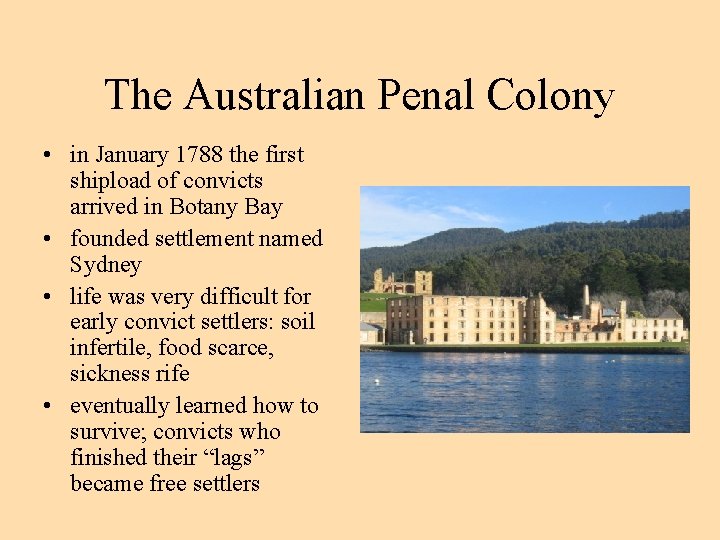
The Australian Penal Colony • in January 1788 the first shipload of convicts arrived in Botany Bay • founded settlement named Sydney • life was very difficult for early convict settlers: soil infertile, food scarce, sickness rife • eventually learned how to survive; convicts who finished their “lags” became free settlers
Colonial Expansion • Lachlan Macquarie became Governor of the colony in 1810 • number of free settlers increased markedly • exploration inland • development of towns, roads, public buildings • pastoral wealth; gold discovered in 1850 s • convict transportation ceased in 1868
What about the Aborigines? • 18 C approx. 600, 000 - one million Aborigines • huge cultural gap between colonizers and colonized • Aborigines considered to be “rural pests” • opposing notions of land ownership and use: terra nullius • two centuries of appalling economic and cultural disadvantage
The Stolen Generation • as a result of murder, dispossession, sickness, Aboriginal population plummeted • c. 1900 Europeans assumed that Aborigines were dying out • non-full-blood children forcibly removed from families, placed in institutions to learn European values and trades • expected to breed with other “halfcastes” or whites and ultimately eliminate the Aboriginal blood line • loss of identity, mistreatment
History of Australian Theatre Convict Theatre 1788 -1840 • convict theatre fueled by late. Georgian craze for amateur theatricals • instigated by convicts • first play = George Farquhar’s The Recruiting Officer, June 4 1789 • 1796 = Sydney’s first theatre, managed by Robert Sidaway • convict performances sustained until c. 1840
19 C Colonial Theatre • similar trends to other colonial settlements: melodrama, musicals, comedy, domestic drama, farces, and other “light theatre” • bushranger plays • literary-historical drama in verse, based on historical drama of the 18 C (Addison, Racine), also Shakespeare; escapist
Towards an “Australian” Theatre 1900 -1950 • call for “indigenous” Australian drama • influence of realism, and Independent Theatres overseas • rise of repertory groups, “authors’ theatres, ” e. g. Australian Theatre Society, Adelaide Repertory Theatre • still characterized by amateurism, lacked widespread national support
Postcolonial Influences Post-1950 • 1950 s = theatre subsidization • Australian Elizabethan Theatre Trust • Summer of the Seventeenth Doll (1955) and the Australian audience • new era of sustained professionalism in management, production, and acting associated with the Australian play • out of this new creative environment = 1960 s new dramatists, artists, experimenting with new forms
Aboriginal Theatre, 1970 -2005 • 1960 s organized Aboriginal civil rights movement • 1971 Kevin Gilbert’s The Cherry Pickers performed • 1970 s-80 s collective initiatives; Black Theatre Groups • 1989 Bran Nue Dae = turning point in Aboriginal theatre • 1990 s social, political change • more creative control, intense and high-profile activity; women writers; Indigenous Theatre Groups; writing as resistance, also reconciliation