
Historical linguistics Languages change over time External war
![Iconicity — Principle of quantity Conceptual Reduplication Trinidad and Tobago [j. Eswij] • emphatic](https://slidetodoc.com/presentation_image_h/3595a692fa8596b243e27f364cb543db/image-48.jpg "Iconicity — Principle of quantity Conceptual Reduplication Trinidad and Tobago [j. Eswij] • emphatic")
![Iconicity — Principle of quantity Conceptual Reduplication Trinidad and Tobago [j. Eswij] • emphatic](https://slidetodoc.com/presentation_image_h/3595a692fa8596b243e27f364cb543db/image-49.jpg "Iconicity — Principle of quantity Conceptual Reduplication Trinidad and Tobago [j. Eswij] • emphatic")
![Iconicity — Principle of quantity Conceptual Reduplication Trinidad and Tobago [j. Eswij] • emphatic](https://slidetodoc.com/presentation_image_h/3595a692fa8596b243e27f364cb543db/image-50.jpg "Iconicity — Principle of quantity Conceptual Reduplication Trinidad and Tobago [j. Eswij] • emphatic")
![Iconicity — Principle of quantity Conceptual Reduplication Trinidad and Tobago [j. Eswij] • emphatic](https://slidetodoc.com/presentation_image_h/3595a692fa8596b243e27f364cb543db/image-51.jpg "Iconicity — Principle of quantity Conceptual Reduplication Trinidad and Tobago [j. Eswij] • emphatic")
- Slides: 53
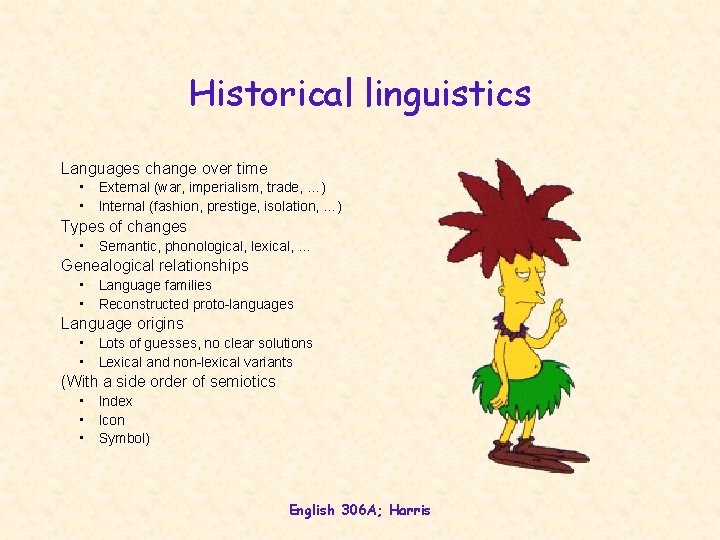
Historical linguistics Languages change over time • External (war, imperialism, trade, …) • Internal (fashion, prestige, isolation, …) Types of changes • Semantic, phonological, lexical, … Genealogical relationships • Language families • Reconstructed proto-languages Language origins • Lots of guesses, no clear solutions • Lexical and non-lexical variants (With a side order of semiotics • Index • Icon • Symbol) English 306 A; Harris
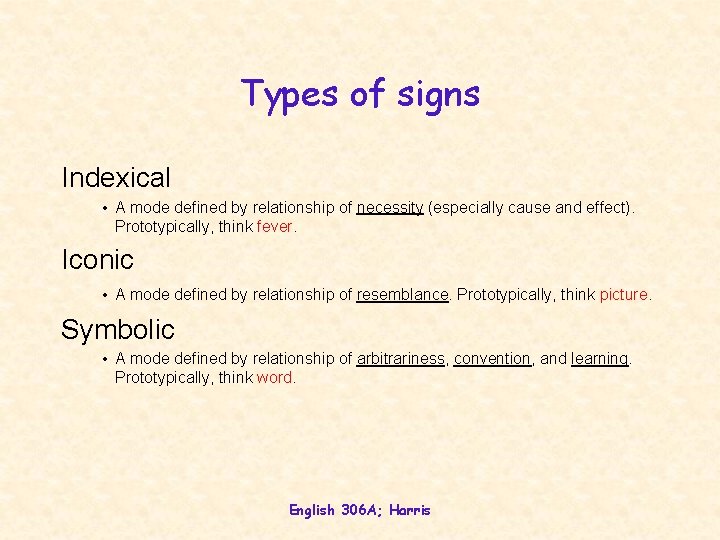
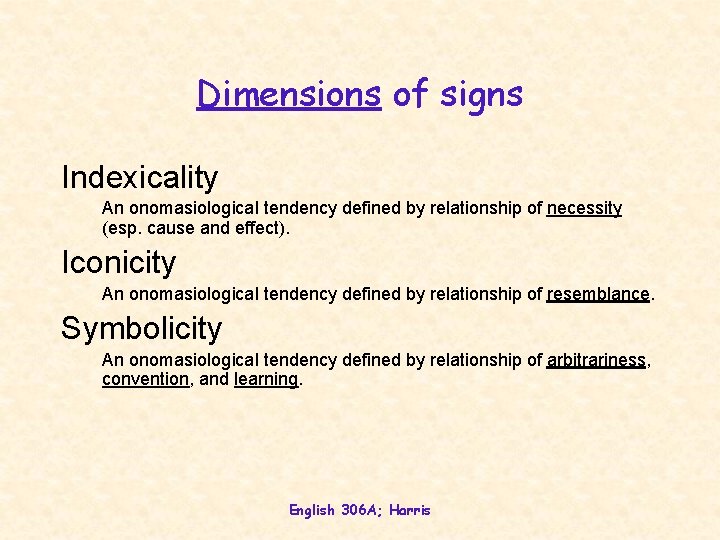
Types of signs Indexical • A mode defined by relationship of necessity (especially cause and effect). Prototypically, think fever. Iconic • A mode defined by relationship of resemblance. Prototypically, think picture. Symbolic • A mode defined by relationship of arbitrariness, convention, and learning. Prototypically, think word. English 306 A; Harris
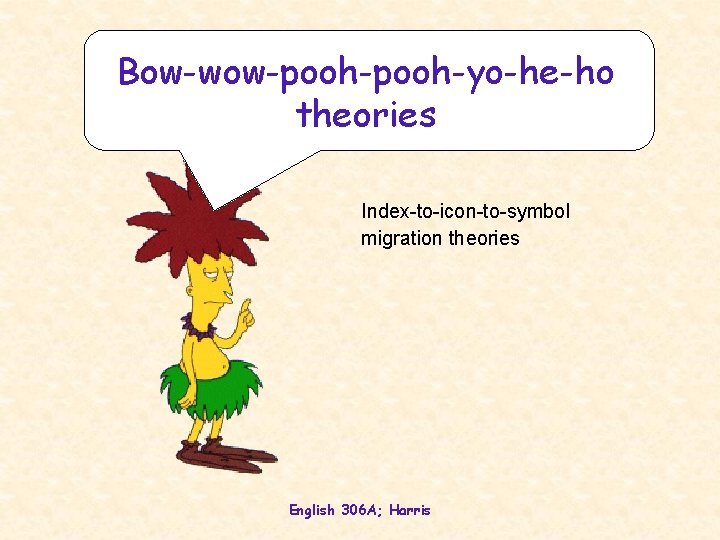
Bow-wow-pooh-yo-he-ho theories Index-to-icon-to-symbol migration theories English 306 A; Harris
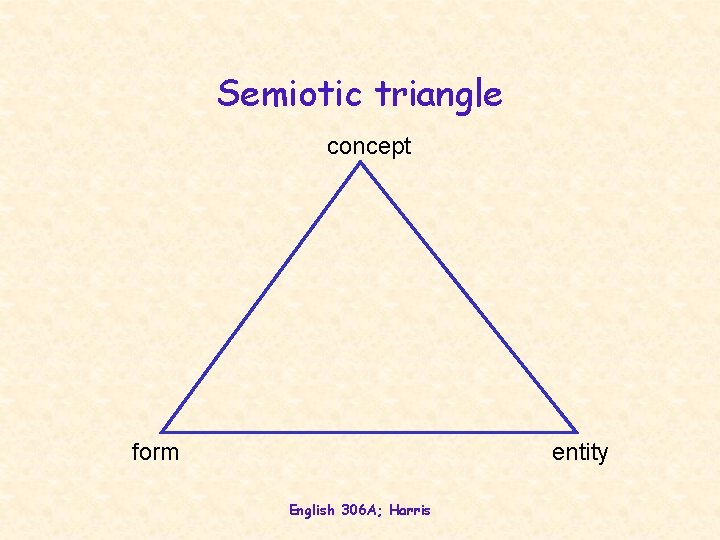
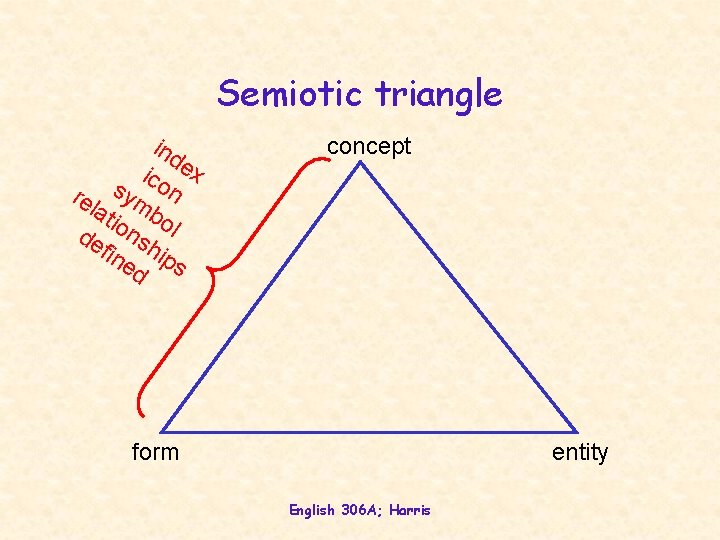
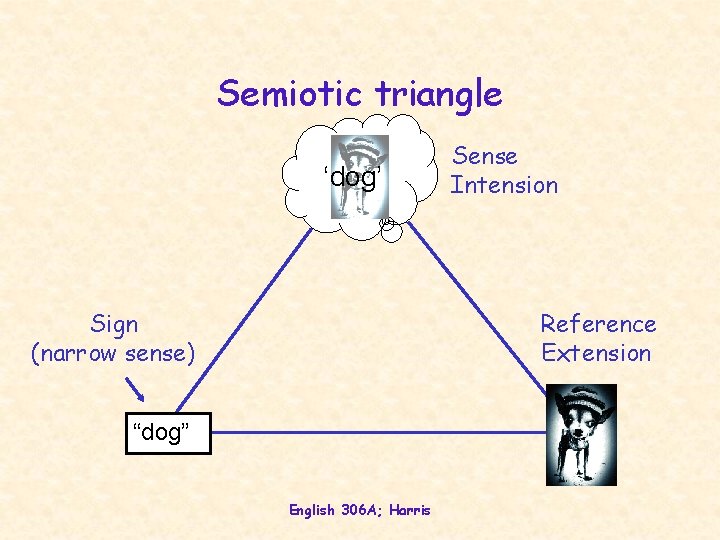
Semiotic triangle concept form entity English 306 A; Harris
Semiotic triangle ind ico ex re sym n lat ion bol de fin ship ed s concept form entity English 306 A; Harris
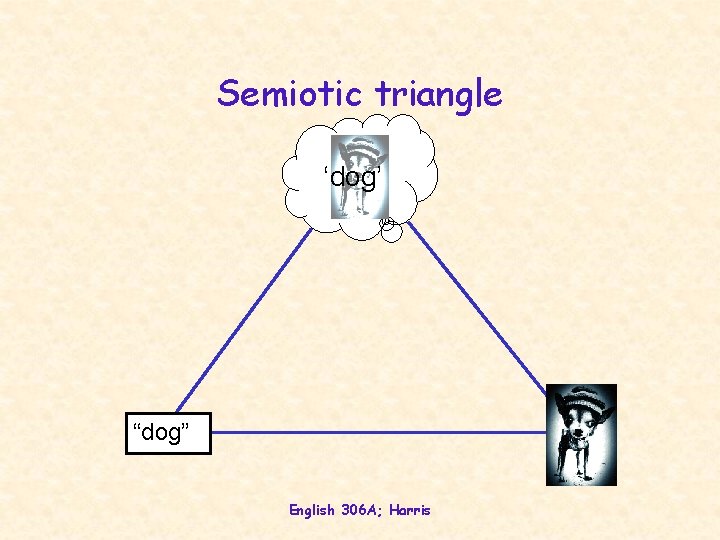
Semiotic triangle ‘dog’ “dog” English 306 A; Harris
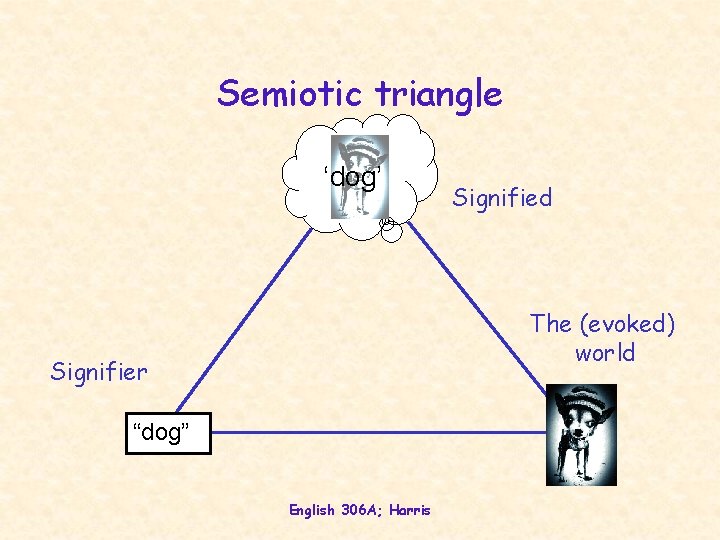
Semiotic triangle ‘dog’ Signified The (evoked) world Signifier “dog” English 306 A; Harris
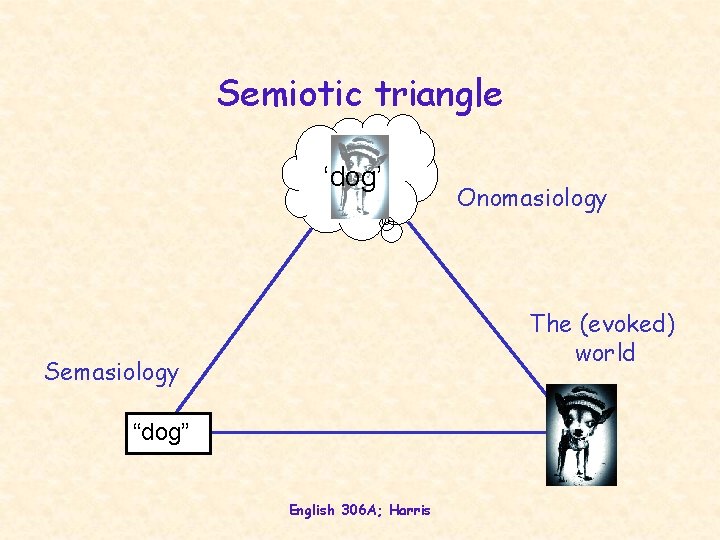
Semiotic triangle ‘dog’ Onomasiology The (evoked) world Semasiology “dog” English 306 A; Harris
Semiotic triangle ‘dog’ Sign (narrow sense) Sense Intension Reference Extension “dog” English 306 A; Harris
Dimensions of signs Indexicality An onomasiological tendency defined by relationship of necessity (esp. cause and effect). Iconicity An onomasiological tendency defined by relationship of resemblance. Symbolicity An onomasiological tendency defined by relationship of arbitrariness, convention, and learning. English 306 A; Harris
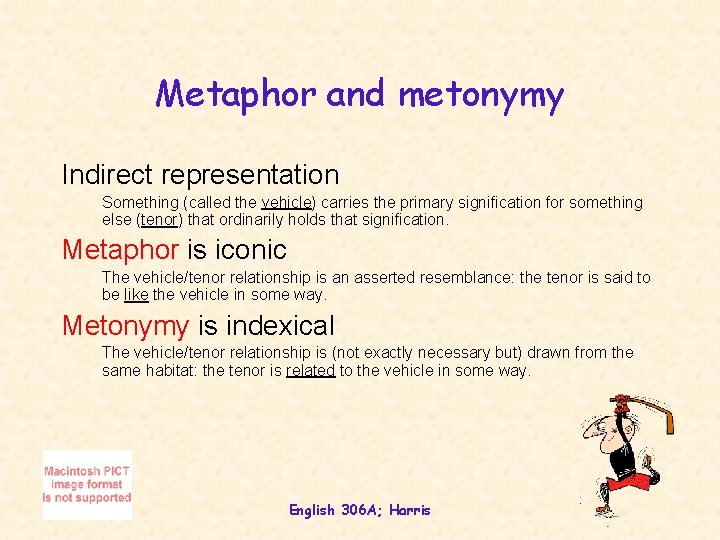
Metaphor and metonymy Indirect representation Something (called the vehicle) carries the primary signification for something else (tenor) that ordinarily holds that signification. Metaphor is iconic The vehicle/tenor relationship is an asserted resemblance: the tenor is said to be like the vehicle in some way. Metonymy is indexical The vehicle/tenor relationship is (not exactly necessary but) drawn from the same habitat: the tenor is related to the vehicle in some way. English 306 A; Harris
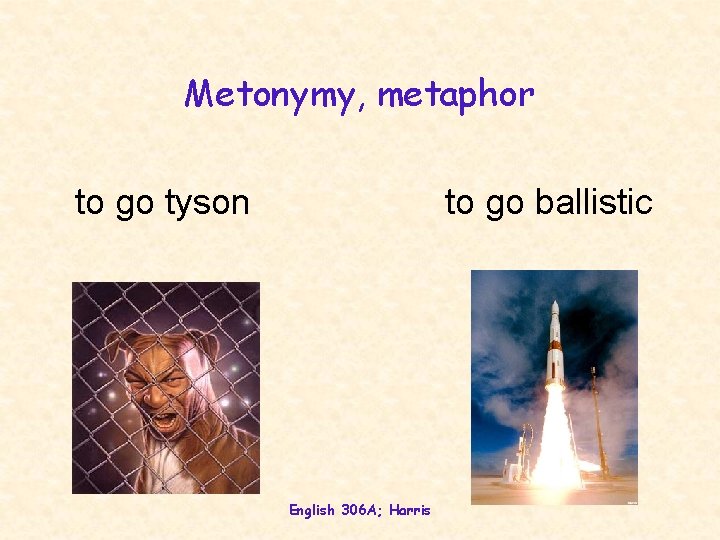
Metonymy, metaphor to go tyson to go ballistic English 306 A; Harris
Metonymy— The principle of set membership One element of a set or a relationship (the vehicle) singled out to represent other element(s) (the tenor) • • • Hollywood loves westerns. Toronto collapses! Calgary wins in OT! All hands on deck. Thirty head of cattle. English 306 A; Harris
Metaphor— The principle of comparison One element (the vehicle) represents another element (the tenor), to which it is unrelated. • • • My love is red, red rose. Homer is a pig. Toronto is toast. The table leg is broken. The orthopedic wing is closed. Fire kills thousands every year. (Personification) English 306 A; Harris
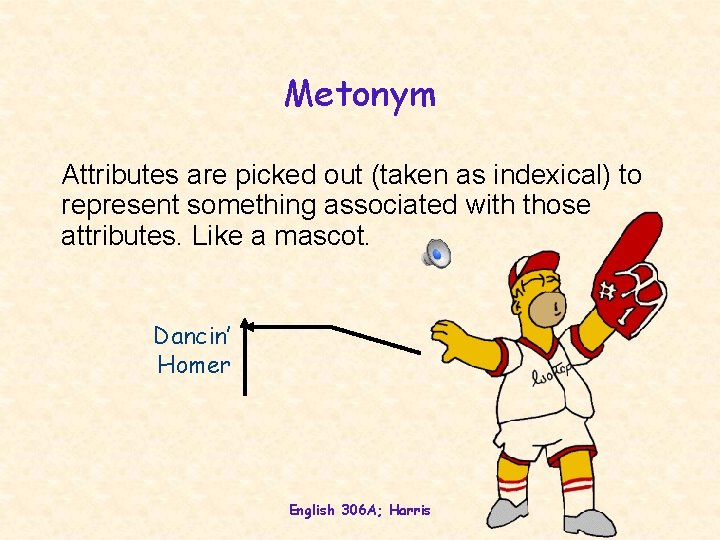
Metonym Attributes are picked out (taken as indexical) to represent something associated with those attributes. Like a mascot. Dancin’ Homer English 306 A; Harris
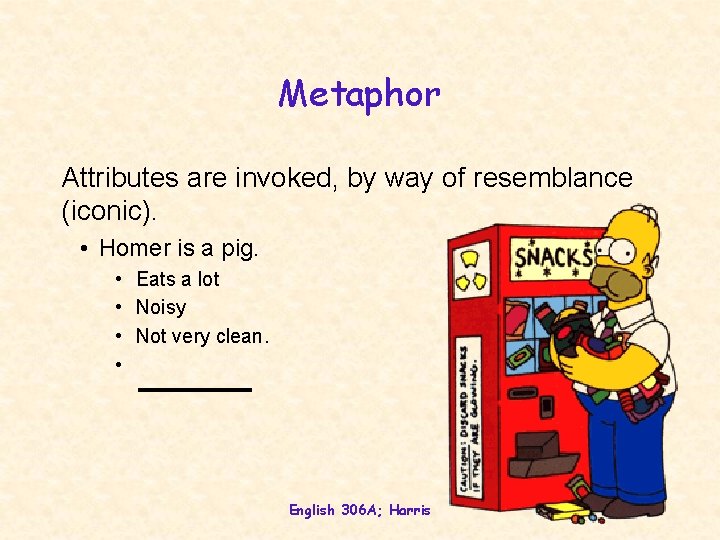
Metaphor Attributes are invoked, by way of resemblance (iconic). • Homer is a pig. • Eats a lot • Noisy • Not very clean. • English 306 A; Harris
English 306 A; Harris
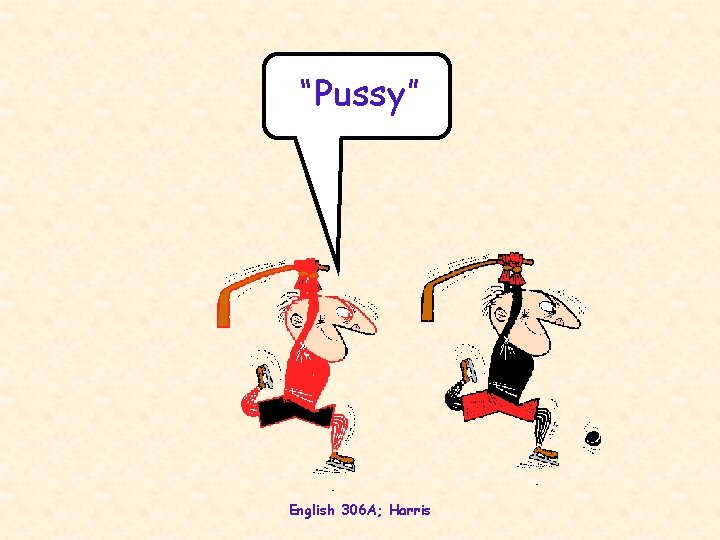
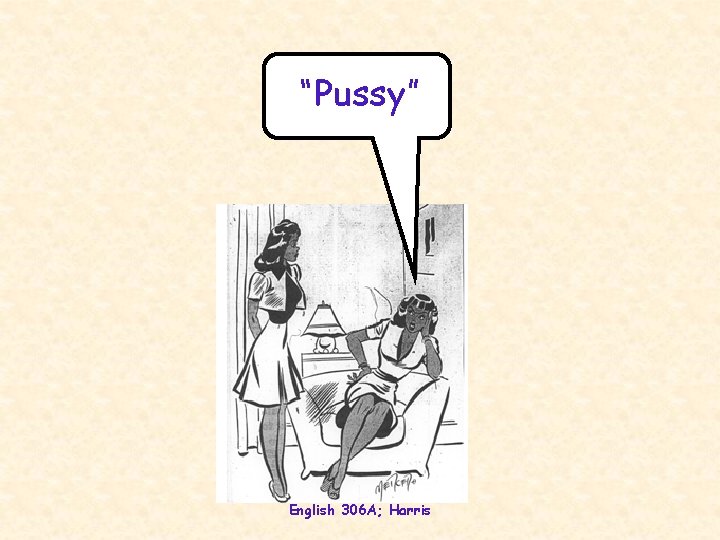
“Pussy” English 306 A; Harris
“Pussy” English 306 A; Harris
“Pussy” English 306 A; Harris
“Pussy” English 306 A; Harris
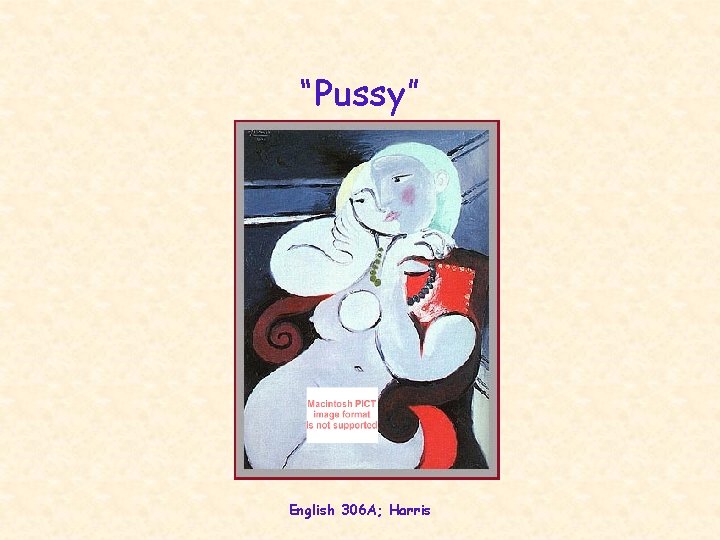
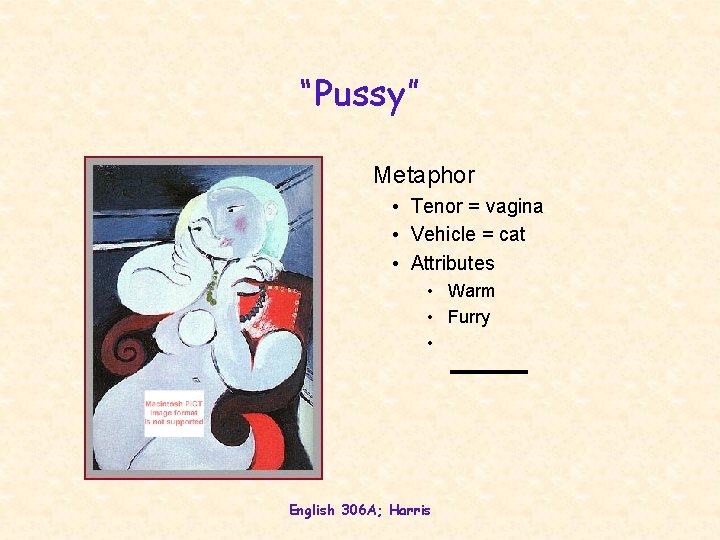
“Pussy” Metaphor • Tenor = vagina • Vehicle = cat • Attributes • Warm • Furry • English 306 A; Harris
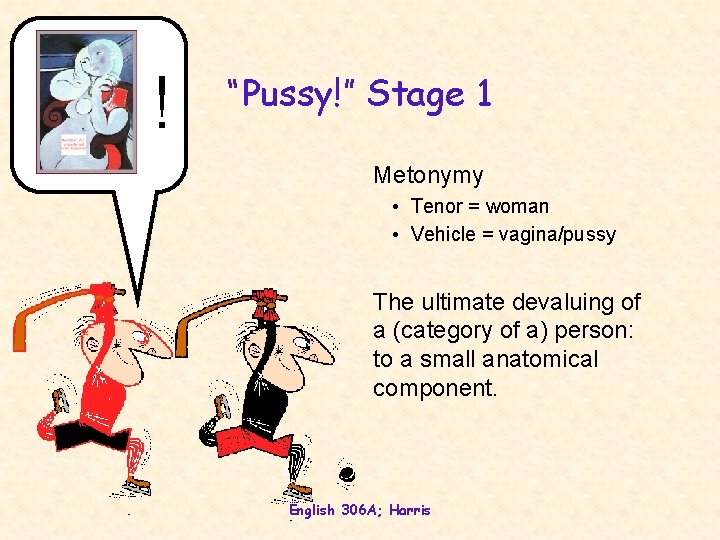
! “Pussy!” Stage 1 Metonymy • Tenor = woman • Vehicle = vagina/pussy The ultimate devaluing of a (category of a) person: to a small anatomical component. English 306 A; Harris
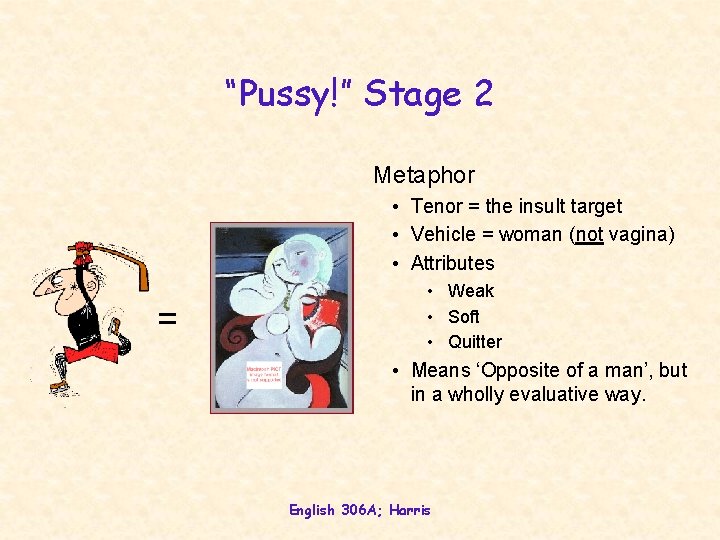
“Pussy!” Stage 2 Metaphor • Tenor = the insult target • Vehicle = woman (not vagina) • Attributes = • Weak • Soft • Quitter • Means ‘Opposite of a man’, but in a wholly evaluative way. English 306 A; Harris
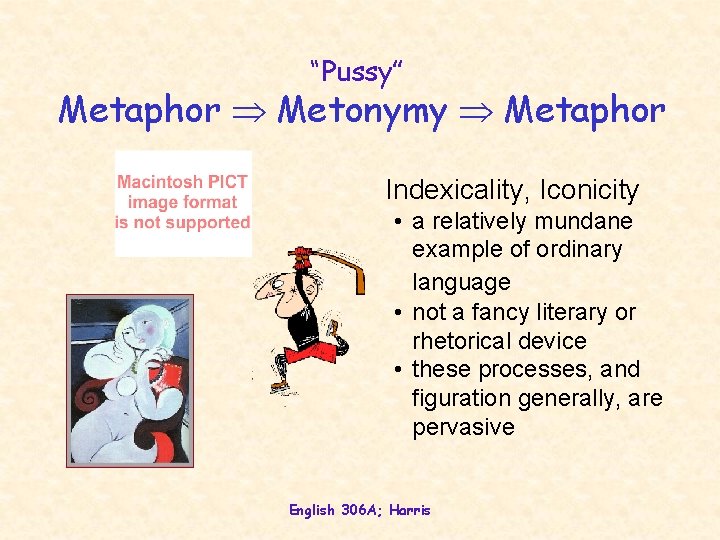
“Pussy” Metaphor Metonymy Metaphor Indexicality, Iconicity • a relatively mundane example of ordinary language • not a fancy literary or rhetorical device • these processes, and figuration generally, are pervasive English 306 A; Harris
“Pussy” English 306 A; Harris
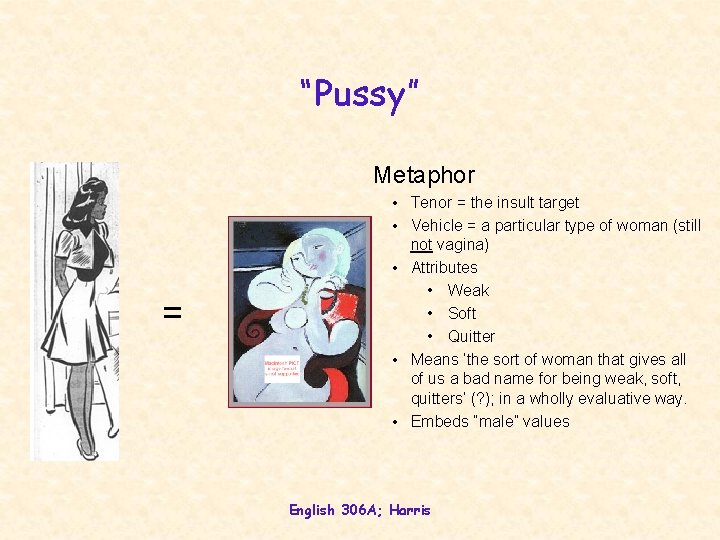
“Pussy” Metaphor = • Tenor = the insult target • Vehicle = a particular type of woman (still not vagina) • Attributes • Weak • Soft • Quitter • Means ‘the sort of woman that gives all of us a bad name for being weak, soft, quitters’ (? ); in a wholly evaluative way. • Embeds “male” values English 306 A; Harris
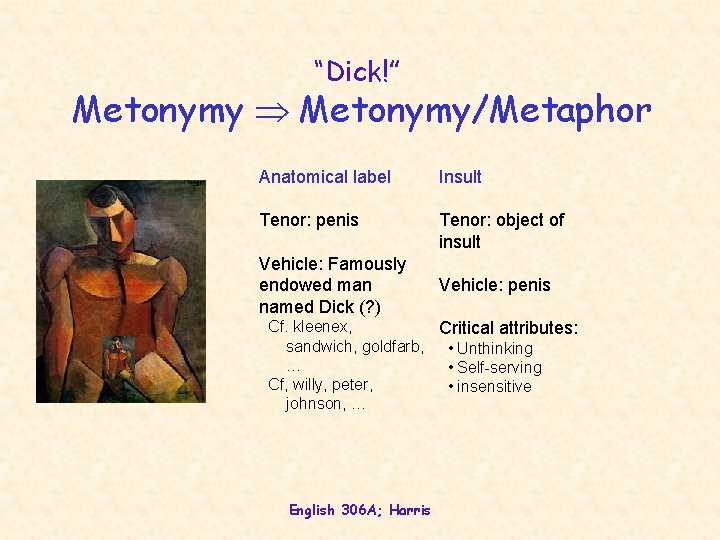
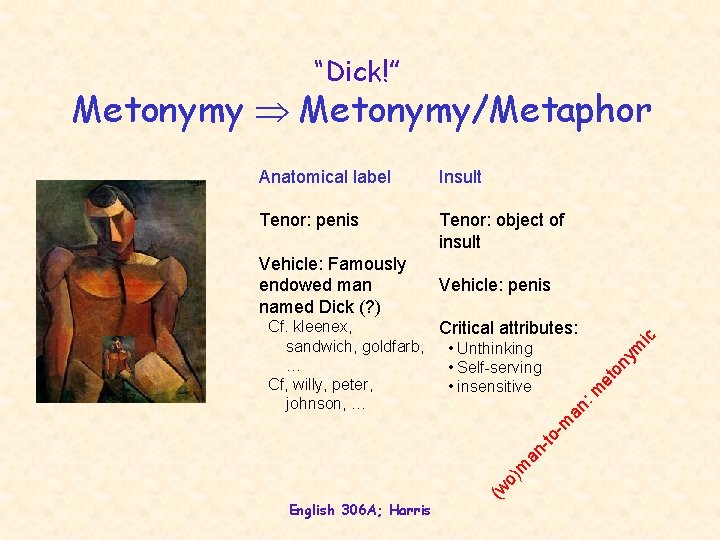
“Dick!” Metonymy/Metaphor Anatomical label Insult Tenor: penis Tenor: object of insult Vehicle: Famously endowed man named Dick (? ) Vehicle: penis Cf. kleenex, Critical attributes: sandwich, goldfarb, • Unthinking … • Self-serving Cf, willy, peter, • insensitive johnson, … English 306 A; Harris
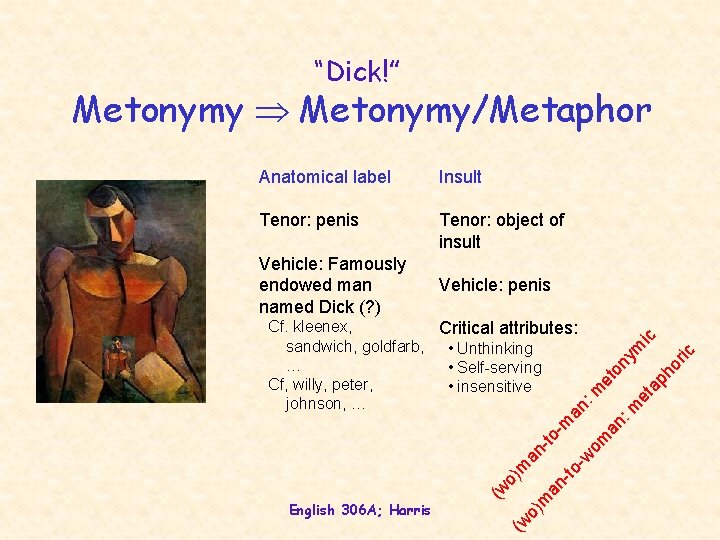
“Dick!” Metonymy/Metaphor Anatomical label Insult Tenor: penis Tenor: object of insult English 306 A; Harris (w o) m an - to -m an ym on : m Cf. kleenex, Critical attributes: sandwich, goldfarb, • Unthinking … • Self-serving Cf, willy, peter, • insensitive johnson, … ic Vehicle: penis et Vehicle: Famously endowed man named Dick (? )
“Dick!” Metonymy/Metaphor Anatomical label Insult Tenor: penis Tenor: object of insult Vehicle: Famously endowed man named Dick (? ) Vehicle: penis (w English 306 A; Harris o) (w m an o) m -to an -w : m om et an on : m ym et ic ap ho ric Cf. kleenex, Critical attributes: sandwich, goldfarb, • Unthinking … • Self-serving Cf, willy, peter, • insensitive johnson, …
We now return you to regular programming F English 306 A; Harris
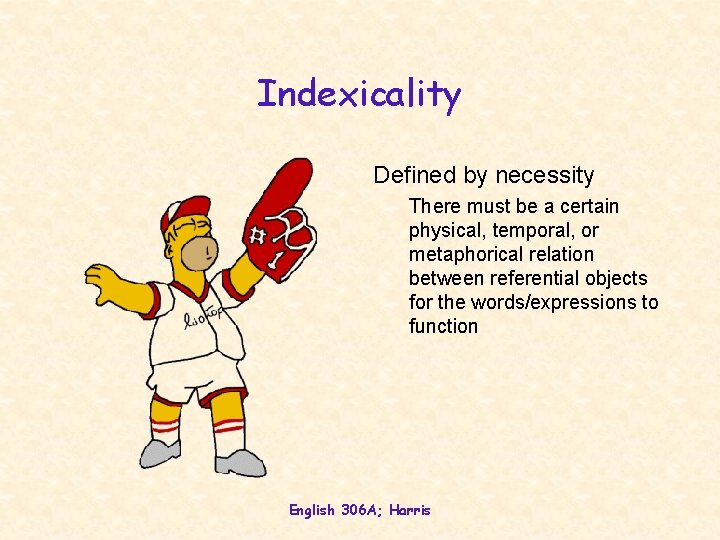
Indexicality Defined by necessity There must be a certain physical, temporal, or metaphorical relation between referential objects for the words/expressions to function English 306 A; Harris
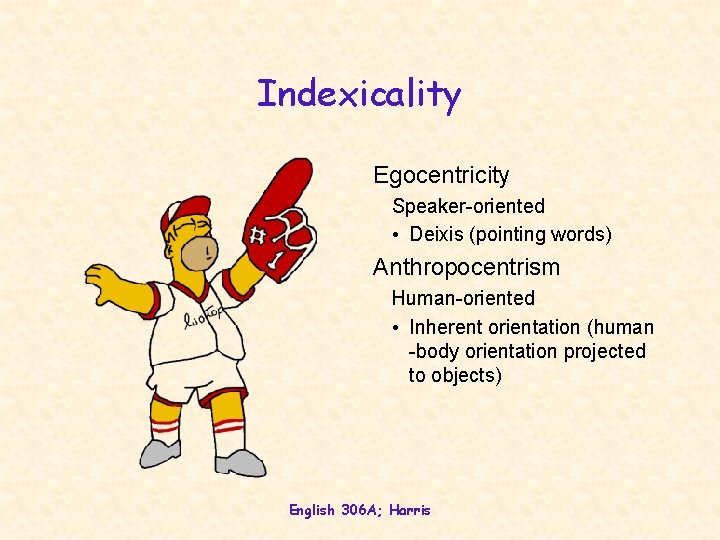
Indexicality Egocentricity Speaker-oriented • Deixis (pointing words) Anthropocentrism Human-oriented • Inherent orientation (human -body orientation projected to objects) English 306 A; Harris
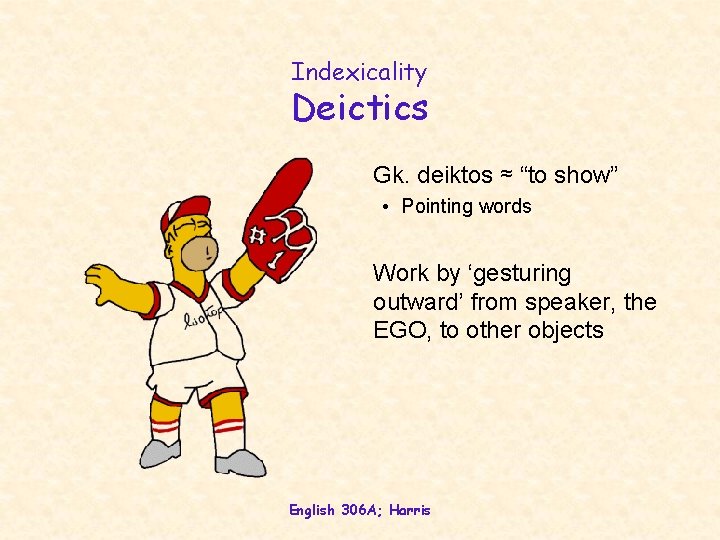
Indexicality Deictics Gk. deiktos ≈ “to show” • Pointing words Work by ‘gesturing outward’ from speaker, the EGO, to other objects English 306 A; Harris
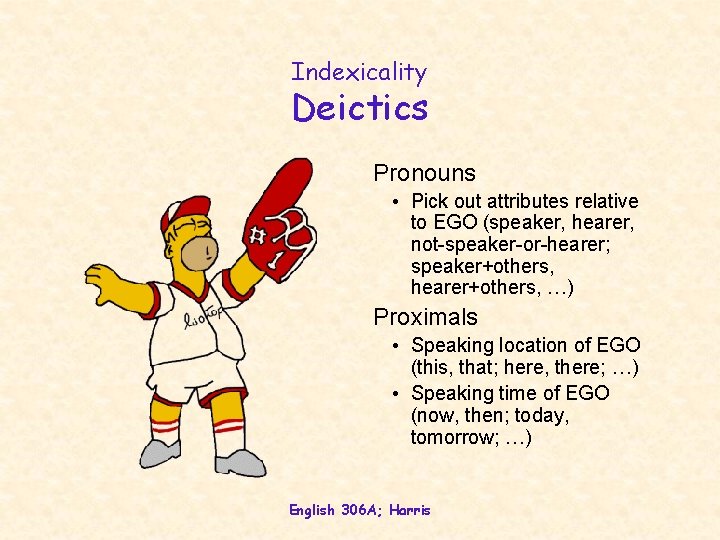
Indexicality Deictics Pronouns • Pick out attributes relative to EGO (speaker, hearer, not-speaker-or-hearer; speaker+others, hearer+others, …) Proximals • Speaking location of EGO (this, that; here, there; …) • Speaking time of EGO (now, then; today, tomorrow; …) English 306 A; Harris
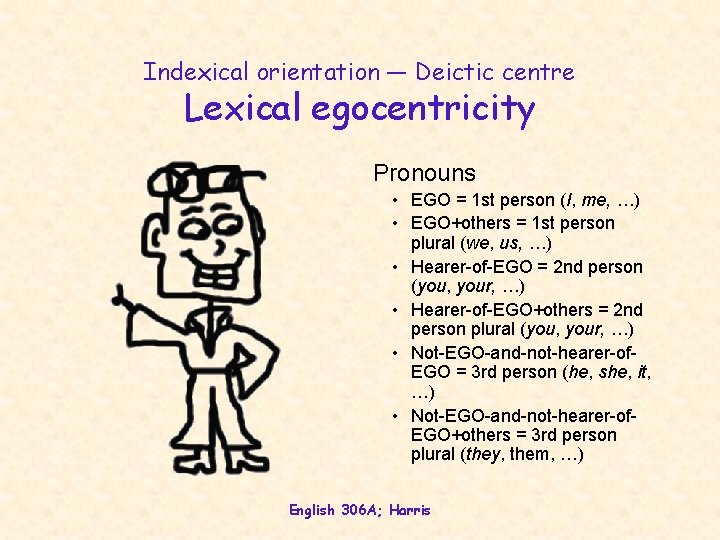
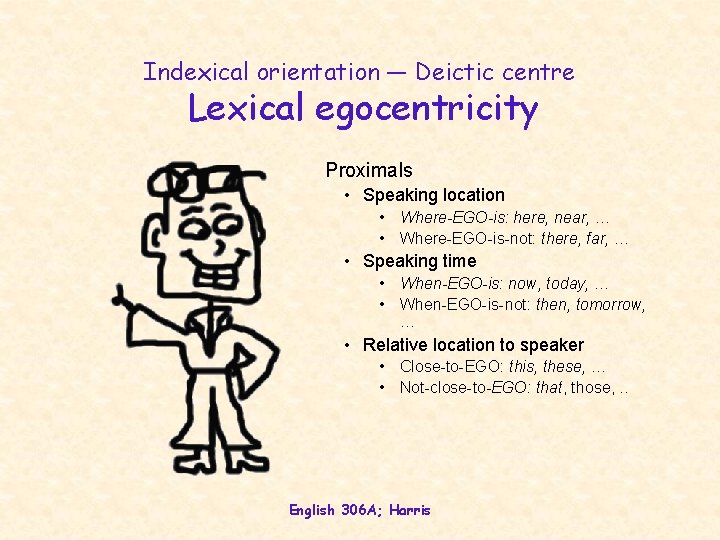
Indexical orientation — Deictic centre Lexical egocentricity Pronouns • EGO = 1 st person (I, me, …) • EGO+others = 1 st person plural (we, us, …) • Hearer-of-EGO = 2 nd person (you, your, …) • Hearer-of-EGO+others = 2 nd person plural (you, your, …) • Not-EGO-and-not-hearer-of. EGO = 3 rd person (he, she, it, …) • Not-EGO-and-not-hearer-of. EGO+others = 3 rd person plural (they, them, …) English 306 A; Harris
Indexical orientation — Deictic centre Lexical egocentricity Proximals • Speaking location • Where-EGO-is: here, near, … • Where-EGO-is-not: there, far, … • Speaking time • When-EGO-is: now, today, … • When-EGO-is-not: then, tomorrow, … • Relative location to speaker • Close-to-EGO: this, these, … • Not-close-to-EGO: that, those, . . English 306 A; Harris
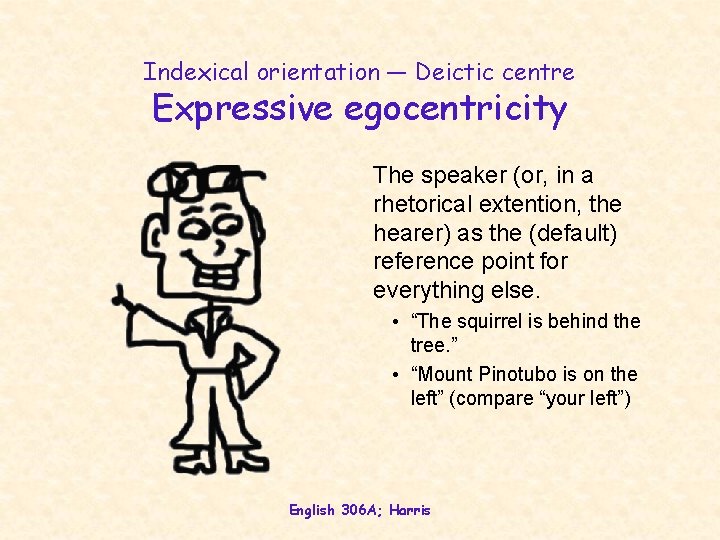
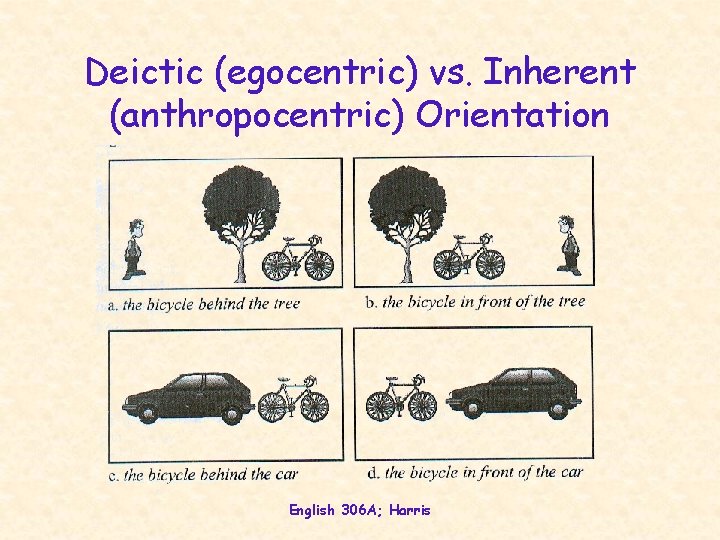
Indexical orientation — Deictic centre Expressive egocentricity The speaker (or, in a rhetorical extention, the hearer) as the (default) reference point for everything else. • “The squirrel is behind the tree. ” • “Mount Pinotubo is on the left” (compare “your left”) English 306 A; Harris
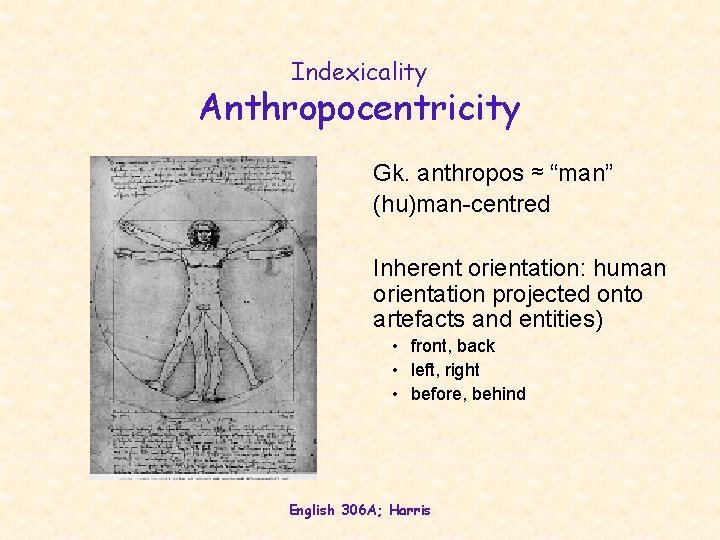
Indexicality Anthropocentricity Gk. anthropos ≈ “man” (hu)man-centred Inherent orientation: human orientation projected onto artefacts and entities) • front, back • left, right • before, behind English 306 A; Harris
Deictic (egocentric) vs. Inherent (anthropocentric) Orientation English 306 A; Harris
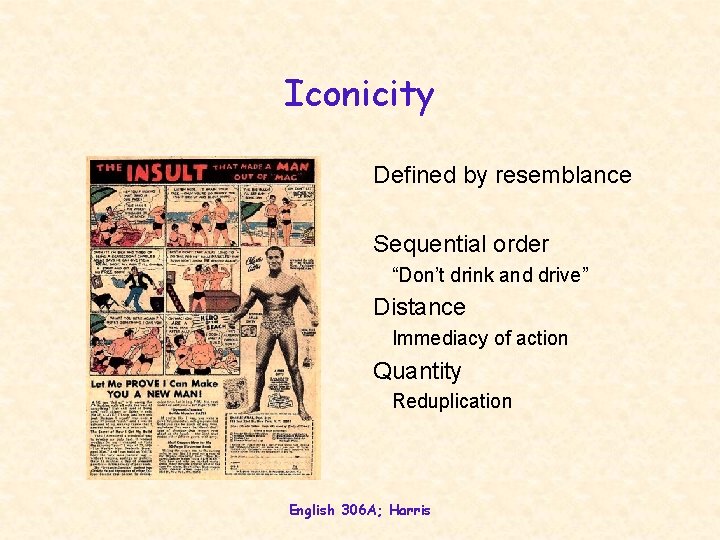
Iconicity Defined by resemblance Sequential order “Don’t drink and drive” Distance Immediacy of action Quantity Reduplication English 306 A; Harris
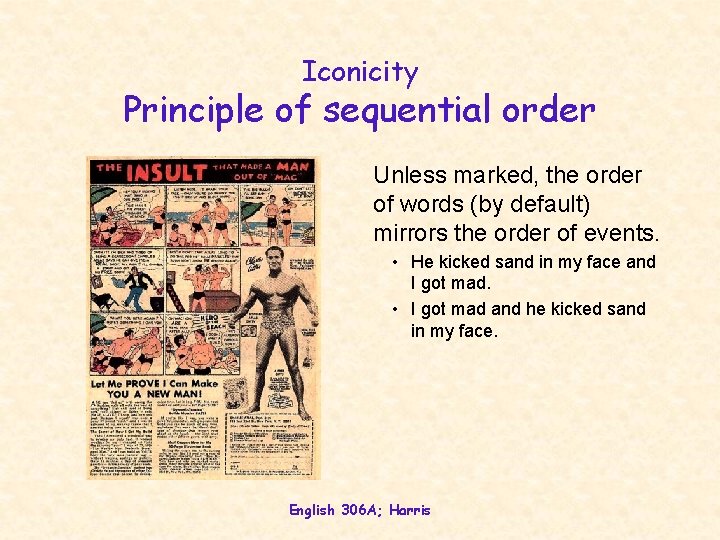
Iconicity Principle of sequential order Unless marked, the order of words (by default) mirrors the order of events. • He kicked sand in my face and I got mad. • I got mad and he kicked sand in my face. English 306 A; Harris
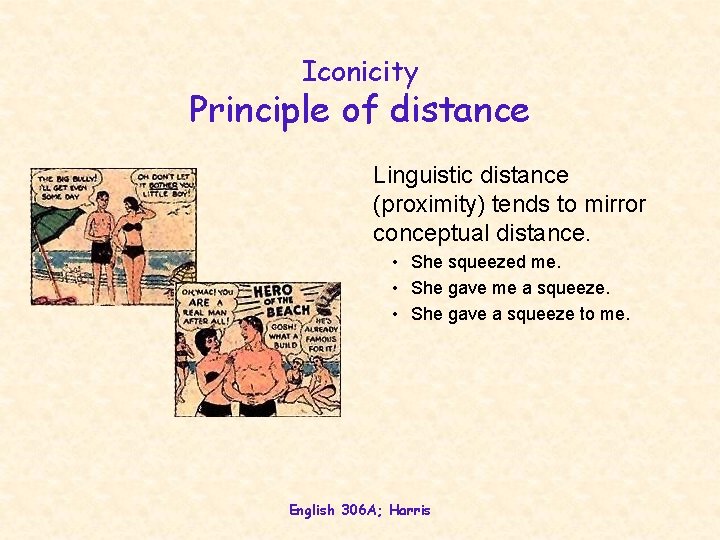
Iconicity Principle of distance Linguistic distance (proximity) tends to mirror conceptual distance. • She squeezed me. • She gave me a squeeze. • She gave a squeeze to me. English 306 A; Harris
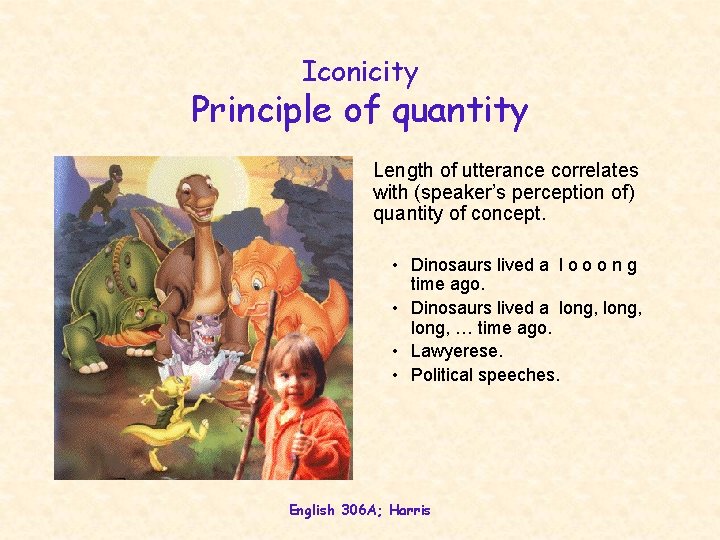
Iconicity Principle of quantity Length of utterance correlates with (speaker’s perception of) quantity of concept. • Dinosaurs lived a l o o o n g time ago. • Dinosaurs lived a long, … time ago. • Lawyerese. • Political speeches. English 306 A; Harris
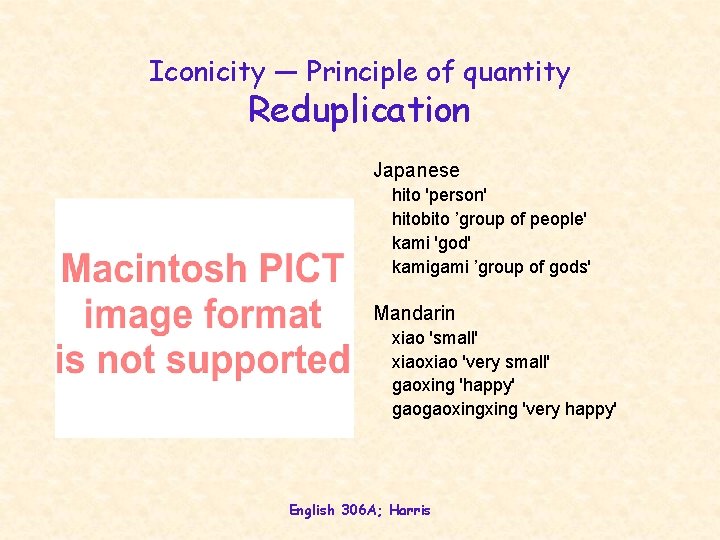
Iconicity — Principle of quantity Reduplication Japanese hito 'person' hitobito ’group of people' kami 'god' kamigami ’group of gods' Mandarin xiao 'small' xiao 'very small' gaoxing 'happy' gaogaoxing 'very happy' English 306 A; Harris
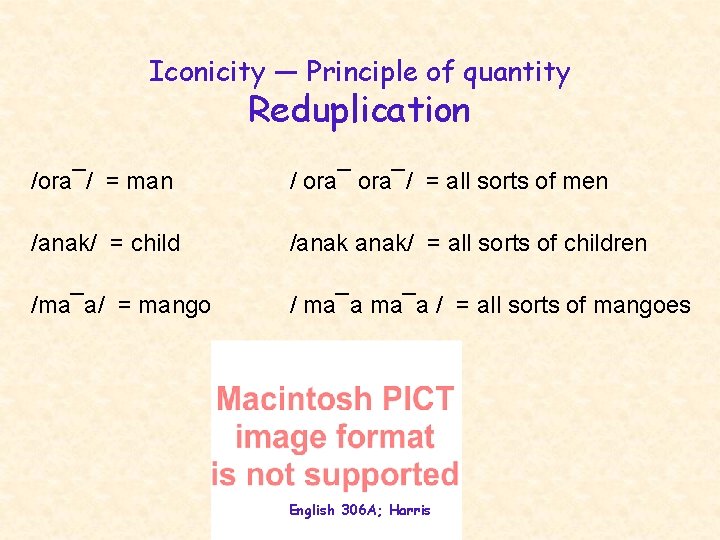
Iconicity — Principle of quantity Reduplication /ora¯/ = man / ora¯/ = all sorts of men /anak/ = child /anak/ = all sorts of children /ma¯a/ = mango / ma¯a / = all sorts of mangoes English 306 A; Harris
Iconicity — Principle of quantity Reduplication Download the= all. SIL / ora¯/ sorts of men to =see /anak/ = child. IPA fonts /anak/ all sorts of children these /ma¯a/ = mango / ma¯a / = all sorts of mangoes transcriptions in PPS files /ora¯/ = man English 306 A; Harris
Iconicity — Principle of quantity Conceptual Reduplication Trinidad and Tobago [j. Eswij] • emphatic confirmation, agreement; interjective intensifier Children at Play, Romeo Downer http: //caribbeanartist. com/ English 306 A; Harris
Iconicity — Principle of quantity Conceptual Reduplication Trinidad and Tobago [j. Eswij] • emphatic confirmation, agreement; interjective intensifier • yes-we? Children at Play, Romeo Downer http: //caribbeanartist. com/ English 306 A; Harris
Iconicity — Principle of quantity Conceptual Reduplication Trinidad and Tobago [j. Eswij] • emphatic confirmation, agreement; interjective intensifier • yes-we? • yes-whee? Children at Play, Romeo Downer http: //caribbeanartist. com/ English 306 A; Harris
Iconicity — Principle of quantity Conceptual Reduplication Trinidad and Tobago [j. Eswij] • emphatic confirmation, agreement; interjective intensifier • yes-we? • yes-whee? • yes-oui! Children at Play, Romeo Downer http: //caribbeanartist. com/ English 306 A; Harris
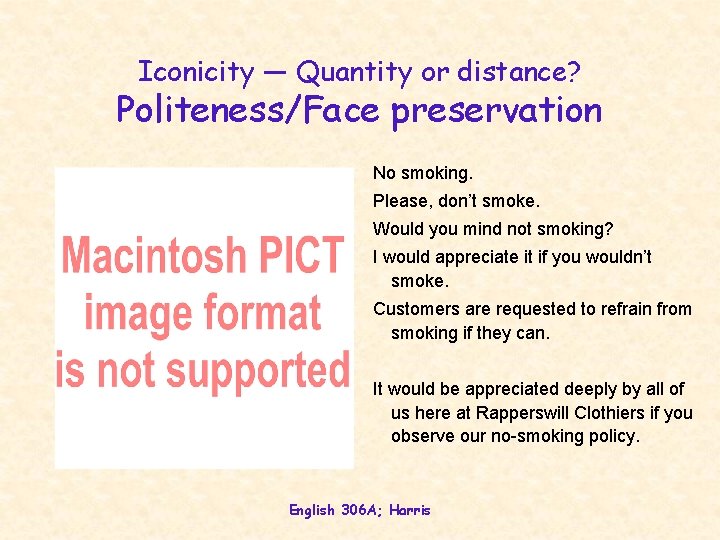
Iconicity — Quantity or distance? Politeness/Face preservation No smoking. Please, don’t smoke. Would you mind not smoking? I would appreciate it if you wouldn’t smoke. Customers are requested to refrain from smoking if they can. It would be appreciated deeply by all of us here at Rapperswill Clothiers if you observe our no-smoking policy. English 306 A; Harris
Any questions? Semiotic triangle Metaphoricity, metonymy Symbolicity (arbitrariness, convention, learning) Indexicality (relation of necessity) • Egocentricity (deixis) • Anthropocentricity (inherent orientation) Iconicity (relation of resemblance) • Sequential order • Distance • Quantity English 306 A; Harris