
Historical Geology Absolute Age Absolute Age When round

Historical Geology Absolute Age
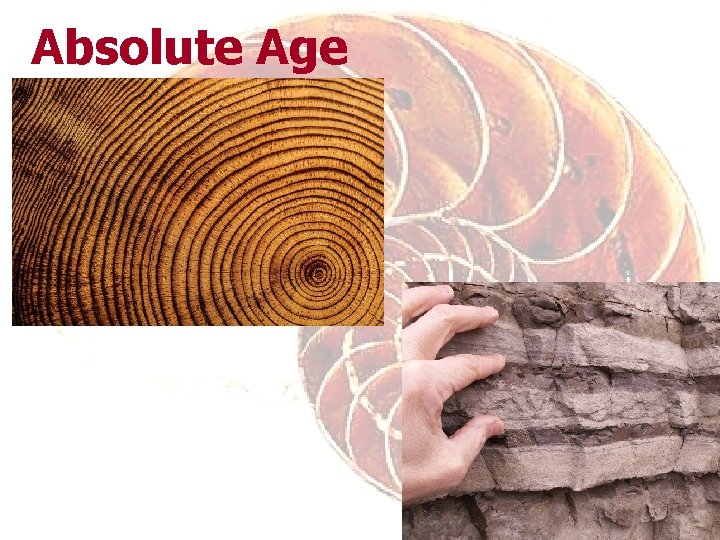
Absolute Age • When round about age isn’t good enough but need the actual date of the event 1. Tree Rings & Varves 2. Radioactive Decay
Absolute Age
Radioactive Decay • Most rocks contain elements that are radioactive. Since these elements give of particles and energy they will eventually form new nonradioactive elements.
Radioactive Decay • By comparing the amount of radioactive and nonradioactive elements scientists can predict the absolute age of a specific rock
Examples: • Uranium is commonly found in rocks • U-238 will decay to form U-234 (releases 2 protons & 2 neutrons) • It will eventually decay all the way to produce Pb -206
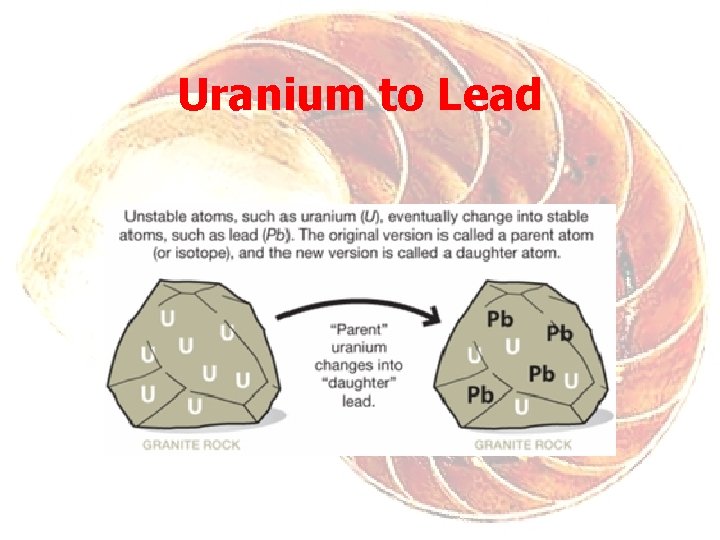
Uranium to Lead
Examples: • U-238 = parent element • Pb-206 = daughter element
Half-Life • The decay of U-238 to Pb -206 is a very slow process. • Rate of decay is constant • It takes 4. 5 billion yrs for half of U-238 to decay
Half-Life • In conclusion = the more Pb-206 in a rock the older it will be.
Carbon Dating • C-14 is a radioactive element found in ALL living things. • When plant/animal dies C -14 decays to form N-14 • The half-life of C-14 is about 5, 730 years
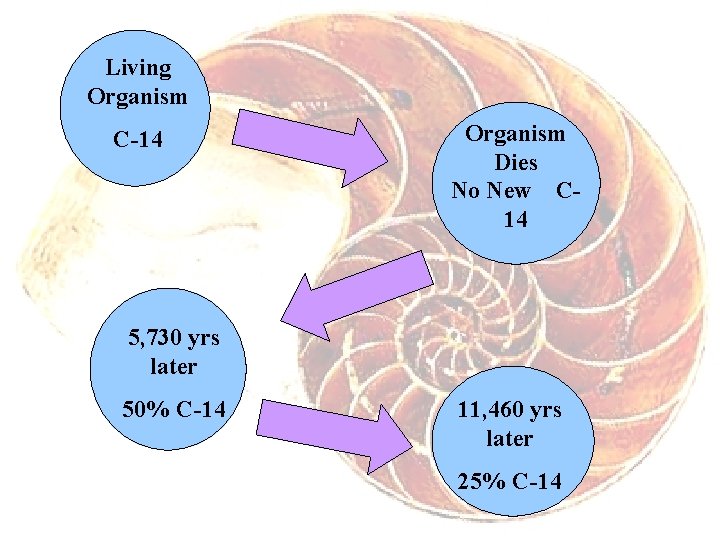
Living Organism C-14 Organism Dies No New C 14 5, 730 yrs later 50% C-14 11, 460 yrs later 25% C-14

Let’s take some time to practice learning what is meant by an element’s half-life
- Slides: 13