
Historical Approach to Discipleship A brief history Relational
Historical Approach to Discipleship

A brief history • Relational: first century. • Experiential: third century through middle ages • Academic: Enlightenment, Reformation • Individual and Personal: (19 th and 20 th) • Incarnational: (20 th and 21 st)
Robert E. Webber “Although the NT does not set forth a systematic and linear sequence of stages in Christian formation in any great detail we do however catch snapshots here and there we see hints of early practices. Acts 2 contains several of these. Most obvious is the conversion process in ‘Repent and be baptized, everyone of you, in the name of Jesus Christ for the forgiveness of your sins. And you shall receive the gift of the Holy Spirit’ (Acts 2: 38). ”
The Following Elements of a Process Emerge from Acts • • • Hearing the Gospel Instruction to flee the corrupt world Reception of the Gospel Repentance Baptism (a passage rite) Reception of the Holy Spirit
Phillip Carrington, bishop of Quebec Found a pattern in Ephesians, Colossians, James, 1 Peter that stressed four points for all new Christians to observe 1. Wherefore putting off evil 2. Submit yourselves 3. Watch and pray 4. Resist the Devil

Another example of sequential and holistic discipleship 16 Then the eleven disciples went to Galilee, to the mountain where Jesus had told them to go. 17 When they saw him, they worshiped him; but some doubted. 18 Then Jesus came to them and said, "All authority in heaven and on earth has been given to me. 19 Therefore go and make disciples of all nations, baptizing them in the name of the Father and of the Son and of the Holy Spirit, 20 and teaching them to obey everything I have commanded you. And surely I am with you always, to the very end of the age. " --Matthew 28

A picture of what discipleship looks like • 42 These remained faithful to the teaching of the apostles, to the brotherhood, to the breaking of bread and to the prayers. 43 And everyone was filled with awe; the apostles worked many signs and miracles. 44 And all who shared the faith owned everything in common; 45 they sold their goods and possessions and distributed the proceeds among themselves according to what each one needed. 46 Each day, with one heart, they regularly went to the Temple but met in their houses for the breaking of bread; they shared their food gladly and generously; 47 they praised God and were looked up to by everyone. Day by day the Lord added to their community those destined to be saved. –Acts 2 (New Jerusalem Bible)
Believe. . . Behave. . . Belong • “As I see it, in Christianity’s early centuries conversion involved changes in belief, belonging, and behavior in the context of the experience of God. ” --Alan Kreider – See Justin (AD 130) – Justin’s Writings reveal a cycle of believing, belonging and behaving that exhibits the making of disciples in the second century
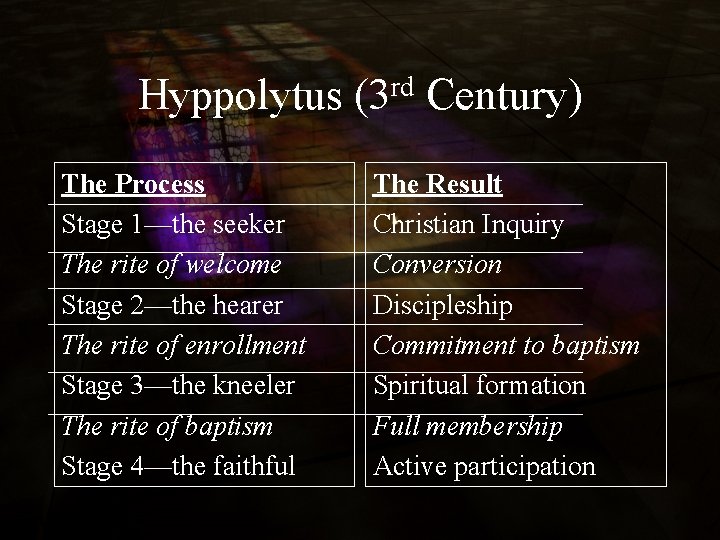
Hyppolytus The Process Stage 1—the seeker The rite of welcome Stage 2—the hearer The rite of enrollment Stage 3—the kneeler The rite of baptism Stage 4—the faithful rd (3 Century) The Result Christian Inquiry Conversion Discipleship Commitment to baptism Spiritual formation Full membership Active participation

The Making of a Disciple Theme • Biblical understanding of Disciple • Ancient Process Comments • All converts to Jesus are disciples, discipleship not optional • Inquiry • Catechumenate • Purification • Mystagogue
The Dissolution. . . • Conversion of Constantine was more a statement on how to conquer others than on how to be conquered by Christ. . . • By legitimizing the church, there was a shift from the countercultural model of the previous centuries to one that had a new place in society.
The Dissolution. . . • Infant Baptism. Because Society was Christianized baptism shifted from adult to infant, and the process of Christian formation shifted now had to occur after baptism. – See Agustine who was received into the church as an infant but later had to experience conversion and discipleship
The Dissolution. . . • Medieval Christendom. Baptismal Regeneration. Discipleship in the Medieval era became sacramental and institutional: – Infants baptized—which forgave original sin and gave the infant the Holy Spirit – At seven a first confession was made for the child’s first communion – First communion – The child was confirmed—it was thought that confirmation provided an increase in the Holy Spirit. . . – When the child/adult sinned the sacrament of penance was now available to restore. . . – Eucharist provided right relationship with God. – Sacrament of unction, provided at the deathbed was the final sacrament for salvation
The Reformation Era • Catechetical Innovation. • Luther introduced the catechism “instruct” because of the invention of print. Its purpose, “It is necessary to make the pupils and the people to learn by heart the formulas chosen to be included in the catechism, without changing a single syllable. As for those who refuse to learn tell them they are denying Christ.
The Reformation Era • Catechetical Innovation. • Its positive features: taught the Christian Faith. And its negative aspect: children became subject to intellectual faith. • “The negative impact of the catechism has reverberated down through the history in the Protestant tradition. The spirituality of the medieval mystics was now supplanted by intellectual knowledge.
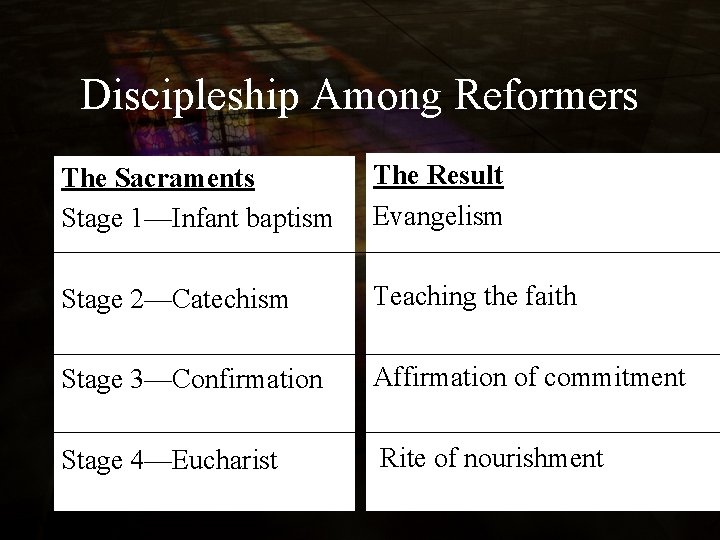
Discipleship Among Reformers The Sacraments Stage 1—Infant baptism The Result Evangelism Stage 2—Catechism Teaching the faith Stage 3—Confirmation Affirmation of commitment Stage 4—Eucharist Rite of nourishment
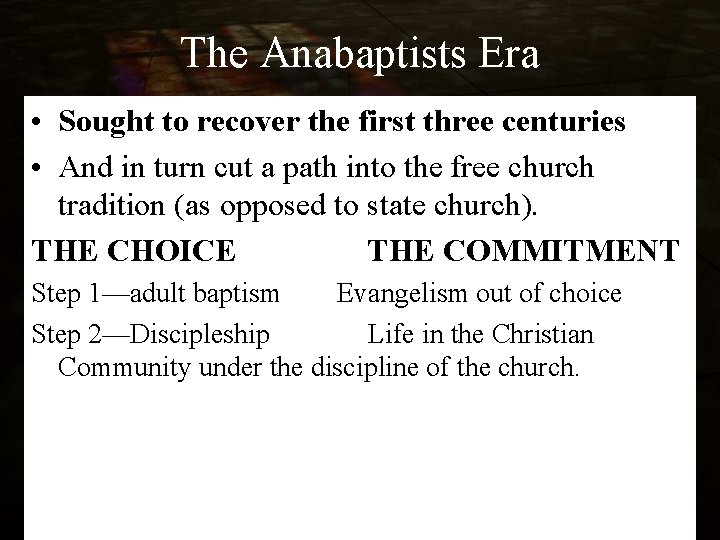
The Anabaptists Era • Sought to recover the first three centuries • And in turn cut a path into the free church tradition (as opposed to state church). THE CHOICE THE COMMITMENT Step 1—adult baptism Evangelism out of choice Step 2—Discipleship Life in the Christian Community under the discipline of the church.
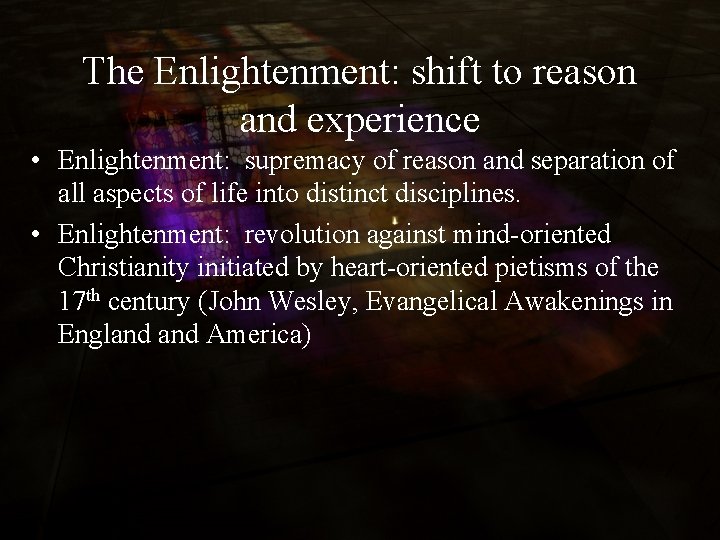
The Enlightenment: shift to reason and experience • Enlightenment: supremacy of reason and separation of all aspects of life into distinct disciplines. • Enlightenment: revolution against mind-oriented Christianity initiated by heart-oriented pietisms of the 17 th century (John Wesley, Evangelical Awakenings in England America)
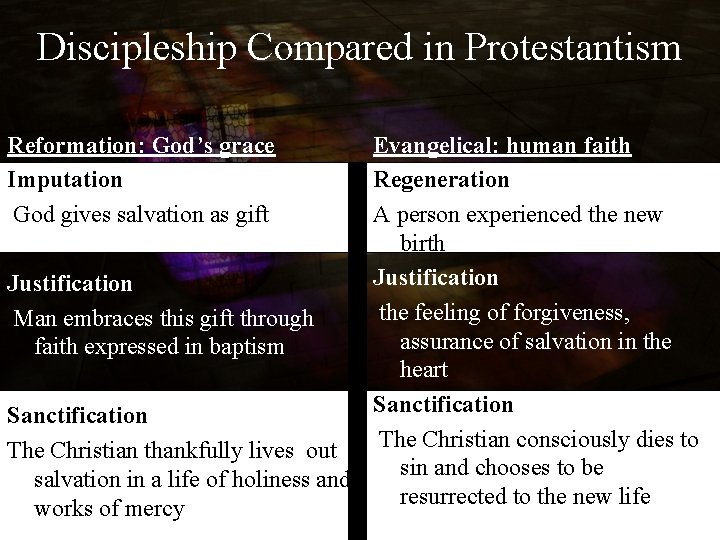
Discipleship Compared in Protestantism Reformation: God’s grace Imputation God gives salvation as gift Evangelical: human faith Regeneration A person experienced the new birth Justification the feeling of forgiveness, Man embraces this gift through assurance of salvation in the faith expressed in baptism heart Sanctification The Christian consciously dies to The Christian thankfully lives out sin and chooses to be salvation in a life of holiness and resurrected to the new life works of mercy
Wesley’s Model bears close resemblance to the 3 rd century model THE PROCESS • Step 1 Preaching—entire congregation • Step 2 Societies—pastoral care classes • Step 3 Society bands— smaller groups for discipleship THE RESULT • Evangelism, repentance and faith • Embodying the way of salvation • Pursuit of Christian perfection
• “The rise of a secular and pagan society, the emergence of the New Age Movement of spirituality, postmodern pluralism and relativism have created a new cultural situation in which the church speaks the faith. ”
Conclusion The international Consultation on Discipleship: current models of evangelism do not make disciples.
Dissolution of the Ancient Process Event Constantine (AD 311) Medieval Christendom (600 -1500) Luther and Calvin (1500 -Present) The Anabaptists (1500 -Present) The Enlightenment (1750 -1950) Wesleyan Evangelism (17501900) 20 th Century Evangelicalism 21 st Century Evangelism
• Translating the ancient process for today
- Slides: 26