
Historical and geopolitical development of Slovakia Human Geography

- Slides: 28
Historical and geopolitical development of Slovakia Human Geography of the Slovak Republic foreign students
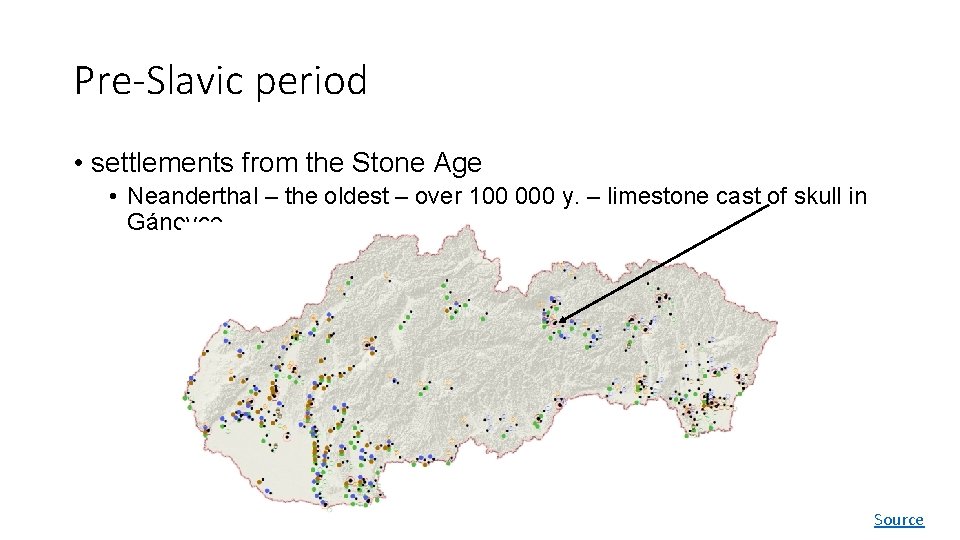
Pre-Slavic period • settlements from the Stone Age • Neanderthal – the oldest – over 100 000 y. – limestone cast of skull in Gánovce Source
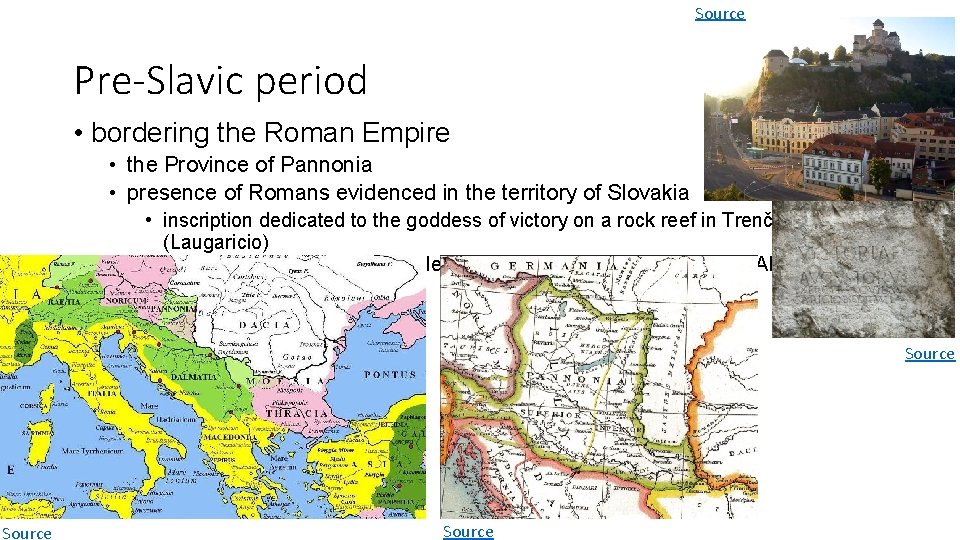
Source Pre-Slavic period • bordering the Roman Empire • the Province of Pannonia • presence of Romans evidenced in the territory of Slovakia • inscription dedicated to the goddess of victory on a rock reef in Trenčín (Laugaricio) by commander of the Roman legions Maximilianus Valerius in 179 AD Source
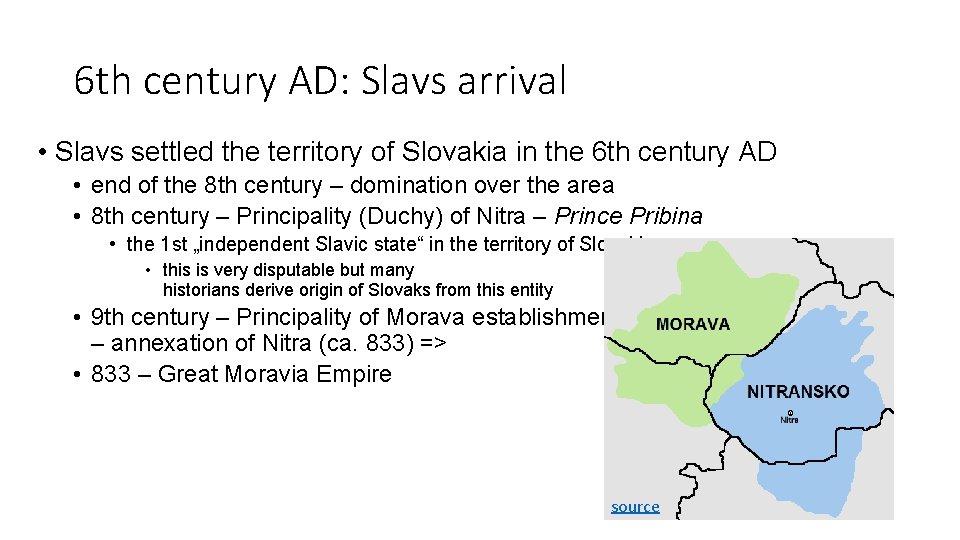
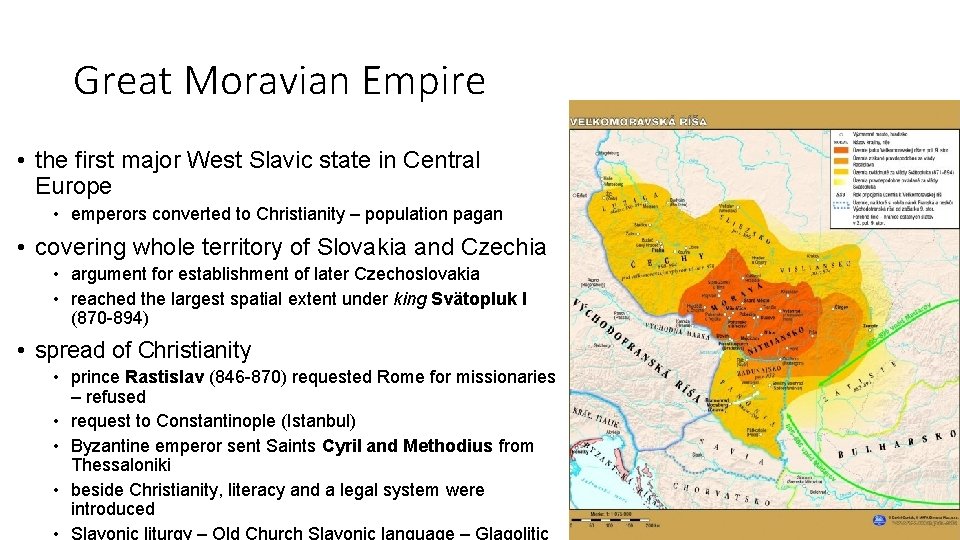
6 th century AD: Slavs arrival • Slavs settled the territory of Slovakia in the 6 th century AD • end of the 8 th century – domination over the area • 8 th century – Principality (Duchy) of Nitra – Prince Pribina • the 1 st „independent Slavic state“ in the territory of Slovakia • this is very disputable but many historians derive origin of Slovaks from this entity • 9 th century – Principality of Morava establishment – annexation of Nitra (ca. 833) => • 833 – Great Moravia Empire source
Great Moravian Empire • the first major West Slavic state in Central Europe • emperors converted to Christianity – population pagan • covering whole territory of Slovakia and Czechia • argument for establishment of later Czechoslovakia • reached the largest spatial extent under king Svätopluk I (870 -894) • spread of Christianity • prince Rastislav (846 -870) requested Rome for missionaries – refused • request to Constantinople (Istanbul) • Byzantine emperor sent Saints Cyril and Methodius from Thessaloniki • beside Christianity, literacy and a legal system were introduced • Slavonic liturgy – Old Church Slavonic language – Glagolitic
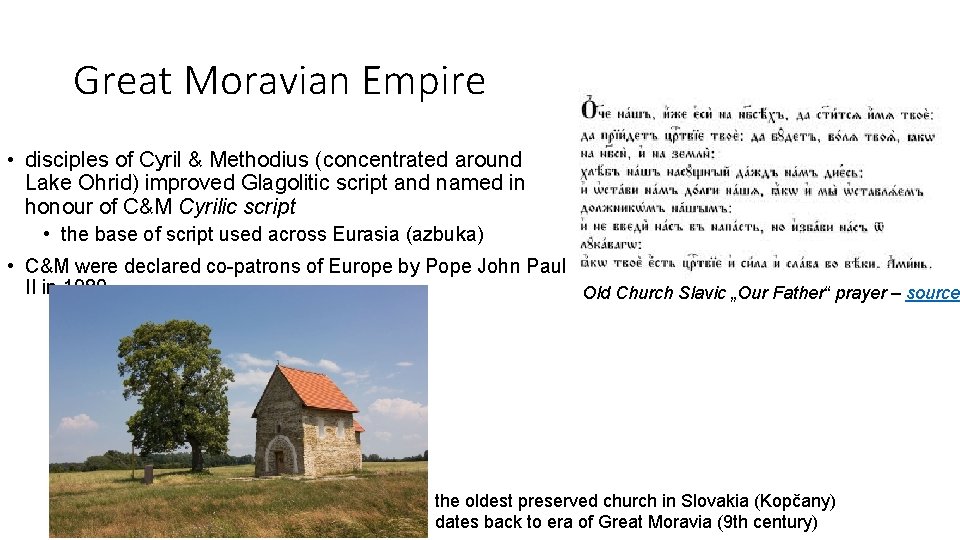
Great Moravian Empire • disciples of Cyril & Methodius (concentrated around Lake Ohrid) improved Glagolitic script and named in honour of C&M Cyrilic script • the base of script used across Eurasia (azbuka) • C&M were declared co-patrons of Europe by Pope John Paul II in 1980 Old Church Slavic „Our Father“ prayer – source the oldest preserved church in Slovakia (Kopčany) dates back to era of Great Moravia (9 th century)
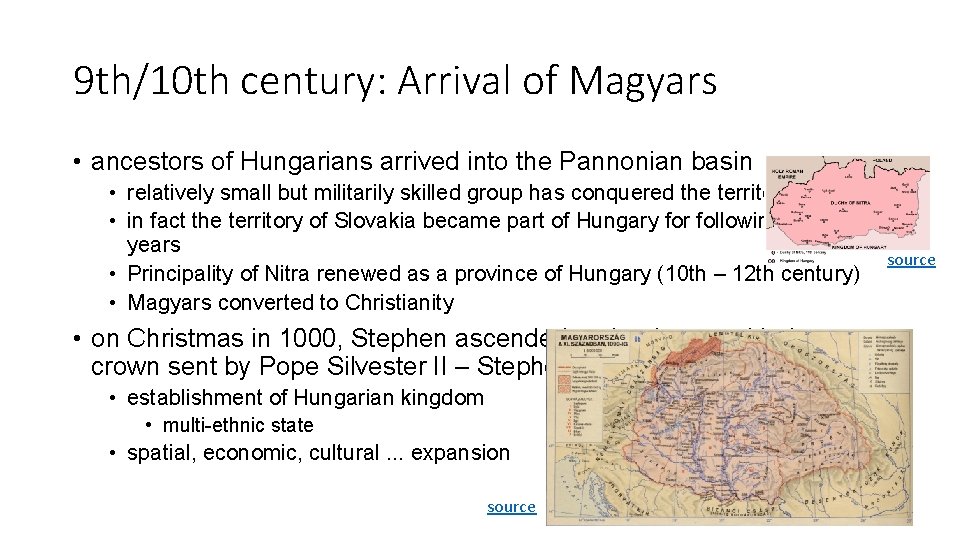
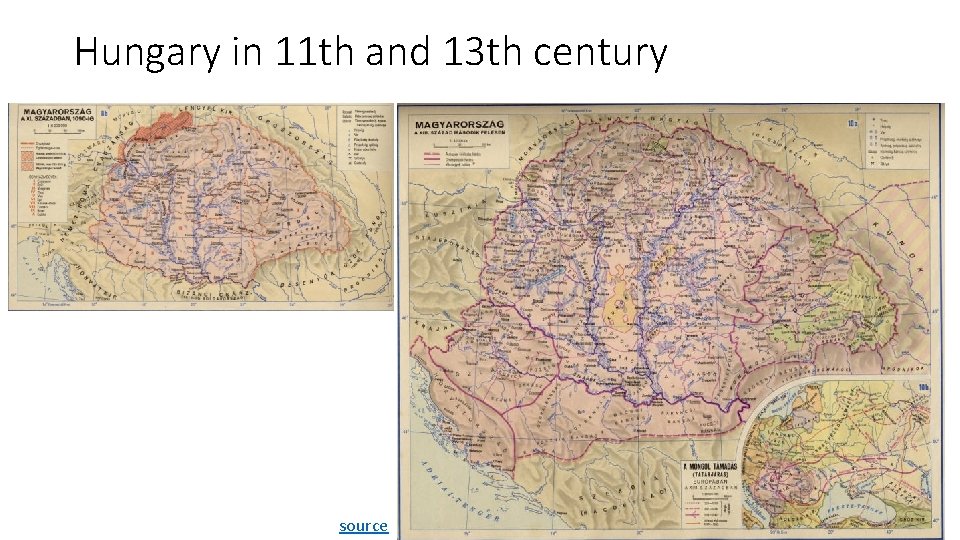
9 th/10 th century: Arrival of Magyars • ancestors of Hungarians arrived into the Pannonian basin • relatively small but militarily skilled group has conquered the territory • in fact the territory of Slovakia became part of Hungary for following 1000 years • Principality of Nitra renewed as a province of Hungary (10 th – 12 th century) • Magyars converted to Christianity • on Christmas in 1000, Stephen ascended to the throne with the crown sent by Pope Silvester II – Stephen I of Hungary • establishment of Hungarian kingdom • multi-ethnic state • spatial, economic, cultural. . . expansion source
1241 -1242: Mongols‘ invasion • short but devastating, during the rule of Belo IV • burned out and spilled areas, famine, loss of population, economic decline • building castles in border areas, privileges to German colonists (Saxons, Schwabs) • establishment of many towns – basis of current urban network • rapid economic growth in German areas (mining, trade, crafts)
Hungary in 11 th and 13 th century source
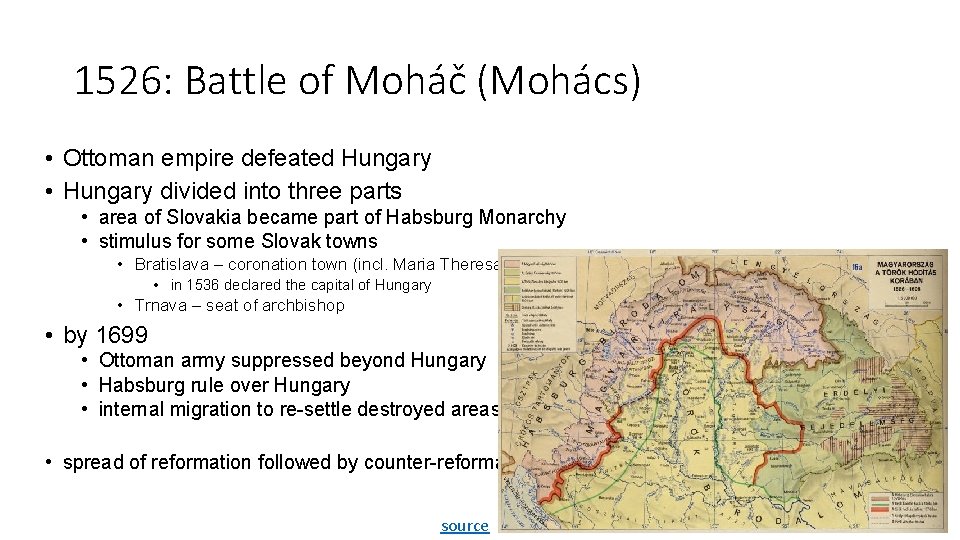
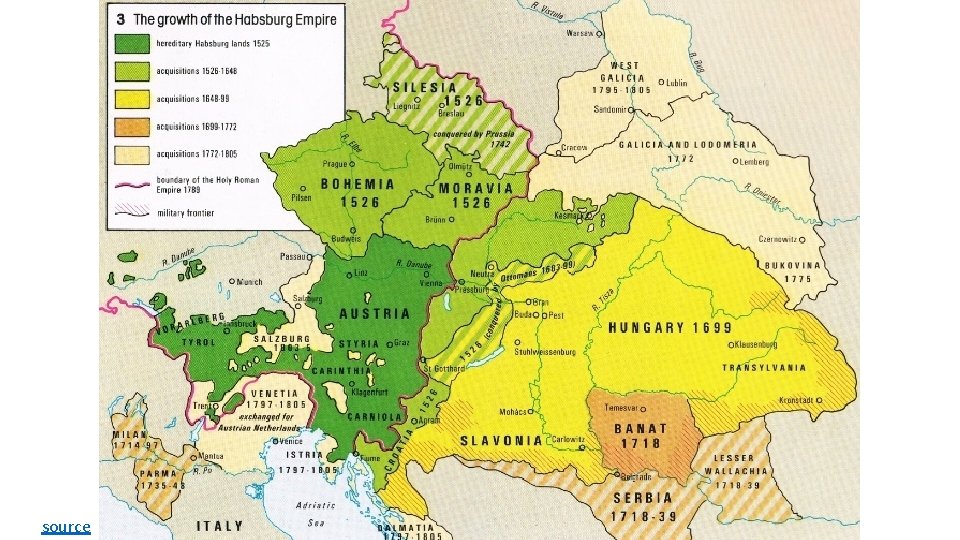
1526: Battle of Moháč (Mohács) • Ottoman empire defeated Hungary • Hungary divided into three parts • area of Slovakia became part of Habsburg Monarchy • stimulus for some Slovak towns • Bratislava – coronation town (incl. Maria Theresa) • in 1536 declared the capital of Hungary • Trnava – seat of archbishop • by 1699 • Ottoman army suppressed beyond Hungary • Habsburg rule over Hungary • internal migration to re-settle destroyed areas • spread of reformation followed by counter-reformation source
source
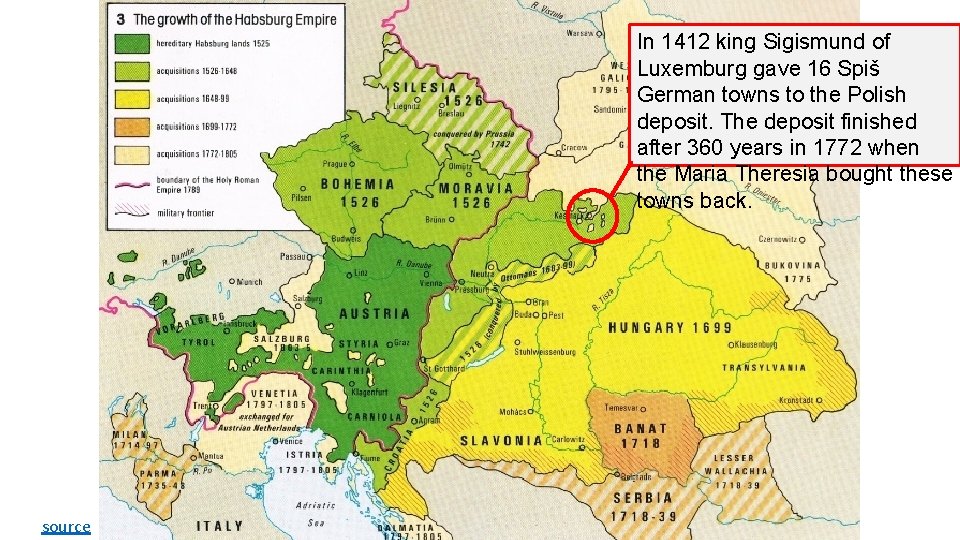
In 1412 king Sigismund of Luxemburg gave 16 Spiš German towns to the Polish deposit. The deposit finished after 360 years in 1772 when the Maria Theresia bought these towns back. source
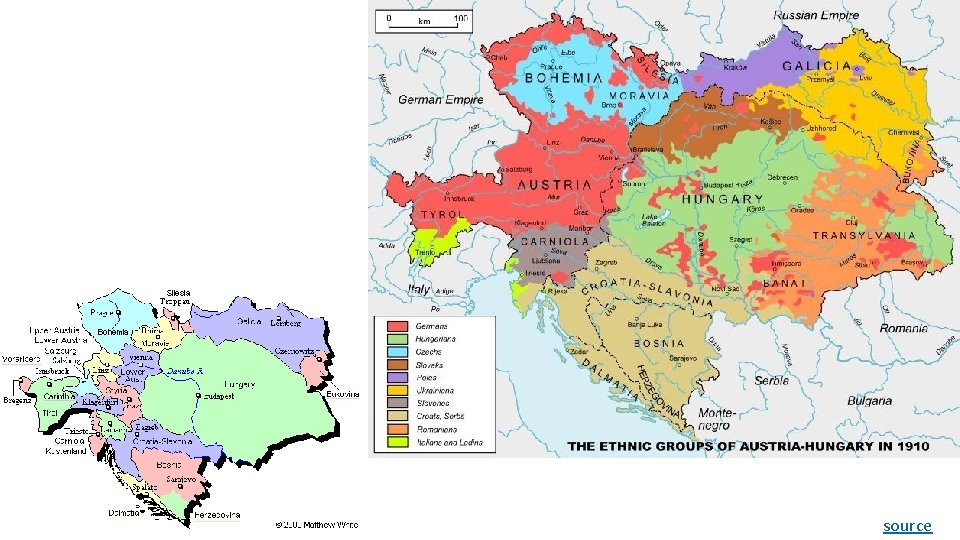
18 th & 19 th century: Slovak nationalism • end of 18 th century – attempts to codify common Slovak language • successful as late as mid-19 th century • in the 19 th century a Slovak National Revival began • led by Ludovit Stur (1815 -1856) • codified language, first periodicals. . . • Austro-Hungaria became dual monarchy (1867) • attempts for Hungarisation of Slovaks • education not possible in Slovak • increase in emigration – Slovak diaspora in Americas, Western Europe • emergence of diplomacy in exile
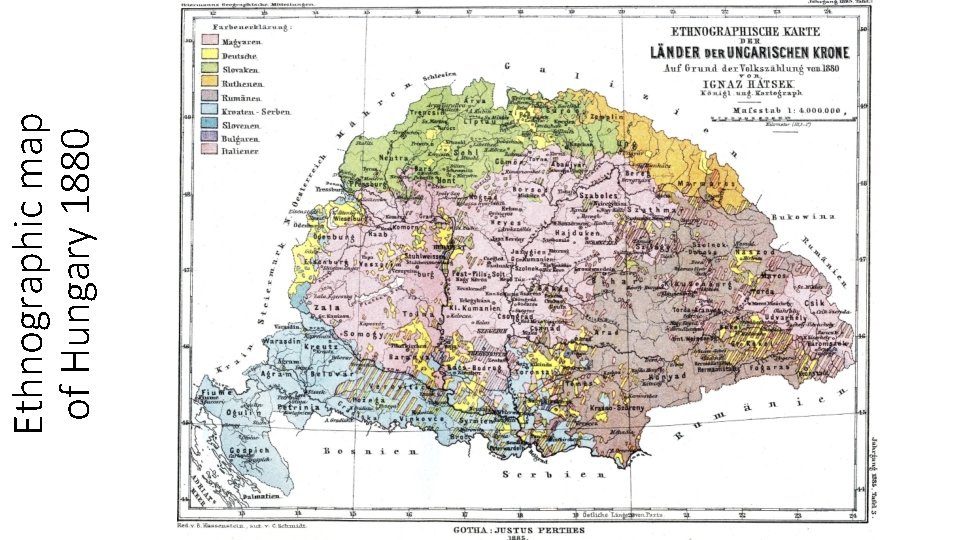
Ethnographic map of Hungary 1880
source
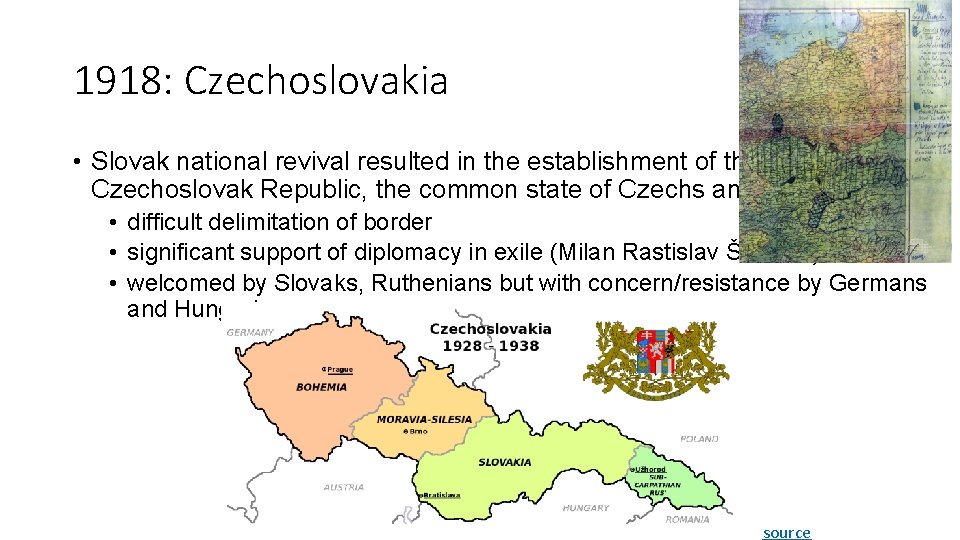
1918: Czechoslovakia • Slovak national revival resulted in the establishment of the Czechoslovak Republic, the common state of Czechs and Slovaks • difficult delimitation of border • significant support of diplomacy in exile (Milan Rastislav Štefánik) • welcomed by Slovaks, Ruthenians but with concern/resistance by Germans and Hungarians source
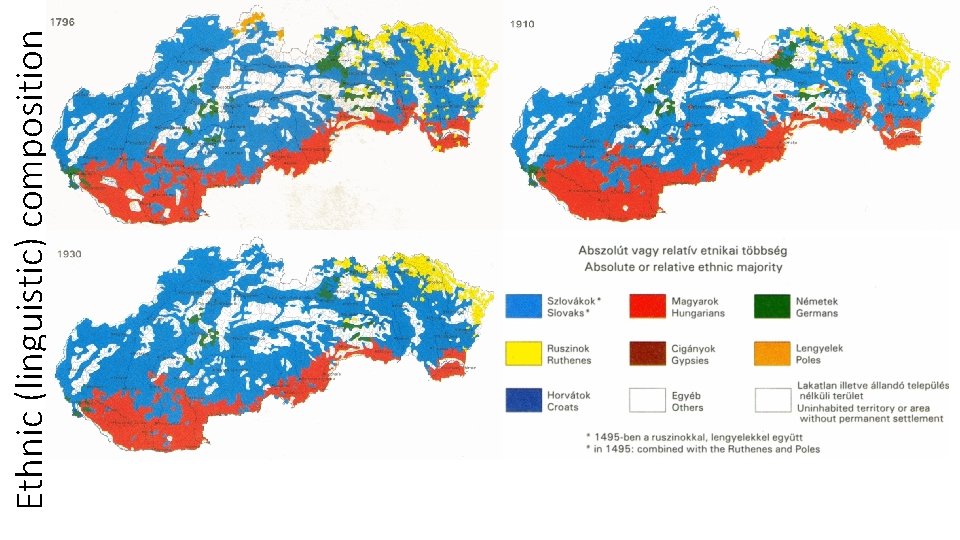
Ethnic (linguistic) composition
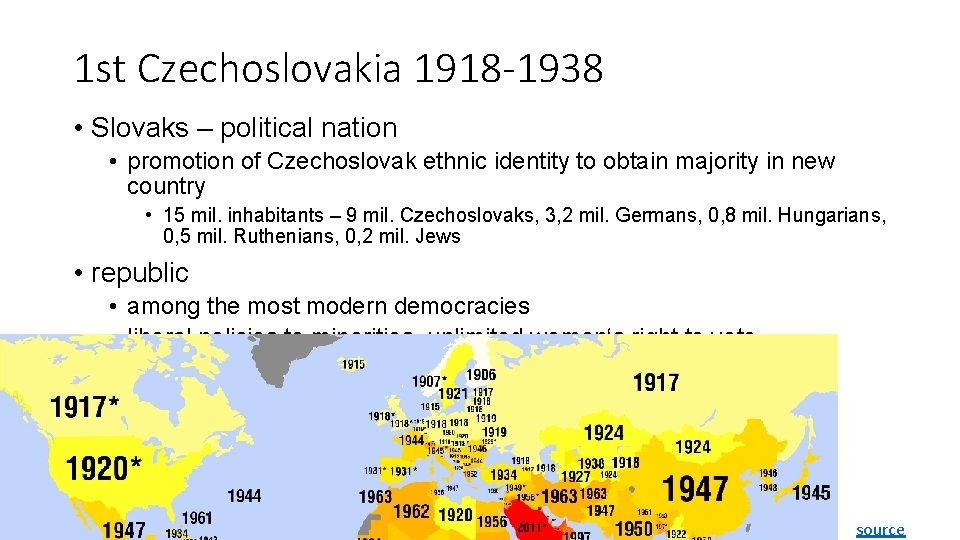
1 st Czechoslovakia 1918 -1938 • Slovaks – political nation • promotion of Czechoslovak ethnic identity to obtain majority in new country • 15 mil. inhabitants – 9 mil. Czechoslovaks, 3, 2 mil. Germans, 0, 8 mil. Hungarians, 0, 5 mil. Ruthenians, 0, 2 mil. Jews • republic • among the most modern democracies • liberal policies to minorities, unlimited women‘s right to vote. . . source
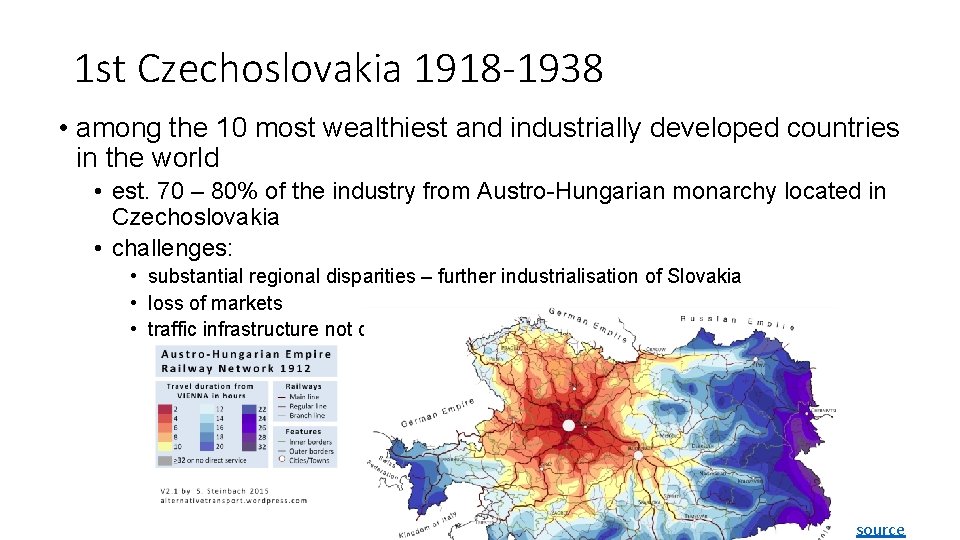
1 st Czechoslovakia 1918 -1938 • among the 10 most wealthiest and industrially developed countries in the world • est. 70 – 80% of the industry from Austro-Hungarian monarchy located in Czechoslovakia • challenges: • substantial regional disparities – further industrialisation of Slovakia • loss of markets • traffic infrastructure not corresponding with the shape of new country source
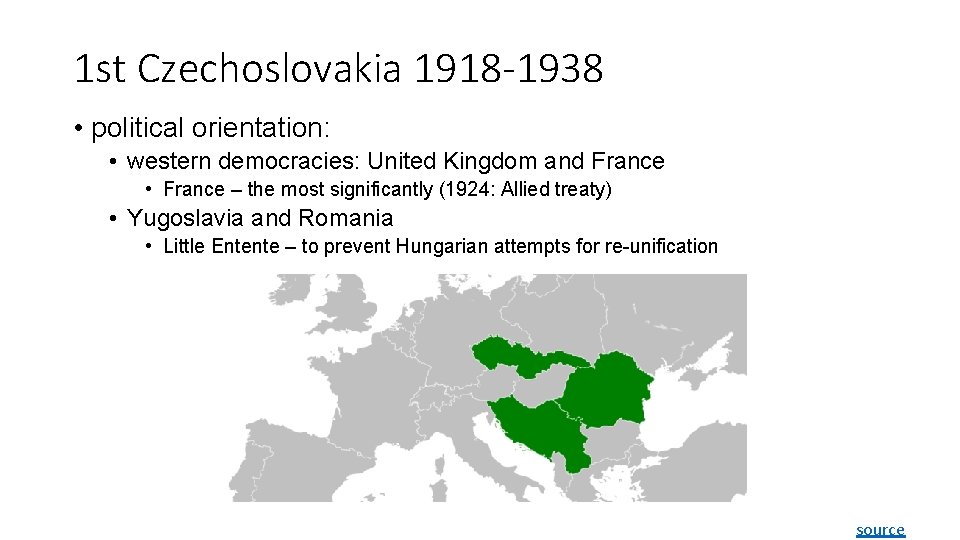
1 st Czechoslovakia 1918 -1938 • political orientation: • western democracies: United Kingdom and France • France – the most significantly (1924: Allied treaty) • Yugoslavia and Romania • Little Entente – to prevent Hungarian attempts for re-unification source
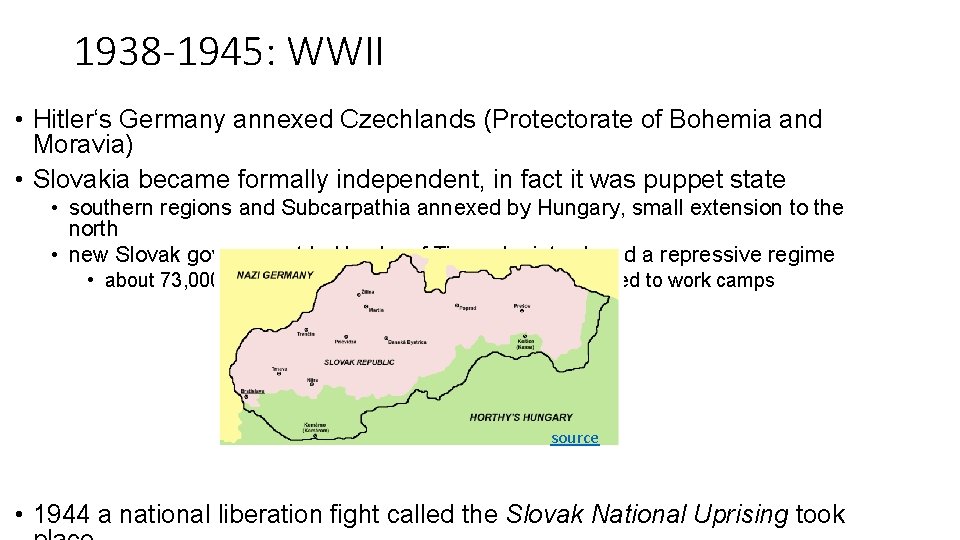
1938 -1945: WWII • Hitler‘s Germany annexed Czechlands (Protectorate of Bohemia and Moravia) • Slovakia became formally independent, in fact it was puppet state • southern regions and Subcarpathia annexed by Hungary, small extension to the north • new Slovak government led by Jozef Tiso, who introduced a repressive regime • about 73, 000 Slovak Jews and thousands of Roma deported to work camps source • 1944 a national liberation fight called the Slovak National Uprising took
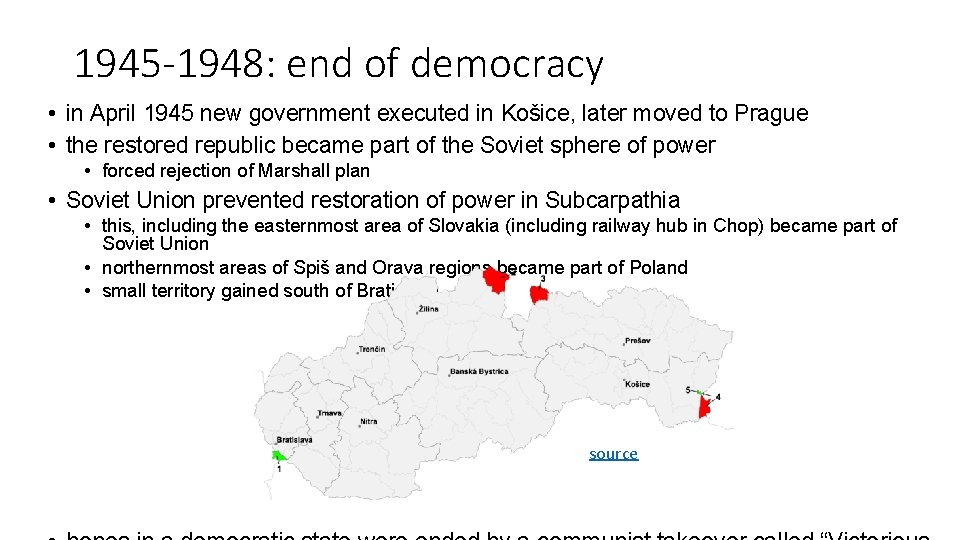
1945 -1948: end of democracy • in April 1945 new government executed in Košice, later moved to Prague • the restored republic became part of the Soviet sphere of power • forced rejection of Marshall plan • Soviet Union prevented restoration of power in Subcarpathia • this, including the easternmost area of Slovakia (including railway hub in Chop) became part of Soviet Union • northernmost areas of Spiš and Orava regions became part of Poland • small territory gained south of Bratislava source
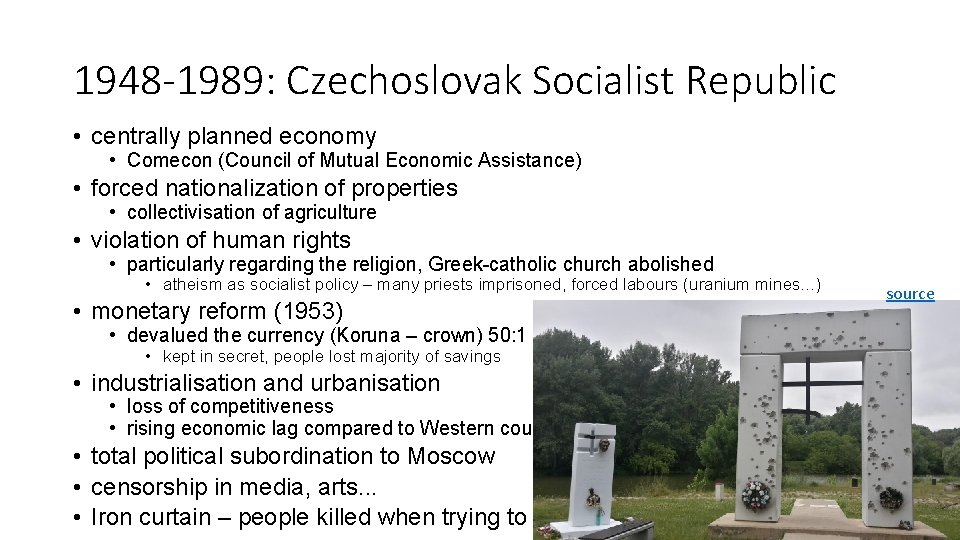
1948 -1989: Czechoslovak Socialist Republic • centrally planned economy • Comecon (Council of Mutual Economic Assistance) • forced nationalization of properties • collectivisation of agriculture • violation of human rights • particularly regarding the religion, Greek-catholic church abolished • atheism as socialist policy – many priests imprisoned, forced labours (uranium mines. . . ) • monetary reform (1953) • devalued the currency (Koruna – crown) 50: 1 • kept in secret, people lost majority of savings • industrialisation and urbanisation • loss of competitiveness • rising economic lag compared to Western countries • total political subordination to Moscow • censorship in media, arts. . . • Iron curtain – people killed when trying to escape source
1948 -1989: Czechoslovak Socialist Republic • 1968 – Czechoslovak communists tried to humanize totalitarian regime and revive society (human rights, censorship, . . . ) • „Socialism with a human face“ • represented by Alexander Dubček – head of communist party • in August armies of 5 Eastern Bloc countries invaded Czechoslovakia • USSR, Poland, Hungary, East Germany, Bulgaria • Soviet troops occupied country over 20 years • period of Normalisation
1989: Fall of totalitarian Communist regime • preceeded by Candle demonstraton in Bratislava in March 1988 • first mass demonstration since 1969 against the communist regime in Czechoslovakia • organized by Roman Catholic dissent groups requesting religious freedom • violently suppressed by the police • Velvet revolution • gradual decay of the Communist regime and the Soviet empire, and the mass protests and demonstrations of the Czechoslovak people culminated in the overthrow of the Communist regime in November 1989 • election of Vaclav Havel as president of the republic • 1990 multi-party elections held • victory of democratic parties
1993: Independent Slovakia • in 1992 peaceful divison of Czechoslovakia was agreed • January 1 st, 1993 – Slovakia gained independence, Bratislava became capital • wild privatization and authoritarian regime of Prime minister Vladimír Mečiar • e. g. , 1997 U. S. Secretary of State Madeleine Albright described Slovakia as the “black hole of Europe. ” It was when the son of then president Michal Kováč had been kidnapped and a key witness in the case was murdered. All probably organized by Slovak secret service • lagging behind the surrounding countries in the integration process to Western structures • after 1998 and particularly 2002 – substantial reforms made by right-wing government of Mikuláš Dzurinda • from Black hole to Tatra tiger • since 2006 (except for 2010 -2012) Slovakia has been ruled by socialist party Smer of Robert Fico • criticised for deterioration of the business environment, law enforcement. . . • February 2018: the murder of young Slovak investigative journalist reporting cases of the
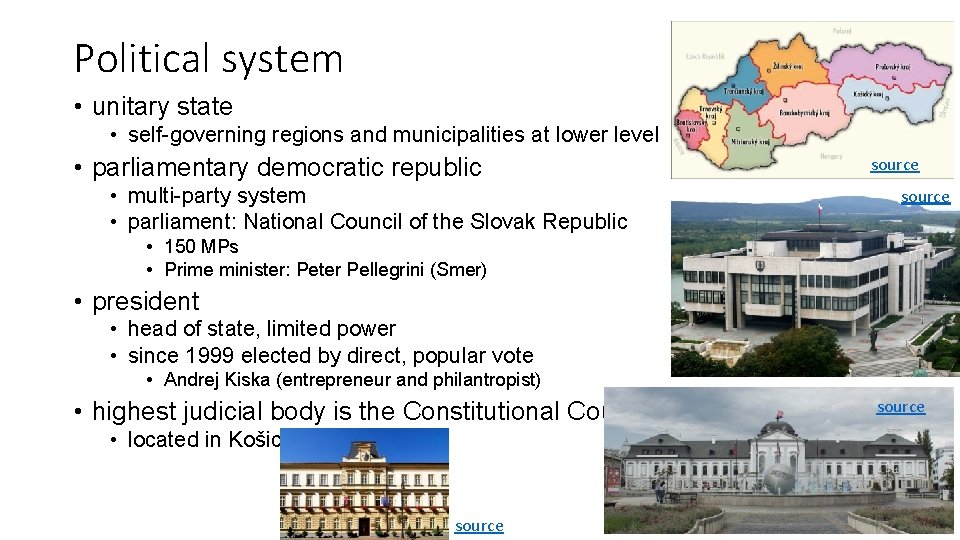
Political system • unitary state • self-governing regions and municipalities at lower level • parliamentary democratic republic • multi-party system • parliament: National Council of the Slovak Republic source • 150 MPs • Prime minister: Peter Pellegrini (Smer) • president • head of state, limited power • since 1999 elected by direct, popular vote • Andrej Kiska (entrepreneur and philantropist) • highest judicial body is the Constitutional Court • located in Košice source
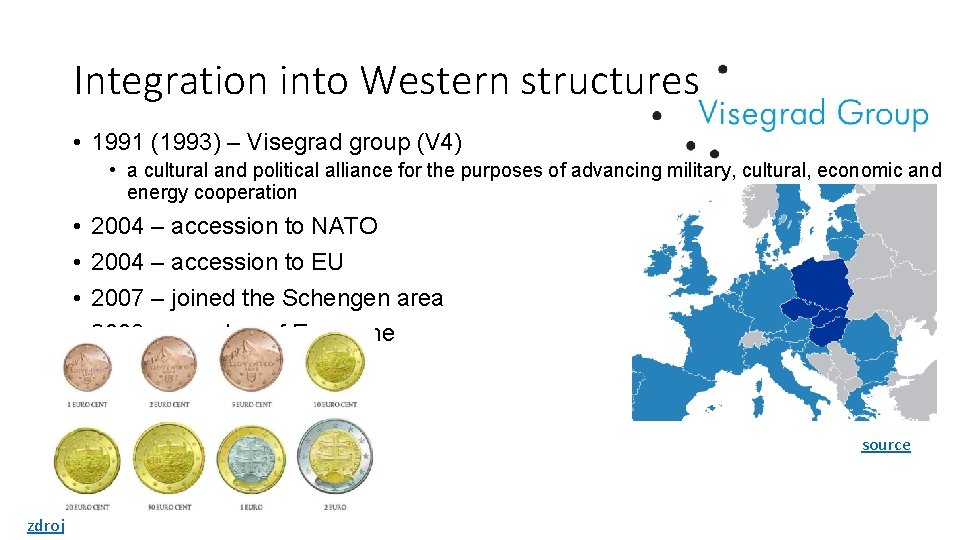
Integration into Western structures • 1991 (1993) – Visegrad group (V 4) • a cultural and political alliance for the purposes of advancing military, cultural, economic and energy cooperation • • 2004 – accession to NATO 2004 – accession to EU 2007 – joined the Schengen area 2009 – member of Eurozone source zdroj