
Historic People World History Unit 8 Essential Questions
- Slides: 39
Historic People World History Unit 8
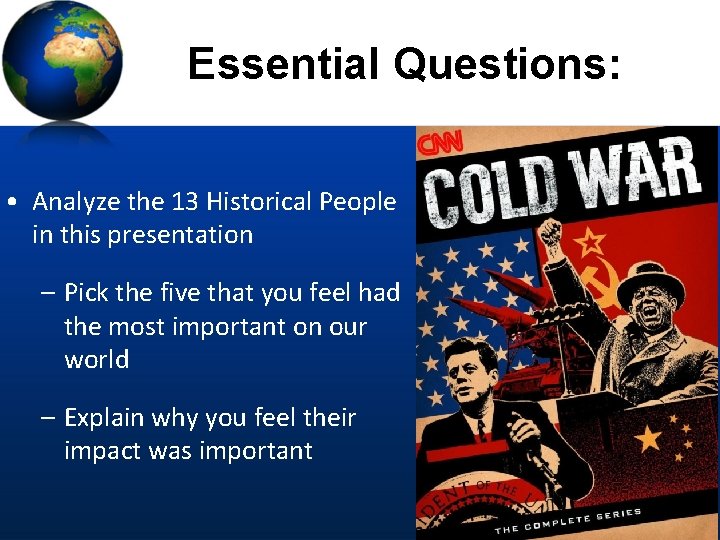
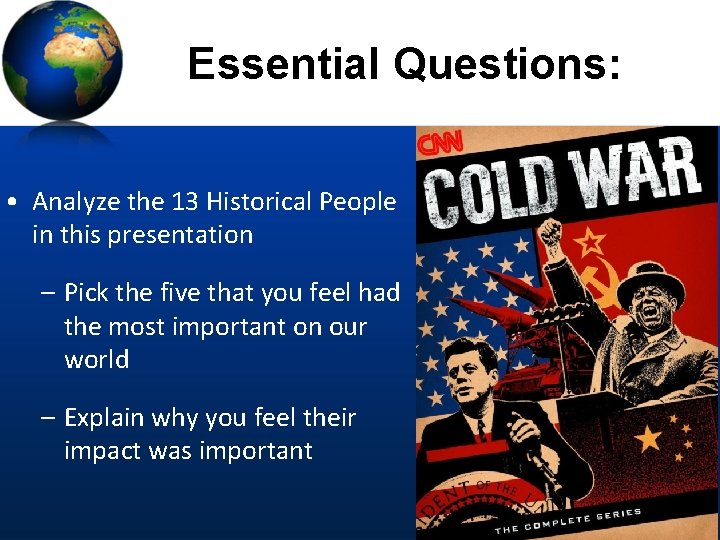
Essential Questions: • Analyze the 13 Historical People in this presentation – Pick the five that you feel had the most important on our world – Explain why you feel their impact was important
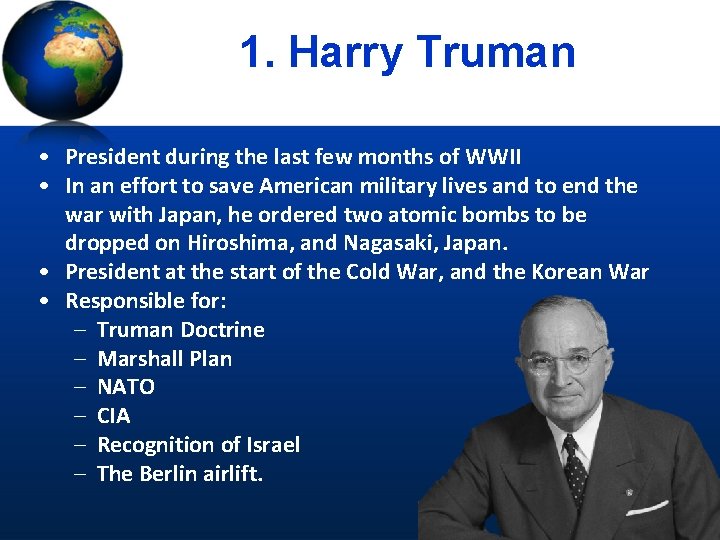
1. Harry Truman • President during the last few months of WWII • In an effort to save American military lives and to end the war with Japan, he ordered two atomic bombs to be dropped on Hiroshima, and Nagasaki, Japan. • President at the start of the Cold War, and the Korean War • Responsible for: – Truman Doctrine – Marshall Plan – NATO – CIA – Recognition of Israel – The Berlin airlift.
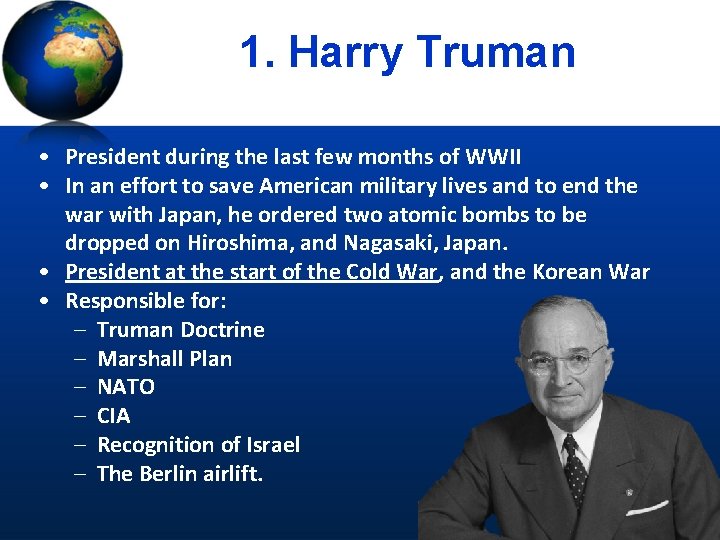
1. Harry Truman • President during the last few months of WWII • In an effort to save American military lives and to end the war with Japan, he ordered two atomic bombs to be dropped on Hiroshima, and Nagasaki, Japan. • President at the start of the Cold War, and the Korean War • Responsible for: – Truman Doctrine – Marshall Plan – NATO – CIA – Recognition of Israel – The Berlin airlift.
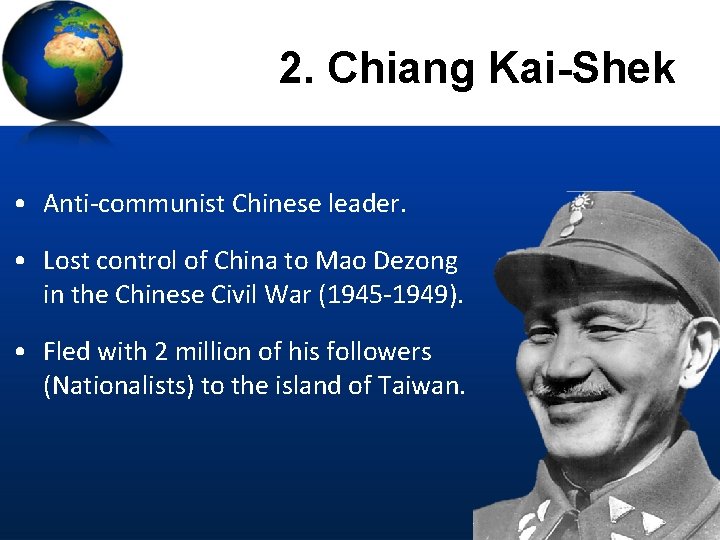
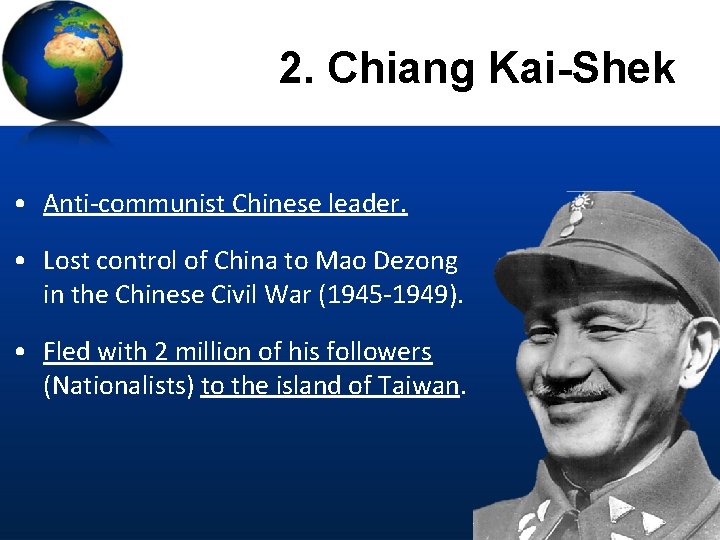
2. Chiang Kai-Shek • Anti-communist Chinese leader. • Lost control of China to Mao Dezong in the Chinese Civil War (1945 -1949). • Fled with 2 million of his followers (Nationalists) to the island of Taiwan.
2. Chiang Kai-Shek • Anti-communist Chinese leader. • Lost control of China to Mao Dezong in the Chinese Civil War (1945 -1949). • Fled with 2 million of his followers (Nationalists) to the island of Taiwan.
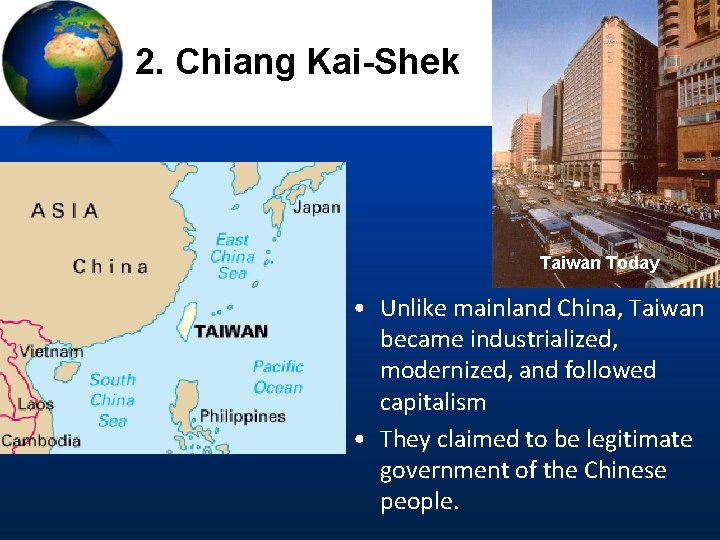
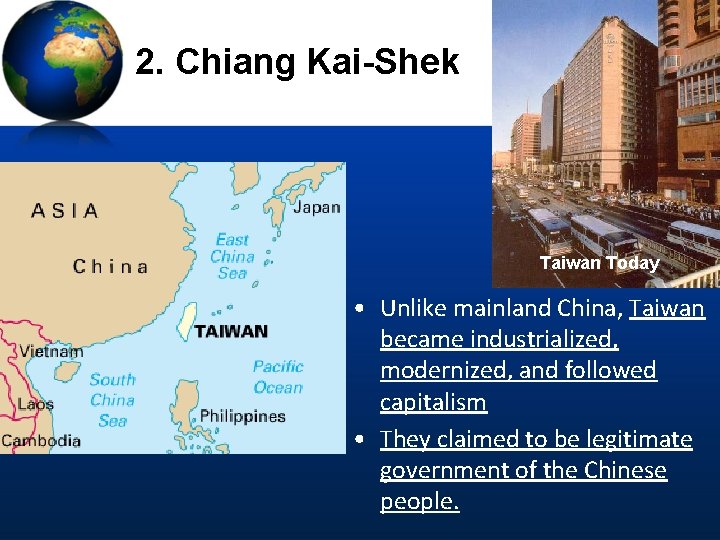
2. Chiang Kai-Shek Taiwan Today • Unlike mainland China, Taiwan became industrialized, modernized, and followed capitalism • They claimed to be legitimate government of the Chinese people.
2. Chiang Kai-Shek Taiwan Today • Unlike mainland China, Taiwan became industrialized, modernized, and followed capitalism • They claimed to be legitimate government of the Chinese people.
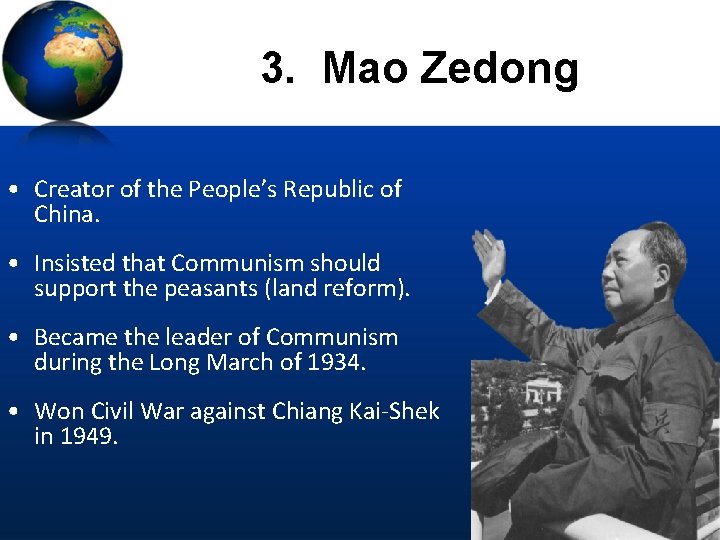
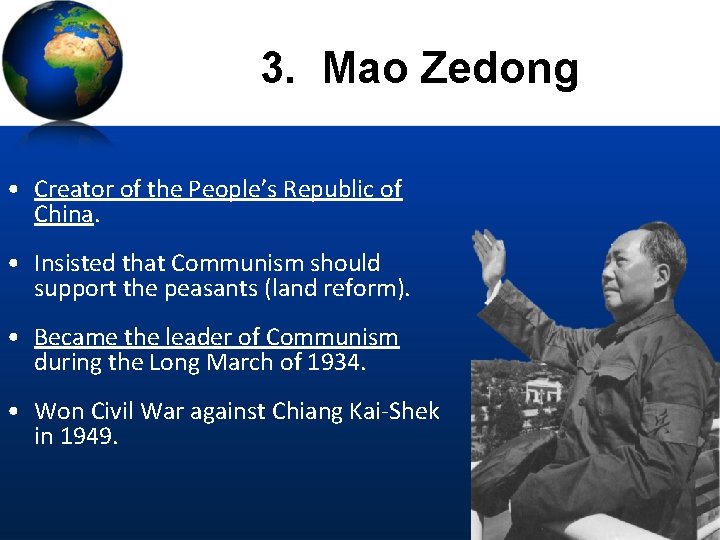
3. Mao Zedong • Creator of the People’s Republic of China. • Insisted that Communism should support the peasants (land reform). • Became the leader of Communism during the Long March of 1934. • Won Civil War against Chiang Kai-Shek in 1949.
3. Mao Zedong • Creator of the People’s Republic of China. • Insisted that Communism should support the peasants (land reform). • Became the leader of Communism during the Long March of 1934. • Won Civil War against Chiang Kai-Shek in 1949.
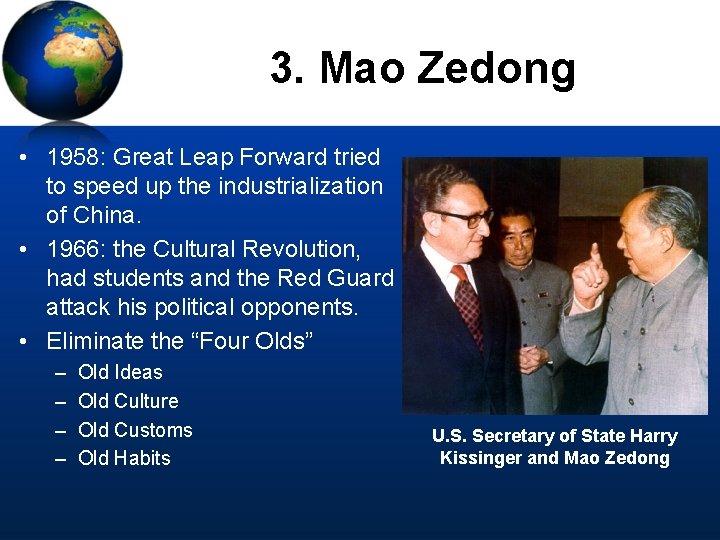
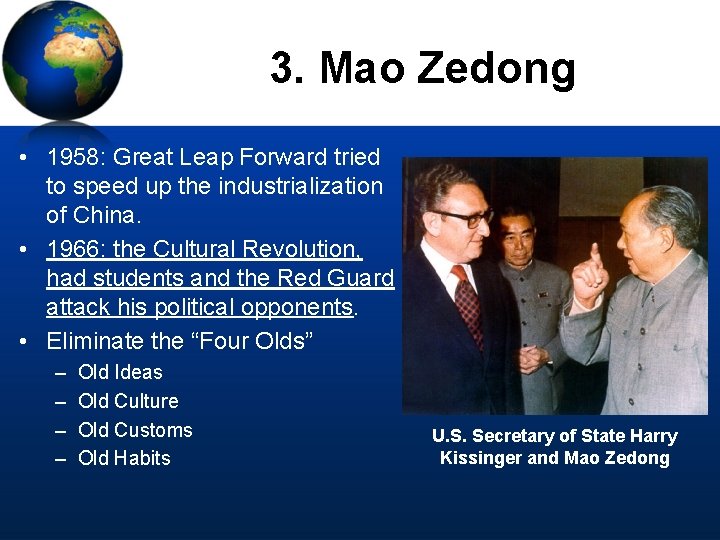
3. Mao Zedong • 1958: Great Leap Forward tried to speed up the industrialization of China. • 1966: the Cultural Revolution, had students and the Red Guard attack his political opponents. • Eliminate the “Four Olds” – – Old Ideas Old Culture Old Customs Old Habits U. S. Secretary of State Harry Kissinger and Mao Zedong
3. Mao Zedong • 1958: Great Leap Forward tried to speed up the industrialization of China. • 1966: the Cultural Revolution, had students and the Red Guard attack his political opponents. • Eliminate the “Four Olds” – – Old Ideas Old Culture Old Customs Old Habits U. S. Secretary of State Harry Kissinger and Mao Zedong
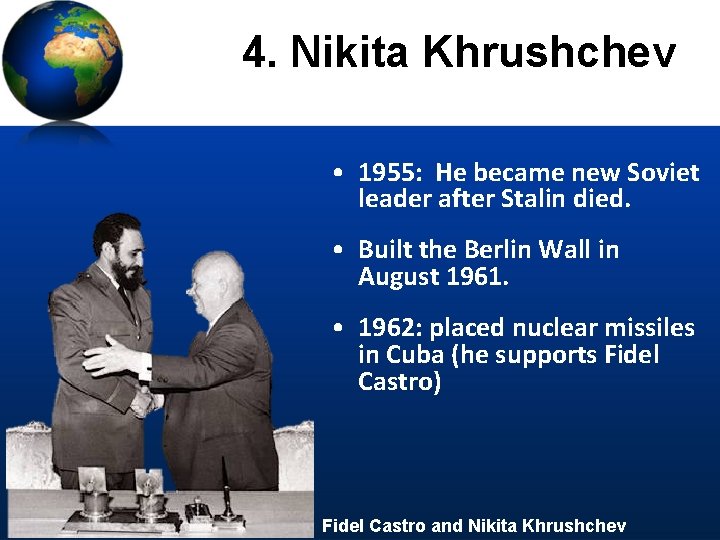
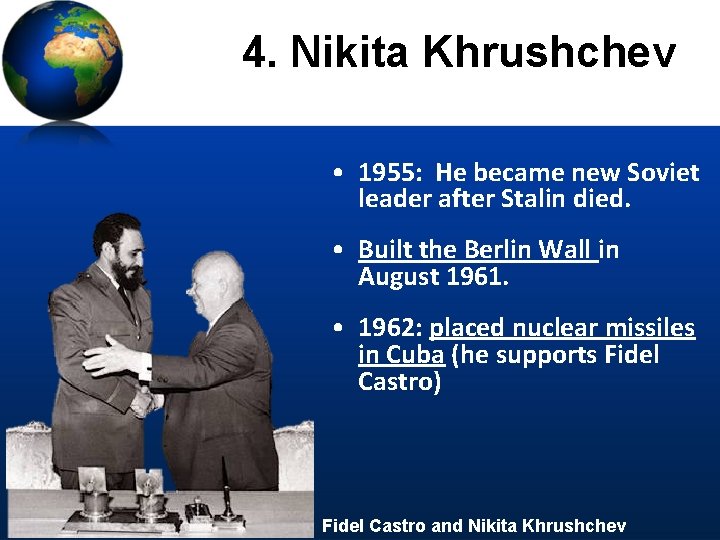
4. Nikita Khrushchev • 1955: He became new Soviet leader after Stalin died. • Built the Berlin Wall in August 1961. • 1962: placed nuclear missiles in Cuba (he supports Fidel Castro) Fidel Castro and Nikita Khrushchev
4. Nikita Khrushchev • 1955: He became new Soviet leader after Stalin died. • Built the Berlin Wall in August 1961. • 1962: placed nuclear missiles in Cuba (he supports Fidel Castro) Fidel Castro and Nikita Khrushchev
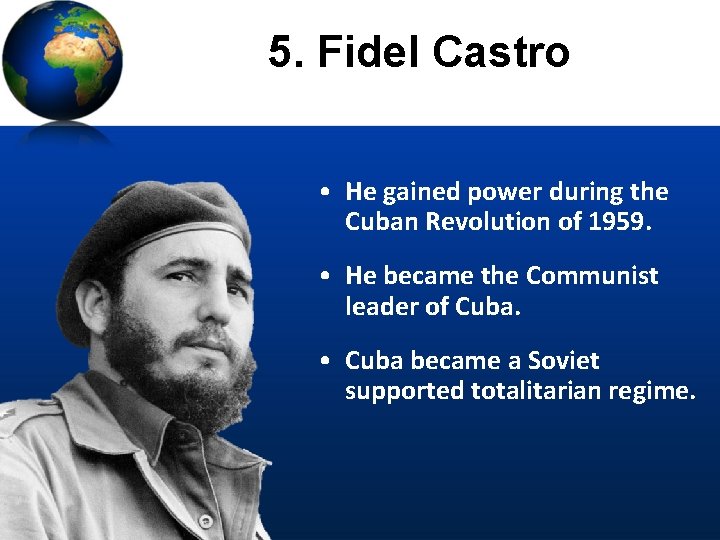
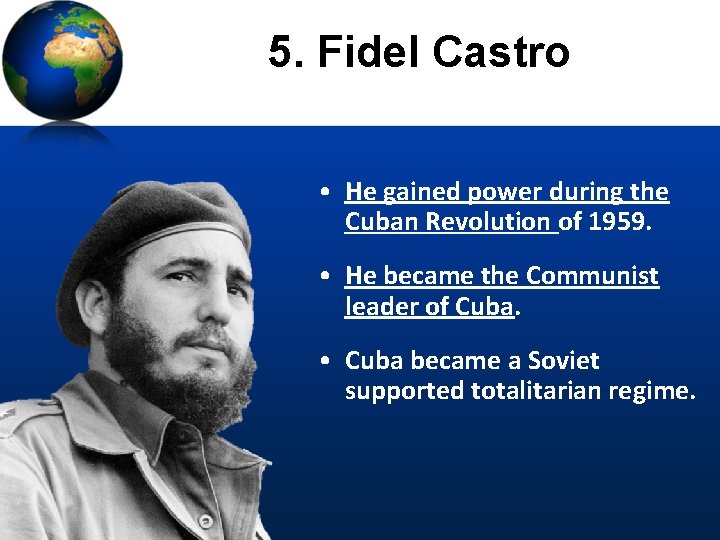
5. Fidel Castro • He gained power during the Cuban Revolution of 1959. • He became the Communist leader of Cuba. • Cuba became a Soviet supported totalitarian regime.
5. Fidel Castro • He gained power during the Cuban Revolution of 1959. • He became the Communist leader of Cuba. • Cuba became a Soviet supported totalitarian regime.
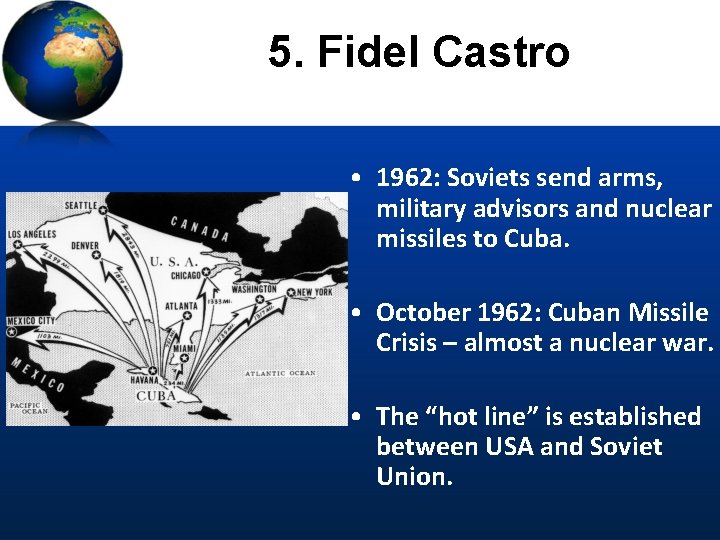
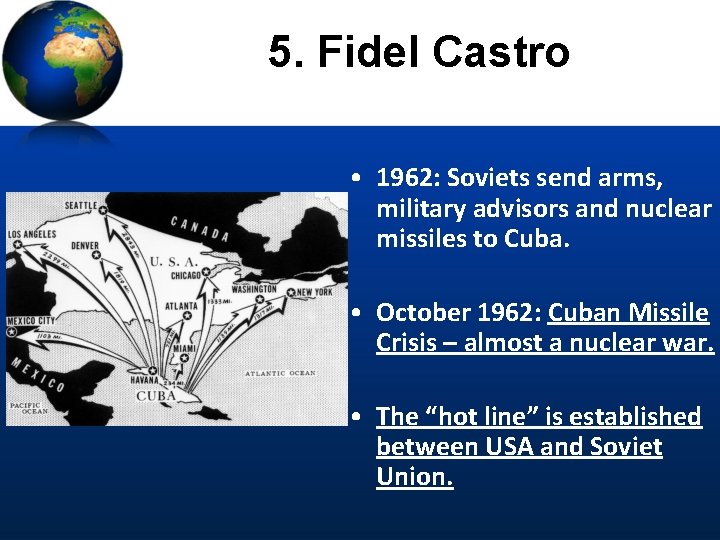
5. Fidel Castro • 1962: Soviets send arms, military advisors and nuclear missiles to Cuba. • October 1962: Cuban Missile Crisis – almost a nuclear war. • The “hot line” is established between USA and Soviet Union.
5. Fidel Castro • 1962: Soviets send arms, military advisors and nuclear missiles to Cuba. • October 1962: Cuban Missile Crisis – almost a nuclear war. • The “hot line” is established between USA and Soviet Union.
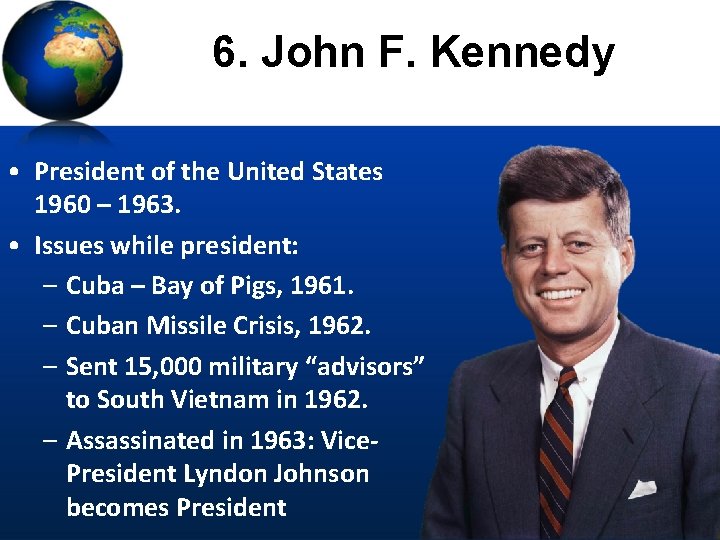
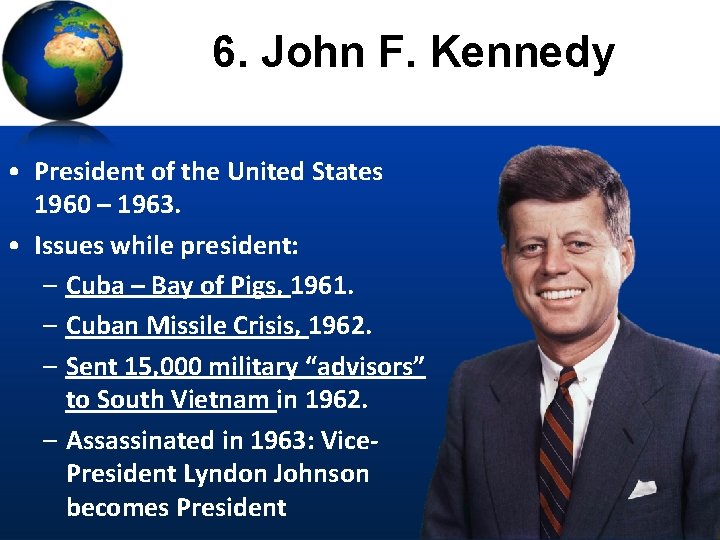
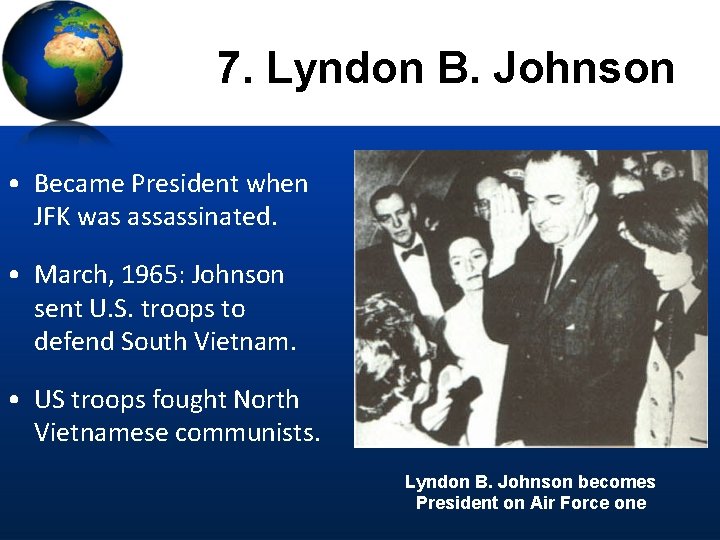
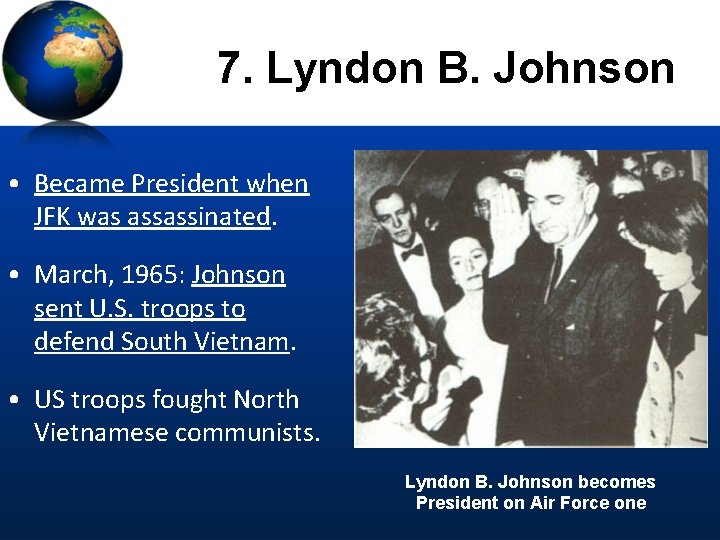
6. John F. Kennedy • President of the United States 1960 – 1963. • Issues while president: – Cuba – Bay of Pigs, 1961. – Cuban Missile Crisis, 1962. – Sent 15, 000 military “advisors” to South Vietnam in 1962. – Assassinated in 1963: Vice. President Lyndon Johnson becomes President JFK
6. John F. Kennedy • President of the United States 1960 – 1963. • Issues while president: – Cuba – Bay of Pigs, 1961. – Cuban Missile Crisis, 1962. – Sent 15, 000 military “advisors” to South Vietnam in 1962. – Assassinated in 1963: Vice. President Lyndon Johnson becomes President JFK
7. Lyndon B. Johnson • Became President when JFK was assassinated. • March, 1965: Johnson sent U. S. troops to defend South Vietnam. • US troops fought North Vietnamese communists. Lyndon B. Johnson becomes President on Air Force one
7. Lyndon B. Johnson • Became President when JFK was assassinated. • March, 1965: Johnson sent U. S. troops to defend South Vietnam. • US troops fought North Vietnamese communists. Lyndon B. Johnson becomes President on Air Force one
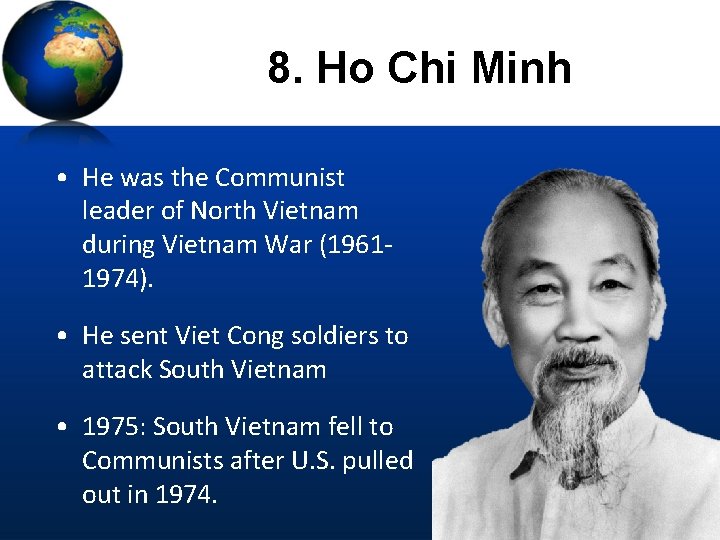
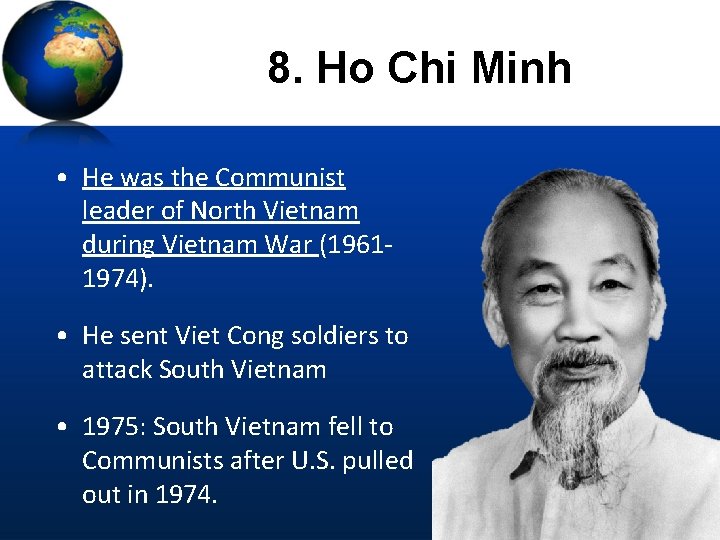
8. Ho Chi Minh • He was the Communist leader of North Vietnam during Vietnam War (19611974). • He sent Viet Cong soldiers to attack South Vietnam • 1975: South Vietnam fell to Communists after U. S. pulled out in 1974.
8. Ho Chi Minh • He was the Communist leader of North Vietnam during Vietnam War (19611974). • He sent Viet Cong soldiers to attack South Vietnam • 1975: South Vietnam fell to Communists after U. S. pulled out in 1974.
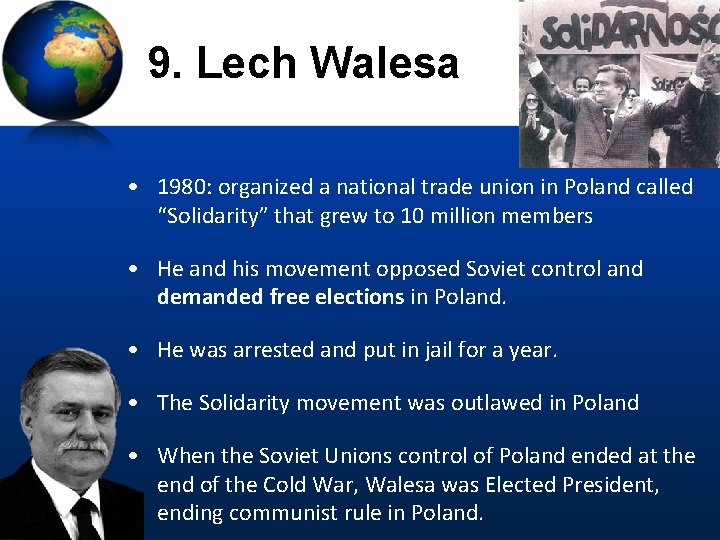
9. Lech Walesa • 1980: organized a national trade union in Poland called “Solidarity” that grew to 10 million members • He and his movement opposed Soviet control and demanded free elections in Poland. • He was arrested and put in jail for a year. • The Solidarity movement was outlawed in Poland • When the Soviet Unions control of Poland ended at the end of the Cold War, Walesa was Elected President, ending communist rule in Poland.
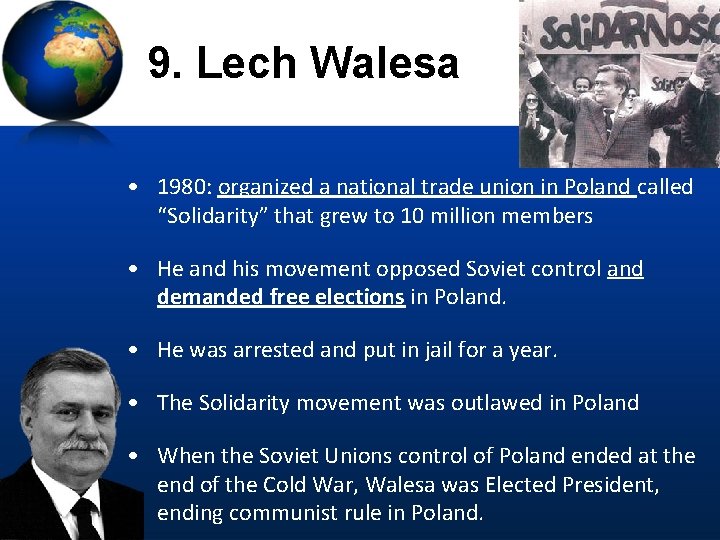
9. Lech Walesa • 1980: organized a national trade union in Poland called “Solidarity” that grew to 10 million members • He and his movement opposed Soviet control and demanded free elections in Poland. • He was arrested and put in jail for a year. • The Solidarity movement was outlawed in Poland • When the Soviet Unions control of Poland ended at the end of the Cold War, Walesa was Elected President, ending communist rule in Poland.
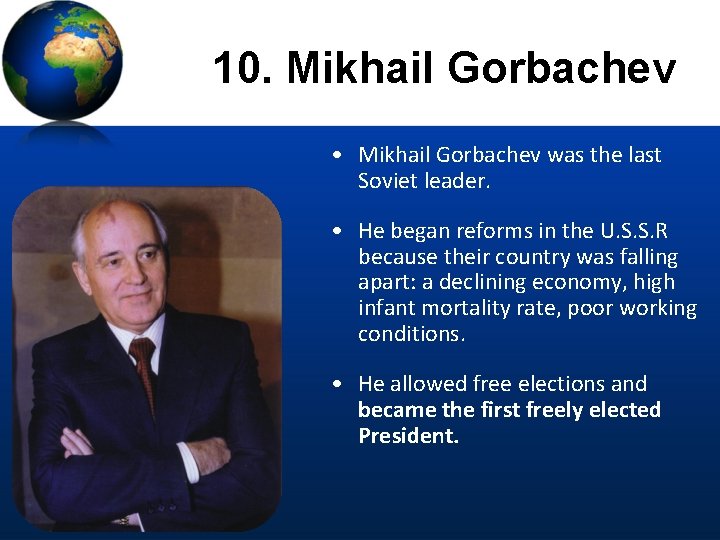
10. Mikhail Gorbachev • Mikhail Gorbachev was the last Soviet leader. • He began reforms in the U. S. S. R because their country was falling apart: a declining economy, high infant mortality rate, poor working conditions. • He allowed free elections and became the first freely elected President.
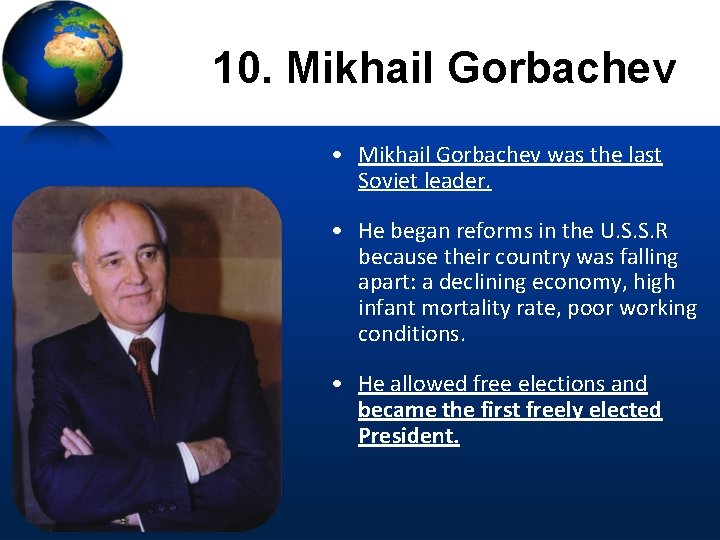
10. Mikhail Gorbachev • Mikhail Gorbachev was the last Soviet leader. • He began reforms in the U. S. S. R because their country was falling apart: a declining economy, high infant mortality rate, poor working conditions. • He allowed free elections and became the first freely elected President.
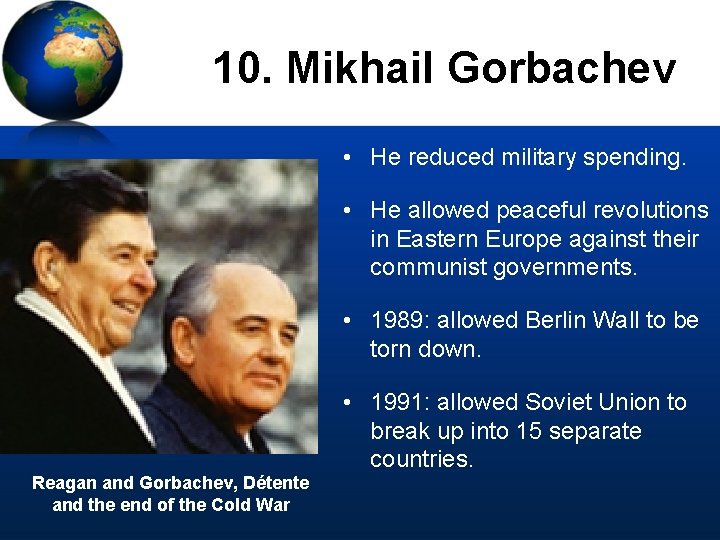
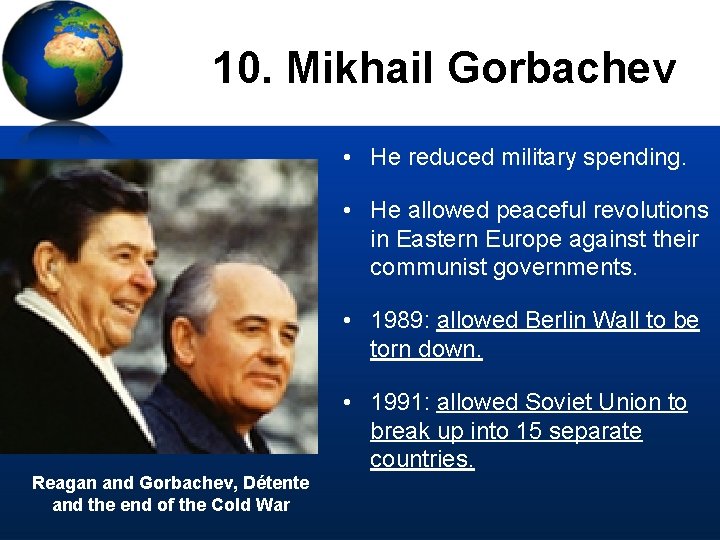
10. Mikhail Gorbachev • He reduced military spending. • He allowed peaceful revolutions in Eastern Europe against their communist governments. • 1989: allowed Berlin Wall to be torn down. • 1991: allowed Soviet Union to break up into 15 separate countries. Reagan and Gorbachev, Détente and the end of the Cold War
10. Mikhail Gorbachev • He reduced military spending. • He allowed peaceful revolutions in Eastern Europe against their communist governments. • 1989: allowed Berlin Wall to be torn down. • 1991: allowed Soviet Union to break up into 15 separate countries. Reagan and Gorbachev, Détente and the end of the Cold War
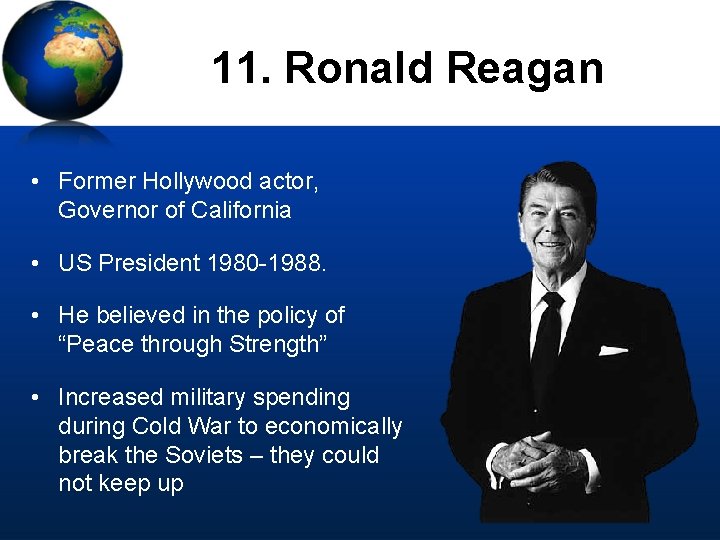
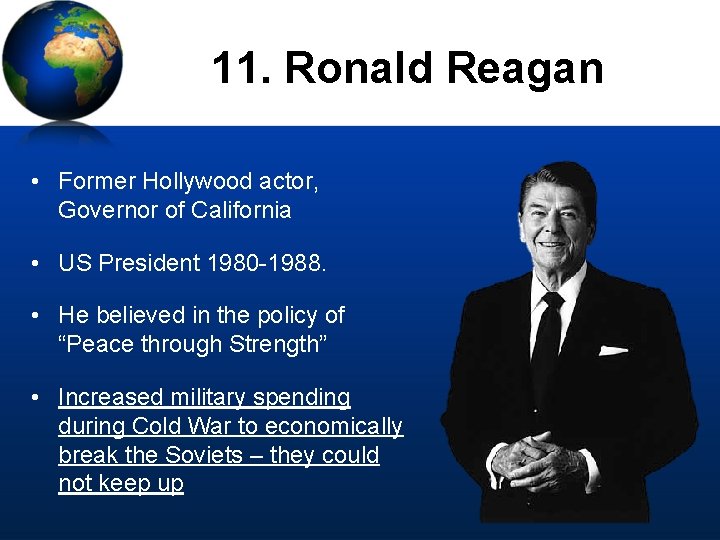
11. Ronald Reagan • Former Hollywood actor, Governor of California • US President 1980 -1988. • He believed in the policy of “Peace through Strength” • Increased military spending during Cold War to economically break the Soviets – they could not keep up
11. Ronald Reagan • Former Hollywood actor, Governor of California • US President 1980 -1988. • He believed in the policy of “Peace through Strength” • Increased military spending during Cold War to economically break the Soviets – they could not keep up
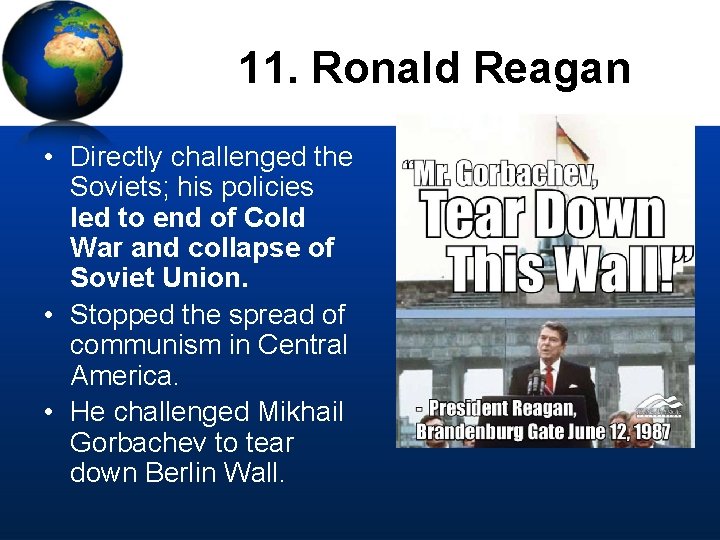
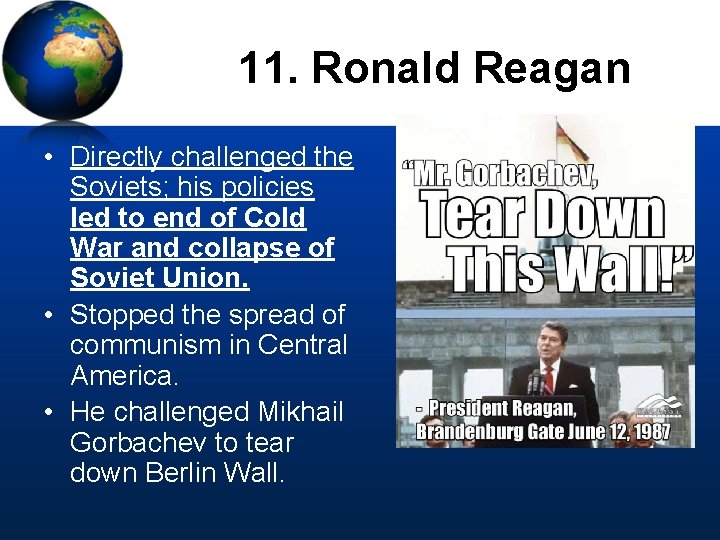
11. Ronald Reagan • Directly challenged the Soviets; his policies led to end of Cold War and collapse of Soviet Union. • Stopped the spread of communism in Central America. • He challenged Mikhail Gorbachev to tear down Berlin Wall.
11. Ronald Reagan • Directly challenged the Soviets; his policies led to end of Cold War and collapse of Soviet Union. • Stopped the spread of communism in Central America. • He challenged Mikhail Gorbachev to tear down Berlin Wall.
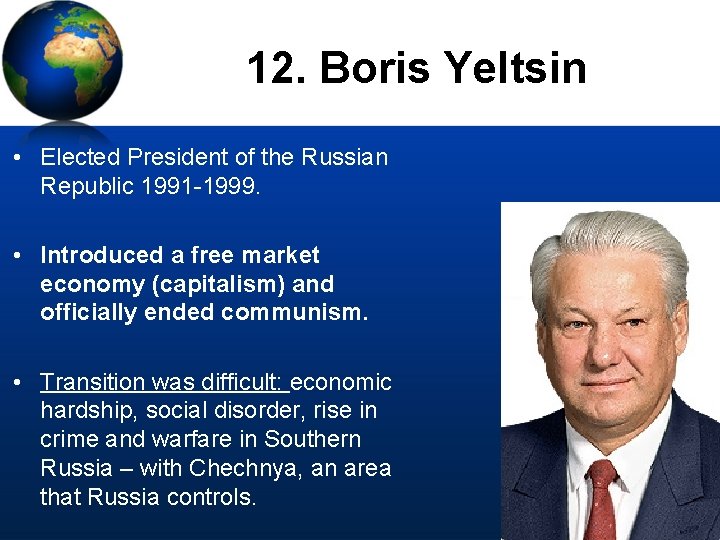
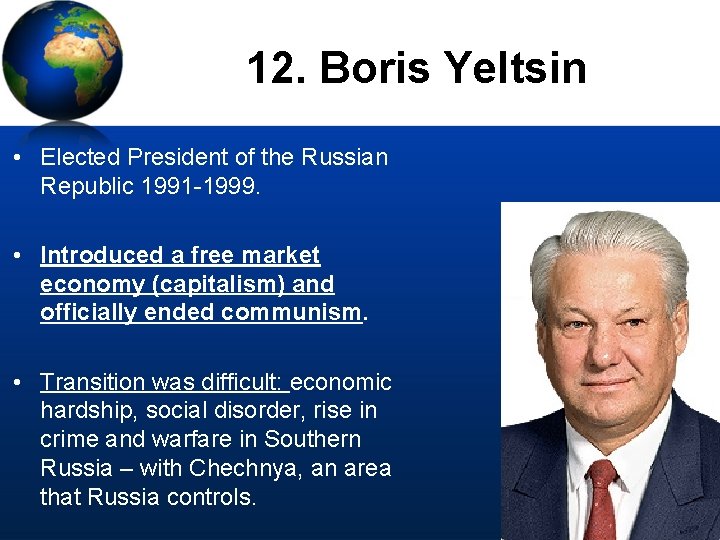
12. Boris Yeltsin • Elected President of the Russian Republic 1991 -1999. • Introduced a free market economy (capitalism) and officially ended communism. • Transition was difficult: economic hardship, social disorder, rise in crime and warfare in Southern Russia – with Chechnya, an area that Russia controls.
12. Boris Yeltsin • Elected President of the Russian Republic 1991 -1999. • Introduced a free market economy (capitalism) and officially ended communism. • Transition was difficult: economic hardship, social disorder, rise in crime and warfare in Southern Russia – with Chechnya, an area that Russia controls.
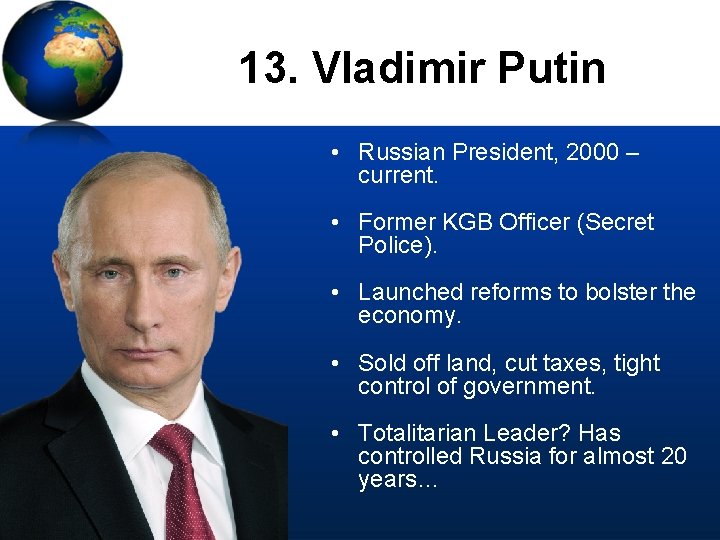
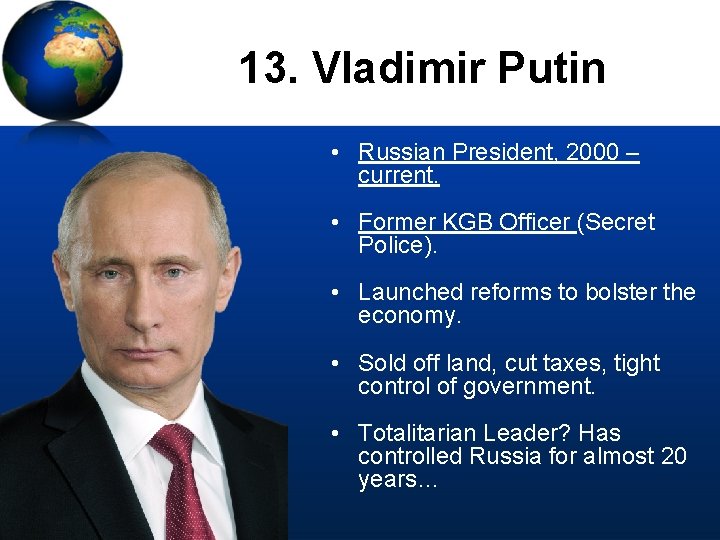
13. Vladimir Putin • Russian President, 2000 – current. • Former KGB Officer (Secret Police). • Launched reforms to bolster the economy. • Sold off land, cut taxes, tight control of government. • Totalitarian Leader? Has controlled Russia for almost 20 years…
13. Vladimir Putin • Russian President, 2000 – current. • Former KGB Officer (Secret Police). • Launched reforms to bolster the economy. • Sold off land, cut taxes, tight control of government. • Totalitarian Leader? Has controlled Russia for almost 20 years…
Essential Questions: • Analyze the 13 Historical People in this presentation – Pick the five that you feel had the most important on our world – Explain why you feel their impact was important