
Histology of the kidney Dra Dvid Assistant lecturer

- Slides: 19
Histology of the kidney Dóra Dávid Assistant lecturer 2018. april
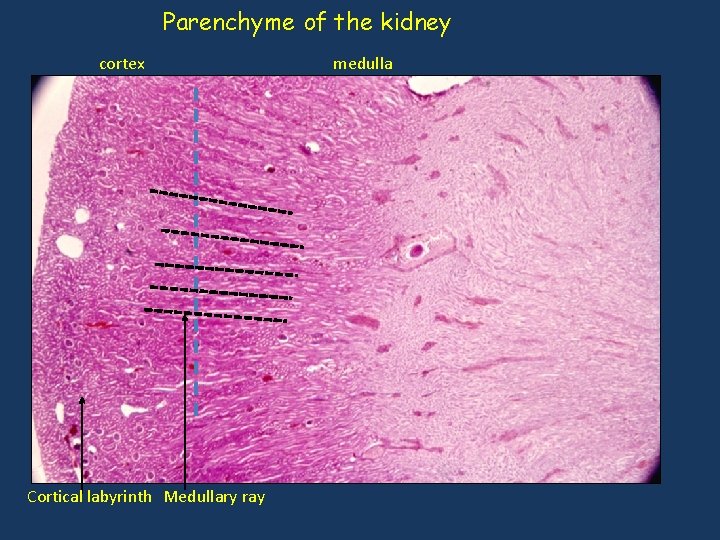
Parenchyme of the kidney cortex Cortical labyrinth Medullary ray medulla
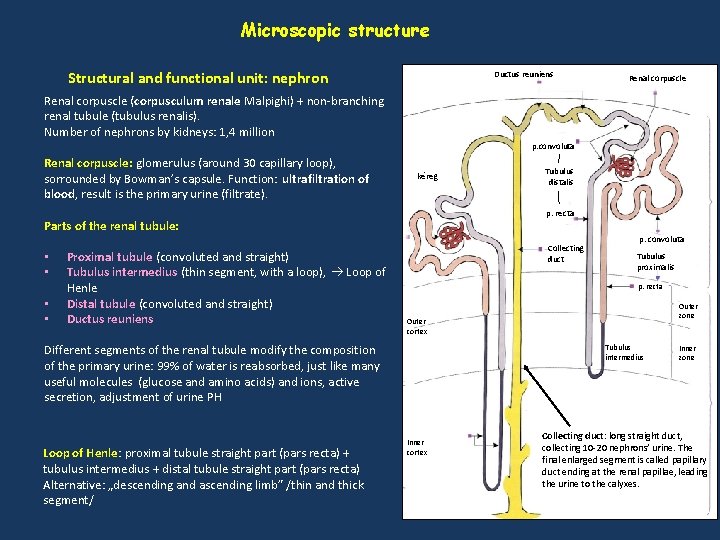
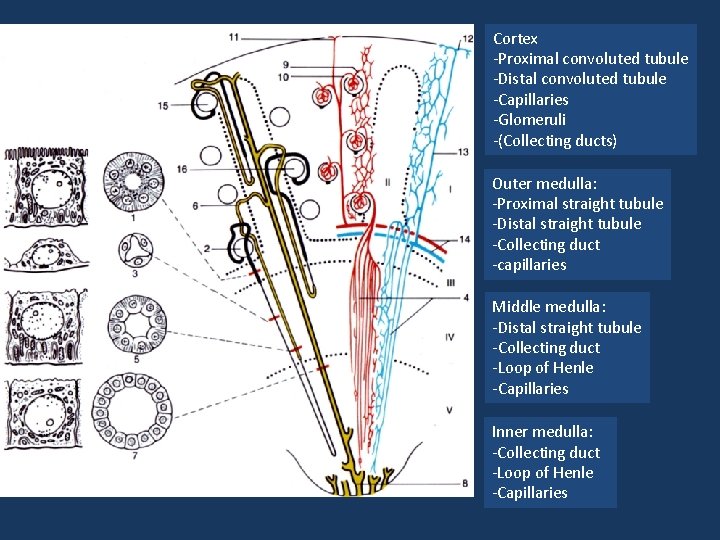
Microscopic structure Structural and functional unit: nephron Ductus reuniens Renal corpuscle (corpusculum renale Malpighi) + non-branching renal tubule (tubulus renalis). Number of nephrons by kidneys: 1, 4 million p. convoluta Renal corpuscle: glomerulus (around 30 capillary loop), sorrounded by Bowman’s capsule. Function: ultrafiltration of blood, result is the primary urine (filtrate). kéreg p. recta Parts of the renal tubule: • • Proximal tubule (convoluted and straight) Tubulus intermedius (thin segment, with a loop), Loop of Henle Distal tubule (convoluted and straight) Ductus reuniens Tubulus distalis p. convoluta Collecting duct Tubulus proximalis p. recta Outer zone Outer cortex Different segments of the renal tubule modify the composition of the primary urine: 99% of water is reabsorbed, just like many useful molecules (glucose and amino acids) and ions, active secretion, adjustment of urine PH Tubulus intermedius Sammelrohr Loop of Henle: proximal tubule straight part (pars recta) + tubulus intermedius + distal tubule straight part (pars recta) Alternative: „descending and ascending limb” /thin and thick segment/ Inner cortex Inner zone Collecting duct: long straight duct, collecting 10 -20 nephrons’ urine. The final enlarged segment is called papillary duct ending at the renal papillae, leading the urine to the calyxes.
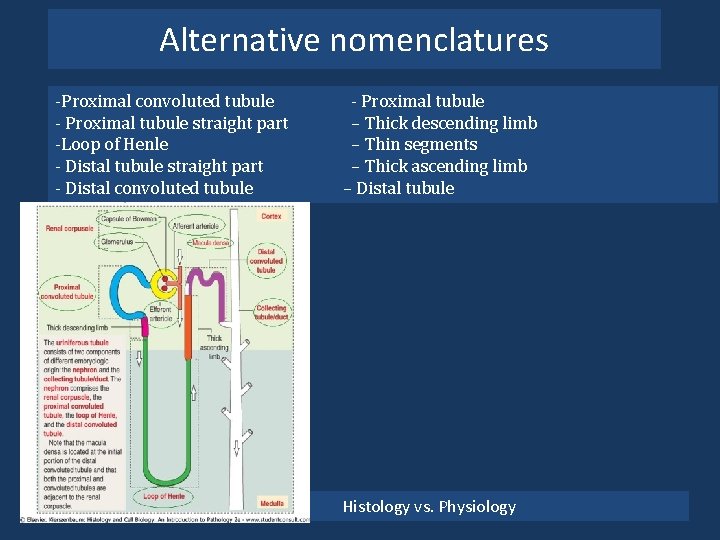
Alternative nomenclatures -Proximal convoluted tubule - Proximal tubule straight part -Loop of Henle - Distal tubule straight part - Distal convoluted tubule - Proximal tubule – Thick descending limb – Thin segments – Thick ascending limb – Distal tubule Histology vs. Physiology
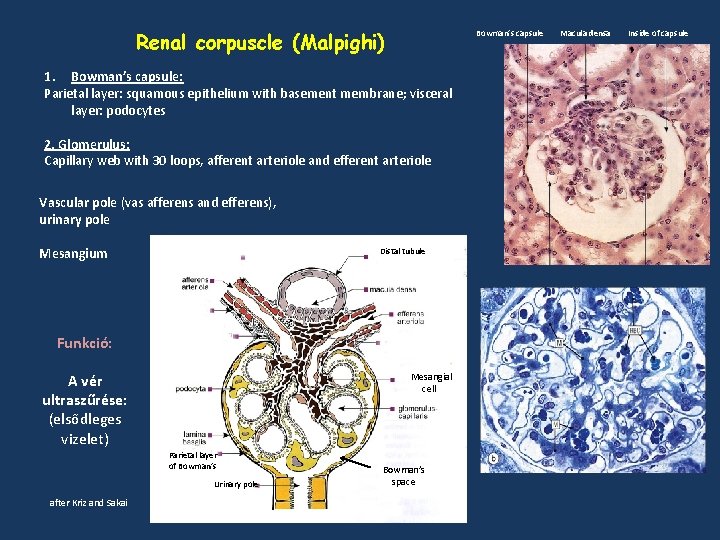
Renal corpuscle (Malpighi) Bowman’s capsule 1. Bowman’s capsule: Parietal layer: squamous epithelium with basement membrane; visceral layer: podocytes 2. Glomerulus: Capillary web with 30 loops, afferent arteriole and efferent arteriole Vascular pole (vas afferens and efferens), urinary pole Mesangium Distal tubule Funkció: . Mesangial cell A vér ultraszűrése: (elsődleges vizelet) Parietal layer of Bowman’s Urinary pole after Kriz and Sakai Bowman’s space Macula densa Inside of capsule
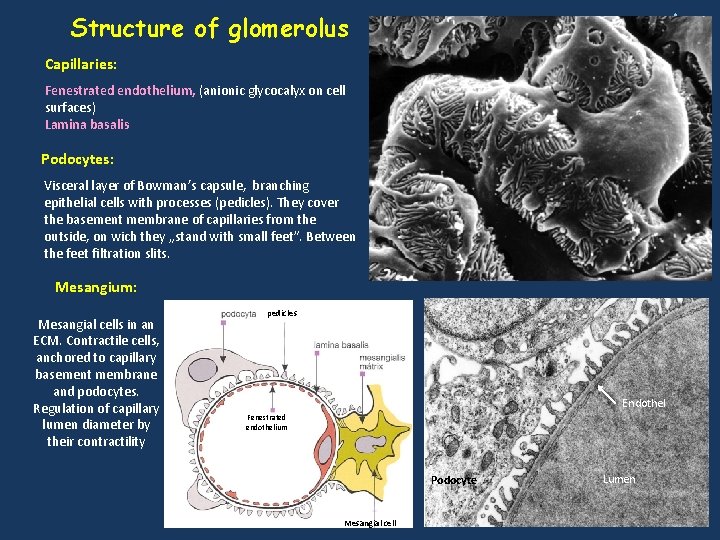
* Structure of glomerolus Capillaries: Fenestrated endothelium, (anionic glycocalyx on cell surfaces) Lamina basalis Podocytes: Visceral layer of Bowman’s capsule, branching epithelial cells with processes (pedicles). They cover the basement membrane of capillaries from the outside, on wich they „stand with small feet”. Between the feet filtration slits. Mesangium: Mesangial cells in an ECM. Contractile cells, anchored to capillary basement membrane and podocytes. Regulation of capillary lumen diameter by their contractility pedicles Endothel Fenestrated endothelium Podocyte Mesangial cell Lumen
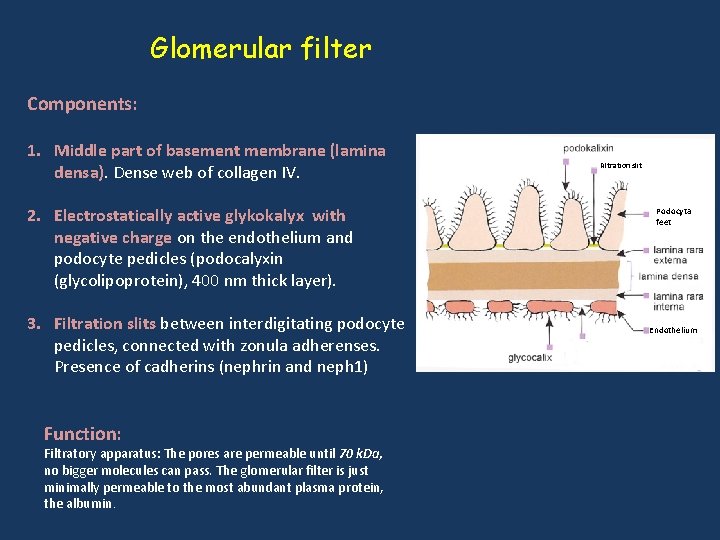
Glomerular filter Components: 1. Middle part of basement membrane (lamina densa). Dense web of collagen IV. 2. Electrostatically active glykokalyx with negative charge on the endothelium and podocyte pedicles (podocalyxin (glycolipoprotein), 400 nm thick layer). 3. Filtration slits between interdigitating podocyte pedicles, connected with zonula adherenses. Presence of cadherins (nephrin and neph 1) Function: Filtratory apparatus: The pores are permeable until 70 k. Da, no bigger molecules can pass. The glomerular filter is just minimally permeable to the most abundant plasma protein, the albumin. Filtration slit Podocyta feet Endothelium
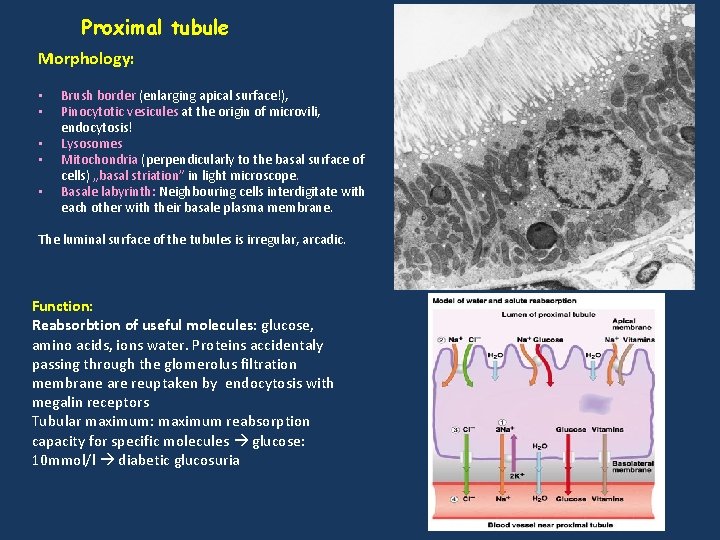
Proximal tubule Morphology: • • • Brush border (enlarging apical surface!), Pinocytotic vesicules at the origin of microvili, endocytosis! Lysosomes Mitochondria (perpendicularly to the basal surface of cells) „basal striation” in light microscope. Basale labyrinth: Neighbouring cells interdigitate with each other with their basale plasma membrane. The luminal surface of the tubules is irregular, arcadic. Function: Reabsorbtion of useful molecules: glucose, amino acids, ions water. Proteins accidentaly passing through the glomerolus filtration membrane are reuptaken by endocytosis with megalin receptors Tubular maximum: maximum reabsorption capacity for specific molecules glucose: 10 mmol/l diabetic glucosuria
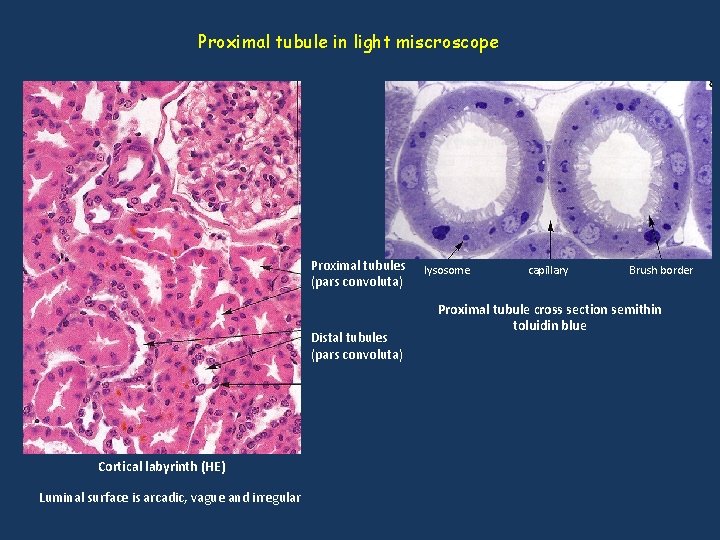
Proximal tubule in light miscroscope Proximal tubules (pars convoluta) Distal tubules (pars convoluta) Cortical labyrinth (HE) Luminal surface is arcadic, vague and irregular lysosome capillary Brush border Proximal tubule cross section semithin toluidin blue
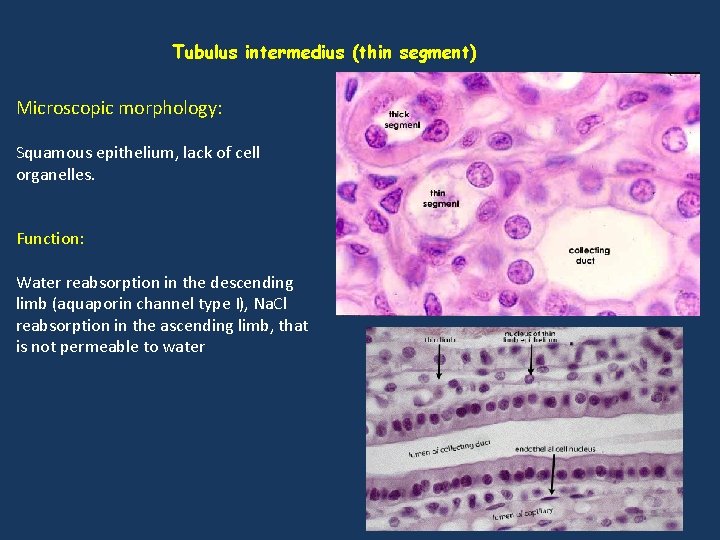
Tubulus intermedius (thin segment) Microscopic morphology: Squamous epithelium, lack of cell organelles. Function: Water reabsorption in the descending limb (aquaporin channel type I), Na. Cl reabsorption in the ascending limb, that is not permeable to water
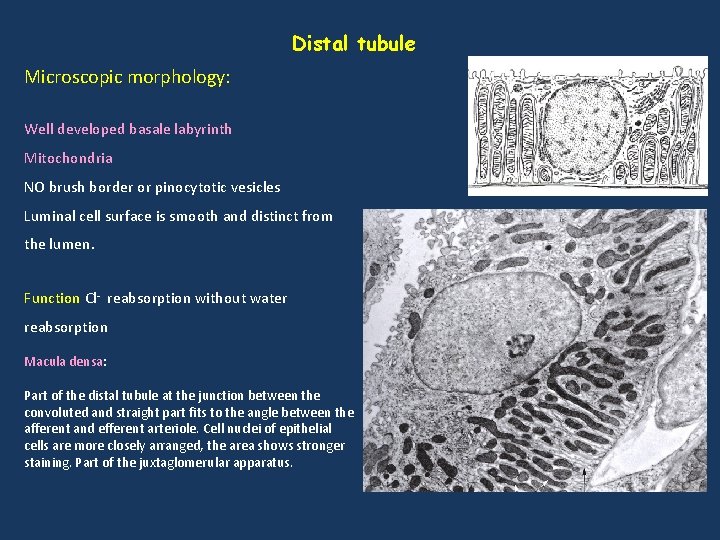
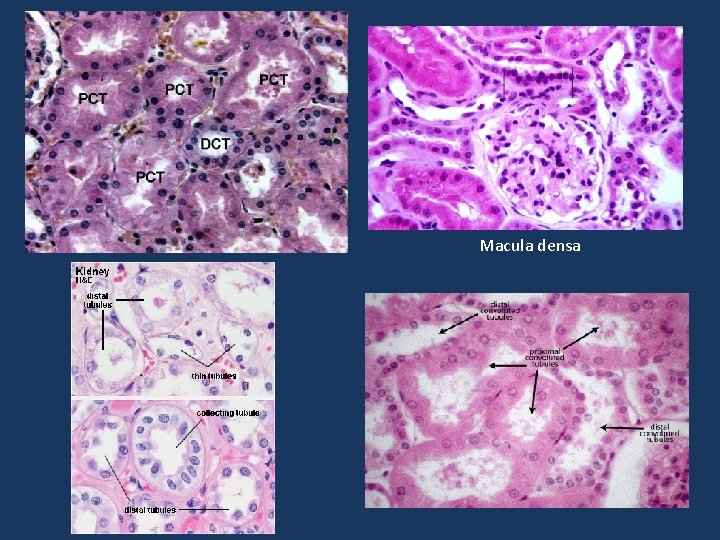
Distal tubule Microscopic morphology: Well developed basale labyrinth Mitochondria NO brush border or pinocytotic vesicles Luminal cell surface is smooth and distinct from the lumen. Function Cl- reabsorption without water reabsorption Macula densa: Part of the distal tubule at the junction between the convoluted and straight part fits to the angle between the afferent and efferent arteriole. Cell nuclei of epithelial cells are more closely arranged, the area shows stronger staining. Part of the juxtaglomerular apparatus.
Macula densa
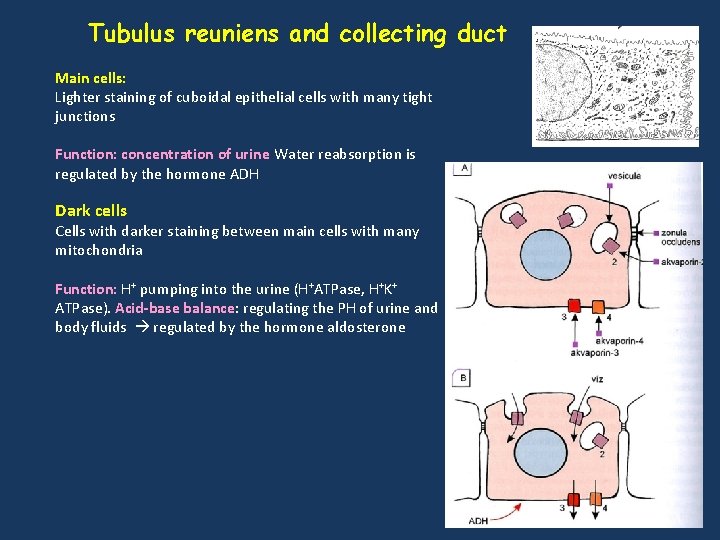
Tubulus reuniens and collecting duct Main cells: Lighter staining of cuboidal epithelial cells with many tight junctions Function: concentration of urine Water reabsorption is regulated by the hormone ADH Dark cells Cells with darker staining between main cells with many mitochondria Function: H+ pumping into the urine (H+ATPase, H+K+ ATPase). Acid-base balance: regulating the PH of urine and body fluids regulated by the hormone aldosterone
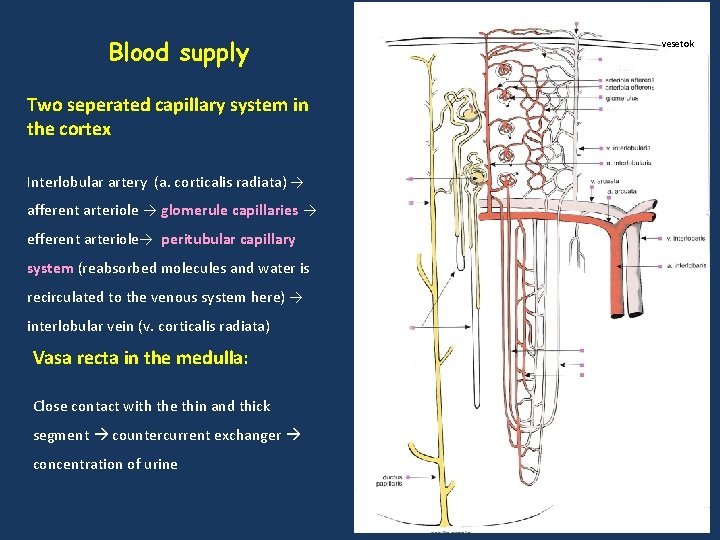
Blood supply Two seperated capillary system in the cortex Interlobular artery (a. corticalis radiata) → afferent arteriole → glomerule capillaries → efferent arteriole→ peritubular capillary system (reabsorbed molecules and water is recirculated to the venous system here) → interlobular vein (v. corticalis radiata) Vasa recta in the medulla: Close contact with the thin and thick segment countercurrent exchanger concentration of urine vesetok
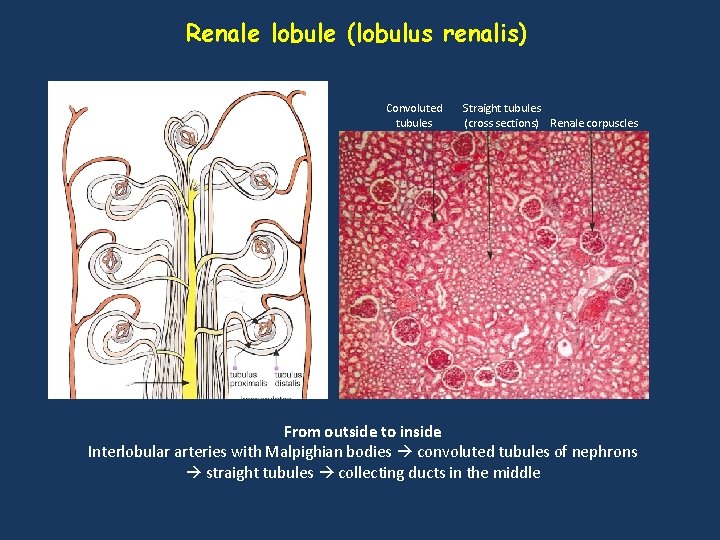
Renale lobule (lobulus renalis) Convoluted tubules Straight tubules (cross sections) Renale corpuscles From outside to inside Interlobular arteries with Malpighian bodies convoluted tubules of nephrons straight tubules collecting ducts in the middle
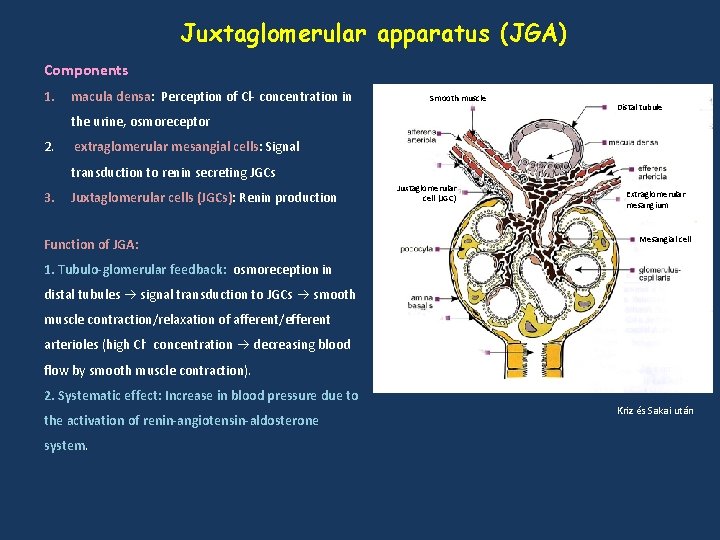
Juxtaglomerular apparatus (JGA) Components 1. macula densa: Perception of Cl- concentration in Smooth muscle Distal tubule the urine, osmoreceptor 2. extraglomerular mesangial cells: Signal transduction to renin secreting JGCs 3. Juxtaglomerular cells (JGCs): Renin production Function of JGA: Juxtaglomerular cell (JGC) Extraglomerular mesangium Mesangial cell 1. Tubulo-glomerular feedback: osmoreception in distal tubules signal transduction to JGCs smooth muscle contraction/relaxation of afferent/efferent arterioles (high Cl- concentration decreasing blood flow by smooth muscle contraction). 2. Systematic effect: Increase in blood pressure due to the activation of renin-angiotensin-aldosterone system. Kriz és Sakai után
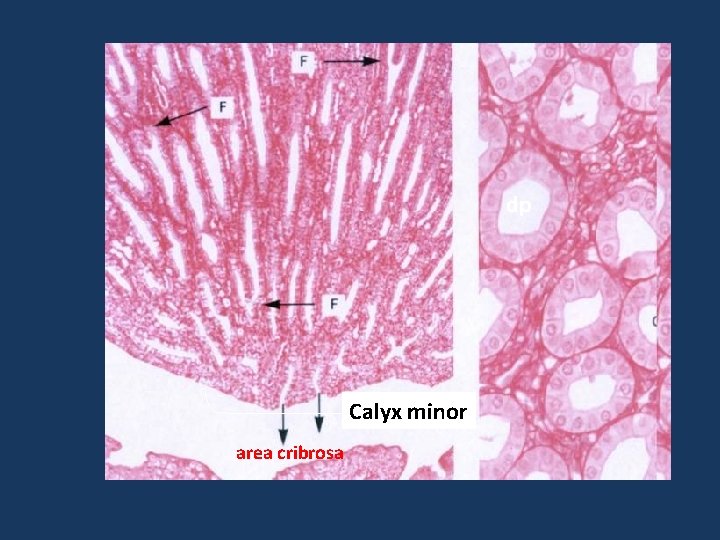
dp Calyx minor area cribrosa
Cortex -Proximal convoluted tubule -Distal convoluted tubule -Capillaries -Glomeruli -(Collecting ducts) Outer medulla: -Proximal straight tubule -Distal straight tubule -Collecting duct -capillaries Middle medulla: -Distal straight tubule -Collecting duct -Loop of Henle -Capillaries Inner medulla: -Collecting duct -Loop of Henle -Capillaries
Thank you for your attention! Source of images Röhlich Pál: Histology (Hungarian), Semmelweis Kiadó, Budapest, 4 th edition, 2014 And: * Ross, Kaye, Pawlina: Histology, 2003