
Histology of the Eye Objectives n By the

Histology of the Eye

Objectives n By the end of this lecture, the student should be able to describe: –The general structure of the eye. –The microscopic structure of: » Cornea. » Retina.
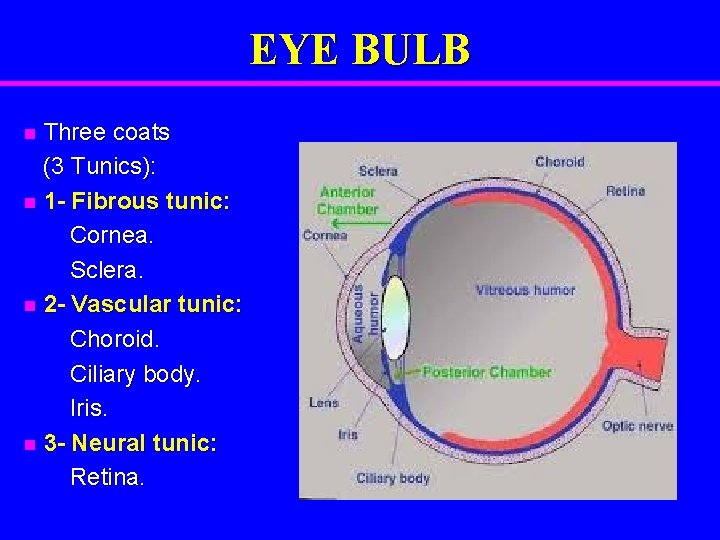
EYE BULB Three coats (3 Tunics): n 1 - Fibrous tunic: Cornea. Sclera. n 2 - Vascular tunic: Choroid. Ciliary body. Iris. n 3 - Neural tunic: Retina. n
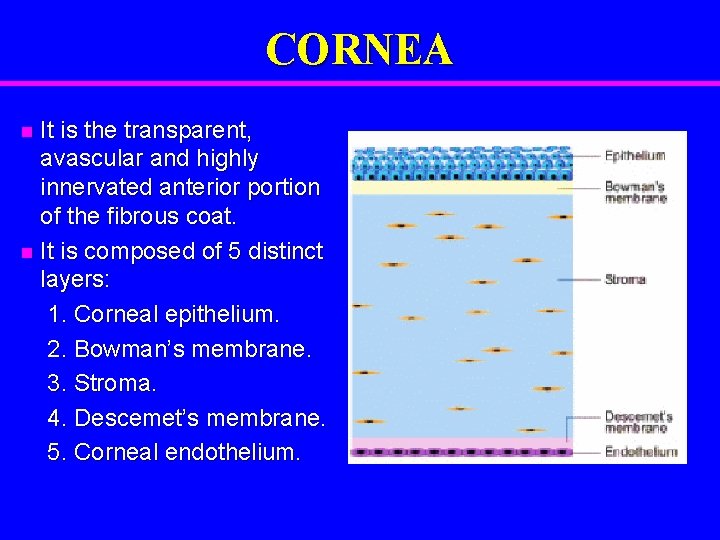
CORNEA It is the transparent, avascular and highly innervated anterior portion of the fibrous coat. n It is composed of 5 distinct layers: 1. Corneal epithelium. 2. Bowman’s membrane. 3. Stroma. 4. Descemet’s membrane. 5. Corneal endothelium. n
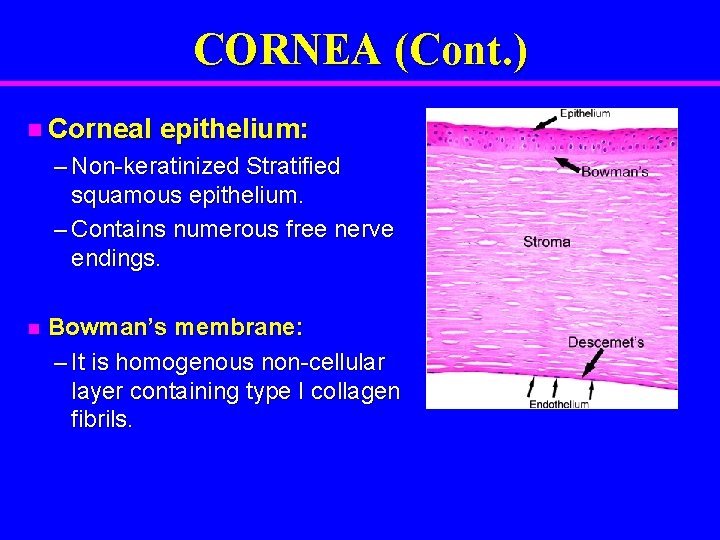
CORNEA (Cont. ) n Corneal epithelium: – Non-keratinized Stratified squamous epithelium. – Contains numerous free nerve endings. n Bowman’s membrane: – It is homogenous non-cellular layer containing type I collagen fibrils.
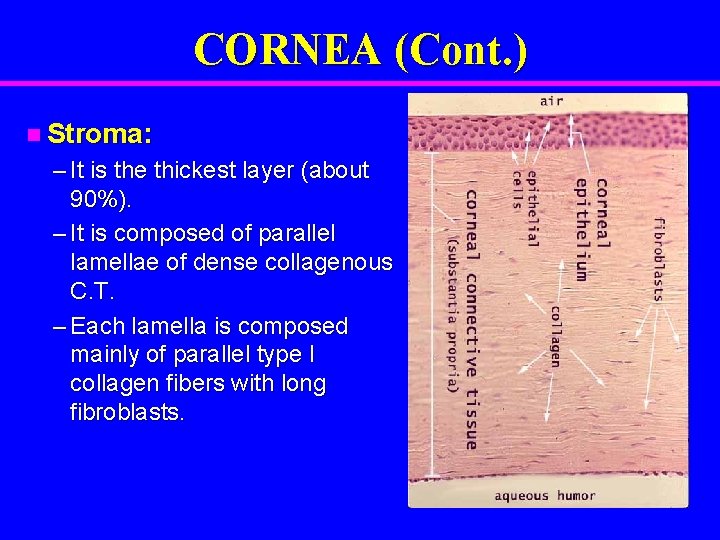
CORNEA (Cont. ) n Stroma: – It is the thickest layer (about 90%). – It is composed of parallel lamellae of dense collagenous C. T. – Each lamella is composed mainly of parallel type I collagen fibers with long fibroblasts.
CORNEA (Cont. ) n Descemet’s membrane: – It is a thick basement membrane. n Corneal endothelium: – It is s simple squamous epithelium. – Functions: 1 - Formation of Descemet’s membrane. 2 - Keeping the stroma relatively dehydrated (sod. pump → water withdrawal from the stroma).

LIMBUS (CORNEO SCLERAL JUNCTION) It is the transition region between the cornea and sclera. n It is about 1. 5 mm width. n It is highly vascular. n It contains: 1. Trabecular meshwork: Endothelium-lined spaces. It leads to canal of Schlemm. 2. Canal of Schlemm: It drains the aqueous humor into the venous system. n Iris Cornea Canal of Schlemm Sclera Ciliary body Lens
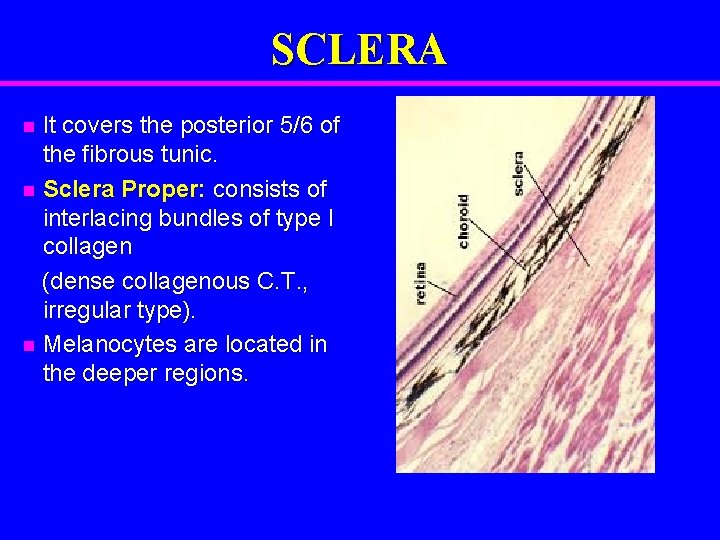
SCLERA It covers the posterior 5/6 of the fibrous tunic. n Sclera Proper: consists of interlacing bundles of type I collagen (dense collagenous C. T. , irregular type). n Melanocytes are located in the deeper regions. n

CHOROID It is the vascular, pigmented posterior portion of the middle vascular tunic. n Structure: It is composed mainly of loose C. T. with melanocytes. It is separated from the retina by its Bruch’s membrane. n
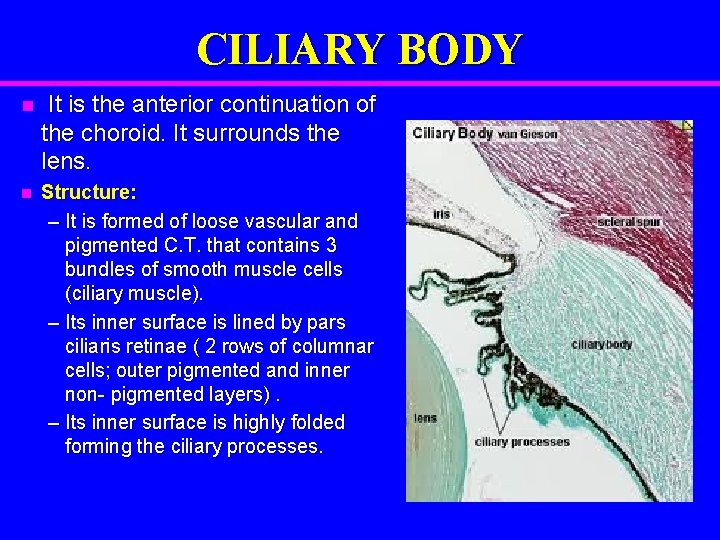
CILIARY BODY n It is the anterior continuation of the choroid. It surrounds the lens. n Structure: – It is formed of loose vascular and pigmented C. T. that contains 3 bundles of smooth muscle cells (ciliary muscle). – Its inner surface is lined by pars ciliaris retinae ( 2 rows of columnar cells; outer pigmented and inner non- pigmented layers). – Its inner surface is highly folded forming the ciliary processes.
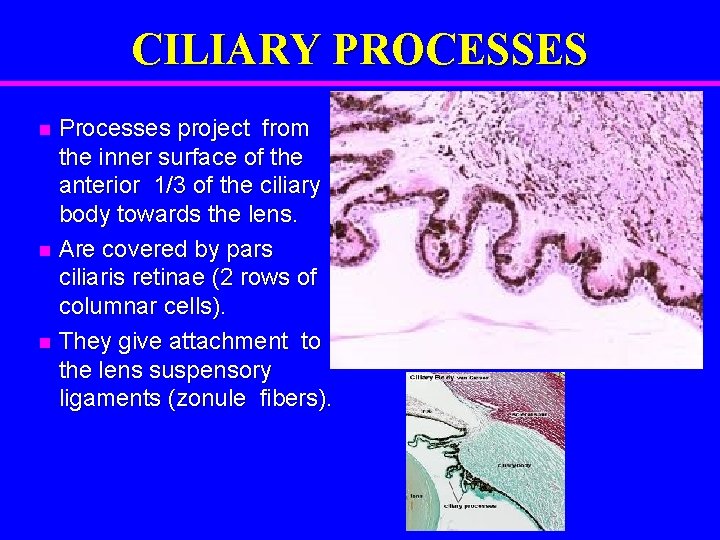
CILIARY PROCESSES Processes project from the inner surface of the anterior 1/3 of the ciliary body towards the lens. n Are covered by pars ciliaris retinae (2 rows of columnar cells). n They give attachment to the lens suspensory ligaments (zonule fibers). n
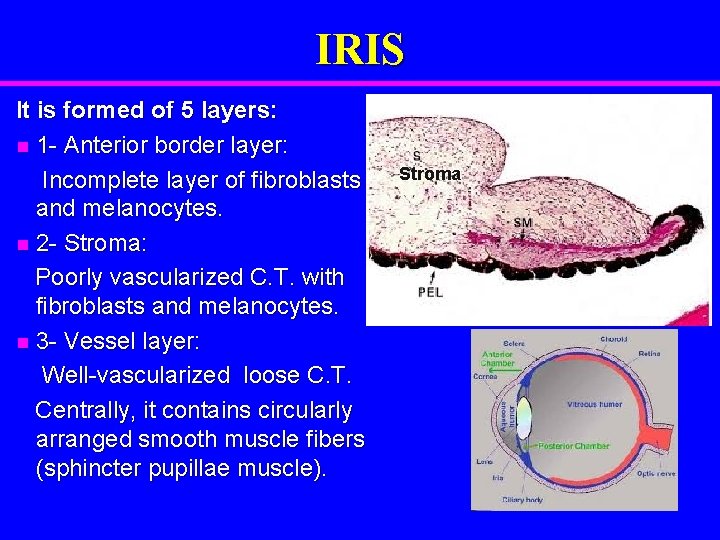
IRIS It is formed of 5 layers: n 1 - Anterior border layer: Incomplete layer of fibroblasts and melanocytes. n 2 - Stroma: Poorly vascularized C. T. with fibroblasts and melanocytes. n 3 - Vessel layer: Well-vascularized loose C. T. Centrally, it contains circularly arranged smooth muscle fibers (sphincter pupillae muscle). Stroma
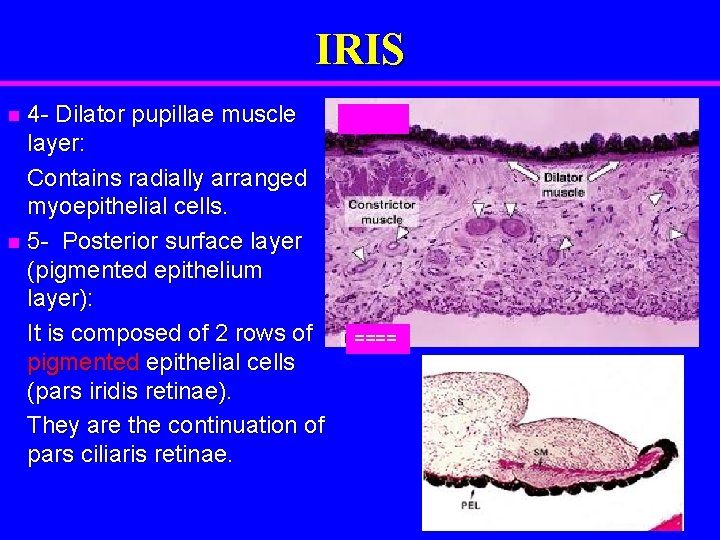
IRIS 4 - Dilator pupillae muscle layer: Contains radially arranged myoepithelial cells. n 5 - Posterior surface layer (pigmented epithelium layer): It is composed of 2 rows of pigmented epithelial cells (pars iridis retinae). They are the continuation of pars ciliaris retinae. n ====
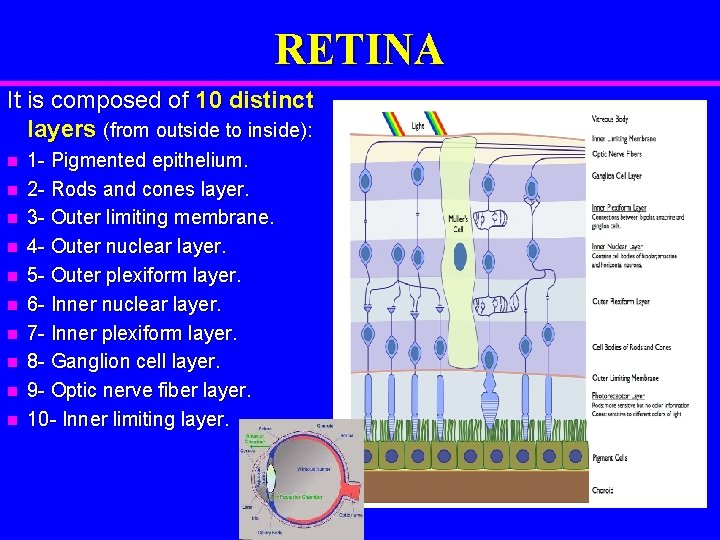
RETINA It is composed of 10 distinct layers (from outside to inside): n n n n n 1 - Pigmented epithelium. 2 - Rods and cones layer. 3 - Outer limiting membrane. 4 - Outer nuclear layer. 5 - Outer plexiform layer. 6 - Inner nuclear layer. 7 - Inner plexiform layer. 8 - Ganglion cell layer. 9 - Optic nerve fiber layer. 10 - Inner limiting layer.
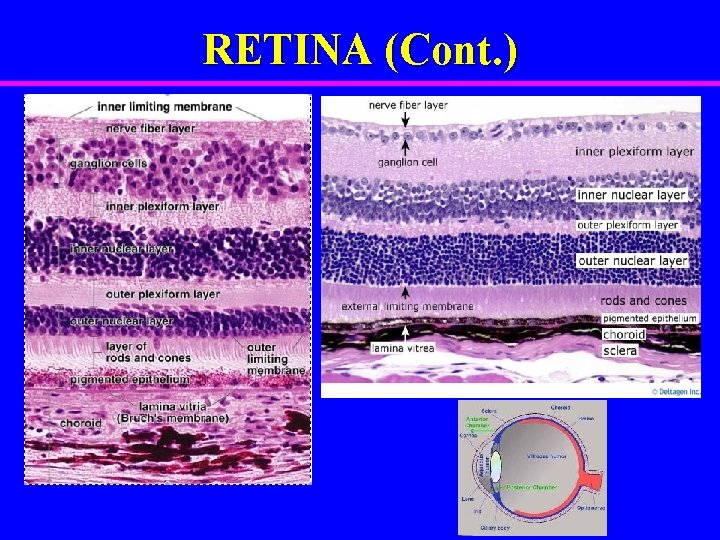
RETINA (Cont. )
RETINA (Cont. ) Pigmented Epithelium: n Cuboidal to columnar cells (single layer). n Apical microvilli. n Abundance of melanin granules. n n Functions: 1 - Absorb light. 2 - Phagocytosis of membranous discs from tips of rods. 3 - Esterification of Vitamin A (in SER).
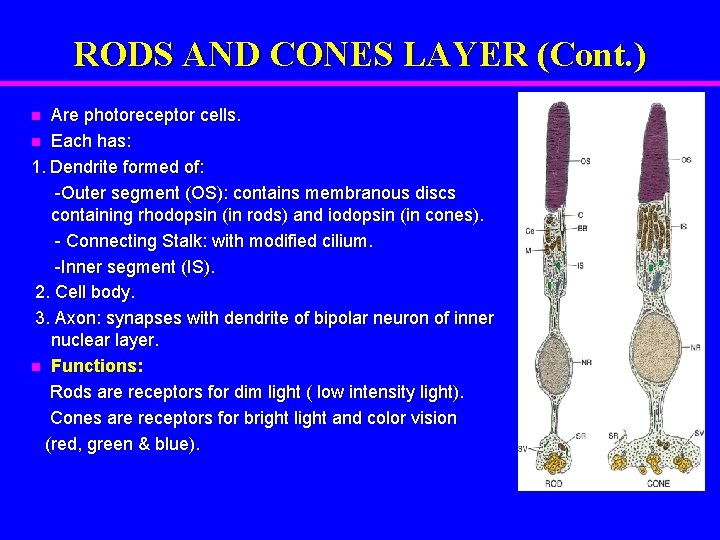
RODS AND CONES LAYER (Cont. ) Are photoreceptor cells. n Each has: 1. Dendrite formed of: -Outer segment (OS): contains membranous discs containing rhodopsin (in rods) and iodopsin (in cones). - Connecting Stalk: with modified cilium. -Inner segment (IS). 2. Cell body. 3. Axon: synapses with dendrite of bipolar neuron of inner nuclear layer. n Functions: Rods are receptors for dim light ( low intensity light). Cones are receptors for bright light and color vision (red, green & blue). n
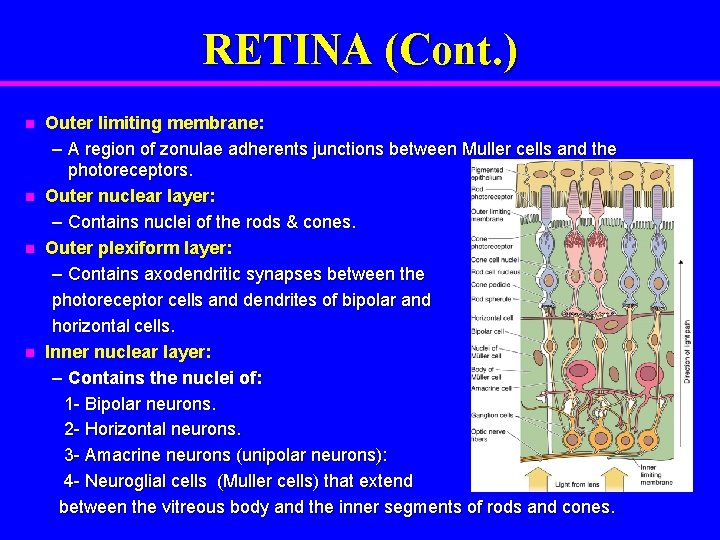
RETINA (Cont. ) n n Outer limiting membrane: – A region of zonulae adherents junctions between Muller cells and the photoreceptors. Outer nuclear layer: – Contains nuclei of the rods & cones. Outer plexiform layer: – Contains axodendritic synapses between the photoreceptor cells and dendrites of bipolar and horizontal cells. Inner nuclear layer: – Contains the nuclei of: 1 - Bipolar neurons. 2 - Horizontal neurons. 3 - Amacrine neurons (unipolar neurons): 4 - Neuroglial cells (Muller cells) that extend between the vitreous body and the inner segments of rods and cones.
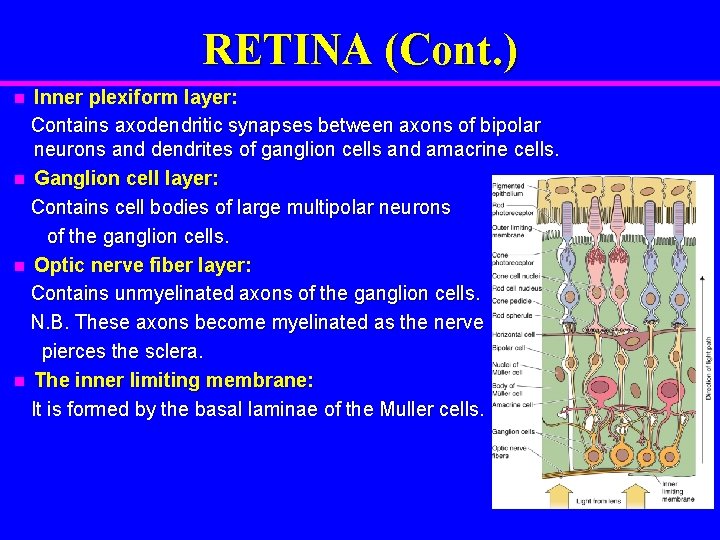
RETINA (Cont. ) Inner plexiform layer: Contains axodendritic synapses between axons of bipolar neurons and dendrites of ganglion cells and amacrine cells. n Ganglion cell layer: Contains cell bodies of large multipolar neurons of the ganglion cells. n Optic nerve fiber layer: Contains unmyelinated axons of the ganglion cells. N. B. These axons become myelinated as the nerve pierces the sclera. n The inner limiting membrane: It is formed by the basal laminae of the Muller cells. n

RETINA (Cont. ) Fovea centralis: n It lies in the center of macula lutea. n Cones are highly concentrated in the fovea. n It is responsible for visual acuity. n
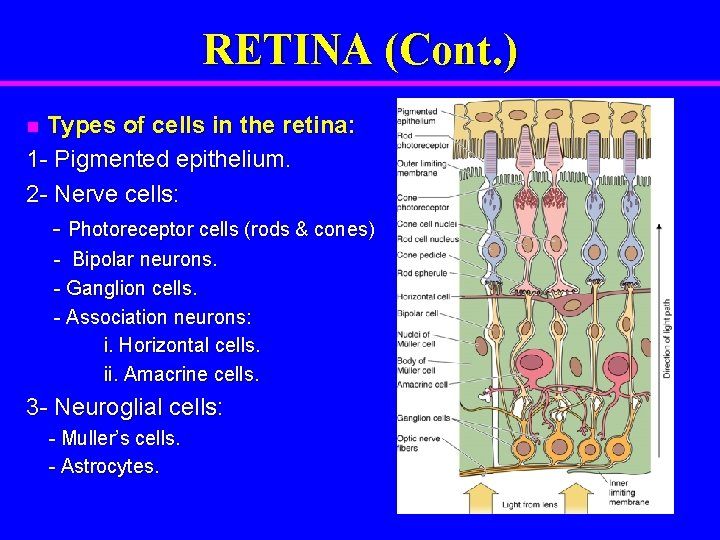
RETINA (Cont. ) Types of cells in the retina: 1 - Pigmented epithelium. 2 - Nerve cells: - Photoreceptor cells (rods & cones) n - Bipolar neurons. - Ganglion cells. - Association neurons: i. Horizontal cells. ii. Amacrine cells. 3 - Neuroglial cells: - Muller’s cells. - Astrocytes.

CONJUNCTIVA It is the transparent mucous membrane lining the inner surfaces of the eyelids (palpebral conjunctiva) and reflecting onto the sclera of the anterior surface of the eye (bulbar conjunctiva). n L/M: n 1 - Epithelium: Stratified columnar epithelium with numerous goblet cells. n 2 - Lamina propria: Loose C. T. n

GOOD LUCK
- Slides: 24