
Histology of the blood vessel Red important Black
Histology of the blood vessel Red: important. Black: in male|female slides. Gray: notes|extra. Editing file
Ø OBJECTIVES Identify and describe the microscopic structure of the wall of the blood vessels including: • Elastic arteries. • Muscular (medium-sized) arteries. • Medium-sized veins. • Blood capillaries. Histology team 437 | CVS block | Lecture two
EXTRA: Histology team 437 | CVS block | Lecture two
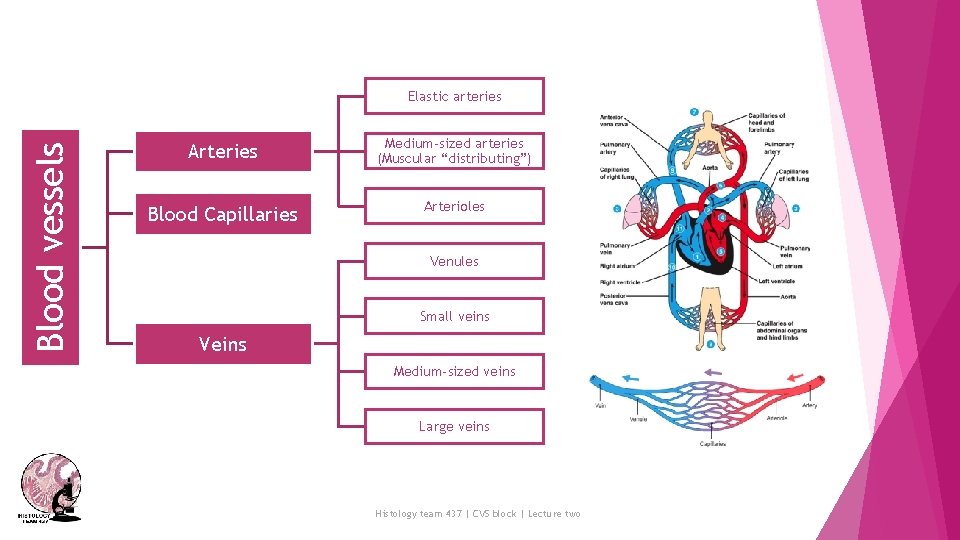
Blood vessels Elastic arteries Arteries Medium-sized arteries (Muscular “distributing”) Blood Capillaries Arterioles Venules Small veins Veins Medium-sized veins Large veins Histology team 437 | CVS block | Lecture two

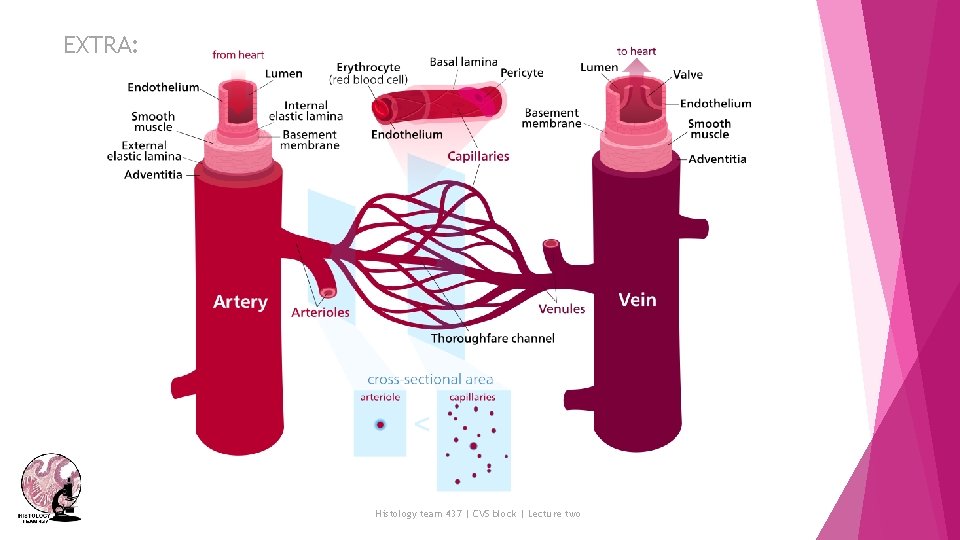
Ø Major structure of blood vessels: Tunica intima (Interna) • innermost layer • Composed of: 1 - Endothelial cells: SSE=Simple squamous epithelium • “Remember SSE lining all circularity system” 2 - Subendothelial layer: loose C. T. 3 - Internal elastic lamina: fenestrated elastic sheet “rich” Tunica media • Intermediate layer “Thickest layer” • Composed of: 1 - Smooth muscles “mainly” 2 - Elastic fibers 3 - Type I collagen 4 - Type III collagen (reticular fibers) *NB: Large muscular arteries have external elastic lamina separation the tunica media from the tunica adventitia. Tunica adventitia (Externa) • Outermost layer “mainly connective tissue” • Composed of connective tissue containing Vasa vasorum: • They are small arterioles in tunica adventitia and the outer part of tunica media. • They are more prevalent in the walls of veins than arteries (because venous blood contains less oxygen and nutrients than arterial blood) Histology team 437 | CVS block | Lecture two “Tunica = layer”
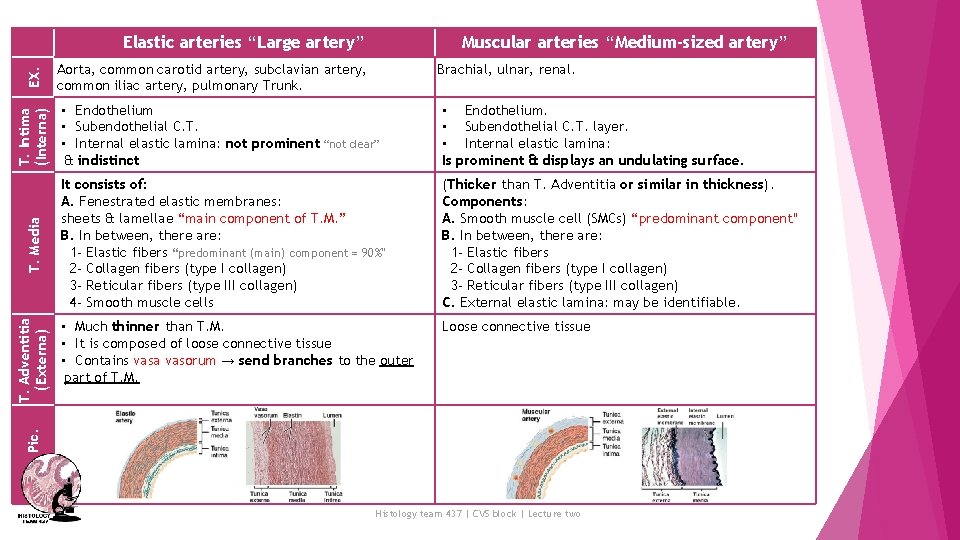
Muscular arteries “Medium-sized artery” Brachial, ulnar, renal. • Endothelium • Subendothelial C. T. • Internal elastic lamina: not prominent “not clear” & indistinct • Endothelium. • Subendothelial C. T. layer. • Internal elastic lamina: Is prominent & displays an undulating surface. It consists of: A. Fenestrated elastic membranes: sheets & lamellae “main component of T. M. ” B. In between, there are: 1 - Elastic fibers “predominant (main) component = 90%" 2 - Collagen fibers (type I collagen) 3 - Reticular fibers (type III collagen) 4 - Smooth muscle cells (Thicker than T. Adventitia or similar in thickness). Components: A. Smooth muscle cell (SMCs) “predominant component" B. In between, there are: 1 - Elastic fibers 2 - Collagen fibers (type I collagen) 3 - Reticular fibers (type III collagen) C. External elastic lamina: may be identifiable. • Much thinner than T. M. • It is composed of loose connective tissue • Contains vasa vasorum → send branches to the outer part of T. M. Loose connective tissue Pic. T. Adventitia (Externa) T. Intima (Interna) Aorta, common carotid artery, subclavian artery, common iliac artery, pulmonary Trunk. T. Media EX. Elastic arteries “Large artery” Histology team 437 | CVS block | Lecture two
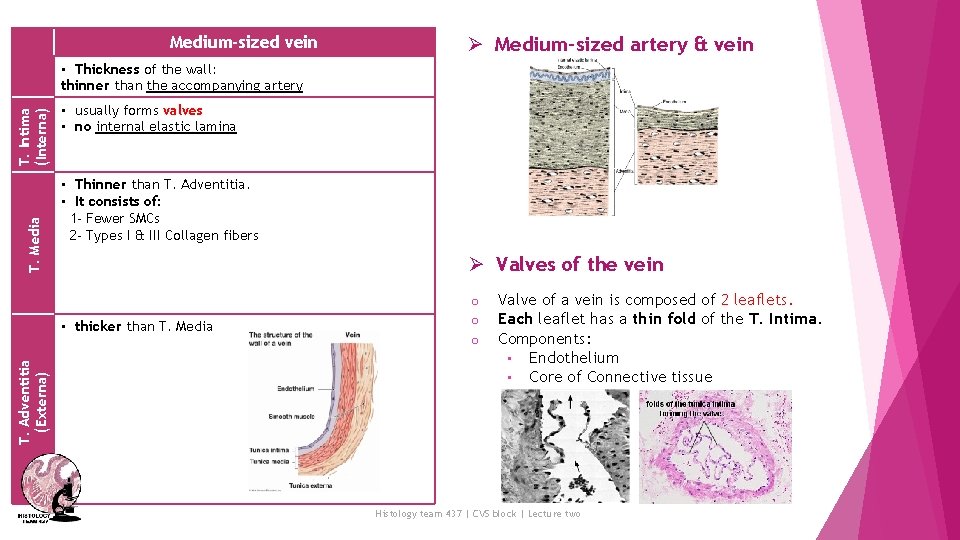
Medium-sized vein Ø Medium-sized artery & vein T. Media T. Intima (Interna) • Thickness of the wall: thinner than the accompanying artery • usually forms valves • no internal elastic lamina • Thinner than T. Adventitia. • It consists of: 1 - Fewer SMCs 2 - Types I & III Collagen fibers Ø Valves of the vein T. Adventitia (Externa) • thicker than T. Media o o o Valve of a vein is composed of 2 leaflets. Each leaflet has a thin fold of the T. Intima. Components: • Endothelium • Core of Connective tissue Histology team 437 | CVS block | Lecture two
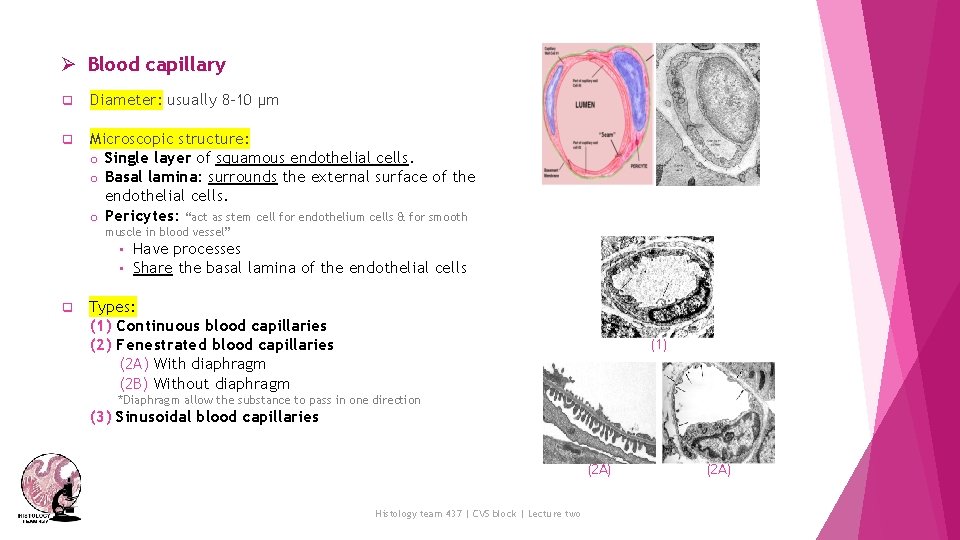
Ø Blood capillary q Diameter: usually 8 -10 µm q Microscopic structure: o Single layer of squamous endothelial cells. o Basal lamina: surrounds the external surface of the endothelial cells. o Pericytes: “act as stem cell for endothelium cells & for smooth muscle in blood vessel” • • q Have processes Share the basal lamina of the endothelial cells Types: (1) Continuous blood capillaries (2) Fenestrated blood capillaries (2 A) With diaphragm (2 B) Without diaphragm (1) *Diaphragm allow the substance to pass in one direction (3) Sinusoidal blood capillaries (2 A) Histology team 437 | CVS block | Lecture two (2 A)
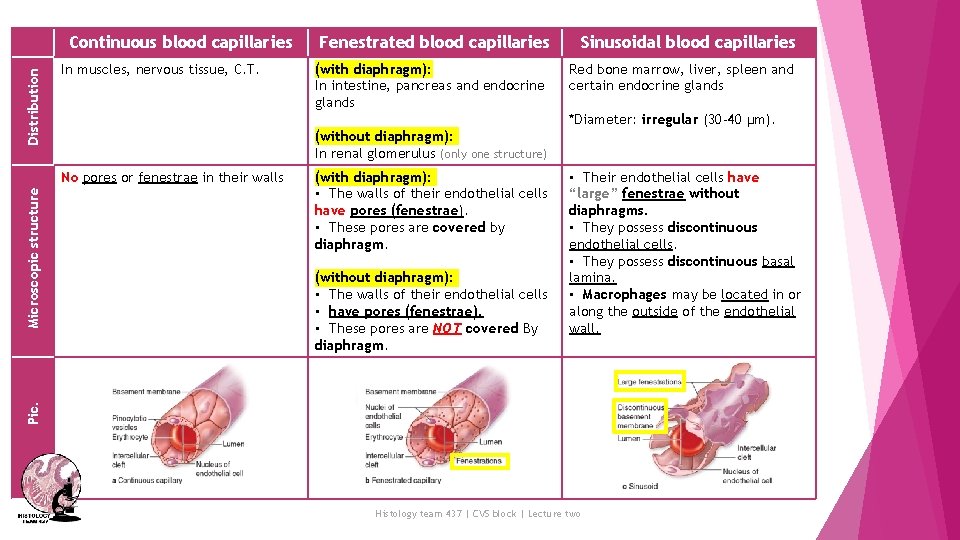
Distribution Continuous blood capillaries In muscles, nervous tissue, C. T. (with diaphragm): In intestine, pancreas and endocrine glands Sinusoidal blood capillaries Red bone marrow, liver, spleen and certain endocrine glands *Diameter: irregular (30 -40 µm). (without diaphragm): In renal glomerulus (only one structure) No pores or fenestrae in their walls (with diaphragm): • The walls of their endothelial cells have pores (fenestrae). • These pores are covered by diaphragm. (without diaphragm): • The walls of their endothelial cells • have pores (fenestrae). • These pores are NOT covered By diaphragm. • Their endothelial cells have “large” fenestrae without diaphragms. • They possess discontinuous endothelial cells. • They possess discontinuous basal lamina. • Macrophages may be located in or along the outside of the endothelial wall. Pic. Microscopic structure Fenestrated blood capillaries Histology team 437 | CVS block | Lecture two
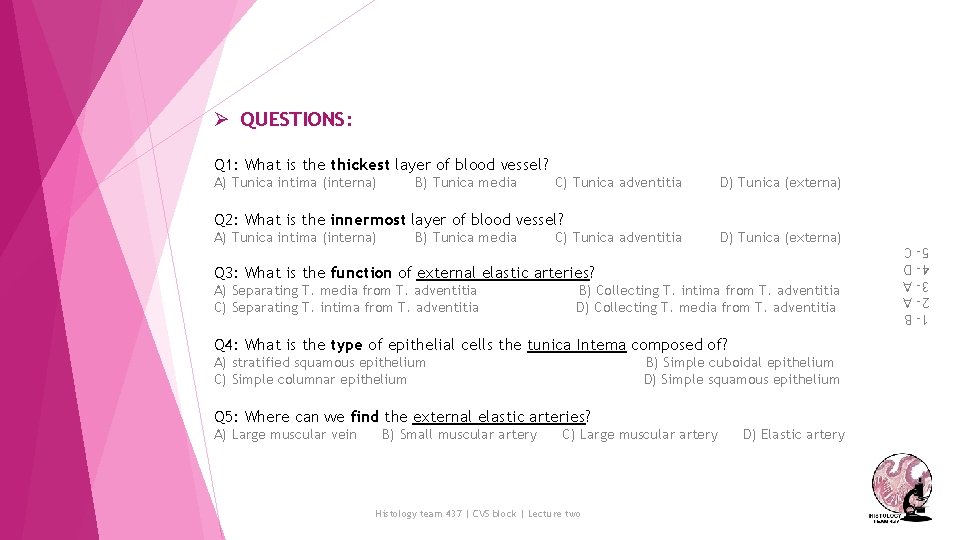
Ø QUESTIONS: Q 1: What is the thickest layer of blood vessel? A) Tunica intima (interna) B) Tunica media C) Tunica adventitia D) Tunica (externa) Q 2: What is the innermost layer of blood vessel? C) Tunica adventitia D) Tunica (externa) Q 3: What is the function of external elastic arteries? A) Separating T. media from T. adventitia C) Separating T. intima from T. adventitia B) Collecting T. intima from T. adventitia D) Collecting T. media from T. adventitia Q 4: What is the type of epithelial cells the tunica Intema composed of? A) stratified squamous epithelium C) Simple columnar epithelium B) Simple cuboidal epithelium D) Simple squamous epithelium Q 5: Where can we find the external elastic arteries? A) Large muscular vein B) Small muscular artery C) Large muscular artery Histology team 437 | CVS block | Lecture two D) Elastic artery B A A D C B) Tunica media 12345 - A) Tunica intima (interna)
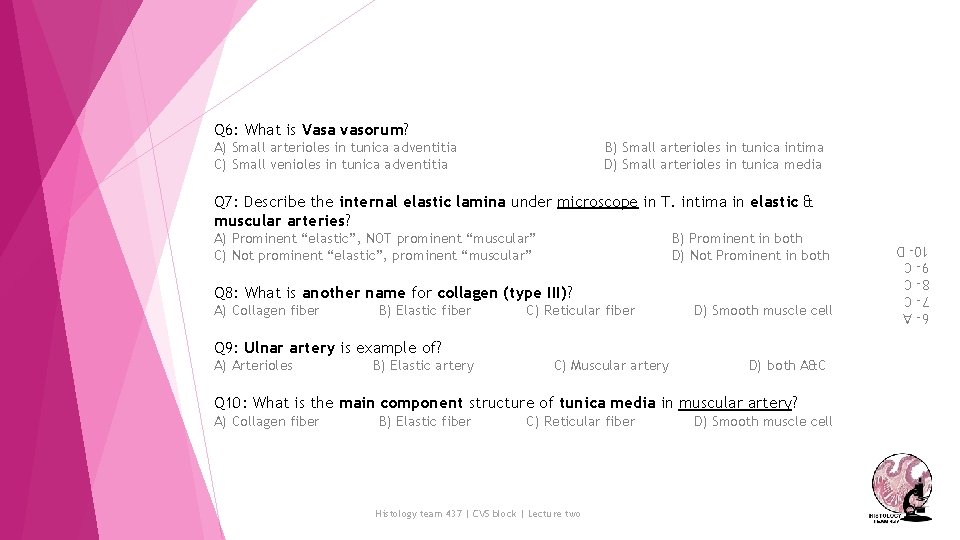
Q 6: What is Vasa vasorum? A) Small arterioles in tunica adventitia C) Small venioles in tunica adventitia B) Small arterioles in tunica intima D) Small arterioles in tunica media Q 7: Describe the internal elastic lamina under microscope in T. intima in elastic & muscular arteries? B) Prominent in both D) Not Prominent in both Q 8: What is another name for collagen (type III)? A) Collagen fiber B) Elastic fiber C) Reticular fiber D) Smooth muscle cell Q 9: Ulnar artery is example of? A) Arterioles B) Elastic artery C) Muscular artery D) both A&C Q 10: What is the main component structure of tunica media in muscular artery? A) Collagen fiber B) Elastic fiber C) Reticular fiber Histology team 437 | CVS block | Lecture two D) Smooth muscle cell 6 - A 7 - C 8 - C 9 - C 10 - D A) Prominent “elastic”, NOT prominent “muscular” C) Not prominent “elastic”, prominent “muscular”
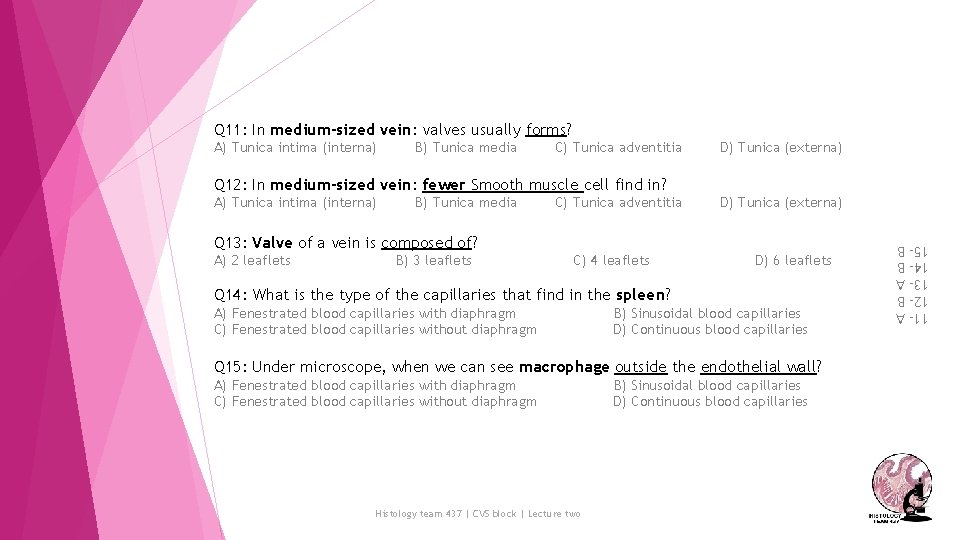
Q 11: In medium-sized vein: valves usually forms? A) Tunica intima (interna) B) Tunica media C) Tunica adventitia D) Tunica (externa) Q 12: In medium-sized vein: fewer Smooth muscle cell find in? C) Tunica adventitia D) Tunica (externa) Q 13: Valve of a vein is composed of? A) 2 leaflets B) 3 leaflets C) 4 leaflets D) 6 leaflets Q 14: What is the type of the capillaries that find in the spleen? A) Fenestrated blood capillaries with diaphragm C) Fenestrated blood capillaries without diaphragm B) Sinusoidal blood capillaries D) Continuous blood capillaries Q 15: Under microscope, when we can see macrophage outside the endothelial wall? A) Fenestrated blood capillaries with diaphragm C) Fenestrated blood capillaries without diaphragm Histology team 437 | CVS block | Lecture two B) Sinusoidal blood capillaries D) Continuous blood capillaries A B B B) Tunica media 1112131415 - A) Tunica intima (interna)
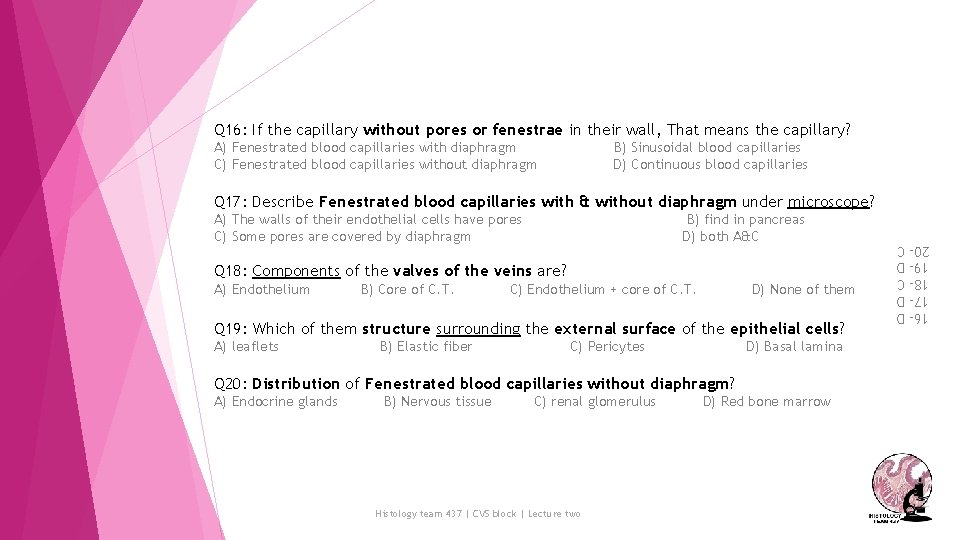
Q 16: If the capillary without pores or fenestrae in their wall, That means the capillary? A) Fenestrated blood capillaries with diaphragm C) Fenestrated blood capillaries without diaphragm B) Sinusoidal blood capillaries D) Continuous blood capillaries Q 17: Describe Fenestrated blood capillaries with & without diaphragm under microscope? Q 18: Components of the valves of the veins are? A) Endothelium B) Core of C. T. C) Endothelium + core of C. T. D) None of them Q 19: Which of them structure surrounding the external surface of the epithelial cells? A) leaflets B) Elastic fiber C) Pericytes D) Basal lamina Q 20: Distribution of Fenestrated blood capillaries without diaphragm? A) Endocrine glands B) Nervous tissue C) renal glomerulus Histology team 437 | CVS block | Lecture two D) Red bone marrow D D C B) find in pancreas D) both A&C 1617181920 - A) The walls of their endothelial cells have pores C) Some pores are covered by diaphragm
ﻟﻬﺎ ﺃﻤ ﻭﻟﻸﻤﺪ ﺇﻧﻘﻀﺎ. . " ﺳﻨﻴﻦ ﺍﻟﺠﻬﺪ ﺇﻥ ﻃﺎﻟﺖ ﺳﺘﻄﻮﻯ " ﻭﻋﻨﺪ ﺍﻟﻠﻪ ﻣﺎ ﺧﺎﺏ ﺍﻟﺮﺟﺎﺀ. . ﻟﻨﺎ ﺑﺎﻟﻠﻪ آﻤﺎﻝ ﻭﺳﻠﻮﻯ Team members : Ebtesam Almutairi Marwah Alkhalil Rinad Alghoraiby Hussain Alkharboush Tareq Allhaidan Team leaders : Khalid Fayez Alshehri Rawan Mohammad Alharbi Twitter. com/Histology 437 Histology. Team 437@gmail. com Histology team 437 | CVS block | Lecture two ﺯ
- Slides: 14