
HISTOLOGY OF CIRCULATORY SYSTEM II DIVISIONS MACROVASCULATURE 0
- Slides: 12
HISTOLOGY OF CIRCULATORY SYSTEM II
DIVISIONS �MACROVASCULATURE: > 0. 1µm, large arterioles, muscular & elastic arteries, muscular veins �MICROVASCULATURE: < 0. 1µm, arterioles, capillaries, post capillary venules �Exchange vessels
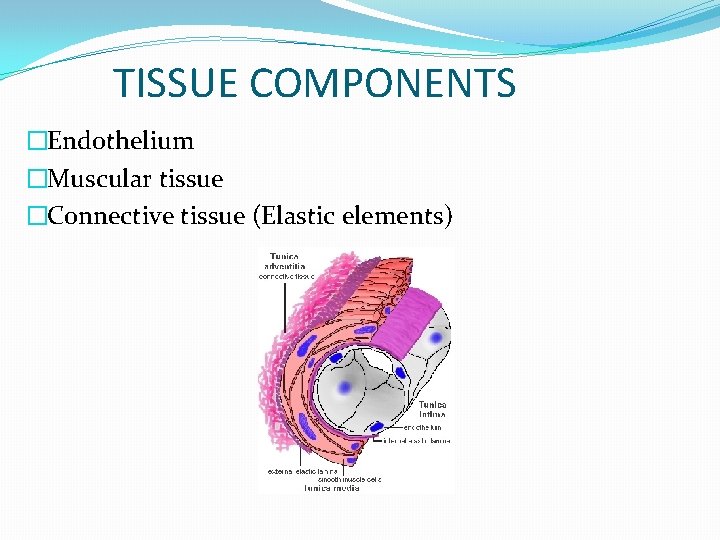
TISSUE COMPONENTS �Endothelium �Muscular tissue �Connective tissue (Elastic elements)
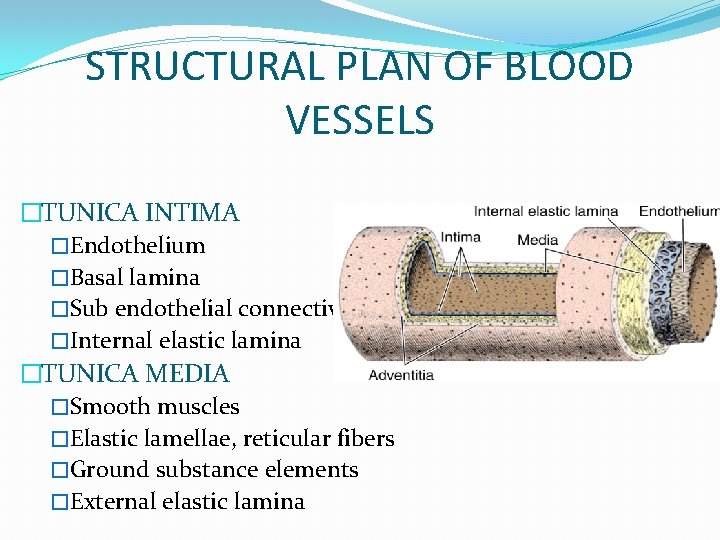
STRUCTURAL PLAN OF BLOOD VESSELS �TUNICA INTIMA �Endothelium �Basal lamina �Sub endothelial connective tissue �Internal elastic lamina �TUNICA MEDIA �Smooth muscles �Elastic lamellae, reticular fibers �Ground substance elements �External elastic lamina
�TUNICA ADVENTITIA �Collagen & elastic fibers �VASA VASORUM �Vessels of vessels �Arterioles, capillaries, venules in adventitia �INNERVATION �Sympathetic fibers (norepinephrine) �Vasoconstriction �Arteries in Skeletal Muscles- cholinergic vasodilator fibers
ENDOTHELIUM: � Semi permeable barrier � Monitor bidirectional exchange � Nonthrombogenic surface; � heparin, tissue plaminogen activator & Von Willibrand factor � Regulate Vascular tone & Blood flow; � Contraction: endothelin 1 & ACE � Relaxation: NO & Prostacyclin � Inflammation & Local Immune response; � Adhesion of WBCs, expression of P-Selectin, Weibel Palade Bodies � Growth Factors; � VEGF in Vasculogenesis, Angiogenesis, � role of Angiopoeitins � Lipolysis � Produce Vasoactive substances � Thrombosis, emboli (Role of TPA)
VASCULAR SMOOTH MUSCLES �Present in all vessels EXCEPT capillaries and post capillary venules �Enclosed in basal lamina & connective tissue �Arranged helically �Connected by gap junctions VASCULAR CONNECTIVE TISSUE �Variable proportion �Collagen, IV, III, I �Elastic fibers �Ground substance; heterogenous gel
Medical Application �Arteriosclerosis �Thickening of walls of small arteries �Monkeberg’s calcific sclerosis �Atherosclerosis
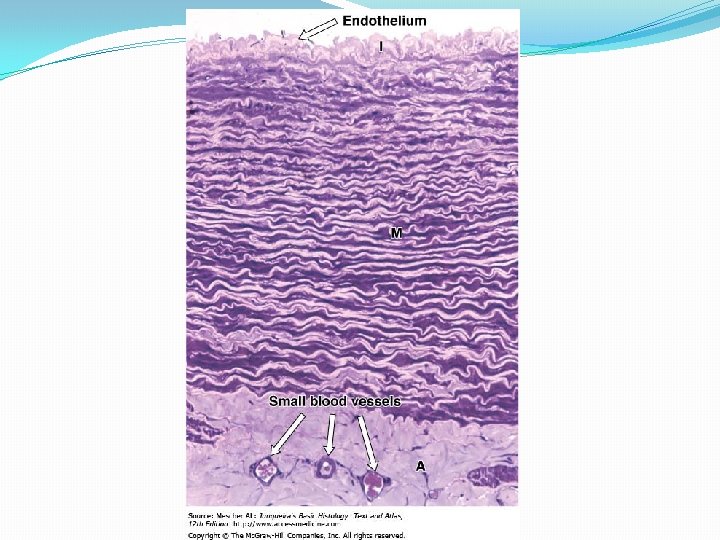
LARGE ELASTIC ARTERIES �T. INTIMA �Intima is thicker; smooth muscles in sub endothelial connective tissue �Internal elastic lamina, though present not prominent �T. MEDIA �Concentric lamellae of elastic fibers (40 -70) �Reticular fibers, smooth muscles �T. ADVENTITIA �Less developed
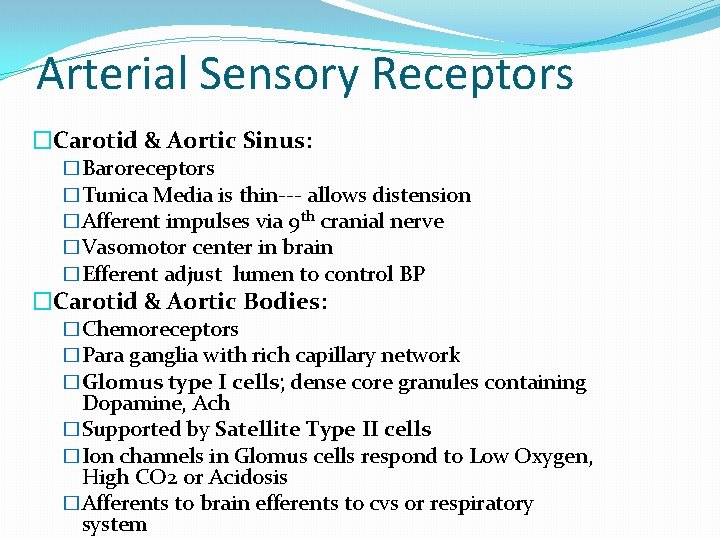
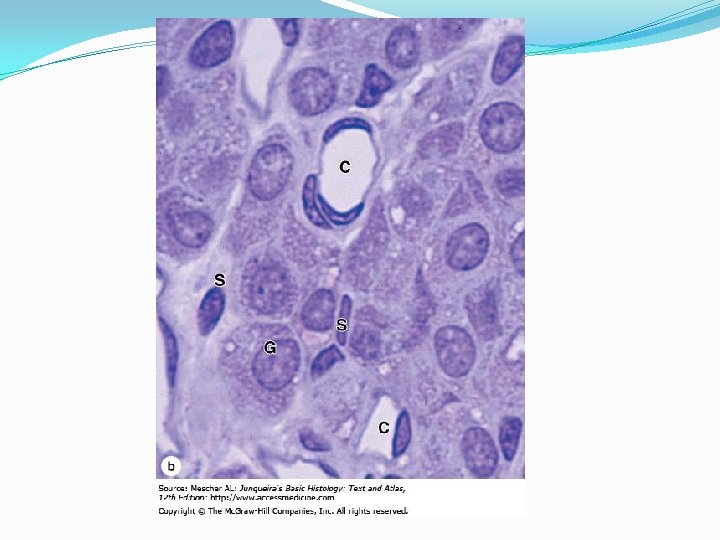
Arterial Sensory Receptors �Carotid & Aortic Sinus: �Baroreceptors �Tunica Media is thin--- allows distension �Afferent impulses via 9 th cranial nerve �Vasomotor center in brain �Efferent adjust lumen to control BP �Carotid & Aortic Bodies: �Chemoreceptors �Para ganglia with rich capillary network �Glomus type I cells; dense core granules containing Dopamine, Ach �Supported by Satellite Type II cells �Ion channels in Glomus cells respond to Low Oxygen, High CO 2 or Acidosis �Afferents to brain efferents to cvs or respiratory system