
HISTOLOGICAL PROCESS STAINING 14112020 Azhin Saber Ali Chnar
HISTOLOGICAL PROCESS (STAINING ) 14/11/2020 Azhin Saber Ali Chnar Hussam Taha MSc in Histology azhinsabr@epu. edu. iq BA in Biology chnar. hussam@tiu. edu. iq Lab 4/ Histology and Histopathology (Practical) Tishk International University Science College Medical Analysis Department
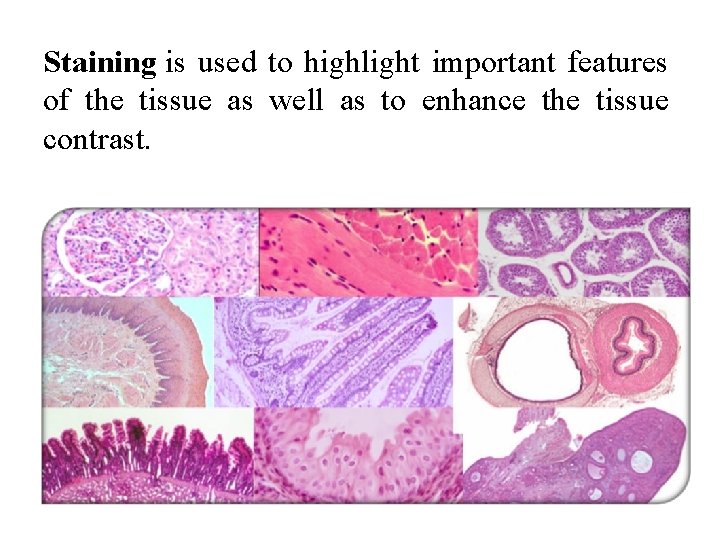
Staining is used to highlight important features of the tissue as well as to enhance the tissue contrast.
Chemical features of tissue structures according to affinity to acid -base stains: 1. Basophilic structures, are stained by basic dyes: Ø Basic dyes, example; Hematoxylin ØHematoxylin is positively charged dye Ø Basophilic structures are negatively charged (ex. DNA and RNA) v. Basophilic = Blue 2. Acidophilic (eosinophilic)structures, are stained by acid dyes. ØAcidic dyes, example; Eosin Ø Eosin is negatively charged dye Ø Acidophilic structures are positive (ex. Proteins and cytoplasm) v. Eosinophilic = Pink
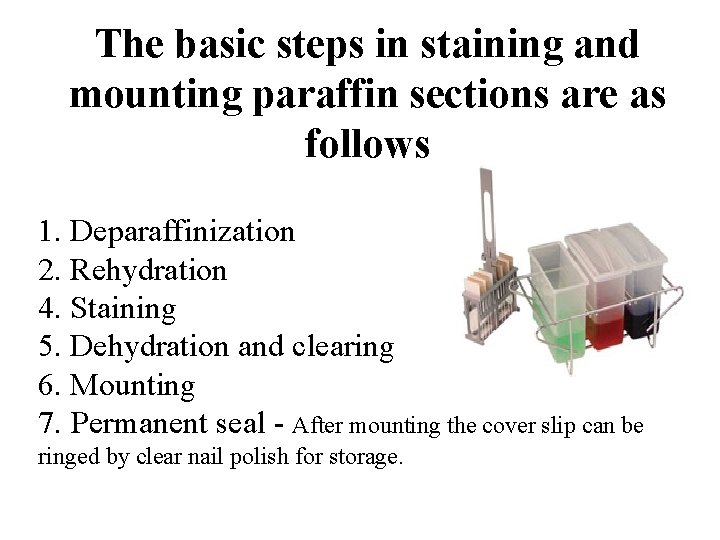
The basic steps in staining and mounting paraffin sections are as follows 1. Deparaffinization 2. Rehydration 4. Staining 5. Dehydration and clearing 6. Mounting 7. Permanent seal - After mounting the cover slip can be ringed by clear nail polish for storage.
1. Deparaffinization; removal of wax is done with xylol. It is essential to remove the wax completely, otherwise subsequent stages will not be possible. At least 2 to 3 changes in xylol are given for suitable length of time. Sections of this stage should appear clear and transparent. Presence of any patches indicates the presence of wax and sections should be kept longer in the xylol. 2. Rehydration; most of the stains used are aqueous or dilute alcoholic solutions. Hence it is essential to bring the section to water before the stains are applied. The hydration is done with graded alcohols from higher concentration to lower concentration (descending). Alcohol and acetone are miscible with xylol. First change is made to absolute alcohol or acetone followed by 100%, 70% alcohol and finally distilled water. Sections now should appear opaque. Presence of any clear areas are indicative of the presence of xylol. To remove this xylol, sections should be returned to absolute alcohol and rehydrated.
3. Staining; various staining procedures are applied from this hydrated stage. The most common stain applied for histological study is haematoxylin and Eosin. Various types of haematoxylin formulations are used. Washing and rinsing of tissue sections is a necessary part of most staining techniques. It eliminates carrying over of one dye solution to the next. 4. Dehydration and clearing; dehydration is done is graded alcohols or acetones from 70% to absolute alcohol or acetone. Dehydrating alcohol and acetones can remove some of the stains. Time has to be suitably modified to minimize fading of stains. Since alcohol and acetone are miscible in xylol, it is used for clearing the sections. Any sections from which water has not been completely removed would give a milky appearance after the first xylol. Such sections should be returned to absolute alcohol and the process repeated. Mounting is done after 2 nd or 3 rd xylol.
5. Cover slipping and mounting Ø Make quite sure that the sections are quite clear. Do not let the section go dry before mounting 1. Hold the slide between the thumb and the forefinger of one hand wipe with a clean cloth both ends of the slides. Look for the engraved number to make sure the side the sections is present. 2. Clean carefully around the section and lay on a clean blotting paper with section uppermost along with appropriate coverslip which has already been polished. 3. Place a drop of mountant on the slide over coverslip. Amount of mountant should be just enough. Invert the slide over the coverslip and lower it so that it just adheres to the cover slip quickly turn the slide over, then lay it on a flat surface to allow the mountant to spread. Do not press or push the slide at all. It can damage the section.
4. After the mountant has spread to the edge of the coverslip wipe around it for neatness. If proper care has been taken there should be no air bubbles. If many are present, slide should be returned to the xylol to remove the coverslip. It will slip off and remounting is done. No attempt should be made to pull the coverslip. Slight warming of the slide from below will make the small air bubbles to escape from the slide of the coverslip. 5. Coverslip should be in the center of the slide with neatly written label on one slide.
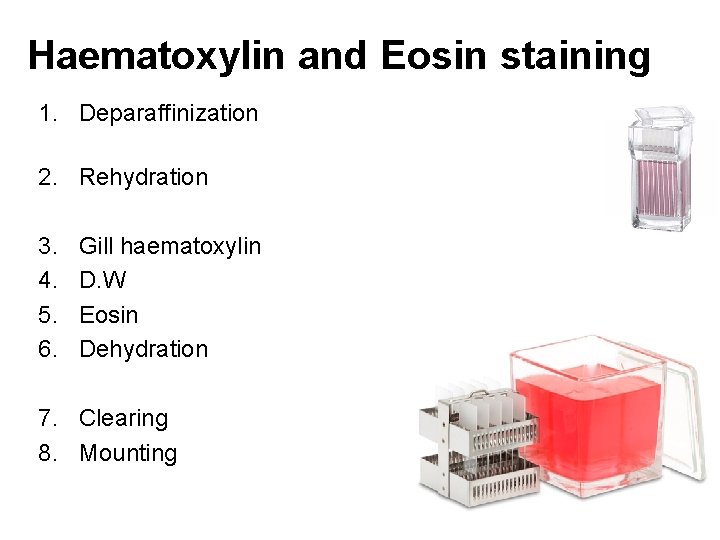
Haematoxylin and Eosin staining 1. Deparaffinization 2. Rehydration 3. 4. 5. 6. Gill haematoxylin D. W Eosin Dehydration 7. Clearing 8. Mounting
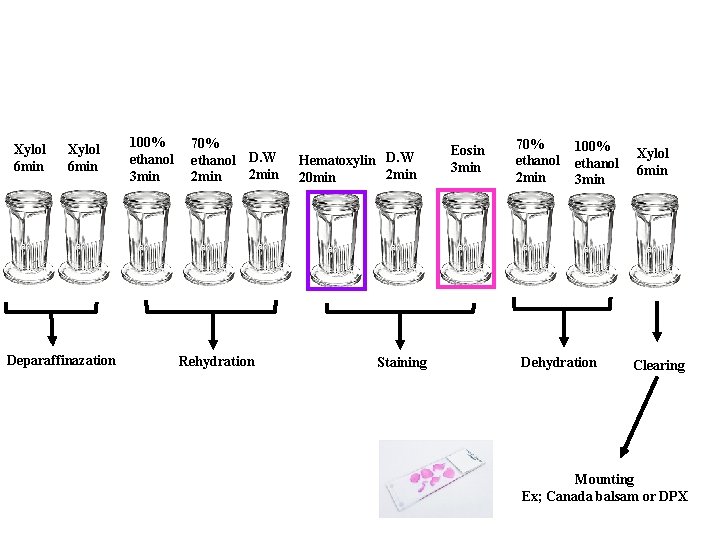
Xylol 6 min Deparaffinazation 100% ethanol 3 min 70% ethanol D. W 2 min Rehydration Hematoxylin D. W 2 min 20 min Staining Eosin 3 min 70% ethanol 2 min 100% ethanol 3 min Dehydration Xylol 6 min Clearing Mounting Ex; Canada balsam or DPX
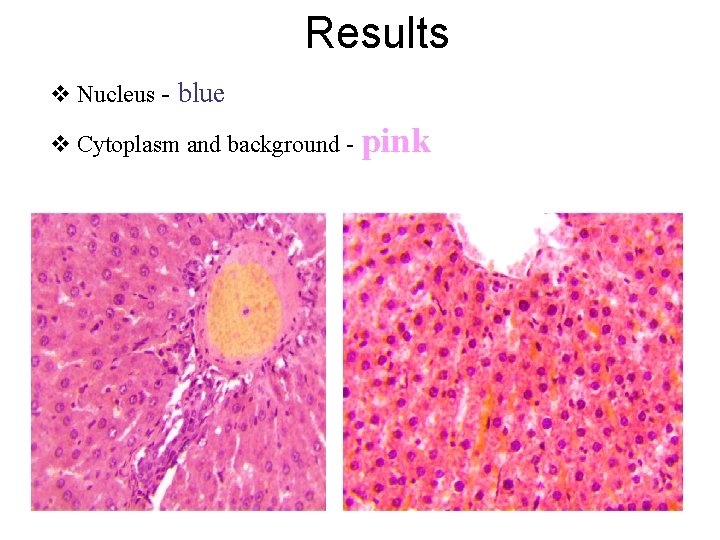
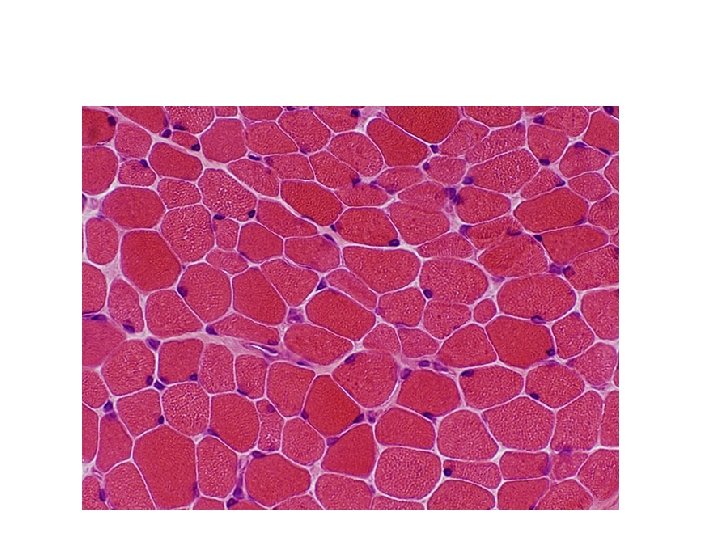
Results v Nucleus - blue v Cytoplasm and background - pink
- Slides: 12