
HISTOGRAM TRANSFORMATION IN IMAGE PROCESSING AND ITS APPLICATIONS
- Slides: 49
HISTOGRAM TRANSFORMATION IN IMAGE PROCESSING AND ITS APPLICATIONS Attila Kuba University of Szeged
Contents l Histogram transformation l Histogram equalization l Contrast streching l Applications
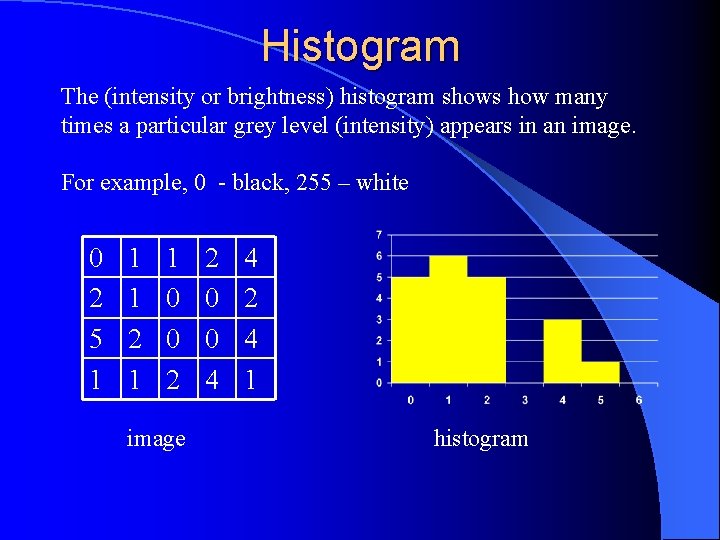
Histogram The (intensity or brightness) histogram shows how many times a particular grey level (intensity) appears in an image. For example, 0 - black, 255 – white 0 2 5 1 1 1 2 1 1 0 0 2 image 2 0 0 4 4 2 4 1 histogram
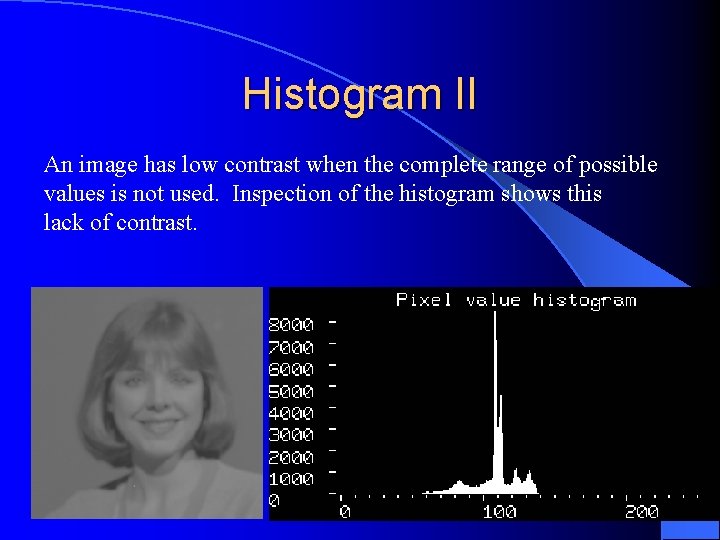
Histogram II An image has low contrast when the complete range of possible values is not used. Inspection of the histogram shows this lack of contrast.
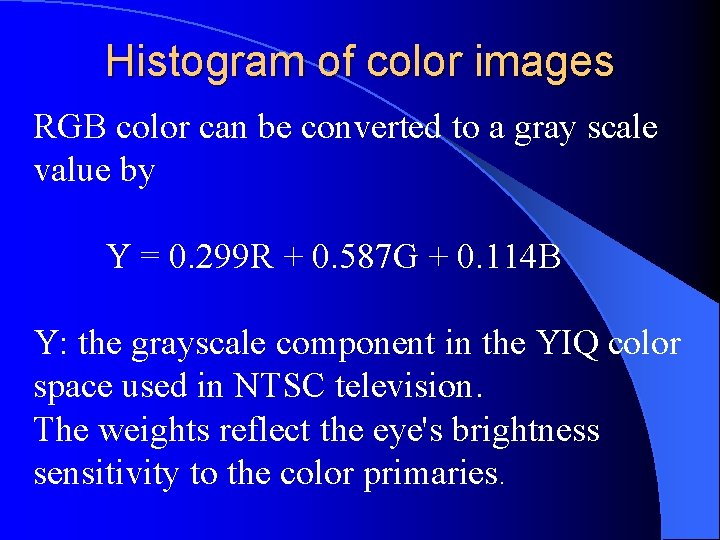
Histogram of color images RGB color can be converted to a gray scale value by Y = 0. 299 R + 0. 587 G + 0. 114 B Y: the grayscale component in the YIQ color space used in NTSC television. The weights reflect the eye's brightness sensitivity to the color primaries.
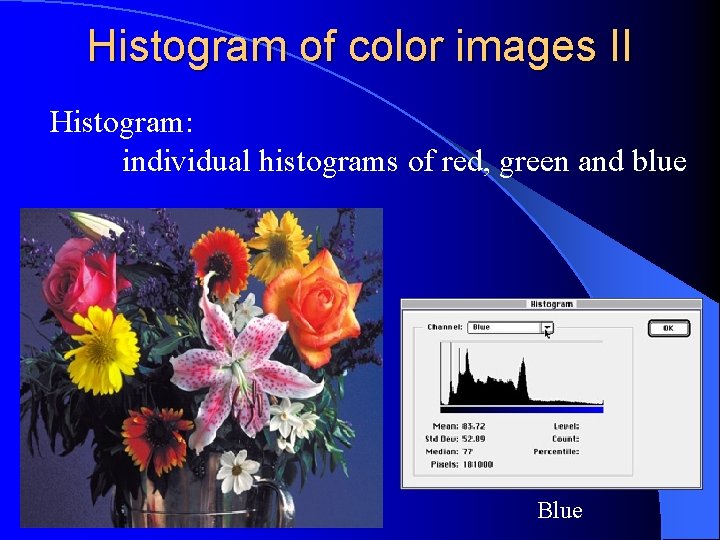
Histogram of color images II Histogram: individual histograms of red, green and blue Blue
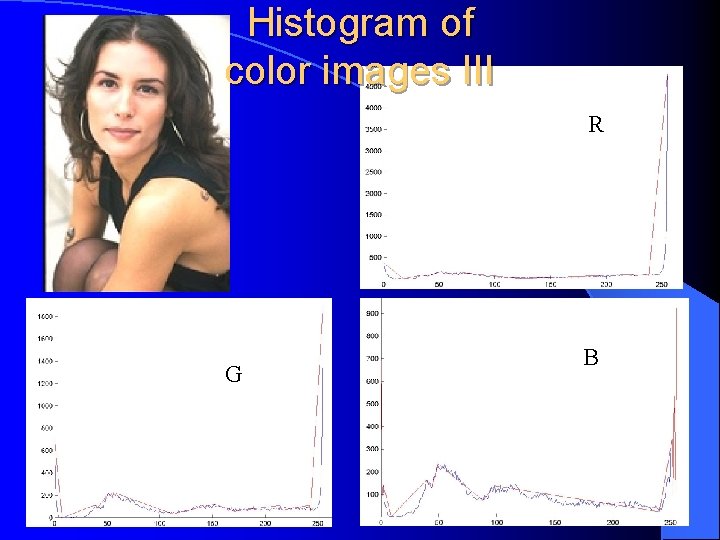
Histogram of color images III R R G R B
Histogram of color images IV or a 3 -D histogram can be produced, with the three axes representing the red, blue and green channels, and brightness at each point representing the pixel count
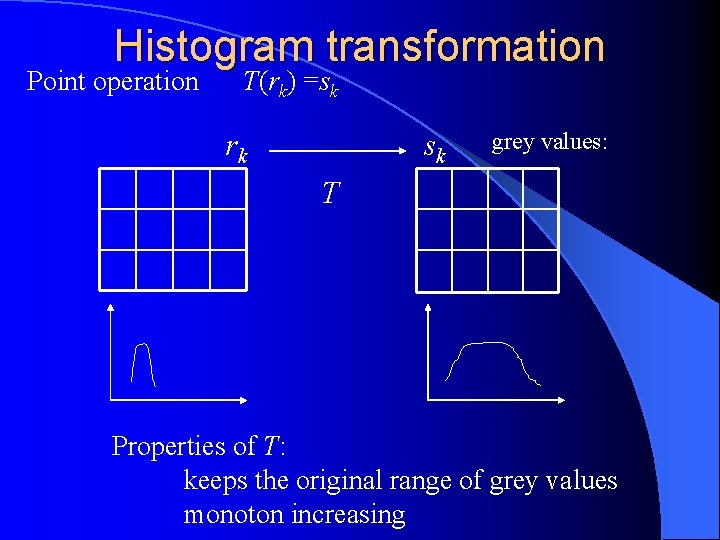
Histogram transformation Point operation T(rk) =sk rk sk grey values: T Properties of T: keeps the original range of grey values monoton increasing
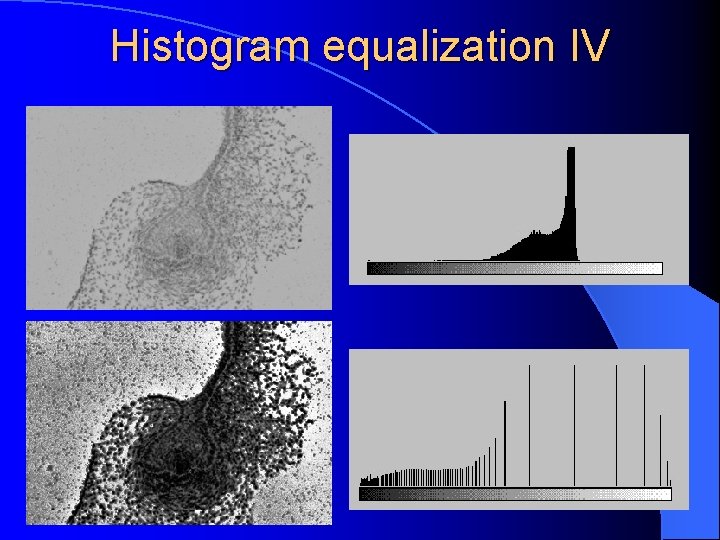
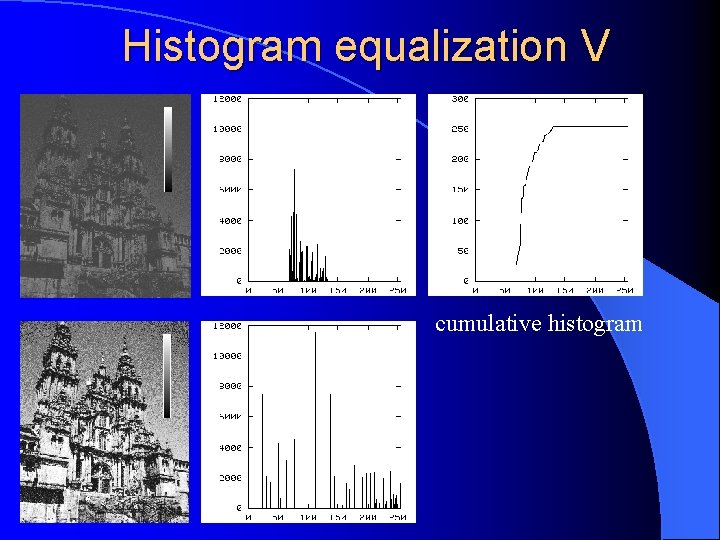
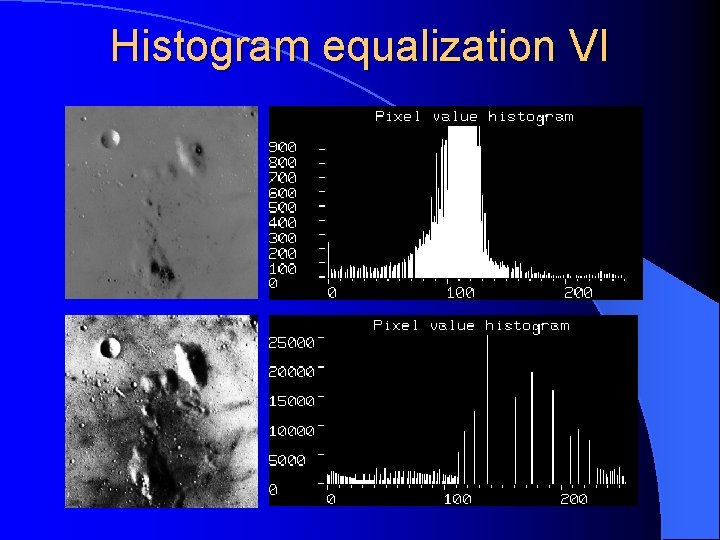
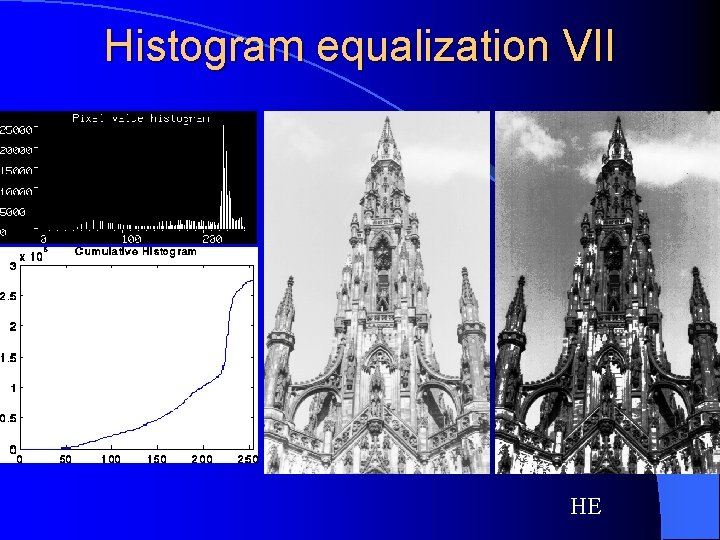
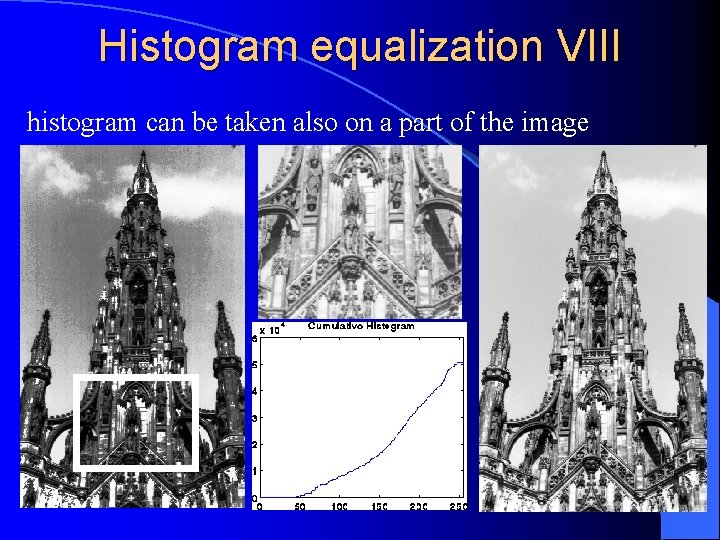
Histogram equalization (HE) transforms the intensity values so that the histogram of the output image approximately matches the flat (uniform) histogram
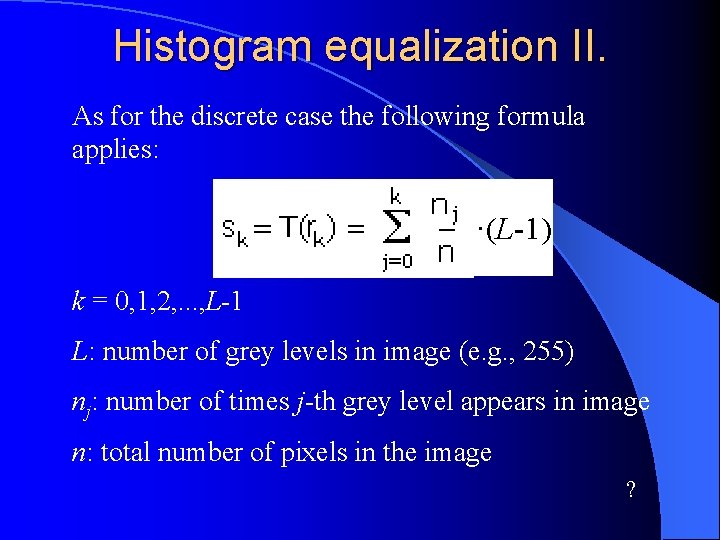
Histogram equalization II. As for the discrete case the following formula applies: ·(L-1) k = 0, 1, 2, . . . , L-1 L: number of grey levels in image (e. g. , 255) nj: number of times j-th grey level appears in image n: total number of pixels in the image ?
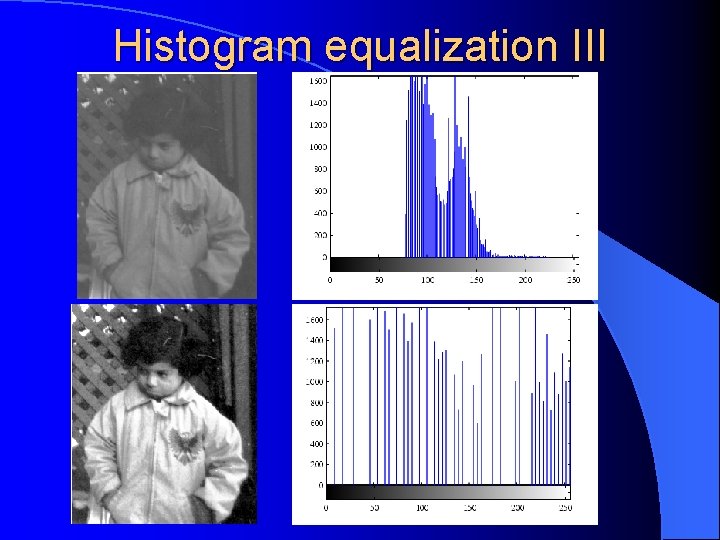
Histogram equalization III
Histogram equalization IV
Histogram equalization V cumulative histogram
Histogram equalization VI
Histogram equalization VII HE
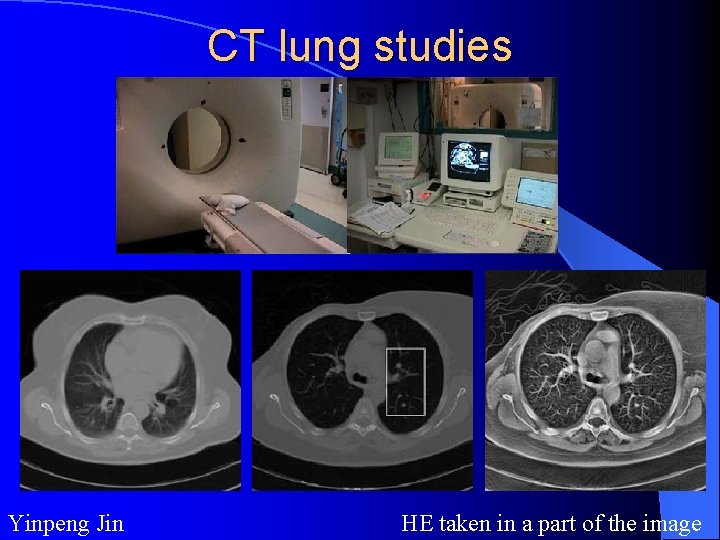
Histogram equalization VIII histogram can be taken also on a part of the image
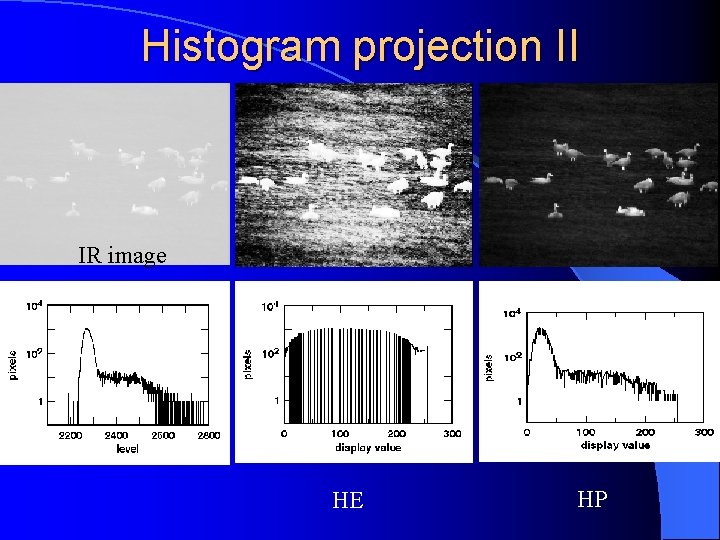
Histogram projection (HP) assigns equal display space to every occupied raw signal level, regardless of how many pixels are at that same level. In effect, the raw signal histogram is "projected" into a similar-looking display histogram.
Histogram projection II IR image HE HP
Histogram projection III occupied (used) grey level: there is at least one pixel with that grey level B(k): the fraction of occupied grey levels at or below grey level k B(k) rises from 0 to 1 in discrete uniform steps of 1/n, where n is the total number of occupied levels HP transformation: sk = 255 ·B(k).
Plateau equalization By clipping the histogram count at a saturation or plateau value, one can produce display allocations intermediate in character between those of HP and HE.
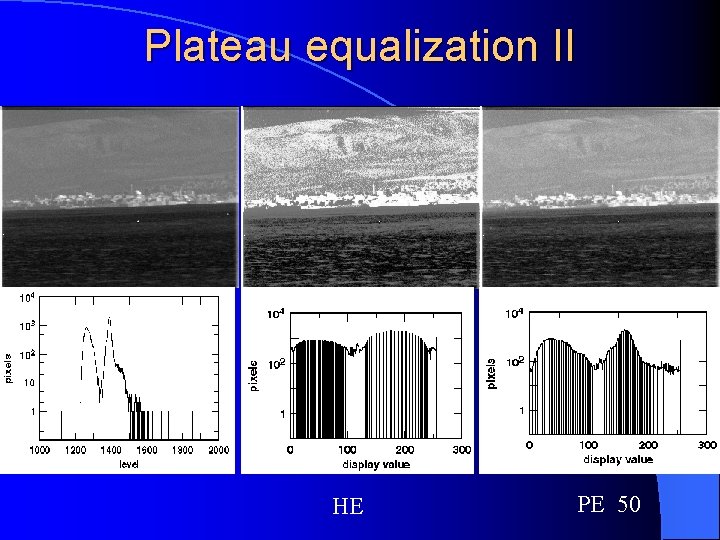
Plateau equalization II HE PE 50
Plateau equalization III The PE algorithm computes the distribution not for the full image histogram but for the histogram clipped at a plateau (or saturation) value in the count. When that plateau value is set at 1, we generate B(k) and so perform HP; When it is set above the histogram peak, we generate F(k) and so perform HE. At intermediate values, we generate an intermediate distribution which we denote by P(k). PE transformation: sk = 255· P(k)
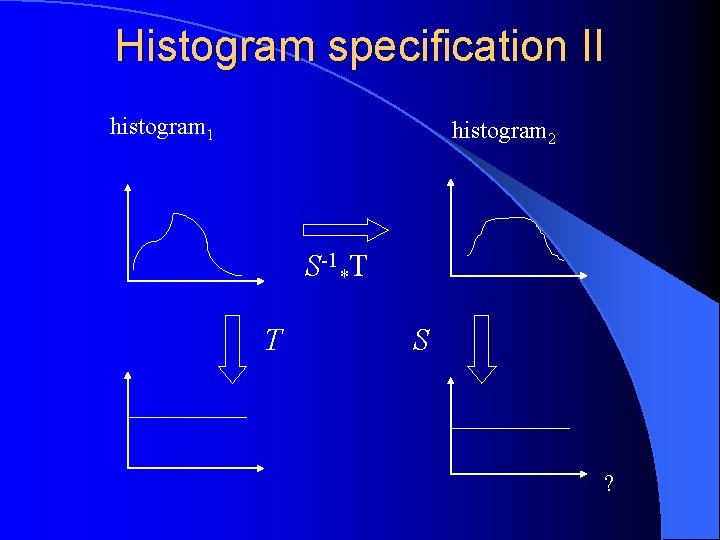
Histogram specification (HS) an image's histogram is transformed according to a desired function Transforming the intensity values so that the histogram of the output image approximately matches a specified histogram.
Histogram specification II histogram 1 histogram 2 S-1*T T S ?
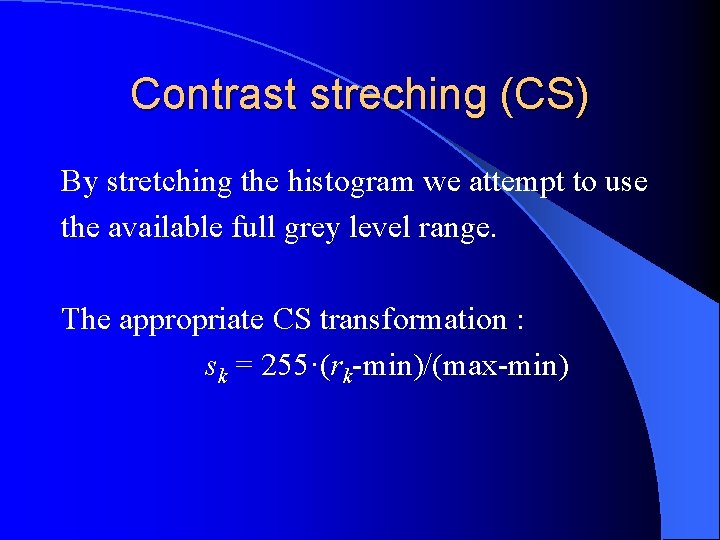
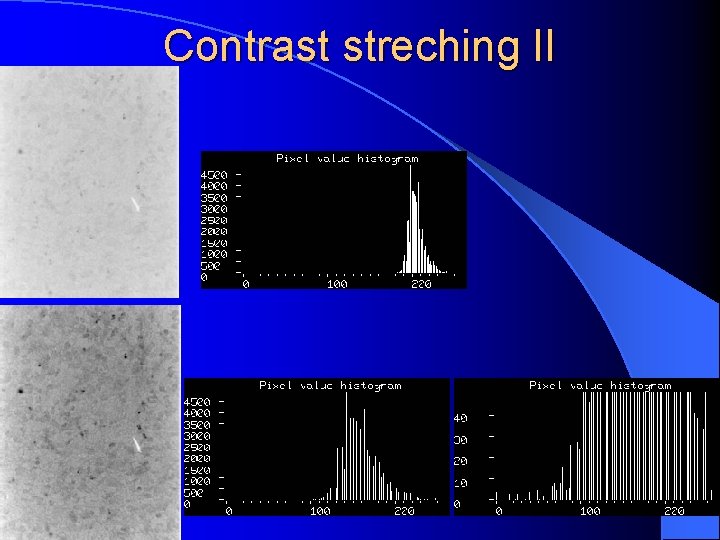
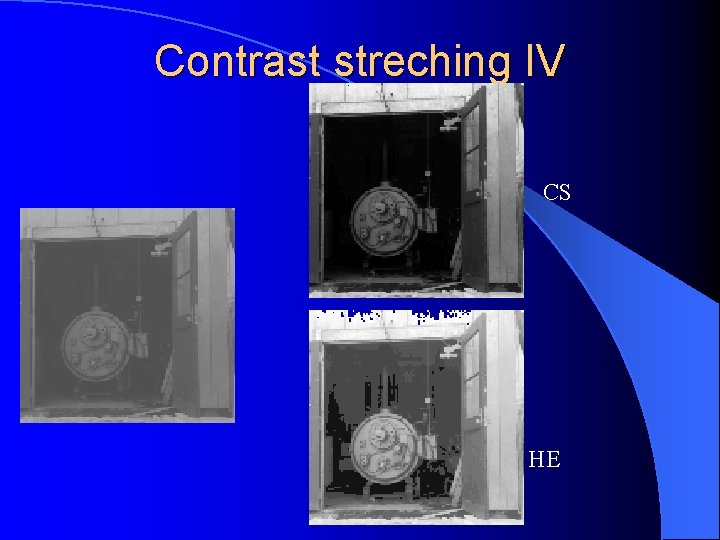
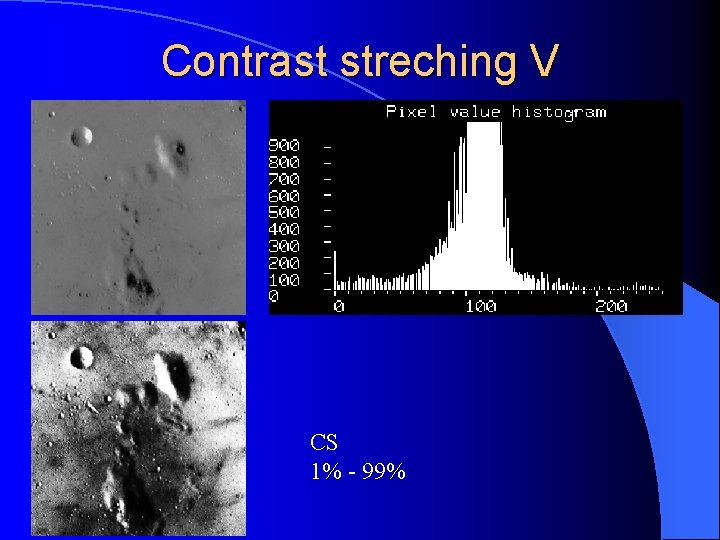
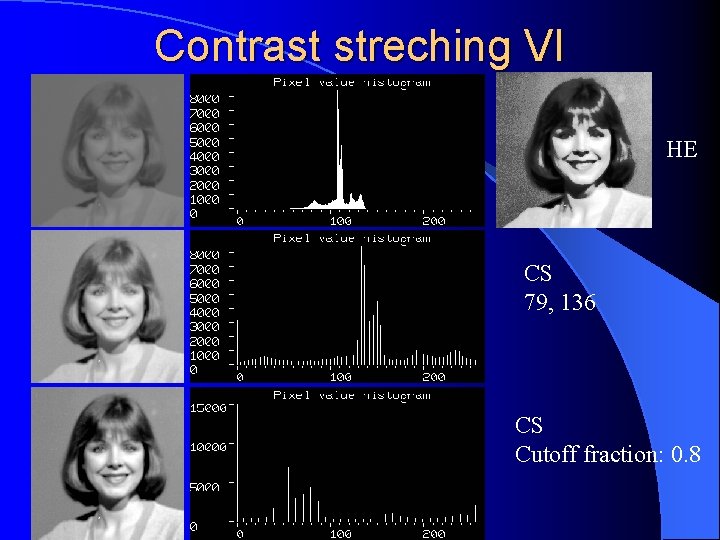
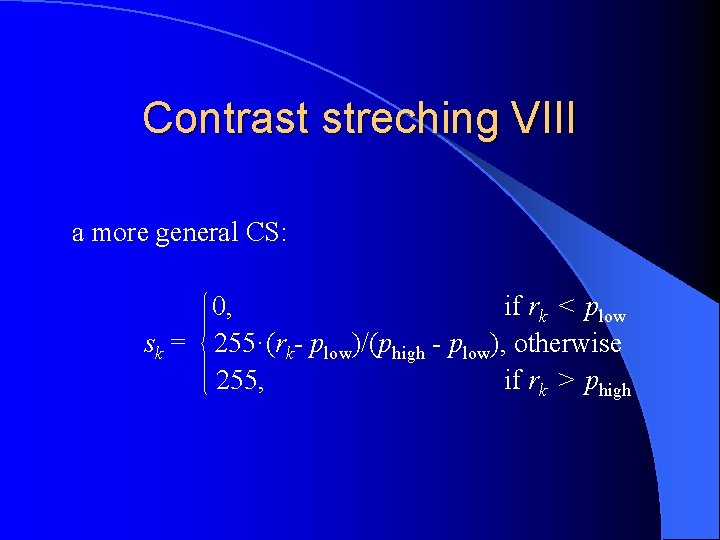
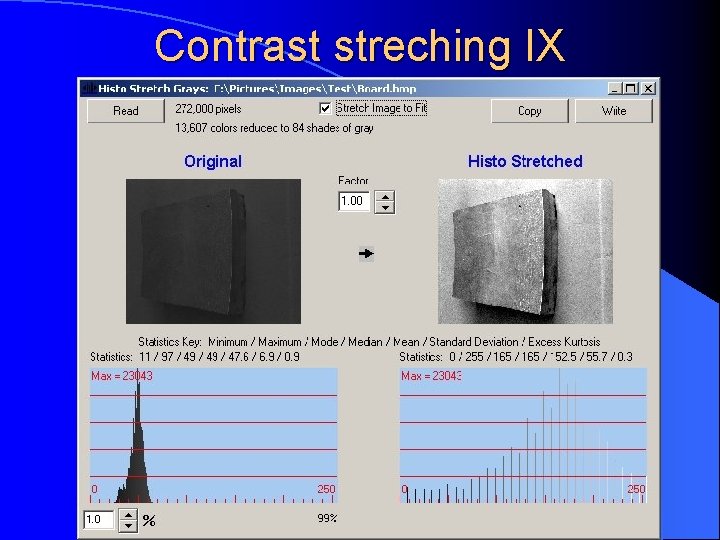
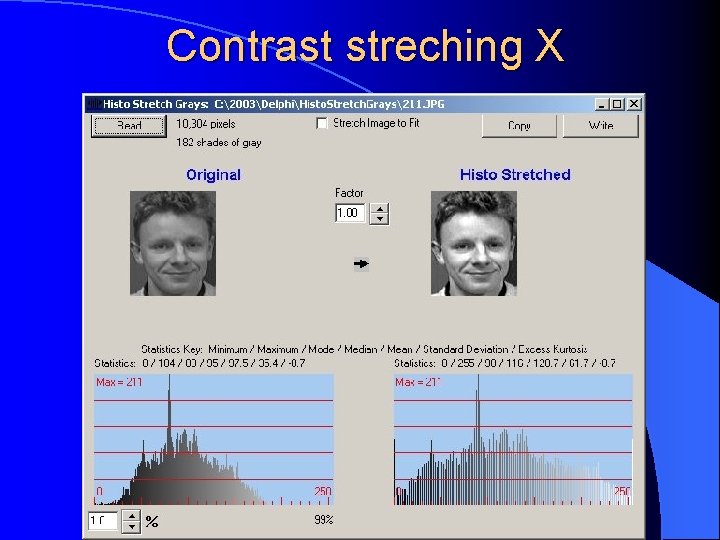
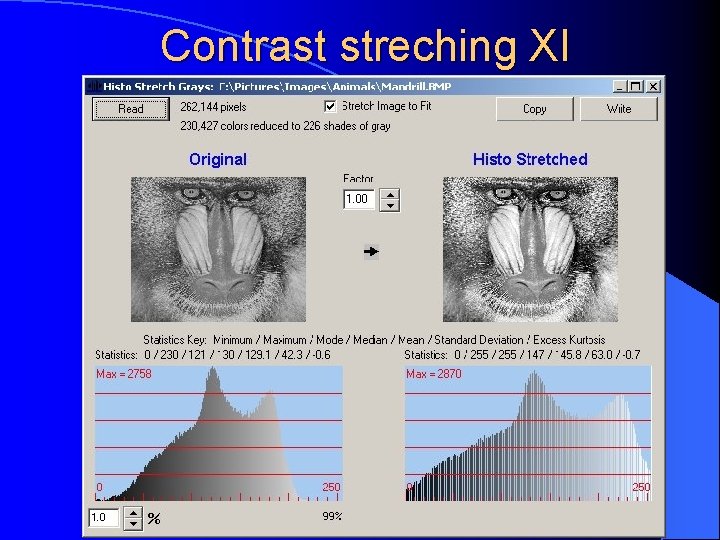
Contrast streching (CS) By stretching the histogram we attempt to use the available full grey level range. The appropriate CS transformation : sk = 255·(rk-min)/(max-min)
Contrast streching II
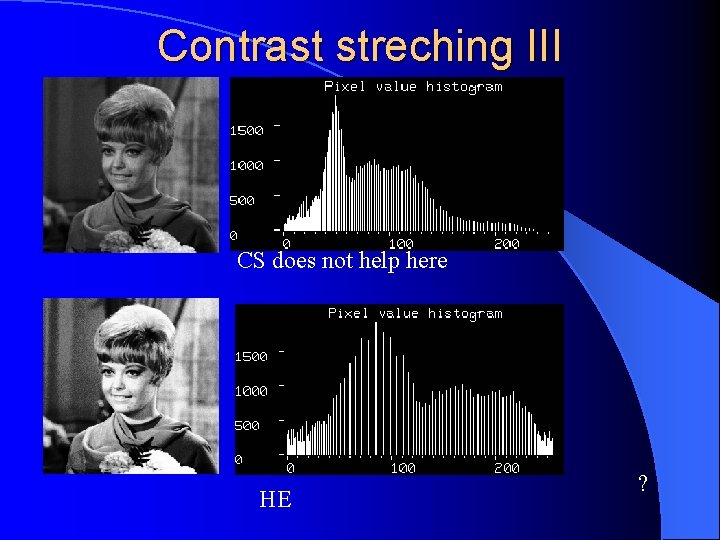
Contrast streching III CS does not help here HE ?
Contrast streching IV CS HE
Contrast streching V CS 1% - 99%
Contrast streching VI HE CS 79, 136 CS Cutoff fraction: 0. 8
Contrast streching VIII a more general CS: 0, if rk < plow sk = 255·(rk- plow)/(phigh - plow), otherwise 255, if rk > phigh
Contrast streching IX
Contrast streching X
Contrast streching XI
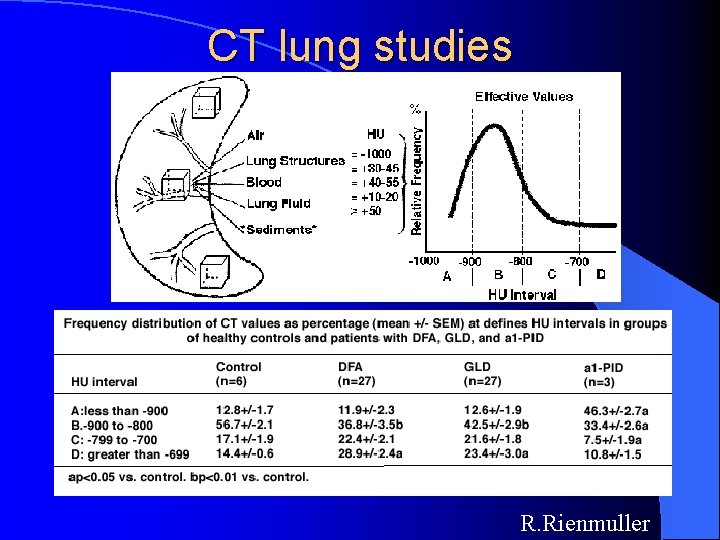
Applications CT lung studies Thresholding Normalization of MRI images Presentation of high dynamic images (IR, CT)
CT lung studies Yinpeng Jin HE taken in a part of the image
CT lung studies R. Rienmuller
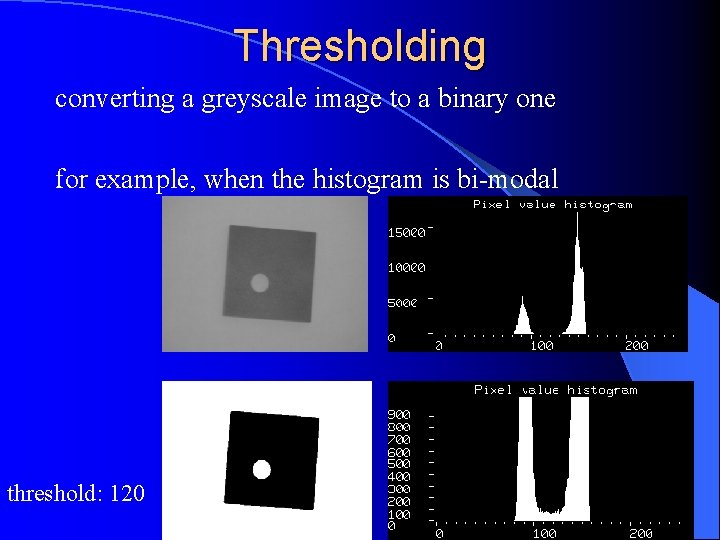
Thresholding converting a greyscale image to a binary one for example, when the histogram is bi-modal threshold: 120
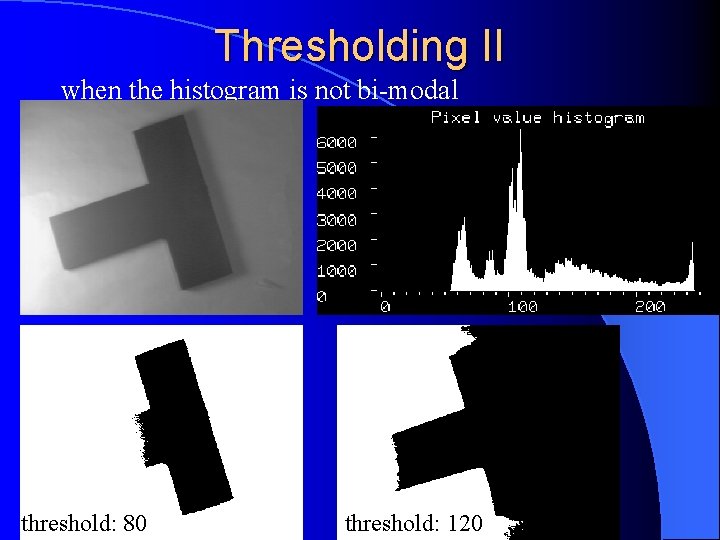
Thresholding II when the histogram is not bi-modal threshold: 80 threshold: 120
Normalization I When one wishes to compare two or more images on a specific basis, such as texture, it is common to first normalize their histograms to a "standard" histogram. This can be especially useful when the images have been acquired under different circumstances. Such a normalization is, for example, HE.
Normalization II Histogram matching takes into account the shape of the histogram of the original image and the one being matched.
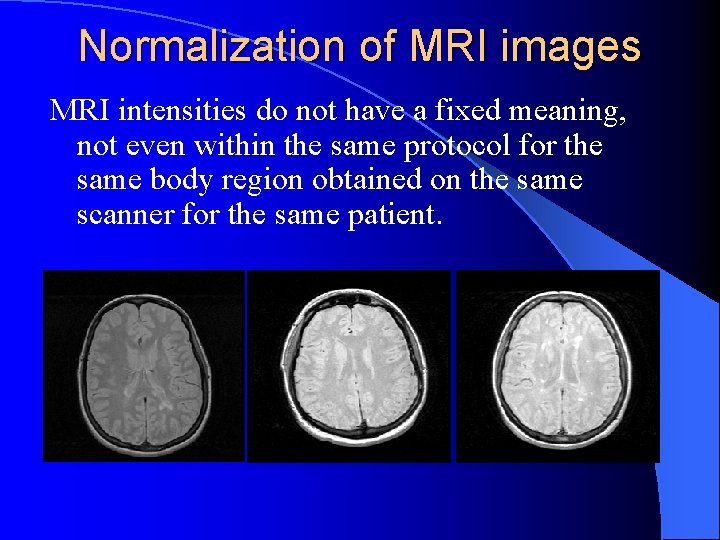
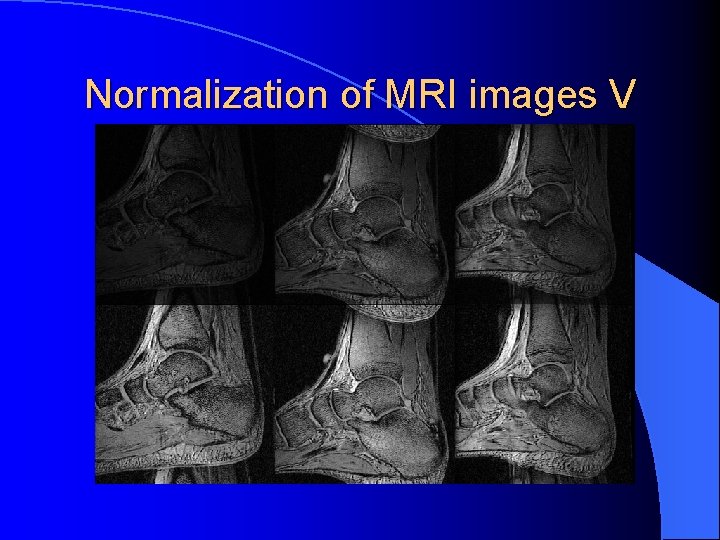
Normalization of MRI images MRI intensities do not have a fixed meaning, not even within the same protocol for the same body region obtained on the same scanner for the same patient.
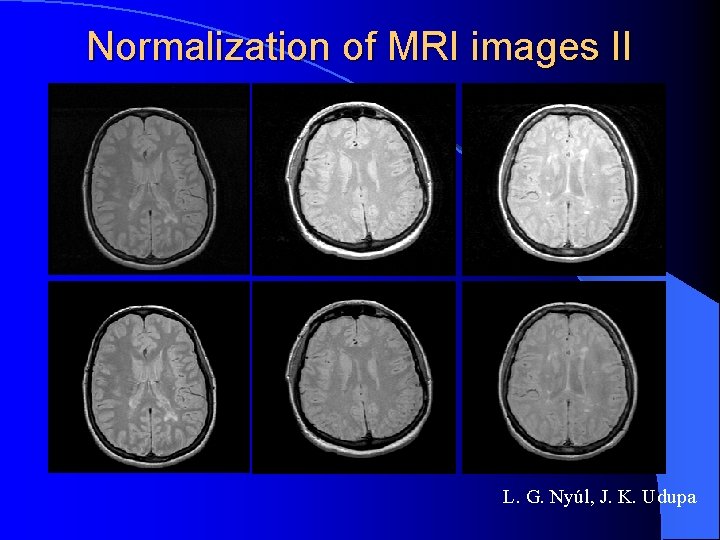
Normalization of MRI images II L. G. Nyúl, J. K. Udupa
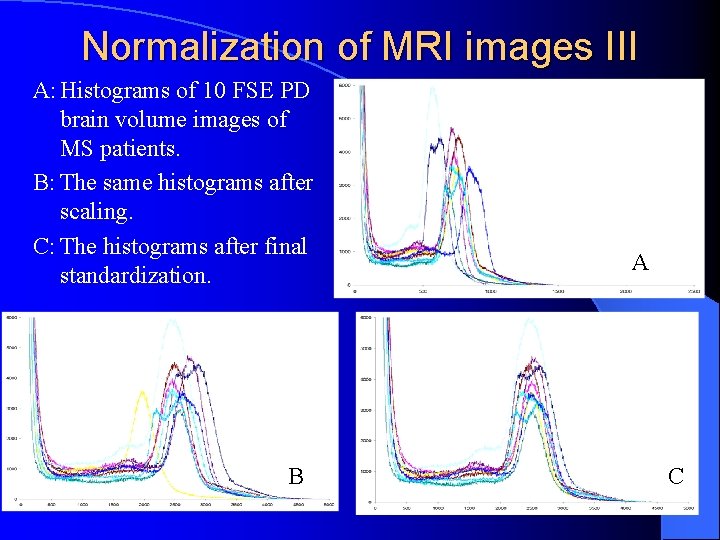
Normalization of MRI images III A: Histograms of 10 FSE PD brain volume images of MS patients. B: The same histograms after scaling. C: The histograms after final standardization. B A C L. G. Nyúl, J. K. Udupa
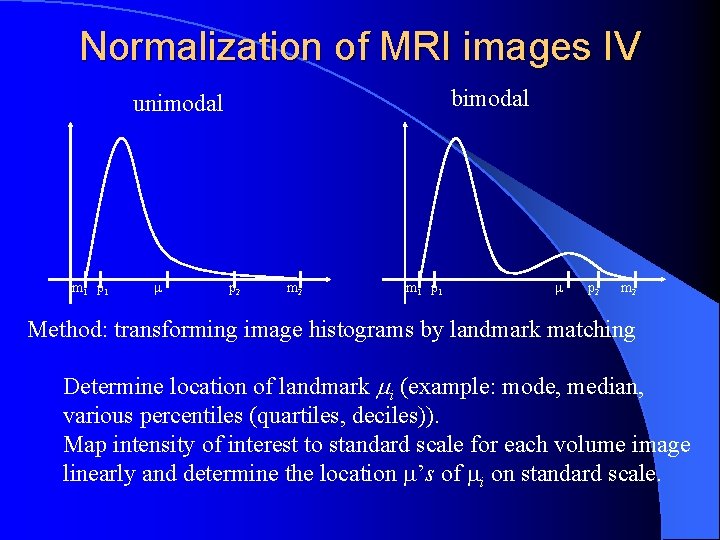
Normalization of MRI images IV bimodal unimodal m 1 p 1 p 2 m 2 Method: transforming image histograms by landmark matching Determine location of landmark i (example: mode, median, various percentiles (quartiles, deciles)). Map intensity of interest to standard scale for each volume image linearly and determine the location ’s of i on standard scale.
Normalization of MRI images V
Applications III A digitized high dynamic range image, such as an infrared (IR) image or a CAT scan image, spans a much larger range of levels than the typical values (0 - 255) available for monitor display. The function of a good display algorithm is to map these digitized raw signal levels into display values from 0 to 255 (black to white), preserving as much information as possible for the purposes of the human observer.
Applications IV The HP algorithm is widely used by infrared (IR) camera manufacturers as a real-time automated image display. The PE algorithm is used in the B-52 IR navigation and targeting sensor.