
HISTOGRAM STEM AND LEAF PLOT and DOT PLOTS
- Slides: 10
HISTOGRAM , STEM AND LEAF PLOT and DOT PLOTS
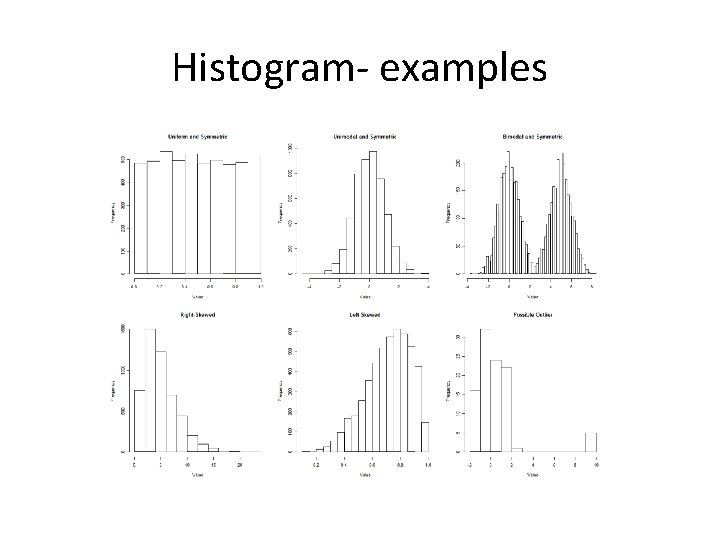
Histogram • Used to summarize continuous data. • Visualisation of a frequency distribution • Vertical bars representing frequencies are drawn over class intervals. • Usually equal width classes are considered • Histograms are useful to understand symmetry or asymmetry of data • Important: Histogram is different from bar diagram (How ? ) • Prepare detailed notes and workout examples.
Histogram- examples
• Interactive histogram
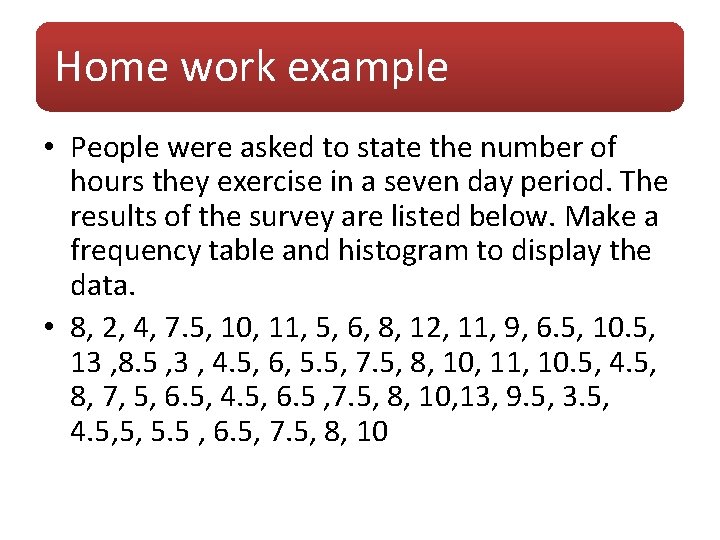
Home work example • People were asked to state the number of hours they exercise in a seven day period. The results of the survey are listed below. Make a frequency table and histogram to display the data. • 8, 2, 4, 7. 5, 10, 11, 5, 6, 8, 12, 11, 9, 6. 5, 10. 5, 13 , 8. 5 , 3 , 4. 5, 6, 5. 5, 7. 5, 8, 10, 11, 10. 5, 4. 5, 8, 7, 5, 6. 5, 4. 5, 6. 5 , 7. 5, 8, 10, 13, 9. 5, 3. 5, 4. 5, 5, 5. 5 , 6. 5, 7. 5, 8, 10
Stem and leaf plot • Bears strong resemblance to a histogram and serves the same purpose • Used to show the distributional structure of quantitative data • It preserves the information contained in individual observations • It can be constructed along with the tallying process when a frequency distribution is constructed
Method of construction • Each measurement( observation ) is partitioned into two parts – a stem and a leaf • Arrange the observations horizontally in increasing order against a stem value. All such values are the leaves. Do this for all the stem values. Such an arrangement looks like a histogram with horizontal bars of numbers. • Original data can be read. • We may have to approximate the numbers if there are many digits/decimal places.
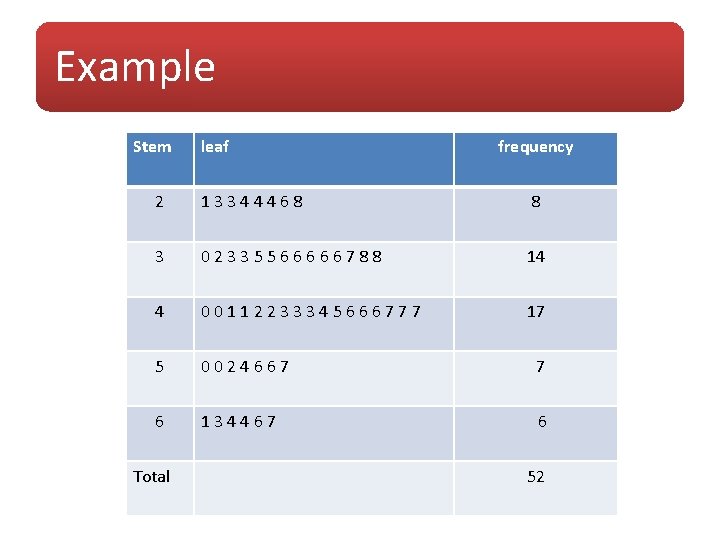
Example Stem leaf frequency 2 13344468 8 3 02335566666788 14 4 00112233345666777 17 5 0024667 7 6 134467 6 Total 52
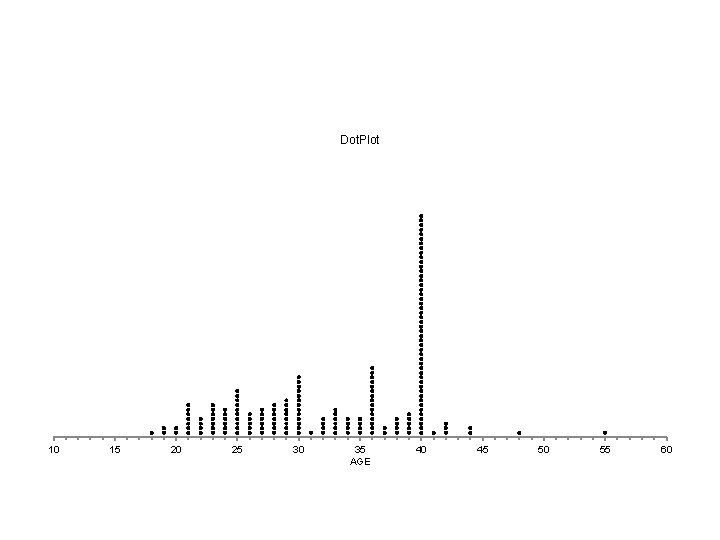
Dot plot • A dot plot is another kind of visual representation of data. Here the frequency of each data point is shown as a dot on the xaxis. When a value repeats, the dots are repeated to give a column of dots. This resembles a stem and leaf chart with the numbers in the leaf part replaced by dots.
Dot. Plot 10 15 20 25 30 35 AGE 40 45 50 55 60