
HIST 1000 B History for Today Second Term
HIST 1000 B History for Today Second Term, 2012/2013 (in English) Dr. Frederick Hokming CHEUNG (KHB 124, Tel. : 3943 -7123) E-mail: fhmcheung@cuhk. edu. hk Course Webpage: http: //ihome. cuhk. edu. hk/~b 012732 Lectures & Tutorials: Wed. 12: 30 pm – 3: 15 pm (at YIA LT 6) YIA = Yasumoto International Academic Park Tutors: Dr. LUI Wing-sing Ms LIU Yu Rosalynn
• Course Description: • This course seeks to enhance students’ understanding of the relevance of historical knowledge to concerns of today. It addresses issues which university students may be personally concerned with as individuals and as responsible and contributing members of society. The topics will be adjusted from time to time on a flexible and student-oriented approach, covering selected issues befitting the objectives of the course.
• Course Schedule: • Jan. 15, 2013 Introduction: History for Today • Jan. 23 Historical Names & Terms in Our Daily Life • Jan. 30 Mythology (Chinese & Western): Past & Present • Feb. 6 History: Learning History via Speeches • Feb. 13 • HOLIDAY

• Assessment Method: • 1. Each student is to present a review [newspaper, essays, articles, or books to be approved by the professor] (orally for 5 minutes at the tutorial or in written form in 1, 000 words) = 25% • 2. A Mid-term Quiz (answer 1 out of 2 questions) = 25% • 3. A Final Essay = 50% (about 10 [A 4 size] pages, double-spaced, on a topic approved by the Professor)
• Reminder: • *Each student must upload before the deadline of submission a soft copy of the completed assignment to the plagiarism detection engine Veri. Guide, at the URL: • http: //Veri. Guide. cse. cuhk. edu. hk/student • The system will issue a receipt which also contains a declaration of honesty, which is the same as that in • http: //www. cuhk. edu. hk/policy/academichonesty/p 09. htm • The declaration should be signed, and the receipt stapled to a hard copy of the assignment, which should be handed in to the professor before the deadline of submission.
• • Learning Outcomes By the end of the course, students will: • 1. Have enhanced awareness and curiosity of professional historical knowledge and its relevance to today’s major issues or personal concerns; • 2. Have enhanced judgment to distinguish narratives from facts; • 3. Have enhanced ability to apply the arts and skills of historical research; • 4. Have enhanced reading, writing, and oral expression skills.
• • • General Reference: Carr, Edward. What is History Hollister, C. Warren. Roots of the Western Tradition -----------. Medieval Europe Powell, Barry B. Classical Myth Safire, William. Lend Me Your Ears: Great Speeches in History Gibbon, Edward. The Decline and Fall of the Roman Empire Palmer, R. R. A History of the Modern World Holborn, Hajo. The Political Collapse of Europe Fairbank, John King. East Asia: The Great Tradition & Transformation Hsu, Immanuel C. Y. The Rise of Modern China • Keywords: world history, past and present, Chinese and western, cartoon, music, movies, history for today
• Etymology, Prosopography, Chronology, and Biography(Fred Cheung) • Etymology (noun) 1. the derivation of a word; word origin, word source, derivation, origin; 2. a chronological account of the birth and development of a particular word or element of a word, often delineating its spread from one language to another and its evolving changes in form and meaning; word history, word lore, historical development; 3. the study of historical linguistic change, especially as manifested in individual words.
• Prosopography (noun) : a study that identifies and relates a group of persons or characters within a particular historical or literary context; New Latin prosopographia, from Greek prosopon person + graphia –graphy.
• Prosopography (noun) : a study that identifies and relates a group of persons or characters within a particular historical or literary context; New Latin prosopographia, from Greek prosopon person + graphia –graphy.
• Chronology (noun) 1. the science that deals with measuring time by regular divisions and that assigns to events their proper dates; 2. a chronological table, list, or account; 3. an arrangement (as of events) in order of occurrence. New Latin chronologia, from chron- + -logia – logy.
• Biography (noun); plural: biographies. • 1. a written account of another person's life; 2. an account in biographical form of an organization, society, theater, animal, etc. ; 3. such writings collectively; 4. the writing of biography as an occupation or field of endeavor. Origin: Greek biographia. See bio-, graphy. • All in all, it is an account of a person's life written, composed, or compiled.
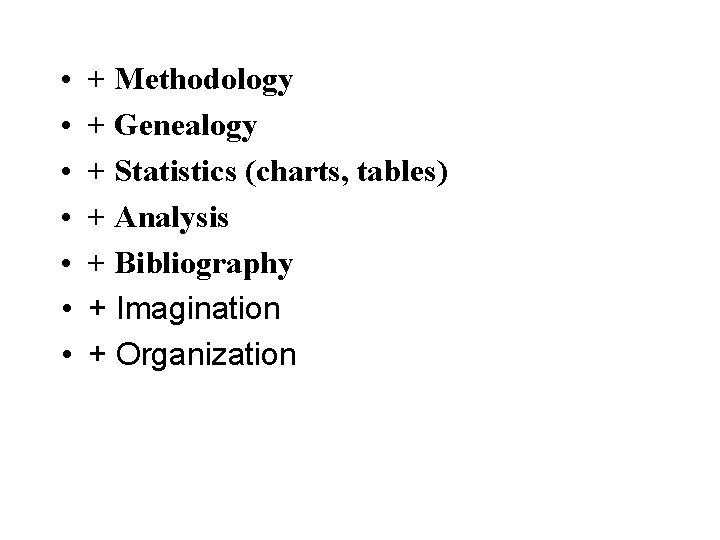
• • + Methodology + Genealogy + Statistics (charts, tables) + Analysis + Bibliography + Imagination + Organization
- Slides: 14