
Hiroshima Nagasaki The Atomic Bomb Date Learning Gain
Hiroshima & Nagasaki: The Atomic Bomb Date Learning Gain: All learners will explore the history behind the dropping of the atomic bomb. Today we will: • Discuss America’s decision to drop an atomic bomb. • Explain the historical significance of dropping an atomic bomb • Consider the causes and consequences of dropping the atomic bomb. Brainstorm a list of what you already know or remember about World War II.
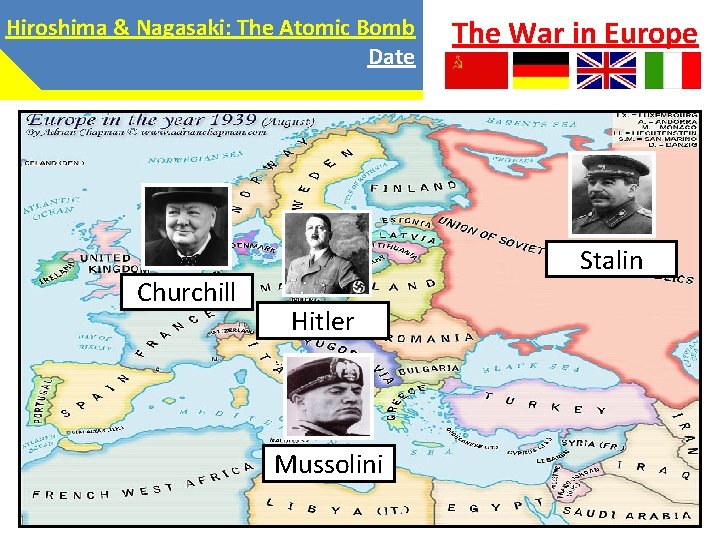
Hiroshima & Nagasaki: The Atomic Bomb Date Churchill The War in Europe Stalin Hitler Mussolini
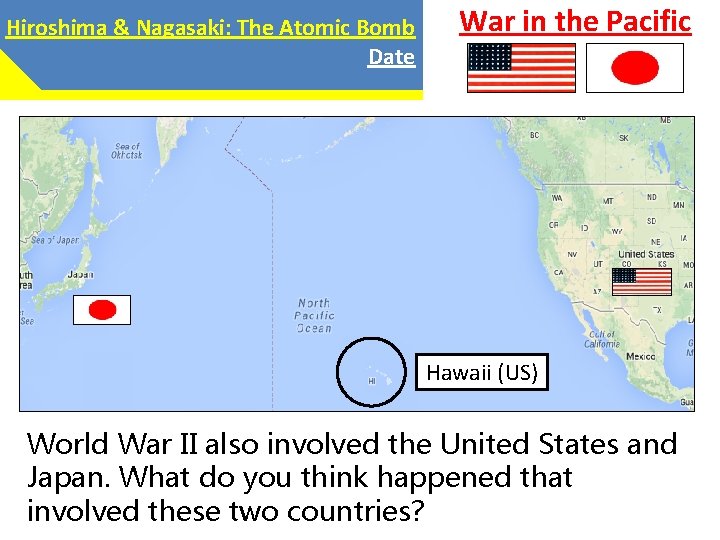
Hiroshima & Nagasaki: The Atomic Bomb Date War in the Pacific Hawaii (US) World War II also involved the United States and Japan. What do you think happened that involved these two countries?
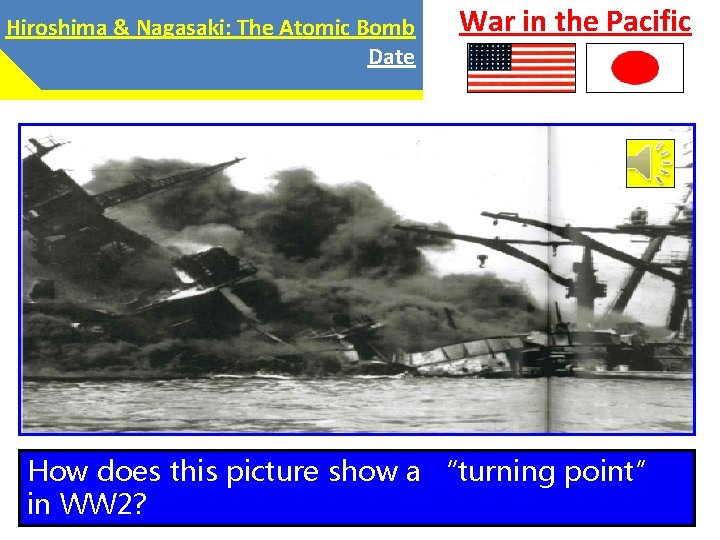
Hiroshima & Nagasaki: The Atomic Bomb Date War in the Pacific How does this picture show a “turning point” in WW 2?
Working in pairs, you will get a jigsaw puzzle with some events which included American or Japanese involvement in World War II. Your task is to fit the jigsaw pieces together so that you can discover the chronological order of these events.
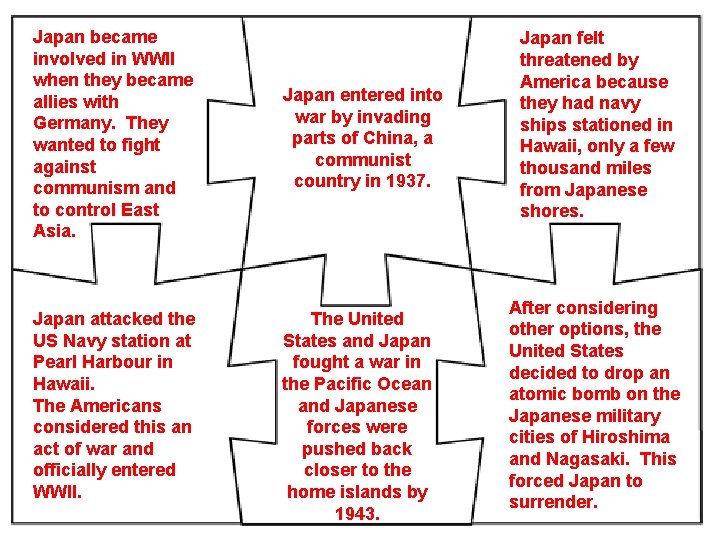
Japan became involved in WWII when they became allies with Germany. They wanted to fight against communism and to control East Asia. Japan attacked the US Navy station at Pearl Harbour in Hawaii. The Americans considered this an act of war and officially entered WWII. Japan entered into war by invading parts of China, a communist country in 1937. The United States and Japan fought a war in the Pacific Ocean and Japanese forces were pushed back closer to the home islands by 1943. Japan felt threatened by America because they had navy ships stationed in Hawaii, only a few thousand miles from Japanese shores. After considering other options, the United States decided to drop an atomic bomb on the Japanese military cities of Hiroshima and Nagasaki. This forced Japan to surrender.
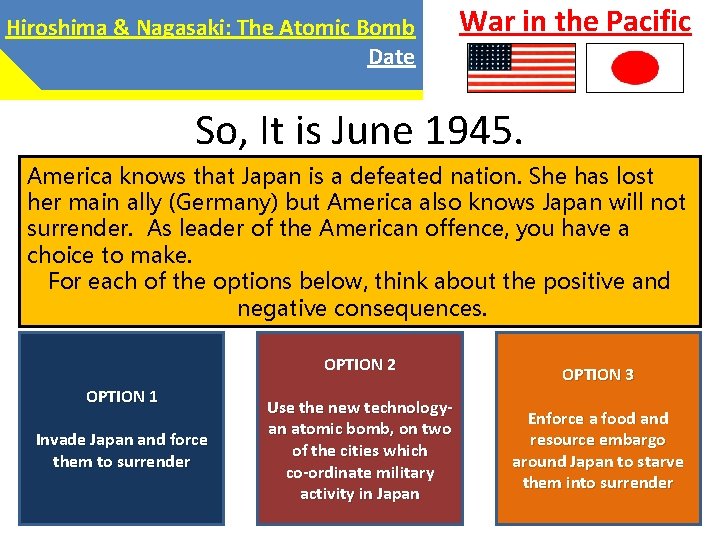
Hiroshima & Nagasaki: The Atomic Bomb Date War in the Pacific So, It is June 1945. America knows that Japan is a defeated nation. She has lost her main ally (Germany) but America also knows Japan will not surrender. As leader of the American offence, you have a choice to make. For each of the options below, think about the positive and negative consequences. OPTION 2 OPTION 1 Invade Japan and force them to surrender Use the new technologyan atomic bomb, on two of the cities which co-ordinate military activity in Japan OPTION 3 Enforce a food and resource embargo around Japan to starve them into surrender
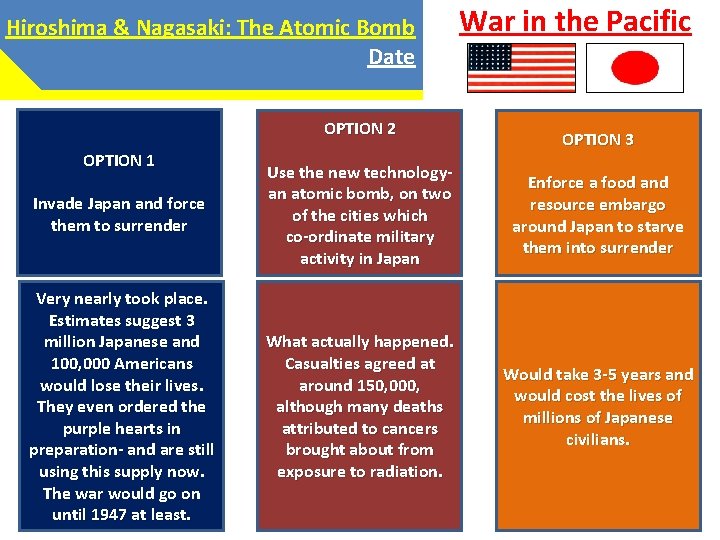
Hiroshima & Nagasaki: The Atomic Bomb Date OPTION 2 OPTION 1 War in the Pacific OPTION 3 Invade Japan and force them to surrender Use the new technologyan atomic bomb, on two of the cities which co-ordinate military activity in Japan Enforce a food and resource embargo around Japan to starve them into surrender Very nearly took place. Estimates suggest 3 million Japanese and 100, 000 Americans would lose their lives. They even ordered the purple hearts in preparation- and are still using this supply now. The war would go on until 1947 at least. What actually happened. Casualties agreed at around 150, 000, although many deaths attributed to cancers brought about from exposure to radiation. Would take 3 -5 years and would cost the lives of millions of Japanese civilians.
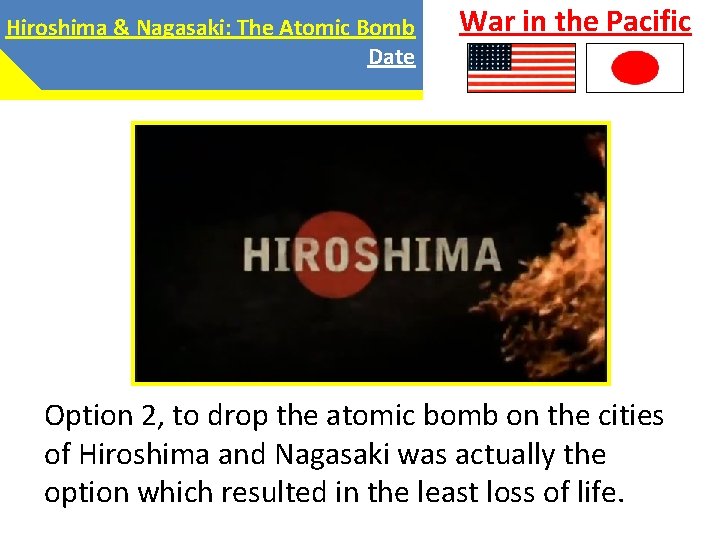
Hiroshima & Nagasaki: The Atomic Bomb Date War in the Pacific Option 2, to drop the atomic bomb on the cities of Hiroshima and Nagasaki was actually the option which resulted in the least loss of life.
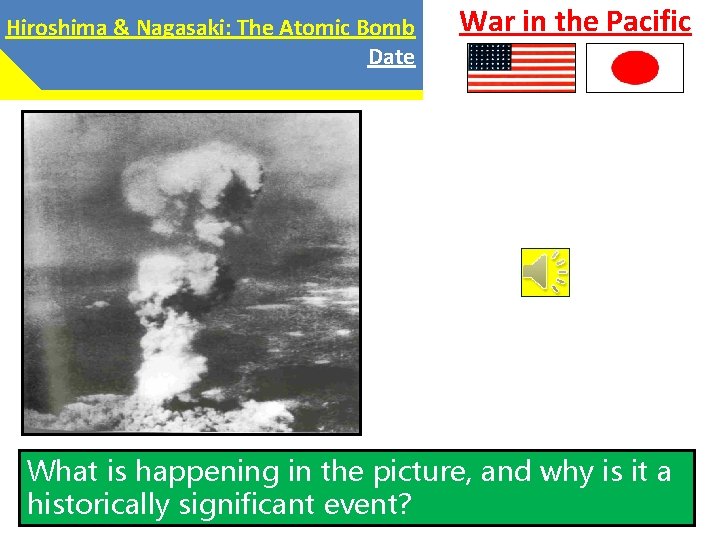
Hiroshima & Nagasaki: The Atomic Bomb Date War in the Pacific What is happening in the picture, and why is it a historically significant event?
- Slides: 10