
Hipot test units in LAPR Manuallyoperated units with

- Slides: 4
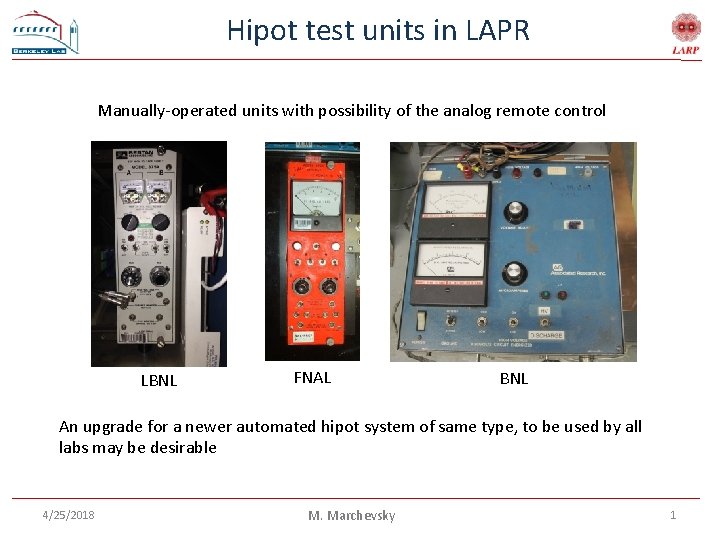
Hipot test units in LAPR Manually-operated units with possibility of the analog remote control LBNL FNAL BNL An upgrade for a newer automated hipot system of same type, to be used by all labs may be desirable 4/25/2018 M. Marchevsky 1
Hipot hardware at LBNL We use Bertan 375 X 5 k. V power supply interfaced with NI DAQ / Labview control to ramp up voltage and measure leakage current. The setup allows to: • Controls voltage step, ramp rate and number of averages • Stores I-V data (. CSV) and graphs (JPG) • Safely interrupts voltage ramp, manually or by auto -trip at ~80% of the current range Ø Typically we ramp up voltage at 1 V increments, at ~4 V/s. Optional stops can be made at pre-set voltages Ø We normally choose current range of 1 m. A; power supply then automatically “trips” at 0. 8 m. A Ø 10 MW resistor is installed in series with the tested pair, to limit the current 4/25/2018 M. Marchevsky 2
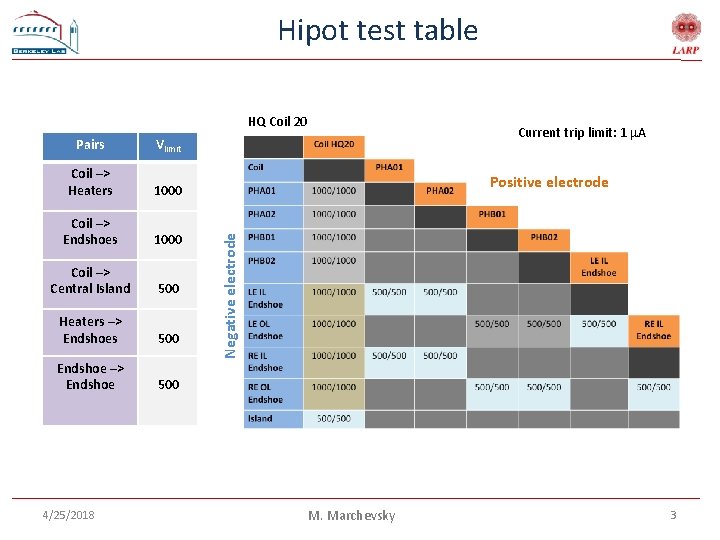
Hipot test table HQ Coil 20 Vlimit Coil –> Heaters 1000 Coil –> Endshoes 1000 Coil –> Central Island 500 Heaters –> Endshoes 500 Endshoe –> Endshoe 500 4/25/2018 Current trip limit: 1 m. A Positive electrode Negative electrode Pairs M. Marchevsky 3
Recommendations on hipot testing From the “ Electrical QA guidelines for magnet assembly and test” document (5/2014): -> Note that the measured current Ileak = C*d. V/dt + V/R. The first term can be large if ether capacitance C of the tested pair or ramp rate d. V/dt is large. The former generally increases with coil dimensions; the latter is typically set to ~4 V/s by choosing 1 V voltage increment step in the program. Ramp rate can be increased if the capacitance of the tested pair allows it, but voltage steps larger than 5 V are not recommended. It is a good idea to keep the capacitive contribution to Ileak below 0. 2 m. A. -> One should watch the I-V curve plotted during test. If the slope is positive and constant, it means that resistive leakage is prevalent; this often happens due to excessive air humidity. A nonlinear and/or jumpy I-V curve may be indicating an ongoing breakdown(s). Only if the PS trips on a linearly rising voltage, one can choose the 10 m. A range and repeat the test; otherwise hipot failure is normally recorded. -> Hipot testing may be potentially destructive to the coil, as conductive carbon channel can form along the breakdown path. The probability of this happening seems proportional to the stored energy of the junction that is CU 2/2. Thus repeated testing of high-capacitance junctions (or high voltage stress) should be avoided when not absolutely necessary. Also, pairing several junctions together to speed up testing should be done carefully, to avoid building up excessive capacitance. Again, having < 0. 2 m. A of capacitive current at nominal ~4 V/s ramp rate is a good starting criterion. 4/25/2018 M. Marchevsky 4