
HIPAA Privacy and Security Awareness Core Training AFMS


- Slides: 45
HIPAA Privacy and Security Awareness Core Training AFMS HIPAA Privacy office AFMSA/SG 3 SA Current: January 2012
Purpose of The Briefing Current guidance from the Office of the Assistant Secretary of Defense for Health Affairs (OSD/HA) requires all workforce members within the Military Health System (MHS) to complete standardized HIPAA training using the centrally managed JKO training platform. Some Air Force facilities are unable to use this system due to connectivity issues, and have been granted a waiver to deliver training by alternative means. This presentation serves as the approved HIPAA Privacy and Security awareness training for Air Force Medical Service (AFMS) facilities that are unable to utilize the JKO training platform. Department of Defense (Do. D), and Federal Regulations require employees of a Covered Entity to receive Health Insurance Portability and Accountability Act (HIPAA) training upon initial assignment to the workforce, and supplemental training when an individual’s duties and responsibilities are affected by a material change in policies and procedures. Within the Air Force, AFI 41 -210 requires initial HIPAA awareness training be provided within 30 days of an individual being assigned to the workforce, and annually thereafter. This training will familiarize you with the general provisions of the HIPAA Privacy and Security Rules, and how their requirements apply to you as a workforce member within the Air Force Medical Service. After reviewing the presentation you will: Have a basic understanding of the HIPAA Privacy and Security Rules Be familiar with the rights afforded individuals under HIPAA Understand how to properly safeguard protected health information Understand the guidelines for using and disclosing protected health information in performance of your duties Know what to do in the event of protected health information becoming lost, stolen, or compromised The HIPAA Privacy and Security Officers at your current duty assignment will augment this training with additional information as necessary to address local policies and procedures specific to your facility, and/or your current job role. 1
Briefing Content HIPAA In A Nutshell HIPAA in the AFMS Important Terms and Acronyms The Privacy Rule The Security Rule Putting it All Together 2
HIPAA In A Nutshell (What it is) What HIPAA Is Public Law 104 -191, also known as the Health Insurance Portability and Accountability Act (HIPAA) Passed by the 104 th Congress in 1996 Implemented in the Code of Federal Regulations (CFR) Privacy and Security, which align under Administrative Simplification, represent only two components of HIPAA 3
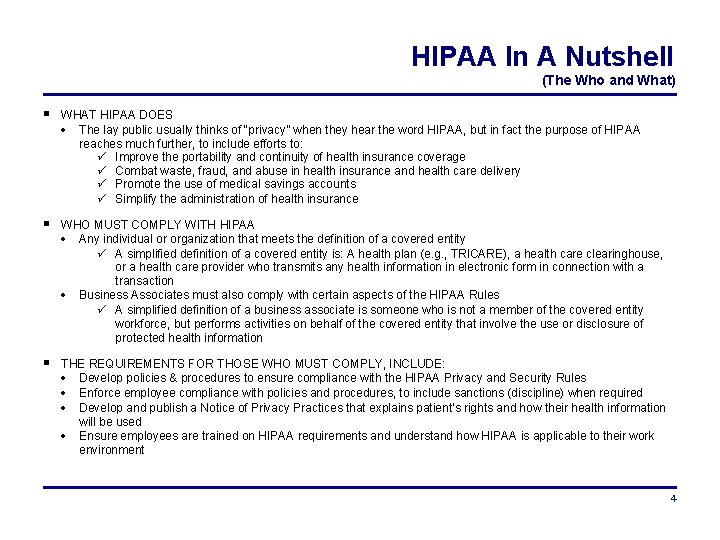
HIPAA In A Nutshell (The Who and What) WHAT HIPAA DOES The lay public usually thinks of “privacy” when they hear the word HIPAA, but in fact the purpose of HIPAA reaches much further, to include efforts to: Improve the portability and continuity of health insurance coverage Combat waste, fraud, and abuse in health insurance and health care delivery Promote the use of medical savings accounts Simplify the administration of health insurance WHO MUST COMPLY WITH HIPAA Any individual or organization that meets the definition of a covered entity A simplified definition of a covered entity is: A health plan (e. g. , TRICARE), a health care clearinghouse, or a health care provider who transmits any health information in electronic form in connection with a transaction Business Associates must also comply with certain aspects of the HIPAA Rules A simplified definition of a business associate is someone who is not a member of the covered entity workforce, but performs activities on behalf of the covered entity that involve the use or disclosure of protected health information THE REQUIREMENTS FOR THOSE WHO MUST COMPLY, INCLUDE: Develop policies & procedures to ensure compliance with the HIPAA Privacy and Security Rules Enforce employee compliance with policies and procedures, to include sanctions (discipline) when required Develop and publish a Notice of Privacy Practices that explains patient’s rights and how their health information will be used Ensure employees are trained on HIPAA requirements and understand how HIPAA is applicable to their work environment 4
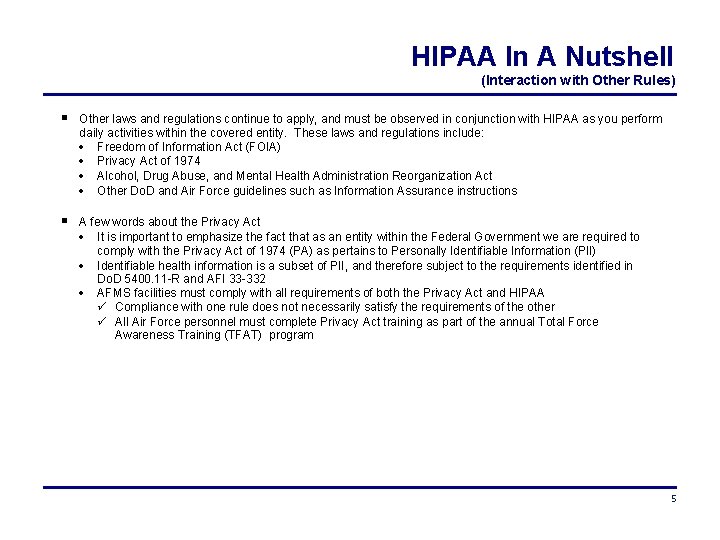
HIPAA In A Nutshell (Interaction with Other Rules) Other laws and regulations continue to apply, and must be observed in conjunction with HIPAA as you perform daily activities within the covered entity. These laws and regulations include: Freedom of Information Act (FOIA) Privacy Act of 1974 Alcohol, Drug Abuse, and Mental Health Administration Reorganization Act Other Do. D and Air Force guidelines such as Information Assurance instructions A few words about the Privacy Act It is important to emphasize the fact that as an entity within the Federal Government we are required to comply with the Privacy Act of 1974 (PA) as pertains to Personally Identifiable Information (PII) Identifiable health information is a subset of PII, and therefore subject to the requirements identified in Do. D 5400. 11 -R and AFI 33 -332 AFMS facilities must comply with all requirements of both the Privacy Act and HIPAA Compliance with one rule does not necessarily satisfy the requirements of the other All Air Force personnel must complete Privacy Act training as part of the annual Total Force Awareness Training (TFAT) program 5
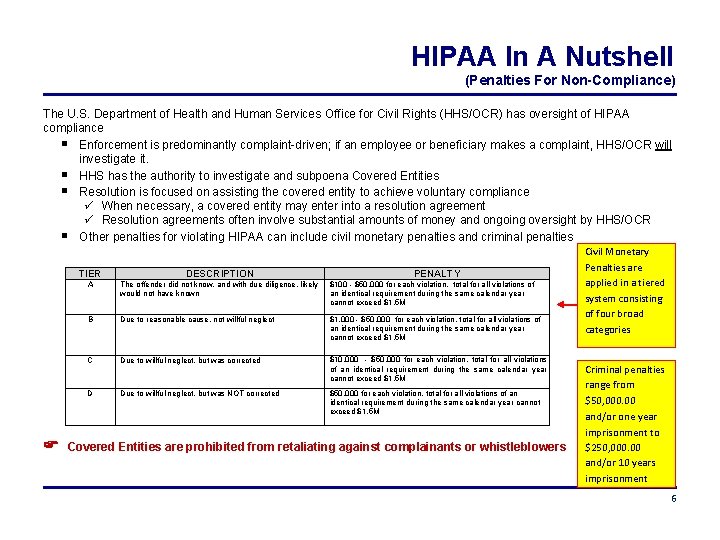
HIPAA In A Nutshell (Penalties For Non-Compliance) The U. S. Department of Health and Human Services Office for Civil Rights (HHS/OCR) has oversight of HIPAA compliance Enforcement is predominantly complaint-driven; if an employee or beneficiary makes a complaint, HHS/OCR will investigate it. HHS has the authority to investigate and subpoena Covered Entities Resolution is focused on assisting the covered entity to achieve voluntary compliance When necessary, a covered entity may enter into a resolution agreement Resolution agreements often involve substantial amounts of money and ongoing oversight by HHS/OCR Other penalties for violating HIPAA can include civil monetary penalties and criminal penalties TIER DESCRIPTION A The offender did not know, and with due diligence, likely would not have known $100 - $50, 000 for each violation, total for all violations of an identical requirement during the same calendar year cannot exceed $1. 5 M PENALTY B Due to reasonable cause, not willful neglect $1, 000 - $50, 000 for each violation, total for all violations of an identical requirement during the same calendar year cannot exceed $1. 5 M C Due to willful neglect, but was corrected $10, 000 - $50, 000 for each violation, total for all violations of an identical requirement during the same calendar year cannot exceed $1. 5 M D Due to willful neglect, but was NOT corrected $50, 000 for each violation, total for all violations of an identical requirement during the same calendar year cannot exceed $1. 5 M Covered Entities are prohibited from retaliating against complainants or whistleblowers Civil Monetary Penalties are applied in a tiered system consisting of four broad categories Criminal penalties range from $50, 000. 00 and/or one year imprisonment to $250, 000. 00 and/or 10 years imprisonment 6
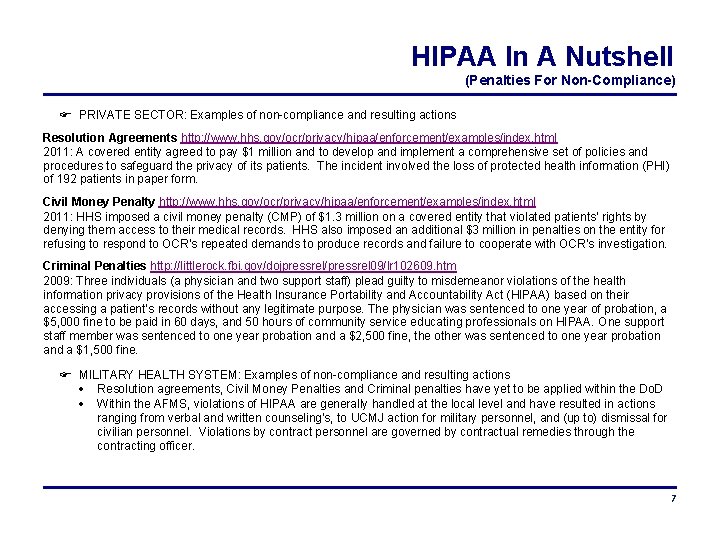
HIPAA In A Nutshell (Penalties For Non-Compliance) PRIVATE SECTOR: Examples of non-compliance and resulting actions Resolution Agreements http: //www. hhs. gov/ocr/privacy/hipaa/enforcement/examples/index. html 2011: A covered entity agreed to pay $1 million and to develop and implement a comprehensive set of policies and procedures to safeguard the privacy of its patients. The incident involved the loss of protected health information (PHI) of 192 patients in paper form. Civil Money Penalty http: //www. hhs. gov/ocr/privacy/hipaa/enforcement/examples/index. html 2011: HHS imposed a civil money penalty (CMP) of $1. 3 million on a covered entity that violated patients’ rights by denying them access to their medical records. HHS also imposed an additional $3 million in penalties on the entity for refusing to respond to OCR’s repeated demands to produce records and failure to cooperate with OCR’s investigation. Criminal Penalties http: //littlerock. fbi. gov/dojpressrel/pressrel 09/lr 102609. htm 2009: Three individuals (a physician and two support staff) plead guilty to misdemeanor violations of the health information privacy provisions of the Health Insurance Portability and Accountability Act (HIPAA) based on their accessing a patient’s records without any legitimate purpose. The physician was sentenced to one year of probation, a $5, 000 fine to be paid in 60 days, and 50 hours of community service educating professionals on HIPAA. One support staff member was sentenced to one year probation and a $2, 500 fine, the other was sentenced to one year probation and a $1, 500 fine. MILITARY HEALTH SYSTEM: Examples of non-compliance and resulting actions Resolution agreements, Civil Money Penalties and Criminal penalties have yet to be applied within the Do. D Within the AFMS, violations of HIPAA are generally handled at the local level and have resulted in actions ranging from verbal and written counseling’s, to UCMJ action for military personnel, and (up to) dismissal for civilian personnel. Violations by contract personnel are governed by contractual remedies through the contracting officer. 7
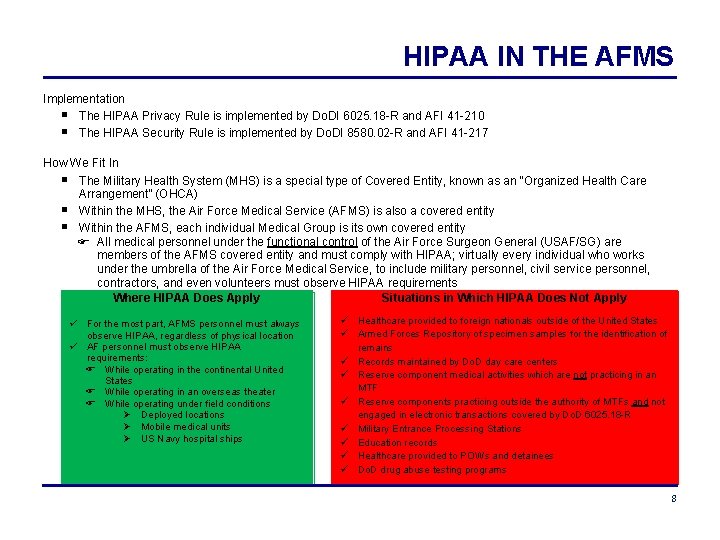
HIPAA IN THE AFMS Implementation The HIPAA Privacy Rule is implemented by Do. DI 6025. 18 -R and AFI 41 -210 The HIPAA Security Rule is implemented by Do. DI 8580. 02 -R and AFI 41 -217 How We Fit In The Military Health System (MHS) is a special type of Covered Entity, known as an “Organized Health Care Arrangement” (OHCA) Within the MHS, the Air Force Medical Service (AFMS) is also a covered entity Within the AFMS, each individual Medical Group is its own covered entity All medical personnel under the functional control of the Air Force Surgeon General (USAF/SG) are members of the AFMS covered entity and must comply with HIPAA; virtually every individual who works under the umbrella of the Air Force Medical Service, to include military personnel, civil service personnel, contractors, and even volunteers must observe HIPAA requirements Where HIPAA Does Apply Situations in Which HIPAA Does Not Apply For the most part, AFMS personnel must always observe HIPAA, regardless of physical location AF personnel must observe HIPAA requirements: While operating in the continental United States While operating in an overseas theater While operating under field conditions Deployed locations Mobile medical units US Navy hospital ships Healthcare provided to foreign nationals outside of the United States Armed Forces Repository of specimen samples for the identification of remains Records maintained by Do. D day care centers Reserve component medical activities which are not practicing in an MTF Reserve components practicing outside the authority of MTFs and not engaged in electronic transactions covered by Do. D 6025. 18 -R Military Entrance Processing Stations Education records Healthcare provided to POWs and detainees Do. D drug abuse testing programs 8
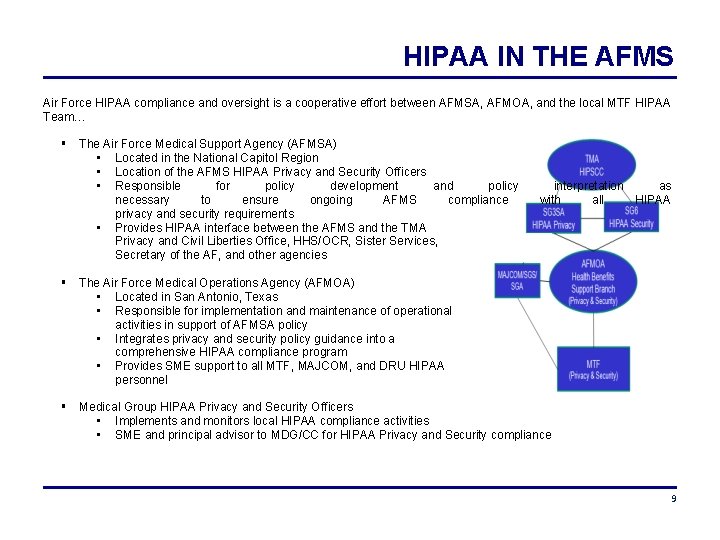
HIPAA IN THE AFMS Air Force HIPAA compliance and oversight is a cooperative effort between AFMSA, AFMOA, and the local MTF HIPAA Team… The Air Force Medical Support Agency (AFMSA) • Located in the National Capitol Region • Location of the AFMS HIPAA Privacy and Security Officers • Responsible for policy development and policy necessary to ensure ongoing AFMS compliance privacy and security requirements • Provides HIPAA interface between the AFMS and the TMA Privacy and Civil Liberties Office, HHS/OCR, Sister Services, Secretary of the AF, and other agencies interpretation as with all HIPAA The Air Force Medical Operations Agency (AFMOA) • Located in San Antonio, Texas • Responsible for implementation and maintenance of operational activities in support of AFMSA policy • Integrates privacy and security policy guidance into a comprehensive HIPAA compliance program • Provides SME support to all MTF, MAJCOM, and DRU HIPAA personnel Medical Group HIPAA Privacy and Security Officers • Implements and monitors local HIPAA compliance activities • SME and principal advisor to MDG/CC for HIPAA Privacy and Security compliance 9
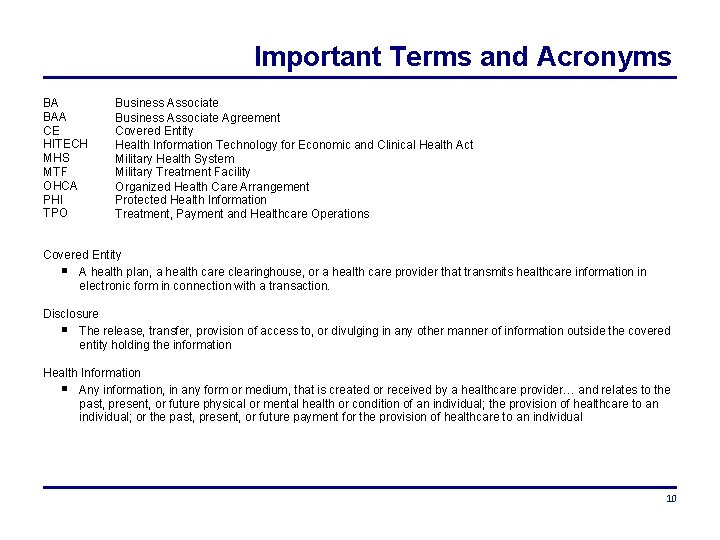
Important Terms and Acronyms BA BAA CE HITECH MHS MTF OHCA PHI TPO Business Associate Agreement Covered Entity Health Information Technology for Economic and Clinical Health Act Military Health System Military Treatment Facility Organized Health Care Arrangement Protected Health Information Treatment, Payment and Healthcare Operations Covered Entity A health plan, a health care clearinghouse, or a health care provider that transmits healthcare information in electronic form in connection with a transaction. Disclosure The release, transfer, provision of access to, or divulging in any other manner of information outside the covered entity holding the information Health Information Any information, in any form or medium, that is created or received by a healthcare provider… and relates to the past, present, or future physical or mental health or condition of an individual; the provision of healthcare to an individual; or the past, present, or future payment for the provision of healthcare to an individual 10
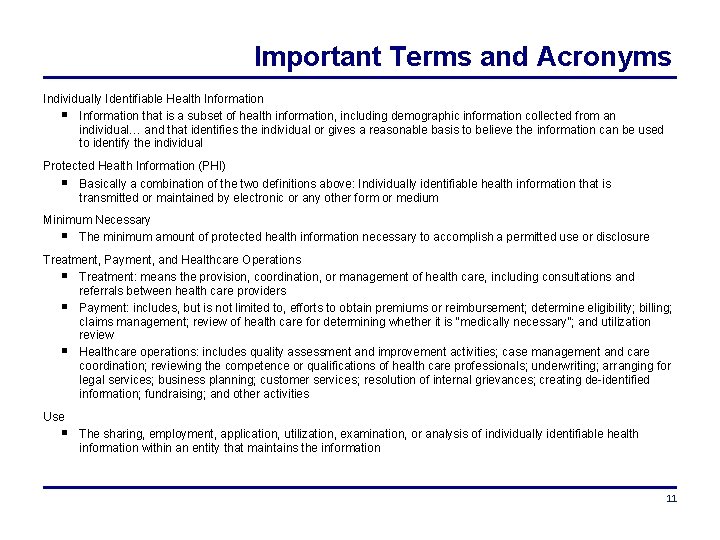
Important Terms and Acronyms Individually Identifiable Health Information that is a subset of health information, including demographic information collected from an individual… and that identifies the individual or gives a reasonable basis to believe the information can be used to identify the individual Protected Health Information (PHI) Basically a combination of the two definitions above: Individually identifiable health information that is transmitted or maintained by electronic or any other form or medium Minimum Necessary The minimum amount of protected health information necessary to accomplish a permitted use or disclosure Treatment, Payment, and Healthcare Operations Treatment: means the provision, coordination, or management of health care, including consultations and referrals between health care providers Payment: includes, but is not limited to, efforts to obtain premiums or reimbursement; determine eligibility; billing; claims management; review of health care for determining whether it is “medically necessary”; and utilization review Healthcare operations: includes quality assessment and improvement activities; case management and care coordination; reviewing the competence or qualifications of health care professionals; underwriting; arranging for legal services; business planning; customer services; resolution of internal grievances; creating de-identified information; fundraising; and other activities Use The sharing, employment, application, utilization, examination, or analysis of individually identifiable health information within an entity that maintains the information 11
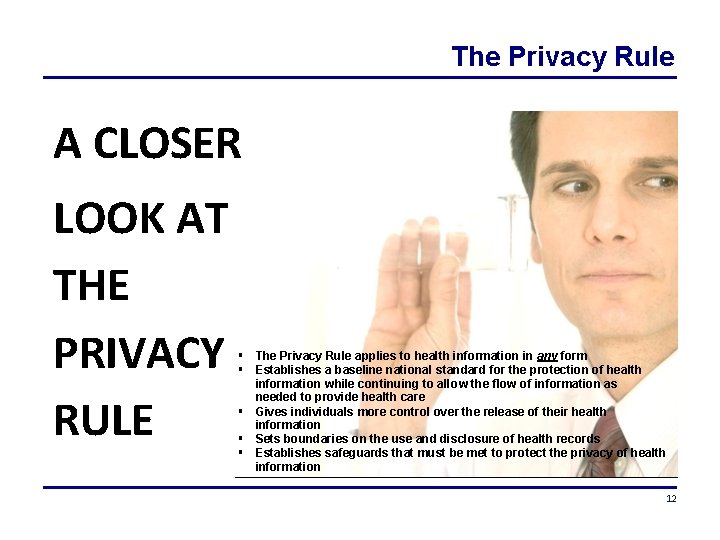
The Privacy Rule A CLOSER LOOK AT THE PRIVACY RULE The Privacy Rule applies to health information in any form Establishes a baseline national standard for the protection of health information while continuing to allow the flow of information as needed to provide health care Gives individuals more control over the release of their health information Sets boundaries on the use and disclosure of health records Establishes safeguards that must be met to protect the privacy of health information 12
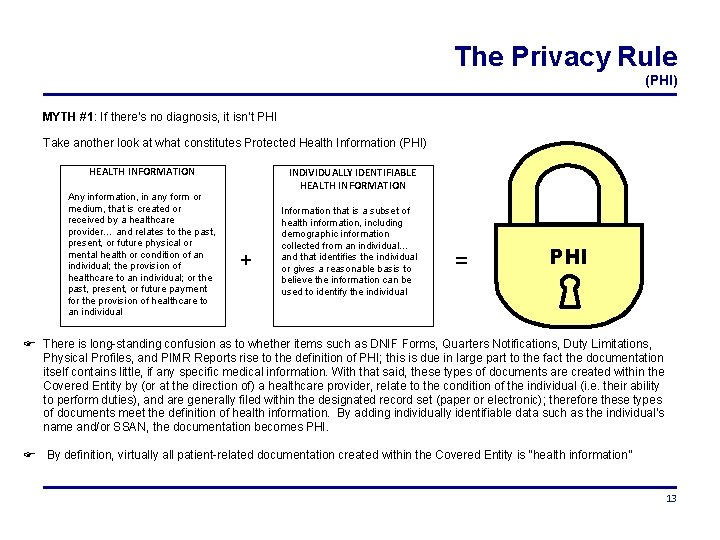
The Privacy Rule (PHI) MYTH #1: If there’s no diagnosis, it isn’t PHI Take another look at what constitutes Protected Health Information (PHI) HEALTH INFORMATION Any information, in any form or medium, that is created or received by a healthcare provider… and relates to the past, present, or future physical or mental health or condition of an individual; the provision of healthcare to an individual; or the past, present, or future payment for the provision of healthcare to an individual INDIVIDUALLY IDENTIFIABLE HEALTH INFORMATION + Information that is a subset of health information, including demographic information collected from an individual… and that identifies the individual or gives a reasonable basis to believe the information can be used to identify the individual = PHI There is long-standing confusion as to whether items such as DNIF Forms, Quarters Notifications, Duty Limitations, Physical Profiles, and PIMR Reports rise to the definition of PHI; this is due in large part to the fact the documentation itself contains little, if any specific medical information. With that said, these types of documents are created within the Covered Entity by (or at the direction of) a healthcare provider, relate to the condition of the individual (i. e. their ability to perform duties), and are generally filed within the designated record set (paper or electronic); therefore these types of documents meet the definition of health information. By adding individually identifiable data such as the individual’s name and/or SSAN, the documentation becomes PHI. By definition, virtually all patient-related documentation created within the Covered Entity is “health information” 13
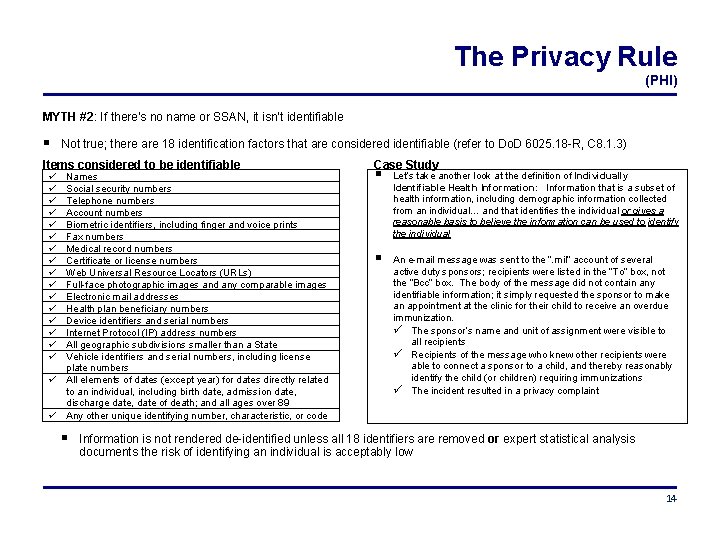
The Privacy Rule (PHI) MYTH #2: If there’s no name or SSAN, it isn’t identifiable Not true; there are 18 identification factors that are considered identifiable (refer to Do. D 6025. 18 -R, C 8. 1. 3) Items considered to be identifiable Names Social security numbers Telephone numbers Account numbers Biometric identifiers, including finger and voice prints Fax numbers Medical record numbers Certificate or license numbers Web Universal Resource Locators (URLs) Full-face photographic images and any comparable images Electronic mail addresses Health plan beneficiary numbers Device identifiers and serial numbers Internet Protocol (IP) address numbers All geographic subdivisions smaller than a State Vehicle identifiers and serial numbers, including license plate numbers All elements of dates (except year) for dates directly related to an individual, including birth date, admission date, discharge date, date of death; and all ages over 89 Any other unique identifying number, characteristic, or code Case Study Let’s take another look at the definition of Individually Identifiable Health Information: Information that is a subset of health information, including demographic information collected from an individual… and that identifies the individual or gives a reasonable basis to believe the information can be used to identify the individual An e-mail message was sent to the “. mil” account of several active duty sponsors; recipients were listed in the “To” box, not the “Bcc” box. The body of the message did not contain any identifiable information; it simply requested the sponsor to make an appointment at the clinic for their child to receive an overdue immunization. The sponsor’s name and unit of assignment were visible to all recipients Recipients of the message who knew other recipients were able to connect a sponsor to a child, and thereby reasonably identify the child (or children) requiring immunizations The incident resulted in a privacy complaint Information is not rendered de-identified unless all 18 identifiers are removed or expert statistical analysis documents the risk of identifying an individual is acceptably low 14
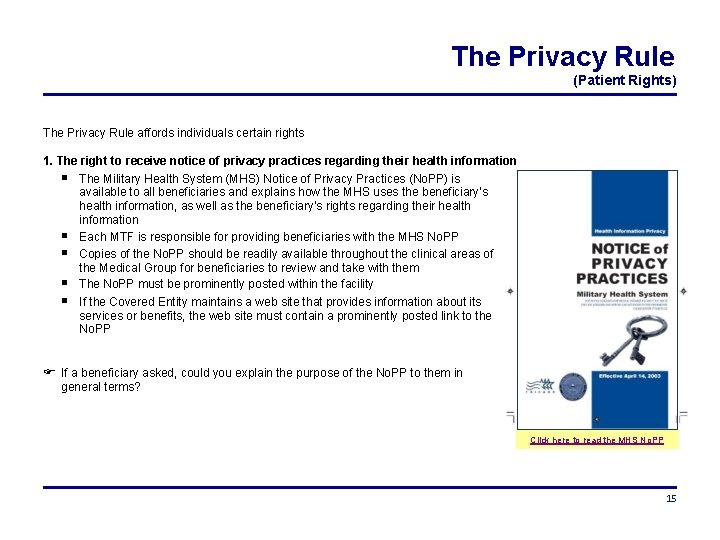
The Privacy Rule (Patient Rights) The Privacy Rule affords individuals certain rights 1. The right to receive notice of privacy practices regarding their health information The Military Health System (MHS) Notice of Privacy Practices (No. PP) is available to all beneficiaries and explains how the MHS uses the beneficiary’s health information, as well as the beneficiary’s rights regarding their health information Each MTF is responsible for providing beneficiaries with the MHS No. PP Copies of the No. PP should be readily available throughout the clinical areas of the Medical Group for beneficiaries to review and take with them The No. PP must be prominently posted within the facility If the Covered Entity maintains a web site that provides information about its services or benefits, the web site must contain a prominently posted link to the No. PP If a beneficiary asked, could you explain the purpose of the No. PP to them in general terms? Click here to read the MHS No. PP 15
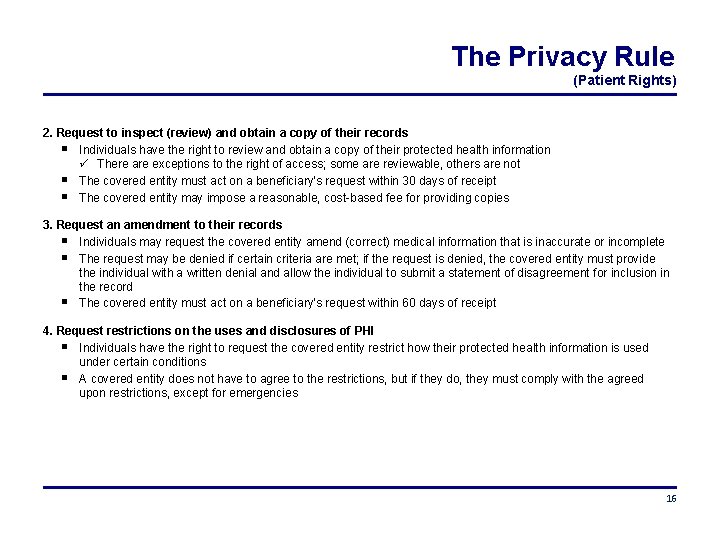
The Privacy Rule (Patient Rights) 2. Request to inspect (review) and obtain a copy of their records Individuals have the right to review and obtain a copy of their protected health information There are exceptions to the right of access; some are reviewable, others are not The covered entity must act on a beneficiary’s request within 30 days of receipt The covered entity may impose a reasonable, cost-based fee for providing copies 3. Request an amendment to their records Individuals may request the covered entity amend (correct) medical information that is inaccurate or incomplete The request may be denied if certain criteria are met; if the request is denied, the covered entity must provide the individual with a written denial and allow the individual to submit a statement of disagreement for inclusion in the record The covered entity must act on a beneficiary’s request within 60 days of receipt 4. Request restrictions on the uses and disclosures of PHI Individuals have the right to request the covered entity restrict how their protected health information is used under certain conditions A covered entity does not have to agree to the restrictions, but if they do, they must comply with the agreed upon restrictions, except for emergencies 16
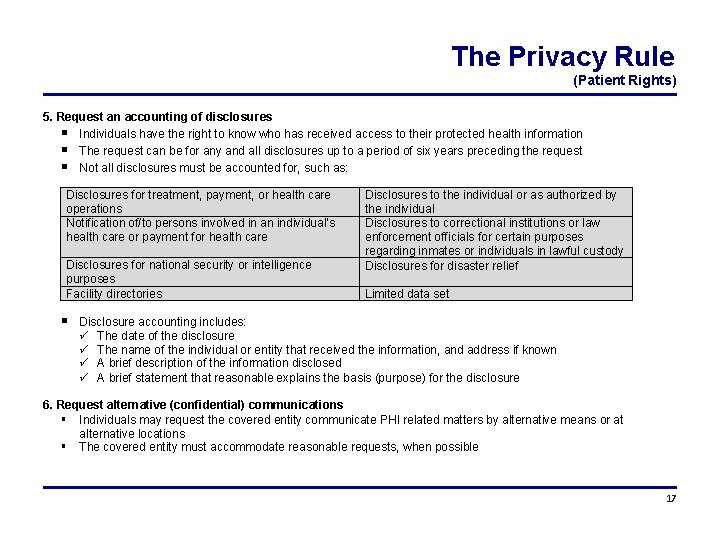
The Privacy Rule (Patient Rights) 5. Request an accounting of disclosures Individuals have the right to know who has received access to their protected health information The request can be for any and all disclosures up to a period of six years preceding the request Not all disclosures must be accounted for, such as: Disclosures for treatment, payment, or health care operations Notification of/to persons involved in an individual’s health care or payment for health care Disclosures for national security or intelligence purposes Facility directories Disclosures to the individual or as authorized by the individual Disclosures to correctional institutions or law enforcement officials for certain purposes regarding inmates or individuals in lawful custody Disclosures for disaster relief Limited data set Disclosure accounting includes: The date of the disclosure The name of the individual or entity that received the information, and address if known A brief description of the information disclosed A brief statement that reasonable explains the basis (purpose) for the disclosure 6. Request alternative (confidential) communications Individuals may request the covered entity communicate PHI related matters by alternative means or at alternative locations The covered entity must accommodate reasonable requests, when possible 17
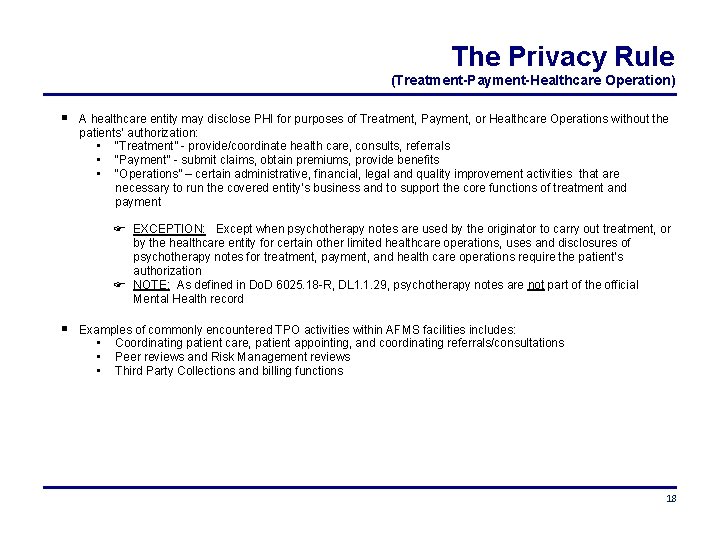
The Privacy Rule (Treatment-Payment-Healthcare Operation) A healthcare entity may disclose PHI for purposes of Treatment, Payment, or Healthcare Operations without the patients’ authorization: • “Treatment” - provide/coordinate health care, consults, referrals • “Payment” - submit claims, obtain premiums, provide benefits • “Operations” – certain administrative, financial, legal and quality improvement activities that are necessary to run the covered entity’s business and to support the core functions of treatment and payment EXCEPTION: Except when psychotherapy notes are used by the originator to carry out treatment, or by the healthcare entity for certain other limited healthcare operations, uses and disclosures of psychotherapy notes for treatment, payment, and health care operations require the patient’s authorization NOTE: As defined in Do. D 6025. 18 -R, DL 1. 1. 29, psychotherapy notes are not part of the official Mental Health record Examples of commonly encountered TPO activities within AFMS facilities includes: • Coordinating patient care, patient appointing, and coordinating referrals/consultations • Peer reviews and Risk Management reviews • Third Party Collections and billing functions 18
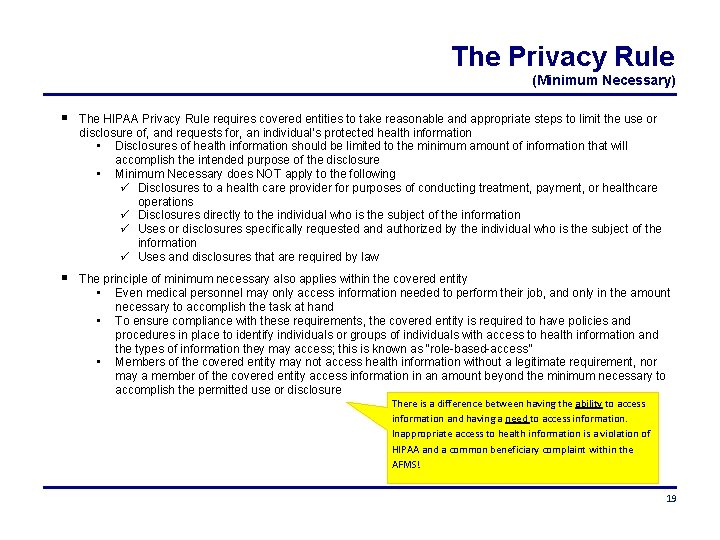
The Privacy Rule (Minimum Necessary) The HIPAA Privacy Rule requires covered entities to take reasonable and appropriate steps to limit the use or disclosure of, and requests for, an individual’s protected health information • Disclosures of health information should be limited to the minimum amount of information that will accomplish the intended purpose of the disclosure • Minimum Necessary does NOT apply to the following Disclosures to a health care provider for purposes of conducting treatment, payment, or healthcare operations Disclosures directly to the individual who is the subject of the information Uses or disclosures specifically requested and authorized by the individual who is the subject of the information Uses and disclosures that are required by law The principle of minimum necessary also applies within the covered entity • Even medical personnel may only access information needed to perform their job, and only in the amount necessary to accomplish the task at hand • To ensure compliance with these requirements, the covered entity is required to have policies and procedures in place to identify individuals or groups of individuals with access to health information and the types of information they may access; this is known as “role-based-access” • Members of the covered entity may not access health information without a legitimate requirement, nor may a member of the covered entity access information in an amount beyond the minimum necessary to accomplish the permitted use or disclosure There is a difference between having the ability to access information and having a need to access information. Inappropriate access to health information is a violation of HIPAA and a common beneficiary complaint within the AFMS! 19
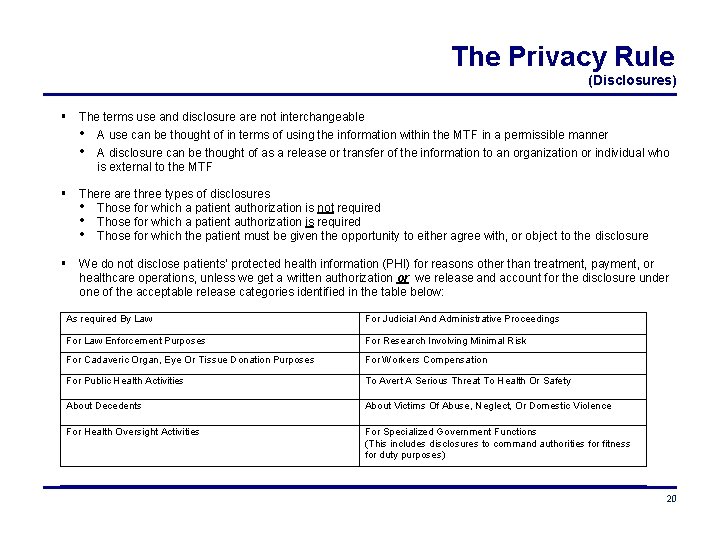
The Privacy Rule (Disclosures) The terms use and disclosure are not interchangeable • A use can be thought of in terms of using the information within the MTF in a permissible manner • A disclosure can be thought of as a release or transfer of the information to an organization or individual who is external to the MTF There are three types of disclosures • Those for which a patient authorization is not required • Those for which a patient authorization is required • Those for which the patient must be given the opportunity to either agree with, or object to the disclosure We do not disclose patients’ protected health information (PHI) for reasons other than treatment, payment, or healthcare operations, unless we get a written authorization or we release and account for the disclosure under one of the acceptable release categories identified in the table below: As required By Law For Judicial And Administrative Proceedings For Law Enforcement Purposes For Research Involving Minimal Risk For Cadaveric Organ, Eye Or Tissue Donation Purposes For Workers Compensation For Public Health Activities To Avert A Serious Threat To Health Or Safety About Decedents About Victims Of Abuse, Neglect, Or Domestic Violence For Health Oversight Activities For Specialized Government Functions (This includes disclosures to command authorities for fitness for duty purposes) 20
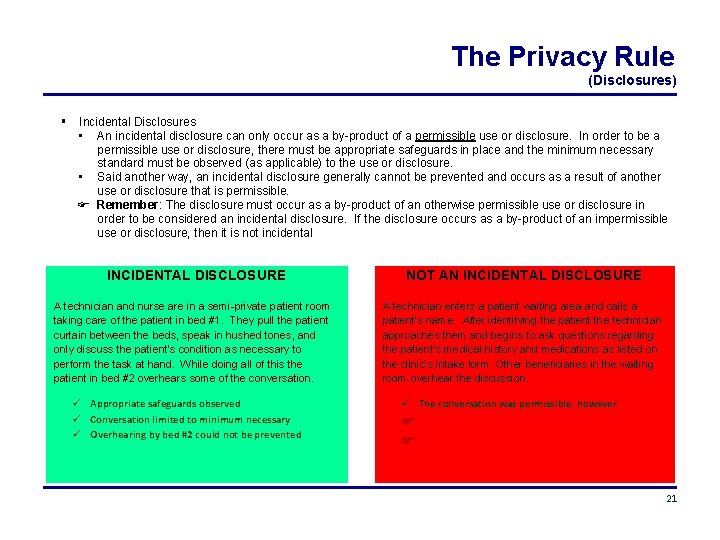
The Privacy Rule (Disclosures) Incidental Disclosures • An incidental disclosure can only occur as a by-product of a permissible use or disclosure. In order to be a permissible use or disclosure, there must be appropriate safeguards in place and the minimum necessary standard must be observed (as applicable) to the use or disclosure. • Said another way, an incidental disclosure generally cannot be prevented and occurs as a result of another use or disclosure that is permissible. Remember: The disclosure must occur as a by-product of an otherwise permissible use or disclosure in order to be considered an incidental disclosure. If the disclosure occurs as a by-product of an impermissible use or disclosure, then it is not incidental INCIDENTAL DISCLOSURE A technician and nurse are in a semi-private patient room taking care of the patient in bed #1. They pull the patient curtain between the beds, speak in hushed tones, and only discuss the patient’s condition as necessary to perform the task at hand. While doing all of this the patient in bed #2 overhears some of the conversation. Appropriate safeguards observed Conversation limited to minimum necessary Overhearing by bed #2 could not be prevented NOT AN INCIDENTAL DISCLOSURE A technician enters a patient waiting area and calls a patient’s name. After identifying the patient the technician approaches them and begins to ask questions regarding the patient’s medical history and medications as listed on the clinic’s intake form. Other beneficiaries in the waiting room overhear the discussion. The conversation was permissible, however 21
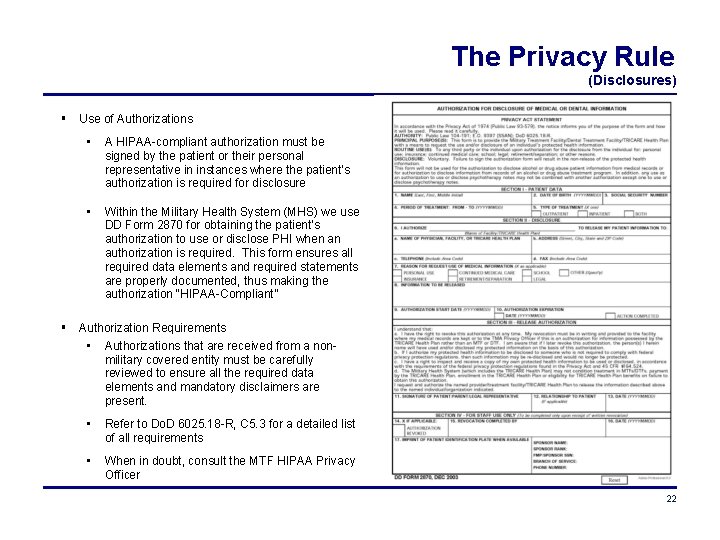
The Privacy Rule (Disclosures) Use of Authorizations • A HIPAA-compliant authorization must be signed by the patient or their personal representative in instances where the patient’s authorization is required for disclosure • Within the Military Health System (MHS) we use DD Form 2870 for obtaining the patient’s authorization to use or disclose PHI when an authorization is required. This form ensures all required data elements and required statements are properly documented, thus making the authorization “HIPAA-Compliant” Authorization Requirements • Authorizations that are received from a nonmilitary covered entity must be carefully reviewed to ensure all the required data elements and mandatory disclaimers are present. • Refer to Do. D 6025. 18 -R, C 5. 3 for a detailed list of all requirements • When in doubt, consult the MTF HIPAA Privacy Officer 22
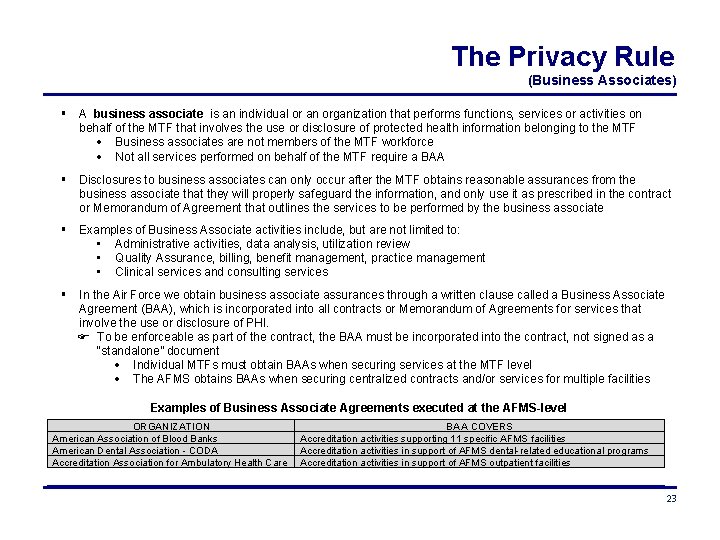
The Privacy Rule (Business Associates) A business associate is an individual or an organization that performs functions, services or activities on behalf of the MTF that involves the use or disclosure of protected health information belonging to the MTF Business associates are not members of the MTF workforce Not all services performed on behalf of the MTF require a BAA Disclosures to business associates can only occur after the MTF obtains reasonable assurances from the business associate that they will properly safeguard the information, and only use it as prescribed in the contract or Memorandum of Agreement that outlines the services to be performed by the business associate Examples of Business Associate activities include, but are not limited to: • Administrative activities, data analysis, utilization review • Quality Assurance, billing, benefit management, practice management • Clinical services and consulting services In the Air Force we obtain business associate assurances through a written clause called a Business Associate Agreement (BAA), which is incorporated into all contracts or Memorandum of Agreements for services that involve the use or disclosure of PHI. To be enforceable as part of the contract, the BAA must be incorporated into the contract, not signed as a “standalone” document Individual MTFs must obtain BAAs when securing services at the MTF level The AFMS obtains BAAs when securing centralized contracts and/or services for multiple facilities Examples of Business Associate Agreements executed at the AFMS-level ORGANIZATION American Association of Blood Banks American Dental Association - CODA Accreditation Association for Ambulatory Health Care BAA COVERS Accreditation activities supporting 11 specific AFMS facilities Accreditation activities in support of AFMS dental-related educational programs Accreditation activities in support of AFMS outpatient facilities 23
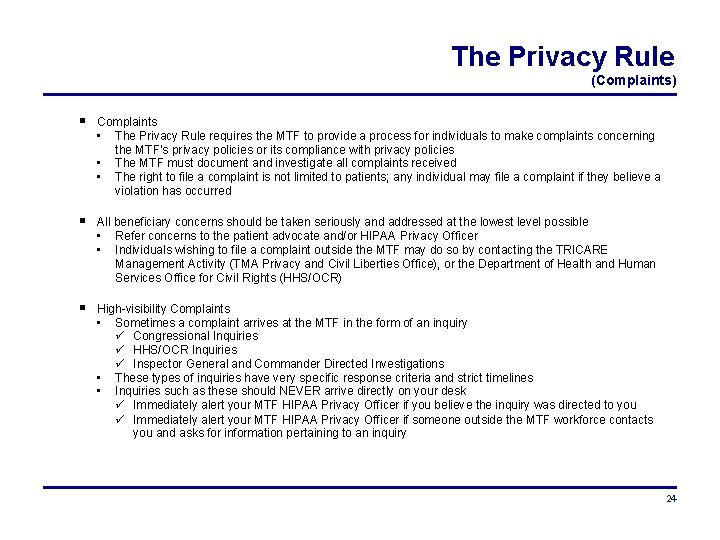
The Privacy Rule (Complaints) Complaints • The Privacy Rule requires the MTF to provide a process for individuals to make complaints concerning the MTF’s privacy policies or its compliance with privacy policies • The MTF must document and investigate all complaints received • The right to file a complaint is not limited to patients; any individual may file a complaint if they believe a violation has occurred All beneficiary concerns should be taken seriously and addressed at the lowest level possible • Refer concerns to the patient advocate and/or HIPAA Privacy Officer • Individuals wishing to file a complaint outside the MTF may do so by contacting the TRICARE Management Activity (TMA Privacy and Civil Liberties Office), or the Department of Health and Human Services Office for Civil Rights (HHS/OCR) High-visibility Complaints • Sometimes a complaint arrives at the MTF in the form of an inquiry Congressional Inquiries HHS/OCR Inquiries Inspector General and Commander Directed Investigations • These types of inquiries have very specific response criteria and strict timelines • Inquiries such as these should NEVER arrive directly on your desk Immediately alert your MTF HIPAA Privacy Officer if you believe the inquiry was directed to you Immediately alert your MTF HIPAA Privacy Officer if someone outside the MTF workforce contacts you and asks for information pertaining to an inquiry 24
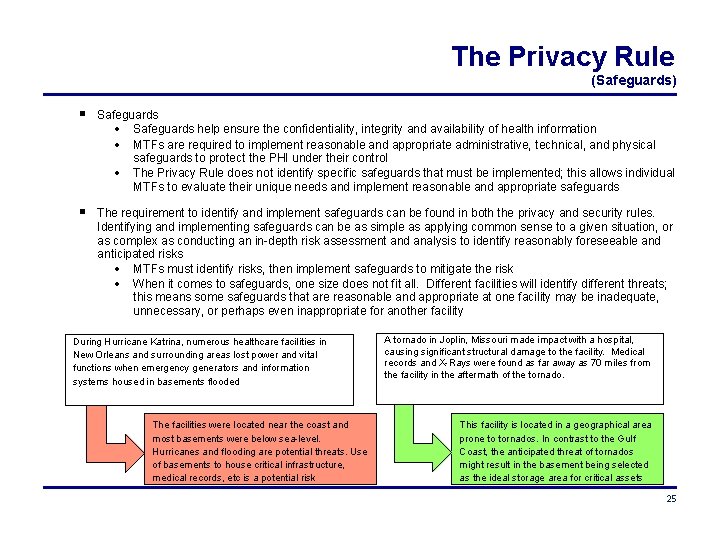
The Privacy Rule (Safeguards) Safeguards help ensure the confidentiality, integrity and availability of health information MTFs are required to implement reasonable and appropriate administrative, technical, and physical safeguards to protect the PHI under their control The Privacy Rule does not identify specific safeguards that must be implemented; this allows individual MTFs to evaluate their unique needs and implement reasonable and appropriate safeguards The requirement to identify and implement safeguards can be found in both the privacy and security rules. Identifying and implementing safeguards can be as simple as applying common sense to a given situation, or as complex as conducting an in-depth risk assessment and analysis to identify reasonably foreseeable and anticipated risks MTFs must identify risks, then implement safeguards to mitigate the risk When it comes to safeguards, one size does not fit all. Different facilities will identify different threats; this means some safeguards that are reasonable and appropriate at one facility may be inadequate, unnecessary, or perhaps even inappropriate for another facility During Hurricane Katrina, numerous healthcare facilities in New Orleans and surrounding areas lost power and vital functions when emergency generators and information systems housed in basements flooded The facilities were located near the coast and most basements were below sea-level. Hurricanes and flooding are potential threats. Use of basements to house critical infrastructure, medical records, etc is a potential risk A tornado in Joplin, Missouri made impact with a hospital, causing significant structural damage to the facility. Medical records and X-Rays were found as far away as 70 miles from the facility in the aftermath of the tornado. This facility is located in a geographical area prone to tornados. In contrast to the Gulf Coast, the anticipated threat of tornados might result in the basement being selected as the ideal storage area for critical assets 25
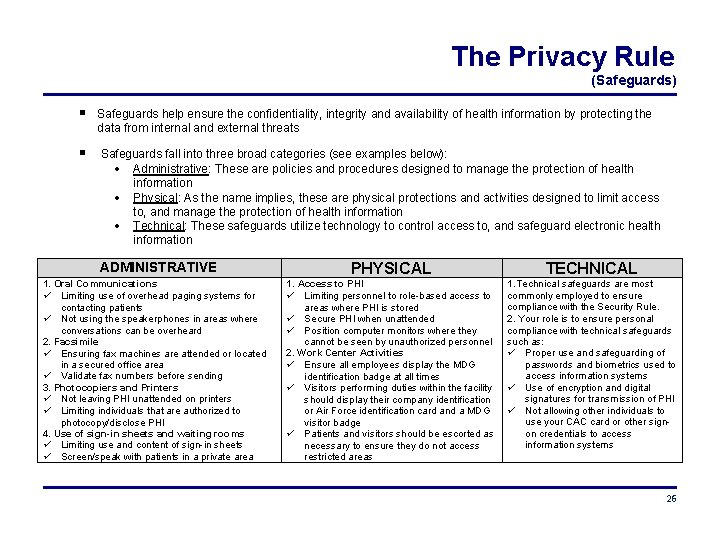
The Privacy Rule (Safeguards) Safeguards help ensure the confidentiality, integrity and availability of health information by protecting the data from internal and external threats Safeguards fall into three broad categories (see examples below): Administrative: These are policies and procedures designed to manage the protection of health information Physical: As the name implies, these are physical protections and activities designed to limit access to, and manage the protection of health information Technical: These safeguards utilize technology to control access to, and safeguard electronic health information ADMINISTRATIVE 1. Oral Communications Limiting use of overhead paging systems for contacting patients Not using the speakerphones in areas where conversations can be overheard 2. Facsimile Ensuring fax machines are attended or located in a secured office area Validate fax numbers before sending 3. Photocopiers and Printers Not leaving PHI unattended on printers Limiting individuals that are authorized to photocopy/disclose PHI 4. Use of sign-in sheets and waiting rooms Limiting use and content of sign-in sheets Screen/speak with patients in a private area PHYSICAL TECHNICAL 1. Access to PHI Limiting personnel to role-based access to areas where PHI is stored Secure PHI when unattended Position computer monitors where they cannot be seen by unauthorized personnel 2. Work Center Activities Ensure all employees display the MDG identification badge at all times Visitors performing duties within the facility should display their company identification or Air Force identification card and a MDG visitor badge Patients and visitors should be escorted as necessary to ensure they do not access restricted areas 1. Technical safeguards are most commonly employed to ensure compliance with the Security Rule. 2. Your role is to ensure personal compliance with technical safeguards such as: Proper use and safeguarding of passwords and biometrics used to access information systems Use of encryption and digital signatures for transmission of PHI Not allowing other individuals to use your CAC card or other signon credentials to access information systems 26
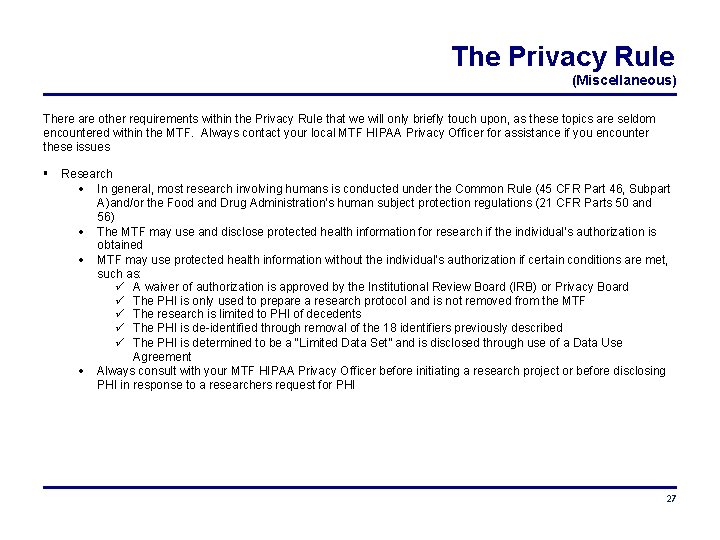
The Privacy Rule (Miscellaneous) There are other requirements within the Privacy Rule that we will only briefly touch upon, as these topics are seldom encountered within the MTF. Always contact your local MTF HIPAA Privacy Officer for assistance if you encounter these issues Research In general, most research involving humans is conducted under the Common Rule (45 CFR Part 46, Subpart A)and/or the Food and Drug Administration’s human subject protection regulations (21 CFR Parts 50 and 56) The MTF may use and disclose protected health information for research if the individual’s authorization is obtained MTF may use protected health information without the individual’s authorization if certain conditions are met, such as: A waiver of authorization is approved by the Institutional Review Board (IRB) or Privacy Board The PHI is only used to prepare a research protocol and is not removed from the MTF The research is limited to PHI of decedents The PHI is de-identified through removal of the 18 identifiers previously described The PHI is determined to be a “Limited Data Set” and is disclosed through use of a Data Use Agreement Always consult with your MTF HIPAA Privacy Officer before initiating a research project or before disclosing PHI in response to a researchers request for PHI 27
The Privacy Rule (Miscellaneous) Marketing is a communication about a product or service that encourages recipients of the communication to purchase or use the product or service Marketing is not: Communicating with the patient about health-related products or services provided by or included in the MHS health plan Communicating for purposes of treatment Communications related to case management or care coordination Fundraising The Privacy Rule allows fundraising, provided certain requirements are met We do not solicit our beneficiary population for fundraising, nor does our MHS Notice of Privacy Practices make reference to fundraising 28
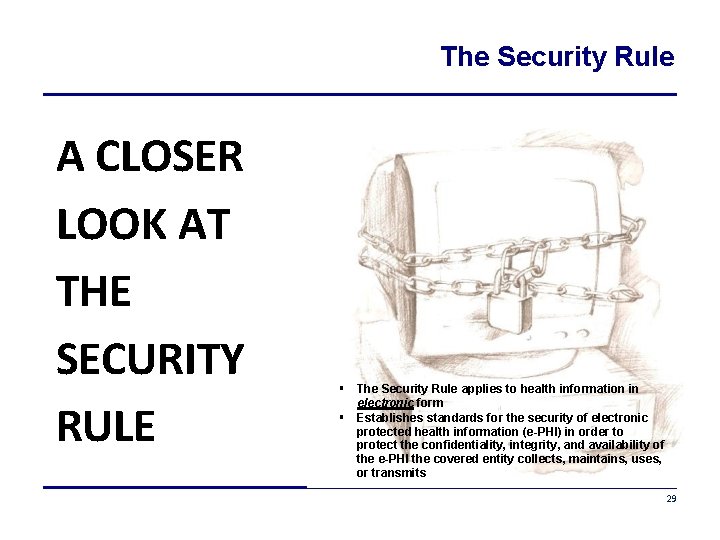
The Security Rule A CLOSER LOOK AT THE SECURITY RULE The Security Rule applies to health information in electronic form Establishes standards for the security of electronic protected health information (e-PHI) in order to protect the confidentiality, integrity, and availability of the e-PHI the covered entity collects, maintains, uses, or transmits 29
The Security Rule (Safeguards) The goal of the Security Rule is to provide for the confidentiality, integrity, and availability of the electronic health information (e-PHI) under the control of the Covered Entity Confidentiality means the data or information is not made available or disclosed to unauthorized persons, processes or devices Integrity refers to the fact the data or information has not been altered or destroyed in an unauthorized manner Availability means the data or information is accessible and useable upon demand by an authorized person E-PHI is protected health information that is stored or transmitted in electronic form. Examples of commonly encountered e-PHI include, but are not limited to: PHI that is stored on memory devices such computer hard drives, shared drives, magnetic tape, and portable media devices (e. g. , flash memory sticks, digital memory cards, CD-ROM’s, DVD’s, cloud storage, portable hard drives, etc) PHI that is stored in retained memory of medical devices and medical equipment PHI that is transmitted via e-mail, internet, intranet, private networks, leased lines, dial-up lines, or computerbased facsimile programs The Security Rule requires the MTF to: Conduct information security risk assessments (the AFMS currently uses OCTAVE® ) Protect against any reasonably anticipated threats and hazards to the security or integrity of electronic PHI Protect against reasonably anticipated uses or disclosures of information that are not permitted by the Privacy Rule Select and implement the technologies and practices most appropriate for the size and operational complexity of the facility Maintain ongoing management of identified risks to the confidentiality, integrity and availability of e-PHI 30
The Security Rule (Safeguards) Regularly review information systems activity for evidence of unauthorized access, unusual activity, and tampering Conduct security awareness training to: Educate the workforce regarding individual roles in protecting against, identifying, and reporting malicious software Educate the workforce regarding recognition and reporting procedures for suspicious activity and attempts at unauthorized user access Educate the workforce regarding security procedures for password management These requirements are achieved through the Air Force’s Information Assurance training program that all workforce members complete annually to maintain systems access Compliance with the HIPAA Security Rule is largely transparent to the majority of Air Force Medical Service personnel; this is due in large part to the Air Force’s robust Information Assurance program which aligns with many of the Security Rule requirements Good Security practices include things such as: • Not attempting to access PHI in an unauthorized manner • Not sharing passwords or allowing another individual to use your account credentials • Not adding or removing hardware and software to/from AFMS computer systems • Lock or log-off computer systems when unattended • Never remove e-PHI from the facility without first clearing with the HIPAA Privacy or Security officer • Minimizing PHI stored on shared drives and ensuring appropriate safeguards and access controls are observed 31
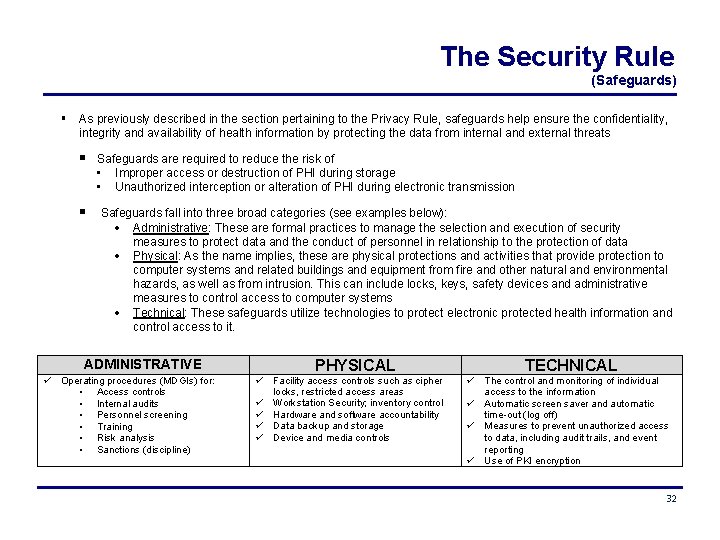
The Security Rule (Safeguards) As previously described in the section pertaining to the Privacy Rule, safeguards help ensure the confidentiality, integrity and availability of health information by protecting the data from internal and external threats Safeguards are required to reduce the risk of • Improper access or destruction of PHI during storage • Unauthorized interception or alteration of PHI during electronic transmission Safeguards fall into three broad categories (see examples below): Administrative: These are formal practices to manage the selection and execution of security measures to protect data and the conduct of personnel in relationship to the protection of data Physical: As the name implies, these are physical protections and activities that provide protection to computer systems and related buildings and equipment from fire and other natural and environmental hazards, as well as from intrusion. This can include locks, keys, safety devices and administrative measures to control access to computer systems Technical: These safeguards utilize technologies to protect electronic protected health information and control access to it. ADMINISTRATIVE Operating procedures (MDGIs) for: • Access controls • Internal audits • Personnel screening • Training • Risk analysis • Sanctions (discipline) PHYSICAL Facility access controls such as cipher locks, restricted access areas Workstation Security; inventory control Hardware and software accountability Data backup and storage Device and media controls TECHNICAL The control and monitoring of individual access to the information Automatic screen saver and automatic time-out (log off) Measures to prevent unauthorized access to data, including audit trails, and event reporting Use of PKI encryption 32
Putting It All Together APPLICATION OF PRIVACY AND SECURITY PRACTICES IN THE WORKPLACE 33
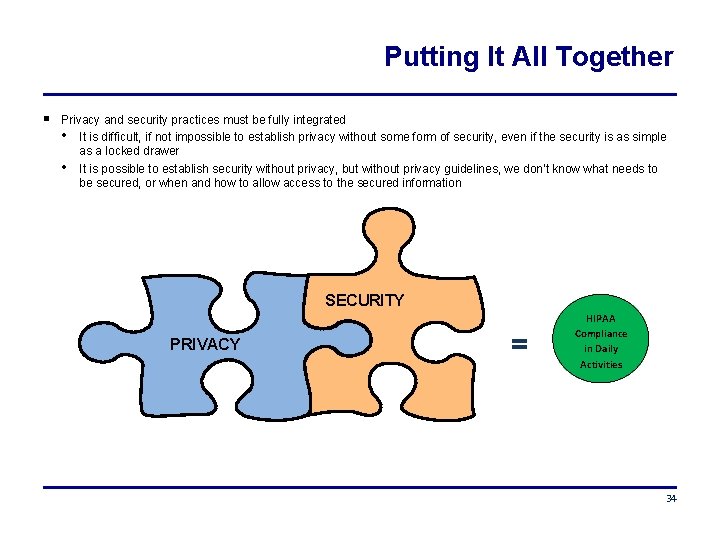
Putting It All Together Privacy and security practices must be fully integrated • It is difficult, if not impossible to establish privacy without some form of security, even if the security is as simple as a locked drawer • It is possible to establish security without privacy, but without privacy guidelines, we don’t know what needs to be secured, or when and how to allow access to the secured information SECURITY PRIVACY = HIPAA Compliance in Daily Activities 34
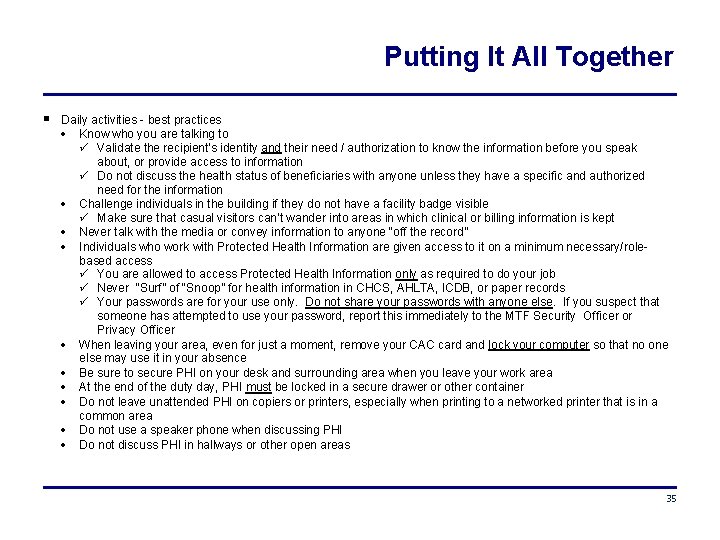
Putting It All Together Daily activities - best practices Know who you are talking to Validate the recipient's identity and their need / authorization to know the information before you speak about, or provide access to information Do not discuss the health status of beneficiaries with anyone unless they have a specific and authorized need for the information Challenge individuals in the building if they do not have a facility badge visible Make sure that casual visitors can’t wander into areas in which clinical or billing information is kept Never talk with the media or convey information to anyone “off the record” Individuals who work with Protected Health Information are given access to it on a minimum necessary/rolebased access You are allowed to access Protected Health Information only as required to do your job Never “Surf” of “Snoop” for health information in CHCS, AHLTA, ICDB, or paper records Your passwords are for your use only. Do not share your passwords with anyone else. If you suspect that someone has attempted to use your password, report this immediately to the MTF Security Officer or Privacy Officer When leaving your area, even for just a moment, remove your CAC card and lock your computer so that no one else may use it in your absence Be sure to secure PHI on your desk and surrounding area when you leave your work area At the end of the duty day, PHI must be locked in a secure drawer or other container Do not leave unattended PHI on copiers or printers, especially when printing to a networked printer that is in a common area Do not use a speaker phone when discussing PHI Do not discuss PHI in hallways or other open areas 35
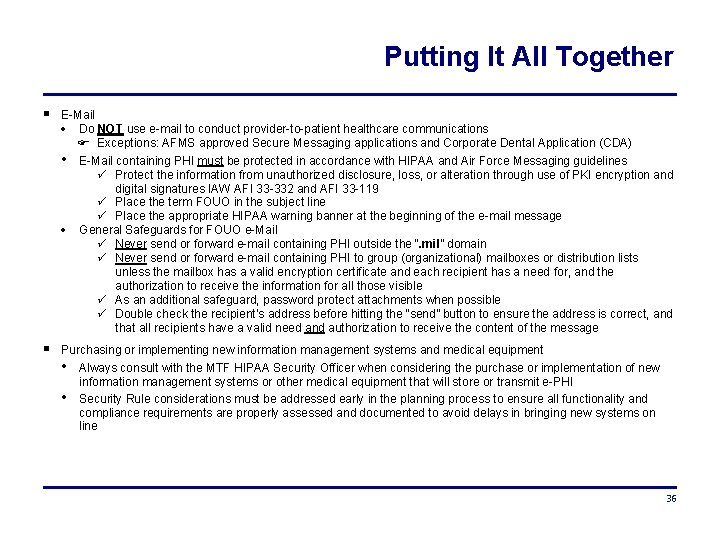
Putting It All Together E-Mail Do NOT use e-mail to conduct provider-to-patient healthcare communications Exceptions: AFMS approved Secure Messaging applications and Corporate Dental Application (CDA) • E-Mail containing PHI must be protected in accordance with HIPAA and Air Force Messaging guidelines Protect the information from unauthorized disclosure, loss, or alteration through use of PKI encryption and digital signatures IAW AFI 33 -332 and AFI 33 -119 Place the term FOUO in the subject line Place the appropriate HIPAA warning banner at the beginning of the e-mail message General Safeguards for FOUO e-Mail Never send or forward e-mail containing PHI outside the “. mil” domain Never send or forward e-mail containing PHI to group (organizational) mailboxes or distribution lists unless the mailbox has a valid encryption certificate and each recipient has a need for, and the authorization to receive the information for all those visible As an additional safeguard, password protect attachments when possible Double check the recipient’s address before hitting the “send” button to ensure the address is correct, and that all recipients have a valid need and authorization to receive the content of the message Purchasing or implementing new information management systems and medical equipment • Always consult with the MTF HIPAA Security Officer when considering the purchase or implementation of new information management systems or other medical equipment that will store or transmit e-PHI • Security Rule considerations must be addressed early in the planning process to ensure all functionality and compliance requirements are properly assessed and documented to avoid delays in bringing new systems on line 36
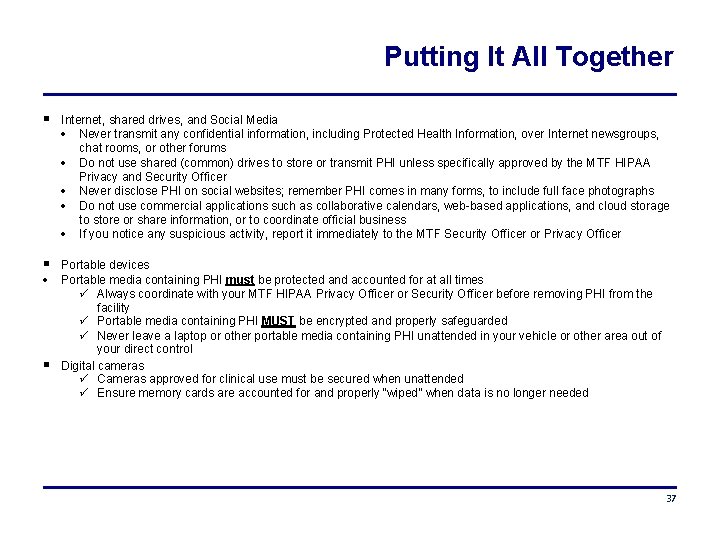
Putting It All Together Internet, shared drives, and Social Media Never transmit any confidential information, including Protected Health Information, over Internet newsgroups, chat rooms, or other forums Do not use shared (common) drives to store or transmit PHI unless specifically approved by the MTF HIPAA Privacy and Security Officer Never disclose PHI on social websites; remember PHI comes in many forms, to include full face photographs Do not use commercial applications such as collaborative calendars, web-based applications, and cloud storage to store or share information, or to coordinate official business If you notice any suspicious activity, report it immediately to the MTF Security Officer or Privacy Officer Portable devices Portable media containing PHI must be protected and accounted for at all times Always coordinate with your MTF HIPAA Privacy Officer or Security Officer before removing PHI from the facility Portable media containing PHI MUST be encrypted and properly safeguarded Never leave a laptop or other portable media containing PHI unattended in your vehicle or other area out of your direct control Digital cameras Cameras approved for clinical use must be secured when unattended Ensure memory cards are accounted for and properly “wiped” when data is no longer needed 37
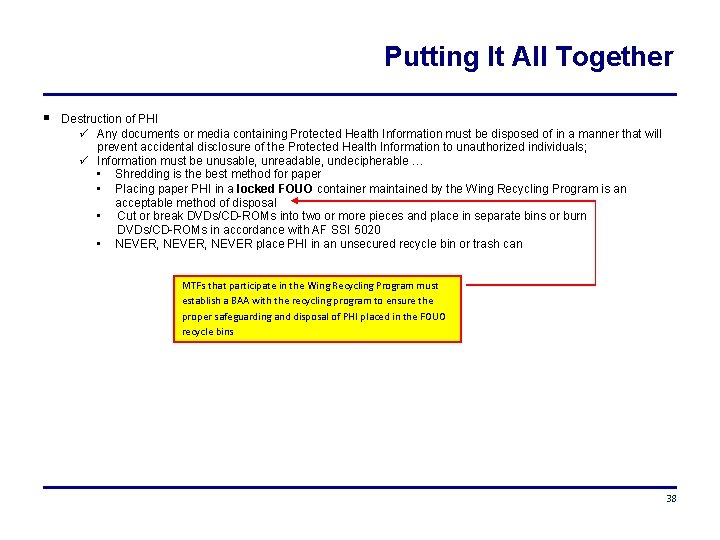
Putting It All Together Destruction of PHI Any documents or media containing Protected Health Information must be disposed of in a manner that will prevent accidental disclosure of the Protected Health Information to unauthorized individuals; Information must be unusable, unreadable, undecipherable … • Shredding is the best method for paper • Placing paper PHI in a locked FOUO container maintained by the Wing Recycling Program is an acceptable method of disposal • Cut or break DVDs/CD-ROMs into two or more pieces and place in separate bins or burn DVDs/CD-ROMs in accordance with AF SSI 5020 • NEVER, NEVER place PHI in an unsecured recycle bin or trash can MTFs that participate in the Wing Recycling Program must establish a BAA with the recycling program to ensure the proper safeguarding and disposal of PHI placed in the FOUO recycle bins 38
Putting It All Together Breach of information As an entity within the Federal Government, the Air Force must observe the requirements of Do. D 5400. 11 -R, Department of Defense Privacy Program as pertains to safeguarding and reporting breaches of Personally Identifiable Information (PII). Identifiable medical information is considered PII by definition, and therefore subject to the safeguards and reporting requirements identified in Do. D 5400. 11 -R As an entity subject to HIPAA, the AFMS must also comply with the HIPAA breach reporting requirements The Do. D and HHS definition of a breach are shown below: Protected Health Information (HHS) Breach means the acquisition, access, use, or disclosure of PHI in a manner not permitted under subpart E of this section (aka the Privacy Rule) which compromises PHI security or privacy. For purpose of this definition, “acquisition, access, use, or disclosure of PHI in a manner not permitted under the Privacy Rule” is presumed to be a breach unless the covered entity or business associate, as applicable, can demonstrate that there is a low probability that the PHI has been compromised based on a risk assessment Personally Identifiable Information (Do. D) Actual or possible loss of control, unauthorized disclosure, or unauthorized access of personal information where persons other than authorized users gain access or potential access to such information for an other than authorized purposes where one or more individuals will be adversely affected. Such incidents also are known as breaches A breach can be intentional or unintentional Common examples of breaches include: Providing or allowing access to PHI by unauthorized individuals Loss or theft of a laptop, portable hard drive, or other media containing PHI or PII Mailing, e-mailing, or faxing PHI to the wrong address Electronic transmission of PHI through unsecured channels If you suspect a breach has occurred Secure unattended PHI (if applicable) Immediately notify your HIPAA Privacy Officer Do not delay reporting! The Privacy Officer will evaluate the circumstances of the event and initiate appropriate action steps if a breach has occurred NOTE: Breach reporting is a high-visibility issue within the Do. D. You will never be faulted for reporting a suspected or actual breach – when in doubt, always notify the HIPAA Privacy Officer; they will sort it out! 39
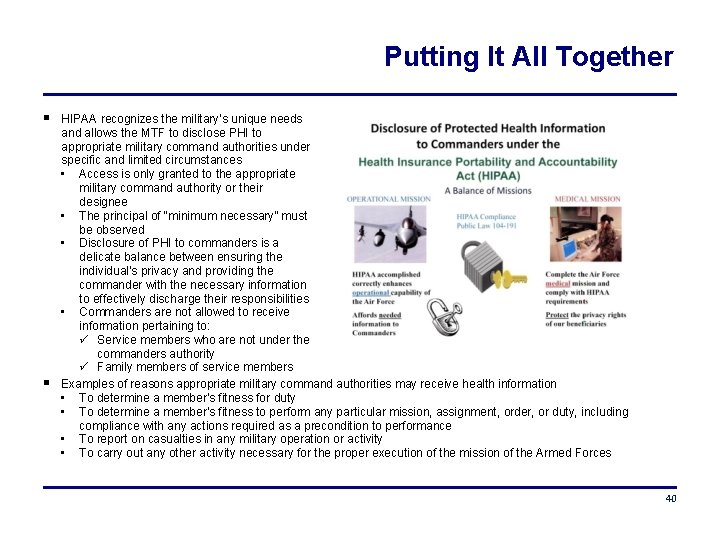
Putting It All Together HIPAA recognizes the military’s unique needs and allows the MTF to disclose PHI to appropriate military command authorities under specific and limited circumstances • Access is only granted to the appropriate military command authority or their designee • The principal of “minimum necessary” must be observed • Disclosure of PHI to commanders is a delicate balance between ensuring the individual’s privacy and providing the commander with the necessary information to effectively discharge their responsibilities • Commanders are not allowed to receive information pertaining to: Service members who are not under the commanders authority Family members of service members Examples of reasons appropriate military command authorities may receive health information • To determine a member's fitness for duty • To determine a member's fitness to perform any particular mission, assignment, order, or duty, including compliance with any actions required as a precondition to performance • To report on casualties in any military operation or activity • To carry out any other activity necessary for the proper execution of the mission of the Armed Forces 40
Putting It All Together The Commander Designee Process • Verification of identity is required before releasing PHI to commanders or their designee • Deputy/Vice Commanders and First Sergeants are considered designees by virtue of position (AFI 41 -210) • All other designees must be appointed in writing for a specified period of time and for a specified purpose • The MTF HIPAA Privacy Officer is responsible for establishing local procedures regarding the commander designee process, to include: Procedures for verification of identity and authority to receive the requested PHI Procedures to ensure routine disclosures of PHI such as appointment rosters, PIMR reports, and quarters notifications are only released to authorized personnel Procedures for disclosure accounting Communicating with friends and family It is permissible to communicate with family members and other individuals identified by the patient. In situations where the patient is not present or is unable to give specific permission, the MTF can exercise professional judgment in communicating with family, friends, and other individuals if it is deemed in the best interest of the patient or if it can be reasonably inferred that the patient would not object Communications and Treatment of Minors Parents generally have the legal authority to make health care decisions about minor children; thus making them the personal representative of the child There are exceptions to the parent acting as the minor child’s personal representative When state law allows a minor to consent for a particular health service, the minor is acting as his/her own personal representative for that particular episode of care When a court or other law authorizes someone other than the parent to make treatment decisions for a minor When a parent agrees to a confidential relationship between the minor and the physician 41
Putting It All Together When a provider reasonably believes in his or her professional judgment that the child has been or may be subjected to abuse or neglect, or that treating the parent as the child’s personal representative could endanger the child Military family members often reach the age of majority at 18 years, but under certain circumstances may remain a dependent of their military sponsor for several years (determine dependency through DEERS or with Military Personnel Flight). Despite his/her dependent status, the family member becomes his/her own personal representative once the age of majority is reached Always consult with your HIPAA Privacy Officer regarding minors, as rules regarding treatment and communications with minors vary by state and OCONUS region 42
Conclusion This concludes the Air Force Medical Service core training requirements for HIPAA Privacy and Security. Please contact your facility’s HIPAA Privacy Officer or Security Officer if you have questions on the content of this presentation, or would like additional information on a particular topic. Your facility will provide additional training as necessary to address local policies and procedures, and role-based training requirements. Please return completed HIPAA training form attached. 43
Health Insurance Portability and Accountability Act HIPAA Please Print this Slide, Sign & Date: I have reviewed the slides of this presentation and agree to abide by the KMC HIPAA Guidelines. Signature: ________________ Date: _____ Printed Name: ______________