
HIPAA Pharmacy Transactions and Code Sets Will They

- Slides: 17
HIPAA Pharmacy Transactions and Code Sets: Will They Support the Implementation of the New Pharmaceutical Benefit in 2006? By: Steven S. Lazarus, Ph. D, FHIMSS, Boundary Information Group and Mary Ryan, R. Ph. , Medco Health Solutions, Inc.
Boundary Information Group (BIG) n n n Virtual Consortium of Health Care Information Systems Consulting Firms Founded 1995 Company website: www. boundary. net BIG HIPAA Resources: www. hipaainfo. net Senior Consultants with HIPAA and Business Process Improvement Leadership Experience Clients include: Hospitals and multi-hospital organizations ¨ Medical groups ¨ Health plans ¨ Vendors ¨ 2
Medco Health Solutions, Inc. n Client Base Retail/Home Delivery Pharmacy benefit to more than 60 million American lives ¨ $33 billion company based on 2003 net revenues ¨ Partner with close to half of the Fortune 100 and a third of the Fortune 200 companies as well as Managed Care Organizations, insurance carriers, and various levels of government and unions ¨ n Infrastructure ¨ ¨ ¨ 2 state-of-the-art fully automated pharmacies dispensing 1. 8 M RX/week 9 prescription processing centers 7 customer service call centers with 24/7 access 2, 500 pharmacists, physicians, and nurses on staff World’s largest and most experienced online pharmacy 3
Agenda 1. 2. 3. 4. How the pharmacy transactions work today Roles of the payer, PBM, mail order pharmacy, retail pharmacy and patient Identify Medicare pharmaceutical benefit implementation issues – Part D Discussion and Questions 4
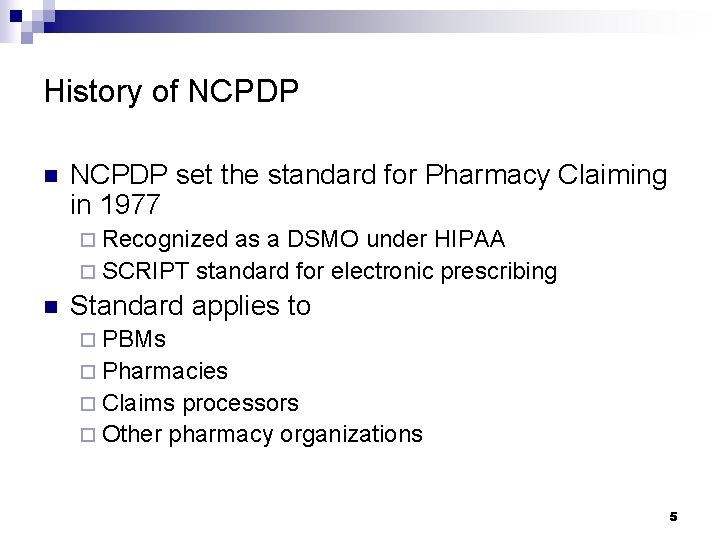
History of NCPDP n NCPDP set the standard for Pharmacy Claiming in 1977 ¨ Recognized as a DSMO under HIPAA ¨ SCRIPT standard for electronic prescribing n Standard applies to ¨ PBMs ¨ Pharmacies ¨ Claims processors ¨ Other pharmacy organizations 5
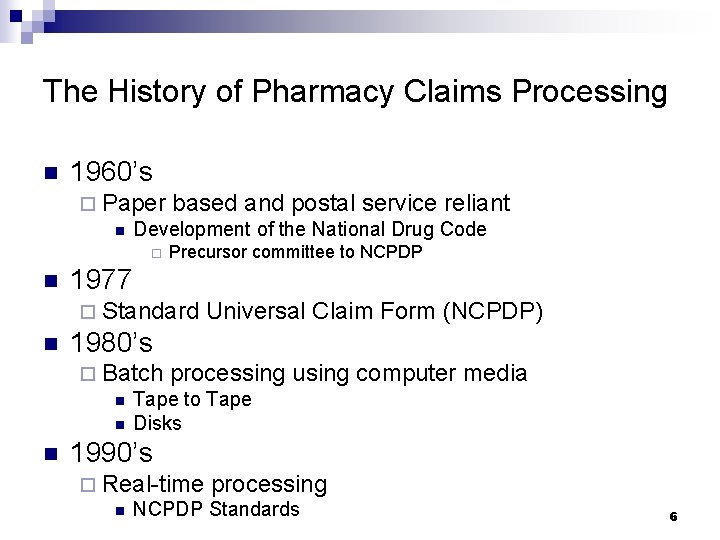
The History of Pharmacy Claims Processing n 1960’s ¨ Paper based and postal service reliant n Development of the National Drug Code ¨ n Precursor committee to NCPDP 1977 ¨ Standard n Universal Claim Form (NCPDP) 1980’s ¨ Batch processing n Tape to Tape n Disks n using computer media 1990’s ¨ Real-time processing n NCPDP Standards 6
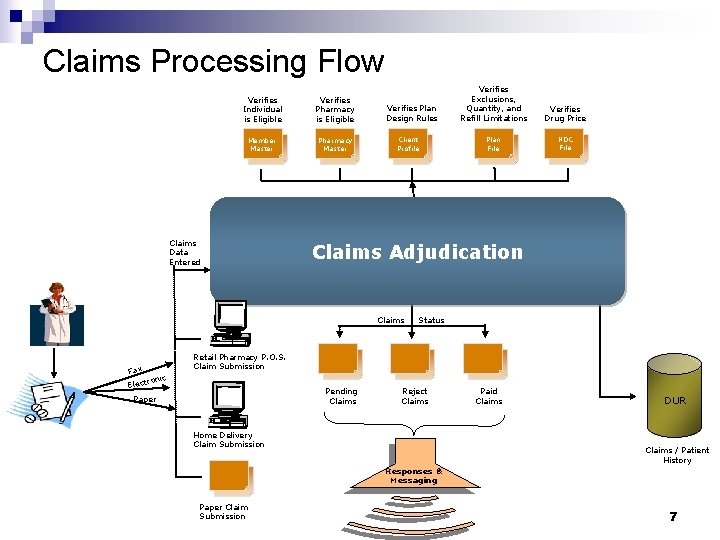
Claims Processing Flow Verifies Individual is Eligible Verifies Pharmacy is Eligible Member Master Pharmacy Master Claims Data Entered Verifies Plan Design Rules Client Profile Verifies Drug Price Plan File NDC File Claims Adjudication Claims Fax Verifies Exclusions, Quantity, and Refill Limitations Status Retail Pharmacy P. O. S. Claim Submission nic ro Elect Pending Claims Paper Reject Claims Home Delivery Claim Submission Paid Claims DUR Claims / Patient History Responses & Messaging Paper Claim Submission 7
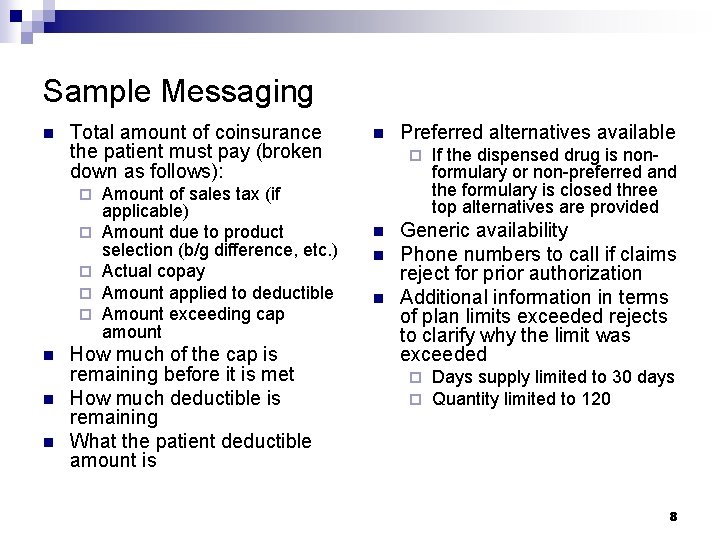
Sample Messaging n Total amount of coinsurance the patient must pay (broken down as follows): ¨ ¨ ¨ n n n Amount of sales tax (if applicable) Amount due to product selection (b/g difference, etc. ) Actual copay Amount applied to deductible Amount exceeding cap amount How much of the cap is remaining before it is met How much deductible is remaining What the patient deductible amount is n Preferred alternatives available ¨ n n n If the dispensed drug is nonformulary or non-preferred and the formulary is closed three top alternatives are provided Generic availability Phone numbers to call if claims reject for prior authorization Additional information in terms of plan limits exceeded rejects to clarify why the limit was exceeded ¨ ¨ Days supply limited to 30 days Quantity limited to 120 8
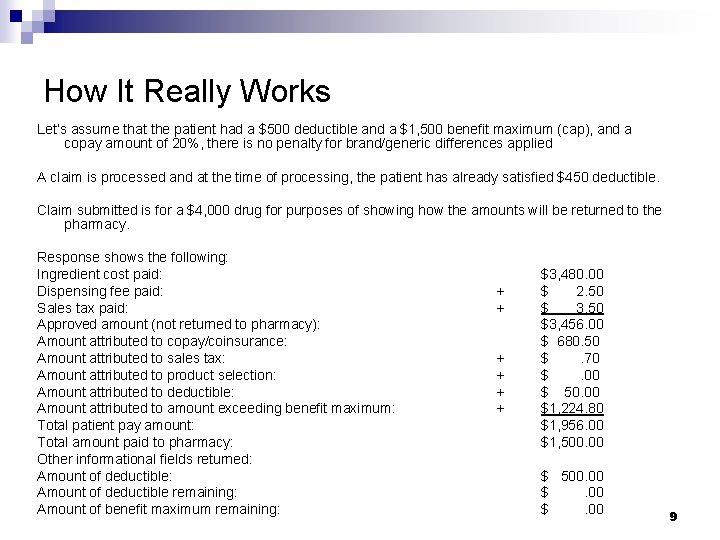
How It Really Works Let’s assume that the patient had a $500 deductible and a $1, 500 benefit maximum (cap), and a copay amount of 20%, there is no penalty for brand/generic differences applied A claim is processed and at the time of processing, the patient has already satisfied $450 deductible. Claim submitted is for a $4, 000 drug for purposes of showing how the amounts will be returned to the pharmacy. Response shows the following: Ingredient cost paid: Dispensing fee paid: Sales tax paid: Approved amount (not returned to pharmacy): Amount attributed to copay/coinsurance: Amount attributed to sales tax: Amount attributed to product selection: Amount attributed to deductible: Amount attributed to amount exceeding benefit maximum: Total patient pay amount: Total amount paid to pharmacy: Other informational fields returned: Amount of deductible remaining: Amount of benefit maximum remaining: + + + $3, 480. 00 $ 2. 50 $ 3. 50 $3, 456. 00 $ 680. 50 $. 70 $. 00 $ 50. 00 $1, 224. 80 $1, 956. 00 $1, 500. 00 $. 00 9
Real Time Vs. Batch Transaction n Currently Medicare Transaction processing for Parts A and B are based on batch, often with overnight processing The retail pharmacy (and mail order) industry is based on real time transactions for eligibility and patient balance amount due The pharmacy will not be able to tell Medicare patients to come back for their prescription tomorrow when eligibility and payment due information will be available 10
Medicare May Require Unique Data Elements, if they do: n n NCPDP standards would need to be changed The change would have to be recognized in modified transactions The process would take 2. 5 to 5 years The industry might have to reprogram and test the existing transactions 11
Filling the Donut Hole n n n Eligibility and claims transactions for all drugs must be filed and recorded by the payer Need to know when the patient realizes the lower limit of the donut hole and when the patient exceeds the upper limit of the donut hole, as the patient amount owed will change Who will be responsible for answering patient questions about where they are in the pre-donut hole, and post-donut hole stages? Explanation of benefits industry Medical expenses year-to-date are not used in pharmacy benefits programs today – would add to the expense ¨ Pharmacy? ¨ Medicare contractor? ¨ Web access? By who? 12 ¨
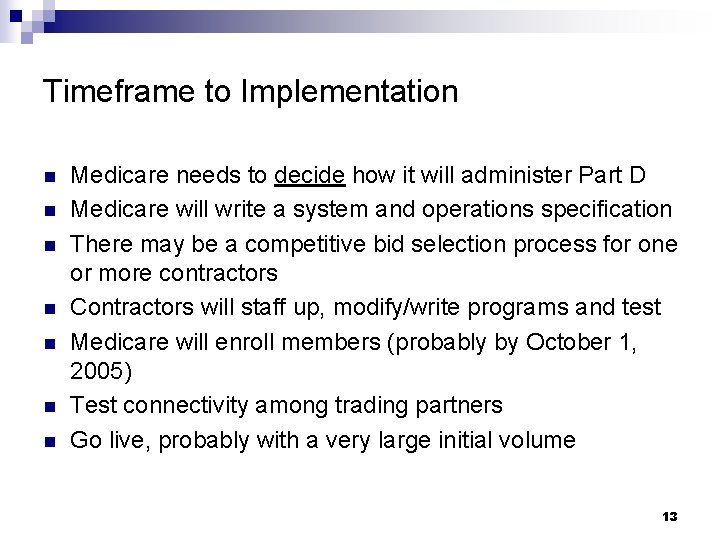
Timeframe to Implementation n n n Medicare needs to decide how it will administer Part D Medicare will write a system and operations specification There may be a competitive bid selection process for one or more contractors Contractors will staff up, modify/write programs and test Medicare will enroll members (probably by October 1, 2005) Test connectivity among trading partners Go live, probably with a very large initial volume 13
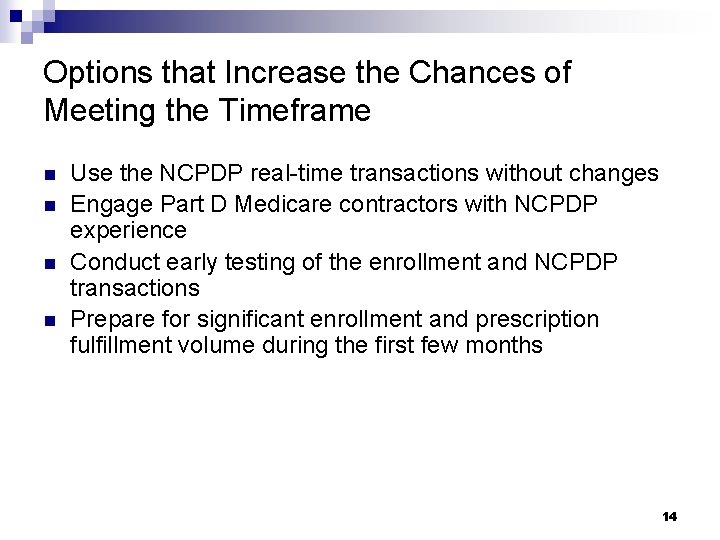
Options that Increase the Chances of Meeting the Timeframe n n Use the NCPDP real-time transactions without changes Engage Part D Medicare contractors with NCPDP experience Conduct early testing of the enrollment and NCPDP transactions Prepare for significant enrollment and prescription fulfillment volume during the first few months 14
Medicare Preparations n n Planning for the transactions in the CMS Office of HIPAA Standards Medicare is aware of these issues 15
Questions and Discussion 16
Contact Information n Steven S. Lazarus, Ph. D, FHIMSS President Boundary Information Group 4401 South Quebec Street, Suite 100 Denver, CO 80237 -2644 (303) 488 -9911 sslazarus@aol. com n Mary Ryan, R. Ph. Vice President, Corporate Regulatory Group Medco Health Solutions, Inc. 100 Parsons Pond Drive M/S E 3 -3 Franklin Lakes, NJ 07417 201 -269 -6900 mary_ryan@medcohealth. com 17