
Hip Labeling Sports med 2 The Hip Sports
Hip Labeling Sports med 2
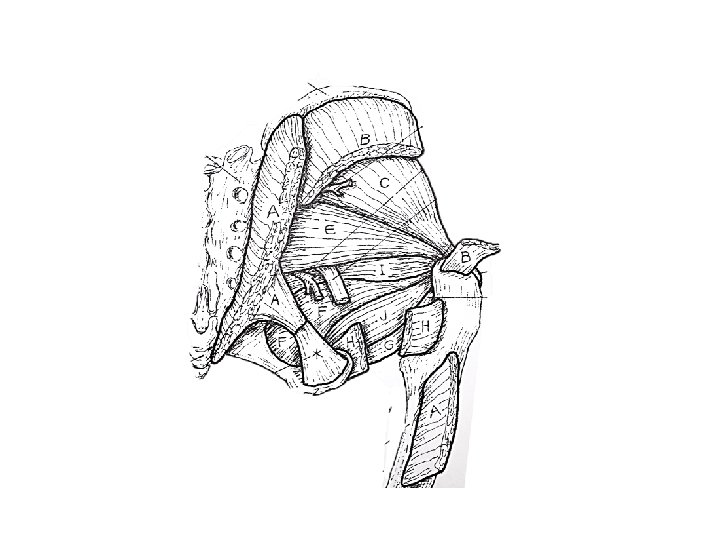
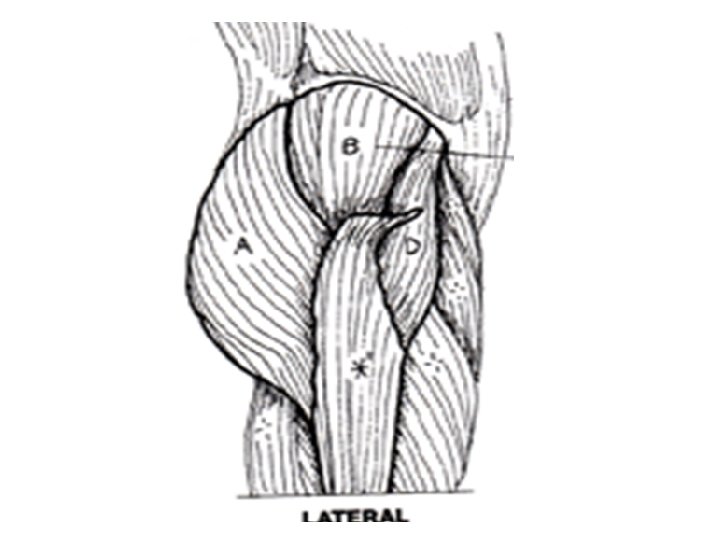
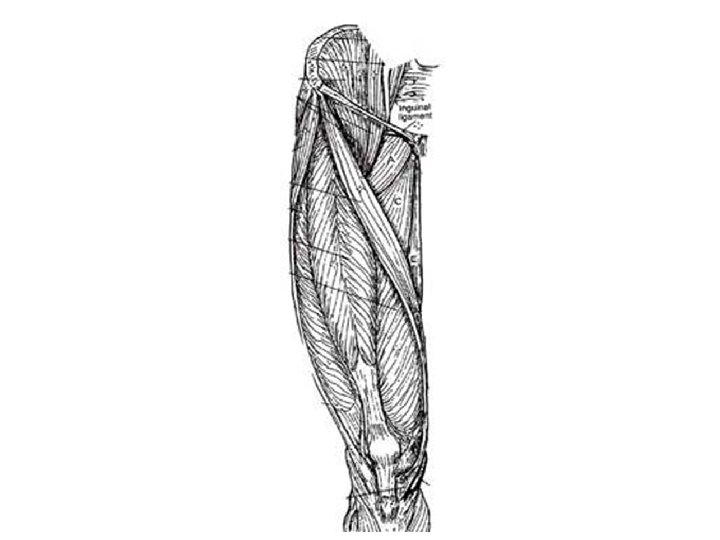

The Hip Sports Med 2
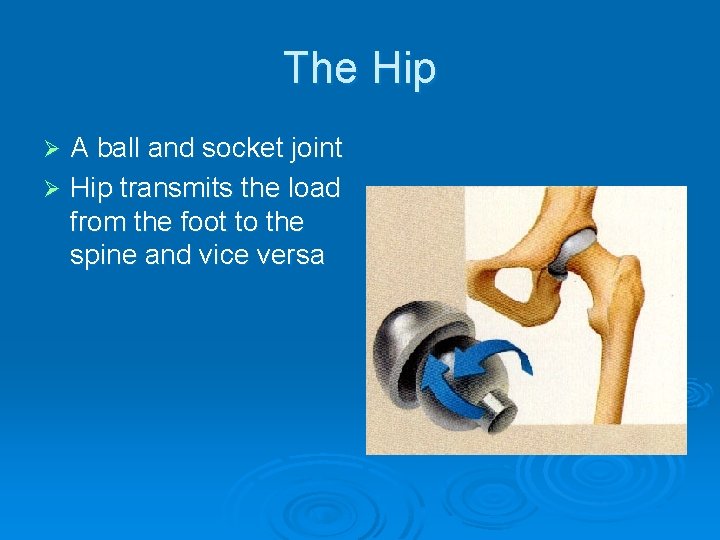
The Hip A ball and socket joint Ø Hip transmits the load from the foot to the spine and vice versa Ø
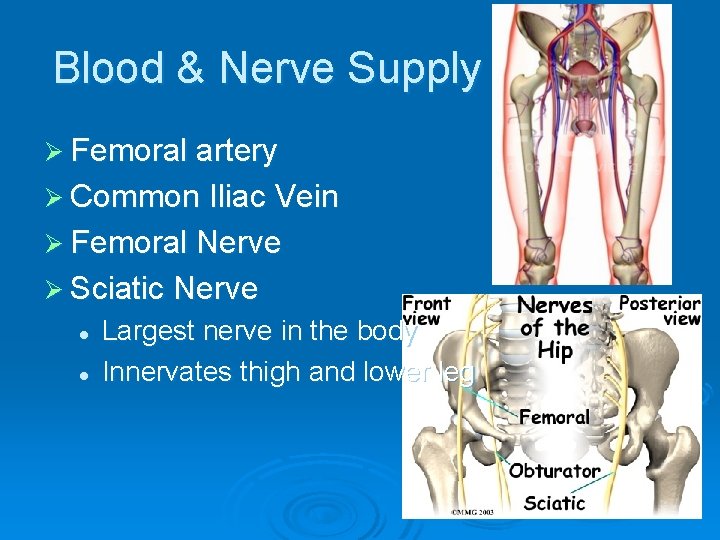
Blood & Nerve Supply Ø Femoral artery Ø Common Iliac Vein Ø Femoral Nerve Ø Sciatic Nerve l l Largest nerve in the body Innervates thigh and lower leg
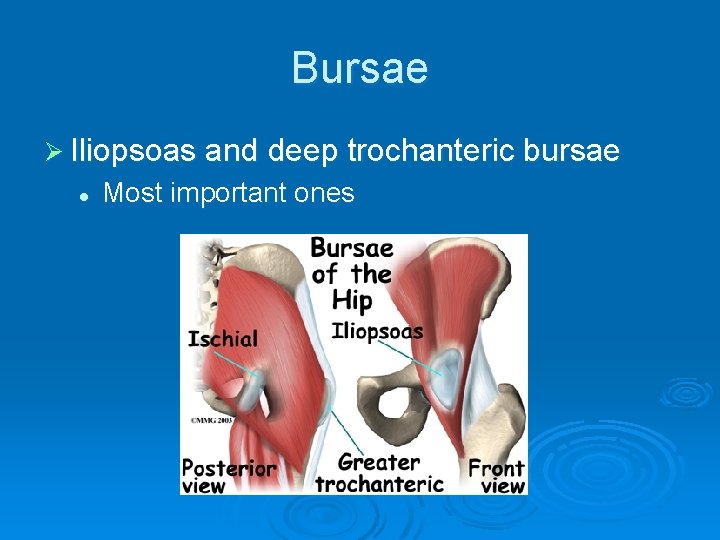
Bursae Ø Iliopsoas and deep trochanteric bursae l Most important ones
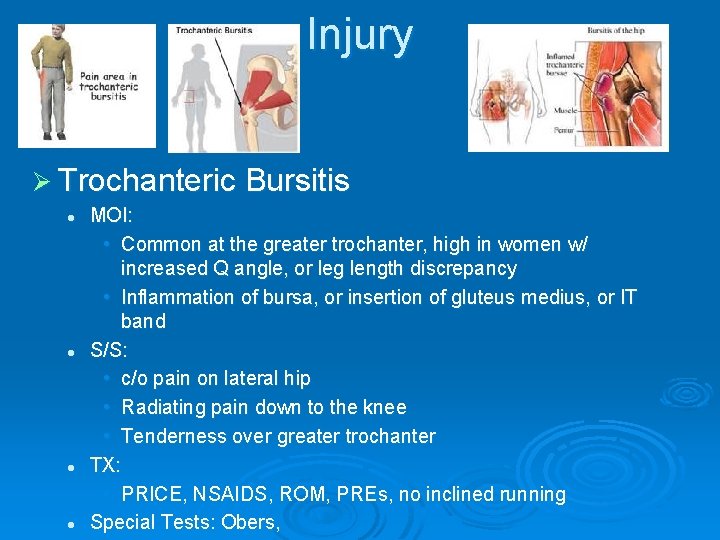
Injury Ø Trochanteric Bursitis l l MOI: • Common at the greater trochanter, high in women w/ increased Q angle, or leg length discrepancy • Inflammation of bursa, or insertion of gluteus medius, or IT band S/S: • c/o pain on lateral hip • Radiating pain down to the knee • Tenderness over greater trochanter TX: • PRICE, NSAIDS, ROM, PREs, no inclined running Special Tests: Obers,
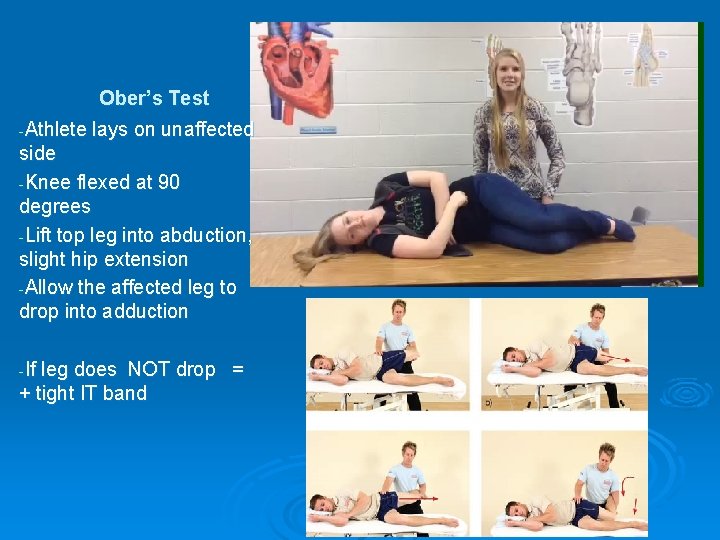
Ober’s Test -Athlete lays on unaffected side -Knee flexed at 90 degrees -Lift top leg into abduction, slight hip extension -Allow the affected leg to drop into adduction -If leg does NOT drop = + tight IT band
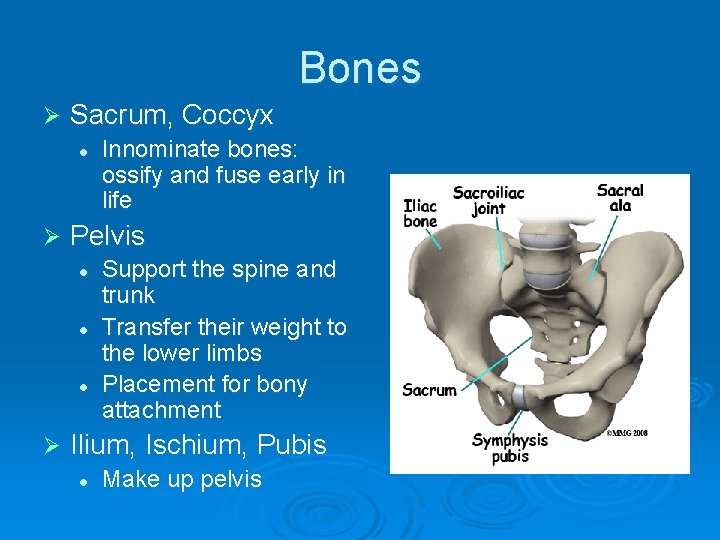
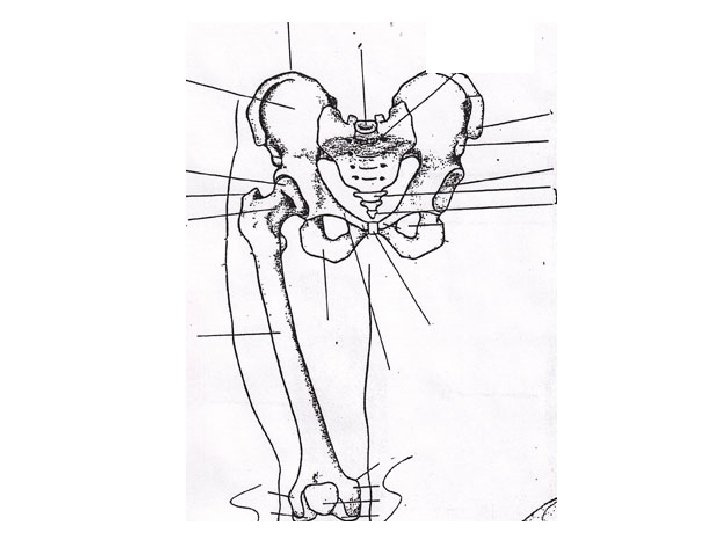
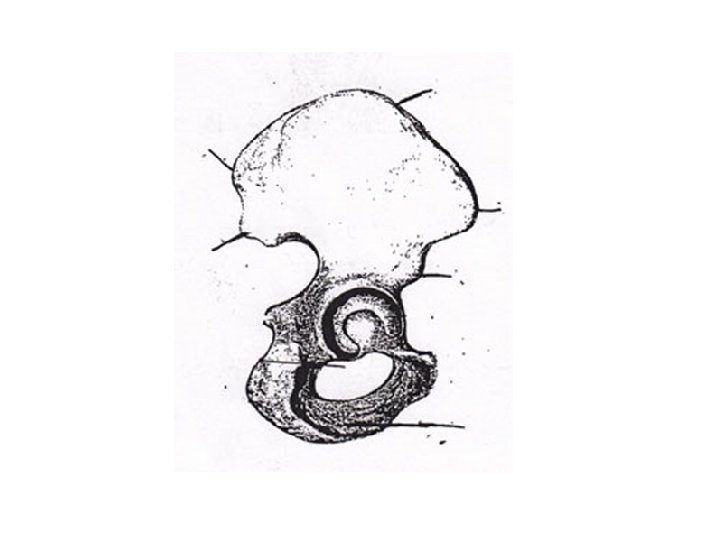
Bones Ø Sacrum, Coccyx l Ø Pelvis l l l Ø Innominate bones: ossify and fuse early in life Support the spine and trunk Transfer their weight to the lower limbs Placement for bony attachment Ilium, Ischium, Pubis l Make up pelvis
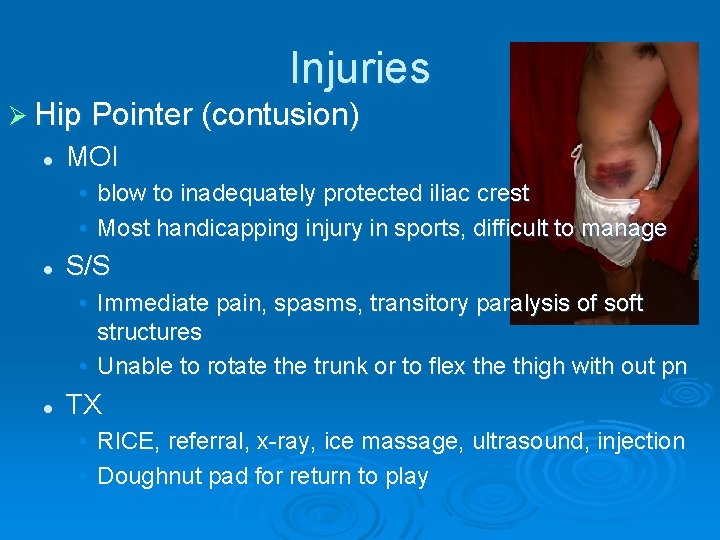
Injuries Ø Hip Pointer (contusion) l MOI • blow to inadequately protected iliac crest • Most handicapping injury in sports, difficult to manage l S/S • Immediate pain, spasms, transitory paralysis of soft structures • Unable to rotate the trunk or to flex the thigh with out pn l TX • RICE, referral, x-ray, ice massage, ultrasound, injection • Doughnut pad for return to play
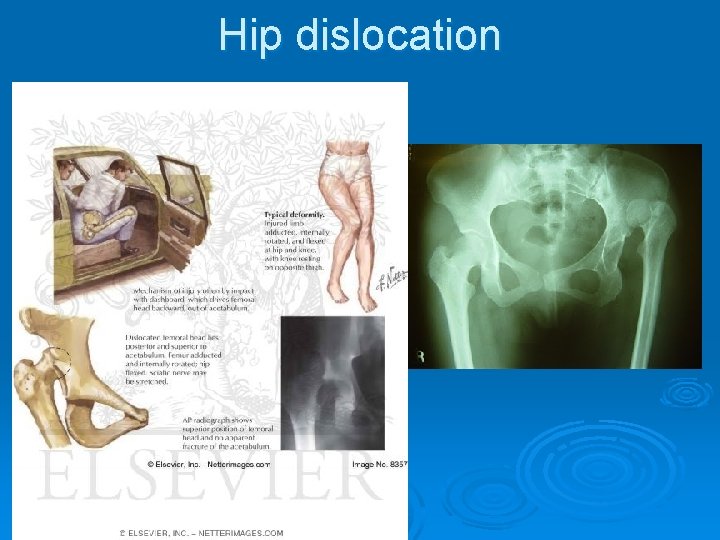
Hip dislocation
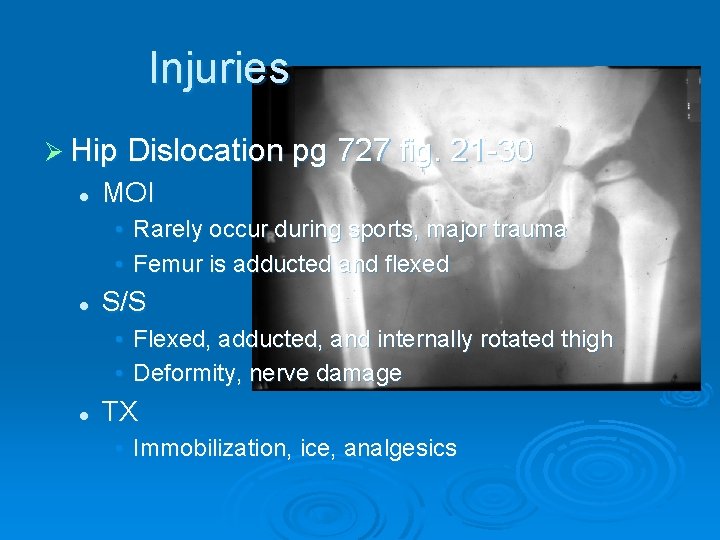
Injuries Ø Hip Dislocation pg 727 fig. 21 -30 l MOI • Rarely occur during sports, major trauma • Femur is adducted and flexed l S/S • Flexed, adducted, and internally rotated thigh • Deformity, nerve damage l TX • Immobilization, ice, analgesics
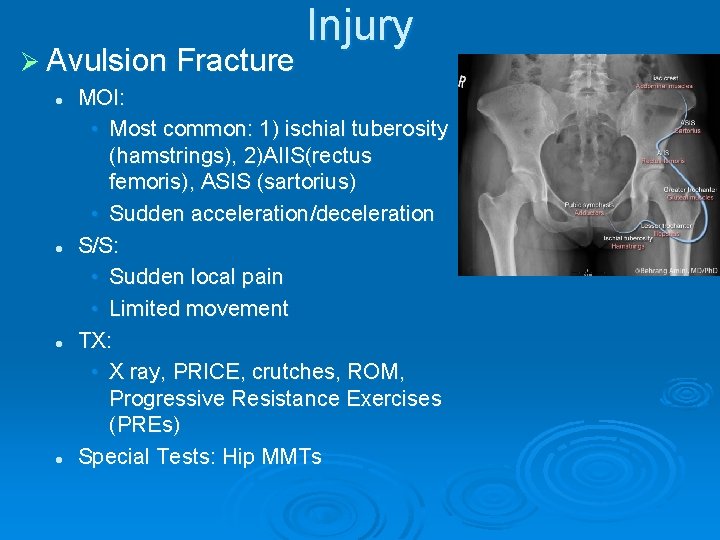
Ø Avulsion Fracture l l Injury MOI: • Most common: 1) ischial tuberosity (hamstrings), 2)AIIS(rectus femoris), ASIS (sartorius) • Sudden acceleration/deceleration S/S: • Sudden local pain • Limited movement TX: • X ray, PRICE, crutches, ROM, Progressive Resistance Exercises (PREs) Special Tests: Hip MMTs
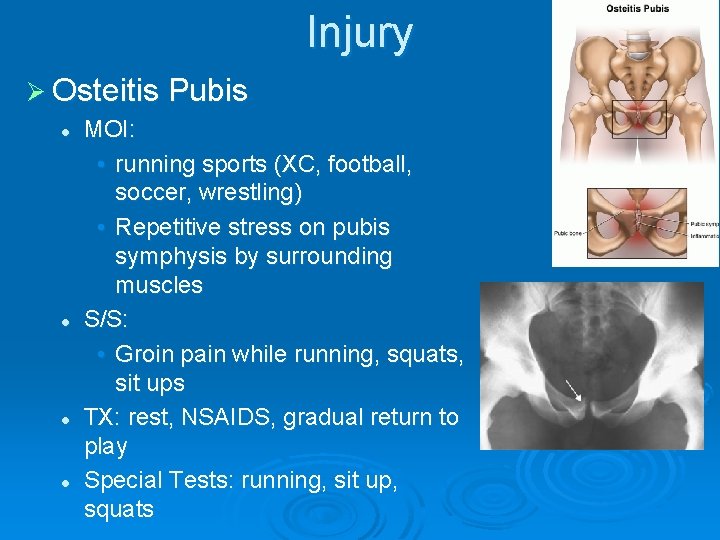
Injury Ø Osteitis Pubis l l MOI: • running sports (XC, football, soccer, wrestling) • Repetitive stress on pubis symphysis by surrounding muscles S/S: • Groin pain while running, squats, sit ups TX: rest, NSAIDS, gradual return to play Special Tests: running, sit up, squats
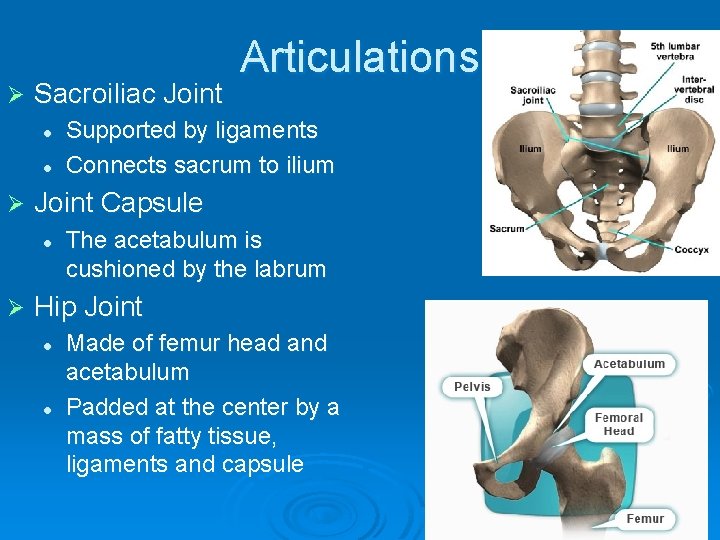
Ø Sacroiliac Joint l l Ø Supported by ligaments Connects sacrum to ilium Joint Capsule l Ø Articulations The acetabulum is cushioned by the labrum Hip Joint l l Made of femur head and acetabulum Padded at the center by a mass of fatty tissue, ligaments and capsule
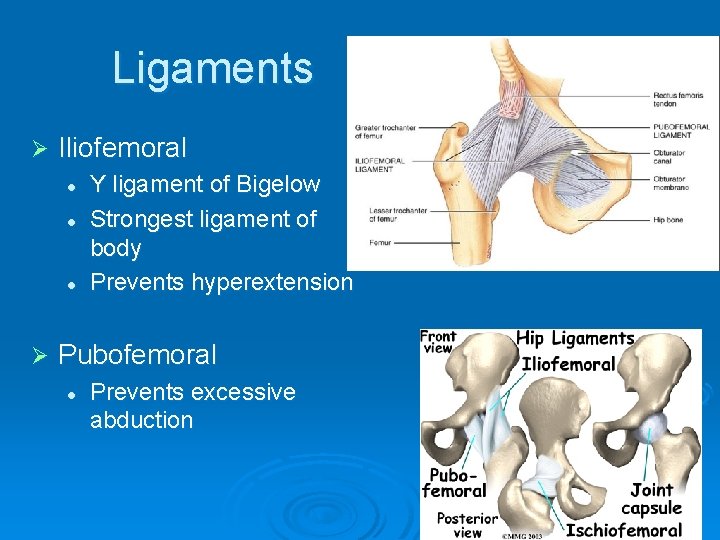
Ligaments Ø Iliofemoral l Ø Y ligament of Bigelow Strongest ligament of body Prevents hyperextension Pubofemoral l Prevents excessive abduction
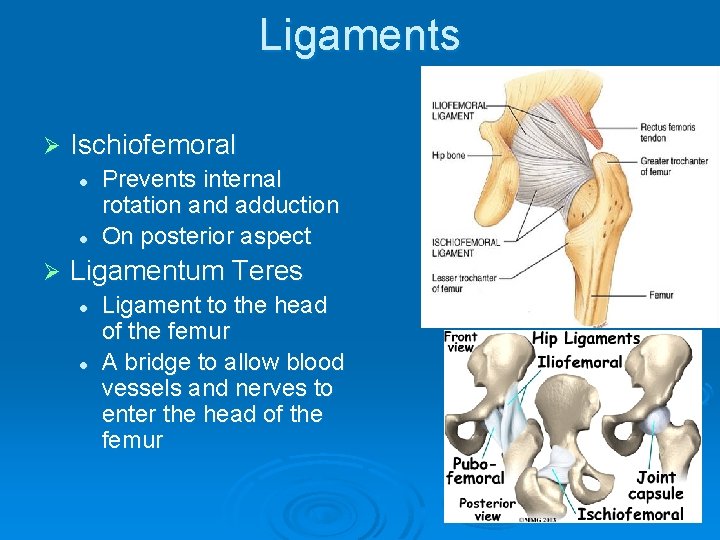
Ligaments Ø Ischiofemoral l l Ø Prevents internal rotation and adduction On posterior aspect Ligamentum Teres l l Ligament to the head of the femur A bridge to allow blood vessels and nerves to enter the head of the femur
Injuries Ø Hip Sprain l MOI • Strong = best protected, seldom injured • Violent twisting produced by opponent, foot firmly planted and trunk forced in opposing direction l S/S • Athlete is unable to circumduct the thigh • pain l TX • X-rays to rule out fx • RICE, analgesics, limit wt. bearing, pain free ROM l Special Tests: active circumduction of thigh, IR, ER
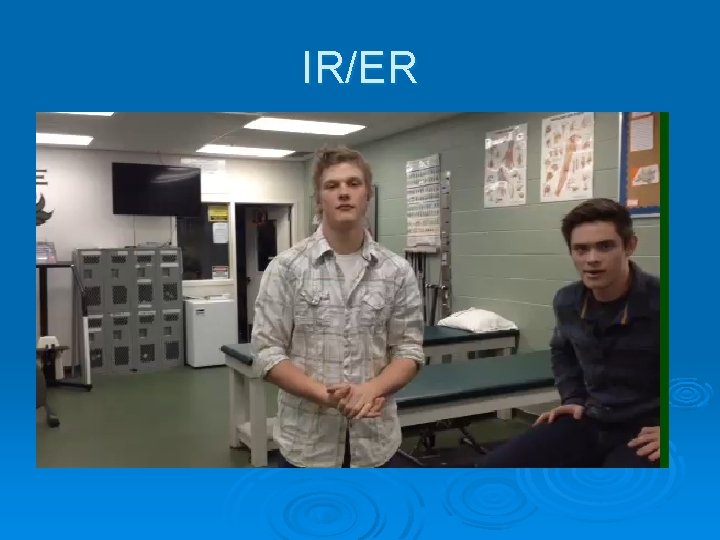
IR/ER
Injuries Ø Sacroiliac Joint Sprain (S. I. Joint) l MOI • Twists with both feet on the ground • Stumbles forward, falls backward, steps in hole l S/S • Pain over joint, muscle guarding, radiating pain down back of gluteus and hamstring • Asymmetrical ASIS/PSIS or leg length difference l TX • Modalities, brace, stability exercises l Special Test: FABERS/Patricks
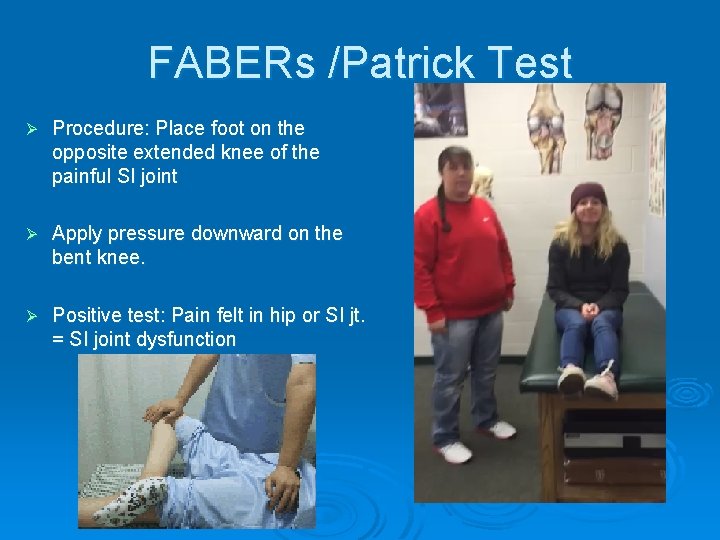
FABERs /Patrick Test Ø Procedure: Place foot on the opposite extended knee of the painful SI joint Ø Apply pressure downward on the bent knee. Ø Positive test: Pain felt in hip or SI jt. = SI joint dysfunction
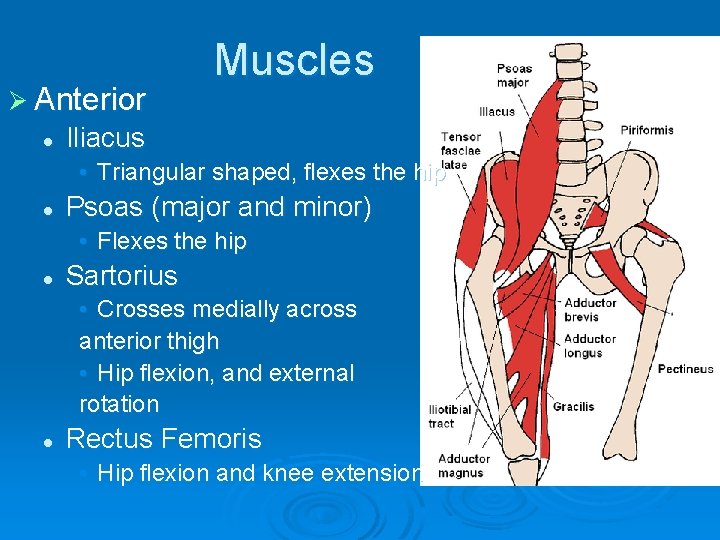
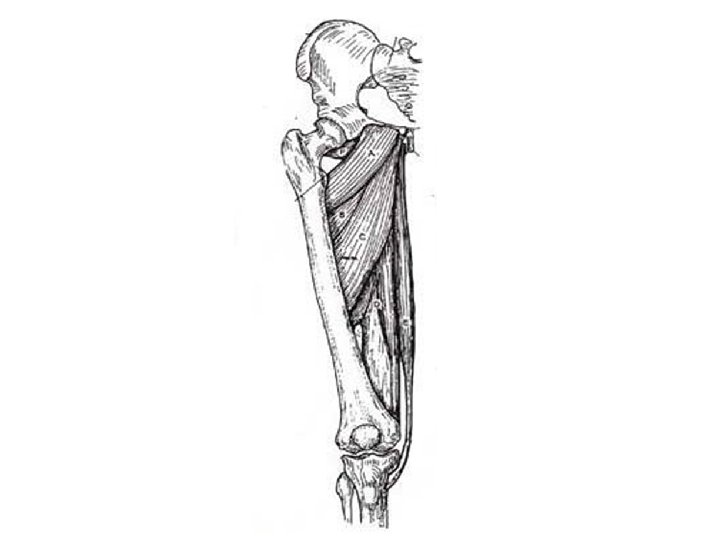
Ø Anterior l Muscles Iliacus • Triangular shaped, flexes the hip l Psoas (major and minor) • Flexes the hip l Sartorius • Crosses medially across anterior thigh • Hip flexion, and external rotation l Rectus Femoris • Hip flexion and knee extension
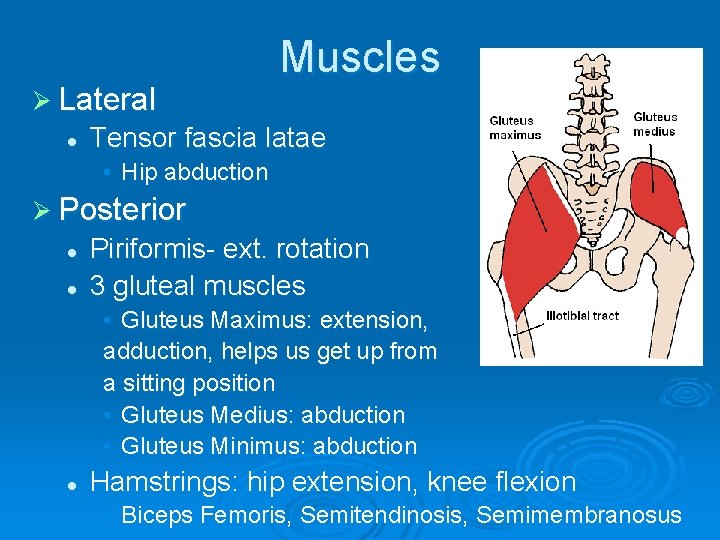
Ø Lateral l Muscles Tensor fascia latae • Hip abduction Ø Posterior l l Piriformis- ext. rotation 3 gluteal muscles • Gluteus Maximus: extension, adduction, helps us get up from a sitting position • Gluteus Medius: abduction • Gluteus Minimus: abduction l Hamstrings: hip extension, knee flexion • Biceps Femoris, Semitendinosis, Semimembranosus
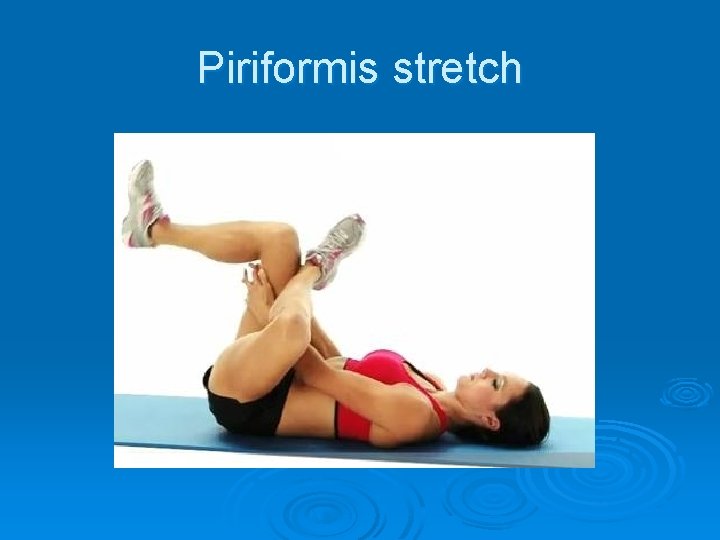
Piriformis stretch
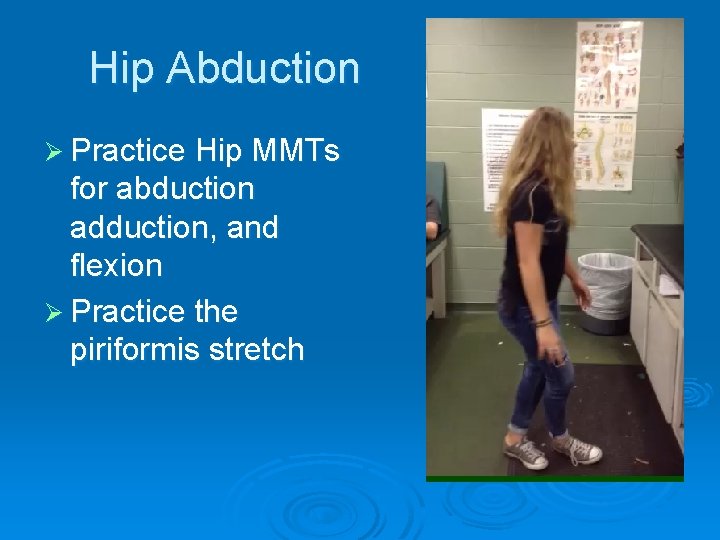
Hip Abduction Ø Practice Hip MMTs for abduction adduction, and flexion Ø Practice the piriformis stretch
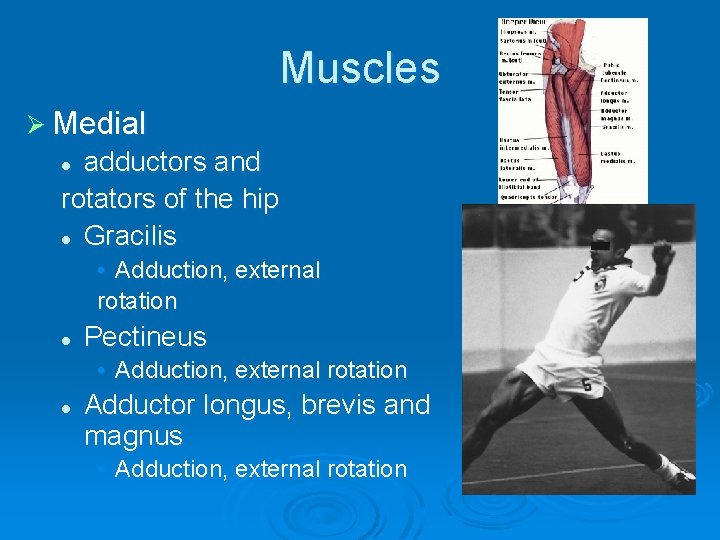
Muscles Ø Medial adductors and rotators of the hip l Gracilis l • Adduction, external rotation l Pectineus • Adduction, external rotation l Adductor longus, brevis and magnus • Adduction, external rotation
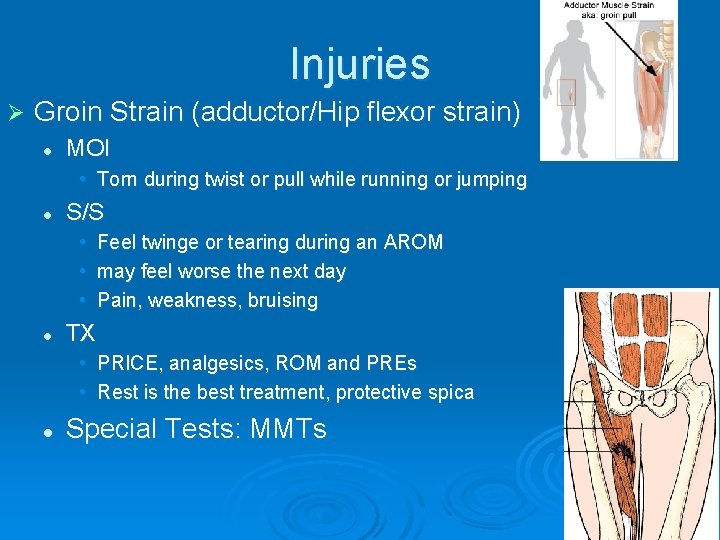
Injuries Ø Groin Strain (adductor/Hip flexor strain) l MOI • Torn during twist or pull while running or jumping l S/S • Feel twinge or tearing during an AROM • may feel worse the next day • Pain, weakness, bruising l TX • PRICE, analgesics, ROM and PREs • Rest is the best treatment, protective spica l Special Tests: MMTs
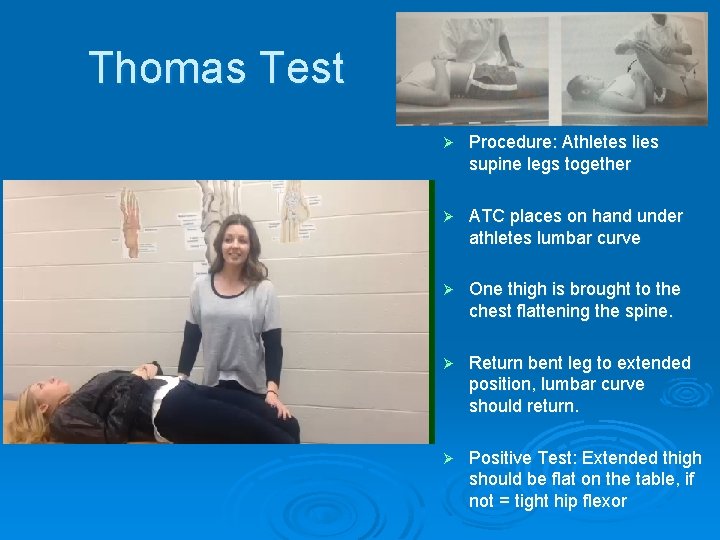
Thomas Test Ø Procedure: Athletes lies supine legs together Ø ATC places on hand under athletes lumbar curve Ø One thigh is brought to the chest flattening the spine. Ø Return bent leg to extended position, lumbar curve should return. Ø Positive Test: Extended thigh should be flat on the table, if not = tight hip flexor
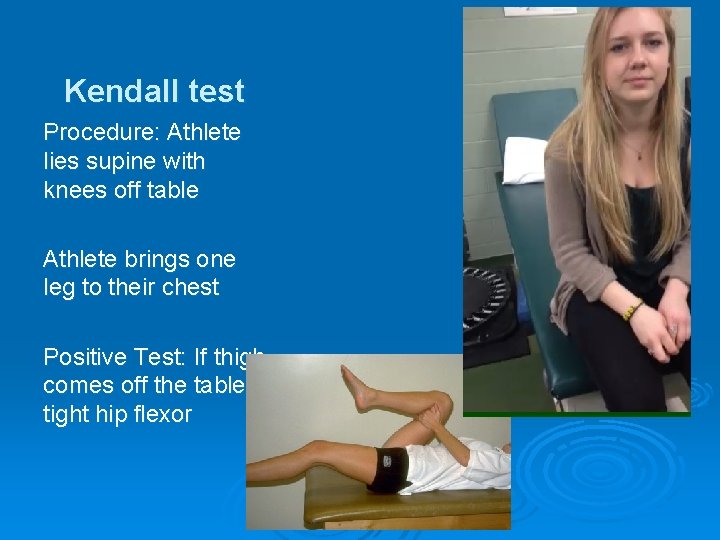
Kendall test Procedure: Athlete lies supine with knees off table Athlete brings one leg to their chest Positive Test: If thigh comes off the table = tight hip flexor
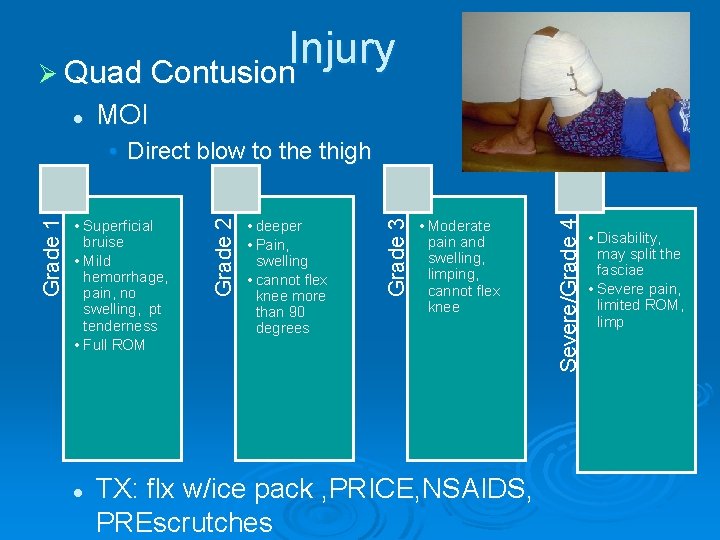
Injury Ø Quad Contusion l MOI l • Moderate pain and swelling, limping, cannot flex knee TX: flx w/ice pack , PRICE, NSAIDS, PREscrutches Severe/Grade 4 • deeper • Pain, swelling • cannot flex knee more than 90 degrees Grade 3 • Superficial bruise • Mild hemorrhage, pain, no swelling, pt tenderness • Full ROM Grade 2 Grade 1 • Direct blow to the thigh • Disability, may split the fasciae • Severe pain, limited ROM, limp
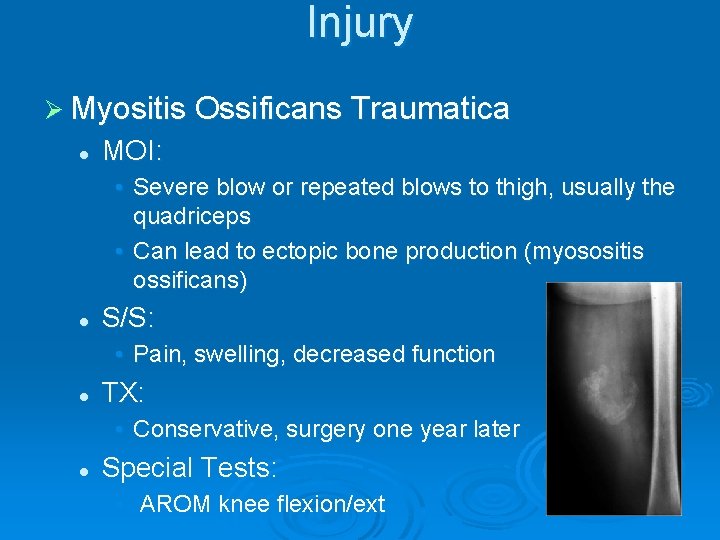
Injury Ø Myositis Ossificans Traumatica l MOI: • Severe blow or repeated blows to thigh, usually the quadriceps • Can lead to ectopic bone production (myosositis ossificans) l S/S: • Pain, swelling, decreased function l TX: • Conservative, surgery one year later l Special Tests: • AROM knee flexion/ext
Injury Ø Hamstring Strain l MOI • Most common injury to thigh, exact cause not known • Possible MOI: muscle fatigue, faulty posture, leg length discrepancy, tight hamstrings l S/S • Hemorrhage, pain, loss of function. • 3 grades of strain l TX • PRICE, NSAIDS, very conservative, PREs l Special test: MMTs
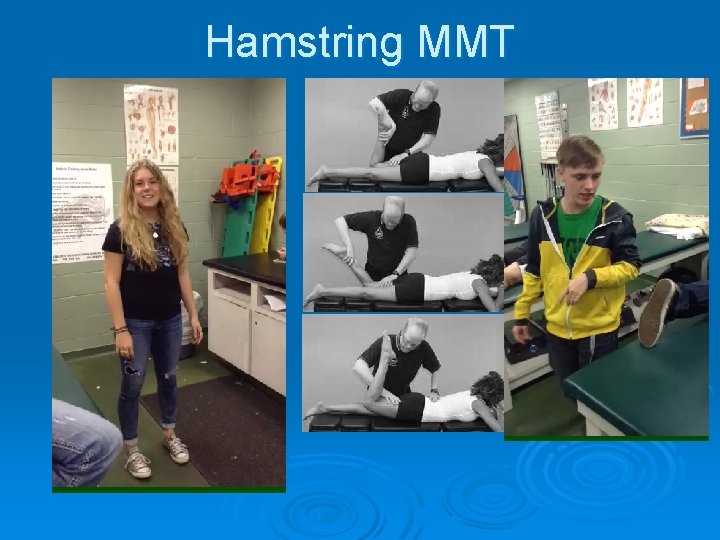
Hamstring MMT
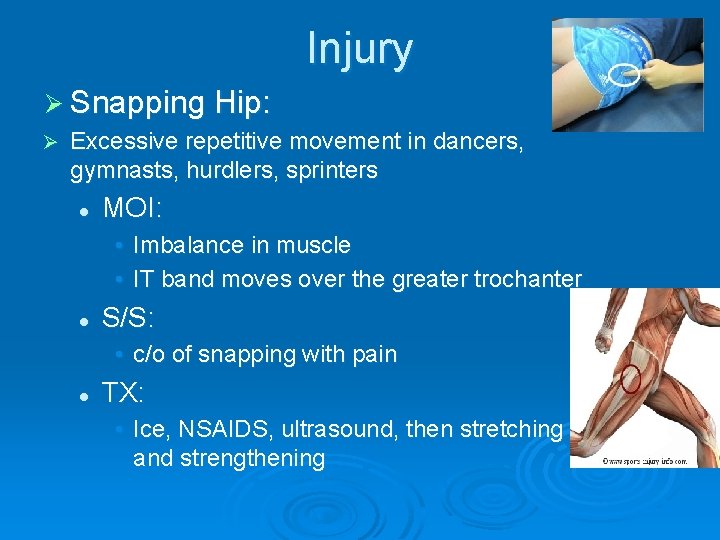
Injury Ø Snapping Hip: Ø Excessive repetitive movement in dancers, gymnasts, hurdlers, sprinters l MOI: • Imbalance in muscle • IT band moves over the greater trochanter l S/S: • c/o of snapping with pain l TX: • Ice, NSAIDS, ultrasound, then stretching and strengthening
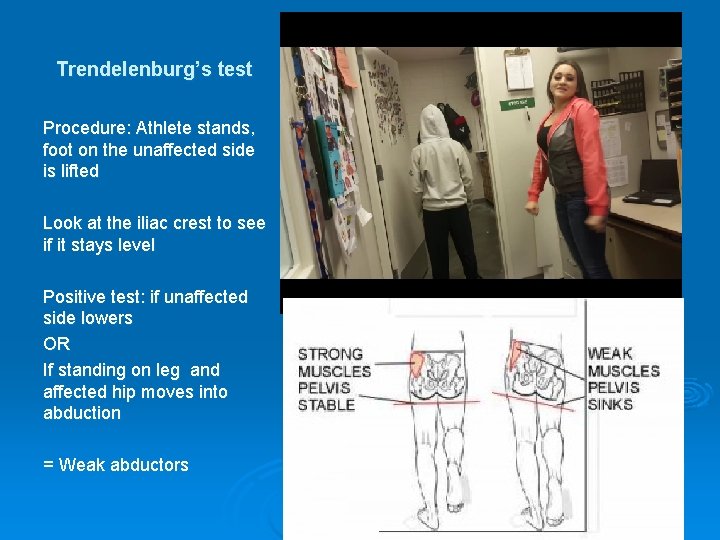
Trendelenburg’s test Procedure: Athlete stands, foot on the unaffected side is lifted Look at the iliac crest to see if it stays level Positive test: if unaffected side lowers OR If standing on leg and affected hip moves into abduction = Weak abductors
Injury Femoroacetabular impingement (FAI) Ø Hip Impingement Ø MOI Ø l l Ø S/S l l Ø abutment of the acetabular rim and the proximal femur Bone abnormalities, congenital or developed Anterolateral hip pain aggravating activities: prolonged sitting, leaning forward, getting in or out of a car, and pivoting in sports. TX l l Analgesics, ROM, PREs Refer to Ortho
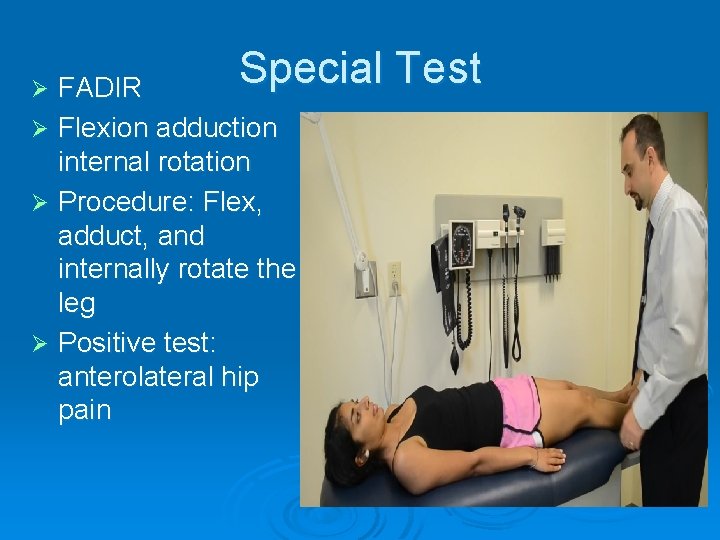
Special Test FADIR Ø Flexion adduction internal rotation Ø Procedure: Flex, adduct, and internally rotate the leg Ø Positive test: anterolateral hip pain Ø
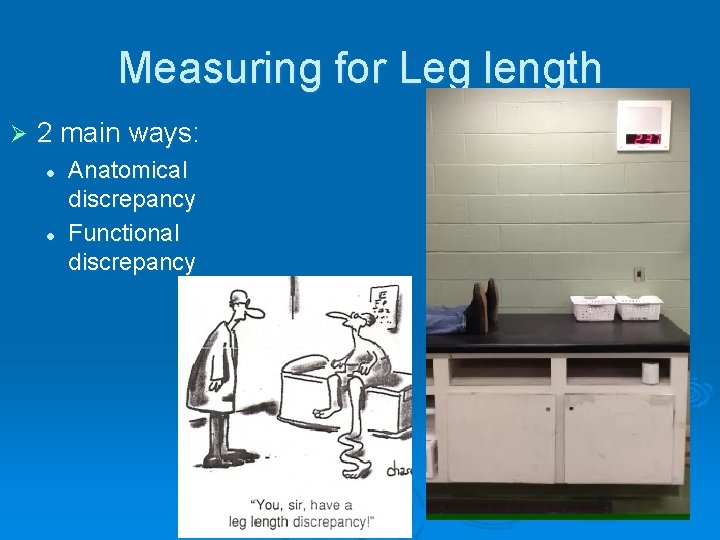
Measuring for Leg length Ø 2 main ways: l l Anatomical discrepancy Functional discrepancy
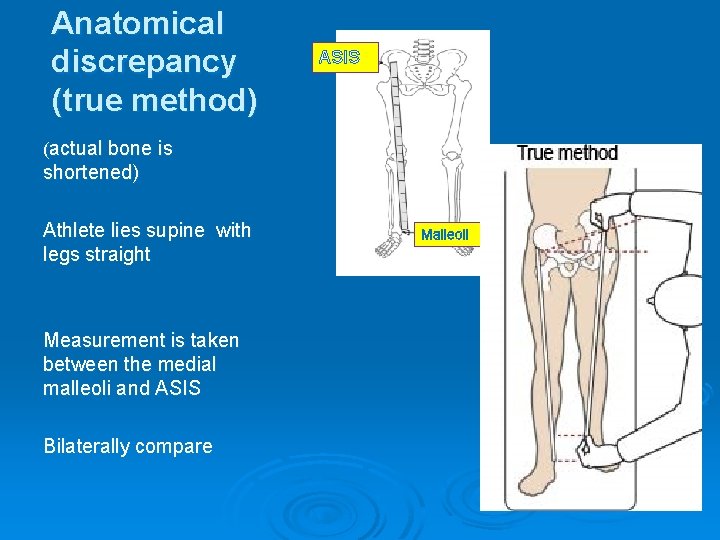
Anatomical discrepancy (true method) ASIS (actual bone is shortened) Athlete lies supine with legs straight Measurement is taken between the medial malleoli and ASIS Bilaterally compare Malleoli
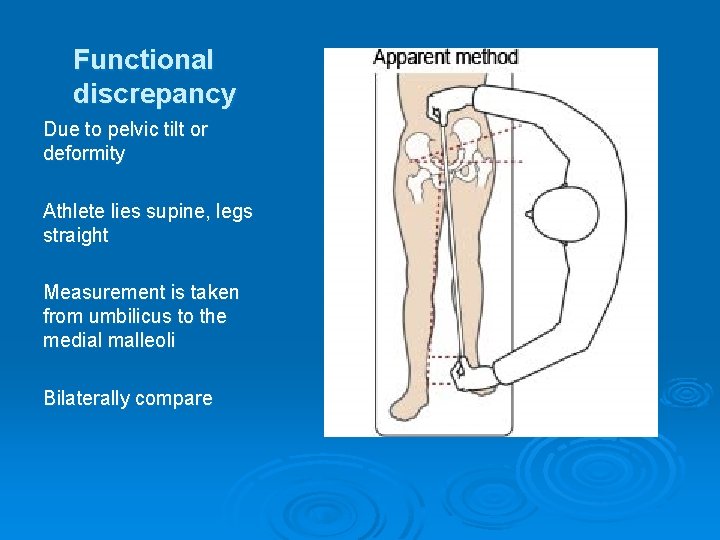
Functional discrepancy Due to pelvic tilt or deformity Athlete lies supine, legs straight Measurement is taken from umbilicus to the medial malleoli Bilaterally compare
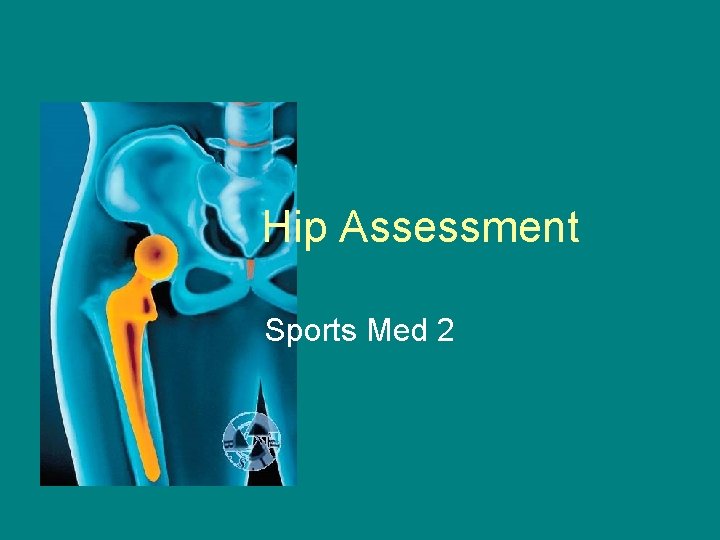
Hip Assessment Sports Med 2
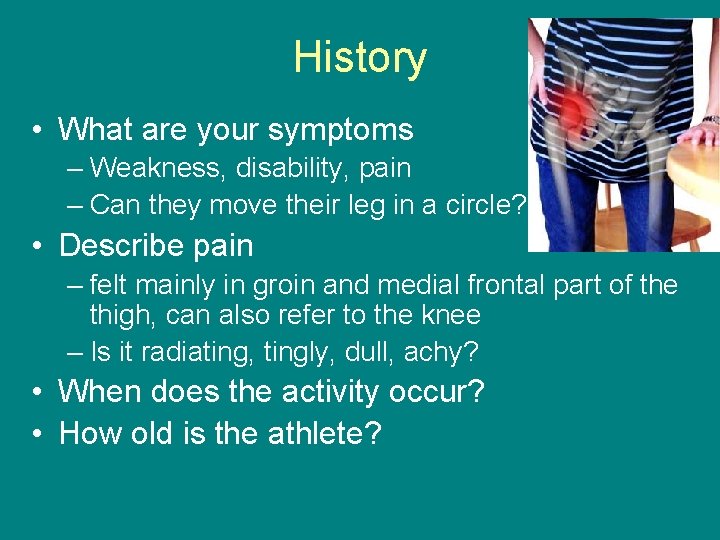
History • What are your symptoms – Weakness, disability, pain – Can they move their leg in a circle? • Describe pain – felt mainly in groin and medial frontal part of the thigh, can also refer to the knee – Is it radiating, tingly, dull, achy? • When does the activity occur? • How old is the athlete?
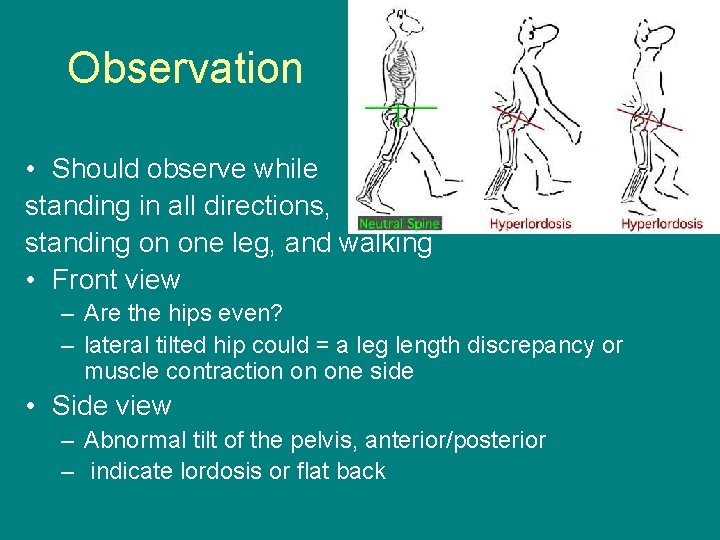
Observation • Should observe while standing in all directions, standing on one leg, and walking • Front view – Are the hips even? – lateral tilted hip could = a leg length discrepancy or muscle contraction on one side • Side view – Abnormal tilt of the pelvis, anterior/posterior – indicate lordosis or flat back
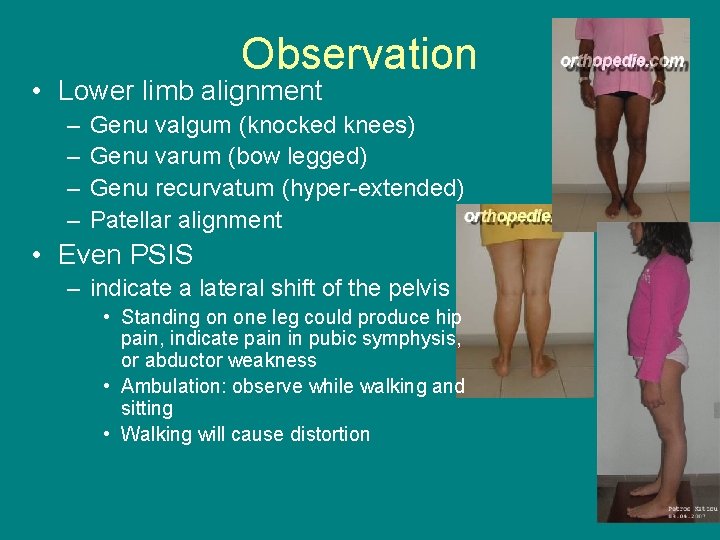
Observation • Lower limb alignment – – Genu valgum (knocked knees) Genu varum (bow legged) Genu recurvatum (hyper-extended) Patellar alignment • Even PSIS – indicate a lateral shift of the pelvis • Standing on one leg could produce hip pain, indicate pain in pubic symphysis, or abductor weakness • Ambulation: observe while walking and sitting • Walking will cause distortion
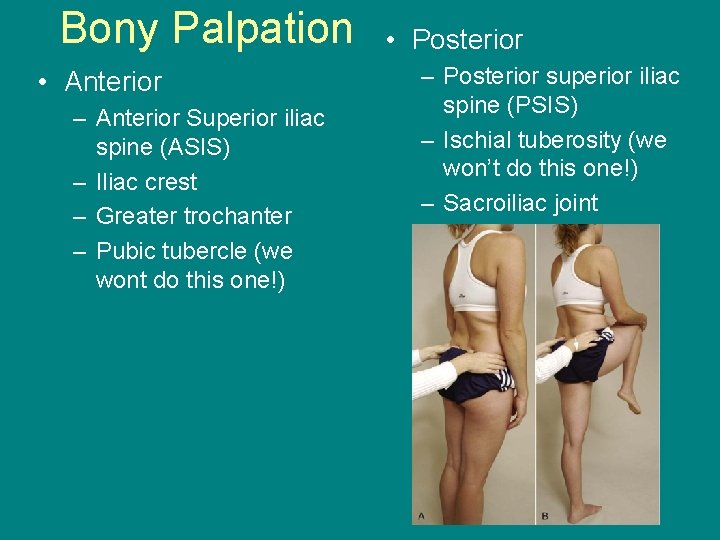
Bony Palpation • Anterior – Anterior Superior iliac spine (ASIS) – Iliac crest – Greater trochanter – Pubic tubercle (we wont do this one!) • Posterior – Posterior superior iliac spine (PSIS) – Ischial tuberosity (we won’t do this one!) – Sacroiliac joint
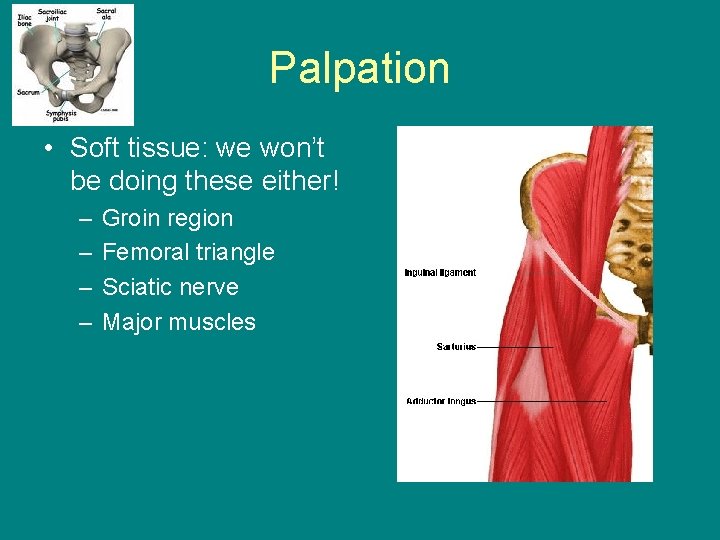
Palpation • Soft tissue: we won’t be doing these either! – – Groin region Femoral triangle Sciatic nerve Major muscles
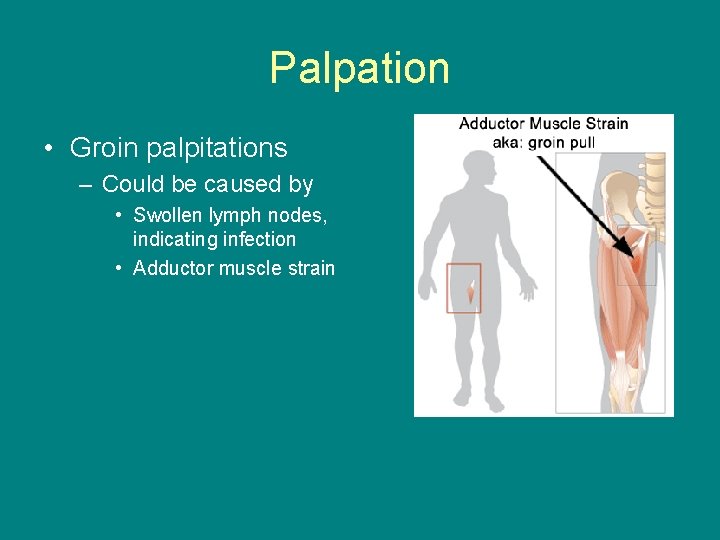
Palpation • Groin palpitations – Could be caused by • Swollen lymph nodes, indicating infection • Adductor muscle strain
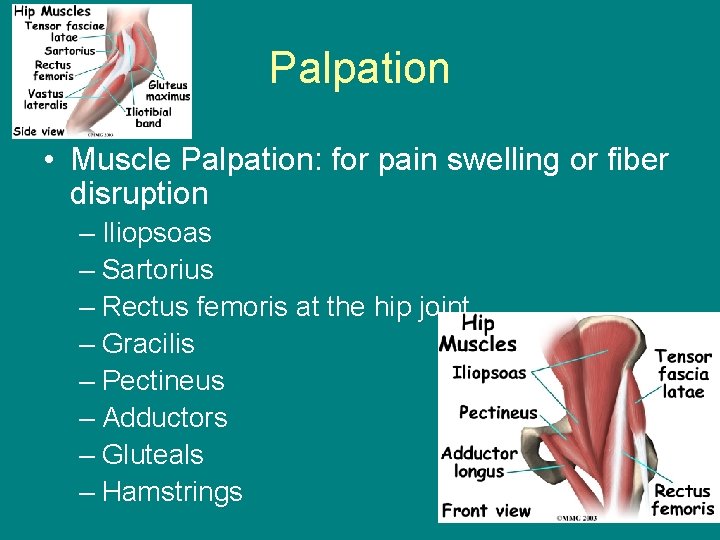
Palpation • Muscle Palpation: for pain swelling or fiber disruption – Iliopsoas – Sartorius – Rectus femoris at the hip joint – Gracilis – Pectineus – Adductors – Gluteals – Hamstrings
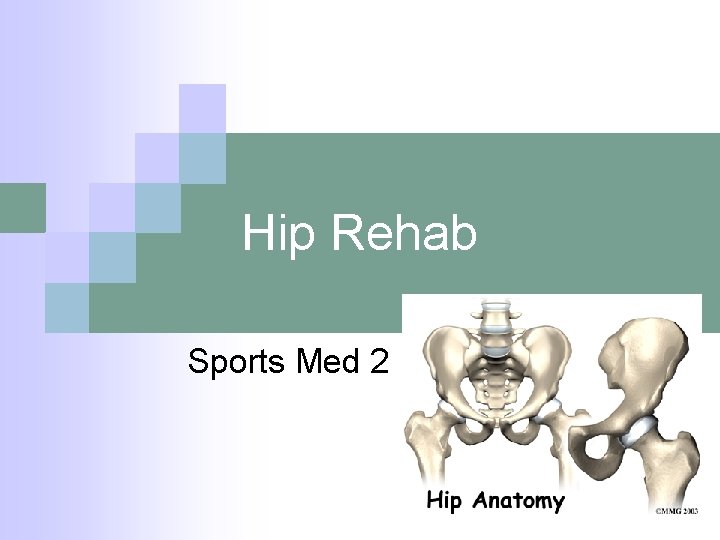
Hip Rehab Sports Med 2
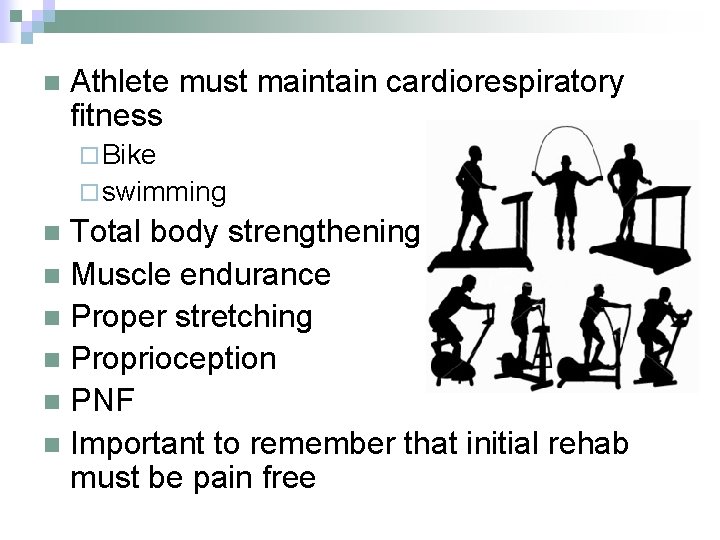
n Athlete must maintain cardiorespiratory fitness ¨ Bike ¨ swimming Total body strengthening n Muscle endurance n Proper stretching n Proprioception n PNF n Important to remember that initial rehab must be pain free n
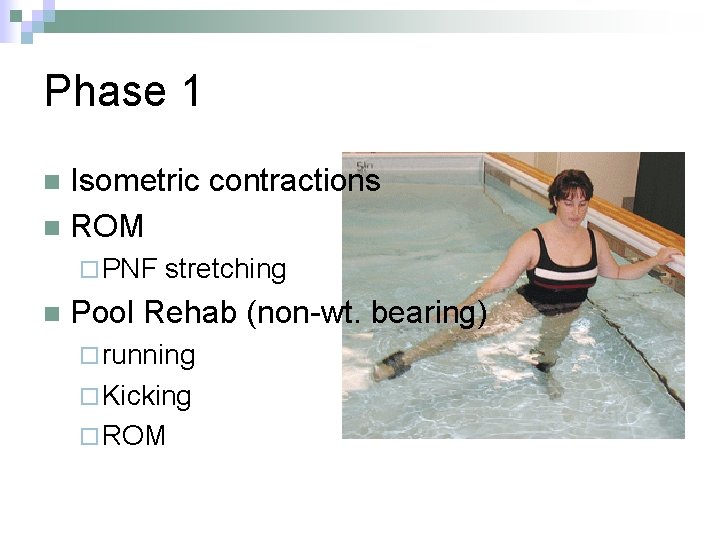
Phase 1 Isometric contractions n ROM n ¨ PNF n stretching Pool Rehab (non-wt. bearing) ¨ running ¨ Kicking ¨ ROM
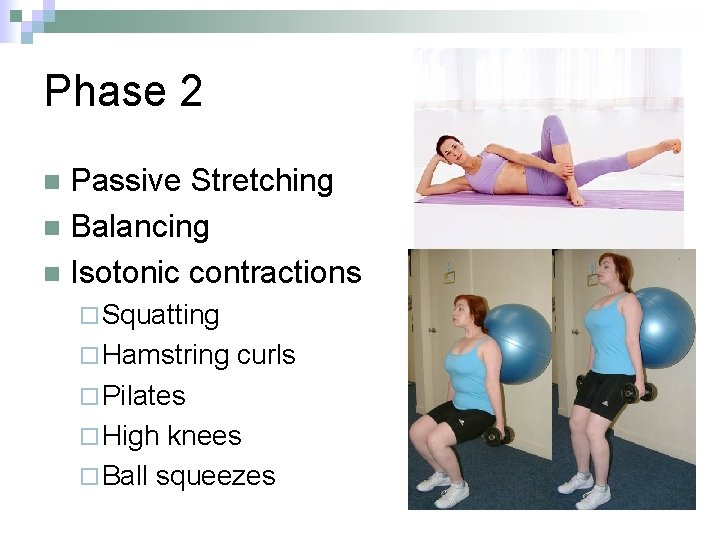
Phase 2 Passive Stretching n Balancing n Isotonic contractions n ¨ Squatting ¨ Hamstring curls ¨ Pilates ¨ High knees ¨ Ball squeezes
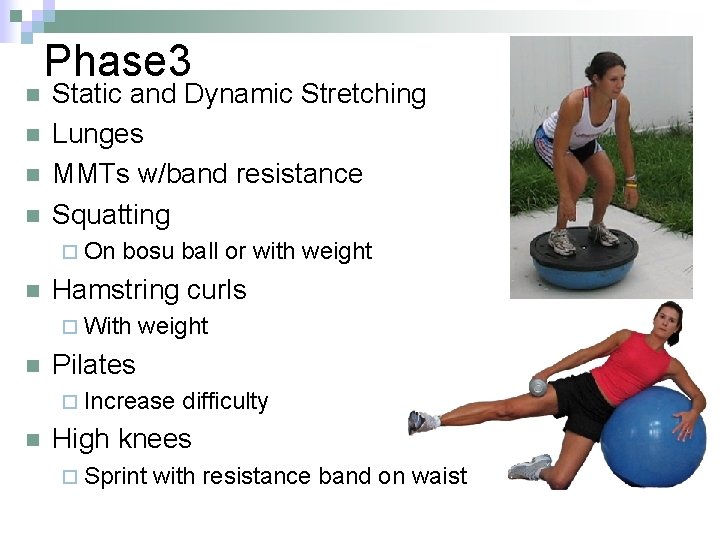
n n Phase 3 Static and Dynamic Stretching Lunges MMTs w/band resistance Squatting ¨ On n bosu ball or with weight Hamstring curls ¨ With n weight Pilates ¨ Increase n difficulty High knees ¨ Sprint with resistance band on waist
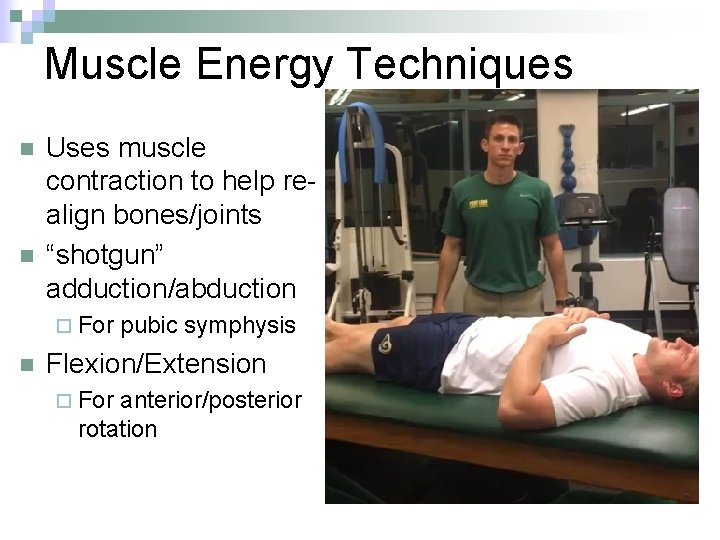
Muscle Energy Techniques n n Uses muscle contraction to help realign bones/joints “shotgun” adduction/abduction ¨ For n pubic symphysis Flexion/Extension ¨ For anterior/posterior rotation
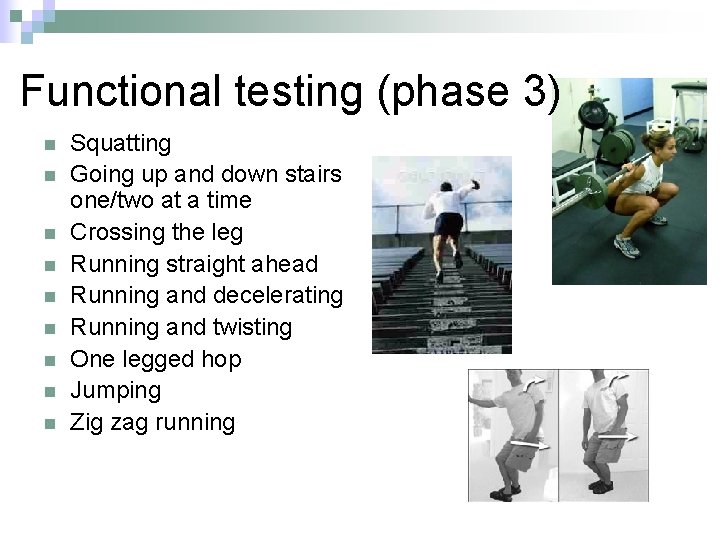
Functional testing (phase 3) n n n n n Squatting Going up and down stairs one/two at a time Crossing the leg Running straight ahead Running and decelerating Running and twisting One legged hop Jumping Zig zag running
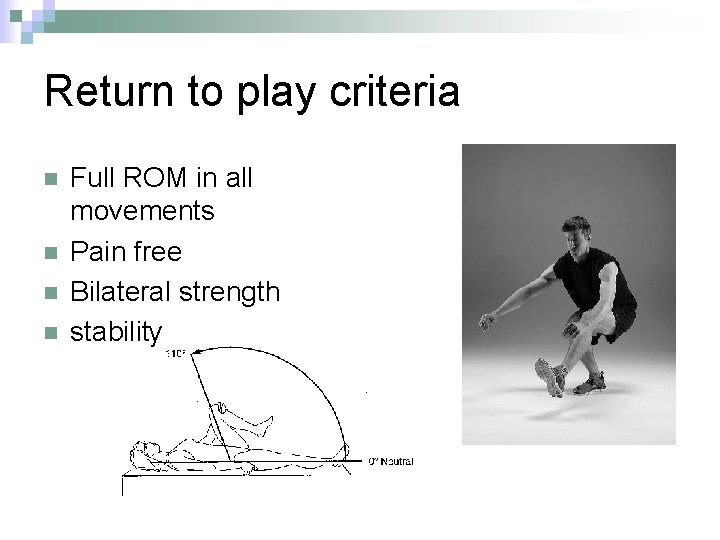
Return to play criteria n n Full ROM in all movements Pain free Bilateral strength stability

Rules of the Game n What signal will the ref give for blood in wrestling? n Draw and list the items to set up for a wrestling match. n How many innings are played in a high school baseball game? Softball? n In baseball and softball, what does “top of the inning” mean? n
- Slides: 63