
Hip Bone Marrow Lesions in asymptomatic and osteoarthritic
Hip Bone Marrow Lesions in asymptomatic and osteoarthritic adults: Prevalence, risk factors and significance Summer Research Project Luke Dawson
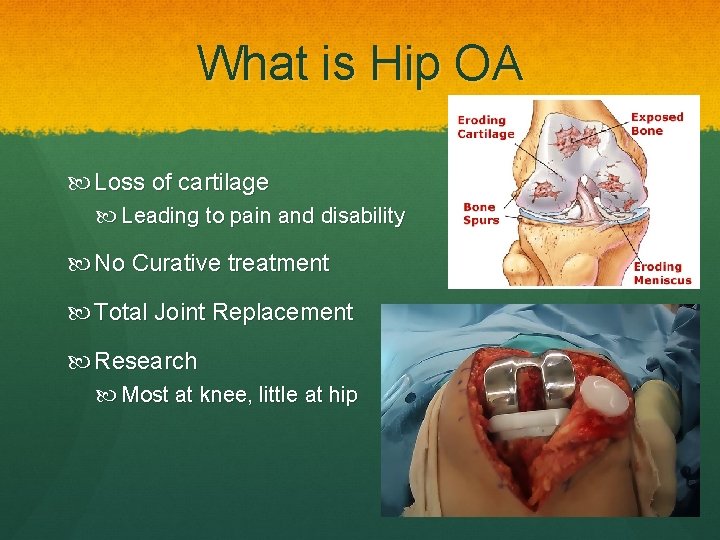
What is Hip OA Loss of cartilage Leading to pain and disability No Curative treatment Total Joint Replacement Research Most at knee, little at hip
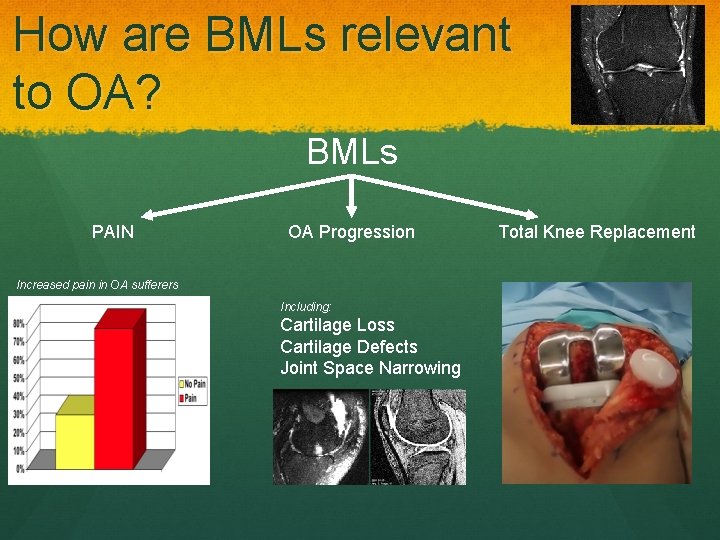
How are BMLs relevant to OA? BMLs PAIN OA Progression Increased pain in OA sufferers Including: Cartilage Loss Cartilage Defects Joint Space Narrowing Total Knee Replacement
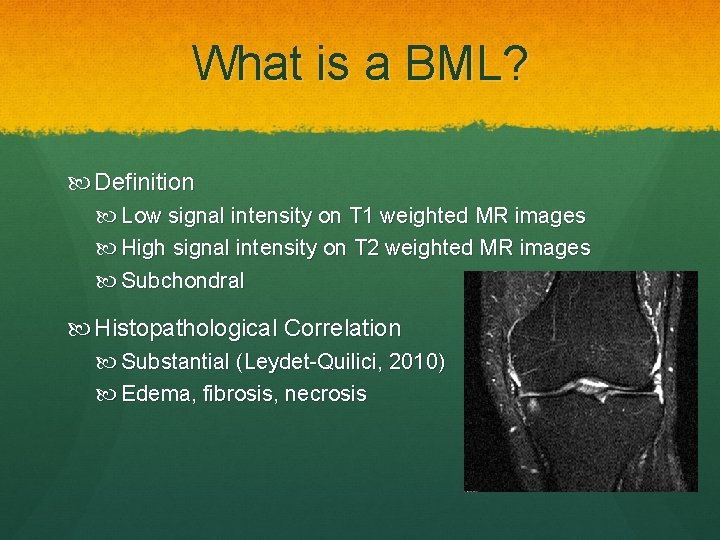
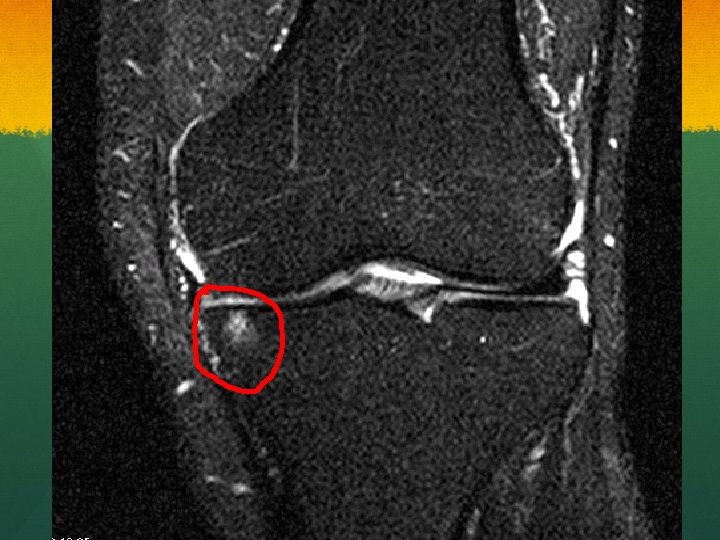
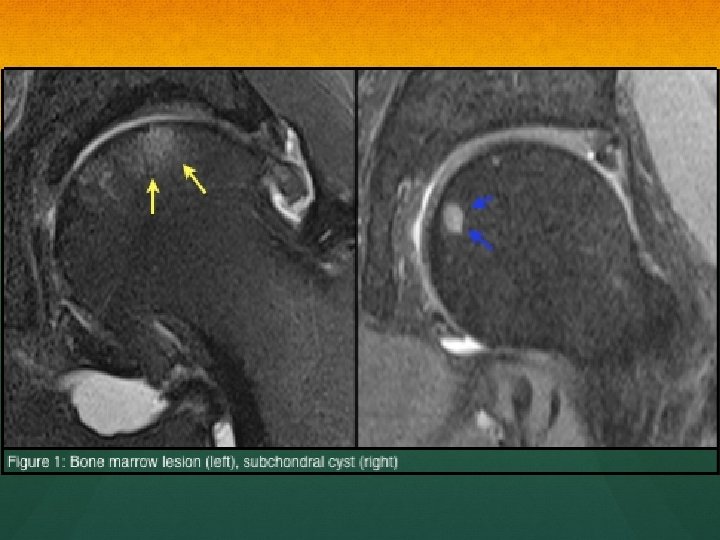
What is a BML? Definition Low signal intensity on T 1 weighted MR images High signal intensity on T 2 weighted MR images Subchondral Histopathological Correlation Substantial (Leydet-Quilici, 2010) Edema, fibrosis, necrosis
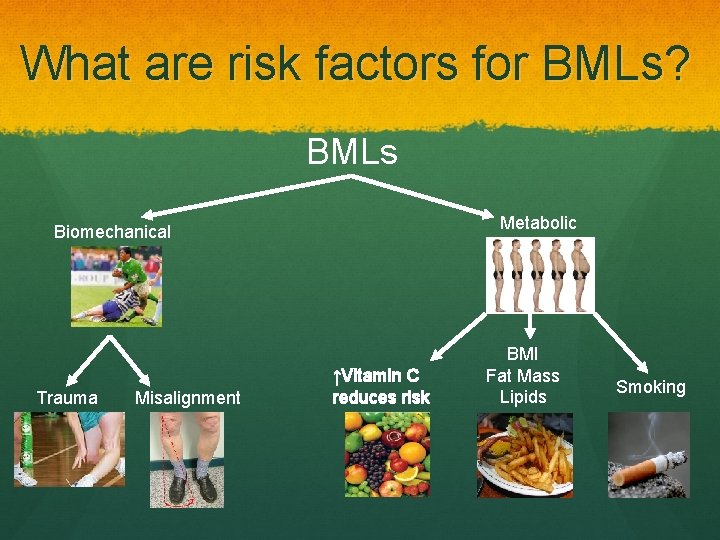
What are risk factors for BMLs? BMLs Metabolic Biomechanical Trauma Misalignment ↑Vitamin C reduces risk BMI Fat Mass Lipids Smoking
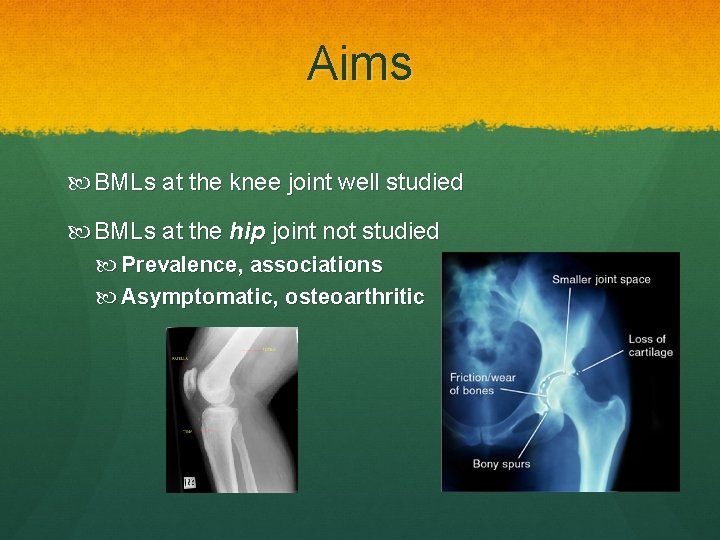
Aims BMLs at the knee joint well studied BMLs at the hip joint not studied Prevalence, associations Asymptomatic, osteoarthritic
Patients Melbourne Collaborative Cohort Study Prospective cohort study 1990 -1994 142 participants recruited Exclusion criteria Hip OA, recent hip pain, malignancy, arthritis 19 Hip OA participants also recruited Box Hill MRI Centre
Methods Trained observer BMLs Present or absent Kappa intra-observer reliability 0. 73 Also measured high-intensity BML Previously Measured Cartilage volumes (mm 3) Bone head area (mm 2)
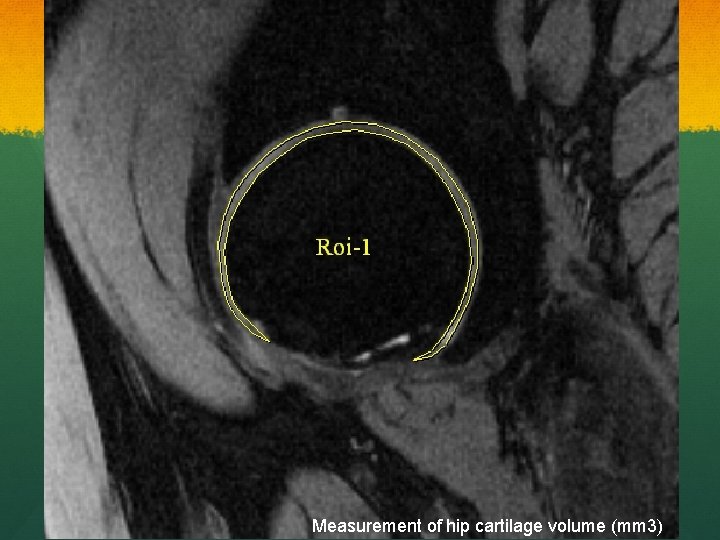
Measurement of hip cartilage volume (mm 3)
Results I Age 66. 8+/-7. 4 years (healthy) 59. 5+/-7. 6 years (OA) p<0. 001 Females 55. 6% (healthy) 57. 9% (OA) p=0. 85 BMI 27. 6+/-4. 8 kg/m 2 (healthy) 27. 2+/-4. 8 kg/m 2 (OA) p=0. 73
Results II Prevalence of BMLs at the Hip 17. 6% in asymptomatic population 63. 2% in OA population Risk Factors for BMLs Younger Age, p=0. 045 in asymptomatic group Not associated with gender or BMI
Results III BMLs and Osteoarthritis OR 5. 32, 95%CI 1. 78 -15. 9, p=0. 003 Adjusted for age, gender, BMI BMLs and lower Cartilage Volume -245. 7 mm 3 (95%CI -455. 5, -36. 0, p=0. 02) (total pop) -426. 6 mm 3 (95%CI -855. 2, 2. 14, p=0. 05) (OA group) Adjusted for age, gender, BMI, bone area, hip OA
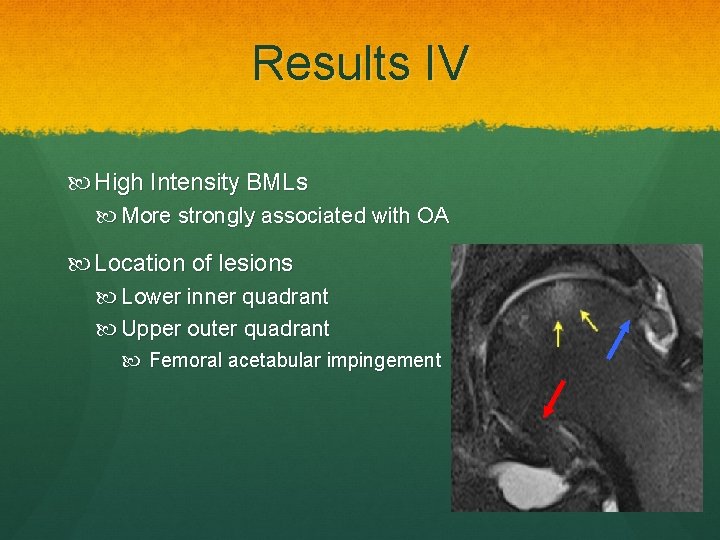
Results IV High Intensity BMLs More strongly associated with OA Location of lesions Lower inner quadrant Upper outer quadrant Femoral acetabular impingement
Discussion BMLs common at hip joint in those with OA Also present in asymptomatic Associated with reduced hip cartilage volume Comparable to knee BMLs 17. 6% (hip) v 13. 1 -14. 9% (knee) in asymptomatic population 63. 2% (hip) vs 46. 9 -66% (knees) in OA group Significantly associated with OA Significantly associated with structural damage Younger age is a risk factor ? Low grade trauma
Limitations Cross-sectional Need longitudinal data Small sample size of OA group Narrow Age Range Effect of physical Activity
Conclusions BMLs are associated with hip OA BMLs at hip may provide a novel target for the treatment and prevention of hip OA

Thanks to Rheumatology Research Team Flavia Cicuttini, Yuanyuan Wang, Anita Wluka, Fahad Hanna Summer Project Coordinators Jayamini Illesinghe, Basia Diug SPHPM
- Slides: 19