
HINT A New Way to Measure Computer Performance

- Slides: 44
HINT: A New Way to Measure Computer Performance John L. Gustafson and Quinn. O. Snell In Proceedings of the Fifth Annual Hawaii International Conference on System Sciences (HICSS) 1995 1
Introduction (1 of 2) • Early computers had single instruction • • 2 stream Floating-point operations took longest Thus, computer with higher flops per second would be faster Wasn’t linear (doubling flop/s didn’t quite halve execution time) but predictions were in the “right direction” It doesn’t work anymore…
Introduction (2 of 2) • Most algorithms do more “data motion” than arithmetic – And data motion is often the bottleneck • Growing rift in nominal speed (as • determined by MIPS or MFlop/s) and actual application speed Using memory bandwidth figures (say, in Mbytes/sec) too simplistic – Each memory layer (registers, primary cache, 2 nd-ary cache, main memory, disk …) has its own size and speed – Parallel memories make this problem worse 3
Outline • Introduction • Problems • HINT • Net QUIPS • Examples 4
Failure of Other “Speed” Measures - SPEC • SPEC (http: //www. spec. org/) – Is popular – Not independent (is a consortium) – Has to be revised when “too small” for workstations – Uses geometric ratio of the time reduction of various kernels • Compare to base machine (was VAX-11/780) – But some VAX-11/780 have SPEC mark of 3! • System variances cause performance variances 5 – “Survives because lack of credible alternatives”
Failure of Other “Speed” Measures - PERFECT • PERFECT – Benchmark suite – Has 100, 000 lines of (semi-) standard FORTAN – Not widely used since converting the application is difficult – Results available only for a handful of systems 6
How to Measuring Computer Speed? • Traditional measures of computer performance have little resemblance to other human endeavor fields – Meters per second and reaction rate are “hard currency” for measuring speed that is easily understood • But at a loss for performance for method • 7 of computing Only agreed measure is time – So fix problem (work) and run on different computers and see what is faster – speed is work/time
Work, Work • But, since “work” is hard to define, keep it constant and measure relative speeds – Dividing one speed by another cancels numerator (work) and leaves ratios of time – Avoids definition of work • Fixing program (work) problematic, since increased performance can attack larger problems or get better quality answer – Users scale job to fit time to wait – Ex: You don’t purchase 1000 -processor systema to do same job in 1/1000 th of the time! 8
Possible Measures of Speed? (1 of 2) • VAX unit of performance – But, as SPEC shows, can vary by at least 3 • Mflop/sec – No standard “floating point operation” since different computers have different errors – No measure of how much progress on computation, only what was done – Ex: analogous to measuring speed of human runner by counting footsteps per second, ignoring how large the footsteps are 9
Possible Measures of Speed? (2 of 2) • MHz – Universal indicator of speed for PCs • Ex: 3. 2 GHz computer faster than 2. 0 GHz – But if memory and hard-disk speeds are bottleneck, slower computer (2. 0 GHz) can sometimes run faster than faster computer (3. 2 GHz) – Analogous to noting largest car speedometer number and inferring performance • Solution? Definition of computational work where there is a quality of an answer 10 – Quality Improvement per Second (QUIPS)
The Precedent of SLALOM (1 of 3) • SLALOM (Scalable, Language-independent, Ames Laboratory, One-minute Measurement) – – Fixed time of radiosity 1 at one minute Asked how accurate an answer Any answer, any architecture Good because vendors could scale problem to power available could show powersolving ability To find the equilibrium radiation inside a box made of diffuse colored surfaces. The faces are divided into regions called "patches, " the equations that determine their coupling are set up, and the equations are solved for red, green, and blue spectral components. 1 11
The Precedent of SLALOM (2 of 3) • Troubles – Answer is “patches” (number of areas that geometry is divided into) • ignores roundoff errors – Complexity was n 3, n is number of patches • Published advances put this at n 2 • Then, nlog(n) method so hard to compare – Ease of use is one advantage of benchmark • Otherwise, just run target application! – SLALOM was 1000 lines, then 8000 lines (nlogn version) • parallelization took 1 graduate student year 12
The Precedent of SLALOM (3 of 3) • Troubles (continued) – Was “forgiving” of machines with inadequate memory bandwidth – Did not run for 1 minute on computers with insufficient memory compared with arithmetic speed – Conversely, computers with large memories could not take advantage of their memory • Large memory related to application performance, even if not “speed” 13
Outline • Introduction • Problems • HINT • Net QUIPS • Examples 14
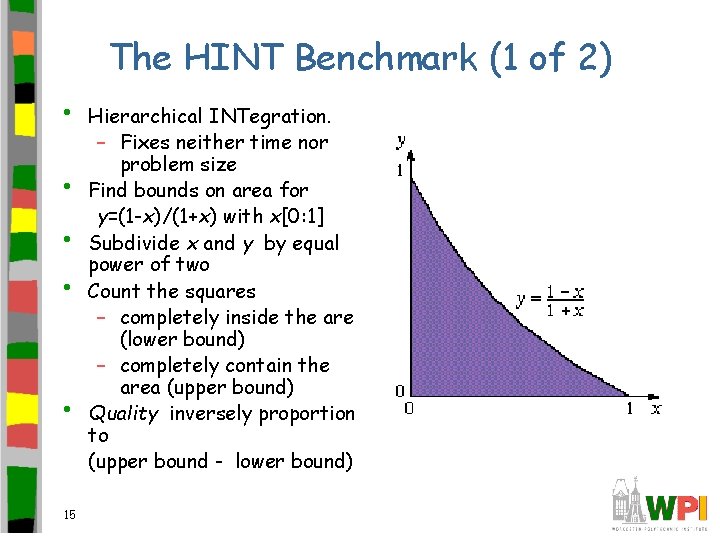
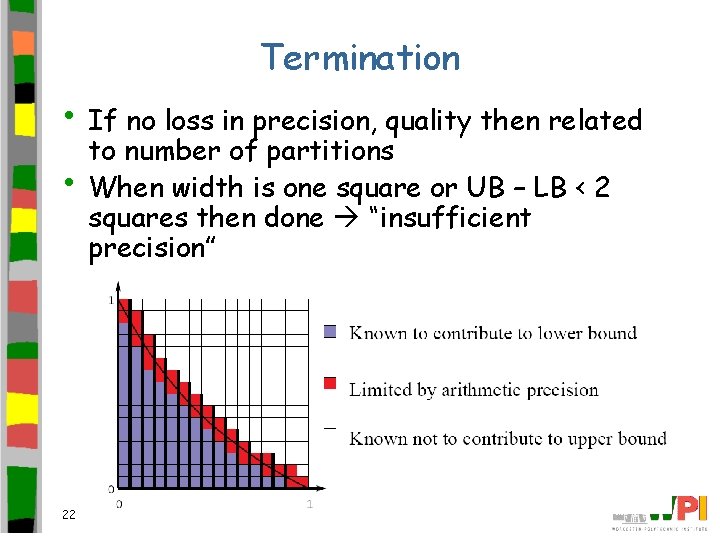
The HINT Benchmark (1 of 2) • • • 15 Hierarchical INTegration. – Fixes neither time nor problem size Find bounds on area for y=(1 -x)/(1+x) with x[0: 1] Subdivide x and y by equal power of two Count the squares – completely inside the area (lower bound) – completely contain the area (upper bound) Quality inversely proportional to (upper bound - lower bound)
The HINT Benchmark (2 of 2) • • • 16 Obtain highest quality answer in least amount of time Quality increases as a step function of time Maintain a queue of intervals in memory to split Split the intervals into subdivisions in order of largest removable error Calculate removable error for each subdivision Sort the resulting smaller errors into the queue
Why this HINT? • Proof (not shown) that hierarchical • integration shows linear improvement Tries to capture adaptive methods used by many applications – Find largest contributor to error and refine • Benchmarks must have mathematically sounds results 17
HINT Details • Adjusts to precision available – Unlimited scalability in that no mathematical upper limit on quality – Only limit is precision, memory, speed of computer • Lower limit is extremely low – About 40 operations give quality of 2. 0 • A human can get that in a few seconds • Quality attained in order N for order N storage and order N operations – Scaling is linear – (Show q 1 memory graph) 18
HINT Example (1 of 3) • Given word size bd bits, x-axis represented by bd/2 bits, yaxis bd/2 bits – Ex: d = 8 bits, so x-axis [0: 15], y-axis [0: 15] • If nx and nx are numbers of area units along x, y then – Compute (1 -x)/(1+x) as ny(nx-i)/(nx+i) – Rounding up will be used for upper bound – Rounding down will be used for lower bound • Then divide by ny (Example with numbers next) 19
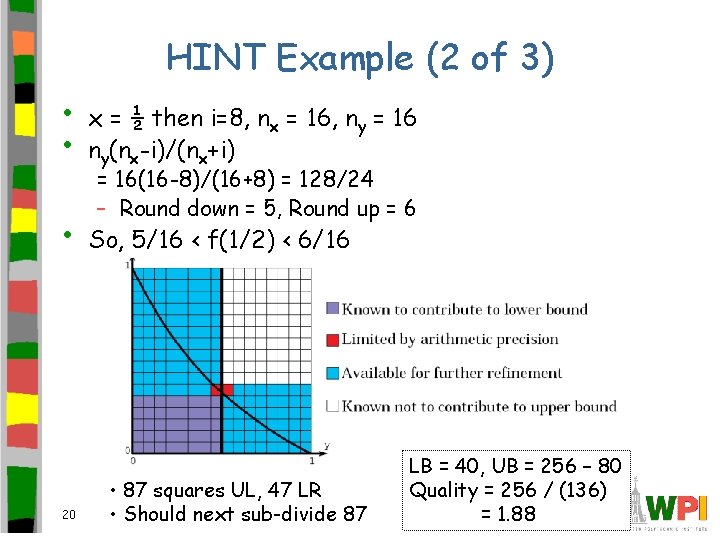
HINT Example (2 of 3) • • x = ½ then i=8, nx = 16, ny = 16 ny(nx-i)/(nx+i) • So, 5/16 < f(1/2) < 6/16 20 = 16(16 -8)/(16+8) = 128/24 – Round down = 5, Round up = 6 • 87 squares UL, 47 LR • Should next sub-divide 87 LB = 40, UB = 256 – 80 Quality = 256 / (136) = 1. 88
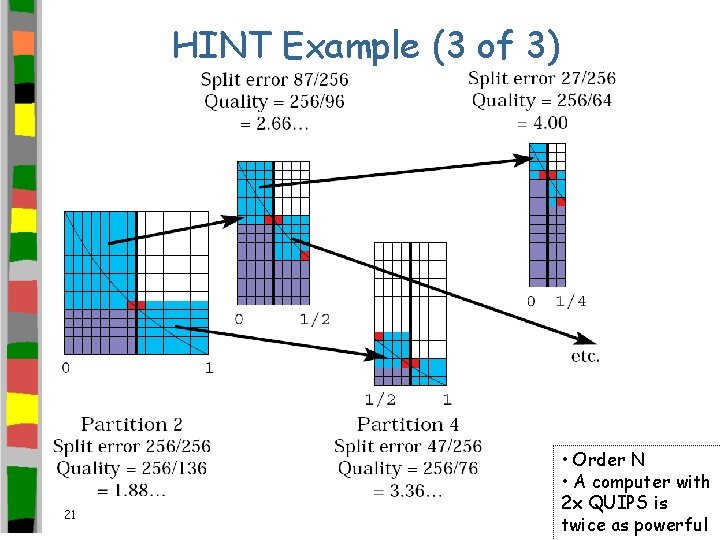
HINT Example (3 of 3) 21 • Order N • A computer with 2 x QUIPS is twice as powerful
Termination • If no loss in precision, quality then related • 22 to number of partitions When width is one square or UB – LB < 2 squares then done “insufficient precision”
Memory Requirements • Must compute and store record of upperlower bounding rectangle for each region – Left and right x values xl, xr – UB and LB • If bd bits for data and bi bits for index – n iterations is (9 bd +4 bi)n bits • Note, program storage varies widely but should not be bottleneck – If want to stress instruction caching, do not use HINT 23
Data Types • Can use floating points instead of integers – Roughly, 40 Flops per HINT iteration • Computers have roughly same QUIPS for different data types – But specialized may do better. • Ex: scientific may have better QUIPS for floating point while business may have better QUIPS for integer 24
Memory vs. Instructions HINT kernel for a conventional processor reveals: • • • Index operations: 39 adds or subs 16 fetches or stores 6 shifts 3 conditional branches 2 multiplies • • • Data operations 69 fetches or stores 24 adds or subs 10 multiplies 2 conditional branches 2 divides • Roughly, 20 -90 bytes of memory per iteration • So, about a 1 -to-1 ratio of operations to storage • Other benchmarks operation-intensive but stressing memory needed 25 • Shows up when page to disk
Anticipated Objections to HINT (1 of 5) • No benchmark can predict the performance of every application – True. – Maintain that memory references dominate most applications • HINT measures memory reference capacity as well as operation speed 26
Anticipated Objections to HINT (2 of 5) • It’s only a kernel, not a complete application – Not true. – Most kernels are pieces of code (ie- dot product or matrix multiply) – Usually, measure number of iterations • HINT is miniature, standalone scalable application – Measures work in quality of answer, not what is done to get there – Unlikely hardware could improve HINT performance without improving app perf 27
Anticipated Objections to HINT (3 of 5) • QUIPS are just like Mflop/s; they are nothing new – Can translate Whetsontes to Mflop/s, SPECmarks to Mflop/s and LINPACK times to Mflop/s – QUIPS cannot be so translated • Not proportional to operations once precision begins to show 28 – Ex: a vector or parallel computer will have to do more computations to equal the quality – Traditional benchmark gives credit, even if work did not help quality – Plus, can get high quality without flops
Anticipated Objections to HINT (4 of 5) • This will just measure who has the cleverest mathematicians or trickiest compilers – Not true. – HINT is not amenable to algorithmic “cleverness” • Already O(N) and cannot use knowledge of function – Compiler optimizations don’t help much, even with hand-coded assembler 29
Anticipated Objections to HINT (5 of 5) • For parallel machines, the only communication is in the sum collapse – True. – But this “diameter” is representative of algorithms that are limited by synch costs, global costs, master-slave… – “We challenge anyone to find a more predictive test of parallel communication that is this simple to use” 30
Outline • Introduction • Problems • HINT • Net QUIPS • Examples 31
In Quest of a Single Number Rating • Tug-of-War between distributors of data and interpreters of data – Distributors produce lots of data showing different facets of measurements – Interpreters want one number to answer “How good is it? ” • So, QUIPS vs. time or QUIPS vs. memory • 32 will be distilled Have devised a method Net QUIPS
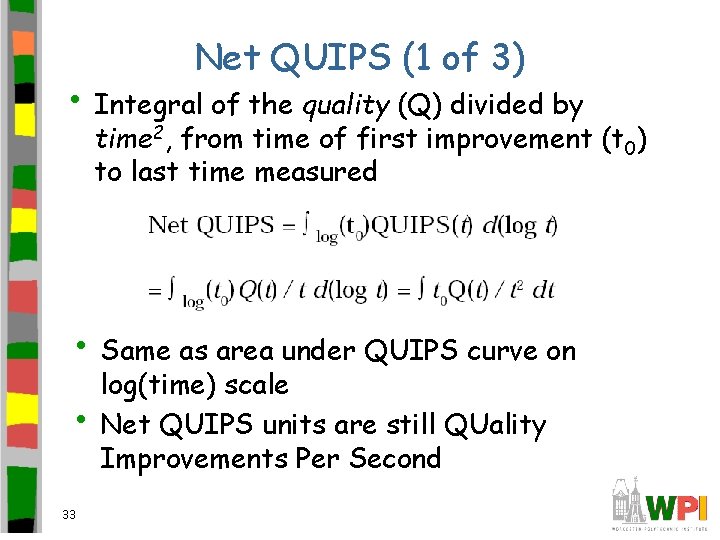
Net QUIPS (1 of 3) • Integral of the quality (Q) divided by time 2, from time of first improvement (t 0) to last time measured • Same as area under QUIPS curve on • 33 log(time) scale Net QUIPS units are still QUality Improvements Per Second
Net QUIPS (2 of 3) • More memory or more cache, then QUIPS high for larger range of time – Net QUIPS higher • Improved precision lifts overall Q – Net QUIPS higher • Lack of interruptions (say, OS) – Net QUIPS higher • Philosophically, Net QUIPS totals QUIPS weighted inversely with time to get there 34
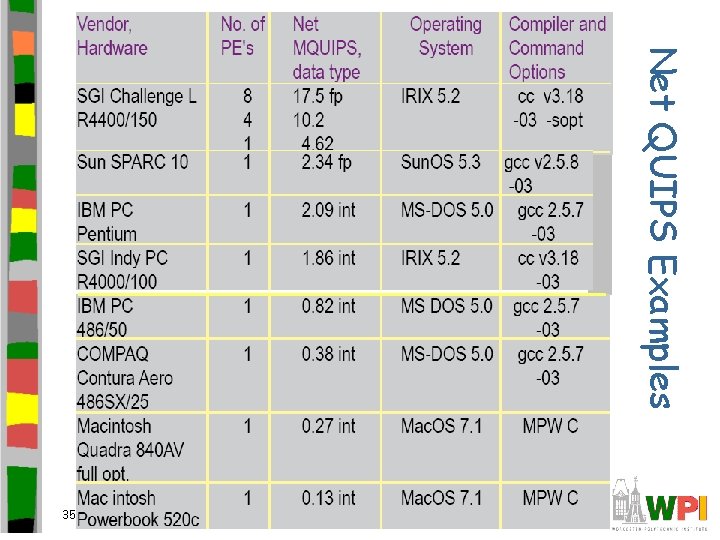
Net QUIPS Examples 35
Net QUIPS (3 of 3) • Hopefully, users can interpret QUIPS • versus time and not use Net QUIPS Can be used to make “speedup” plots for multiprocessors – Shows not quite linear with number of processors, which is common in practice • Can be used for humans, too – College-educated adults have about 0. 1 QUIPS – Humans increase precision dynamically as needed 36
Outline • Introduction • Problems • HINT • Net QUIPS • Examples 37
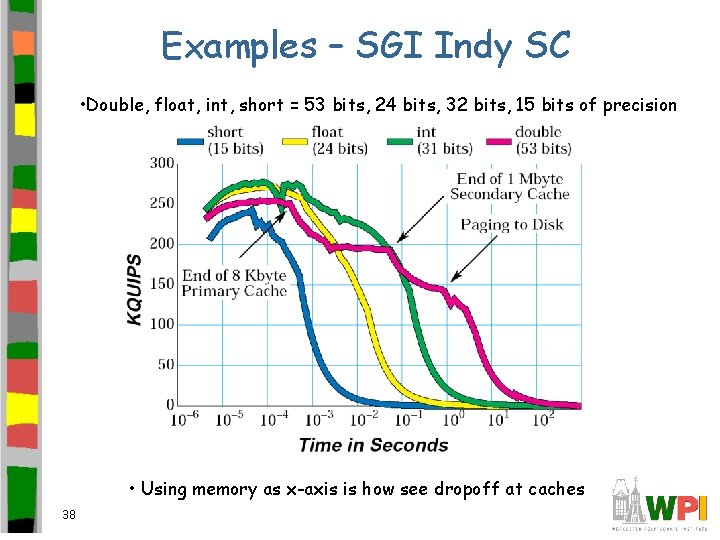
Examples – SGI Indy SC • Double, float, int, short = 53 bits, 24 bits, 32 bits, 15 bits of precision • Using memory as x-axis is how see dropoff at caches 38
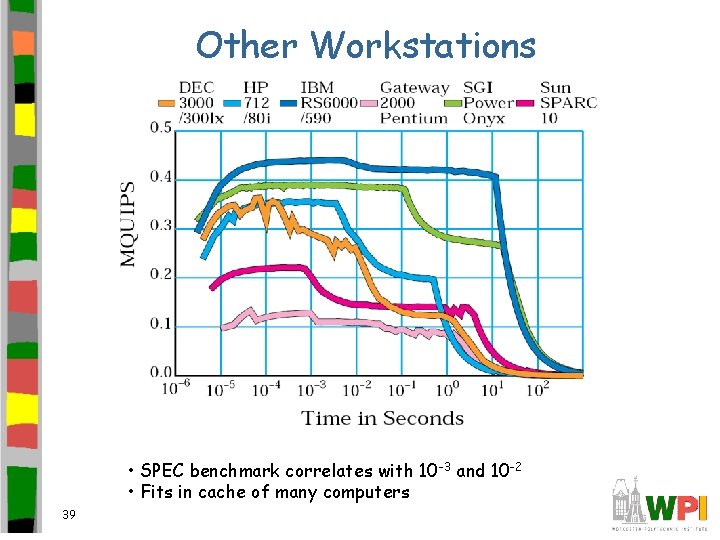
Other Workstations • SPEC benchmark correlates with 10 -3 and 10 -2 • Fits in cache of many computers 39
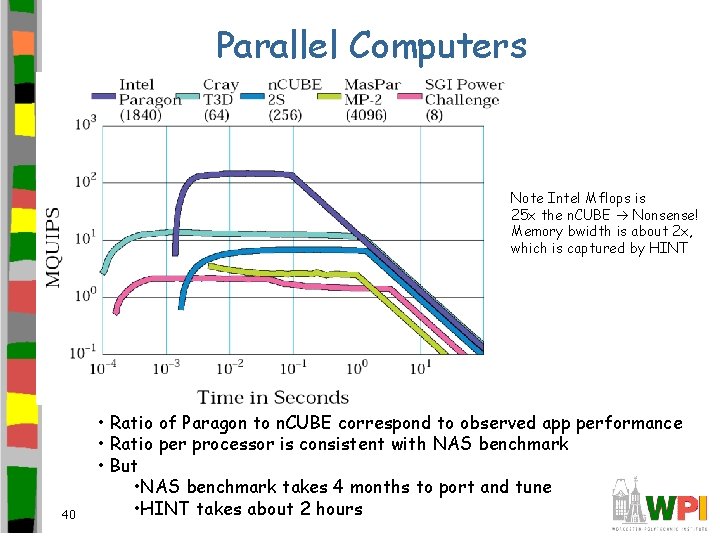
Parallel Computers Note Intel Mflops is 25 x the n. CUBE Nonsense! Memory bwidth is about 2 x, which is captured by HINT 40 • Ratio of Paragon to n. CUBE correspond to observed app performance • Ratio per processor is consistent with NAS benchmark • But • NAS benchmark takes 4 months to port and tune • HINT takes about 2 hours
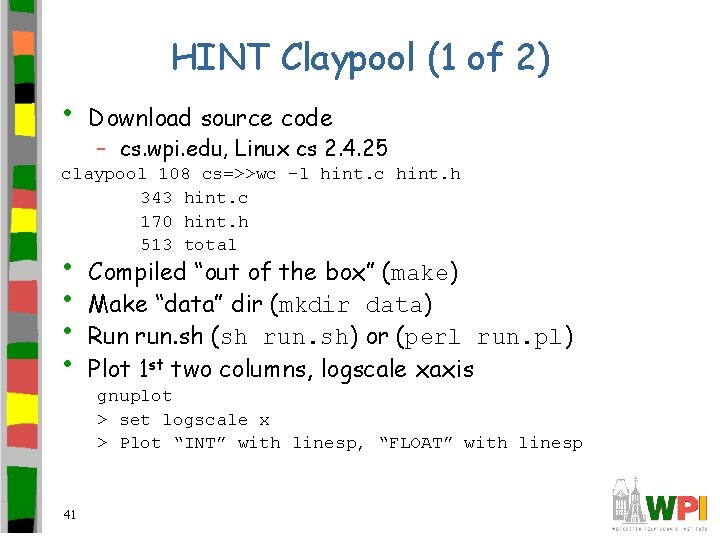
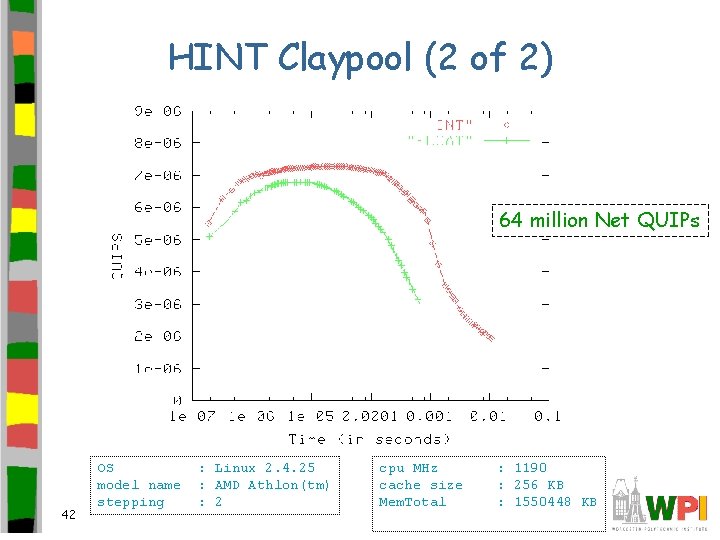
HINT Claypool (1 of 2) • Download source code – cs. wpi. edu, Linux cs 2. 4. 25 claypool 108 cs=>>wc -l hint. c hint. h 343 hint. c 170 hint. h 513 total • • 41 Compiled “out of the box” (make) Make “data” dir (mkdir data) Run run. sh (sh run. sh) or (perl run. pl) Plot 1 st two columns, logscale xaxis gnuplot > set logscale x > Plot “INT” with linesp, “FLOAT” with linesp
HINT Claypool (2 of 2) 64 million Net QUIPs 42 OS model name stepping : Linux 2. 4. 25 : AMD Athlon(tm) : 2 cpu MHz cache size Mem. Total : 1190 : 256 KB : 1550448 KB
Extra Credit for Next Class • Run HINT on machine of your choice – Download code from http: //hint. byu. edu/pub/HINT/source/ • QUIPS Graph (ala previous slides) – INT, FLOAT or other … • Report – Net QUIPS (returned by software) – CPU, OS, Memory • Email to me and we’ll discuss, build a modern Net QUIPS table 43
Conclusions • HINT is designed to last • Fair comparisons over extreme variations in • • • 44 computer arch, storage capacity, precision Linear in answer quality, memory usage and operations Low cost to convert Speed measure that is as pure and “information-theoretic” as possible, yet practical and useful predictor of app performance