
Hinduism Origin Founders 3000 BCE older than Judaism
Hinduism
Origin / Founders • ~3000 BCE (older than Judaism) • Religion derives from the mixing of indigenous cultural practices • No one specific founder or date; developed over long period of time
Deities & Sacred Writings • Monotheistic • Over 1 million expressions of Brahman • TRIMURTI: the 3 main aspects of Brahman (the ultimate reality) • *Brahma (creator) • *Vishnu (preserver) • *Shiva (destroyer) • Writings: Veda, Epics & Upanishads
Beliefs / Practices • SAMSARA: series of life, death, rebirth (reincarnation) • Goal: • achieve MOKSHA (break cycle of samsara) • At this point your ATMAN (soul) joins Brahman • KARMA – your actions in this life determine your position in the next • DHARMA – duties for your station in life “Do your DHARMA to create good KARMA”
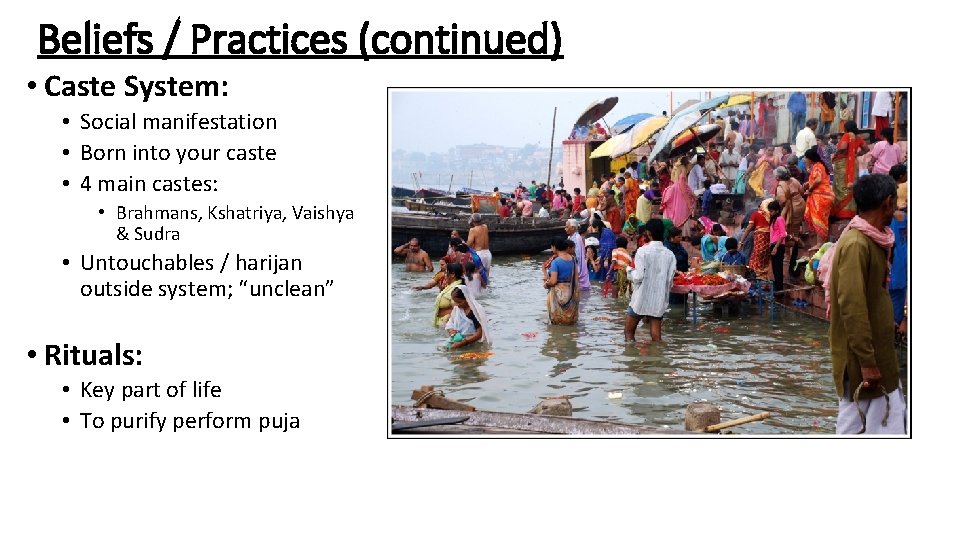
Beliefs / Practices (continued) • Caste System: • Social manifestation • Born into your caste • 4 main castes: • Brahmans, Kshatriya, Vaishya & Sudra • Untouchables / harijan outside system; “unclean” • Rituals: • Key part of life • To purify perform puja
Buddhism
Origin / Founders • 525 BCE • Siddhartha Gautama – prince, but unsatisfied with life; set out searching for way to end suffering; became the Buddha, or “Enlightened One” • 2 main branches in South Asia (Theravada and Mayahana) spreads to E. Asia (more prevalent there)
Deities & Sacred Writings • No creator • Human spirit is divine, but no real deity • Key writings are in 2 different languages -> split into two main branches, but no sacred texts • Most teachings passed down orally
Beliefs / Practices • Reincarnation • Goal: seek enlightenment and achieve NIRVANA (word literally means ‘stop’) • To do this you follow the • Four Noble Truths
Beliefs / Practices (continued) • Four Noble Truths: 1. Life is suffering (b/c the wheel is out of balance) 2. Suffering is caused by desire 3. To end suffering, desire must be stopped 4. way to end desire is to follow the Eightfold Path
Beliefs / Practices (continued) • Eightfold Path: right living, right thought, right desire, right speech, right action, understanding, right effort, mindfulness and concentration
Stupas (India or SE Asia) Pagoda (East Asia) • Built for a variety of reasons, Buddhist stupas are classified based on form and function into five types: • Relic stupa, in which the relics or remains of the Buddha, his disciples and lay saints are interred. • Object stupa, in which the items interred are objects belonged to the Buddha or his disciples such as a begging bowl or robe, or important Buddhist scriptures. • Commemorative stupa, built to commemorate events in the lives of Buddha or his disciples. • Symbolic stupa, to symbolize aspects of Buddhist theology • Votive stupa, constructed to commemorate visits or to gain spiritual benefits, usually at the site of prominent stupas which are regularly visited.
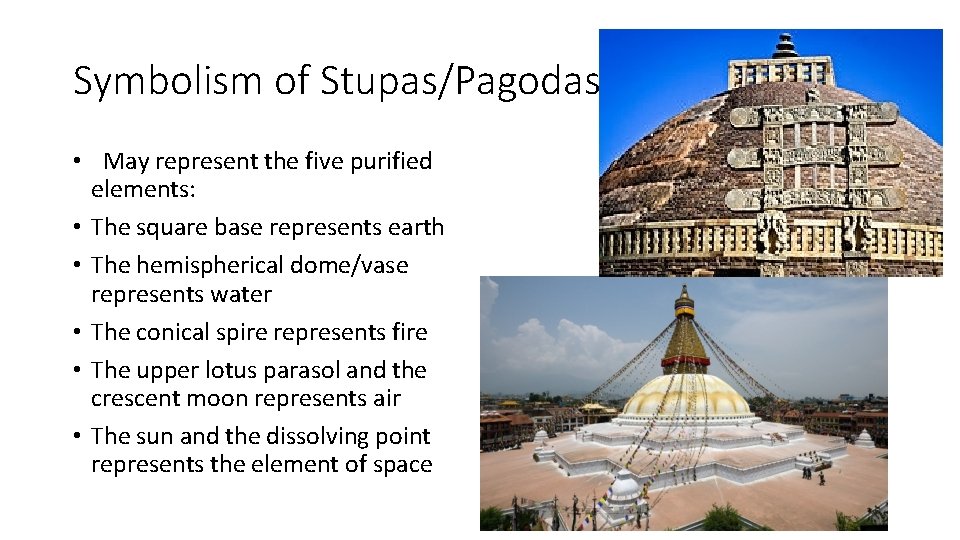
Symbolism of Stupas/Pagodas • May represent the five purified elements: • The square base represents earth • The hemispherical dome/vase represents water • The conical spire represents fire • The upper lotus parasol and the crescent moon represents air • The sun and the dissolving point represents the element of space
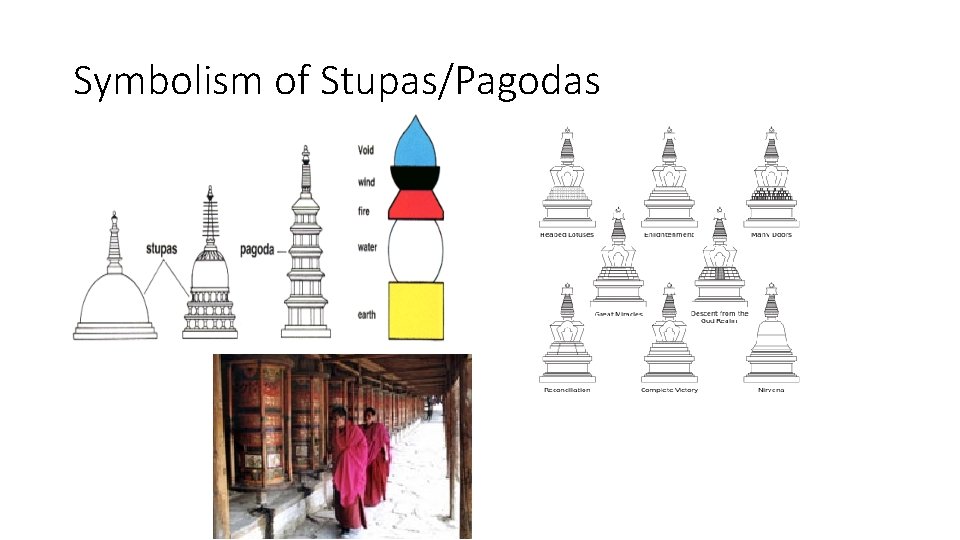
Symbolism of Stupas/Pagodas
- Slides: 14