
Hinduism Oldest organized religion on earth at least

- Slides: 22
Hinduism Oldest organized religion on earth (at least 4000 + years old) Aryans bring their religion to India when they conquer subcontinent @ 1000 BC political and social organizations of Aryan invaders and native civilizations slowly change and evolve into Hinduism
Hinduism Roots of Hindu thought and philosophy are in the VEDAS The Vedas are a collection of hymns, legends and epic poems of deeds of Aryan warriors and heroes Collected and organized by priests and penned in written form of Aryan sanskrit language Vedas form the basis of Hindu religious practices and social codes The RIG VEDA is world’s oldest religious text
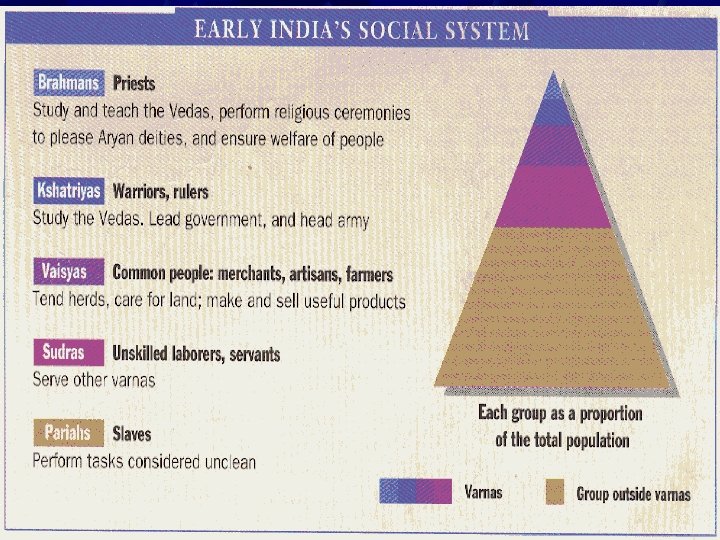
Hinduism – texts (cont) VEDAS outline the Hindu concept of duty and religious law (DHARMA) One epic poem in particular, the BHAGAVAD GITA (a. k. a. “Song of the Lord”) expresses that duty through the story of the hero Arjuna The Vedas also break down Indian society into separate classes, or CASTES The concept of DHARMA involves living and acting in proper manners for your sex, age and caste
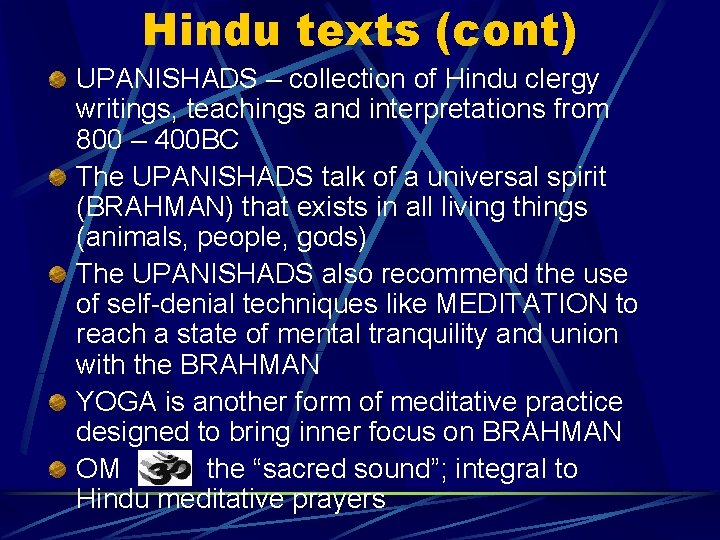
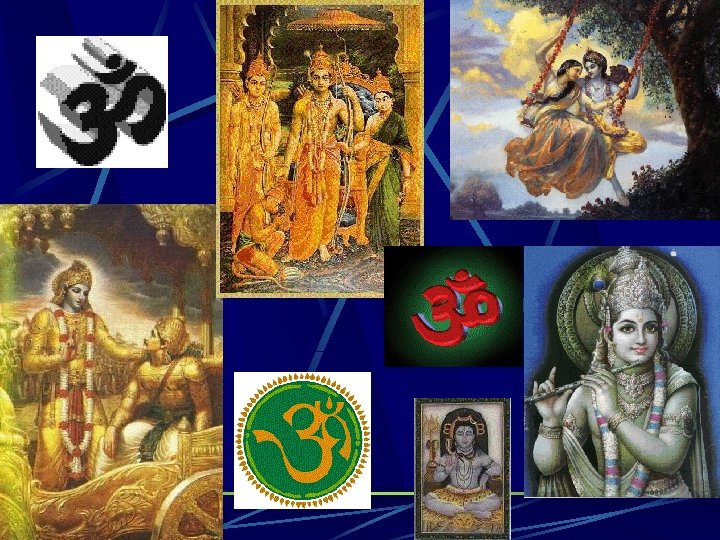
Hindu texts (cont) UPANISHADS – collection of Hindu clergy writings, teachings and interpretations from 800 – 400 BC The UPANISHADS talk of a universal spirit (BRAHMAN) that exists in all living things (animals, people, gods) The UPANISHADS also recommend the use of self-denial techniques like MEDITATION to reach a state of mental tranquility and union with the BRAHMAN YOGA is another form of meditative practice designed to bring inner focus on BRAHMAN OM the “sacred sound”; integral to Hindu meditative prayers
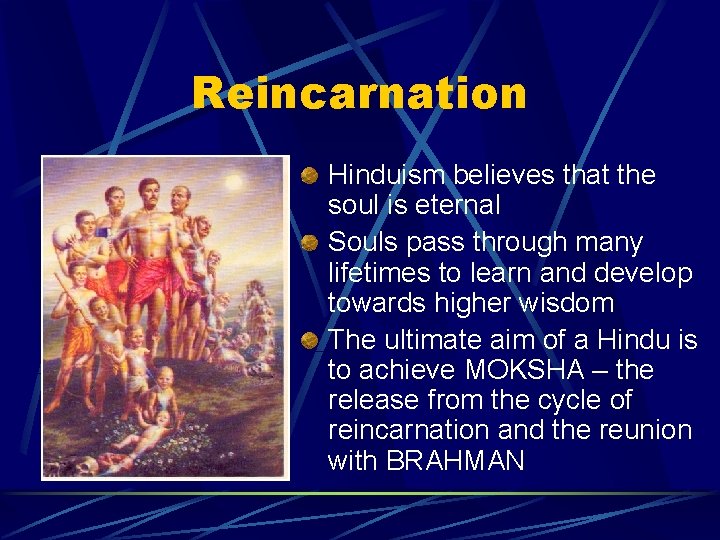
Reincarnation Hinduism believes that the soul is eternal Souls pass through many lifetimes to learn and develop towards higher wisdom The ultimate aim of a Hindu is to achieve MOKSHA – the release from the cycle of reincarnation and the reunion with BRAHMAN
Hindu concepts To move towards union with Brahman, a Hindu must fulfill their DHARMA – proper role in life One must continue to build up good KARMA – the actions and thoughts in this life that determine the form you will take in the next life Part of building up good KARMA involves living by the concept of AHIMSA – nonviolence to all living things Many Hindus are therefore vegetarians because animals have a soul too, so eating meat would go against AHIMSA and would build up bad KARMA
Hinduism - deities Hinduism is POLYTHEISTIC in that it has multiple gods, but all gods stem from the ultimate source BRAHMAN Hinduism contains hundreds of gods and demi-gods (even down to individual family gods) The main focus of Hindu deity worship is the TRIMURTI – the three major gods BRAHMA, VISHNU and SHIVA (personifications of BRAHMAN) Each of the TRIMURTI gods had many AVATARS – earthly forms designed to bring knowledge and wisdom through revelation of the sacred Hindu texts
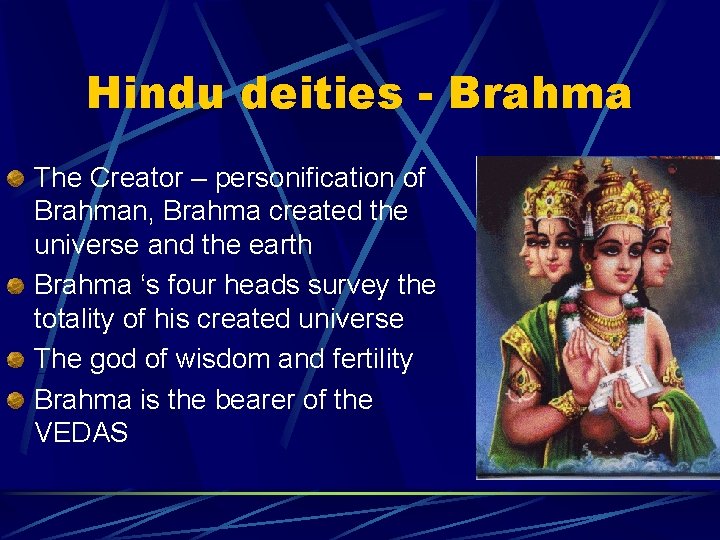
Hindu deities - Brahma The Creator – personification of Brahman, Brahma created the universe and the earth Brahma ‘s four heads survey the totality of his created universe The god of wisdom and fertility Brahma is the bearer of the VEDAS
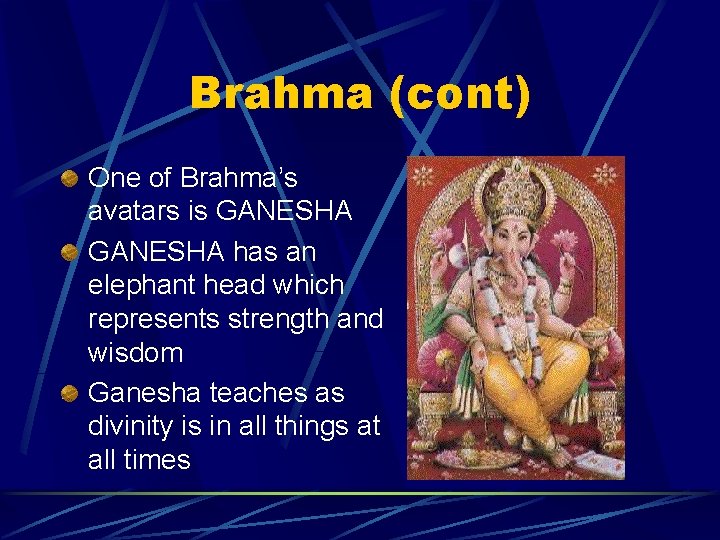
Brahma (cont) One of Brahma’s avatars is GANESHA has an elephant head which represents strength and wisdom Ganesha teaches as divinity is in all things at all times
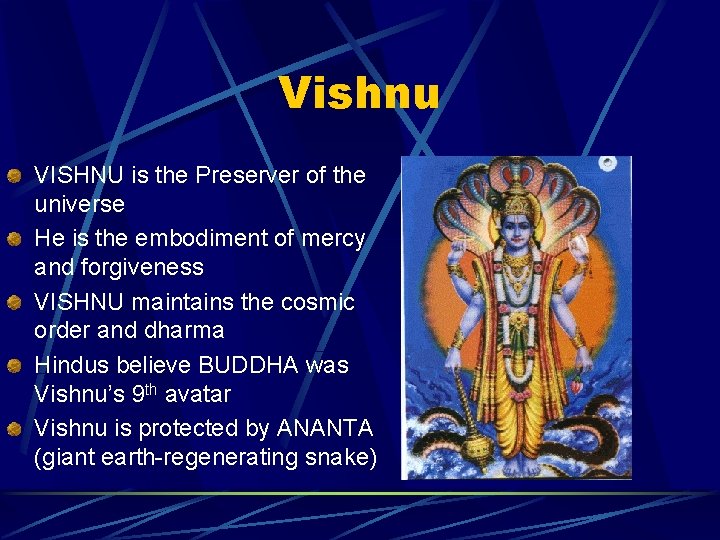
Vishnu VISHNU is the Preserver of the universe He is the embodiment of mercy and forgiveness VISHNU maintains the cosmic order and dharma Hindus believe BUDDHA was Vishnu’s 9 th avatar Vishnu is protected by ANANTA (giant earth-regenerating snake)
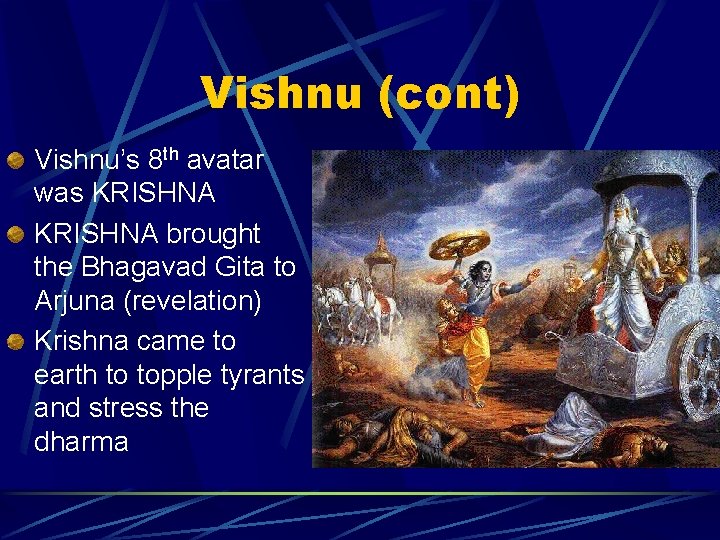
Vishnu (cont) Vishnu’s 8 th avatar was KRISHNA brought the Bhagavad Gita to Arjuna (revelation) Krishna came to earth to topple tyrants and stress the dharma
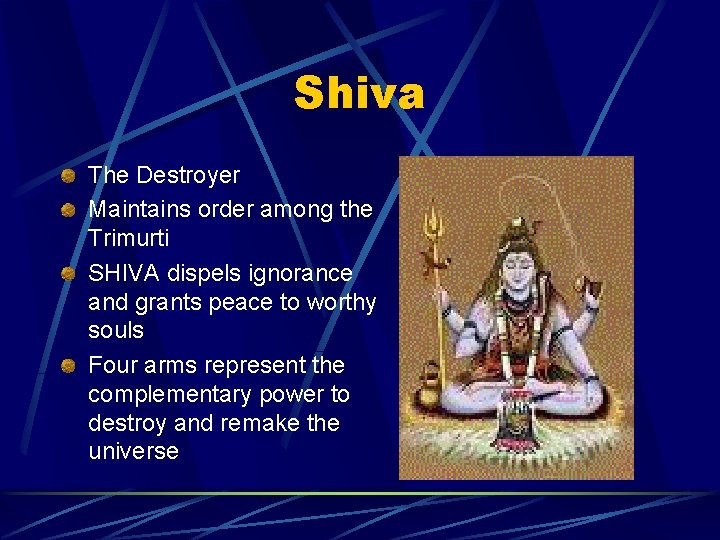
Shiva The Destroyer Maintains order among the Trimurti SHIVA dispels ignorance and grants peace to worthy souls Four arms represent the complementary power to destroy and remake the universe
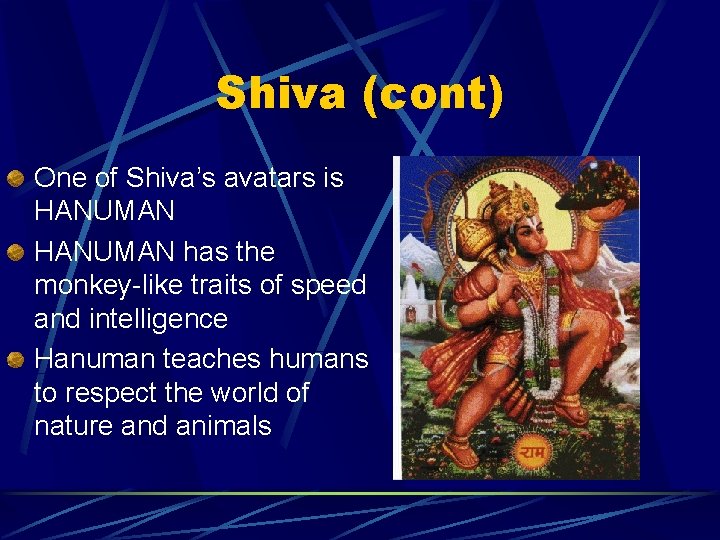
Shiva (cont) One of Shiva’s avatars is HANUMAN has the monkey-like traits of speed and intelligence Hanuman teaches humans to respect the world of nature and animals
Hinduism is practiced differently across India and has spawned three other faiths BUDDHISM accepts many concepts from Hinduism but rejects the focus on one supreme external god and the Hindu caste system JAINISM similarly rejects the rigid social structure and self-sacrificial activity of Hinduism; Jainism places special emphasis on the practice of ahimsa SIKHISM is a relatively new faith (@ 500 years old) and combines elements of Hinduism and Islam; Sikhs are monotheists and believe in equality of the sexes
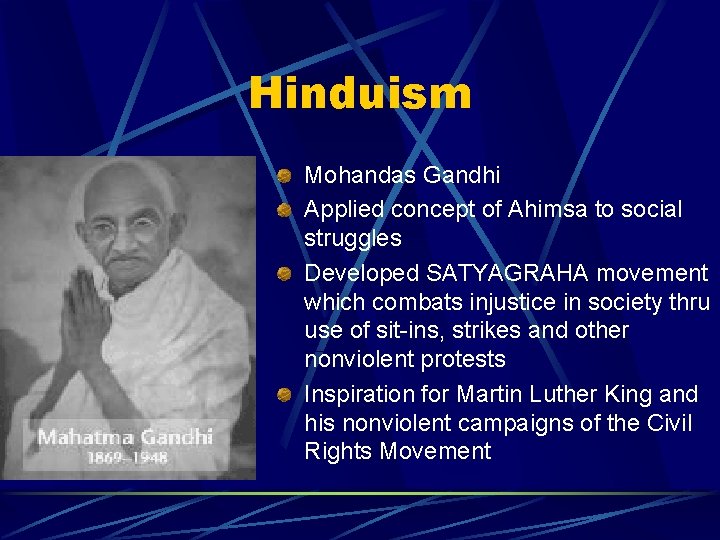
Hinduism Mohandas Gandhi Applied concept of Ahimsa to social struggles Developed SATYAGRAHA movement which combats injustice in society thru use of sit-ins, strikes and other nonviolent protests Inspiration for Martin Luther King and his nonviolent campaigns of the Civil Rights Movement
Buddhism Stems from teachings of Siddharta Gautama in 5 th century BC India Rejects strict social codes of Hinduism but accepts much of its ethical codes Four Noble Truths l l Life is suffering Suffering is caused by attachment Freedom from attachment is cure for suffering Way out of suffering is by following the 8 Fold Path
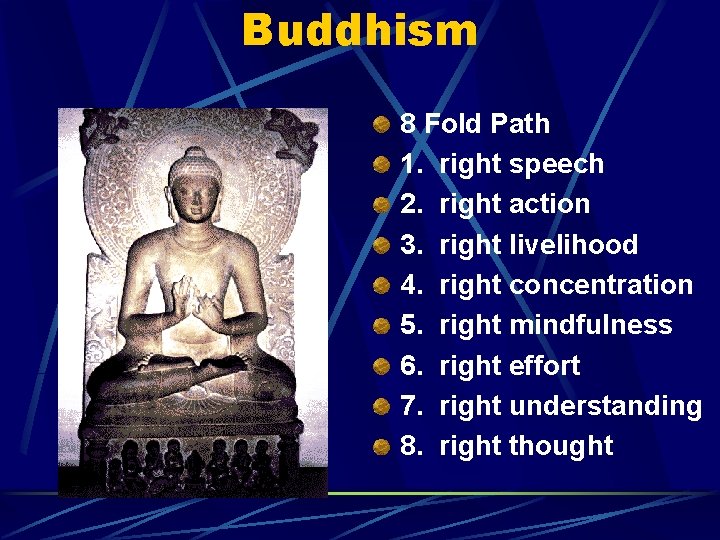
Buddhism 8 Fold Path 1. right speech 2. right action 3. right livelihood 4. right concentration 5. right mindfulness 6. right effort 7. right understanding 8. right thought
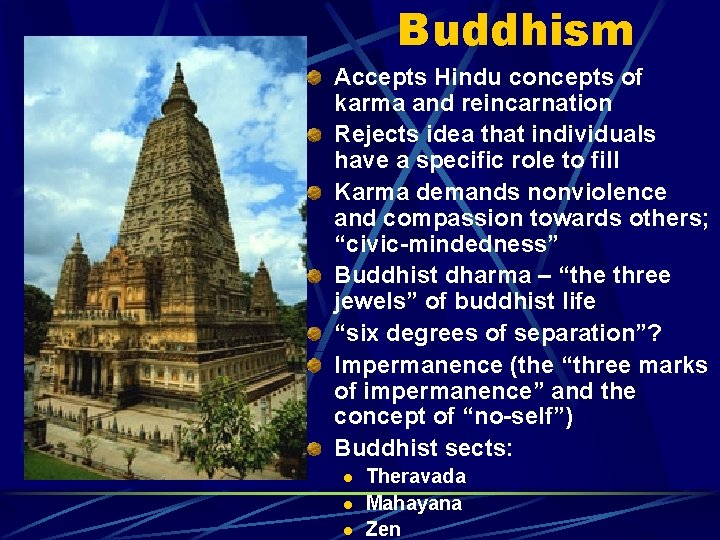
Buddhism Accepts Hindu concepts of karma and reincarnation Rejects idea that individuals have a specific role to fill Karma demands nonviolence and compassion towards others; “civic-mindedness” Buddhist dharma – “the three jewels” of buddhist life “six degrees of separation”? Impermanence (the “three marks of impermanence” and the concept of “no-self”) Buddhist sects: l l l Theravada Mahayana Zen
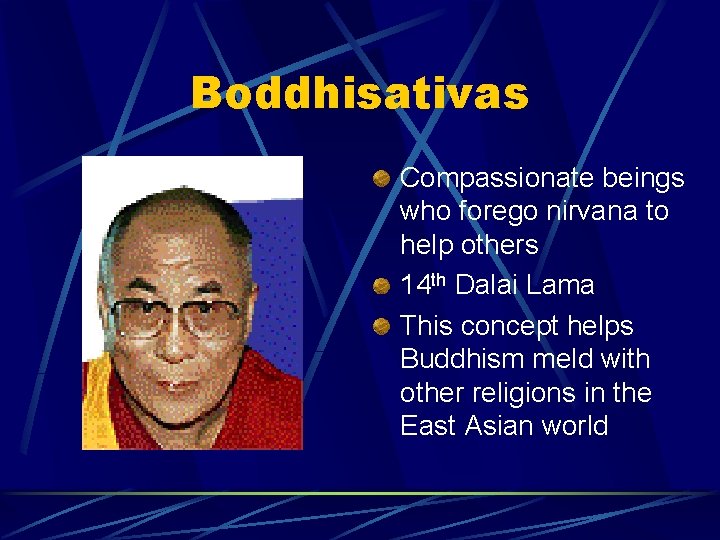
Boddhisativas Compassionate beings who forego nirvana to help others 14 th Dalai Lama This concept helps Buddhism meld with other religions in the East Asian world