
Hinduism Notes 1 Brahmanism Religion had been an
Hinduism Notes 1
Brahmanism �Religion had been an important part of Aryan life even before the Aryans moved to India �Eventually, in India, religion took on even more meaning �Because Aryan priests were called Brahmins, their religion is often called Brahmanism 2
The Caste System �*According to the Vedas, there were four main varnas, or social divisions, in Aryan society These varnas were: �Brahmins– priest �*Kshatriyas – Rulers and Warriors �Vaisyas– farmers, crafts people, and traders �*Sudras –Workers, Servants, and non-Aryans �*The Brahmins were seen as the Highest ranking because they performed rituals for the gods �*This gave the Brahmins great influence over 3 the other varnas
Caste Rules �To keep their classes distinct, the Aryans developed SUTRAS , or guides, which listed all the rules of the caste system ◦ For example, people were not allowed to marry anyone from a different caste ◦ It was even forbidden for people from one class to eat with people from another �People who broke the caste rules could be Kicked Out from their homes and their castes, which would make them untouchables �Because of these rules, people spent almost all of their time with others in their Own caste 4
5
Later Vedic Texts �Over the centuries, Aryan Brahmins wrote down their thoughts about the Vedas �In time these thoughts were compiled into collections called Vedic texts �One collection of Vedic text describes Aryan religious rituals ◦ For example, it describes how sacrifices should be performed ◦ Priests placed animals, food, or drinks to be sacrificed in a fire ◦ The Aryans believed that the fire would carry these offerings to the gods 6
�A second collection of Vedic texts describes secret rituals that only certain people could perform ◦ In fact, the rituals were so secret that they had to be done in the forest, far for other people �The final group of Vedic texts are the Upanishads, most of which were written by about 600 BC ◦ These writings are reflections on the Vedas by religious students and teachers 7
Hinduism Develops �The Vedas, the Upanishads, and the other Vedic texts remained the basis of Indian religion for centuries �Eventually, however, the ideas of these sacred texts began to blend with ideas from other cultures �People from Persia and other kingdoms in Central Asia brought their ideas to India �In time, this blending of ideas created a religion called Hinduism ◦ Hinduism – the largest religion in India today 8
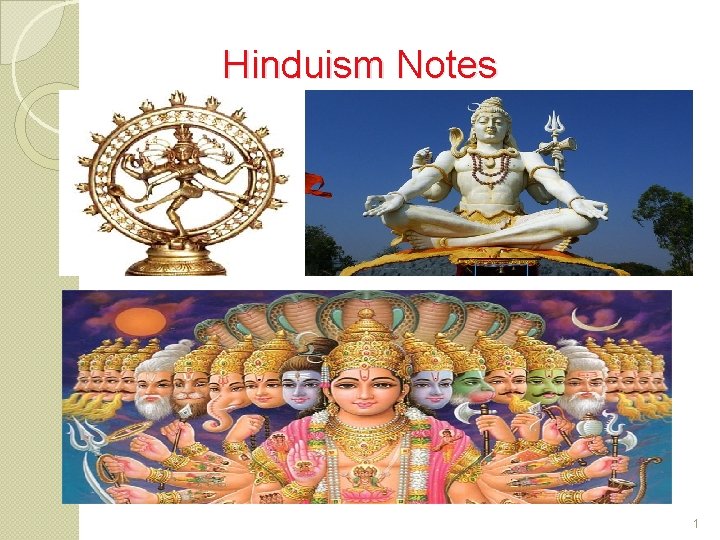
Hindu Beliefs �The Hindus believe in many gods �Among them are three major gods: Brahma the Creator, Siva the Destroyer, and Vishnu the Preserver �At the same time Hindus believe that each god is part of a single universal spirit called Brahman �They believe that Brahman created the world and preserves it �Gods like Brahma, Siva, and Vishnu represent different aspects of Brahman �In fact, Hindus believe that everything in the world is part of Brahman 9
Life and Rebirth �According to Hindu teachings, everyone has a soul, or atman, inside them �This soul holds the person’s personality, the qualities that make them who they are �Hindus believe that a person’s ultimate goal should be to reunite that soul with Brahman, the universal spirit �Hindus believe that their souls will eventually join Brahman because the world we live in is an illusion �Brahman is the only reality 10
�The Upanishads taught that people must try to see through the illusion of the world �Since it is hard to see through the illusions, it can take several lifetimes �That is why Hindus believe that souls are born and reborn many times, each time in a new body ◦ Reincarnation – the process of rebirth 11
Hinduism and the Caste System �According to the traditional Hindu view of reincarnation, a person who has died is reborn in a new physical form �The type of form depends upon his or her karma ◦ Karma – the effects that good or bad actions have on a person’s soul �Evil actions will build bad karma ◦ A person with bad karma will be born into a lower cast or life form �Good actions build good karma ◦ People with good karma are born into a higher caste in their next life 12
�In time, good karma will bring salvation, or freedom from life’s worries and the cycle of rebirth �This salvation is called moksha �Hinduism taught that each person had dharma, or set of spiritual duties, to fulfill �Fulfilling one’s dharma required accepting one’s station in life �By teaching people to accept their stations, Hinduism helped preserve the caste system 13
Groups React to Hinduism �Although Hinduism was widely following in India, not everyone agreed with its beliefs �Some unsatisfied people and groups looked for new religious ideas �Two such groups were the Jains, believers in a religion called Jainism and the Sikhs, believers in Sikhism 14
Jainism � Jainism is based on the teaching of a man named Mahavira, who is believed to have been born around 599 BC � Mahavira was raised as a Hindu � As an adult, he thought Hinduism put too much emphasis on rituals � Instead of rituals, his teachings emphasize four basic principles ◦ Injure no life ◦ Tell the truth ◦ Do not steal ◦ Own no property 15
�In their efforts not to injure anyone or anything, the Jains practice nonviolence ◦ Nonviolence – the avoidance of violent actions �The Sanskrit word for this nonviolence is ahimsa �The Jains’ emphasis on nonviolence comes from their belief that everything is alive and part of the cycle of rebirth �Jains are very serious about not injuring or killing any creature – humans, animals, insects, or even plants �They do not believe in animal sacrifice because they don’t want to hurt living creatures; Jains are vegetarians 16 �They do not eat any food that comes from animals
Sikhism �Founded centuries later than Jainism �Sikhism has its roots in the teaching of the Guru Nanak, who lived in the AD 1400 s �The title guru is Sanskrit for “teacher” �Nanak was raised a Hindu but grew dissatisfied with the religion’s teachings �He began to travel and came into contact with many other religions, including Islam �His teachings blended ideas from Hinduism with ideas from Islam and other religions �Over time, these teachings were explained and expanded by nine other gurus 17
�Sikhism is monotheistic �Sikhs believe in only one God, who has no physical form but can be sensed in the creation �For Sikhs, the ultimate goal is to be reunited with God after death �To achieve this goal, one must meditate to find spiritual enlightenment �Because they believe that achieving enlightenment may take several lifetimes, Sikhs also believe in reincarnation 18
�Sikhism teaches that people should live truthfully and treat all people equally, regardless of their gender, social class, or any other factor �Sikhs pray several times each day �They are expected to wear five items at all times as signs of tier religion: ◦ Long hair ◦ A small comb ◦ A steel bracelet ◦ A sword ◦ A special undergarment �In addition, all Sikh men wear turbans, as do many women 19
- Slides: 19