
HINDUISM AND BUDDHISM Thousands of years agotwo major
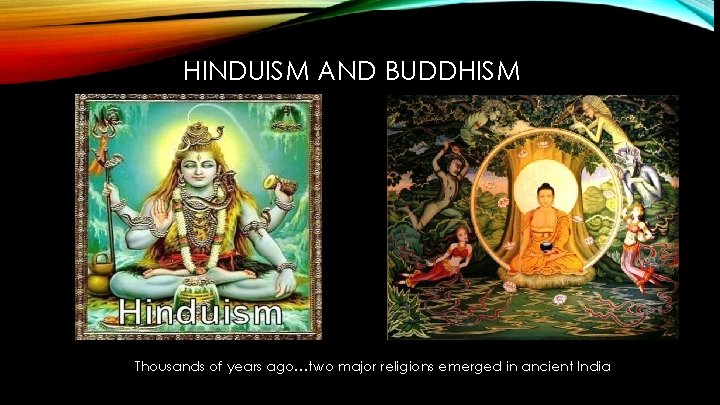
HINDUISM AND BUDDHISM Thousands of years ago…two major religions emerged in ancient India
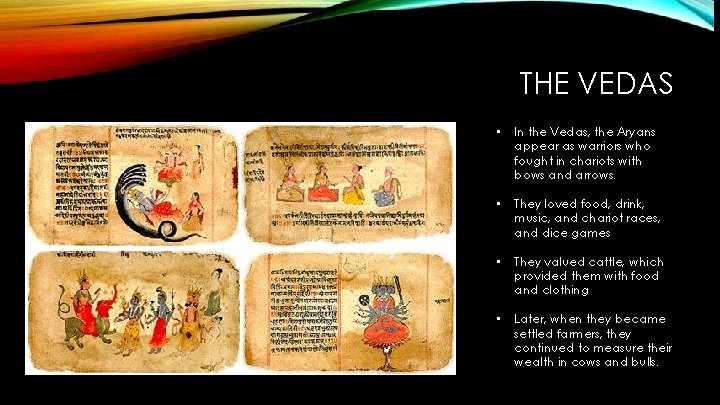
THE VEDAS • In the Vedas, the Aryans appear as warriors who fought in chariots with bows and arrows. • They loved food, drink, music, and chariot races, and dice games • They valued cattle, which provided them with food and clothing • Later, when they became settled farmers, they continued to measure their wealth in cows and bulls.
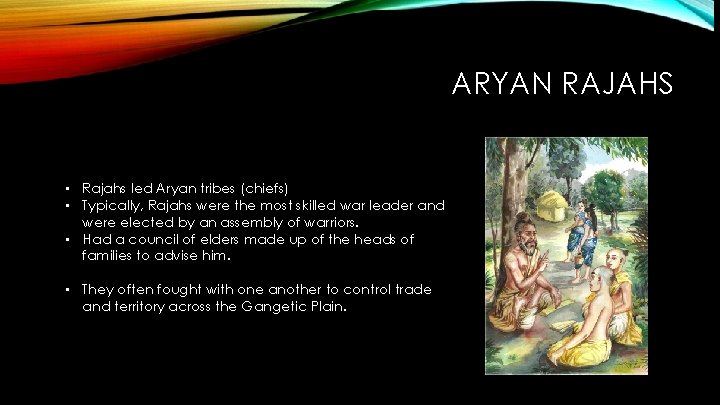
ARYAN RAJAHS • Rajahs led Aryan tribes (chiefs) • Typically, Rajahs were the most skilled war leader and were elected by an assembly of warriors. • Had a council of elders made up of the heads of families to advise him. • They often fought with one another to control trade and territory across the Gangetic Plain.
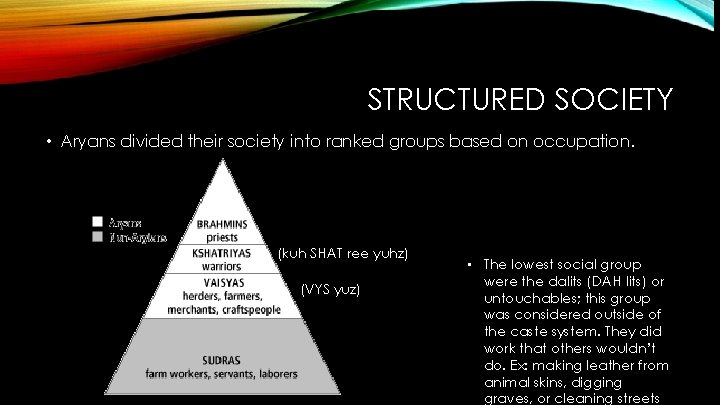
STRUCTURED SOCIETY • Aryans divided their society into ranked groups based on occupation. (kuh SHAT ree yuhz) (VYS yuz) • The lowest social group were the dalits (DAH lits) or untouchables; this group was considered outside of the caste system. They did work that others wouldn’t do. Ex: making leather from animal skins, digging graves, or cleaning streets
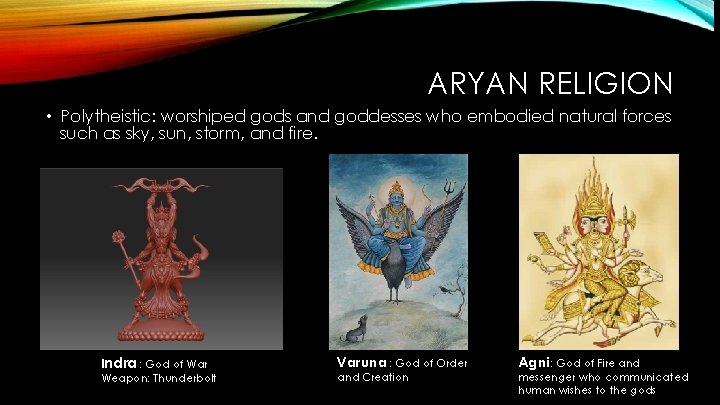
ARYAN RELIGION • Polytheistic: worshiped gods and goddesses who embodied natural forces such as sky, sun, storm, and fire. Indra : God of War Weapon: Thunderbolt Varuna : God of Order and Creation Agni : God of Fire and messenger who communicated human wishes to the gods
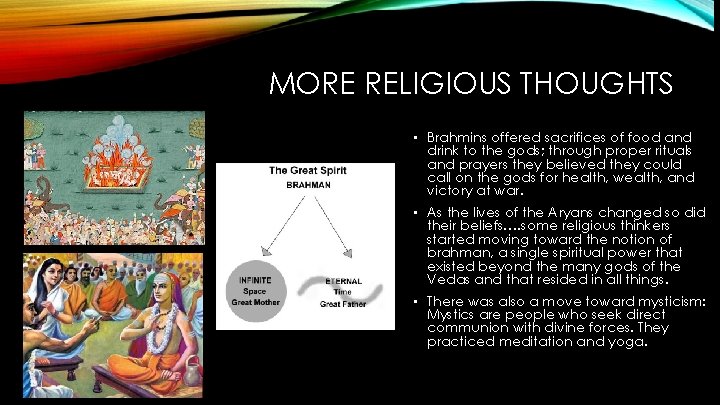
MORE RELIGIOUS THOUGHTS • Brahmins offered sacrifices of food and drink to the gods; through proper rituals and prayers they believed they could call on the gods for health, wealth, and victory at war. • As the lives of the Aryans changed so did their beliefs…. some religious thinkers started moving toward the notion of brahman, a single spiritual power that existed beyond the many gods of the Vedas and that resided in all things. • There was also a move toward mysticism: Mystics are people who seek direct communion with divine forces. They practiced meditation and yoga.
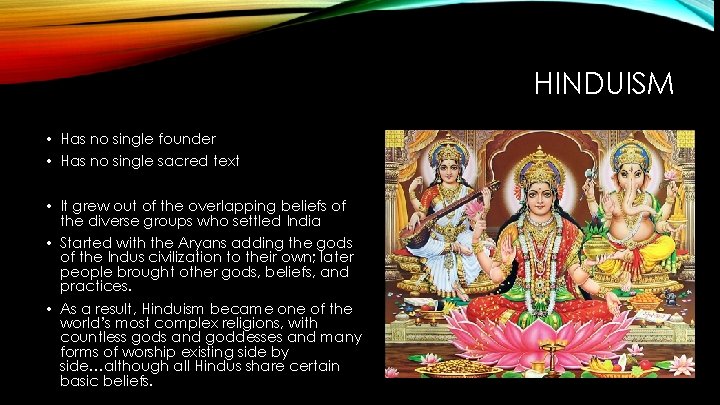
HINDUISM • Has no single founder • Has no single sacred text • It grew out of the overlapping beliefs of the diverse groups who settled India • Started with the Aryans adding the gods of the Indus civilization to their own; later people brought other gods, beliefs, and practices. • As a result, Hinduism became one of the world’s most complex religions, with countless gods and goddesses and many forms of worship existing side by side…although all Hindus share certain basic beliefs.
HINDU BELIEFS • Everything is part of the unchanging, all-powerful spiritual force called BRAHMAN • Worship a variety of gods who give concrete form to brahman • The most important Hindu gods are Brahma, the Creator; Vishnu, the Preserver; and Shiva, the Destroyer. Each can take many forms, human or animal, to represent the various aspects of brahman with which he is associated • Some Hindus worship various forms of the powerful goddess Shakti. She is both kind and cruel, a creator and a destroyer • Over many hundreds of years, Hindu teachings were recorded in the sacred texts of the Vedas *Upanishads (oo PAN ih shadz): are a section of the Vedas that address mystical questions related to Hinduism
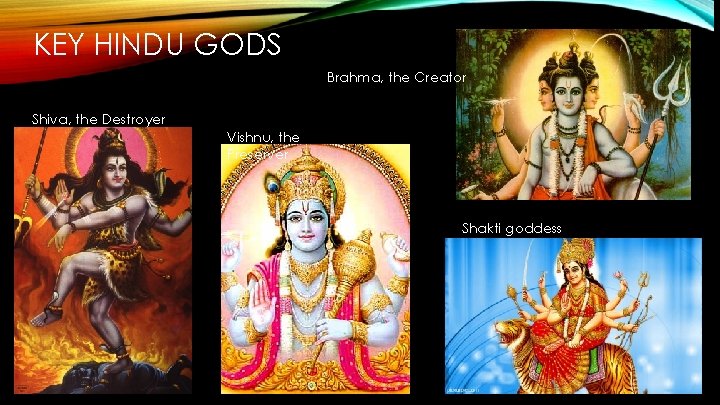
KEY HINDU GODS Brahma, the Creator Shiva, the Destroyer Vishnu, the Preserver Shakti goddess
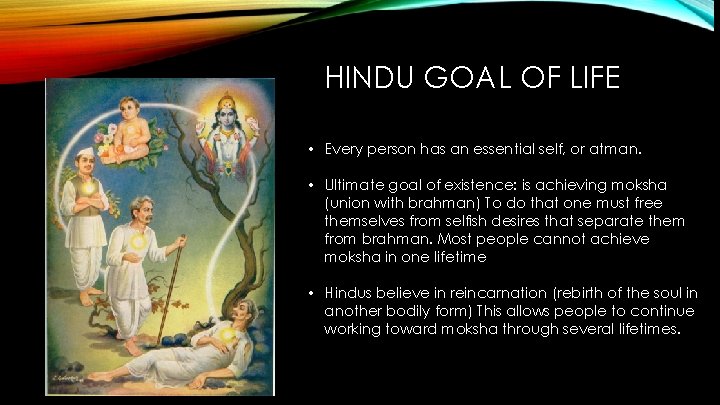
HINDU GOAL OF LIFE • Every person has an essential self, or atman. • Ultimate goal of existence: is achieving moksha (union with brahman) To do that one must free themselves from selfish desires that separate them from brahman. Most people cannot achieve moksha in one lifetime • Hindus believe in reincarnation (rebirth of the soul in another bodily form) This allows people to continue working toward moksha through several lifetimes.
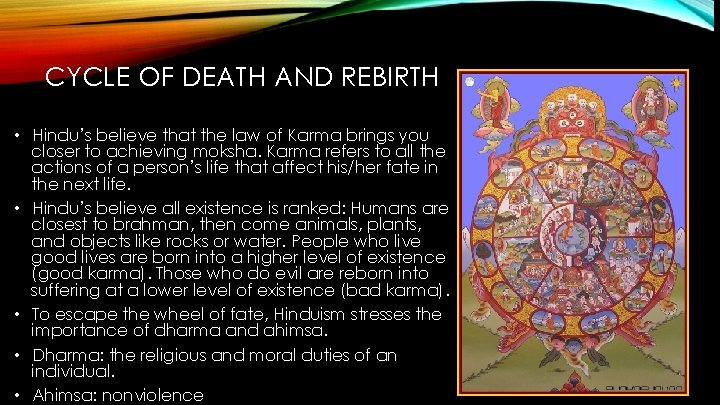
CYCLE OF DEATH AND REBIRTH • Hindu’s believe that the law of Karma brings you closer to achieving moksha. Karma refers to all the actions of a person’s life that affect his/her fate in the next life. • Hindu’s believe all existence is ranked: Humans are closest to brahman, then come animals, plants, and objects like rocks or water. People who live good lives are born into a higher level of existence (good karma). Those who do evil are reborn into suffering at a lower level of existence (bad karma). • To escape the wheel of fate, Hinduism stresses the importance of dharma and ahimsa. • Dharma: the religious and moral duties of an individual. • Ahimsa: nonviolence
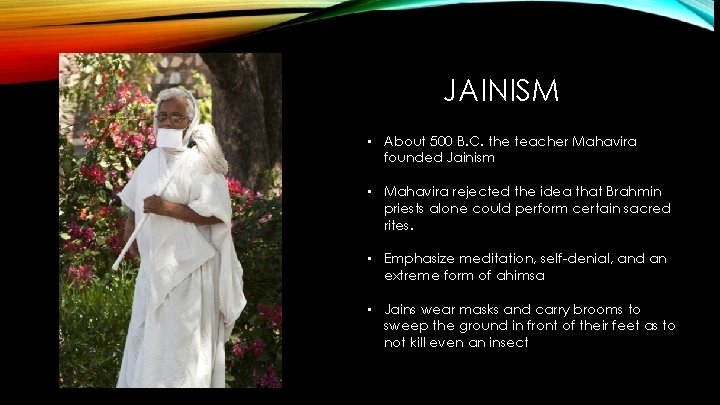
JAINISM • About 500 B. C. the teacher Mahavira founded Jainism • Mahavira rejected the idea that Brahmin priests alone could perform certain sacred rites. • Emphasize meditation, self-denial, and an extreme form of ahimsa • Jains wear masks and carry brooms to sweep the ground in front of their feet as to not kill even an insect
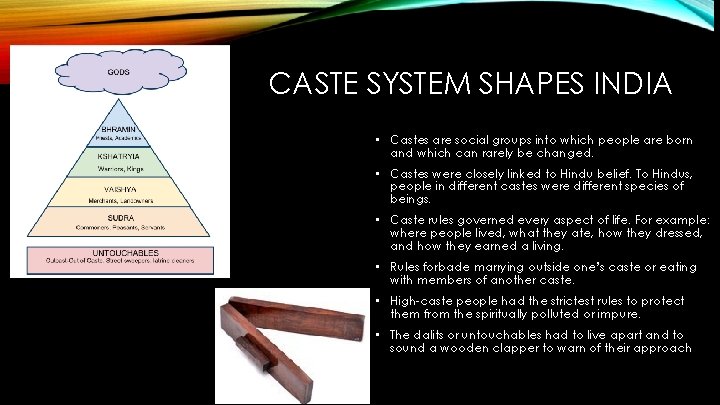
CASTE SYSTEM SHAPES INDIA • Castes are social groups into which people are born and which can rarely be changed. • Castes were closely linked to Hindu belief. To Hindus, people in different castes were different species of beings. • Caste rules governed every aspect of life. For example: where people lived, what they ate, how they dressed, and how they earned a living. • Rules forbade marrying outside one’s caste or eating with members of another caste. • High-caste people had the strictest rules to protect them from the spiritually polluted or impure. • The dalits or untouchables had to live apart and to sound a wooden clapper to warn of their approach
CASTES AFFECT THE SOCIAL ORDER • Despite its inequalities, castes ensured a stable social order • Law of karma determined their caste; could not change their status in this life, they could reach a higher state in a future life by faithfully fulfilling the duties of their present caste • Gave many people a sense of identity and interdependence • Each caste had its own occupations and leaders. Caste members cooperated to help one another • Although separated, different castes depended on one another for their basic needs • Over time, many additional castes and sub-castes evolved
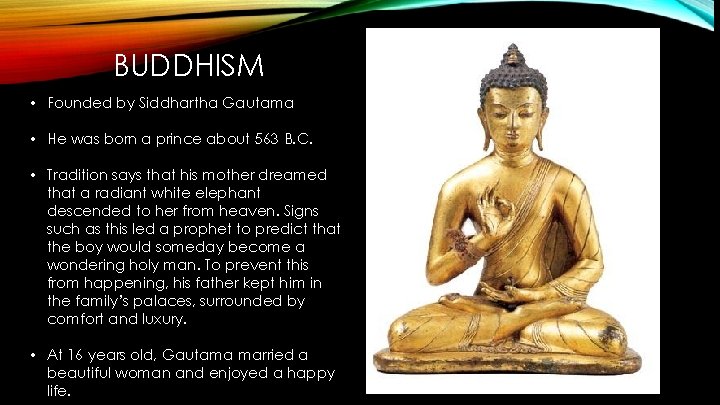
BUDDHISM • Founded by Siddhartha Gautama • He was born a prince about 563 B. C. • Tradition says that his mother dreamed that a radiant white elephant descended to her from heaven. Signs such as this led a prophet to predict that the boy would someday become a wondering holy man. To prevent this from happening, his father kept him in the family’s palaces, surrounded by comfort and luxury. • At 16 years old, Gautama married a beautiful woman and enjoyed a happy life.
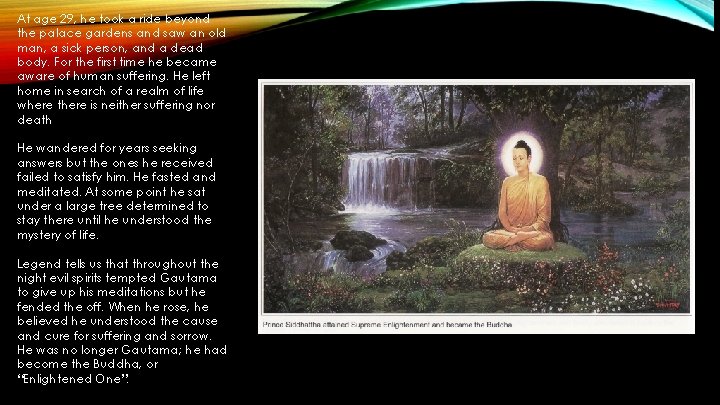
At age 29, he took a ride beyond the palace gardens and saw an old man, a sick person, and a dead body. For the first time he became aware of human suffering. He left home in search of a realm of life where there is neither suffering nor death He wandered for years seeking answers but the ones he received failed to satisfy him. He fasted and meditated. At some point he sat under a large tree determined to stay there until he understood the mystery of life. Legend tells us that throughout the night evil spirits tempted Gautama to give up his meditations but he fended the off. When he rose, he believed he understood the cause and cure for suffering and sorrow. He was no longer Gautama; he had become the Buddha, or “Enlightened One”.
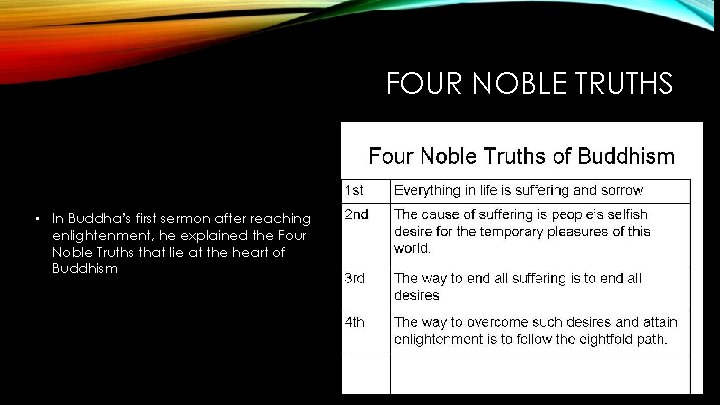
FOUR NOBLE TRUTHS • In Buddha’s first sermon after reaching enlightenment, he explained the Four Noble Truths that lie at the heart of Buddhism
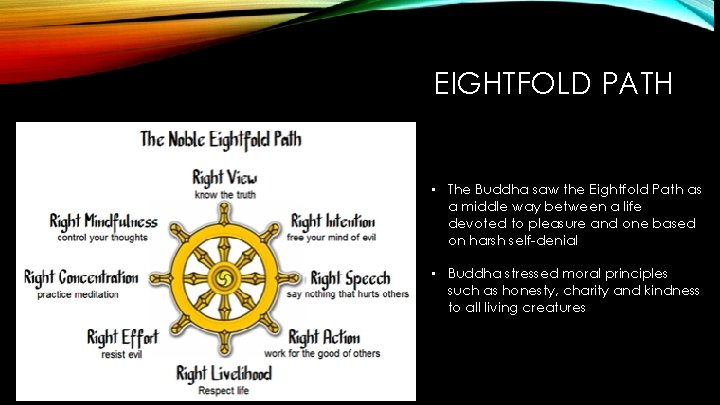
EIGHTFOLD PATH • The Buddha saw the Eightfold Path as a middle way between a life devoted to pleasure and one based on harsh self-denial • Buddha stressed moral principles such as honesty, charity and kindness to all living creatures
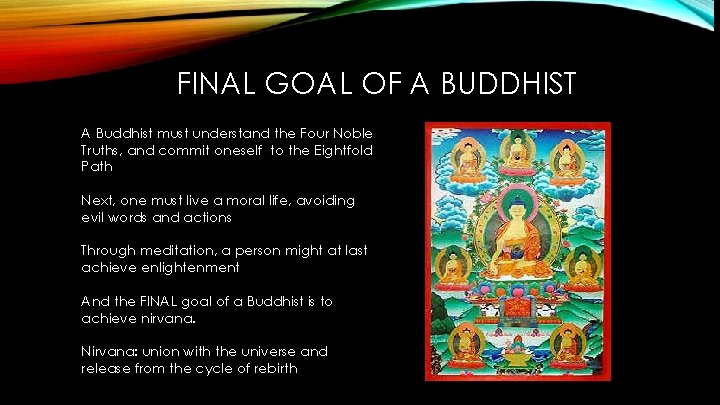
FINAL GOAL OF A BUDDHIST A Buddhist must understand the Four Noble Truths, and commit oneself to the Eightfold Path Next, one must live a moral life, avoiding evil words and actions Through meditation, a person might at last achieve enlightenment And the FINAL goal of a Buddhist is to achieve nirvana. Nirvana: union with the universe and release from the cycle of rebirth
COMPARING BUDDHISM AND HINDUISM Similarities • Grew from same traditions • Both stress nonviolence • Both believe in karma, dharma, and a cycle of rebirth Differences • Hinduism: focused on priests, formal rituals, and many gods • Buddhism: each person seeks enlightenment through meditation • Hinduism: use of caste system • Buddhism: rejected the use of caste system, offering the hope of nirvana to all regardless of birth
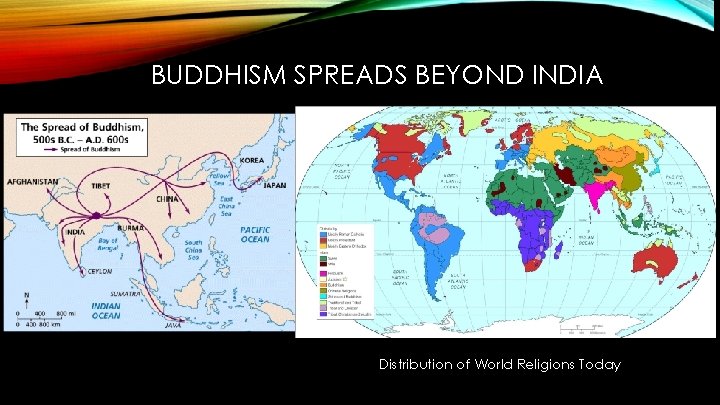
BUDDHISM SPREADS BEYOND INDIA Distribution of World Religions Today
- Slides: 21