
Hinduism A brief overview Name Hinduism Religion of
Hinduism A brief overview
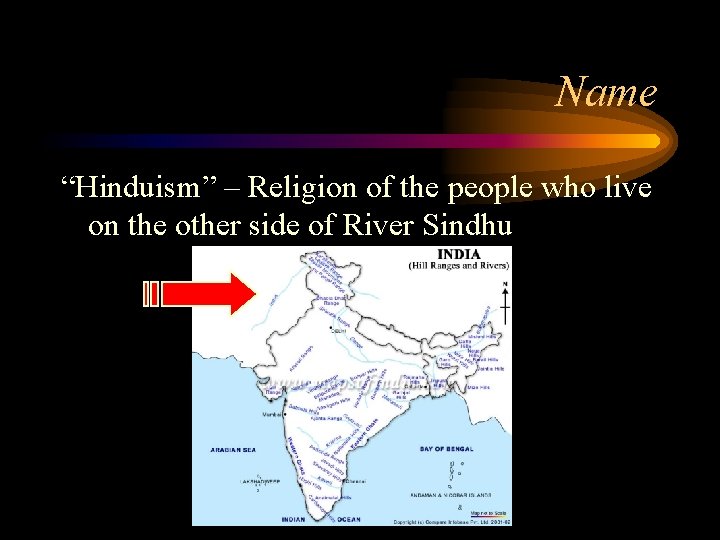
Name “Hinduism” – Religion of the people who live on the other side of River Sindhu
Real Name • Sanathana Dharma – Eternal and Universal Religion • • • Not based on any one doctrine Not based on any one person Not based on any one place Not based on any one time Based on spiritual experience and not against reason
Prasthana Thraya 1. Upanishads – – Essence of the Vedas Records of experiences of rishis 2. Brahma Sutras – Systematic logical presentation of philosophy 3. Bhagavad Gita – • • Methods of application in everyday life Open to ever increasing array of saints Open to ever increasing collection of books
Basic Principles What are the principles of Hinduism? 1. God has manifested as this world. 2. Aim of life is to realize God, and serve the world as a manifestation of God. 3. “As many minds, so many paths. ”
Concept of God Basic qualities – Exists – Core of all existence - Asti – Is knowable – Core of all knowledge - Bhati – Is lovable – Core of all bliss - Priyam Sat – Chit – Ananda Existence – Consciousness – Bliss
Aim of Life Ultimatum of all human pursuits – Urge to exist – Urge to know – Urge to be happy Sat – Chit – Ananda Existence – Consciousness – Bliss
Aim of Life • To be PERFECT • Free from psychological complexes – Lust, greed, ego, anger, jealousy, delusion • Sees things in their true color free from bias and prejudice • Not perturbed or carried away by any situation • “Realize the infinitude and independence of the real Self”
Approaches to God • • Formless, free from qualities Formless, with qualities Natural phenomenon Abstract form Deity with a human form Incarnation of God in everything and everyone
Major Paths • Karma Yoga – Work • Yagna, Daana, Tapasya • Raja Yoga – Concentration • Yama, Niyama, … • Bhakti Yoga – Love • Father, mother, son, daughter, friend, master, … • Jnana Yoga – Intellect • Neti-neti, Koham
Significance of Idol Worship • Story of Swami Vivekananda and the Maharaja of Khetri • God is Omniscient. Don’t limit God • God with form and God without form – Ice and water in the ocean • God appears to man in his own form • Symbology of traditional forms
Why is there misery in the world? • Aim of life is not pleasure; Aim of life is wisdom. • World is a gymnasium for souls to evolve. • Opportunities are given to people to remove their defects and grow. • This is possible only in a world with a mixture of joy and sorrow.
Doctrine of Karma • • Cause and effect principle “As you sow, so you reap. ” Physical and mental actions are causes Reflectivity of action – What you do is assumed to be what you want to be done to you.
Concept of Heaven and Hell • • Not a permanent place A place to experience the fruit of action Have to return back to this world of action Personal development and eventual freedom is possible only from here. • Heaven and hell are both places where you would not want to be. – Mere waste of time
Virtues to Remember Yama • Ahimsa • Satya • Asteya • Brahmacharya • Aprigraha Niyama • Shaucha • Santosha • Tapah • Svadhyaya • Ishwara Pranidhana

Questions

More questions? • http: //www. geocities. com/gokulmuthu/faq. html • gokulmuthu@yahoo. com
- Slides: 17